

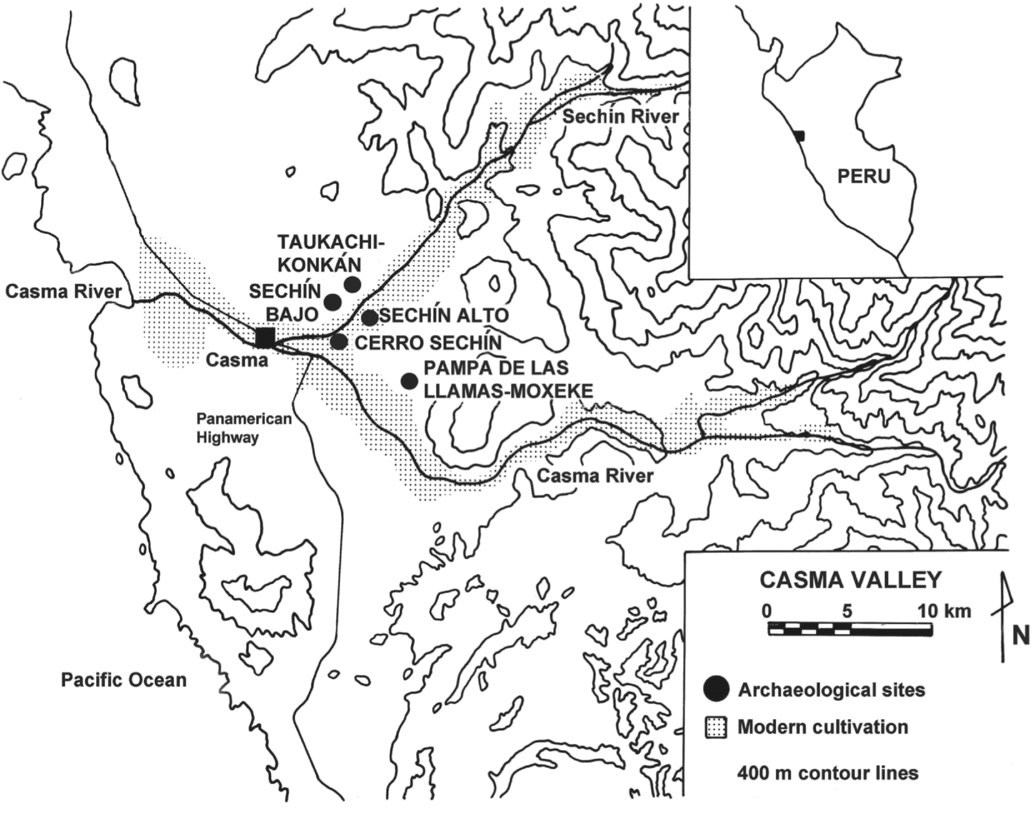
The Casma Valley on the north-central coast of Peru is well known archaeologically because of early cultural developments there during the Late Preceramic (Fuchs et al. Reference Fuchs, Patzschke, Yenque and Briceño2009; T. Pozorski and S. Pozorski Reference Pozorski and Pozorski1990), Initial period (Fuchs et al. Reference Fuchs, Patzschke, Schmitz, Yenque and Briceño2006; S. Pozorski and T. Pozorski Reference Pozorski, Pozorski and Kaulicke1998, Reference Pozorski, Pozorski, Giersz and Ghezzi2011a), and Early Horizon (Ghezzi and Ruggles Reference Ghezzi and Ruggles2006, Reference Ghezzi, Ruggles, Giersz and Ghezzi2011; S. Pozorski and T. Pozorski Reference Pozorski and Pozorski1987:51–70, 86–103). The Initial period (2100–1000 cal BC) was an especially dynamic time characterized by the construction of carefully planned cities dominated by large platform mounds that established site axes and orientations for most of the larger structures at each site (S. Pozorski and T. Pozorski Reference Pozorski and Pozorski1989, Reference Pozorski and Pozorski1994a, Reference Pozorski, Pozorski and Locock1994b, Reference Pozorski, Pozorski and Kaulicke1998). We used data from these three large sites plus over half a dozen smaller sites to define the Sechín Alto polity based on shared architectural forms, orientation, and artifacts (S. Pozorski and T. Pozorski Reference Pozorski, Pozorski, Giersz and Ghezzi2011a; T. Pozorski and S. Pozorski Reference Pozorski and Pozorski2005, Reference Pozorski, Pozorski, Burger and Rosenwig2012). Within the northern, Sechín branch of the Casma Valley, we grouped four contemporary sites into the Sechín Alto Complex based on proximity and consistent orientations of E32oN (S. Pozorski and T. Pozorski Reference Pozorski and Pozorski1987:82; Pozorski and Pozorski Reference Pozorski and Pozorski1992). The Sechín Alto Complex is dominated by the Sechín Alto site, which contained the largest platform mound in the New World during the Initial period, as well as the sites of Taukachi-Konkán, Sechín Bajo, and Cerro Sechín (Figure 1; S. Pozorski and T. Pozorski Reference Pozorski and Pozorski2012).
Map of Casma Valley showing the locations of Initial period sites of the Sechín Alto Polity. Map by S. Pozorski.
Previous Fieldwork at Taukachi-Konkán
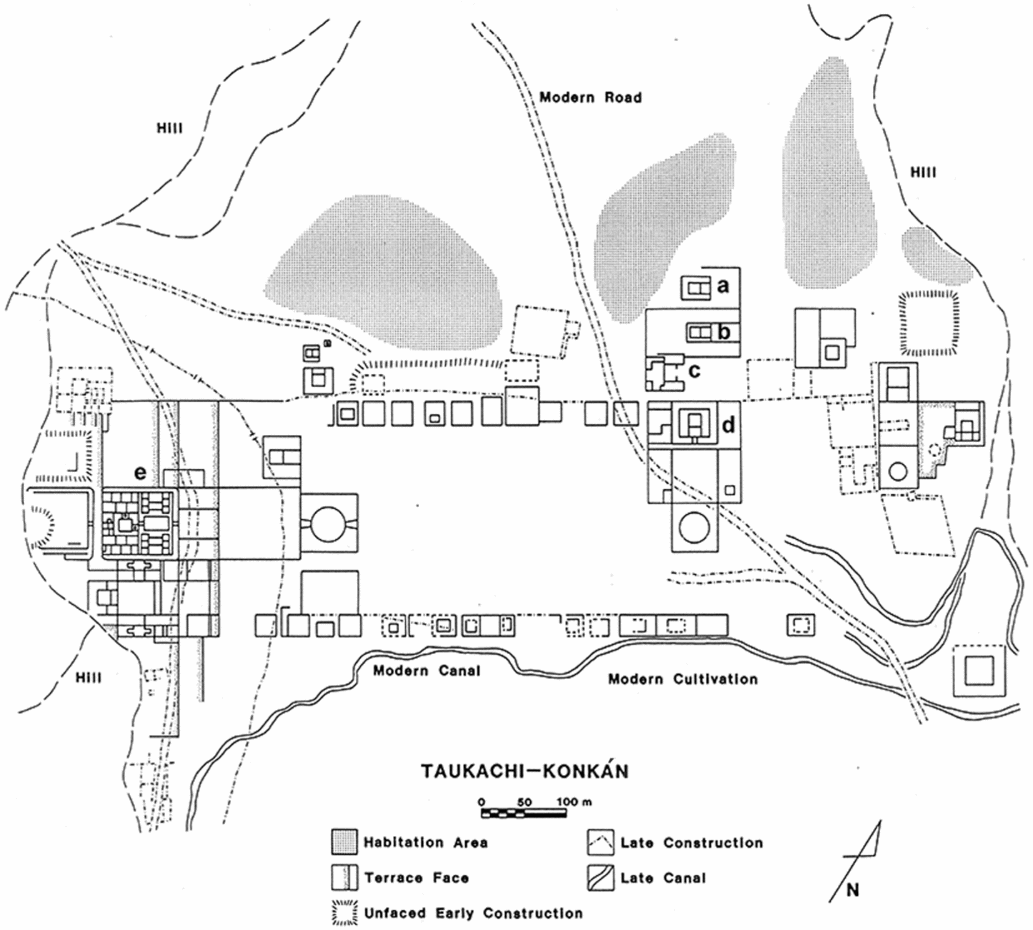
Taukachi-Konkán, the second-largest site within the Sechín Alto Complex, lies slightly northwest of the Sechín Alto site on an expanse of plain bordered by Cerro Taukachi on the west and Cerro Konkán on the east. Based on early site surveys of the area, clusters of platform mounds and associated plazas on either edge of the plain were initially treated as two separate sites (Thompson Reference Thompson1961:211–217). Subsequent examination of air photographs and surface evidence revealed connected and associated architectural features forming a single large site that spans the pampa (Fung and Williams Reference Fung and Williams1977:116–118) and occupies an area of about 1,250 by 500 m (Figure 2; S. Pozorski and T. Pozorski Reference Pozorski and Pozorski1987:75). The principal platform mound of Taukachi-Konkán lies near Cerro Taukachi on the west where the sloping cerro base enhances its height. Associated intermediate-sized structures lie near this main mound and extend out in rows along the edges of the site. At the far eastern end of the pampa is an unfinished platform mound near a group of joined mounds. Along the north edge of the site and near its east end, a group of four mounds stands out because three members of the group are not oriented toward the central site axis, probably because they once faced a road (Figure 2a–d). Taukachi-Konkán was seriously impacted by a Late Intermediate period (AD 1000–1470) Casma-culture occupation of the same pampa. The construction of late walls, roads, and compounds greatly altered the configuration of numerous Initial period buildings at the site, which also suffered because their facing stones were robbed for reuse in later constructions (S. Pozorski and T. Pozorski Reference Pozorski and Pozorski1987:77; S. Pozorski and T. Pozorski Reference Pozorski and Pozorski2012).
Map of the Initial period site of Taukachi-Konkán showing the locations of (a–b, d) intermediate-sized platform mounds and (c) the sunken court excavated in 2015 and 2016, as well as (e) the Mound of the Columns excavated in 1992–1994. Map by S. Pozorski.
We first excavated at Taukachi-Konkán for three field seasons in 1992–1994, concentrating on the western part of the site, especially the principal mound and surrounding structures. We exposed much of the surface of the main mound, now known as the Mound of the Columns (Figure 2e) because the front half of the mound probably had a roof supported by over 100 round columns. We argued that the structure served as a palace or royal residence for Sechín Alto polity nobility based on the presence of audience areas and high-status storage areas as well as a less accessible asymmetrical area at the rear of the mound that had a residential function (T. Pozorski and S. Pozorski Reference Pozorski and Pozorski1997, Reference Pozorski and Pozorski2000, Reference Pozorski, Pozorski, Burger and Rosenwig2012). These data from Taukachi-Konkán were critical to our arguments that the strength and cohesion of the Sechín Alto polity depended on interrelationships among sites containing large platform mounds with varied and complementary functions (S. Pozorski and T. Pozorski Reference Pozorski, Pozorski, Silverman and Isbell2008).
Ceramic collections found associated with the Mound of the Columns are dominated by neckless ollas decorated with large punctations along the shoulders of these vessels. These ceramics are essentially identical to those found at other Sechín Alto polity sites such as Pampa de las Llamas-Moxeke (S. Pozorski and T. Pozorski Reference Pozorski and Pozorski1987:38–39) and Sechín Alto (T. Pozorski and S. Pozorski Reference Pozorski and Pozorski2005:147). Nine radiocarbon dates obtained from cane and wood samples taken mostly from column holes and pilasters demonstrate that the Mound of the Columns was constructed and used between 1500 and 1300 cal BC (Table 1).
Radiocarbon Dates from Taukachi–Konkán.

a Calendar years calibrated at 2σ using SHCAL13.
Recent Excavations at Taukachi-Konkán
We returned to the site of Taukachi-Konkán in 2015 to further explore the eastern zone of the site where we had opened only one excavation in 1993. Much of the site remains to be explored through excavation, and there is an urgency to this fieldwork because of increasingly aggressive efforts to cultivate Taukachi-Konkán despite its clearly proclaimed status as a protected archaeological zone. We just completed our 2016 season, and the plain north of the central site, which contained middens and remains of residential structures, is now under cultivation by means of a small underground pipeline connected to a well pump. Furthermore, the projected path of an intervalley canal to bring water from a larger river farther north cuts Taukachi-Konkán in half.
We began our 2015 excavations by testing six large- to intermediate-sized platform mounds and selecting three of the four well-preserved structures along the north edge of the site for further clearing. The tallest and most southern of the four structures (Figure 2d) had remains of round columns and a special modular room at its center that we have defined as a square-room unit (S. Pozorski and T. Pozorski Reference Pozorski and Pozorski2011b). Square-room–unit architecture has been excavated at all major Sechín Alto polity sites where it consistently occurs in prominent, often central, locations. We have argued that this room form, with its rounded exterior corners, round or square interior corners, high wall niches, raised thresholds, and entrances restricted by pilasters and wooden bar-closure mechanisms is a key architectural form emblematic of Sechín Alto polity administration. Associated ceramics from this tall mound are similar to examples recovered from the Mound of the Columns, and three radiocarbon dates on wood from pilasters within this room date the structure between 1500 and 1400 cal BC (Table 1). The third structure from the south in the sequence (Figure 2b) also has a square-room unit at its center, further illustrating the connection between the eastern platform mounds and the western part of Taukachi-Konkán and with the Sechín Alto polity in general. In 2016, we excavated the summit of the most northern aligned structure (Figure 2a) where we found a third square-room–unit type room that was unusual because it contained two rows of small rectangular columns, a column shape more typical of later sites.
The last structure we tested in 2015 was the second building from the south in the row of aligned structures (Figure 2c). In contrast to the form of the other three, which consist of relatively tall platform mounds capped by square-room units, the second structure consists of a lower, more rectangular mound with clear wings that project toward the east and form the north and south walls of a sunken court in front of the mound (Figure 3). This mound and its wings form a U shape, a configuration that is commonly seen in intermediate-sized mounds at many Casma Valley Initial period sites, as well as at large Initial period mound sites on the north and central coasts.
View from the southeast of the U-shaped mound showing excavations of the north wall of the sunken court. Photograph by T. Pozorski.

We started excavating along the north wall of the sunken court where the wing wall was relatively clear, and almost immediately we found remains of a large frieze. We continued excavating this sunken structure in 2016 and were able to clarify architectural details of the sunken court and clear more friezes on the west, south, and east walls (Figure 4). We also discovered that the sunken court measures 17.75 m north-south by 19.5 m east-west and has two entrances. A narrow staircase near the northwest corner of the court ascends 1.75 m to the mound summit near its north end. This access pattern is very different from the wide, central staircases that typically provide access to Sechín Alto polity platform mounds both large and small. A second, wider staircase, located in the center of the east wall, ascends some 1.25 cm out of the sunken court on to an open, flat plaza. A low bench, 18 cm tall, extends out 4 m from all four interior walls of the sunken court. The court is oriented E21oN, an orientation significantly different from the general Taukachi-Konkán site orientation of E32oN. This difference in orientation may reflect deliberate alignment with a topographical feature or celestial phenomenon or body that was connected with rituals that took place within the sunken court.
Plan of the sunken court with friezes. Plan by S. Pozorski.

No radiocarbon dates are available for the sunken court or its associated mound; nevertheless, artifacts found within the sunken court coincide with artifact inventories from other Initial period sites within the Casma Valley. As is typically the case for large Initial period formal architecture (Burger and Salazar-Burger Reference Burger and Salazar-Burger1998:30–32), the sunken court floor is very clean, with little artifactual evidence. Nevertheless, two artifacts, a fragmentary jet mirror and a worked bone pendant found on the court floor, were likely connected with ceremonies that once took place there. Additional typical Sechín Alto polity artifacts recovered from compact wall fall debris include a few Pampa Llamas–type ceramics with large punctations, a stone bowl rim, three stones with red pigment, cut bird-bone tube fragments, and a shell bangle.
Taukachi-Konkán Friezes
The first frieze we excavated is on the north side of the sunken court where the court wall is at its tallest due to protection by deep sandy deposits. The plastered wall surface bearing the frieze is preserved to a maximum height of 1.46 m above the floor, and consequently this frieze is more than three-quarters complete. The degree of surface weathering indicates that all the friezes remained exposed long enough to erode away any trace of color, leaving only white, which may have been a base coat. Better preserved friezes and frieze fragments within Casma and nearby valleys are polychrome, and the examples from Taukachi-Konkán were likely also once brightly colored. Despite the lack of preserved color, the frieze content is clear: two large sea lions are facing each other (Figure 5). Each is 4.45 m long, and the space between them is 2.22 m. Details of the face, mouth, ears, whiskers, and flippers support the sea lion identification. Close examination reveals that the sea lions are swimming in a position that shows a front view of their stomachs while their heads are in profile. The depictions are generally naturalistic except for a flap-like design on the stomach that borders a square design with rounded corners that has four rectangles attached to its edges and a square at its center.
The frieze on the north wall depicts a pair of sea lions: (a) photograph, (b) drawing of unreconstructed frieze, and (c) drawing of suggested reconstruction. Photograph by T. Pozorski; drawings by S. Pozorski.
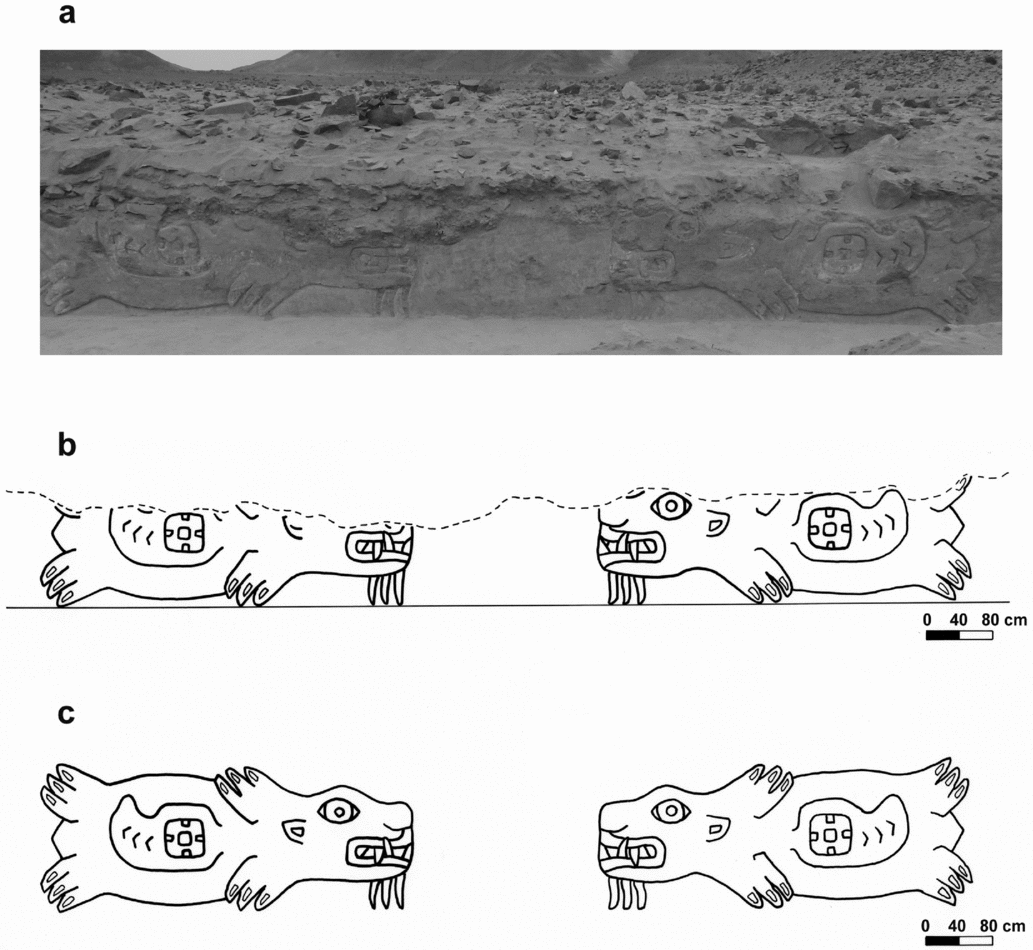
A much smaller, but very similar, depiction of a sea lion was recorded as part of a painted frieze on a wall believed to pertain to one of the earliest construction phases at the site of Punkurí in the Nepeña Valley north of Casma. Its color was described as “bottle green” or “dark green” (Museo de Arqueología y Antropología de San Marcos 2005a:104). The sea lion there forms part of a composition believed to represent a being lying on its side accompanied by animals, including a monkey and a possible opossum. The Nepeña sea lion is only about 45 cm long, and it has a simple circle design on its stomach (Bischof Reference Bischof and Fux2015:143, Figure 82; Museo de Arqueología y Antropología de San Marcos 2005a:103–104; Samaniego Reference Samaniego, Giersz and Ghezzi2011:80–85, Figures 9 and 10). At the Initial period site of Cardal on the central coast, sea lions may have symbolized power and possible connections with the ocean. At the main mound of the site, a group of 16 individuals were found buried in the floor of the atrium. One adult male was distinguished from the other burials because he wore a necklace of sea lion incisors (Burger Reference Burger1992:74).
We first recognized the design on the stomach flap within Initial period Sechín Alto polity iconography at the site of Pampa de las Llamas-Moxeke in the Sechín branch of the Casma Valley, where it forms part of a frieze dominated by immense felines (S. Pozorski and T. Pozorski Reference Pozorski and Pozorski1986, Reference Pozorski and Pozorski1994a). We subsequently argued that this design is a power symbol that tangibly represents the square-room–unit architectural form and the administrative authority behind it within polity iconography (Pozorski and Pozorski Reference Pozorski and Pozorski2011b). This “power symbol” is also present at Cerro Sechín in the Sechín Alto Complex, where it occurs on the clubs or staffs of most warrior figures (Samaniego and Cardenas Reference Samaniego, Cardenas, Samaniego and Cardenas1995:Fichas 4, 39, 76, 87, 111, 124, 137, 150, 163, 175, 196, 261, 279, 293, and 303; Tello Reference Tello1956:146–228) and at Sechín Bajo in the Sechín Alto Complex, where it forms part of Initial period graffiti (Fuchs and Patzschke Reference Fuchs, Patzschke and Peter2015:Figure 46; Fuchs et al. Reference Fuchs, Patzschke, Schmitz, Yenque and Briceño2006:Figure 13). A stone mortar fragment from the Casma Valley exhibits a design (Bischof Reference Bischof, Conklin and Quilter2008:Figure 4.20c; León Reference León, Samaniego and Cardenas1995:Figures 2 and 4; Pozorski and Pozorski Reference Pozorski, Pozorski, Manzanilla and Rothman2016:Figure 5.11) that pairs a power symbol with one-half of a face that shares traits with Cerro Sechín warrior images (Samaniego and Cardenas Reference Samaniego, Cardenas, Samaniego and Cardenas1995:Fichas 4, 13, 25, 39,47 56, 67, 76, 87, 99, 111, 124, 137, 150, 163, 175, 196, 213, 234, and 261) and with one of the faces adorning the Moxeke mound (Tello Reference Tello1956:Figure 31).
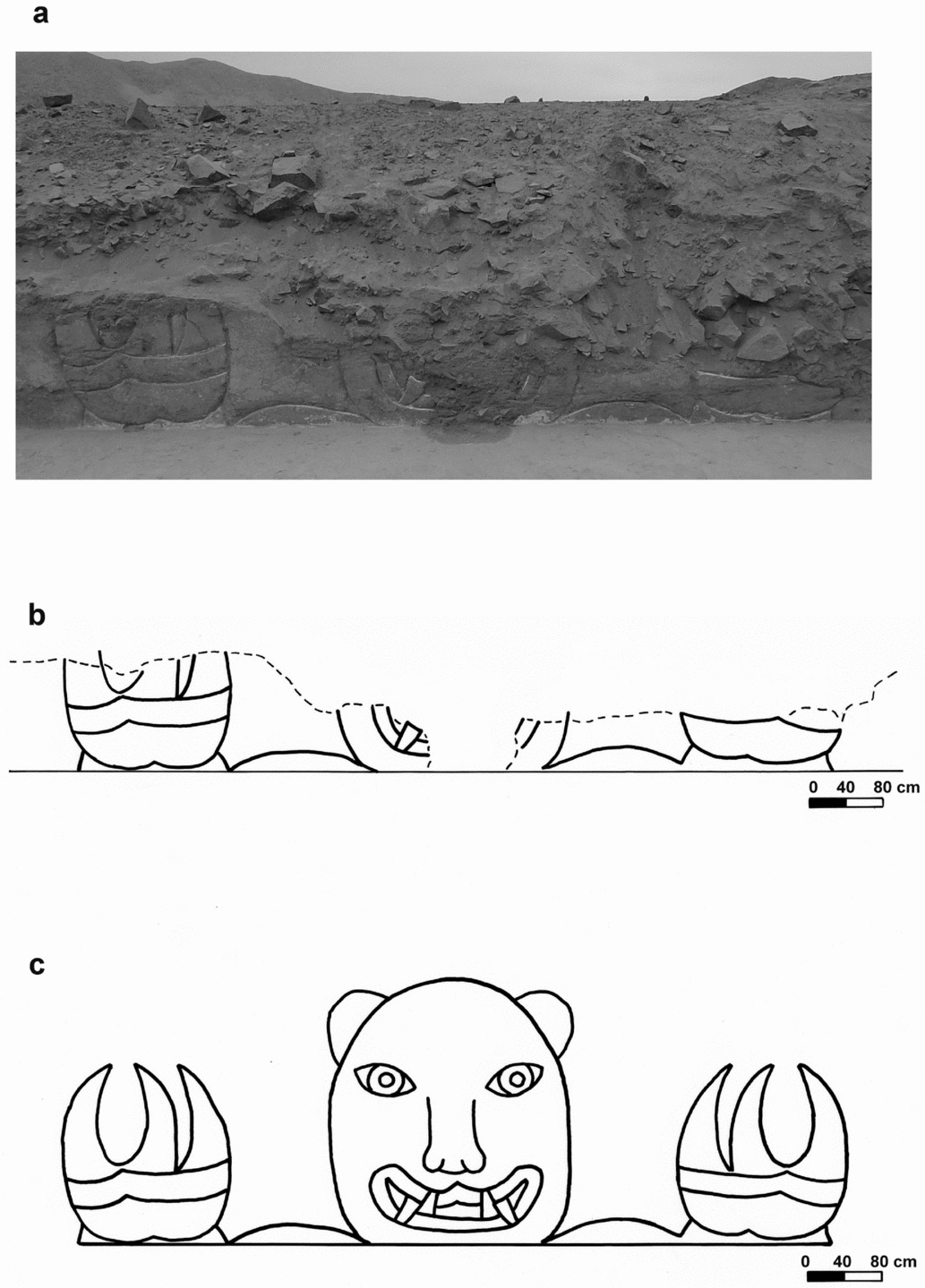
The frieze surface on the western wall is preserved to a maximum height of 1.34 m. This frieze surface is centrally placed on the western wall. The only entrance leading up to the mound is located north of the frieze near the northwest corner of the sunken court. The central portion was damaged by modern tree roots; however, enough remains to suggest a tentative reconstruction. In the center, part of a mouth with fangs is preserved, suggesting a central face, probably a feline (Figure 6). We were puzzled by the frieze fragments on either side of the face until Rosa Marín Jave suggested they represent raised paws. While there are many creatures in early Andean iconography that may be represented with fangs and clawed feet (e.g., birds, felines, bats, hybrid beings), we were able to use known early iconography, especially in the Casma and Nepeña valleys, to more fully interpret and reconstruct the frieze content. The fanged mouth is typical of felines, most notably the full-round feline sculpture at Punkurí in the Nepeña Valley (Bischof Reference Bischof and Fux2015:Figure 81; Museo de Arqueología y Antropología de San Marcos 1005a:86–87; Samaniego Reference Samaniego, Giersz and Ghezzi2011), and is also seen in slightly later Early Horizon iconography (Fux Reference Fux and Peter2015:Figure 12). The three-toed paw with an opposable digit, a key element in our iconographic reconstruction, replicates paws depicted on the painted feline located on the innermost Cerro Sechín structure (Fuchs and Patzschke Reference Fuchs, Patzschke and Peter2015:Figure 47; Samaniego Reference Samaniego, Samaniego and Cardenas1995:Figure 1; Tello Reference Tello1956:251–252), on a feline-like stone sculpture from Mesapatac in the upper Casma Valley (Bischof Reference Bischof and Fux2015:Figure 86; Suárez Ubillus Reference Suárez Ubillus2010), and on a stone carving from Chavín de Huantar (Bischof Reference Bischof and Fux2015:Figure 98b). Based on these comparisons, we feel confident about our reconstruction of the west frieze as the upper body of a feline with raised paws, a stance depicted in the Punkurí feline sculpture.
The frieze on the west wall is interpreted as the face and front paws of a feline: (a) photograph, (b) drawing of unreconstructed frieze, and (c) drawing of suggested reconstruction. Photograph by T. Pozorski; drawings by S. Pozorski.
Recognition of the feline theme of the west frieze enabled us to reconstruct part of the subject matter of the east frieze (Figure 7). The frieze segments there are preserved to a maximum height of 74 cm, and they are separated by the central staircase that rises up out of the sunken court. On either side of the staircase, remnants of probable paws are present, and based on similarities with the west frieze and early iconography, we believe these represent the hind limbs of the feline depicted on the west wall. Other parts of the east frieze are puzzling because there is a clear depiction of a human foot near the left paw. This foot is modeled in detail, including evidence of the big toenail, and this detail and the arrangement of the toes makes it similar to feet excavated by Tello at Cerro Blanco in the 1930s (Museo de Arqueología y Antropología de San Marcos 2005b:149–150).
The frieze on the east wall is partially interpreted as the rear paws of a feline: (a) photograph, (b) drawing of the unreconstructed frieze, and (c) drawing of suggested partial reconstruction. Photograph by T. Pozorski; drawings by S. Pozorski.

The frieze on the south wall is preserved to a maximum height of 86 cm, and it is clear that this frieze (Figure 8) is very different from the sea lions on the opposing north wall. The north and south friezes do share similarities, however, because the designs depicted on the south are similar in size and spacing; they are also mirror images of each other, like the sea lions. The south friezes have proved much more difficult to interpret. A possible bird figure is suggested by the better-preserved left frieze because of what appears to be a long neck with an upward-looking head at its right end while other parts of this frieze may be feathers or feet. A similar upward-looking figure with avian traits occurs on a stone cup or mortar reported to be from Limoncarro, an early site in the Jequetepeque Valley (Benson Reference Benson1972:Figure 1–3; Bischof Reference Bischof1994:Figure 19d; Lapiner Reference Lapiner1976:Figures 117 and 118; Suárez Ubillus Reference Suárez Ubillus2010).
The frieze on the south wall may represent an upward-looking bird: (a) photograph and (b) drawing of unreconstructed frieze. Photograph by T. Pozorski; drawing by S. Pozorski.

Comparisons and Conclusions
Our attempt to interpret the content of the friezes must be speculative because there are so few examples of Initial period iconography and because much of the portable art lacks reliable context. Furthermore, these friezes are over 3,000 years old, making connections with later cultures and ethnohistorical sources tenuous at best. Despite these limitations, we believe that by considering both the context and the content of the friezes, we can gain insights into Initial period cosmology.
The sunken court at Taukachi-Konkán with friezes on all four interior walls is both consistent with the tenets of polity architecture and unique within the Sechín Alto polity and within the body of known Initial period iconography. Its near-square form with rounded corners and the presence of a wide bench are traits common to square-room units, and both entrances are narrowed by pilasters, also a common Sechín Alto polity trait. Despite this consistency, there are significant differences that make this sunken court special. Clearly, the sunken court was planned and constructed in a manner that best displays the friezes and gives them added meaning through their context. The paramount importance of the friezes is evident in the location of the west entrance that ascends to the mound summit. It was constructed well to the side so that the frieze of the face and paws of the feline, the principal figure, could be centered on the front of this mound. Even though they are distinct friezes, the paired mirror images on the north and south walls form a symmetrical complement to feline frieze components that are at the west and east ends of the court. The contrasting locations of the west entrance in the northwest corner and the east entrance, which is centered in the east wall, clearly indicates that the centered east entrance was for arriving visitors while the northwest entrance allowed hosts and/or religious practitioners access to the sunken court from the mound at its west end.
It is also significant that the court is relatively small and sunken over a meter below the surrounding ground surface and even deeper below the summits of the wings and principal mound. This suggests that the court and its friezes were accessible to relatively few individuals who entered the court by descending to a lower level. Such restricted accessibility is in marked contrast to the situation at other Sechín Alto polity sites with friezes. Moxeke, one of the two largest platform mounds at Pampa de las Llamas-Moxeke, is believed to have served as a religious structure or temple (Pozorski and Pozorski Reference Pozorski and Pozorski1997). At Moxeke, immense, full-figure beings that once stood at least 4 m tall and huge heads over 2 m wide fill niches on the front and rounded corners of the mound (Tello Reference Tello1956:60–64, Láminas IVG and V). These friezes were positioned some 15 m above the local ground surface, making them readily visible, and the large open plazas immediately in front of Moxeke could have held an audience of thousands. Additional friezes cover the back walls of the north and south atria of Huaca A (Pozorski and Pozorski Reference Pozorski and Pozorski1986, Reference Pozorski, Pozorski, Millones and Onuki1993, Reference Pozorski and Pozorski2011b; T. Pozorski and S. Pozorski 1994), the other large platform mound at Pampa de las Llamas-Moxeke, which we have interpreted as a large storage structure (Burger Reference Burger1992:83; Pozorski and Pozorski Reference Pozorski and Pozorski1997). We have argued that the north frieze represents a pair of jaguars while the south frieze is too poorly preserved to interpret. The Huaca A friezes would have been less public because of their recessed location, but their position on the facade of the tallest part of the mound probably made them at least partly visible from the plazas to the north and south of the mound. Access to the summit square-room units of Huaca A was severely restricted by a system of gates and wooden bar-closure mechanisms, and the atria decorated by the friezes are relatively small, so it is likely that few individuals actually spent time in close proximity to the friezes.
All component sites of the Sechín Alto Complex also have evidence of friezes. At Cerro Sechín, a succession of superimposed, round-cornered structures with decorated facades forms the core of the site. The innermost room has a pair of painted felines facing each other across the entrance (Samaniego Reference Samaniego, Samaniego and Cardenas1995; Samaniego et al. Reference Samaniego, Vergara, Bischof and Donnan1985; Tello Reference Tello1956:251–252); the second structure has friezes, including prominent fish motifs (Samaniego Reference Samaniego, Samaniego and Cardenas1995; Samaniego et al. Reference Samaniego, Vergara, Bischof and Donnan1985); and the outermost structure has the stone carvings of warriors and victims for which the site is especially well known (Samaniego and Cardenas Reference Samaniego, Cardenas, Samaniego and Cardenas1995; Tello Reference Tello1956:146–228). At Sechín Bajo, anthropomorphic friezes described as religious figures related to ritual activities adorn both sides of the atrium associated with the main central room of the mound, which is also a square-room unit (Fuchs et al. Reference Fuchs, Patzschke, Yenque and Briceño2009).
The Sechín Alto site, capital of the polity of the same name, contained the largest structure in the New World during Initial period times. Friezes were present on the summit of this immense platform mound that measures 250 m by 300 m in area and once stood over 35 m tall. Known friezes associated with the penultimate major Initial period construction phase decorated rows of columns that lined the long edges of a platform made of cone-shaped adobes that forms the center of the mound (Pozorski and Pozorski Reference Pozorski and Pozorski2005, Reference Pozorski, Pozorski, Giersz and Ghezzi2011a). When it was initially constructed, this platform was the tallest part of the mound, towering some 9 m above the surrounding mound summit. About 500 BC, the columns with friezes were almost totally destroyed, leaving only small remnants at the north end of the platform. Enough remains, nevertheless, to determine that the columns were very closely spaced, had friezes on both interior and exterior surfaces, and had subject matter that varied from column to column. Given the height of the platform with columns, the exterior faces of the columns were likely visible from the immense plazas that extend out over a kilometer to the east in front of the main Sechín Alto site mound. Hundreds, even thousands, of individuals could have viewed this imagery. In contrast, access to the interior of the sacred precinct formed by the colonnade was probably much more restricted, and this suggests that only a few special visitors were able to view the friezes on the colonnade interior. We have hints about the subject matter of the friezes on the exterior of the columns because of nearby graffiti. Immediately to the east and well below the raised conical adobe platform, Initial period graffiti artists scratched images on a large wall surface of a platform that supported square-room–unit modules. All the depictions appear to be humans; two are faces and two are full figures (Pozorski and Pozorski 2015). Assuming the graffiti artists were drawing what they saw on the columns, then humans or humanlike beings were part of the frieze content.
During the last major Initial period construction phase at the Sechín Alto site, a thick fill layer was added to the top of the main mound, covering the zone of square-room–unit modules and bringing the level of much of its summit up even with the top of the conical adobe platform. At this time, access to the sacred precinct and its columns was by way of a long, narrow, roofed corridor only 1.25 m wide. A large, rectangular, round-cornered room 25 by 50 m in size was constructed on this new mound surface immediately east of the conical adobe core, and it effectively blocked public view of the sacred precinct from the east. Possibly as a planned replacement for the earlier imagery, the new summit room had a large frieze on its east exterior wall. This wall was 5 m thick at its base and originally stood an estimated 10 m tall, and the frieze on its surface could have measured up to 50 m long by 10 m tall. This frieze would also have been readily visible from the large plazas east of the main mound. Even less of this later frieze survives because it was stripped from the exterior wall surface, leaving a bare stone wall face that contrasts markedly with the intact plaster on the room interior. The only remnants of the frieze are in the wall fall where large fragments of shaped plaster with red, yellow, black, blue, blue-gray, green, and white pigments confirm the former existence of a polychrome frieze. Both the friezes of the colonnade and the frieze on the east room wall were destroyed during the Early Horizon when the summit of the Sechín Alto site main mound was reoccupied by people who built a small settlement on the mound surface. Facing stones were stripped from Initial period facades for reuse in new structures, and the conical adobe platform was mined for silt-rich soil to make mortar and plaster for new buildings. The Initial period friezes would have begun to erode, but enough still remained to provoke desecration during the Early Horizon. It is likely that both the destructive reoccupation of this specific mound, capital of the former Sechín Alto polity, and the destruction of iconography that depicted the polity's leadership, pantheon, and/or power symbols represented a deliberate effort to confront and dominate the legacy of the Sechín Alto polity because of considerable remnant animosity in the social memory of the local population (Pozorski and Pozorski Reference Pozorski, Pozorski, Giersz and Ghezzi2011a).
Taken as a whole, these Casma Valley data suggest that facades and atria decorated by friezes and other media had a more public function, and their content reflects this. This is especially evident in the Moxeke friezes that probably depicted actual deities and/or divine rulers. A parallel can be seen at the Initial period platform-mound site of Huaca de los Reyes in the Moche Valley, where successively smaller plazas have increasingly complex iconography. Colossal heads comparable to the Moxeke examples line one edge of the outermost plaza and are accessible to the largest audience; more varied human figures, possibly culture heroes, border the second plaza that was much smaller and less accessible, and possible full-round images were present within the smallest and least accessible room on the mound summit (Pozorski Reference Pozorski1980).
When we look at the context of the Taukachi-Konkán friezes, we see a sunken court that is set within a U-shaped mound structure, between the two wings that are believed by some scholars to represent opposing yet complementary forces within society and the cosmos (Burger Reference Burger1992:62–63). Our excavations of the sunken court, however, provide more information than is usually available for Initial period courts and plazas. This sunken court has a small floor area and relatively narrow restricted entrances, and this suggests that access into the court was limited. The impact on visitors would have been enhanced because they had to descend below the surrounding ground surface in order to enter, giving the visitor a sense of immersion in the world represented by the friezes. When we examine the content of the Taukachi-Konkán friezes, we see a complementary set of symbols that may represent aspects of Sechín Alto polity cosmology. Straight ahead of the entering visitor, on the mound front, is the feline face bordered by raised paws, and the opposing hind feet on the east wall transform the sunken court into the body of the feline. This would give the visitor a sense of being enveloped by and possibly protected by the feline, a being grounded on the earth and with possible connections to the underworld (Beltrán Reference Beltrán2013:5, 65), given the sunken aspect of the court. The fierce countenance of the feline image, however, with its raised claws and fangs, reveals an aspect that is not totally benevolent. In this worldview, the sea lions on the north wall can be interpreted as representing the ocean, and the possible bird imagery on south wall may represent the sky. Expanding on the idea that the sunken court described here represents the body of the feline, we also suggest that similar round-cornered rooms, especially square-room–unit architectural forms, might also symbolize the feline and its power, despite the absence of feline imagery.
The feline clearly dominates the sunken court, suggesting it may be a major deity, possibly a creator deity. The position of the feline forelimb and hind limb friezes on opposing walls transforms the sunken court into a vessel, possibly symbolizing a womb that opens to the outside world via the east staircase that is centered between the hind limbs. In this scenario, the puzzling human foot element in the east frieze might depict part of a creation myth involving humans born of felines. An aspect of later Moche iconography might be related to this interpretation. The exterior walls of a small room on the summit of Huaca de la Luna in the Moche Valley has a frieze that has been interpreted as representing humans copulating with felines (Morales Gamarra Reference Morales Gamarra, Uceda and Mujica2003:461, Lámina 14.6a).
More broadly, felines, especially jaguars and pumas, are pervasive in Andean iconography and folk beliefs, indicating their importance over centuries and across a wide area (Beltrán Reference Beltrán2013; Gonzalez Eliçabe Reference Gonzalez Eliçabe2016; Steele and Allen Reference Steele and Allen2004). Much of the surviving folklore comes from the tropical forest, the native habitat of jaguars, and these data have been used to suggest coastal-tropical forest connections (Gonzalez Eliçabe Reference Gonzalez Eliçabe2016). Jaguars are also important as symbols of force and power and because their dominant position within the tropical forest ecosystem and their territoriality may have served as a model for human social organization and inter-settlement interaction (Gonzalez Eliçabe Reference Gonzalez Eliçabe2016). Within local communities, jaguars are tools of social control as potential punishers when traditional values and rules are not respected (Beltrán Reference Beltrán2013:70). Close associations among jaguars, shamans, and shamanic practices connect jaguars to religion and ritual, and the monumental depictions within Sechín Alto polity iconography suggest that felines had attained the status of major deity.
It is also possible to examine the context and function of the sunken court with friezes more generally within the site of Taukachi-Konkán and within the Sechín Alto polity. The sunken court lies near the east end of Taukachi-Konkán within a row of three intermediate-sized structures (Figure 2a–c) with orientations perpendicular to the main axis of the site. These structures were probably oriented toward a road that entered the site from the north. A gap in the aligned architecture about 50 m wide immediately east of the row of structures is the likely path of this road within the site (Figure 2). At Pampa de las Llamas-Moxeke, structures with comparable deviant orientations were also found to be oriented toward roads entering the site from the east and west (S. Pozorski and T. Pozorski 1994b). The deliberate positioning of the sunken court along a major entry route into the site of Taukachi-Konkán and the Casma Valley suggests that it was accessible and important to an elite sector of site visitors. In this capacity, it may have been a pilgrimage center or a center for education or indoctrination for both local Sechín Alto polity members and distinguished visitors from outside.
Within the Sechín Alto polity, the sunken room with friezes is one of two known sacred precincts that seem to have varied in accessibility and function. Unfortunately, the subject matter of the colonnade friezes at Sechín Alto site is unknown; nevertheless, we do know that the columns had distinct images, possibly representing supernatural beings or culture heroes important to the polity, that were subsequently intentionally destroyed. Access to this innermost part of Sechín Alto site was very restricted. The sunken court at Taukachi-Konkán and its associated friezes occupy a relatively small space, precluding visitation by masses of people. Nevertheless, it was likely more accessible than the sacred core at the Sechín Alto site, and the iconography was probably more broadly relevant to the local and visiting population. Feline motifs occur within the Sechín Alto polity at Pampa de las Llamas-Moxeke and Cerro Sechín and as stone carvings in the upper Casma Valley. Feline and sea lion motifs occur in iconography from the nearby Nepeña Valley (Samaniego Reference Samaniego, Giersz and Ghezzi2011), profile felines were discovered on side temples at Huaca de los Reyes in the Moche Valley (Pozorski Reference Pozorski1980), and felines continue to be important in Early Horizon iconography. Such commonalities are critical because they enable us to think more broadly in terms of a widespread Initial period cosmology, and they provide a framework within which to assess and interpret new discoveries.
An even broader cosmological framework may be represented by the sunken court friezes at Taukachi-Konkán. Although separated in time and space, the cosmological model proposed by Peter Roe (Reference Roe1982) for many contemporary tropical forest groups holds some intriguing comparative possibilities. In this model, he describes how many groups such as the Shipibo have a three-tiered or three-layered cosmological view of the universe: a Sky World, an Earth World, and a Subaquatic Underworld. In the tropical forest model, the Sky World is represented by the harpy eagle, the Earth World is represented by the jaguar, and the Subaquatic Underworld is represented by the caiman (Roe Reference Roe1982:127–131). Some tropical forest groups have more complex cosmologies containing more layers (Roe Reference Roe1982:128), somewhat analogous to the multitiered cosmologies of the Aztecs and Mayas of Mesoamerica (Coe Reference Coe1994:178, 1999:203–206). More recently, Roe (Reference Pozorski, Pozorski, Conklin and Quilter2008:183) has interpreted Chavín iconography of the Tello Obelisk as reflecting a similar three-tiered cosmological framework. Here the Sky World is represented by the harpy eagle, the Earth World is represented by the jaguar, but the Subaquatic Underworld is represented by the caimanic dragon.
We propose that the Taukachi-Konkán sunken court friezes might reflect a similar cosmological framework. In this scenario, the possible bird motif on the south wall represents the Sky World, the feline of the west and east walls represent the Earth World, and the sea lions represent the Subaquatic Underworld. The feline of the Earth World has a central position in this cosmology, reflecting its status as a transitional being that can, like living jaguars and pumas, go back and forth between the earth and the underworld. By proposing a link between the images of the Taukachi-Konkán sunken court and this broader cosmological model, we add another layer of complexity to their interpretation. The idea that such images might have multiple, layered meanings should not be surprising considering the complex later iconography of Andean cultures such as Chavín and Moche, and we should also keep this potential for multiple meanings in mind when viewing isolated images on artifacts. Surely people living 3,500 years ago would have related to these images on various levels, recognizing them as part of a larger cosmology and worldview.
Acknowledgments
Permission to excavate at the site of Taukachi-Konkán in 2015 was granted by Peruvian Ministerio de Cultura Resolución Directoral 234-2015-DGPA-VMPCPC/MC for fieldwork from 5/16/15 through 8/8/15, and permission to excavate at the site in 2016 was granted by Peruvian Ministerio de Cultura Resolución Directoral 404-2015-DGPA-VMPCIC/MC for fieldwork from 6/16/16 through 8/25/16. Funding was provided by the University of Texas–Pan American and an anonymous donor. We would like to acknowledge the work of our colleagues Bobbie Lovett and Katie Woods who helped draw the friezes and Peruvian conservator Julio Heras Mendoza who advised us about protecting the friezes. Our thanks also go to our excavation team of Peruvian and US students and workmen.
Data Availability Statement
All archaeological material recovered during the excavation of the friezes at Taukachi-Konkán and from other Casma Valley archaeological sites mentioned in the article are curated within the storage facilities in the Museo Regional Max Uhle at the site of Cerro Sechín near the town of Casma, Peru. If more detail is needed about the frieze data presented here, it can be obtained by contacting the authors.



