Introduction
Estimating the number of people who need mental health services in a population is important for policy makers (Regier et al. Reference Regier, Kaelber, Rae, Farmer, Knauper, Kessler and Norquist1998; Narrow et al. Reference Narrow, Rae, Robins and Regier2002), enabling them to appropriately allocate financial resources toward mental health systems and public health interventions. Over the past 30 years, meeting criteria for DSM-based diagnoses of Axis I mental disorders has been used as a proxy of treatment need (Kessler et al. Reference Kessler, Chiu, Demler and Walters2005a, Reference Kessler, Demler, Frank, Olfson, Pincus, Walters, Wang, Wells and Zaslavskyb; Wang et al. Reference Wang, Aguilar-Gaxiola, Alonso, Angermeyer, Borges, Bromet, Bruffaerts, de Girolamo, de Graaf, Gureje, Haro, Karam, Kessler, Kovess, Lane, Lee, Levinson, Ono, Petukhova, Posada-Villa, Seedat and Wells2007). However, several studies have demonstrated that many people without having a mental disorder who use services have legitimate reasons for seeking care (subthreshold symptoms, treatment maintenance, life stressors) (Sareen et al. Reference Sareen, Fleisher, Cox, Hassard and Stein2005c; Druss et al. Reference Druss, Wang, Sampson, Olfson, Pincus, Wells and Kessler2007; Pagura et al. Reference Pagura, Katz, Mojtabai, Druss, Cox and Sareen2011). Conversely, many people with a diagnosis do not seek services or perceive a need for mental health treatment (Sareen et al. Reference Sareen, Cox, Afifi, Clara and Yu2005a,Reference Sareen, Stein, Campbell, Hassard and Menecb; Wang et al. Reference Wang, Aguilar-Gaxiola, Alonso, Angermeyer, Borges, Bromet, Bruffaerts, de Girolamo, de Graaf, Gureje, Haro, Karam, Kessler, Kovess, Lane, Lee, Levinson, Ono, Petukhova, Posada-Villa, Seedat and Wells2007). Thus, many experts have argued that diagnosis alone is a not a good proxy for treatment need (Regier et al. Reference Regier, Kaelber, Rae, Farmer, Knauper, Kessler and Norquist1998; Narrow et al. Reference Narrow, Rae, Robins and Regier2002; Mechanic, Reference Mechanic2003). A review by Aoun et al. (Reference Aoun, Pennebaker and Wood2004) suggests that additional indicators of need for treatment should be considered, such as severity of symptoms, disability, recent stressors, treatment maintenance, childhood adversity, self-perceived treatment need and objective assessment of treatment need.
Cross-sectional epidemiologic studies from around the world have found that the majority of people who meet criteria for a non-psychotic mental disorder do not receive treatment (Kessler et al. Reference Kessler, Frank, Edlund, Katz, Lin and Leaf1997, Reference Kessler, Demler, Frank, Olfson, Pincus, Walters, Wang, Wells and Zaslavsky2005b; Wang et al. Reference Wang, Aguilar-Gaxiola, Alonso, Angermeyer, Borges, Bromet, Bruffaerts, de Girolamo, de Graaf, Gureje, Haro, Karam, Kessler, Kovess, Lane, Lee, Levinson, Ono, Petukhova, Posada-Villa, Seedat and Wells2007). In the mid-1990s when the first reports from the National Comorbidity Survey demonstrated that 48% of the US population met criteria for a lifetime mental disorder (Kessler et al. Reference Kessler, McGonagle, Zhao, Nelson, Hughes, Eshleman, Wittchen and Kendler1994), many policy makers were astounded by these numbers and felt that there would never be enough resources to treat such a large segment of the population (Regier et al. Reference Regier, Kaelber, Rae, Farmer, Knauper, Kessler and Norquist1998; Narrow et al. Reference Narrow, Rae, Robins and Regier2002). Repeated cross-sectional mental health surveys worldwide have shown that the majority of people with a diagnosis of a mental disorder do not receive any treatment in any setting (general medical, mental health specialty, complementary or alternative, or other) (Kessler et al. Reference Kessler, Demler, Frank, Olfson, Pincus, Walters, Wang, Wells and Zaslavsky2005b).
There has been significant debate on whether diagnosis of a non-psychotic mental disorder indicates a need for treatment (Mojtabai et al. Reference Mojtabai, Olfson and Mechanic2002; Aoun et al. Reference Aoun, Pennebaker and Wood2004). Regier et al. (Reference Regier, Kaelber, Rae, Farmer, Knauper, Kessler and Norquist1998) argued that diagnosis, based on meeting criteria for a DSM-based mental disorder, may not by itself be an indicator of need. They further suggested that some people who are diagnosed with a mental disorder in epidemiological studies have transient distress that will resolve without treatment. Wakefield and colleagues also argues that, because of the lack of consideration of psychosocial stressors in the definition of DSM-based disorders, many people who meet criteria for a DSM disorder may be ‘false positives’ (Wakefield et al. Reference Wakefield, Schmitz, First and Horwitz2007; Wakefield, Reference Wakefield2012). Many normal responses to stressors (e.g. grief) may be misclassified as a disorder. In support of their argument, they provide examples of many prevalent physical illnesses (e.g. viral illness, back pain) that are self-limited and do not require formal intervention (Regier et al. Reference Regier, Kaelber, Rae, Farmer, Knauper, Kessler and Norquist1998). Furthermore, many cross-national studies have found that the most common barriers to care among those with a diagnosis are a lack of self-perceived need for mental health treatment and attitudinal barriers (Mojtabai et al. Reference Mojtabai, Olfson and Mechanic2002, Reference Mojtabai, Olfson, Sampson, Jin, Druss, Wang, Wells, Pincus and Kessler2011; Sareen et al. Reference Sareen, Cox, Afifi, Clara and Yu2005a, Reference Sareen, Stein, Campbell, Hassard and Menecd, Reference Sareen, Jagdeo, Cox, ten Have, Clara, de Graaf, Belik and Stein2007). Thus, many people with a diagnosis who do not receive care may be coping with their difficulties in a satisfactory manner without accessing mental health services. However, Kessler et al. (Reference Kessler, Merikangas, Berglund, Eaton, Koretz and Walters2003) have argued that mild disorders affect a large segment of the population and increase the risk of later disability. They argue that it is more cost-effective to treat people with mild disorders because they will respond to briefer interventions and therefore the net impact on society will be greater.
Although these issues have been hotly debated (Kessler et al. Reference Kessler, Merikangas, Berglund, Eaton, Koretz and Walters2003; Regier et al. Reference Regier, Narrow and Rae2004), to the best of our knowledge all of the studies in the literature that have fueled these deliberations have been cross-sectional. The longitudinal outcome of people who meet criteria for a non-psychotic DSM-IV diagnosis and do not receive treatment has not been investigated. It remains unknown to what extent untreated people with a diagnosis of a non-psychotic mental disorder need to be counted in estimates of treatment need. To address this issue, we used the largest nationally representative longitudinal epidemiologic survey ever conducted, the National Epidemiologic Survey of Alcohol and Related Conditions (NESARC; Hasin et al. Reference Hasin, Goodwin, Stinson and Grant2005). With more than 34 000 US household residents assessed at two time points 3 years apart, this survey is uniquely able to address this controversial issue.
In this study, we had two specific objectives. First, we examined the longitudinal course of people with untreated depressive, anxiety and substance use (DAS) disorder(s). Within this group, people could be counted in estimates of treatment need at baseline if they had any one or more of the following longitudinal outcomes: (1) incident mental health service use, (2) incident suicidal behavior, and (3) the presence of the same disorder or co-morbidity with another disorder at wave 2. Thus, we estimated the proportion of people with an untreated DAS disorder at baseline who had a remission of disorder (i.e. below the diagnostic threshold) without any help seeking or development of co-morbidity or suicidal behavior during the 3-year follow-up period. We hypothesized that people with untreated baseline DAS disorder(s) would be more likely to remit without treatment than those who have received treatment for a disorder at baseline. This is because co-morbidity and severity are strong predictors of help seeking (Sareen et al. Reference Sareen, Cox, Afifi, Clara and Yu2005a). Second, we examined whether health-related quality of life (HRQoL) differs between those who remit without treatment compared to those without a past-year disorder at wave 2. It is possible that people who have remitted without treatment at follow-up might have subthreshold symptoms that impair functioning (Druss et al. Reference Druss, Wang, Sampson, Olfson, Pincus, Wells and Kessler2007; Pagura et al. Reference Pagura, Katz, Mojtabai, Druss, Cox and Sareen2011). To the best of our knowledge, the present study is the first to explore in detail the extent to which people with an untreated disorder should be counted in estimates of treatment need.
Method
Sample
The NESARC is a nationally representative survey of the US population funded by the National Institute on Alcohol Abuse and Alcoholism (Compton et al. Reference Compton, Grant, Colliver, Glantz and Stinson2004). Wave 1 of the NESARC (Hasin et al. Reference Hasin, Goodwin, Stinson and Grant2005; Ruan et al. Reference Ruan, Goldstein, Chou, Smith, Saha, Pickering, Dawson, Huang, Stinson and Grant2008) was collected between 2001 and 2002 and included 43 093 respondents aged ⩾18 years. Institutionalized individuals were excluded. Participants received detailed written information describing the NESARC and the existing legislation for protecting their rights to full confidentiality of disclosed information. When the participants had given their informed consent, lay interviewers trained by the US Census Bureau conducted face-to-face interviews in respondents' homes. Wave 2 of the NESARC was collected between 2004 and 2005, and involved an attempt to reinterview the original wave 1 sample (n = 34 653) (Grant et al. Reference Grant, Goldstein, Chou, Huang, Stinson, Dawson, Saha, Smith, Pulay, Pickering, Ruan and Compton2009). The cumulative response rate of participants at the two waves was 70.2%. A thorough description of the design and field procedures of the NESARC and of the prevalence and incidence of mental disorders is reported elsewhere (Hasin et al. Reference Hasin, Goodwin, Stinson and Grant2005; Ruan et al. Reference Ruan, Goldstein, Chou, Smith, Saha, Pickering, Dawson, Huang, Stinson and Grant2008; Grant et al. Reference Grant, Goldstein, Chou, Huang, Stinson, Dawson, Saha, Smith, Pulay, Pickering, Ruan and Compton2009).
Mental disorders
Axis I and Axis II DSM-IV mental disorders were diagnosed using the Alcohol Use Disorder and Associated Disabilities Interview Schedule – DSM-IV version (AUDADIS-IV; Ruan et al. Reference Ruan, Goldstein, Chou, Smith, Saha, Pickering, Dawson, Huang, Stinson and Grant2008), a fully structured diagnostic interview appropriate for use by trained lay interviewers and clinicians. The following Axis I disorders were assessed: any mood disorder (major depression, dysthymia, bipolar disorder), any anxiety disorder (social phobia, panic disorder with/without agoraphobia, specific phobia, agoraphobia without panic disorder, generalized anxiety disorder), and any substance use disorder (alcohol use disorders and illicit drug use disorders). Lifetime and past-year diagnoses were assessed at wave 1. At wave 2, diagnoses since wave 1 and past-year diagnoses were assessed. Because post-traumatic stress disorder (PTSD) was assessed only at wave 2, we were not able to include this disorder in our analysis. Obsessive–compulsive disorder (OCD) was not assessed in the survey.
We excluded people who reported the diagnosis of psychotic illness or met criteria for bipolar disorder for several reasons. First, the debate around diagnosis and need for treatment has focused on non-psychotic illness. Second, psychotic and bipolar disorders are difficult to measure in epidemiologic studies (Kendler et al. Reference Kendler, Gallagher, Abelson and Kessler1996). In the NESARC, psychosis was measured using a single self-report question that inquired about a diagnosis of psychotic illness. Third, bipolar disorder was excluded because, according to DSM-IV, once the person has had an episode of mania (or a major depressive episode and a hypomanic episode), they forever have the diagnosis of bipolar disorder, making remission of these disorders difficult to define. Accordingly, the analysis presented here focused on (non-bipolar) DAS disorders (n = 31 815).
Mental health service use
At wave 1, for each depressive and anxiety disorder, the following four questions were asked: (1) Did you EVER go to any kind of counselor, therapist, doctor, psychologist or any person like that to get help for your fear/low mood/panic/etc.? (2) Did you EVER go to an emergency room to get help for your fear/low mood/panic/etc.? (3) Were you EVER a patient in any kind of hospital overnight or longer because of your fear/low mood/panic/etc.? (4) Did a doctor EVER prescribe any medicines or drugs for your fear/low mood/panic/etc.? For alcohol and drug use disorders, there was one stem question: ‘Have you ever gone anywhere or seen anyone for a reason that was related in any way to your drinking/drug use: a physician, counselor, Alcoholics/Narcotics Anonymous, or any other community agency or professional?’ If the participant endorsed this item, 15 follow-up questions were asked to determine the location and recency of service use.
At wave 2, for each disorder, similar questions were asked about use of mental health services as wave 1. The only change to the questions was that the time frame for the questions changed from ‘ever’ to ‘since your last interview’.
Personality disorders
All 10 Axis II personality disorders were assessed in the survey: schizoid, paranoid, antisocial, dependent, histrionic, obsessive–compulsive, avoidant, borderline, narcissistic and schizotypal.
Sociodemographic factors
The following sociodemographic factors were included: age, income, sex, marital status, education, and race. Age was measured in years. Marital status was categorized as: married/common-law (reference group), never married, and widowed/divorced/separated. Education was categorized as: less than high school (reference group), high school, and some college or higher. Household income was categorized as: <US$20 000 (reference group), US$20 000–39 999, US$40 000–59 999, and >US$60 000. Race was categorized as: white (reference group), black, and other.
Childhood maltreatment
Questions regarding childhood maltreatment in the NESARC came from the Conflict Tactics Scale (Straus, Reference Straus, Straus and Gelles1990) and the Childhood Trauma Questionnaire (Bernstein et al. Reference Bernstein, Fink, Handelsman and Foote1994). We classified individuals as having experienced childhood maltreatment if they experienced childhood physical abuse or childhood sexual abuse. If respondents answered ‘sometimes’, ‘fairly often’ or ‘very often’ to either of two questions about physical abuse before the age of 18, they were coded as having experienced childhood physical abuse. These questions were: (1) How often did a parent or other adult living in your home push, grab, shove, slap or hit you? (2) How often did a parent or other adult living in your home hit you so hard that you had marks or bruises or were injured? Questions assessing sexual abuse included (1) sexually touched or fondled the respondent, (2) had the respondent sexually touch the adult or other person, (3) attempted to have sexual intercourse, or (4) had sexual intercourse with the respondent when the respondent did not want the act or was too young to understand what was happening. If respondents answered at least one of these questions with an answer of anything other than ‘never’, they were classified as having experienced childhood sexual abuse.
Physical conditions
Participants were asked about physician- or health-care professional-diagnosed health conditions that they had in the past year (El-Gabalawy et al. Reference El-Gabalawy, Katz and Sareen2010), including arteriosclerosis, hypertension, liver disease, chest pain or angina pectoris, tachycardia, heart attack, other heart disease, stomach ulcer, gastritis, and arthritis. Responses to these questions were used to create a count of the number of physical health conditions at baseline and at wave 2.
HRQoL
Past-month HRQoL was assessed with the 12-item Medical Outcomes Study – Short Form (SF-12; Ware et al. Reference Ware, Kosinski and Keller1996). This instrument yields a Mental Component Summary (MCS) and Physical Component Summary (PCS) with scores ranging from 0 to 100 on both the MCS and the PCS. Each scale score is standardized to a mean of 50; higher scores are indicative of better HRQoL. This instrument has been shown to have good reliability and validity (Ware et al. Reference Ware, Kosinski and Keller1996).
Suicide attempts
Participants were asked about a lifetime history of suicide attempt and the age at which the most recent suicide attempt occurred.
Main outcomes
We estimated the prevalence of lifetime mental health service use among those with a past-year DAS disorder at wave 1 (i.e. baseline). Next, we determined the outcomes of individuals who had a past-year DAS diagnosis at baseline who had not received any lifetime mental health services. Based on sensitivity analyses, we found that there are five possible outcomes for this group: (1) incident mental health service use over the 3-year follow-up, (2) no longer meeting threshold criteria for the baseline DAS disorder(s) during the third year of follow-up, (3) presence of any of the baseline DAS disorder(s) during the third year of follow-up, (4) presence of a new (incident) co-morbid mental disorder during the third year of follow-up, and (5) presence of a suicide attempt during the third year of follow-up. To be conservative, we used a hierarchy rule that people with a remission of their baseline DAS disorder(s) could only be categorized in the Remission Without Treatment group if they had none of the other outcomes (suicidal behavior during year 3, treatment seeking at any time in the 3 years, meeting criteria for at least one Axis I co-morbid disorder during the past year at wave 2).
Analytic strategy
Weights were created for the NESARC sample so that it was representative of the US population according to age, sex, race and ethnic origin in the 2000 Decennial Census (Ruan et al. Reference Ruan, Goldstein, Chou, Smith, Saha, Pickering, Dawson, Huang, Stinson and Grant2008). These weights were applied in all statistical analyses. Because of the complex sampling frame of the NESARC, Taylor series linearization was used to estimate the regression coefficients and their standard errors using SUDAAN statistical software (Shah et al. Reference Shah, Barnswell and Bieler1995; SUDAAN, 2000). Prior to conducting regression analyses, we ensured that there was no evidence of multicollinearity between the independent variables. We set α at p < 0.05.
First, we used cross-tabulations to describe the proportion of people who had endorsed lifetime mental health service among those with a baseline past-year DAS disorder. χ2 tests of independence were used to determine whether people with a DAS disorder who endorsed baseline service use differed from those who did not endorse baseline service use, with regard to longitudinal outcomes. Second, we examined the relationship between incident mental health service use and persistence of the same disorder, co-morbid disorder, or suicide attempt among individuals without a history of service use at baseline using χ2 tests of independence.
It is possible that people with a DAS disorder that remitted without treatment at follow-up might have subthreshold symptoms that impair functioning (Druss et al. Reference Druss, Wang, Sampson, Olfson, Pincus, Wells and Kessler2007; Pagura et al. Reference Pagura, Katz, Mojtabai, Druss, Cox and Sareen2011). Because of the methodology of the assessment of mental disorders at wave 2 in the NESARC, we could not estimate the number of people who had residual subthreshold symptoms of mental disorders. To address this possible issue, we included a third group in our HRQoL analysis; people without a DAS disorder or suicide attempt at wave 2. Multiple linear regression analyses were used to test for an association between HRQoL and participant group membership at wave 2. The groups were: (1) participants without a past-year history of DAS disorder or suicide attempt at wave 2; (2) participants with a DAS disorder at baseline who remitted without treatment; and (3) participants with a DAS disorder at baseline who had persistence, co-morbidity, suicide attempt, or incident service use. Unadjusted and covariate-adjusted mean HRQoL scores were estimated from the regression analyses. The covariates included a variety of variables associated with mental disorders that may also influence HRQoL, including sociodemographic factors, Axis II disorders, number of physical conditions at wave 2, and history of childhood maltreatment (Sareen et al. Reference Sareen, Jacobi, Cox, Belik, Clara and Stein2006; Afifi et al. Reference Afifi, Enns, Cox, de Graaf, ten Have and Sareen2007).
Results
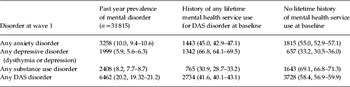
Table 1 demonstrates the past-year prevalence of DAS disorders and lifetime (i.e. prior) mental health service use in the baseline sample. Forty-one percent of people with DAS disorders had sought any lifetime mental health services. In comparison with anxiety and substance use disorders, people with depressive disorders had the highest prevalence of lifetime mental health service use.
Past-year DAS disorders and lifetime history of mental health service use at wave 1

DAS, Depressive, anxiety and substance use; CI, confidence interval.
Values given as n (%, 95% CI).
All frequencies are unweighted and percentages are weighted.
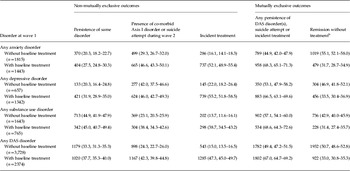
Table 2 demonstrates the 3-year outcomes of people with a DAS diagnosis without prior treatment at baseline in comparison to those who received prior treatment. χ2 tests demonstrated that people with a never-treated DAS disorder at baseline were significantly more likely to have remission (below threshold) without subsequent treatment (50.7%) than those who had used services previously (33.0%). This finding was significant for each of the subtypes of disorders (p < 0.001).
Outcomes at the 3-year follow-upa of participants with a baseline history of DAS disorders

DAS, Depressive, anxiety and substance use; CI, confidence interval.
Values given as n (%, 95% CI).
All frequencies are unweighted and percentages are weighted.
a The following two groups are mutually exclusive: remission without treatment and any indicator of need for treatment. The following three groups are not mutually exclusive from each other: presence of same disorder, presence of co-morbid disorder or suicide attempt, or incident treatment.
b No treatment during the follow-up period.
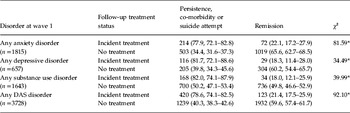
Table 3 demonstrates the relationship between the different outcomes among people with a never-treated baseline disorder. The data show that the vast majority of people with persistence, co-morbidity or suicidal behavior during the follow-up had incident mental health service use in comparison to a minority of people with remission of the disorder. χ2 analyses showed a significant difference across all types of disorders.
Outcomes at the 3-year follow-up of participants with a baseline DAS disorder without baseline treatment in relation to incident treatment

DAS, Depressive, anxiety and substance use; CI, confidence interval.
Values given as n (%, 95% CI).
* p ⩽ 0.001.
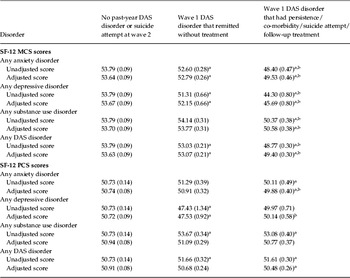
Table 4 compares the HRQoL of three groups in unadjusted and adjusted models. Individuals with a baseline diagnosis who had persistence of a DAS disorder had significantly lower MCS scores (approximately four points difference) than the other two groups (medium effect sizes). People with a DAS disorder who had a remission without treatment also had significantly lower MCS scores than those without a DAS disorder at wave 2. However, the differences were only significant for depressive disorders, anxiety disorders and any DAS disorder (small effect sizes <0.3). No significant differences were found among people with substance use disorders who had a remission of their disorder without treatment.
Unadjusted and adjusted mean scores for HRQoL (SF-12) among three groups at wave 2

HRQoL, Health-related quality of life; SF-12, 12-item Medical Outcomes Study – Short Form; DAS, depressive, anxiety and substance use; MCS, Mental Component Summary; PCS, Physical Component Summary; CI, confidence interval.
Multiple linear regressions adjusted for age, sex, race, income, education, marital status, any lifetime personality disorder, number of physical conditions, and childhood physical or sexual abuse. Higher scores indicate higher quality of life.
Values given as mean (standard error).
a Significantly different from no disorder group at p ⩽ 0.05.
b Significantly different from remitted group at p ⩽ 0.05.
Discussion
To the best of our knowledge, the present study is the first empirical evaluation of the controversial issue of whether people who meet criteria for a DAS disorder who have not sought services should be counted in estimates of treatment need. This study has three main findings. First, among people with a baseline never-treated DAS disorder, approximately 50% of the sample had a remission of the disorder (below threshold) without subsequent treatment. Second, people with a DAS disorder who had sought services at baseline were significantly less likely to have a remission of their disorder than those without help seeking at baseline. Third, people with a remission of their baseline disorder without treatment had slightly lower levels of HRQoL compared to those without a DAS disorder at wave 2.
Together, these findings suggest that epidemiologic studies demonstrating a high prevalence of untreated mental disorders in the community might be overestimating the need for mental health services. As Regier et al. (Reference Regier, Kaelber, Rae, Farmer, Knauper, Kessler and Norquist1998) suggest, some people may have transient distress and meet criteria for a DSM-IV disorder for a short period of time and not require treatment to recover. People who understand their distress symptoms as contextually appropriate and expected in relation to life stressors would be unlikely to seek treatment. Future studies should investigate whether specific life events precede the experience of transient distress.
However, it could be argued that early intervention with people with an untreated DAS disorder could lead to a faster remission of symptoms, reduced morbidity and greater improvement in HRQoL. Our study had a 3-year follow-up period that might not have been long enough to capture all service use. Previous work has demonstrated that the median age of onset of mental disorders to the age of first treatment contact ranges between 5 and 25 years, depending on the type of disorder (Wang et al. Reference Wang, Berglund, Olfson, Pincus, Wells and Kessler2005). Future studies that have longer periods of follow-up should address this issue.
In our study, people with a depressive or anxiety disorder who remitted without treatment still had significantly lower scores on HRQoL than those without a disorder at wave 2, suggesting that they might have benefited from treatment. Nonetheless, it is important to note that the difference between these groups, although statistically significant, was a very small effect (a one-point difference on MCS scores). We suggest that this lower HRQoL in people with a DAS disorder who had remission without treatment is probably due to subthreshold symptoms of the index disorder. Unfortunately, because of the nature of the assessment of disorders at wave 2 in the NESARC, we were unable to determine the number of respondents who had subthreshold symptoms during the year before wave 2. Thus, it could still be argued that timely intervention with this group might have led to a full reduction of symptoms and higher HRQoL.
Our finding that people with a history of mental health service use were significantly less likely to remit than those who had never received services should be considered carefully in the context of the observational nature of these data. These findings are probably due to baseline differences in severity between the two groups. It has been well established that there is a strong association between increasing severity and co-morbidity of mental disorders with treatment seeking (Mojtabai et al. Reference Mojtabai, Olfson and Mechanic2002; Sareen et al. Reference Sareen, Cox, Afifi, Clara and Yu2005a). Another possible interpretation of this finding is that help seeking for DAS disorders is associated with worse outcomes than not receiving care. Because of the observational nature of the data and the selection bias associated with help seeking, we do not consider that the data support the notion that help seeking results in adverse outcomes. A large body of literature supports the positive impact of many interventions in DAS disorders (Katon et al. Reference Katon, Lin, Von Korff, Ciechanowski, Ludman, Young, Peterson, Rutter, McGregor and McCulloch2010; Roy-Byrne et al. Reference Roy-Byrne, Craske, Sullivan, Rose, Edlund, Lang, Bystritsky, Welch, Chavira, Golinelli, Campbell-Sills, Sherbourne and Stein2010).
The present study should be considered in the context of several limitations. First, the diagnoses made by computer algorithms on the basis of lay-interviewer assessments may not match the accuracy of those made by clinicians (Ruan et al. Reference Ruan, Goldstein, Chou, Smith, Saha, Pickering, Dawson, Huang, Stinson and Grant2008). However, there is no gold standard to compare accuracy of different diagnostic methods. Second, the findings may not be generalizable to other countries besides the USA because of differences in health-care systems, prevalence of mental illness and attitudes toward mental disorders and treatment seeking. The World Mental Health Survey Initiative has demonstrated a wide variation in rates of mental illness across countries and the USA has some of the highest rates of mental illness in comparison to other countries (Wang et al. Reference Wang, Aguilar-Gaxiola, Alonso, Angermeyer, Borges, Bromet, Bruffaerts, de Girolamo, de Graaf, Gureje, Haro, Karam, Kessler, Kovess, Lane, Lee, Levinson, Ono, Petukhova, Posada-Villa, Seedat and Wells2007). It will be of considerable interest to learn about the longitudinal stability and course of mental disorders in other nations. Third, the endorsement of emotional symptoms or mental health service use may be affected by recall bias, although the focus on past-year diagnoses at wave 2 may attenuate this limitation. Previous methodological studies comparing self-report service use with administrative data have demonstrated that increasing levels of distress may increase the likelihood of spurious over-reporting of mental health service use (Rhodes & Fung, Reference Rhodes and Fung2004). Similarly, the reliability of self-reported suicide attempts in the NESARC was modest (Palmetto & Link, Reference Palmetto and Link2010). Fourth, because of the lack of assessment of PTSD and OCD at wave 1, we were not able to include these disorders in our analysis and cannot comment on whether findings for those two disorders would follow suit. Fifth, attrition of the sample during the follow-up period may have biased the results. Nonetheless, previous work has demonstrated that mental disorders are not strongly associated with attrition (Eaton et al. Reference Eaton, Anthony, Tepper and Dryman1992; de Graaf et al. Reference de Graaf, Bijl, Smit, Ravelli and Vollebergh2000). Sixth, we analyzed past-year disorders in relation to past-month QoL measures. It would have been ideal to use assessment time frames that were the same; however, the NESARC did not assess past-month disorders. Seventh, the NESARC was not designed to assess the relationship between onset and offset of disorders in relation to mental health service use. Thus, we were unable to conduct analyses of the temporal relationship between remission of disorders in relation to treatment seeking during the follow-up period. Eighth, to minimize the number of comparisons, and because of the substantial co-morbidity of DAS disorders between each other, we did not examine individual disorders separately. It is possible that there might be differences in remission without treatment among different subtypes of DAS disorders. Ninth, the current study used DSM-IV-based criteria for DAS disorders that may not be generalizable to DSM-5-based criteria. With the substantial changes being proposed for DSM-5, future work needs to consider the relationship between diagnoses of DSM-5-based disorders and need for treatment. Finally, the NESARC did not comprehensively assess complementary or alternative treatments. Nonetheless, the findings of lifetime service use for DAS disorders are consistent with other surveys that had broader assessments of mental health service use (Wang et al. Reference Wang, Aguilar-Gaxiola, Alonso, Angermeyer, Borges, Bromet, Bruffaerts, de Girolamo, de Graaf, Gureje, Haro, Karam, Kessler, Kovess, Lane, Lee, Levinson, Ono, Petukhova, Posada-Villa, Seedat and Wells2007).
In summary, the present study suggests that approximately 50% of people in the community who meet DSM-IV criteria for a common DAS disorder who have not sought treatment will subsequently remit without any treatment. Future studies should examine factors that influence remission or lack thereof; the identification of such factors could help public health authorities to target scarce mental health resources towards those most likely to benefit from them.
Acknowledgments
We are grateful to D. Palitsky, N. Mota and R. El-Gabalawy for their thoughtful review of the manuscript. Preparation of this article was supported by a Canadian Institutes of Health Research (CIHR) New Investigator Award (no. 152348) and a Manitoba Health Research Council Chair award to Dr J. Sareen. C. Henriksen conducted all analyses for this manuscript.
Declaration of Interest
None.