Introduction
Mississippian rocks were discovered in 1881 at Lake Valley in southern New Mexico (Lucas, Reference Lucas2012) by the famous herpetologist and vertebrate paleontologist Edward Drinker Cope (1840–1897). Cope also named the Lake Valley Formation for most of the Mississippian strata at Lake Valley. Since Cope’s discovery, much has been written about the phenomenal fossil record of the Lake Valley Formation (Limestone) at its type section (see Kues, Reference Kues1986 for a review). This fossil record is dominated by exceptionally well-preserved crinoids but also includes diverse coelenterates, brachiopods, and mollusks. One of the less well-studied groups in the Lake Valley Formation fossil assemblages is the bryozoans. Here, we report on material of Lake Valley Formation bryozoans from the collections made by Krainer and Lucas (Reference Krainer and Lucas2012) and discuss their stratigraphic, paleogeographic, and paleoecological significance. These bryozoans include a new genus and a new species named here.
Previous reports of Lake Valley Bryozoa
Taxonomic work on bryozoans was widely neglected in previous geological reports on the Lake Valley Formation. The few existing records bear numerous taxonomic and nomenclatural biases that need urgent clarification. The only bryozoan species previously described and depicted from the Lake Valley Formation is Trematopora americana established by Miller (Reference Miller1881, p. 312). The description of this species is superficial, but accompanied by few measurements and two illustrations, in natural size and slightly magnified. The genus Trematopora Hall, Reference Hall1852 belongs to the order Trepostomata. However, Miller’s description of T. americana implies the presence of lunaria (“The apertures are margined by a projecting lip which sometimes overshadows the lower part of the opening”; Miller, Reference Miller1881, p. 312), and a hollow, ramose, branched colony. Therefore, this species must belong to the order Cystoporata. Indeed, Darton (Reference Darton1928, p. 17) listed the species as Fistulipora americana (identified by G. H. Girty) in his list of fossils from this formation. So, Girty (in Darton, Reference Darton1928) was apparently the first to place this species in Fistulipora M’Coy, Reference M’Coy1849. McKee and Gutschick (Reference McKee and Gutschick1969, p. 359) mentioned the species, as Cheilotrypa americana, from the Mississippian Redwall Limestone of Utah. It is not clear, however, who placed this species in the cystoporate genus Cheilotrypa Ulrich, Reference Ulrich1884. The precise taxonomic assignment of this species is impossible because its internal morphology is unknown.
Kues (Reference Kues1986, p. 212) listed Fistulipora americana in a list of fossils from the Lake Valley Formation. He noted that the species Trematopora americana and T. vesiculosa (apparently the species of Winchell, Reference Winchell1864) are synonymous with F. americana. The species Trematopora? vesiculosa and T.? fragilis were described by Winchell (Reference Winchell1864, p. 3) from the Burlington Limestone (Osagean) of Iowa. Unfortunately, these species were not illustrated by Winchell. Trematopora? vesiculosa could belong to Cystoporata, because Winchell (Reference Winchell1864, p. 3) mentioned a vesicular skeleton and branched colony without a solid axis (hollow ramose?). In contrast, T.? fragilis could be a branched trepostome.
Besides these species (Fistulipora americana, Trematopora americana, and T. vesiculosa), Kues (Reference Kues1986, p. 212) listed the following bryozoans from the Lake Valley Formation: Cheilotrypa sp., Cystodictya aff. C. pustulosa Ulrich, Reference Ulrich1890, Cystodictya? sp., Fenestella sp., Hernodia sp. (not a bryozoan), Leioclema (= Lioclema) sp., Lichenotrypa sp., Penniretepora (=Pinnatopora) sp., Polypora sp., Ptylopora sp., Rhombopora sp., and Thamniscus sp. The genus Lichenotrypa Ulrich, Reference Ulrich1886 is restricted to the Middle Devonian, whereas others represent typical genera occurring in the Mississippian elsewhere. However, the exact taxonomic assignment of these bryozoans cannot be verified because of the lack of descriptions, illustrations, and identifiable voucher specimens.
Location and stratigraphy
Location
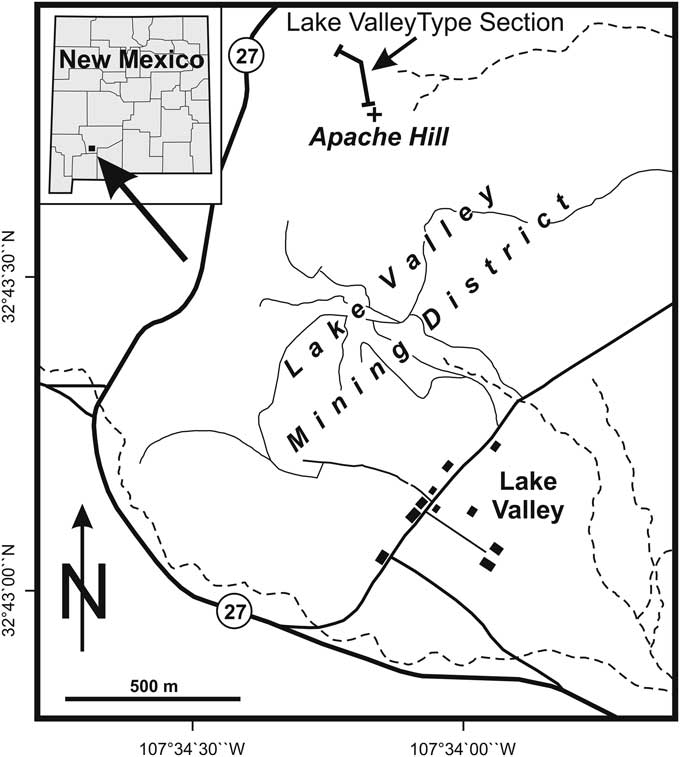
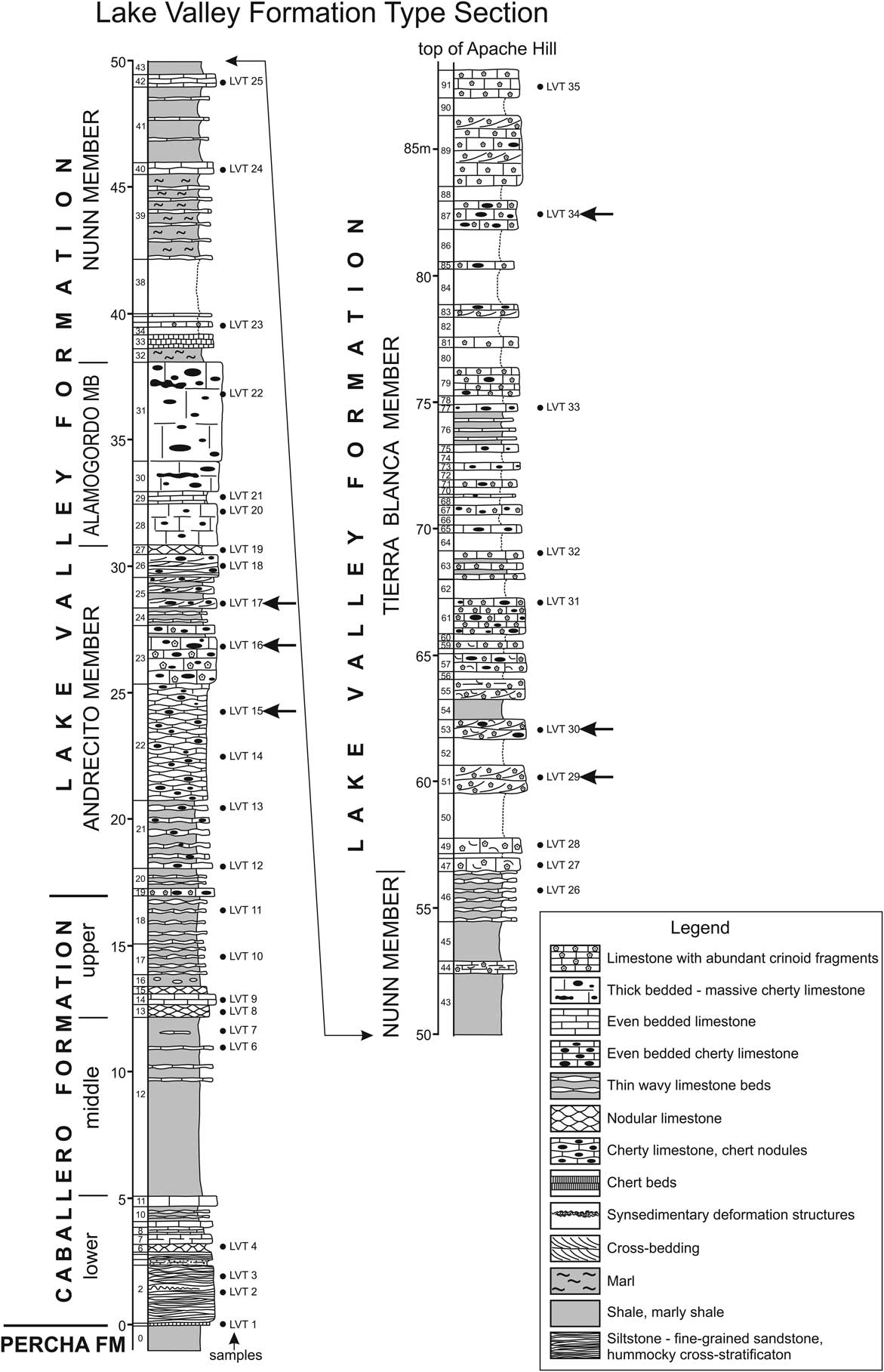
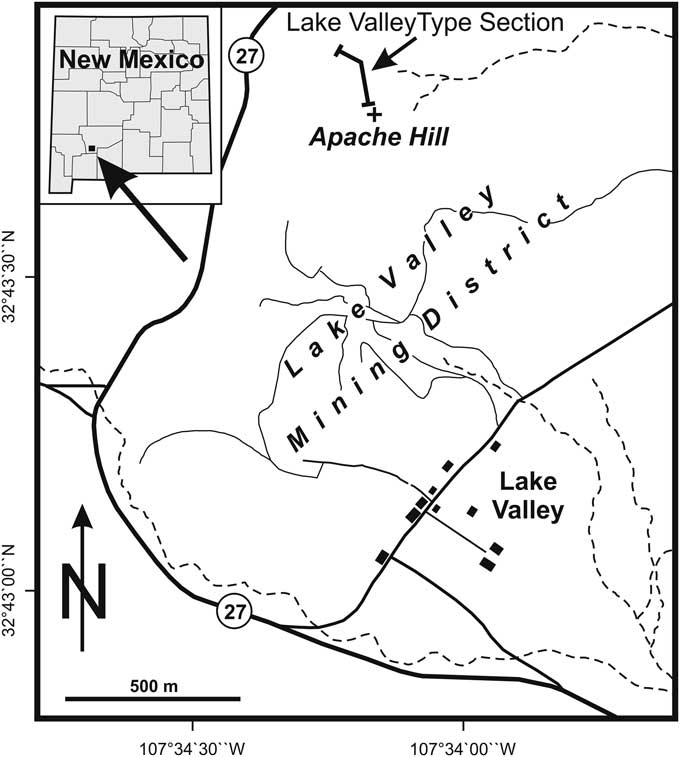
The type section of the Lake Valley Formation is located on the northwestern slope of Apache Hill immediately north of the Lake Valley mining district in the southwestern part of Sierra County, New Mexico (USA) (Figs. 1, 2). We studied bryozoans from the Andrecito Member (samples LVT 15 and 17) and Tierra Blanca Member (samples LVT 29 and 34) of the type section of the Lake Valley Formation (Fig. 2).
Location of type section of Lake Valley Formation in Sierra County, southwestern New Mexico, USA.
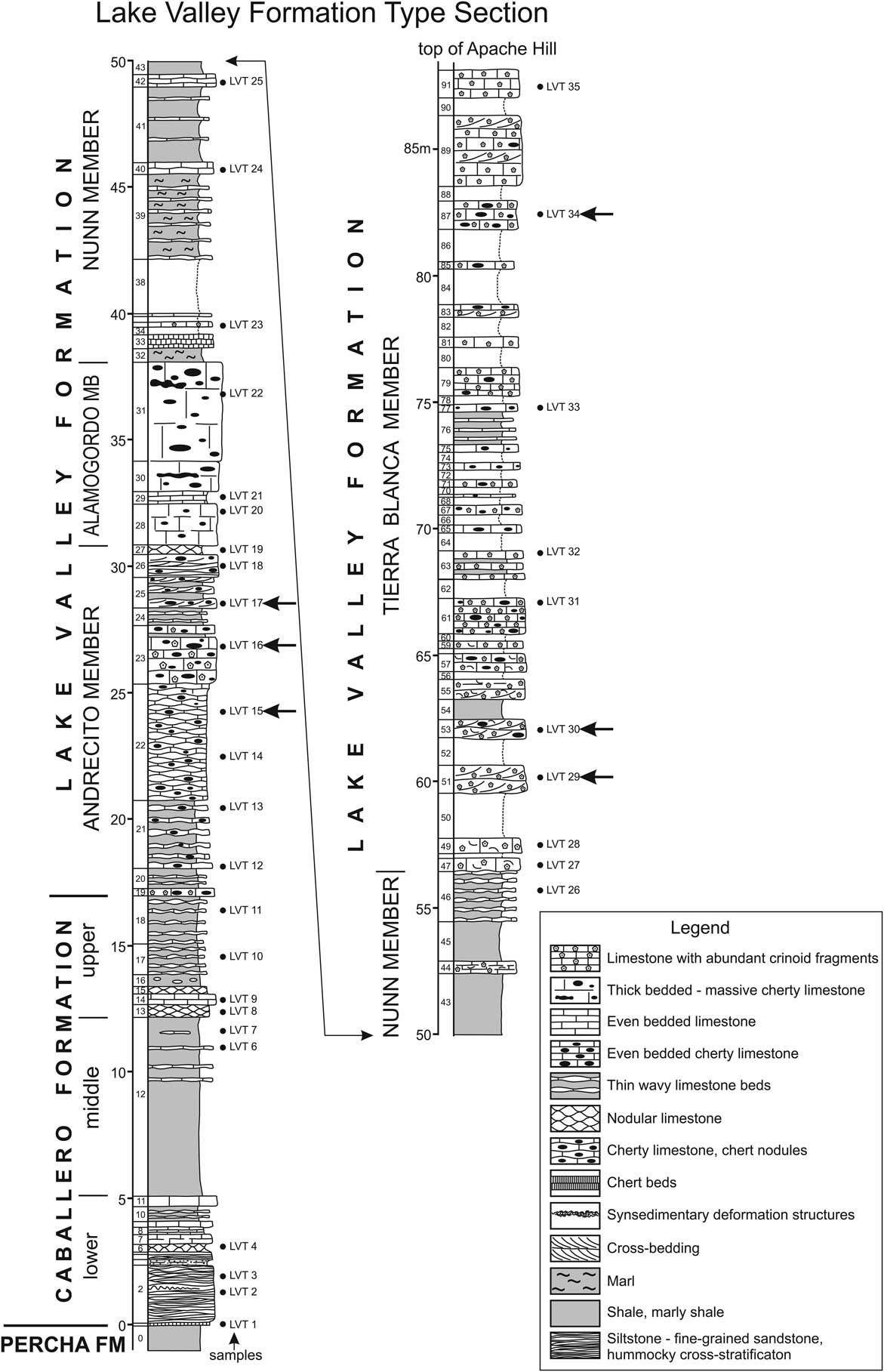
Stratigraphic log of the Lake Valley Formation at the type section (modified from Krainer and Lucas, Reference Krainer and Lucas2012). Arrows indicate samples from which the bryozoans described in this paper originated.
Stratigraphy
The type section of the Mississippian Lake Valley Formation has an exposed thickness of 71 m and is divided into four members, which (in ascending order) are: Andrecito, Alamogordo, Nunn, and Tierra Blanca members (Fig. 2). The Lake Valley Formation is underlain by the Mississippian Caballero Formation, which is 17 m thick and rests on greenish shale of the Upper Devonian Percha Formation (see Krainer and Lucas, Reference Krainer and Lucas2012).
The type section of the Lake Valley Formation (Fig. 2) was recently studied in detail by Krainer and Lucas (Reference Krainer and Lucas2012). Here, we present a brief summary:
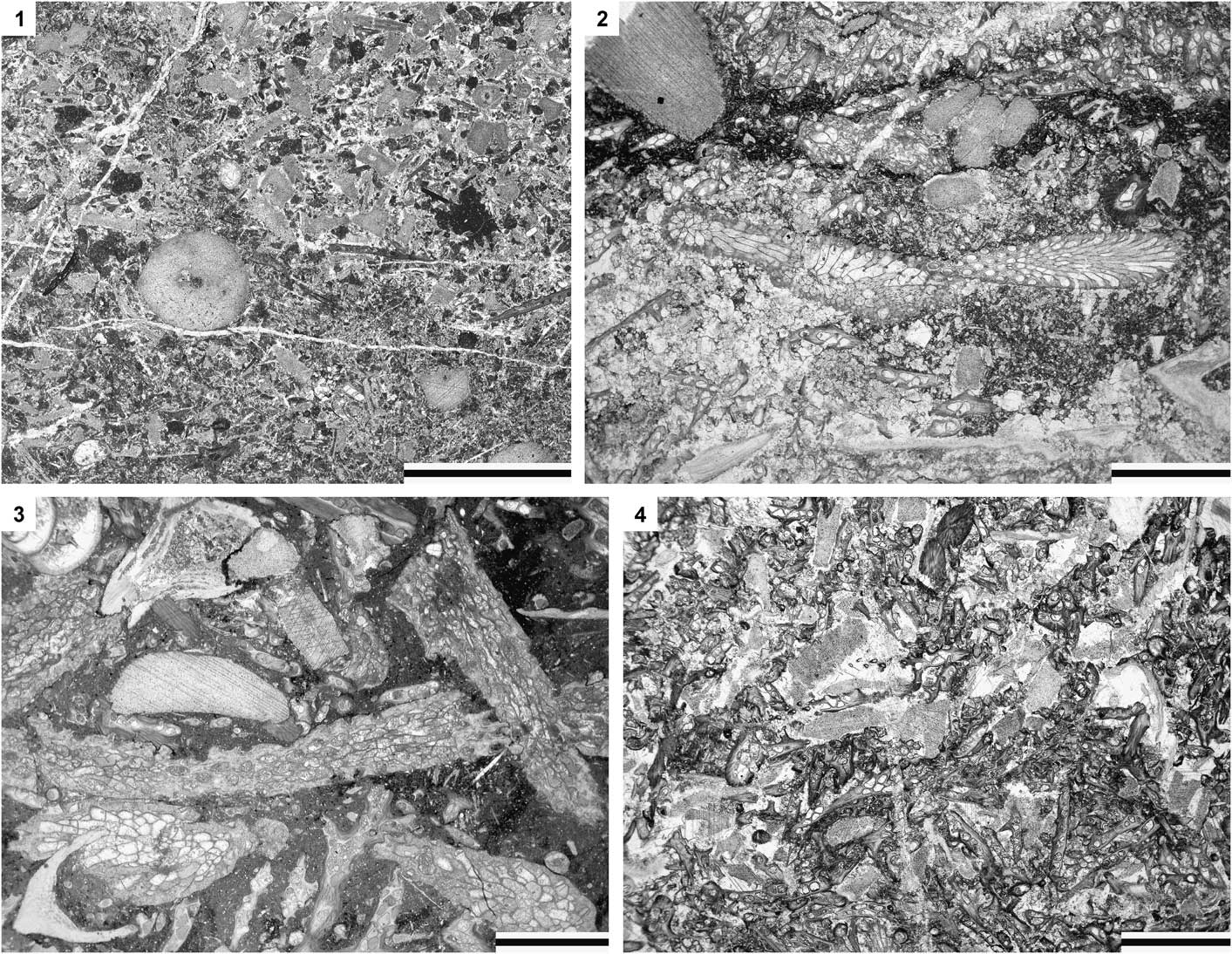
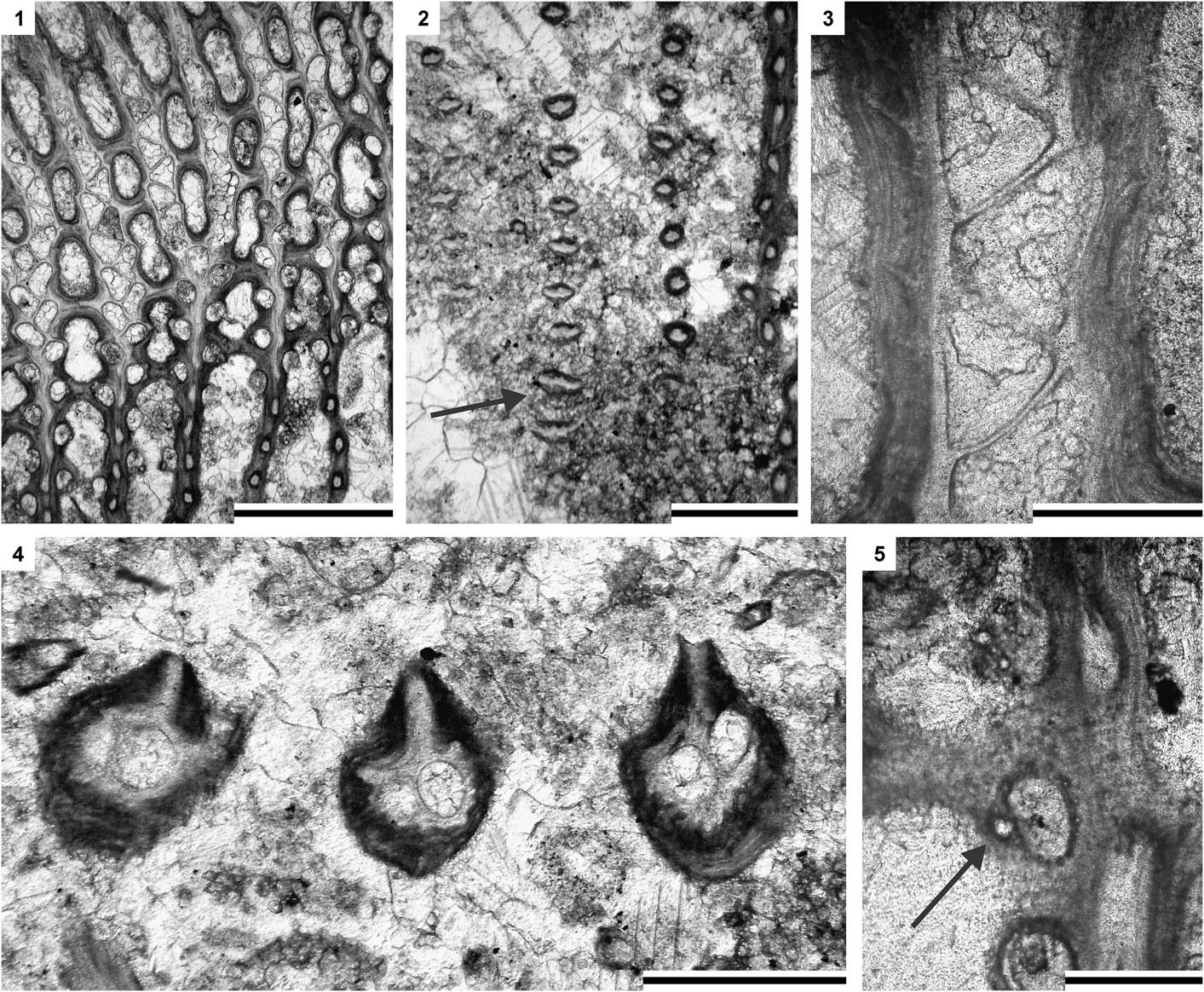
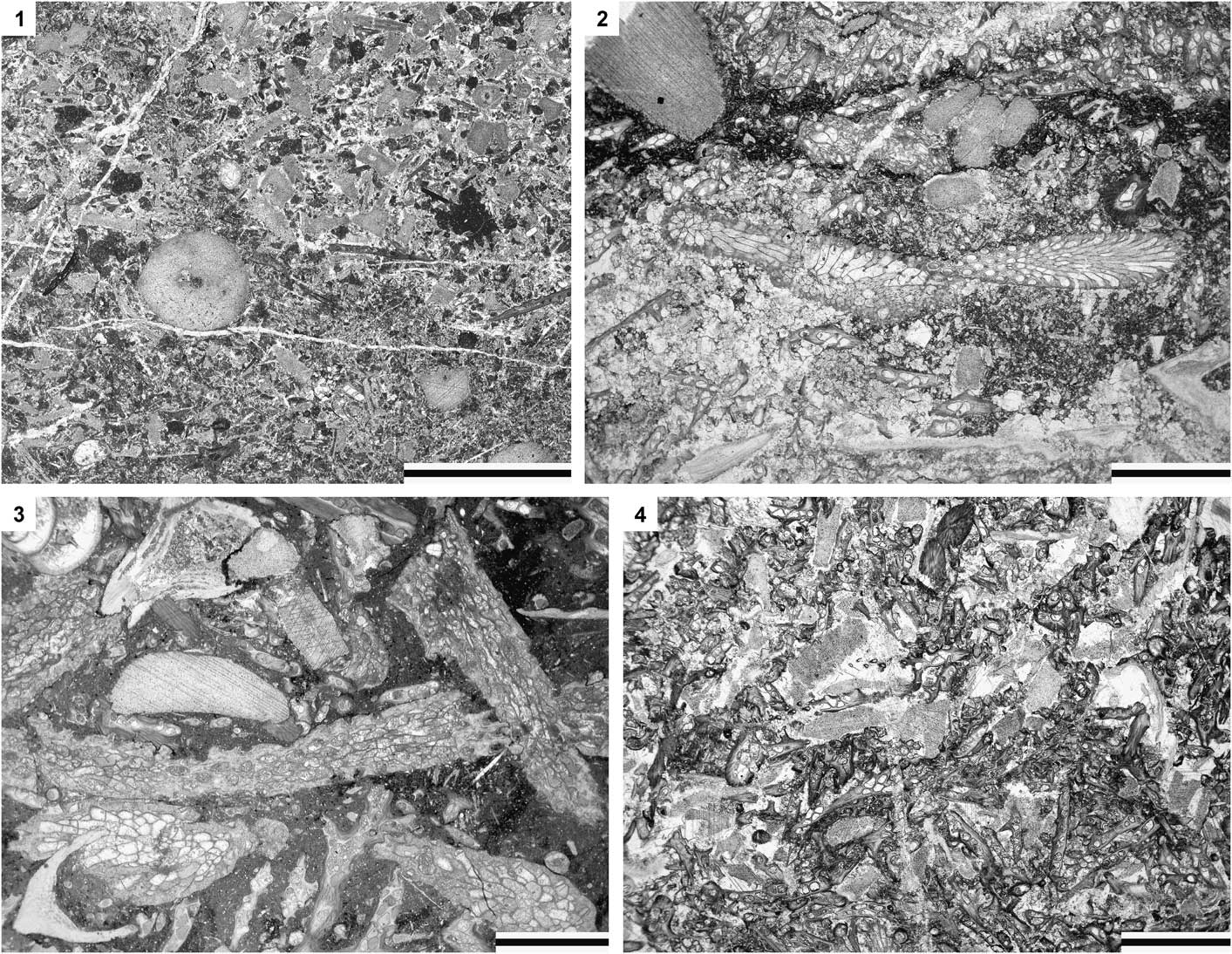
The Andrecito Member (13.9 m) is composed of cherty, wavy bedded micritic limestone, alternating with shale; wavy bedded cherty limestone containing abundant crinoid fragments and bryozoans; medium-bedded, very cherty limestone; and coarse-grained, cross-bedded crinoidal limestone with chert nodules (Fig. 2). Limestone is composed of wackestone to packstone; grainstone and floatstone containing a diverse fossil assemblage of echinoderm fragments (crinoids), bryozoans, ostracodes, brachiopods, gastropods, rare algae, and foraminifers; and a few other skeletal grains (Fig. 3.1, 3.2).
Microfacies of the studied levels of the Lake Valley Formation: (1, 2) Andrecito Member: (1) crinoid-bryozoan packstone, NMMNH P-79579; (2) crinoid-bryozoan floatstone with Nikiforovella sp., Clausotrypa denticulata, and unidentified trepostome bryozoan, NMMNH P-79580; (3, 4) Tierra Blanca Member: (3) floatstone with Cystomeson sierraensis n. gen. n. sp. and fenestrate debris, NMMNH P-79591; (4) bryozoan-crinoid packstone with fenestrate debris, NMMNH P-79600. Scale bars = 5 mm (1), 2 mm (2–4).
The Alamogordo Member (7.2 m) consists of thick-bedded to massive, light gray micritic limestone containing chert nodules (Fig. 2). The dominant microfacies is bioclastic mudstone, and subordinately wackestone to packstone containing a diverse fossil assemblage, including bryozoans.
The Nunn Member (17.6 m) is composed of marl and shale with intercalated marly limestone and limestone containing abundant crinoidal fragments and bryozoans (Fig. 2). The microfacies is wackestone to packstone containing spicules, ostracodes, echinoderm fragments, bryozoans, brachiopods, and rare trilobites.
The Tierra Blanca Member is the thickest member (31.7 m) and represented by fossiliferous, mostly coarse-grained limestone, locally displaying cross bedding (Fig. 2). These limestones alternate with marly shale and covered (shale) intervals. Limestone is composed of packstone to rudstone, grainstone, and wackestone to floatstone (Fig. 3.3, 3.4). All microfacies contain fragmented fossils, particularly echinoderms (crinoids) and bryozoans.
Limestones of the Lake Valley Formation are composed of a typical ‘bryonoderm’ grain association (sensu Beauchamp Reference Beauchamp1994, Beauchamp and Desrochers Reference Beauchamp and Desrochers1997), which is common in upper Paleozoic sedimentary successions. According to Krainer and Lucas (Reference Krainer and Lucas2012), the Caballero and Lake Valley formations represent two transgressive-regressive depositional sequences. The depositional environment ranges from low-energy, deeper shelf to high-energy storm deposits.
Materials and methods
Bryozoans were studied in thin section using a binocular microscope with transmitted light. In total, 43 thin sections were prepared from rock samples. Morphological character terminology is partly adopted from Hageman (Reference Hageman1991) for fenestrates and Hageman (Reference Hageman1993) for cryptostomes. The spacing of structures is measured as the distance between their centers. Statistics were summarized using arithmetic mean, sample standard deviation, coefficient of variation, and minimum and maximum values.
Repositories and institutional abbreviations
The studied material is deposited at the New Mexico Museum of Natural History and Science (NMMNH), Albuquerque, New Mexico, USA. Other repositories include ISGS (ISM)=Illinois State Geological Survey, Illinois State Museum, Springfield, Illinois, and USNM PAL=National Museum of Natural History (formerly United States National Museum), Paleobiology Department, Washington, DC.
Systematic paleontology
Phylum Bryozoa Ehrenberg, Reference Ehrenberg1831
Class Stenolaemata Borg, Reference Borg1926
Superorder Palaeostomata Ma, Buttler, and Taylor, Reference Ma, Buttler and Taylor2014
Order Cystoporata Astrova, Reference Astrova1964
Suborder Fistuliporina Astrova, Reference Astrova1964
Family Fistuliporidae Ulrich, Reference Ulrich1882
Genus Cystomeson new genus
urn:lsid:zoobank.org:act:F9FAFAF3-988D-43A2-BA9F-E5568F3C4A5B
Type species
Cystomeson sierraensis new species, by monotypy.
Diagnosis
Erect branched colonies; 2–5 large axial zooecia present. Autozooecia deriving from axial zooecia, recumbent at their bases, semicircular to trapezoidal at their bases in endozone. Spine-like hemiphragms in exozone, arranged in alternating pattern. Diaphragms rare. Lunaria distinct, with ends not inflecting autozooecial chambers. Vesicles flat, low, restricted to exozone. Thick layer of laminated calcitic material on colony surface. Acanthostyles in calcitic layer present. Heterozooecia absent. Maculae absent.
Etymology
The genus name refers to the presence of a vesicular skeleton (from Greek cystos, vesicle) and of axial zooecia (from Greek meson, median, middle in position).
Occurrence
Lake Valley Formation, Mississippian (Osagean); New Mexico, USA.
Remarks
Cystomeson n. gen. differs from Cheilotrypa Ulrich, Reference Ulrich1884 in the presence of hemiphragms and in its solid branched colony with axial zooecia instead of the hollow ramose colony of Cheilotrypa. It differs from Strotopora Ulrich in Miller, Reference Miller1889 in the presence of axial zooecia and the absence of gonozooecia.
Cystomeson sierraensis new species
urn:lsid:zoobank.org:act:DF6C7BCE-F502-4514-8561-09C62ACF48F8
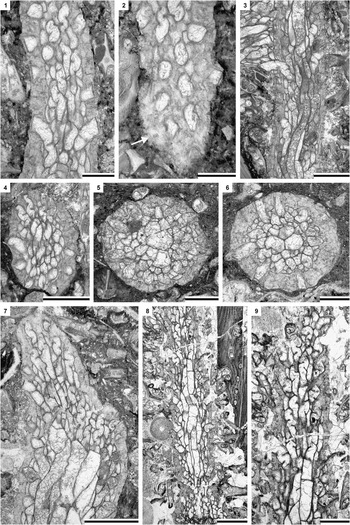
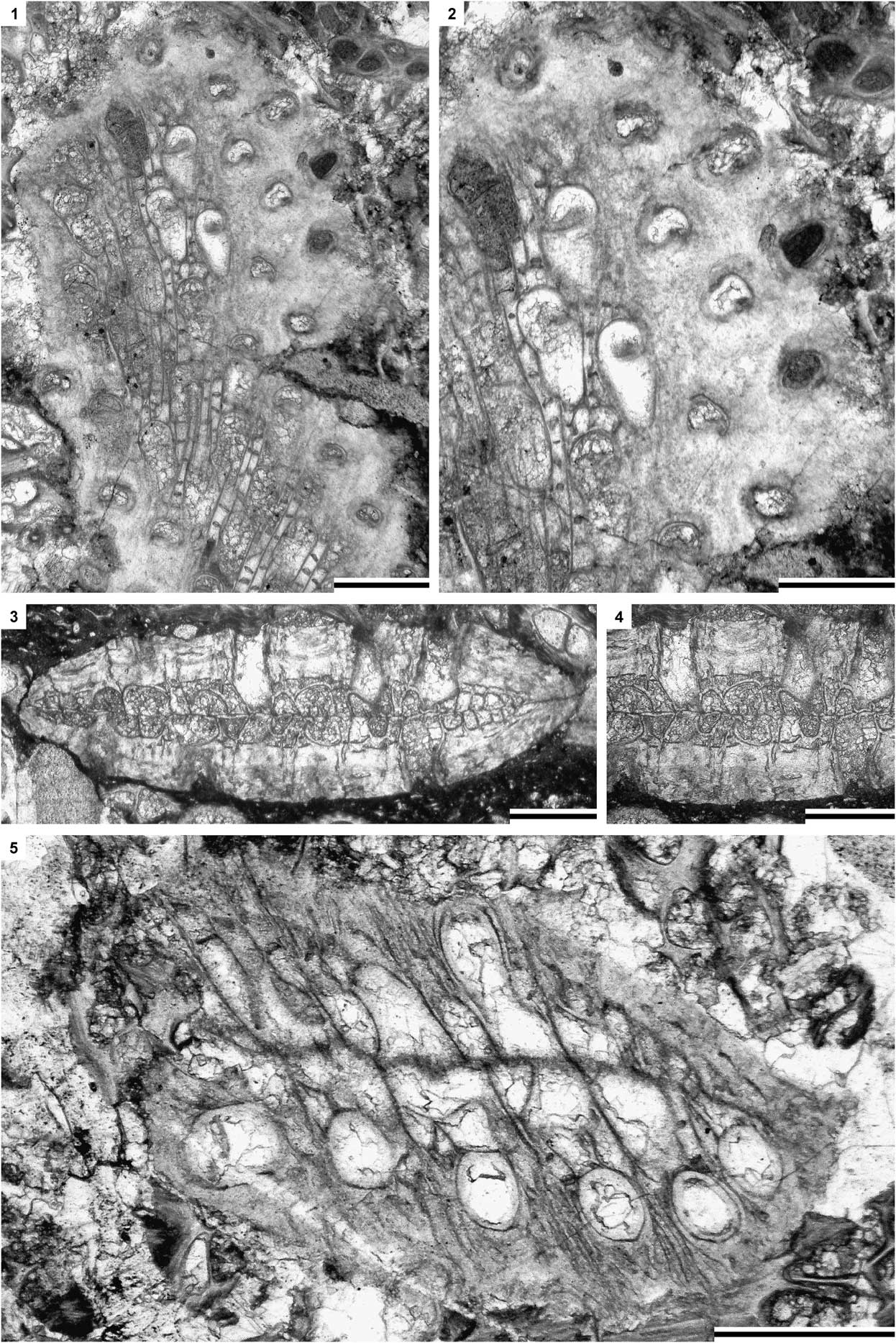
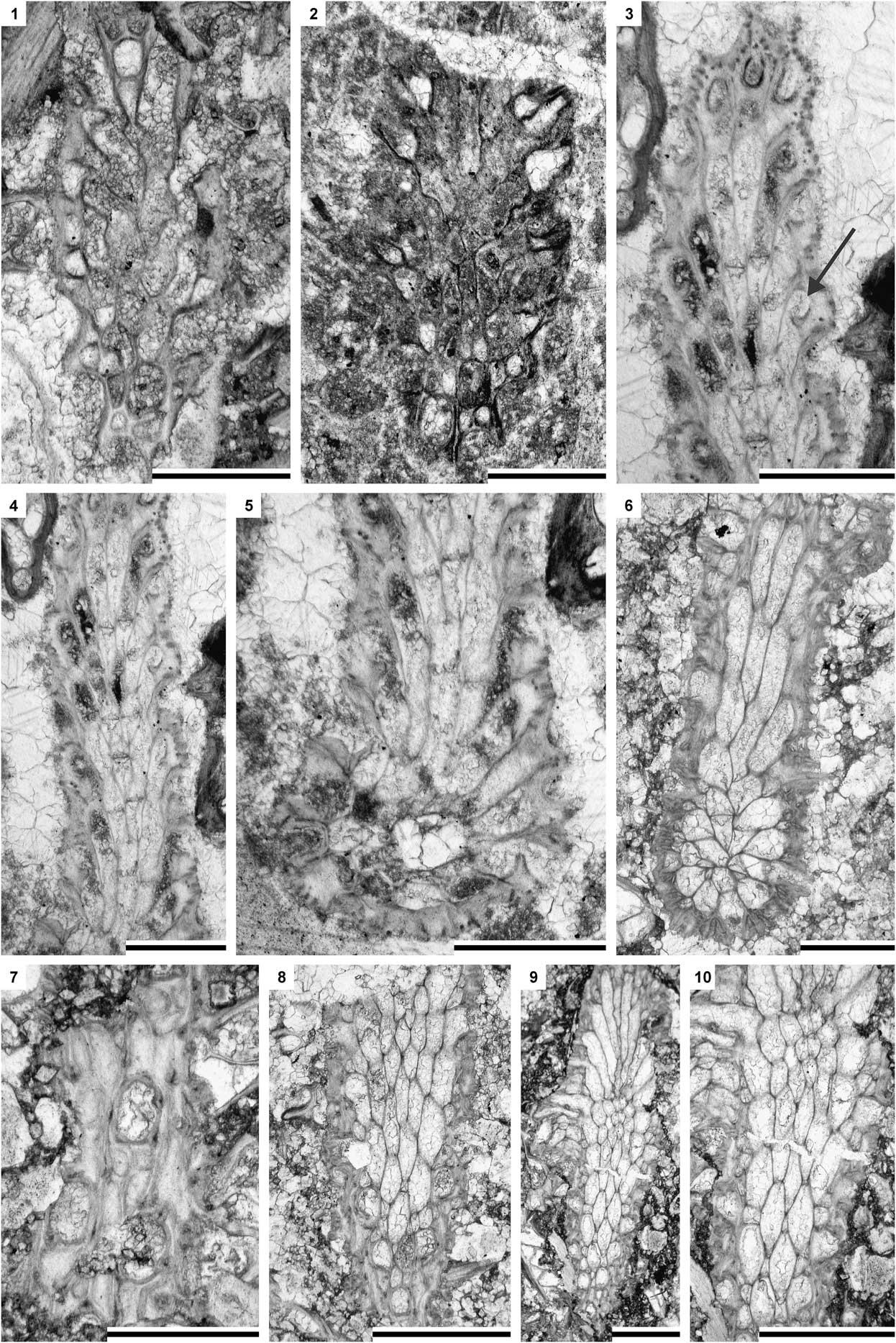
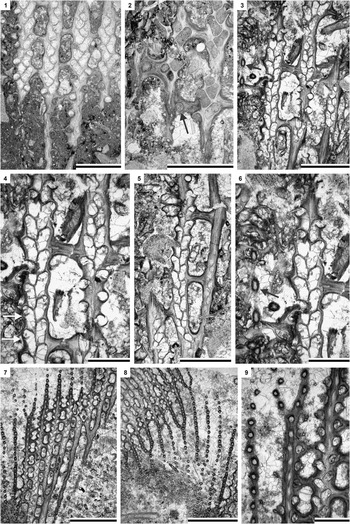
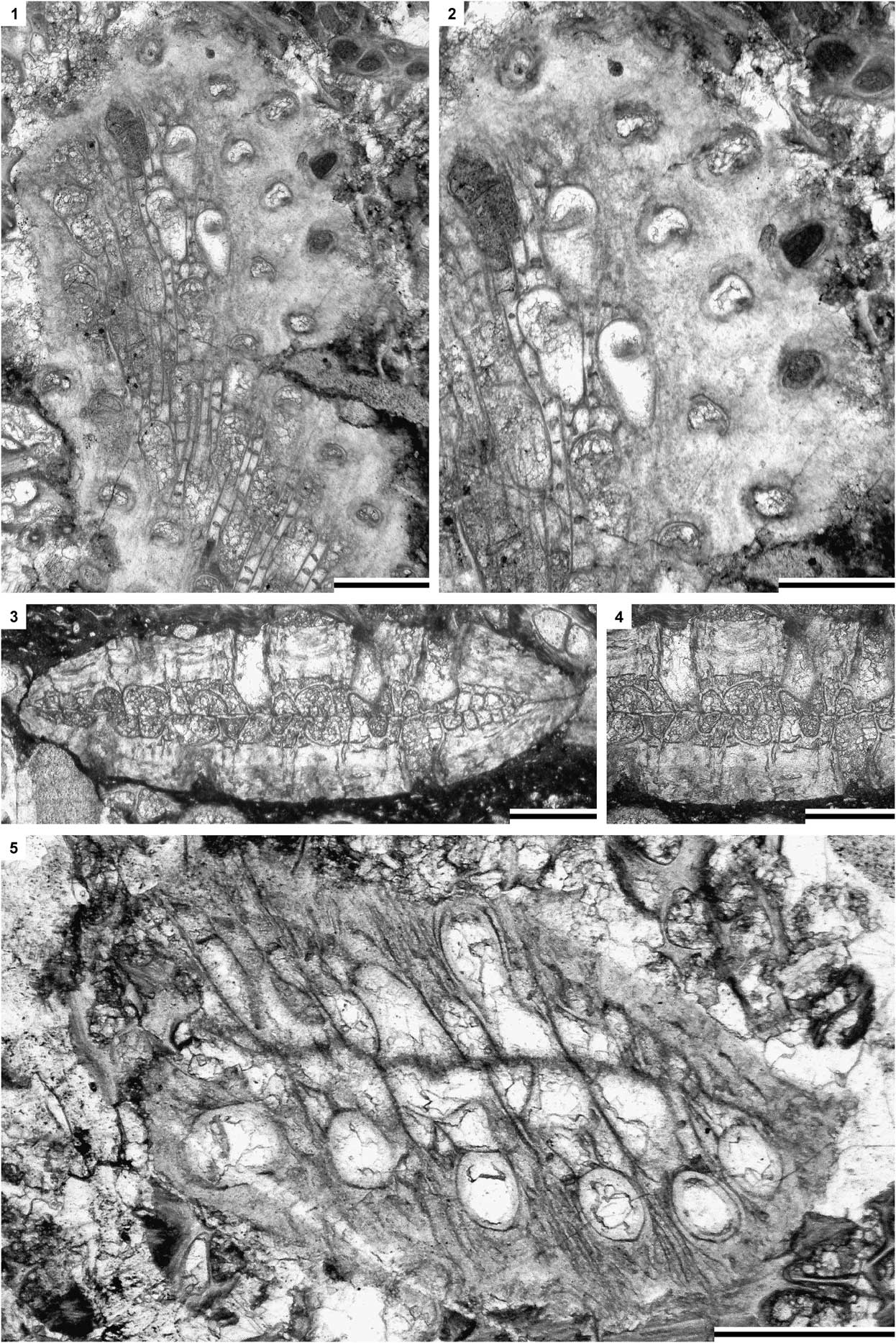
Cystomeson sierraensis n. gen. n. sp.: (1–4) holotype, NMMNH P-79594: (1) longitudinal section showing autozooecial chambers with hemisepta and vesicles; (2) tangential section showing autozooecial apertures and acanthostyles (arrow) in the laminated calcitic layer; (3) longitudinal section showing autozooecial chambers, vesicles, and axial zooecia; (4) oblique transversal section showing autozooecial chambers, vesicles, and axial zooecia; (5, 6) paratype, NMMNH P-79617, transverse sections showing autozooecial chambers, vesicles, and axial zooecia; (7–9) longitudinal sections showing autozooecial chambers with hemisepta and vesicles: (7) paratype, NMMNH P-79596; (8, 9) paratype, NMMNH P-79609. Scale bars = 2 mm (1, 2), 1 mm (3, 4, 7, 8), 0.5 mm (5, 6, 9).

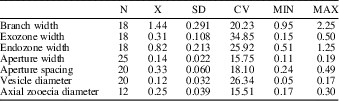
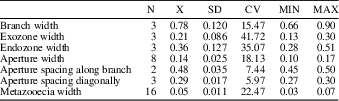
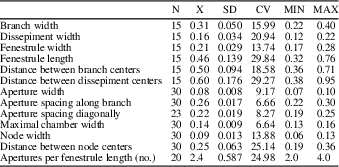
Descriptive statistics of Cystomeson sierraensis n. gen. n. sp. (18 colonies). All measurements in mm. N=number of measurements, X=mean, SD=sample standard deviation, CV=coefficient of variation, MIN=minimum value, MAX=maximum value.

Holotype
NMMNH P-79594. Tierra Blanca Member of the Lake Valley Formation, Mississippian (Osagean); northwestern slope of Apache Hill, north of the Lake Valley mining district in the southwestern part of Sierra County, New Mexico, USA (type locality of the Lake Valley Formation: see Krainer and Lucas, Reference Krainer and Lucas2012).
Paratypes
NMMNH P-79579, P-79580, P-79583, P-79586, P-79589 to P-79593, P-79595 to P-79599, P-79601, P-79606, P-79609, P-79610 to P-79612, P-79614, P-79615, P-79618, and P-75158 to P-75160.
Diagnosis
As for the genus.
Occurrence
Andrecito and Tierra Blanca members, Lake Valley Formation, Mississippian (Osagean); Sierra County, New Mexico, USA.
Description
Erect branched colonies, 0.95–2.25 mm in diameter, with 0.15–0.50 mm wide exozones and 0.51–1.25 mm wide endozones. Two to five long, large zooecia developed in axial region, polygonal in transverse section. Autozooecia deriving from axial zooecia, recumbent at their bases, semicircular to trapezoidal at their bases in endozone. Diaphragms in axial zooecia present, straight, widely spaced. Hemiphragms in exozone abundant, spine-like, arranged in alternating pattern. Lunaria horseshoe-shaped, laminated, positioned proximally, with ends not inflecting autozooecial chambers. Vesicles common, flat, low, restricted to exozone, up to eight surrounding each autozooecial aperture. Layer of laminated calcitic material developed on colony surface, 0.10–0.25 mm thick. Acanthostyles in calcitic layer, 0.02–0.03 mm in diameter, with laminated sheaths and hyaline cores. Heterozooecia absent. Maculae absent. Autozooecial walls granular, locally crenulated, 0.010–0.015 mm thick.
Etymology
The species name refers to Sierra County, the place where it was discovered.
Remarks
As for the genus.
Family Cystodictyonidae Ulrich, Reference Ulrich1884
Genus Cystodictya Ulrich, Reference Ulrich1882
Type species
Cystodictya ocellata Ulrich, Reference Ulrich1882, by original designation. Lower Mississippian; Kentucky, USA.
Diagnosis
Bifoliate colony, strap-like, branching in plane of mesotheca. Autozooecia with peristomes and lunaria. Ridges between autozooecial rows lacking. Mesotheca thin to moderately thick, indistinctly laminated to granular-prismatic, with low ridges, running parallel to ranges of autozooecia. Autozooecia teardrop-shaped at their bases, quadrate in transverse section, partly isolated by box-like vesicles; recumbent portion short; blunt proximolateral hemisepta at zooecial bend, indenting zooecial cavity and producing slight hook-shaped appearance of autozooecia in deep tangential section. Diaphragms lacking. Walls laminated; boundary serrated; tubules in cortex. Lunarium in exozone, light-colored, laminated, some with core and proximal rib. Compound range walls thin in endozone with dark boundaries continuous into dark central layer of mesotheca; thick in exozone with many flexures and irregular tubuli. Vesicles small, box-like, in endozone; low blisters in inner exozone; stereom in exozone; laminated with tubuli and flexures.
Occurrence
Middle Devonian–Pennsylvanian; worldwide.
Remarks
Cystodictya differs from Sulcoretepora d’Orbigny, Reference Orbigny1849 by its teardrop-shaped apertures, straight mesotheca, and autozooecial walls, which are distinctly tripartite in Sulcoretepora and more homogenous in Cystodictya. Furthermore, Cystodictya possesses hemisepta, which are absent in Sulcoretepora. Cystodictya differs from Dichotrypa Ulrich in Miller, Reference Miller1889 by the absence of acanthostyles in exterior stereom.
Cystodictya lineata Ulrich, Reference Ulrich1884
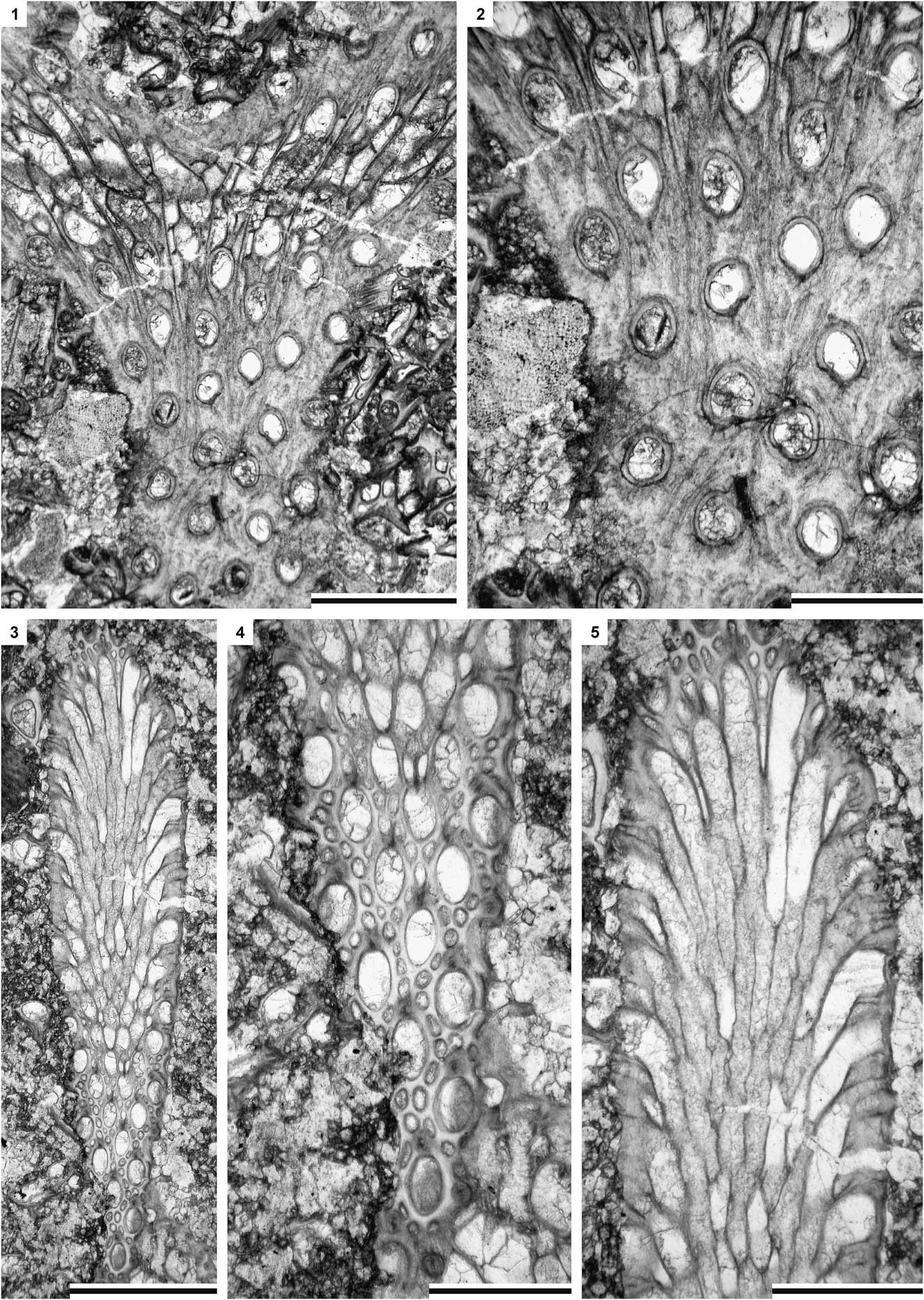
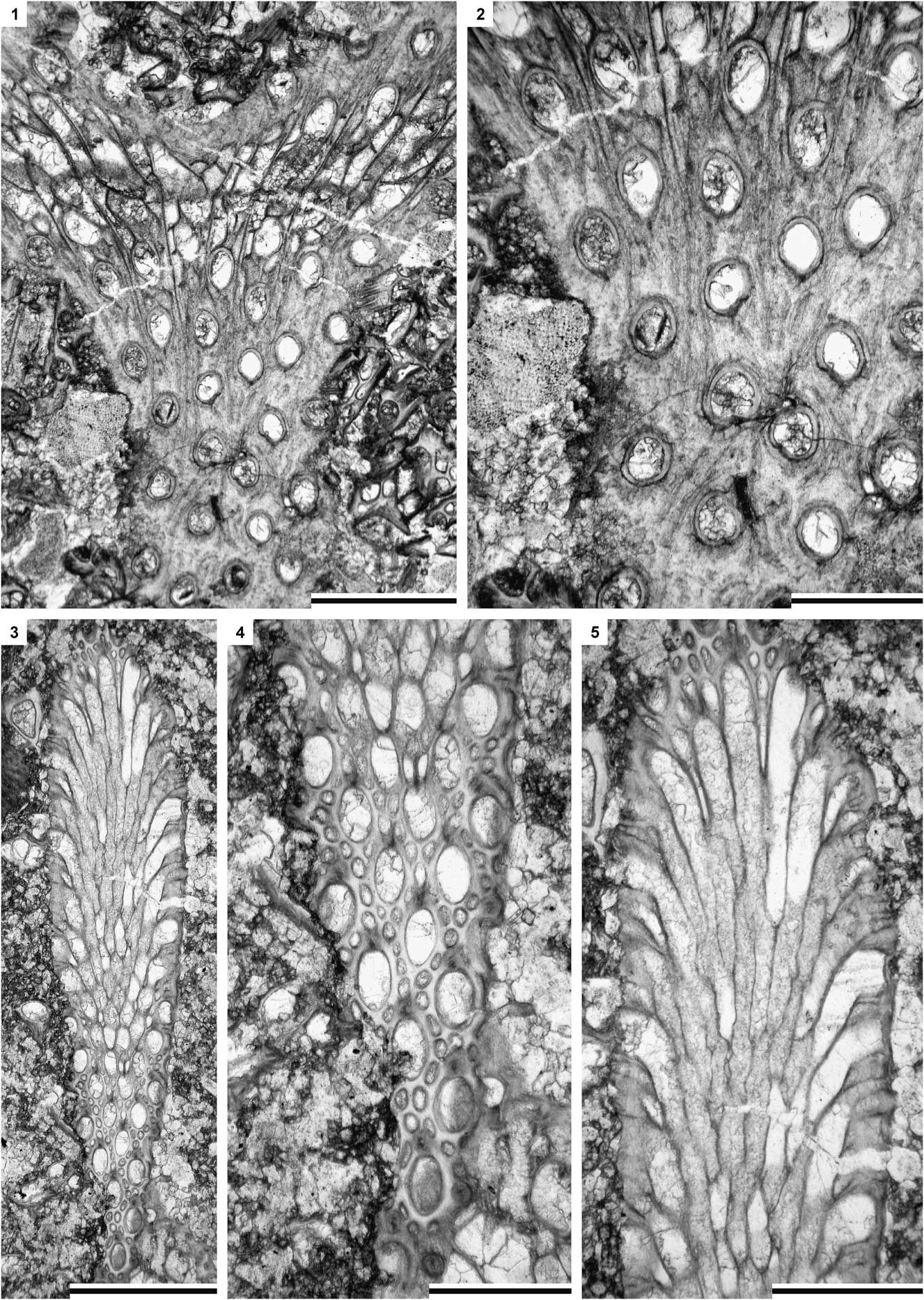
(1–4) Cystodictya lineata Ulrich, Reference Ulrich1884: (1, 2) NMMNH P-79594, tangential section showing autozooecia with hemisepta and vesicles; (3, 4) NMMNH P-79617, transverse section showing autozooecia, mesotheca, and vesicles. (5) Sulcoretepora nitida (Ulrich, Reference Ulrich1890), NMMNH P-79605, oblique section of a branch showing autozooecia, stereo, and mesotheca. Scale bars = 0.5 mm.
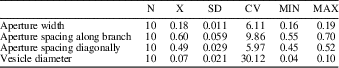
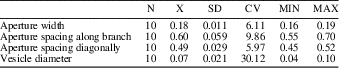
Descriptive statistics of Cystodictya lineata Ulrich, Reference Ulrich1884 (2 colonies). Measurements and abbreviations as in Table 1.
1884 Cystodictya lineata Reference UlrichUlrich, p. 37, pl. 2, figs. 4, 4a–c.
Holotype
USNM PAL 43652, Keokuk limestone, Mississippian; Kings Mountain Tunnel, Kentucky, USA
Occurrence
Tierra Blanca Member, Lake Valley Formation, Mississippian (Osagean); Sierra County, New Mexico, USA (present paper). Keokuk Limestone (Osagean), Mississippian; Kentucky, USA.
Description
Bifoliate branches, 3.13–3.25 mm wide and 0.9–1.0 mm thick. Mesotheca 0.025–0.030 mm thick, three-layered with two light-colored partitions separated by dark median lining; median tubules absent. Autozooecia tubular, teardrop-shaped at their bases, trapezoidal to semicircular in transverse section, quadrate in cross section, recumbent on mesotheca for relatively short distance, then bending upward at low angles in exozone and intersecting surface almost perpendicularly. Diaphragms lacking; long proximolateral hemisepta present at zooecial bend. Autozooecial apertures circular to oval, arranged in 7 or 8 alternating rows on the colony surface. Lunaria distinct, horseshoe-shaped. Vesicular skeleton well developed, covered in exozone by thick stereom. Vesicles small, rectangular in tangential section, with rounded roofs, partly separating autozooecia at mesotheca, completely separating them in exozone in 1 or 2 rows. Stereom well developed, 0.19–0.30 mm thick, consisting of laminated material, completely separating autozooecia in exozone.
Materials
NMMNH P-79593, P-79594, and P-79617.
Remarks
Cystodictya lineata differs from C. ocellata Ulrich, Reference Ulrich1882 in having longer distances between aperture centers (0.40–0.60 mm vs. 0.40–0.50 mm in C. ocellata). Cystodictya lineata differs from C. elegans Harlton, Reference Harlton1933 from the Mississippian of Oklahoma, USA, in having wider branches (3.13–3.25 mm vs. 0.67 mm in C. elegans).
Genus Sulcoretepora d’Orbigny, Reference Orbigny1849
1884 Arcanopora Reference VineVine, p. 204.
1955 Mstania Reference Schulga-NesterenkoSchulga-Nesterenko, p. 175.
1960 Acanthopora Vine; Reference MorozovaMorozova, p. 86, incorrect subsequent spelling.
Type species
Flustra ? parallela Phillips, Reference Phillips1836, by subsequent designation (d’Orbigny, Reference Orbigny1849); Mississippian; Whitewell, Yorkshire, England.
Diagnosis
Colony of narrow bifoliate ribbons, dichotomously branched in plane of mesotheca. Elongate, rounded autozooecia in ranges, rhombically arranged on lateral sides of branches. Lunaria elevated on proximolateral sides of autozooecia; range walls elevated; monticules absent; branch margins narrow, noncelluferous. Mesotheca with dark central layer and laminated outer layers; sharply folded in center, undulatory near branch margins; median tubules absent. Autozooecia full width and rectangular to parallelogram-shaped in deep tangential section; contiguous; alternating across mesotheca. Compound range walls with dark median zone continuous into boundary zone in mesotheca; lateral zones laminated; branched dark zones and tubuli in thickened range walls in exozone. Autozooecia subquadrate to subhemispherical in cross section at mesotheca; angular, teardrop-shaped in deep tangential section in midexozone and partially isolated between range walls by small, blister-like vesicles. Lunaria laminated, indistinct. Vesicles adjacent to mesotheca only at noncelluliferous margins. Stereom laminated with tubules in endozone.
Occurrence
Devonian–Permian; Europe, North America, and Asia.
Remarks
The genus Sulcoretepora differs from the genus Cystodictya by the absence of hemisepta.
Sulcoretepora nitida (Ulrich, Reference Ulrich1890)
Figures 5.5, 6.1, 6.2; Table 3
(1, 2) Sulcoretepora nitida (Ulrich, Reference Ulrich1890), NMMNH P-79603, tangential section showing autozooecial apertures and vesicles. (3–5) Nikiforovella sp., NMMNH P-79580: (3) oblique section of a branch; (4) tangential section showing autozooecial apertures, metazooecia, and acanthostyles; (5) longitudinal section showing autozooecial chambers and metazooecia. Scale bars = 1 mm (1, 3), 0.5 mm (2, 4, 5).
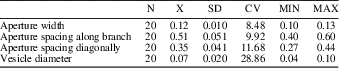
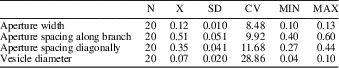
Descriptive statistics of Sulcoretepora nitida (Ulrich, Reference Ulrich1890) (3 colonies). Measurements and abbreviations as in Table 1.
1890 Cystodictya nitida Reference UlrichUlrich, p. 493, pl. 81, figs. 4, 4a–c.
Syntypes
ISGS (ISM) 2737. Keokuk Group, Mississippian; Bentonsport, Iowa, USA
Occurrence
Tierra Blanca Member, Lake Valley Formation, Mississippian (Osagean); Sierra County, New Mexico, USA (present paper). Keokuk Limestone, Mississippian; Iowa, USA.
Description
Branched, bifoliate colonies, 1.6–2.5 mm wide and 0.53 mm thick. Autozooecia short, budding from straight mesotheca, trapezoidal to semicircular in transverse section at bases, rectangular in deep tangential section, becoming rounded in exozone. Mesotheca 0.005–0.010 mm thick. Rare planar diaphragms present in autozooecia. Autozooecial apertures circular to oval, arranged in 6 or 7 alternating rows on colony surface. Lunaria obscure. Vesicles common, flat, with rounded roofs, polygonal in midtangential section, moderate in size. Stereom weakly developed, laminated, containing small tubules. Autozooecial walls compound, 0.008–0.015 mm thick in endozone. Indistinct longitudinal crests dividing apertural rows.
Materials
NMMNH P-79603, P-79605, P-79607 to P-79609, and P-75159.
Remarks
Sulcoretepora nitida differs from S. commutata Balakin, Reference Balakin1975 from the lower Viséan (Mississippian) of Uzbekistan in having narrower branches (1.6–2.5 mm vs. 2.25–4.25 mm in S. commutata) and smaller autozooecial apertures (aperture width 0.10–0.13 mm vs. 0.12–0.16 mm in S. commutata). Sulcoretepora nitida differs from S. curvata Nekhoroshev, Reference Nekhoroshev1956 from the Mississippian of Altai in having smaller autozooecial apertures (aperture width 0.10–0.13 mm vs. 0.16–0.20 mm in S. curvata).
Order Cryptostomata Vine, Reference Vine1884
Suborder Rhabdomesina Astrova and Morozova, Reference Astrova and Morozova1956
Family Nikiforovellidae Gorjunova, Reference Gorjunova1975
Genus Nikiforovella Nekhoroshev, Reference Nekhoroshev1948
Type species
Nikiforovella alternata Nekhoroshev, Reference Nekhoroshev1948, by original designation. Mississippian; Altai, Russia.
Diagnosis
Branched colonies. Autozooecia diverging at low angles from distinct median axis. Hemisepta absent; diaphragms rare. Autozooecial walls laminated, with dark zooecial boundaries. Metazooecia few, between longitudinally successive autozooecial apertures; acanthostyles common to abundant. Longitudinal ridges absent.
Occurrence
Devonian–Permian; worldwide.
Remarks
Nikiforovella is similar to Streblotrypella Nikiforova, Reference Nikiforova1948, but differs from the latter mainly in the shape of the autozooecia, which bend at higher angles in the exozone, and in the absence of longitudinal ridges. Moreover, styles can be absent in Streblotrypella.
Nikiforovella sp.
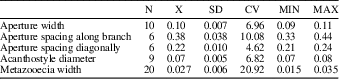
Descriptive statistics of Nikiforovella sp. (one colony). Measurements and abbreviations as in Table 1.
Occurrence
Andrecito Member, Lake Valley Formation, Mississippian (Osagean); Sierra County, New Mexico, USA.
Description
Branched colony, 0.92 mm in diameter, with 0.18 mm wide exozone and 0.56 mm wide endozone. Autozooecia growing in spiral pattern from median axis, rhombic in transverse section of endozone, abruptly bending in exozone. Autozooecial apertures oval to circular, arranged in regular diagonal rows. Autozooecial diaphragms absent; terminal diaphragms occurring. Metazooecia originating at base of exozone, 5 or 6 arranged between longitudinally successive autozooecial apertures. Single acanthostyle positioned on distal end of each autozooecial aperture, having distinct hyaline cores and laminated sheaths. Autozooecial walls granular, 0.003–0.005 mm thick in endozone, finely laminated, without visible zooecial boundaries in exozone.
Material
NMMNH P-79580.
Remarks
The present specimen differs from Nikiforovella alternata Nekhoroshev, Reference Nekhoroshev1948 in having a different number of acanthostyles and metazooecia between longitudinally successive autozooecial apertures (1 acanthostyle vs. 2 in N. alternata, and 5 or 6 metazooecia vs. 2 in N. alternata).
Genus Streblotrypella Nikiforova, Reference Nikiforova1948
Type species
Streblotrypa major Ulrich in Miller, Reference Miller1889. Mississippian; USA.
Diagnosis
Branched colonies. Autozooecia diverging at low angles from distinct median axis or lamina. Hemisepta absent; diaphragms rare. Autozooecial walls laminated, with dark zooecial boundaries. Metazooecia few to abundant; aktinotostyles or acanthostyles few or absent.
Occurrence
Devonian–Permian; worldwide.
Remarks
Streblotrypella is similar to Nikiforovella Nekhoroshev, Reference Nekhoroshev1948, but differs from the latter mainly in the shape of the autozooecia, which bend at low angles in the exozone.
Streblotrypella sp.
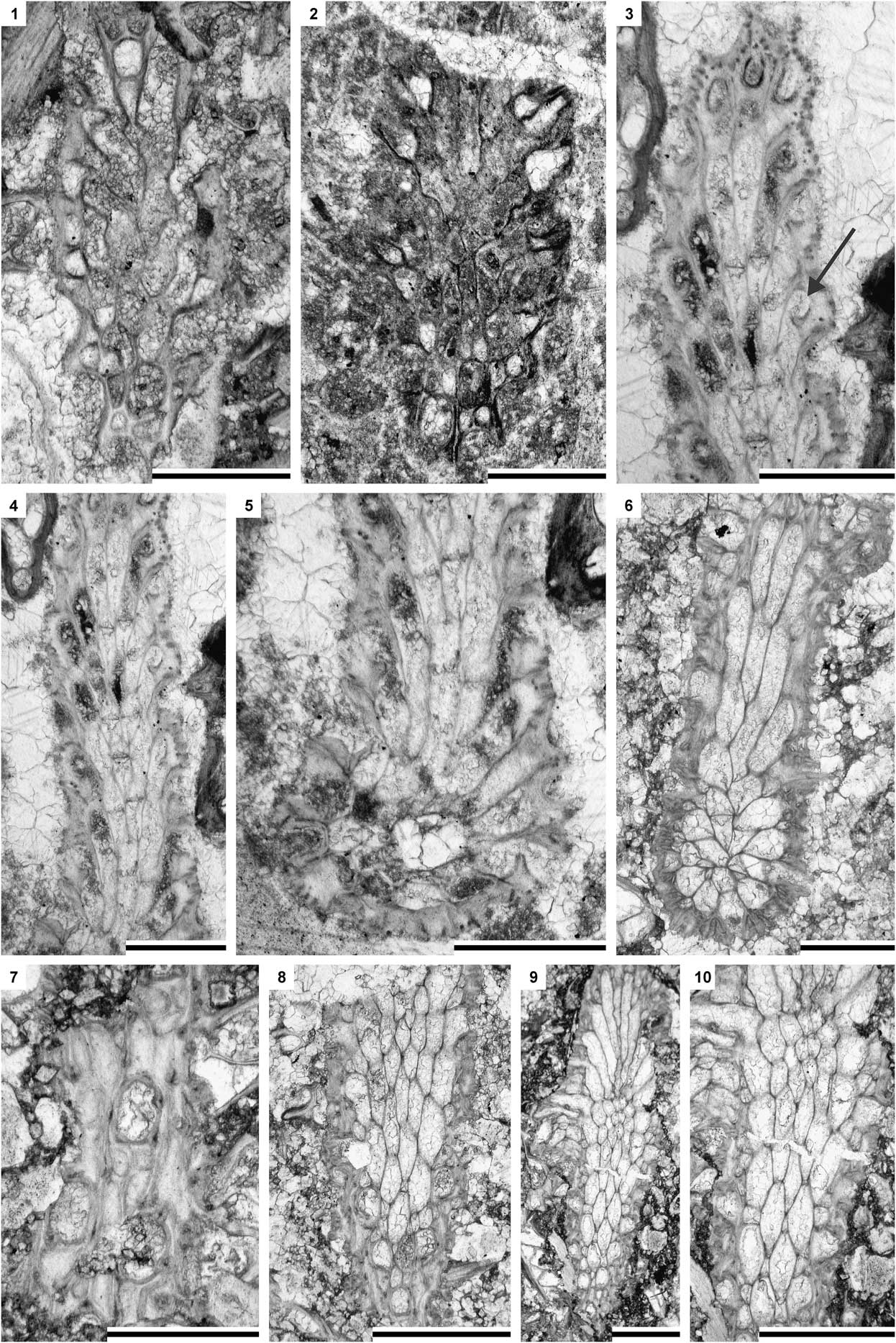
(1, 2) Streblotrypella sp.: (1) NMMNH P-79596, oblique section of a branch showing autozooecial chambers, apertures, and metazooecia; (2) NMMNH P-79588, oblique section of a branch showing autozooecial chambers, apertures, and metazooecia. (3–5) Nicklesopora exigua (Ulrich, Reference Ulrich1890), NMMNH P-79588: (3) oblique section of a branch showing autozooecial chambers, apertures, and paurostyles (arrow = hemiseptum); (4) oblique section of a branch showing autozooecial chambers with diaphragms and hemisepta; (5) oblique section of a branch showing autozooecial chambers with diaphragms, hemisepta, and paurostyles in the laminated wall of the exozone. (6–10) Clausotrypa denticulata (Ulrich, Reference Ulrich1888): (6, 9, 10) NMMNH P-79580: (6) transverse section of a branch showing autozooecial chambers, acanthostyles, and tectitozooecia; (9, 10) oblique section of a branch showing autozooecial chambers and apertures, acanthostyles, and tectitozooecia; (7, 8) NMMNH P-79583: (7) tangential section showing autozooecial apertures, acanthostyles, and tectitozooecia; (8) oblique section of a branch showing autozooecial chambers, apertures, acanthostyles, and tectitozooecia. Scale bars = 0.5 mm (1–7), 1 mm (8–10).
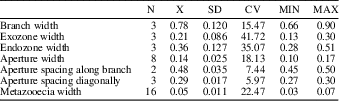
Descriptive statistics of Streblotrypella sp. (5 colonies). Measurements and abbreviations as in Table 1.
Occurrence
Andrecito and Tierra Blanca members, Lake Valley Formation, Mississippian (Osagean); Sierra County, New Mexico, USA.
Description
Branched colonies, 0.66–0.90 mm in diameter, with 0.13–0.30 mm wide exozones and 0.28–0.51 mm wide endozones. Autozooecia growing in spiral pattern from the median axis, rhombic in transverse section of endozone, abruptly bending in exozone. Autozooecial apertures oval to circular, arranged in regular diagonal rows. Autozooecial diaphragms present, usually one in each autozooecium. Metazooecia originating at base of exozone, 2 or 3 arranged between longitudinally successive autozooecial apertures. Styles not observed. Autozooecial walls granular, 0.005–0.008 mm thick in endozone, finely laminated, without visible zooecial boundaries in exozone.
Materials
NMMNH P-79588, P-79592, P-79593, P-79596, and P-79615.
Remarks
Streblotrypella sp. differs from S. major (Ulrich in Miller, Reference Miller1889) in having 2 or 3 metazooecia between autozooecial apertures instead of 3–5 in S. major, as well as in the absence of styles. Streblotrypella sp. differs from S. strabona Trizna, Reference Trizna1958 from the Mississippian of Siberia and Europe in having 2 or 3 metazooecia between autozooecial apertures instead of 2–4 in S. strabona, as well as in having thinner branches (branch width 0.66–0.90 mm vs. 1.0–1.13 mm in S. strabona). The present material, however, is insufficient for establishing a new species.
Family Goldfussitrypidae Gorjunova, Reference Gorjunova1985
Genus Nicklesopora Bassler, Reference Bassler1952
Type species
Rhombopora elegantula Ulrich, Reference Ulrich1884, by subsequent designation (Bassler, Reference Bassler1952). Lower Mississippian; Kentucky, USA.
Diagnosis
Branched colonies. Axial region formed by few axial zooecia, not in distinct bundle. Autozooecia initially polygonal, irregular in transverse section, becoming hexagonal. Autozooecial apertures oval, arranged in regular alternating longitudinal rows. Single short, commonly massive superior hemiseptum near zooecial bend. Diaphragms rare. Paurostyles common, usually in single linear series enclosing apertures in polygonal patterns. Monticules rare, consisting of one much enlarged polymorph, surrounded by smaller polymorphs.
Occurrence
Devonian–Permian; Eurasia and North America.
Remarks
Nicklesopora differs from Rhabdomeson Young and Young, Reference Young and Young1874 in its development of several axial zooecia instead of a single one and in the presence of only paurostyles instead of acanthostyles and paurostyles in Rhabdomeson. Nicklesopora differs from Paranicklesopora Gorjunova, Reference Gorjunova1988 in possessing only superior hemisepta and paurostyles (superior and inferior hemisepta are present in Paranicklesopora, as are acanthostyles and paurostyles).
Nicklesopora exigua (Ulrich, Reference Ulrich1890)
1890 Rhombopora exigua Reference UlrichUlrich, p. 651, pl. 70, fig. 10–10a.
1953 Rhombopora exigua; Reference NekhoroshevNekhoroshev, p. 147, pl. 21, figs. 4a–c.
1962 non Rhombopora exigua Ulrich, Reference Ulrich1890; Reference SakagamiSakagami, p. 238, pl. 38, figs. 1–2.
Holotype
ISGS (ISM) 4450, Burlington Group, Mississippian; Burlington, Iowa, USA.
Occurrence
Upper Tournaisian, Mississippian; Kazakhstan. Burlington Limestone, Osagean, Mississippian; Iowa, USA. Andrecito Member, Lake Valley Formation, Mississippian (Osagean); Sierra County, New Mexico, USA (present paper).
Description
Branched colony, 0.85 mm in diameter, with 0.45 mm wide endozone and 0.20 mm wide exozone. Autozooecia tubular, growing from central bundle of zooecia, abruptly bending in exozones. Superior hemisepta long, hook-shaped, curved proximally. Autozooecial diaphragms present. Autozooecial apertures oval, arranged in regular diagonal rows on branches, 0.05–0.06 mm wide. Paurostyles abundant, 0.02–0.03 mm in diameter. Autozooecial walls finely laminated, 0.003–0.005 mm thick in endozone, laminated, with dark dividing layer in exozones.
Material
NMMNH P-79588.
Remarks
Nicklesopora exigua differs from N. varians (Ulrich, Reference Ulrich1890) from the Mississippian of the USA in having thinner branches (branch diameter 0.85 mm vs. 2–4 mm in N. varians). Nicklesopora exigua differs from N. ispaiensis Balakin, Reference Balakin1975 from the lower Viséan of Uzbekistan in having thinner branches (branch width 0.85 mm vs. 1.25–1.50 mm in N. ispaiensis) and smaller apertures (aperture width 0.05–0.06 mm vs. 0.07–0.09 mm in N. ispaiensis).
Remarks
The species described by Sakagami (Reference Sakagami1962) as Rhombopora exigua Ulrich, Reference Ulrich1890 from the Mississippian of Japan does not fit the diagnosis of this species because it possesses two kinds of styles—acanthostyles and apparently paurostyles—as well as both superior and inferior hemisepta. The Japanese material could belong to the genus Paranicklesopora.
Family Nematotrypidae Spjeldnaes, Reference Spjeldnaes1984
Genus Clausotrypa Bassler, Reference Bassler1929
1971 Nemacanthopora Reference Termier and TermierTermier and Termier, p. 21.
Type species
Clausotrypa separata Bassler, Reference Bassler1929, by original designation. Lower Permian; Timor, Indonesia.
Diagnosis
Branched colonies. Autozooecia elongated-tubular with rare diaphragms. Autozooecial apertures rounded or oval. Tectitozooecia common, irregular, closed by laminated skeleton near colony surface. Acanthostyles on surface common. Autozooecial walls laminated, with dark serrated boundaries.
Occurrence
Mississippian–Permian; Europe and Asia.
Remarks
Clausotrypa differs from Nematotrypa Bassler, Reference Bassler1911 in the absence of hemiphragms and the budding pattern of the autozooecia, which bud from a distinct median axis in Nematotrypa. Nemacanthopora was separated from Clausotrypa because of the shape of its autozooecia (shorter vs. longer autozooecia in Clausotrypa). However, this character is quite subjective and inconsistent within species placed in both genera and apparently depends on the branch diameter. Therefore, Nemacanthopora was assigned as a junior synonym of Clausotrypa (Ernst et al., Reference Ernst, Wyse Jackson and Aretz2015).
Clausotrypa denticulata (Ulrich, Reference Ulrich1888) new combination
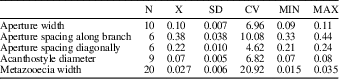
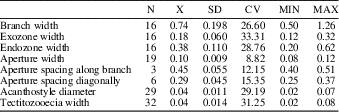
Descriptive statistics of Clausotrypa denticulata (Ulrich, Reference Ulrich1888) (16 colonies). Measurements and abbreviations as in Table 1.

1888 Streblotrypa (?Lioclema) denticulata Reference UlrichUlrich, p. 88, pl. 14, figs. 18, 19.
Syntype
USNM PAL 43484, Waverly Group, Mississippian; Richfield, Ohio, USA.
Occurrence
Andrecito Member, Lake Valley Formation, Mississippian (Osagean); Sierra County, New Mexico, USA (present paper). Cuyahoga shales, Wavery series, Mississippian; Ohio, USA.
Description
Cylindrical branches, 0.50–1.26 mm in diameter, with 0.12–0.32 mm wide endozone and 0.20–0.62 mm wide exozones. Autozooecia long, cylindrical, budding parallel to branch axis for long distance, gently curving toward colony surface. Autozooecial apertures oval. Thin, planar diaphragms rare in autozooecia. Tectitozooecia abundant, separating autozooecia in 1 or 2 rows, restricted to exozone, covered by thick calcitic skeleton on colony surface. Acanthostyles large, having distinct hyaline cores, 5–8 surrounding each aperture, arranged irregularly in spaces between autozooecia. Autozooecial walls laminated, having dark serrated boundaries, 0.008–0.010 mm thick in endozones.
Materials
NMMNH P-79583, P-79585 to P-79588, P-79610, P-79611, P-79613, and P-79615.
Remarks
Clausotrypa denticulata is similar to C. ramosa (Owen, Reference Owen1973) from the Mississippian of Europe, but differs from the latter in having thinner branches (branch diameter 0.50–1.08 mm vs. 1.01–1.64 mm in C. ramosa) and smaller autozooecial apertures (average aperture width 0.10 mm vs. 0.13 mm in C. ramosa).
Order Fenestrata Elias and Condra, Reference Elias and Condra1957
Suborder Fenestellina Astrova and Morozova, Reference Astrova and Morozova1956
Family Fenestellidae King, Reference King1849
Genus Minilya Crockford, Reference Crockford1944
Type species
Minilya duplaris Crockford, Reference Crockford1944, by original designation. Lower Permian; Australia.
Diagnosis
Reticulate colonies consisting of moderately thick branches and thin dissepiments. Fenestrules almost rectangular. Autozooecia arranged in two rows on branches, triangular to trapezoidal in midtangential section. Axial wall between autozooecial rows strongly zigzag. Superior hemisepta present; inferior hemisepta absent. Keel broad, low, carrying two alternating rows of nodes. Dorsal surface containing microstylets and nodes (modified after Morozova, Reference Morozova2001, p. 57).
Occurrence
Middle Devonian–upper Permian; worldwide.
Remarks
Minilya is similar to Spinofenestella Termier and Termier, Reference Termier and Termier1971, but differs in having two rows on the keel instead of one in Spinofenestella.
Minilya sp.
(1, 2) Minilya sp.: (1) NMMNH P-79598, oblique tangential section showing autozooecial chambers and apertures and alternating keel nodes; (2) NMMNH P-79599, oblique tangential section showing autozooecial chambers, apertures (arrow = stellate structure), and alternating keel nodes. (3–6) Laxifenestella sp.: (3, 4, 6) NMMNH P-79604: (3) tangential section showing autozooecial chambers, apertures, and keel nodes (arrow); (4) tangential section showing autozooecial chambers with superior hemisepta (arrows) and apertures; (6) midtangential section showing autozooecial chambers and keel nodes (arrow); (5) NMMNH P-79607, midtangential section showing autozooecial chambers;. (7–9) Spinofenestella sp., NMMNH P-79581: (7, 8) tangential section showing autozooecial chambers, apertures, and keel nodes; (9) tangential section showing chambers, apertures, and keel nodes. Scale bars = 1 mm (1–3, 5), 0.5 mm (4, 6, 9), 2 mm (7, 8).

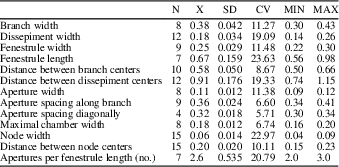
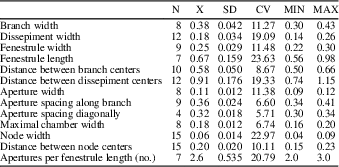
Descriptive statistics of Minilya sp. (2 colonies). All measurements in mm unless otherwise noted. Abbreviations as in Table 1.
Occurrence
Tierra Blanca Member, Lake Valley Formation, Mississippian (Osagean); Sierra County, New Mexico, USA.
Description (exterior)
Reticulate colonies with straight branches, joined by narrow dissepiments. Autozooecia arranged in two alternating rows on branches. Apertures circular, having low peristomes, 2 or 3 spaced per fenestrule length. Shape of fenestrules varying from oval to rectangular with rounded corners. Keel low, carrying two alternating rows of small, closely spaced nodes. Internal granular skeleton thin, continuous with obverse keel, nodes, peristome, and across dissepiments. Outer lamellar skeleton thin. Reverse side smooth, containing microstyles 0.010–0.015 mm in diameter.
Description (interior)
Autozooecia triangular to trapezoidal in middle tangential section, low and elongated, with well-developed vestibule; aperture positioned distal to distal-abaxial end of chamber. Axial wall between autozooecial rows strongly zigzag. Superior hemisepta well-developed, serrated; inferior hemisepta absent.
Materials
NMMNH P-79598 and P-79599.
Remarks
Two species regarded as belonging to Minilya were described from the Mississippian of Utah: M. incipiens (Burkle, Reference Burckle1960) and M. crockfordae (Burkle, Reference Burckle1960). These species were only described externally, therefore their assignment to Minilya can be considered as uncertain. They each differ from the present material in having smaller-sized fenestrules and thicker branches. The present material differs from M. sivonella Snyder, Reference Snyder1991 from the Mississippian of the Upper Mississippi Valley in its smaller fenestrules (fenestrule length 0.67 mm vs. 0.87 mm in M. sivonella; fenestrule width 0.25 mm vs. 0.33 in M. sivonella) and in spacing of 2 or 3 apertures per fenestrule length instead of 2–5 in M. sivonella.
Genus Laxifenestella Morozova, Reference Morozova1974
Type species
Fenestella sarytshevae Schulga-Nesterenko, Reference Schulga-Nesterenko1951, by subsequent designation (Morozova, Reference Morozova1974). Mississippian, Serpukhovian; Moscow Syncline, Russia.
Diagnosis
Reticulate colonies consisting of relatively wide, thick branches and moderately wide dissepiments. Autozooecia arranged in two rows on branches, rectangular to pentagonal in midtangential section. Axial wall between autozooecial rows weakly undulating. Both superior and inferior hemisepta present. Narrow keel with single row of nodes developed (modified after Morozova, Reference Morozova2001, p. 44).
Occurrence
Lower Devonian–upper Permian; worldwide.
Remarks
Laxifenestella differs from Fenestella Lonsdale, Reference Lonsdale1839 in the rectangular to pentagonal shape of its autozooecia in midtangential section and the presence of well-developed hemisepta.
Laxifenestella sp.
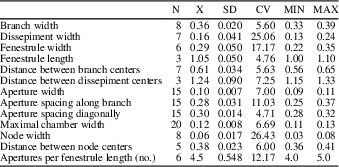
Descriptive statistics of Laxifenestella sp. (2 colonies). All measurements in mm unless otherwise noted. Abbreviations as in Table 1.

Occurrence
Tierra Blanca Member, Lake Valley Formation, Mississippian (Osagean); Sierra County, New Mexico, USA.
Description (exterior)
Reticulate colony formed by straight branches joined by relatively narrow dissepiments. Fenestrules oval to rectangular. Autozooecia arranged in two rows on branches. Autozooecial apertures circular, with low peristome; 4 or 5 apertures spaced per fenestrule length. Rounded nodes on the low keel, regularly spaced. Reverse side finely striated.
Description (interior)
Autozooecia relatively long, roughly pentagonal to rectangular in midtangential section, with short to moderately long vestibule in longitudinal section. Axial wall between autozooecial rows straight to weakly undulating; aperture positioned at distal end of chamber. Superior hemisepta long; inferior hemisepta indistinct. External laminated skeleton well developed, traversed by microstyles on both obverse and reverse sides. Microstyles 0.003–0.005 mm in diameter. Heterozooecia not observed.
Materials
NMMNH P-79604 and P-79607.
Remarks
Laxifenestella sp. differs from L. juxtaserratula (Trizna, Reference Trizna1958) from the Mississippian (Tournaisian) of the Kuznets Basin in having wider branches (branch width 0.33–0.39 mm vs. 0.25–0.30 mm in L. juxtaserratula) and larger fenestrules (fenestrule width 0.22–0.35 mm vs. 0.20–0.22 in L. juxtaserratula; fenestrule length 1.00–1.10 mm vs. 0.45–0.55 in L. juxtaserratula). The present species is similar to L. snyderi Gilmour and McColloch, Reference Gilmour and McColloch1995 from the Otter Formation (Viséan) of Montana, but differs from it in its spacing of 4 or 5 apertures per fenestrule length instead of 3 of 4 in the latter species, as well as in having wider spacing of branches (average distance between branch centers 0.61 mm vs. 0.47 mm in L. snyderi).
Genus Spinofenestella Termier and Termier, Reference Termier and Termier1971
1971 Alternifenestella Reference Termier and TermierTermier and Termier, p. 42.
Type species
Fenestella spinulosa Condra, Reference Condra1902, by subsequent designation (Termier and Termier, Reference Termier and Termier1971). Lower Permian (Wolfcampian); North America.
Diagnosis
Reticulate colonies with relatively wide, thick branches and relatively thin dissepiments. Autozooecia arranged in two rows on branches. Autozooecia triangular in midtangential section, triangular to pentagonal proximal to bifurcations. Narrow keel with single row of nodes.
Occurrence
Lower Devonian–upper Permian; worldwide.
Remarks
Spinofenestella differs from the genus Rectifenestella Morozova, Reference Morozova1974 by the triangular shape of the autozooecia in midtangential section.
Spinofenestella sp.
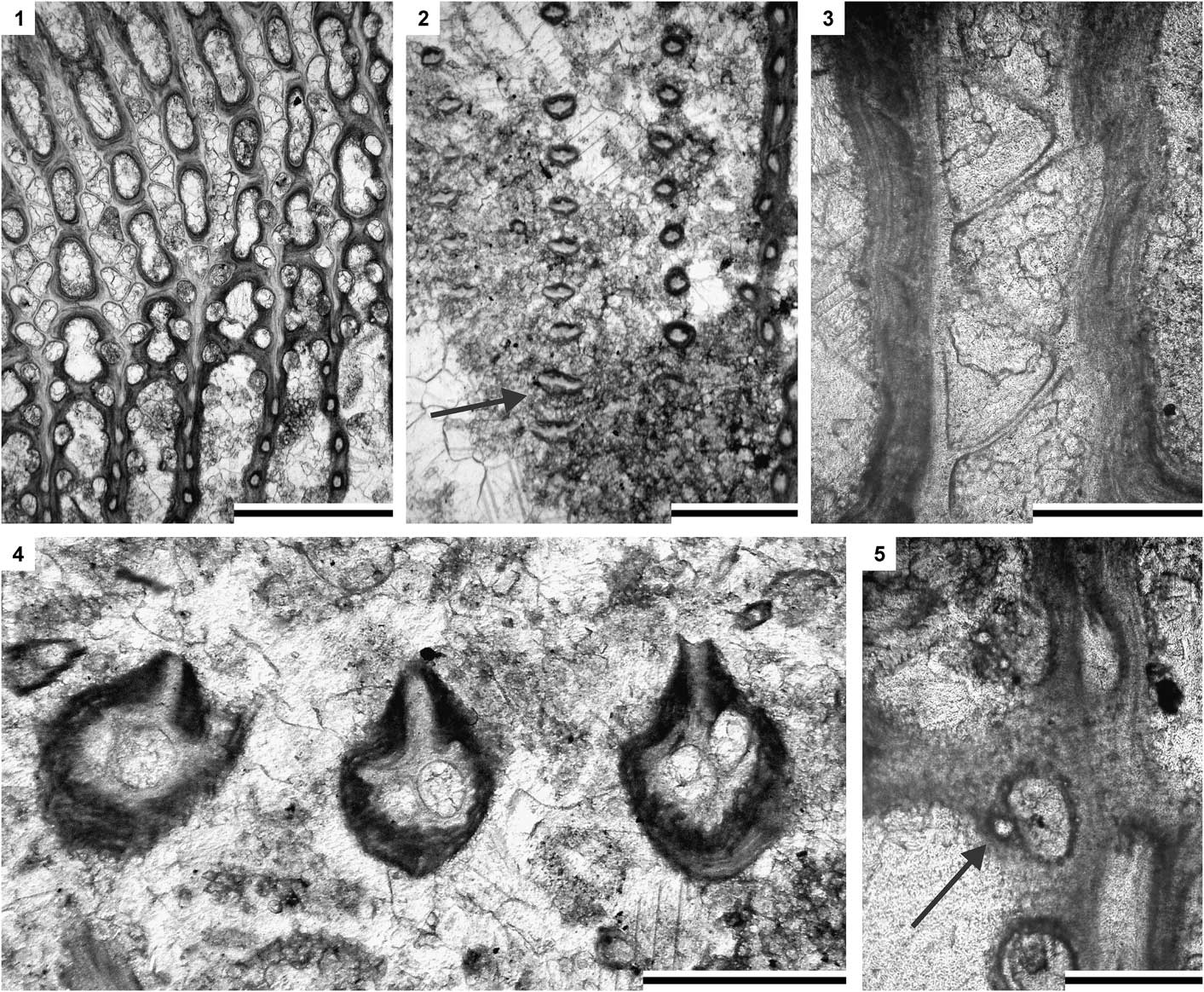
Figures 8.7–8.9, 9.1–9.5; Table 9
Spinofenestella sp.: (1, 2) NMMNH P-79581: (1) midtangential section showing autozooecial chambers, apertures, and keel nodes; (2) shallow tangential section showing dashed keel nodes (arrow); (3–5) NMMNH P-79616: (3) midtangential section showing autozooecial chambers; (4) branch transverse section; (5) tangential section showing autozooecial apertures with nodes (arrow). Scale bars = 1 mm (1), 0.5 mm (2, 4), 0.2 mm (3, 5).
Descriptive statistics of Spinofenestella sp. (2 colonies). All measurements in mm unless otherwise noted. Abbreviations as in Table 1.

Occurrence
Andrecito Member, Lake Valley Formation, Mississippian (Osagean); Sierra County, New Mexico, USA.
Description (exterior)
Reticulate colony formed by straight branches joined by wide dissepiments. Fenestrules oval to rectangular, short, narrow. Autozooecia arranged in two alternating rows on branches. Autozooecial apertures circular, with stellate structure; 2–4 apertures spaced per fenestrule length. Single node present in aperture rim. Median keel low, wide, containing single row of large, densely spaced nodes. Keel nodes locally dashed. Nodes present on reverse side of branches, 0.03–0.08 mm in diameter.
Description (interior)
Autozooecia short, triangular to trapezoid in midtangential section, with short vestibule in longitudinal section. Axial wall between autozooecial rows strongly zigzag; aperture positioned at distal end of chamber. Superior hemisepta weakly developed; inferior hemisepta absent. External laminated skeleton well developed on both obverse and reverse sides, traversed by small microstyles. Heteromorphs not observed.
Materials
NMMNH P-79581, P-79582, P-79585, and P-79616.
Remarks
In its morphology, the present species generally fits the genus Spinofenestella. However, one of two studied samples has locally dashed (diverging) nodes on the keel, which makes it similar to the genus Cervella Chronic, Reference Chronic1949. The latter genus is characterized by an unfused superstructure produced by bifurcating spines on the keel. However, Cervella was described only externally; nothing about the internal morphology of this genus is known.
The present species differs from Spinofenestella taxata (Schulga-Nesterenko, Reference Schulga-Nesterenko1951) from the Mississippian (Serpukhovian) of Russia in having wider branches (branch width 0.22–0.40 mm vs. 0.20–0.25 mm in S. taxata) as well as larger fenestrules (fenestrule length 0.32–0.76 mm vs. 0.30–0.40 mm in S. taxata; fenestrule width 0.17–0.28 mm vs. 0.17–0.25 mm in S. taxata). Spinofenestella taxata lacks diverging nodes on the keel.
Discussion
The studied bryozoan fauna comes from the Andrecito Member (samples LVT 15 and 17) and Tierra Blanca Member (samples LVT 29 and 34) of the type section of the Lake Valley Formation. It includes 10 species: (1) three cystoporates: Cystomeson sierraensis n. gen. n. sp., Cystodictya lineata, and Sulcoretepora nitida; (2) four cryptostomes (Rhabdomesina): Nikiforovella sp., Streblotrypella sp., Nicklesopora exigua, and Clausotrypa denticulata; and (3) three fenestrates, all described in open nomenclature: Minilya sp., Laxifenestella sp., and Spinofenestella sp. Also, the studied samples contain numerous fragments of fenestrates, rhabdomesine cryptostomes, and a few trepostomes that could not be identified at the genus or species level.
The Andrecito Member contains the following species: Cystomeson sierraensis n. gen. n. sp., Nikiforovella sp., Streblotrypella sp., Nicklesopora exigua, Clausotrypa denticulata, and Spinofenestella sp.
The Tierra Blanca Member contains the following species: Cystomeson sierraensis n. gen. n. sp., Cystodictya lineata, Sulcoretepora nitida, Streblotrypella sp., Minilya sp., and Laxifenestella sp.
Cystomeson sierraensis n. gen. n. sp. is ubiquitous in both members, whereas Cystodictya lineata and Sulcoretepora nitida are restricted to the Tierra Blanca Member. Nikiforovella sp. and Nicklesopora exigua were found in the Andrecito Member, where they are rare. Clausotrypa denticulata is a common species in the Andrecito Member. Streblotrypella sp. occurs in both members. Fenestrates seem to be more diverse in the Tierra Blanca Member.
According to their sedimentological and paleontological characteristics, the Andrecito and Tierra Blanca members display different depositional environments (Krainer and Lucas, Reference Krainer and Lucas2012). The Andrecito Member displays generally deeper and quieter conditions, with relatively large amounts of micrite, a less-fragmented fauna and occasional cross bedding. Bryozoans of this member are mainly delicately branched (Nikiforovella sp., Streblotrypella sp., Nicklesopora exigua, Clausotrypa denticulata). Their branch diameters vary within the range 0.50–1.26 mm.
In contrast, the limestones of the Tierra Blanca Member display a higher degree of fragmentation of the fauna (including bryozoans), relatively small amounts of micrite, abundant cross bedding, and poor sorting of components. These sediments were deposited in the shelf area under high energy conditions. Bryozoans from this member are coarser than those in the Andrecito Member. Cystodictya lineata and Sulcoretepora nitida have flat, bifoliate branches that range from 1.60–3.25 mm in width and 0.52–1.00 mm in thickness. The fenestrates in the Tierra Blanca Formation have generally thicker branches than those in the Andrecito Member. Thicker branches in bryozoans often indicate higher energy conditions (e.g., Thomsen, Reference Thomsen1977; Schopf et al., Reference Schopf, Collier and Bach1980).
The genus Nikiforovella was previously identified in the Mississippian of the USA (Gilmour & McColloch, Reference Gilmour and McColloch1995), whereas Clausotrypa is here found for the first time in the Mississippian of North America. Nikiforovella was previously known from the Upper Devonian to the lower Permian of Eurasia, whereas Clausotrypa was recorded from the Devonian of China and from the Mississippian to the upper Permian of Eurasia and North America (Canada). The Mississippian Nikiforovella species are mainly known from Eurasia (Europe, Russia, Kazakhstan, Mongolia, and China). The Mississippian Clausotrypa species are restricted to Europe. All the other identified genera have a cosmopolitan distribution during Mississippian times.
Conclusions
The bryozoan fauna from the Lake Valley Formation (Mississippian) of Sierra County, New Mexico, USA is quite diverse and abundant. It contains a new genus with one new species (Cystomeson sierraensis n. gen. n. sp.) belonging to the order Cystoporata. The bryozoans of the Andrecito Member are less fragmented and generally more delicate than those in the Tierra Blanca Formation and thus indicate lower energy conditions in the Andrecito Member. Beside the new genus, the studied fauna contains genera with wide geographic distributions. But, at the species level, the studied fauna can be characterized as endemic to North America.
Acknowledgments
AE thanks the Deutsche Forschungsgemeinschaft (DFG) for financial support (grant ER 278/6.1). P. Wyse Jackson, Dublin, is thanked for his comments on bryozoan taxonomy. C. Reid, Christchurch, and J.L. Suarez Andres, Zurita de Pielagos, are thanked for their constructive and helpful reviews.