1 Introduction
A general principle in complex dynamics is that singular values control the dynamical behavior. There is now a long history of isolating interesting families of functions whose singular values can be parameterized in a way that allows one to understand how the dynamics varies across the family. In practice, one constrains the number of singular values and the behavior of one or more of them—for example, by demanding that the orbit of one tends to an attracting fixed point.
This paper is a step along the way to a general theory for meromorphic functions with finitely many singular values. We adapt a technique developed by Douady, Hubbard, and their students to study spaces of cubic polynomials, and used in [Reference Goldberg and KeenGK] for rational maps of degree two, in which the parameter space is modeled on the dynamic space of a fixed map in the family. We will be looking at a family of meromorphic functions that are close enough to rational maps of degree two that there should be (and is) a direct similarity between the behaviors. To put this in context, it helps to review some of the history.
The study of the parameter space for families of complex dynamical systems began with the family of quadratic polynomials. They have one critical value whose behavior determines the dynamics and it is this behavior that is captured by the Mandelbrot set and its complement. The next step was to study families with two free critical values—cubic polynomials and rational maps of degree two. Moving out of the realm of rational functions and into that of dynamics of transcendental functions, we see more substantial differences between entire and meromorphic functions than between polynomials and rationals. Rational maps define finite coverings of the plane, but transcendental maps define infinite coverings. Moreover, while the poles of rational maps are no different from regular points, the poles of (transcendental) meromorphic functions add a new flavor to the dynamics. It turns out that there are more similarities between the parameter space of rational maps of degree two and that of the tangent family
 $\lambda \tan z$
than between quadratic polynomials and the exponential family. See e.g. [Reference Devaney, Fagella and JarqueDFJ, Reference Devaney and KeenDK, Reference Fagella and GarijoFG, Reference KeenK, Reference Keen and KotusKK, Reference Rempe-GillenRG, Reference SchleicherSch]. Is this similarity just good fortune or is it suggestive of a more general pattern of relationships with rational maps?
Thanks to invariance under Möbius transformations, to study rational maps of degree two, we can restrict our attention to maps of the form
 $(z+b+1/z)/\rho $
where
 $b \in {\mathbb C}$
and
 $\rho \in {\mathbb C}^*$
. This family is often called
 $Rat_2$
in the literature. These functions fix infinity where the derivative (multiplier) is
 $\rho \neq 0$
and have two free critical values,
 $(b \pm 2)/\rho $
, rather than one as in the quadratic polynomial case. Constraining
 $\rho $
to lie in the punctured unit disk,
 ${\mathbb D}^*$
, makes infinity an attracting fixed point for all values of b. In [Reference Goldberg and KeenGK], a structure theorem is proved for this family that is as close as one could hope to the earlier examples.
Theorem 1.1. (Structure theorem for
 $Rat_2$
)

Fix
 $\rho \in {\mathbb D}^*$
and consider the family
 $(z+b+1/z)/\rho $
, where
 $b \in {\mathbb C}$
. The b plane is divided into three components by a bifurcation locus: two copies of the Mandelbrot set that meet at the origin and are symmetric about it, and a ‘shift locus’. For b in either copy of the Mandelbrot set, one or the other critical value is attracted to infinity and the other is not. In the shift locus, both critical values are attracted to infinity.
This paper looks at the family of meromorphic functions whose members ‘look like degree-two rationals’: they have two finite omitted asymptotic values,
 $\lambda $
and
 $\mu $
, and an attracting fixed point (in this case, at the origin) with multiplier
 $\rho $
:
 $$ \begin{align}~ f_{\lambda , \rho}(z) = \frac{e^z - e^{-z}}{({e^z}/{\lambda }) - ({e^{-z}})/{\mu}} \quad\text{ where } \frac{1}{\lambda } - \frac{1}{\mu}=\frac{2}{\rho}, \,\rho \in \mathbb{D}^*. \end{align} $$
We use
 ${\mathcal F}_2$
to denote this family. Our main result is a structure theorem for the slice of the parameter space defined by a fixed
 $\rho \in {\mathbb D}^*$
, and those
 $\lambda $
for which that
 $\rho $
has a corresponding
 $\mu $
, namely
 $\lambda $
not equal to
 $0$
or
 $\rho /2$
. It is a direct analogue of the
 $Rat_2$
theorem.
Theorem 1.2. (Main structure theorem)
For each
 $\rho \in {\mathbb D}^*$
, the parameter slice,
 $\lambda \in {\mathbb C} \setminus \{0, \rho /2 \}$
, divides into three distinct regions: two copies of connected and full sets,
 ${\mathcal M}_{\lambda }$
and
 ${\mathcal M}_{\mu }$
, in which only one of the asymptotic values,
 $\mu $
or
 $\lambda $
, is attracted to the origin and a ‘shift locus’,
 ${\mathcal S}$
, in which both asymptotic values are attracted to the origin. The shift locus,
 ${\mathcal S}$
, is conformally equivalent to a punctured annulus. The puncture is at the origin. The other puncture of the parameter plane,
 $\rho /2$
, is on the boundary of the shift locus.
We are able to give a description of the sets
 ${\mathcal M}_{\lambda }$
and
 ${\mathcal M}_{\mu }$
. Like the Mandelbrot set in
 $Rat_2$
,
 ${\mathcal M}_{\lambda }$
and
 ${\mathcal M}_{\mu }$
contain hyperbolic components in which one or the other of the asymptotic values tends to a non-zero attracting cycle. Within each component, the functions are quasiconformally conjugate. Components like this were first studied in [Reference Keen and KotusKK] where they occur in the parameter plane of the tangent family
 $\lambda \tan z$
. There, and in other later work (see [Reference Chen and KeenCK, Reference Fagella and KeenFK, Reference Keen and KotusKK]), it was proved that each component is a universal cover of
 ${\mathbb D}^*$
; based on the computer pictures, these components were called shell components. Thus, unlike the Mandelbrot set, the hyperbolic components do not contain a ‘center’ where the periodic cycle contains the critical value and has multiplier zero. Instead, they contain a distinguished boundary point with the property that as the parameter approaches this point, the limit of the multiplier of the periodic cycle attracting the asymptotic value is zero. It is thus called a ‘virtual center’.
Like the characterization of centers of the components of the Mandelbrot set in terms of the sequence of inverse branches that keep the critical value fixed, a virtual center
 $\lambda ^*$
can also be characterized by the property that there is some n such that
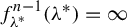 $f_{\lambda ^*}^{n-1}(\lambda ^*) = \infty $
or
 $f_{\lambda ^*}^{n-1}(\mu (\lambda ^*,\rho )) = \infty $
; the point is thus also called a ‘virtual cycle parameter of order n’. In this paper, we give a complete combinatorial description of the virtual cycle parameters.
Theorem 1.3. (Combinatorial structure theorem)
The virtual cycle parameters
 $\lambda _{{\mathbf k}_{n}}$
of order n can all be labeled by sequences
 ${\mathbf k}_n= k_{n-1} \ldots k_1$
, where
 $k_i \in {\mathbb Z}$
, in such a way that each of the parameters
 $\lambda _{{\mathbf k}_{n}}$
is an accumulation point in
 ${\mathbb C}$
of a sequence of parameters
 $\lambda _{{\mathbf k}_{n+1}} $
of order
 $n+1$
and related to
 ${{\mathbf k}_{n}}$
; that is,
 ${\mathbf k}_{n+1} =k_{n-1} \ldots k_1k_{0,j} $
,
 $j\in {\mathbb Z}$
. This combinatorial description of the virtual cycle parameters determines combinatorial descriptions of the sets
 ${\mathcal M}_{\lambda }$
and
 ${\mathcal M}_{\mu }$
.
In [Reference Chen, Jiang and KeenCJK], we proved a ‘transversality theorem’ for functions in the tangent family. Combining the techniques in the proof of this theorem with the results here, we prove the following.
Theorem 1.4. (Common boundary theorem)
Every virtual cycle parameter is both a boundary point of a shell component and a boundary point of the shift locus. Furthermore, the dynamics of the family
 $\{f_{\lambda }\}$
is transversal at each of these virtual cycle parameters (see Definition 5.1 and Remark 5.3). And even further, the set of all virtual cycle parameters is dense in the common boundary of the shift locus
 ${\mathcal S}$
and the sets
 ${\mathcal M}_{\lambda }\cup {\mathcal M}_{\mu }$
.
We begin by quickly reviewing the basic definitions and facts we need about the dynamics of meromorphic functions and a theorem of Nevanlinna, Theorem 2.4, which characterizes the functions we work with in terms of their Schwarzian derivatives. We next take a detailed look at
 ${\mathcal F}_2$
. In particular, in §3.3, we show that there is a dichotomy in the dynamics in this family analogous to that for quadratic polynomials: either the Julia set is a Cantor set or there is a connected ‘filled Julia set’ analogous to the filled Julia set of a quadratic polynomial.
The heart of the paper begins with the description of the sets
 ${\mathcal M}_{\lambda }$
and
 ${\mathcal M}_{\mu }$
from the main structure theorem and gives the definitions of virtual cycle parameters and virtual centers. The combinatorial description of the virtual cycle parameters, the combinatorial structure theorem, is given in §4.2. Pictures of the parameter plane follow and the rest of the paper contains the the proof of the common boundary theorem, which leads to a detailed discussion of the shift locus and the rest of the main structure theorem.
2 Background
2.1 Basic dynamics
Here we give the basic definitions, concepts, and notations we will use. When we say a function is meromorphic, we mean that it is transcendental meromorphic. We refer the reader to standard sources on meromorphic dynamics for details and proofs. See e.g. [Reference BergweilerBerg, Reference Branner and FagellaBF, Reference Baker, Kotus and LüBKL1, Reference Baker, Kotus and LüBKL2, Reference Baker, Kotus and LüBKL3, Reference Baker, Kotus and LüBKL4, Reference Devaney and KeenDK, Reference Keen and KotusKK].
We denote the complex plane by
 ${\mathbb C}$
, the Riemann sphere by
 $\widehat {\mathbb C}$
, and the unit disk by
 ${\mathbb D}$
. We denote the punctured plane by
 ${\mathbb C}^* = {\mathbb C} \setminus \{ 0 \}$
and the punctured disk by
 ${\mathbb D}^* = {\mathbb D} \setminus \{ 0 \}$
.
Given a family of meromorphic functions,
 $\{ f_{\lambda }(z) \}$
, we look at the orbits of points formed by iterating the function
 $f(z)=f_{\lambda }(z)$
. If
 $f^k(z)=\infty $
for some
 $k>0$
, z is called a pre-pole of order k—a pole is a pre-pole of order one. For meromorphic functions, the poles and pre-poles have finite orbits that end at infinity. The Fatou set or stable set,
 $F_f$
, consists of those points at which the iterates
 $\{f_{\lambda }^{n}\}_{n=0}^{\infty }$
are well defined and form a normal family in a neighborhood of each of them. The Julia set
 $J_f$
is the complement of the Fatou set and contains infinity as well as all the poles and pre-poles.
A point z such that
 $f^n(z)=z$
is called periodic. The minimal such
 $n>0$
is called the period. Periodic points are classified by their multipliers,
 $\nu (z)=(f^n)'(z)$
, where n is the period: they are repelling if
 $|\nu (z)|>1$
, attracting if
 $0< |\nu (z)| < 1$
, superattracting if
 $\nu =0$
, and neutral otherwise. A neutral periodic point is parabolic if
 $\nu (z)=e^{2\pi i p/q}$
for some rational
 $p/q$
. The Julia set is the closure of the repelling periodic points. For meromorphic f, it is also the closure of the pre-poles (see e.g. [Reference Baker, Kotus and LüBKL1]).
If D is a component of the Fatou set, either
 $f^n(D) \subseteq f^m(D)$
for some integers
 $n,m$
or
 $f^n(D) \cap f^m(D) = \emptyset $
for all pairs of integers
 $m \neq n$
. In the first case, D is called eventually periodic and in the latter case, it is called wandering. The periodic cycles of stable domains are classified as follows.
-
• Attracting or superattracting if the periodic cycle of domains contains an attracting or superattracting cycle in its interior.
-
• Parabolic if there is a parabolic periodic cycle on its boundary.
-
• Rotation if
$f^n: D \rightarrow D$
is holomorphically conjugate to a rotation map. Rotation domains are either simply connected or topological annuli, which are called Siegel disks or Herman rings, respectively. -
• Essentially parabolic, or Baker, if there is a point
$z_{\infty } \in \partial D$
such that
$f^{n} (z_{\infty })$
is not well defined and for every
$z \in D$
,
$\lim _{k \to \infty } f^{nk}(z) = z_{\infty }.$




A point a is a singular value of f if f is not a regular covering map over a.
-
• a is a critical value if for some z,
$f'(z)=0$
and
$f(z)=a$
. -
• a is an asymptotic value if there is a path
$\gamma (t)$
, called an asymptotic path, such that
$\lim _{t \to \infty } \gamma (t) = \infty $
and
$\lim _{t \to \infty } f(\gamma (t))=a$
. -
• The set of singular values
$S_f$
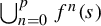
consists of the closure of the critical values and the asymptotic values. The post-singular set is For notational simplicity, if a pre-pole s of order p is a singular value,
$$ \begin{align*} P_f= \overline{\bigcup_{a \in S_f} \bigcup_{n=0}^{\infty} f^n(a) \cup \{\infty\}}. \end{align*} $$
$\bigcup _{n=0}^{p} f^n(s)$
is a finite set with
$f^{p} (s)=\infty $
.







Definition 2.1. If an asymptotic value a is isolated, it has neighborhoods U such that for at least one unbounded simply connected component V of
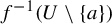 $f^{-1}(U\setminus \{a\})$
,
 $f:V \rightarrow U\setminus \{a\}$
is a universal covering map and we call V an asymptotic tract for a. If
 $V_1$
and
 $V_2$
are asymptotic tracts for a, and
 $f: V_1 \cap V_2 \rightarrow U\setminus \{a\}$
is a universal covering map, we say
 $V_1$
and
 $V_2$
are equivalent. The multiplicity of the asymptotic value a is the number of distinct equivalence classes of asymptotic tracts of a. An asymptotic value is called simple if its multiplicity is one.
Another important concept is the following.
Definition 2.2. A map f is hyperbolic if
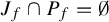 $J_f \cap {P_f} = \emptyset $
.
In rational dynamics, a map is hyperbolic if it satisfies an expansion property on its Julia set; that is, there exist constants
 $c>0$
and
 $K>1$
such that for all z in a neighborhood
 $V \supset J(f)$
,
 $|(f^{n})'(z)|> c K^n$
(see [Reference MilnorMil1]). For such maps, this property is equivalent to the condition that
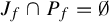 $J_f \cap {P_f} = \emptyset $
.
Because the Julia set of a meromorphic function is unbounded and its iterates have singularities at the pre-poles, we need a version of this condition tailored to transcendental maps. We use the following one proved in [Reference Rippon and StallardRS], which applies to hyperbolic functions in
 ${\mathcal F}_2$
.
Proposition 2.3. (Rippon–Stallard)
If
 $S(f)$
is bounded and
 $\overline {PS(f)} \cap J(f) = \emptyset $
, then there exist two constants
 $c>0$
and
 $K>1$
satisfying
 $$ \begin{align} |(f^n)'(z) |> c K^n(|f^n(z)|+1)/(|z|+1), \end{align} $$
for all
 $z \in J(f) \setminus A_n(f)$
and all n, where
 $A_n(f)$
is the set of points where
 $f^n$
is not analytic (pre-poles of lower order).
A standard result in dynamics is that each attracting, superattracting, parabolic, or Baker cycle of domains contains a singular value. Moreover, unless the cycle is superattracting, the orbit of the singular value is infinite and accumulates on the cycle or the orbit of
 $z_{\infty }$
associated with the Baker domain. The boundary of each rotation domain is contained in the post-singular set. (See e.g. [Reference MilnorMil1, Chs. 8–11] or [Reference BergweilerBerg, §4.3].)
2.1.1 Nevanlinna’s theorem
Recall that the Schwarzian derivative is defined by
 $$ \begin{align*} S(f) = \bigg(\frac{f''}{f'} \bigg)' -\frac{1}{2} \bigg(\frac{f''}{f'} \bigg)^2. \end{align*} $$
It satisfies the cocycle relation
 $$ \begin{align*} S(f \circ g) = S(f)( g')^2 + S(g). \end{align*} $$
Because the Schwarzian derivative of a Möbius transformations is zero, solutions to the Schwarzian differential equation
 $S(f)(z)=P(z)$
are unique up to post-composition by a Möbius transformation. See [Reference HilleHil, Reference NevanlinnaNev] for proofs.
Nevanlinna’s theorem characterizes transcendental functions with finitely many singular values and finitely many critical values in terms of their Schwarzian derivatives.
Theorem 2.4. (Nevanlinna [Reference NevanlinnaNev, Ch. XI], [Reference HilleHil])
Every meromorphic function g with
 $p < \infty $
asymptotic values and no critical values has the property that its Schwarzian derivative is a polynomial function of degree
 $p -2$
. Conversely, for every polynomial function
 $P(z)$
of degree
 $ p-2$
, the solution to the Schwarzian differential equation
 $S(g)=P(z)$
is a meromorphic function with exactly p asymptotic values and no critical points. The only essential singularity is at infinity.
A summary of the proof is given in [Reference Devaney and KeenDK1], where the behavior of the function in a neighborhood of infinity is described. There are p equally spaced asymptotic tracts separated by Julia directions along which the poles tend asymptotically to infinity. An immediate corollary of the theorem is the following.
Corollary 2.5. If f is a meromorphic function with p finite simple asymptotic values and no critical values, and h is a homeomorphism of the complex plane
 ${\mathbb C}$
such that
 $g=h^{-1} \circ f \circ h$
is holomorphic (meromorphic), then
 $S(g)$
is a polynomial of degree p.
In [Reference Devaney and KeenDK1], this corollary is used to prove that if f has polynomial Schwarzian derivative and all its asymptotic values are finite, then f cannot have a Baker domain.
2.2 Functions with two simple asymptotic values
Our focus in this paper is on parameter spaces of meromorphic functions with two finite simple asymptotic values and no critical values. By Theorem 2.4, such functions are characterized by the property that they have a constant Schwarzian derivative. Each asymptotic value is simple and there are exactly two distinct non-equivalent asymptotic tracts. We denote this family by
 ${\mathbb F}_{2}$
.
It is easy to compute that
 $S(e^{2kz})= -2k^2$
and therefore that the most general solution to the equation
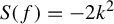 $S(f)=-2k^2$
is
 $$ \begin{align} f(z)= \frac{a e^{kz} + be^{-kz}}{ce^{kz}+de^{-kz}}, \quad ad - bc \neq 0, \end{align} $$
and its asymptotic values are
 $\{ a/c, b/d \}$
. Note that both of them are omitted values. According to Theorem 2.4, the converse is true too. Moreover, by Corollary 2.5, the solution is unique up to post-composition by an affine map. Pre-composition by an affine map multiplies the constant k by the scaling factor.
Functions of the form (3) have a single essential singularity at infinity and their dynamics are invariant under affine conjugation. If one of the asymptotic values is equal to infinity, c or
 $d=0$
and the family is the well-studied exponential family. See e.g. [Reference Devaney, Fagella and JarqueDFJ, Reference Rempe-GillenRG]. The dynamics are quite different if both asymptotic values are finite and here we restrict ourselves to this situation.
Because we assume the asymptotic values are finite, neither c nor d can be zero. We choose a representative of an equivalence class, where the equivalence relation is defined by affine conjugation, such that
 $k=1$
and
 $f(0)=0$
; this implies
 $b=-a$
. If the asymptotic values are
 $\lambda $
and
 $\mu $
, we have
 $$ \begin{align*} f_{\lambda , \mu}(z) = \frac{e^{z}-e^{-z}}{({e^{z}}/{\lambda })-({e^{-z}})/{\mu}}, \end{align*} $$
where
 $\lambda , \mu \in {\mathbb C}^*$
. If
 $f'(0)= \rho \in {\mathbb C}^{*}$
, we have the relation
 $$ \begin{align} \frac{1}{\lambda } - \frac{1}{\mu} = \frac{2}{\rho}. \end{align} $$
We still have the freedom to conjugate by the affine map
 $z \to -z$
so we see that the maps
 $f_{\lambda , \mu }(z)$
and
 $f_{\lambda ', \mu '}(z)=-f_{\lambda , \mu }(-z)$
have the same dynamics. That is,
 $$ \begin{align*}f_{\lambda ', \mu'}(z)=\frac{e^{z}-e^{-z}}{({e^{z}}/{\lambda '})-({e^{-z}})/{\mu'}}=\frac{e^z-e^{-z}}{({e^z}/({-\mu}))-({e^{-z}}/({-\lambda}))},\end{align*} $$
where
 $$ \begin{align} \frac{1}{\lambda '} - \frac{1}{\mu'} = \frac{2}{\rho}=-\frac{1}{\mu} + \frac{1}{\lambda }. \end{align} $$
Set
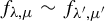 $f_{\lambda ,\mu } \sim f_{\lambda ',\mu '}$
if
 $\lambda '=-\mu , \mu '=-\lambda $
and use this equivalence relation to define the space of pairs of functions:
 $$ \begin{align*} \widehat{\mathbb{F}}_{2} &=\bigg\{ f_{\lambda, \rho} (z)= \frac{e^{z}-e^{-z}}{({e^{z}}/{\lambda })-({e^{-z}})/{\mu}} \; \;\bigg| \;\; \rho \in {\mathbb C}^{*}, \lambda \in {\mathbb C}^*\setminus \{\rho/2\}, \;\; \frac{1}{\lambda } - \frac{1}{\mu} = \frac{2}{\rho} \bigg \} \bigg/\sim. \end{align*} $$
Note that each pair of complex numbers
 $(\lambda , \rho )$
uniquely determines a pair of functions so that we also use
 $\widehat {\mathbb F}_{2}$
to denote the moduli space of
 ${\mathbb F}_{2}$
.
Because of the ambiguity left by the normalization, it is difficult to study
 $\widehat {\mathbb {F}}_2$
directly. This situation is similar to the space
 $Rat_2$
of rational functions of degree two with a fixed point at infinity discussed in §1. The affine conjugation
 $z \to -z$
identifies maps with the same dynamics and sends the parameter b to
 $-b$
. Thus the
 $(b, \rho )$
space is a 2-fold covering map of the space of functions. To understand the role of the parameters, however, it is easier to work in this covering space. This can be done by marking the singular points and choosing a ‘preferred’ point. In [Reference Goldberg and KeenGK], the preferred point was taken as
 $R(+1)$
. The conjugation
 $z \to -z$
interchanged the marking and corresponded to the involution
 ${b \to -b}$
in the lifted parameter space of functions with marked critical values. See e.g. [Reference Goldberg and KeenGK, Reference MilnorMil1] for more details.
We proceed in the same way here. To mark the asymptotic values, we choose
 $\lambda $
as the ‘preferred’ value and
 $\mu $
as the ‘non-preferred’ value. That is,
 $\lambda = \lim _{t \to \infty }f_{\lambda ,\rho }(\gamma (t))$
, where
 $\Re \gamma (t) \to +\infty $
. We call the space with marked asymptotic values
 $\mathbb {F}_2$
. Again the marked space is a 2-fold cover of the space of functions. Note that if
 $\lambda =\infty , \mu =-\rho /2$
and if
 $\mu =\infty , \lambda =\rho /2$
.
Because the stable dynamics of functions in
 $\mathbb {F}_2$
is controlled by the behavior of the orbits of the asymptotic values, it will be convenient to choose a one-dimensional ‘slice’ in this covering space of
 $\mathbb {F}_2$
in such a way that at each point in the slice, the orbit of one asymptotic value has fixed dynamics. One way to do this is to require that both asymptotic values have similar behavior. For example, if
 $\mu =-\lambda $
, so that
 $\lambda =\rho $
, the slice obtained is the tangent family
 $ f_{\rho }(z)=\rho \tanh z = i \rho \tan (iz)$
. The properties of this slice have been investigated in [Reference Chen, Jiang and KeenCJK, Reference Keen and KotusKK].
3 The space
${\mathcal F}_2$

In this paper, we begin with the two-dimensional subfamily
 ${\mathcal F}_2 \subset \mathbb F_2$
, where
 $\rho $
is in the punctured unit disk
 ${\mathbb D}^*$
. This means that the origin is an attracting fixed point so the orbit of at least one of the asymptotic values converges to zero. It may be either the preferred asymptotic value
 $\lambda $
or not. We can parameterize this subspace as
 $$ \begin{align*} {\mathcal F}_2 = \{ f_{\lambda ,\rho} \} =( {\mathbb C} \setminus \{0,\rho/2\} ) \times {\mathbb D}^*. \end{align*} $$
Each
 $\rho \in {\mathbb D}^*$
defines a one-dimensional slice that we denote by
 ${\mathcal F}_{2,\rho }$
. This is a ‘dynamically natural slice’ in the sense of [Reference Fagella and KeenFK] because one asymptotic value is always attracted to the origin where the multiplier is fixed and the other is free. We choose the asymptotic value
 $\lambda $
as a parameter for our slice; either it or
 $\mu (\lambda )$
(determined by equation (5)) is the free asymptotic value. Note that because of equation (5), when
 $\lambda = \rho /2$
,
 $\mu =\infty $
and the function is in the exponential family, not our family. Also, if
 $\lambda =0$
, the function reduces to the constant zero. The points of the slice are denoted by
 $\lambda $
,
 $f_{\lambda }$
, or
 $f_{\lambda ,\rho }$
if we want to emphasize the dependence on
 $\rho $
; if the context is clear, for readablity we use f. We will prove these slices all have the same structure.
Simple calculations show
 $$ \begin{align*} f_{\lambda ,\mu, \rho}(-z)=f_{\mu,\lambda ,-\rho}(z)\quad \text{and}\quad f_{\lambda ,\mu, \rho}(-z)=f_{-\mu,-\lambda ,\rho}(z), \end{align*} $$
so that interchanging the asymptotic values
 $\lambda $
and
 $\mu $
changes the multiplier from
 $\rho $
to
 $-\rho $
; interchanging and negating the asymptotic values changes the marking.
3.1 Fatou components for
$f_{\lambda } \in {\mathcal F}_{2}$

For any
 $f_{\lambda } \in {\mathcal F}_{2}$
, the origin is an attracting fixed point with multiplier
 $\rho $
. Denote its attracting basin (which is non-empty) by
 $A_{\lambda }$
.
Proposition 3.1. The attracting basin
 $A_{\lambda }$
is completely invariant.
Proof. Because the origin is fixed, it is sufficient to prove that its immediate basin of attraction
 $I_{\lambda } \subset A_{\lambda }$
is backward invariant.
On a neighborhood
 $N \subset I_{\lambda }$
of the origin, we can define a uniformizing map
 $\phi _{\lambda }(z)$
such that
 $\phi _{\lambda }(0)=0$
,
 $\phi _{\lambda }'(0)=1$
, and
 $\phi _{\lambda } \circ f_{\lambda } = \rho \phi _{\lambda }$
. It extends by analytic continuation to the whole immediate attractive basin
 $I_{\lambda }$
. Denote by
 $O_{\lambda }$
the largest neighborhood of the origin on which
 $\phi _{\lambda }$
is injective. One (or both) of the asymptotic values must be on the boundary of
 $O_{\lambda }$
. Assume for argument’s sake that
 $\mu \in \partial O_{\lambda }$
. Choose a path
 $\gamma $
joining
 $0$
to
 $\mu $
in
 $O_{\lambda }$
. If g is any inverse branch of
 $f_{\lambda }$
, then
 $g(O_{\lambda })$
contains a path joining
 $g^{-1}(0)$
to infinity that passes through the asymptotic tract
 $\mathcal A_{\mu }$
of
 $\mu $
. Thus all these paths are contained in the same component of
 $f_{\lambda }^{-1}(O_{\lambda })$
. Therefore this component contains all the pre-images of
 $0$
, and because one branch fixes
 $0$
, this component is
 $I_{\lambda }$
. It follows that
 $ I_{\lambda }$
is backward invariant and
 $I_{\lambda }=A_{\lambda }$
.
Remark 3.2. The main point in the above argument is that whenever there is an attracting cycle, its basin contains a singular value, which, in this family, is an omitted asymptotic value, and thus the component of the basin containing the asymptotic value can have only one pre-image and it contains the asymptotic tract. Above, because the attracting cycle consisted of the fixed point
 $0$
, these components coincided. If there is a second, non-zero attracting cycle, and the period of the cycle is one, it too has an invariant basin and the Fatou set consists of two completely invariant components. If the period is greater than one, the component containing the asymptotic value and its pre-image are distinct and the full basin contains infinitely many components; all but the component containing the asymptotic value have infinitely many pre-images.
3.1.1 No Herman rings
Here we digress to prove a proposition about the non-existence of Herman rings for slightly larger classes of functions than
 ${\mathcal F}_2$
. See also [Reference NayakNay] for a similar study.
Proposition 3.3. Suppose f is a meromorphic function with an attracting fixed point whose basin of attraction has the properties that it contains at least one asymptotic value and is completely invariant. Then f cannot have a Herman ring.
Proof. We may assume without loss of generality that f fixes the origin and attracts the asymptotic value
 $\mu $
. By hypothesis, the basin of attraction of the origin,
 $A_0$
, is completely invariant and hence connected. Moreover, because it contains an asymptotic value, it is unbounded. It follows that
 $\partial A_0 \subset J$
is also completely invariant. A standard property of Julia sets is that if
 $z \in J$
, then
 $J=\overline {\bigcup _{n \in {\mathbb Z}}f^n(z)},$
so that
 $\partial A_0=J$
.
If
 $f $
had a Herman ring R, its complement would consist of two components. Moreover, because the poles are dense in J, the bounded complementary component,
 $B_R$
, would contain a pole of some minimal order m and therefore
 $B_R$
would contain an
 $m^{th}$
pre-image of an asymptotic tract of
 $\mu $
so that it would intersect
 $A_0$
. It follows that
 $A_0$
is disconnected, which is a contradictionFootnote
1
.
3.2 The parameter space trichotomy
Proposition 3.1 implies the following trichotomy for
 ${\mathcal F}_{2}$
.
-
•
$A_{\lambda }$
contains both asymptotic values; this is called the shift locus and denoted by
${\mathcal S}$
. -
•
$A_{\lambda }$
contains only the preferred asymptotic value
$\lambda $
; in this case, the other asymptotic value
$\mu $
is not attracted to the origin and we call the set of such
$\lambda $
as
${\mathcal M}_{\mu }$
. We denote the subset where
$\mu $
is attracted to an attracting periodic cycle by
${\mathcal M}_{\mu }^0$
. -
•
$A_{\lambda }$
contains only the non-preferred asymptotic value
$\mu $
; in this case, the other asymptotic value
$\lambda $
is not attracted to the origin and we call the set of these
$\lambda $
as
${\mathcal M}_{\lambda }$
. We denote the subset where
$\lambda $
is attracted to an attracting periodic cycle by
${\mathcal M}_{\lambda }^0$
.


The maps in
 ${\mathcal S}$
,
 ${\mathcal M}_{\lambda }^0$
, and
 ${\mathcal M}_{\mu }^0$
are hyperbolic because the orbits of their asymptotic values accumulate on attracting cycles. The connected components of these three subsets of parameter space are thus called hyperbolic components.
As with the space
 $Rat_2$
, there is an inversion of the space
 ${\mathcal F}_{2}$
that interchanges the regions
 ${\mathcal M}_{\lambda }$
and
 ${\mathcal M}_{\mu }$
, and leaves
 ${\mathcal S}$
invariant.
Let
 ${\mathcal C}_0$
be the circle in the
 $\lambda $
plane centered at the parameter singularity
 $\rho /2$
with radius
 $|\rho /2|$
and let D be the disk it bounds, punctured at the singularity
 $\rho /2$
. (See Figure 11 later.) The inversion
 $$ \begin{align*} I(\lambda )=-\mu = \frac{\lambda }{2\lambda /\rho -1} \end{align*} $$
leaves
 ${\mathcal C}_0$
invariant and interchanges
 $\lambda $
and
 $-\mu $
.
Proposition 3.4. If
 $f_{\lambda }^n(\lambda ) \not \rightarrow 0$
as
 $n \to \infty $
, then
 $f_{I(\lambda )}^n(I(\lambda )) \rightarrow 0$
. That is, the inversion interchanges the regions
 ${\mathcal M}_{\lambda }$
and
 ${\mathcal M}_{\mu }$
in the plane where only one of the asymptotic values goes to zero.
Proof. Suppose
 $f_{\lambda }^n(\lambda ) \not \rightarrow 0$
so that
 $f_{\lambda }^n(\mu ) \rightarrow 0$
. Because
 $ I(\lambda )=-\mu $
and
 $I(\mu )=-\lambda $
, we can write
 $$ \begin{align*} f_{-\mu}(-\mu)=\frac{e^{-2\mu}-1}{({e^{-2\mu}})/({-\mu}) -({1}/({-\lambda }))} = \frac{e^{2\mu}-1}{({e^{2\mu}}/{\lambda }) -({1}/{\mu})}= f_{\lambda }(\mu) \end{align*} $$
and
 $$ \begin{align*} f_{-\mu}(-\lambda )=\frac{e^{-2\lambda }-1}{({e^{-2\lambda }}/({-\mu})) -({1}/({-\lambda }))} = \frac{e^{2\lambda }-1}{({e^{2\lambda }}/{\lambda }) -({1}/{\mu})}= f_{\lambda }(\lambda ).\\[-42pt] \end{align*} $$
It follows that the inversion also preserves the region
 ${\mathcal S}$
where both asymptotic values go to zero.
When
 $\rho $
is real, we can say more.
Proposition 3.5. Suppose
 $\rho $
is real and
 $\lambda \in {\mathcal C}_0$
. Then both
 $f_{\lambda }^n(\lambda ) \rightarrow 0$
and
 $f_{\lambda }^n(\mu ) \rightarrow 0$
.
Proof. Set
 $\lambda _1=I(\lambda )$
. Then
 $-\mu = I(\lambda ) = \bar {\lambda } =\lambda _1$
. Thus,
 $$ \begin{align*}\overline{f_{\lambda } (\lambda )} = f_{\bar{\lambda }}(\bar{\lambda })=f_{\lambda _1}(\lambda _1); \end{align*} $$
so if
 $f_{\lambda }^n(\lambda ) \rightarrow 0$
,
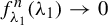 $f_{\lambda _1}^n(\lambda _1) \rightarrow 0$
.
We can rewrite this as
 $$ \begin{align*} f_{\lambda }(\mu)=f_{\lambda }(-\bar{\lambda }) = - \overline{f_{\lambda }(\lambda )}.\end{align*} $$
Therefore, either both asymptotic values iterate to zero or neither does. Because the origin is an attracting fixed point with multiplier
 $\rho $
, at least one must iterate to zero and so they both do.
This proposition says when
 $\rho $
is real, the region where both asymptotic values are attracted to zero contains the invariant circle of the inversion.
Notice that the point
 $\lambda = \rho $
is on the circle
 ${\mathcal C}_0$
. At that point, we have
 $\mu = -\lambda $
,
 $f_{\lambda } = \lambda \tanh z$
, and
 $I(\lambda )=\lambda $
so that it is a branch point of the double covering defined by the marking. Moreover, because of the symmetry, both asymptotic values are attracted to zero.
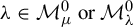
If
 $\lambda \in {\mathcal M}_{\mu }^0 \text { or } {\mathcal M}_{\lambda }^0$
,
 $f_{\lambda }$
has an attracting periodic cycle different from the origin. This cycle has an attractive basin, which we denote by
 $K_{\lambda }$
, and
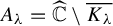 $A_{\lambda } =\widehat {\mathbb C} \setminus \overline {K_{\lambda }}$
. Thus
 $\partial {K_{\lambda }}$
is the Julia set and
 $\overline {K_{\lambda }}$
is the ‘filled Julia set’. Both of them are unbounded sets in
 ${\mathbb C}$
.
3.3 The set
$\overline {K_{\lambda }}$
and the Julian set dichotomy

In [Reference Keen and KotusKK], it is proved that for
 $\rho \in {\mathbb D}^*$
, the Julia set
 $J_{\lambda }$
of the function
 $T_{\rho }(z)=\rho \tanh (z)$
is a Cantor set. Moreover, it is homeomorphic to a space consisting of finite and infinite sequences on an alphabet isomorphic to the natural numbers and infinity. The finite sequences end with infinity. The homeomorphism conjugates
 $T_{\rho }$
to the shift map on this alphabet. See [Reference Devaney and KeenDK1, Reference MoserMo] for details.
At this point in this paper, we can prove the following.
Proposition 3.6. If
 $\Omega $
is the hyperbolic component of the
 $\lambda $
plane containing
 $f_{\lambda _0}=\rho \tanh z$
and
 $\lambda \in \Omega $
, then the Julia set of
 $f_{\lambda }$
is a Cantor set. If
 $\lambda \in {\mathcal M}_{\lambda }$
or
 ${\mathcal M}_{\mu }$
, then
 $\overline {K_{\lambda }}$
is full.
Remark 3.7. In Theorem 6.14, we will prove that the shift locus
 ${\mathcal S}$
is connected so that
 $\Omega ={\mathcal S}$
. It will then follow that we have a dichotomy similar to that for quadratic polynomials.
Proof. If
 $\lambda _0=\rho $
, by symmetry, both
 $\lambda _0$
and
 $\mu _0=-\lambda _0$
are in
 $A_{\lambda }$
. By the results in [Reference Keen and KotusKK], the Julia set of
 $f_{\lambda _0}$
is a Cantor set. Suppose
 $\lambda \in \Omega $
, and let
 $\lambda (t)$
, with
 $\lambda (0)=\lambda _0$
and
 $\lambda (1)=\lambda $
, be a path in
 $\Omega $
. By standard arguments using quasiconformal surgery, see e.g. [Reference Branner and FagellaBF, Reference McMullen and SullivanMcMSul], §6.2.3, and §6.2.4, we can construct quasiconformal homeomorphisms
 $g(t)$
conjugating
 $f_{\lambda _0}$
to
 $f_{\lambda (t)}$
that preserve the dynamics. Because the maps are hyperbolic, the Julia sets of
 $f_{\lambda (t)}$
are quasiconformally equivalent and thus also topologically equivalent.
Suppose now that
 $\lambda \in {\mathcal M}_{\lambda }$
so that
 $\lambda $
is not in
 $A_{\lambda }$
. The same argument works for
 $\lambda \in {\mathcal M}_{\mu }$
, interchanging the roles of
 $\lambda $
and
 $\mu $
. Take a generic small r, such that
 $\partial D_r(0)$
does not contain a point in the forward orbit of
 $\mu $
. Then by definition,
 $A_{\lambda }=\bigcup _{n\geq 1} f^{-n}(D_r(0))$
and
 $f^{-n}(D_r(0))\subset f^{-(n+1)}(D_r(0))$
. Note that because
 $\lambda \notin A_{\lambda }$
,
 $f: f^{-(n+1)}(D_r(0))\to f^{-n}(D_r(0))\setminus \{\mu \}$
is a covering and so
 $f^{-1}(D_r(0))$
is simply connected. Therefore,
 $A_{\lambda }$
is simply connected, which implies that its complement
 $\overline {K_{\lambda }}$
is full.
Note that the argument above adapts easily to show that if
 $f_{\lambda }$
has a non-zero attracting or parabolic fixed point, the attracting basin of this fixed point is unbounded and completely invariant. Other standard arguments [Reference MilnorMil1] show that if
 $f_{\lambda }$
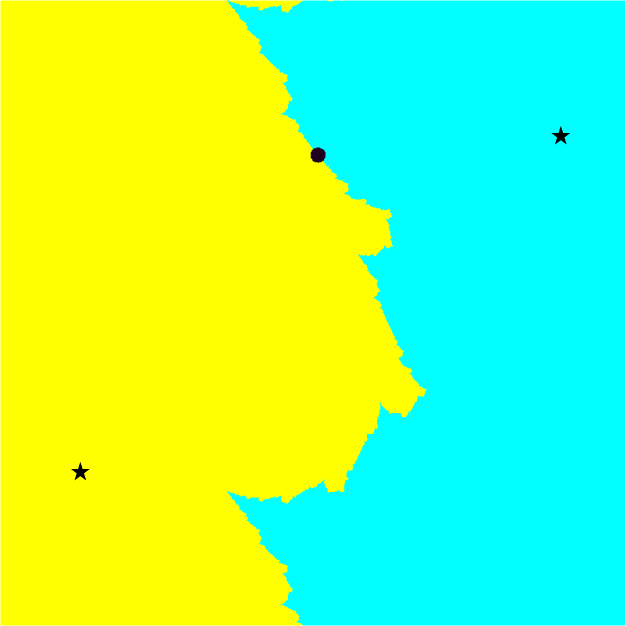
has a neutral fixed point with a Siegel multiplier, its boundary must be contained in the post-singular set. Thus there are two completely invariant domains in the Fatou set separated by the Julia set. An example of this is shown in Figure 1, where
 $\rho =2/3$
and
 $\lambda =2+2i$
. The yellow is the basin of
 $0$
and the blue is the basin of the fixed point
 $2.25818 + 2.12632i$
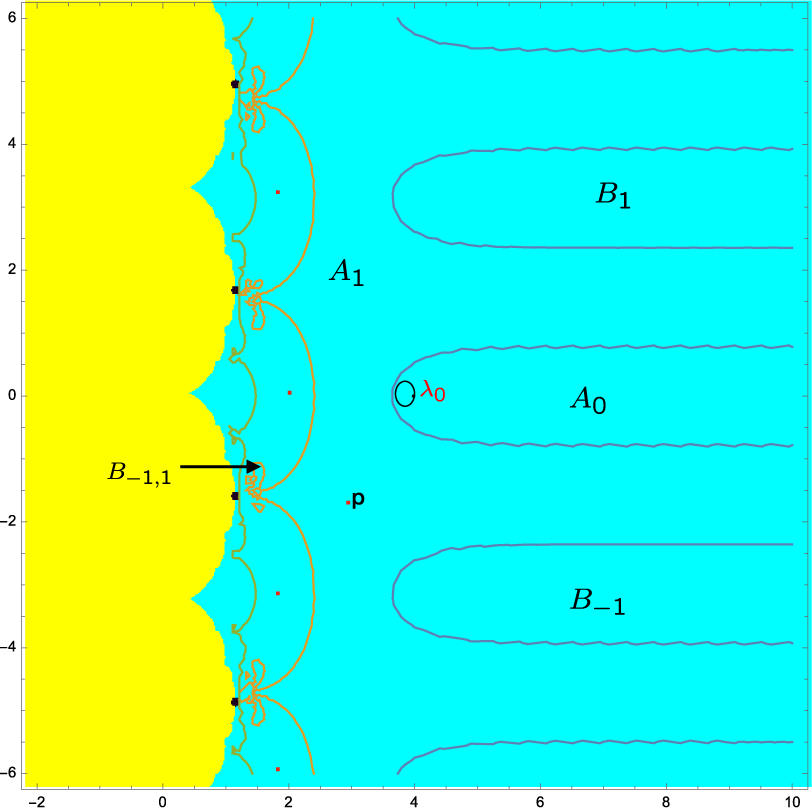
. The proof of the main structure theorem uses another example of a function with two attractive fixed points and its dynamic space is shown in Figure 7 (see later).
The dynamic plane of
 $f_{\lambda }$
with
 $\rho =2/3$
and
 $\lambda =2+2i$
. The stars are fixed points and the black dot is a pole.

4 Shell components: properties of
${\mathcal M}_{\lambda }$
and
${\mathcal M}_{\mu }$


In this section, we work only with hyperbolic components in
 ${\mathcal M}_{\lambda }^0$
. By Propositions 3.4 and 3.5, the discussion for
 ${\mathcal M}_{\mu }^0$
is essentially the same. By definition, all the maps in
 ${\mathcal M}_{\lambda }^0$
are hyperbolic;
 ${\mathcal M}_{\lambda }^0$
consists of components in which standard arguments (see e.g. [Reference Branner and FagellaBF]) show that any two functions corresponding to parameters in the component are quasiconformally conjugate. Following [Reference Fagella and KeenFK], we call these components shell components. In that paper, more general functions were considered and the properties of the shell components were described. Here we summarize what we need from that description. We begin with some definitions.
4.1 Virtual cycle parameters and virtual centers
Let
 $\Omega $
be a hyperbolic component in
 ${\mathcal M}_{\lambda }$
and let
 $\lambda \in \Omega $
. Both
 $\lambda $
and
 $\mu $
are attracted by attracting cycles of
 $f_{\lambda }$
, and because
 $\lambda \in {\mathcal M}_{\lambda }$
,
 $\mu $
is attracted to the origin and
 $\lambda $
is attracted to a different cycle of order
 $n \geq 1$
. Because all the
 $f_{\lambda }$
,
 $\lambda \in \Omega $
are quasiconformally conjugate, all the functions in
 $\Omega $
have non-zero attracting cycles of the same period, say n. We say
 $\Omega $
has period n and, where appropriate, denote it by
 $\Omega _n$
.
We need the following definitions.
Definition 4.1. If
 $\lambda \in {\mathcal F}_2$
and there exists an integer
 $n>1$
such that either
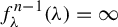 $f_{\lambda }^{n-1}(\lambda )=\infty $
or
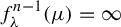 $f_{\lambda }^{n-1}(\mu ) = \infty $
, then
 $\lambda $
is called a virtual cycle parameter. In the first case, set
 $a_1=\lambda $
and in the second case, set
 $a_1=\mu $
. Next set
 $a_{i+1}=f_{\lambda } (a_i)$
, where i is taken modulo n so that
 $a_{0}=\infty $
. We call the set
 $\mathbf {a}=\{a_1, a_2, \ldots , a_{n-1}, a_{0} \}$
a virtual cycle, or if we want to emphasize the period, a virtual cycle of period n.
This definition is justified by the following. Assume for argument’s sake that we are in the first case. Let
 $\gamma (t)$
be an asymptotic path for
 $\lambda =a_1$
, that is,
 $\lim _{t\to \infty } \gamma (t) =\infty $
and
 $\lim _{t\to \infty } f(\gamma (t))=a_1$
.
Then
 $\widehat \gamma =f^{-n}(\gamma (t))$
is again an asymptotic path where the inverse branches are chosen so that
 $f^{-1}(a_i)=a_{i-1}$
; that is,
 $$ \begin{align*} \lim_{t \to \infty} f(\gamma(t))=\lim_{t \to \infty} f^{n+1}(\widehat\gamma(t))=\lambda =a_1, \end{align*} $$
so that in this limiting sense, the points form a cycle.
Definition 4.2. Let
 $\Omega _n$
be a shell component of period n and let
 $$ \begin{align*} {\mathbf a}_{\lambda} =\{a_0, a_1, \ldots, a_{n-2}, a_{n-1} \} \end{align*} $$
be the attracting cycle of period n that attracts
 $\lambda $
or
 $\mu $
. Suppose that as
 $k \to \infty $
,
 $\lambda _k \to \lambda ^* \in \partial {\Omega _n}$
, and the multiplier
 $\nu _{\lambda _k}=\nu ({\mathbf a}_{\lambda _k})=\Pi _{i=0}^{n-1} f'(a_{i}(\lambda _k)) \to 0.$
Then
 $\lambda ^*$
is called a virtual center of
 $\Omega _n$
.
Remark 4.3. Note that if
 $n=1$
and
 $a_0(\lambda _k)$
is the fixed point, the definition implies that
 $f'(a_{0}(\lambda _k)) \to 0$
. This in turn implies that either
 $\lambda $
tends to
 $\infty $
or
 $\lambda $
tends to the parameter singularity
 $\rho /2$
so that
 $\mu $
tends to
 $\infty $
. These ‘would be’ virtual centers do not belong to the parameter space but they share many properties with proper virtual centers including transversality (see Definition 5.1).
Because the attracting basin of the cycle
 ${\mathbf a}_{\lambda }$
must contain an asymptotic value, we will assume throughout the paper that the points in the cycle are labeled so that
 $\lambda $
or
 $\mu $
and
 $a_1$
are in the same component of the immediate basin.
In the next theorem, we collect the results reported in [Reference Fagella and KeenFK] about shell components for fairly general families of functions. The proof of parts (b) and (c) are based on an estimate of the growth of the orbits of the singular values given in lemma 2.2 of [Reference Rippon and StallardRS], and on proposition 6.8 of [Reference Fagella and KeenFK]. Part (d) is theorem 6.10 of [Reference Fagella and KeenFK]. Part (e) combines the accessibility in part (d) and theorem A of [Reference Chen and KeenCK], whose proof contains a construction that shows that every virtual cycle parameter is on the boundary of a shell component.
Theorem 4.4. (Properties of shell components of
${\mathcal F}_{2}$
)

Let
 $\Omega $
be a shell component in
 ${\mathcal F}_{2}$
. Then the following can be stated.
-
(a) The map
$\nu _{\lambda } : \Omega \rightarrow {\mathbb D}^*$
is a universal covering map. It extends continuously to
$\partial \Omega $
and
$\partial \Omega $
is piecewise analytic;
$\Omega $
is simply connected and
$\nu _{\lambda } $
is infinite to one. -
(b) There is a unique virtual center on
$\partial \Omega $
. If the period of the component is
$1$
and
$\Omega $
is a shell component of
${\mathcal M}_{\lambda }$
, the component is unbounded and the virtual center is at infinity; if, however,
$\Omega $
is a shell component of
${\mathcal M}_{\mu }$
of period
$1$
, then it is bounded and the virtual center is at the finite point
$\rho /2$
which is a parameter singularity. This is the only difference between
${\mathcal M}_{\lambda }$
and
${\mathcal M}_{\mu }$
. -
(c) If
$\lambda _k \in \Omega $
of period greater than
$1$
is a sequence tending to the virtual center
$\lambda ^*$
and
$a_0(\lambda _k)$
is the periodic point of the cycle
$\mathbf a(\lambda _k)$
in the component containing the asymptotic tract and
$a_1(\lambda _k)=f_{\lambda _k}(a_0(\lambda _k))$
, then as
$k \to \infty $
,
$a_0(\lambda _k) \to \infty $
and
$a_1(\lambda _k) \to \lambda ^*$
. -
(d) Every virtual center of a shell component is a virtual cycle parameter and is an accessible boundary point.
-
(e) Every virtual cycle parameter is a virtual center.







As a corollary, we have the following.
Corollary 4.5. If
 $\lambda ^*$
is a virtual center of a shell component of period n, there are virtual centers of period
 $n+1$
accumulating on it.
Proof. The poles of
 $f_{\lambda }$
are given by
 $$ \begin{align} p_k(\lambda)=\frac{1}{2}{\text{Log}} \bigg(\frac{\rho-2\lambda}{\rho}\bigg)+ik\pi, \end{align} $$
where
 ${\text {Log}}$
is the branch of the logarithm with an imaginary part in
 $[-\pi ,\pi )$
. They and all their pre-images are holomorphic functions of
 $\lambda $
.
Let V be a neighborhood of
 $\lambda ^*$
in the parameter plane that does not contain any poles of
 $f_{\lambda }^{k}$
for all
 $1\leq k<n-1$
. Such a neighborhood exists because the poles of
 $f_{\lambda }^{k}$
form a discrete set. The holomorphic function
 $h(\lambda )=f_{\lambda }^{n-1}(\lambda )$
maps V to a neighborhood W of infinity and
 $h(\lambda ^*)=\infty $
. Because infinity is an essential singularity, for
 $\lambda \in V$
and large enough
 $|k|$
, W contains infinitely many poles
 $p_k(\lambda )$
of the functions
 $f_{\lambda }(z)$
; moreover, for each
 $\lambda $
, as
 $k \to \infty $
,
 $p_k(\lambda )$
converge to infinity. The zeroes of the functions
 $h_k(\lambda )=h(\lambda )-p_k(\lambda )$
are virtual centers of components of period
 $n+1$
. We want to show there is a sequence of these zeroes in V converging to
 $\lambda ^*$
.
The functions
 $\widehat {h}(\lambda )=1/h(\lambda )$
and
 $\widehat {p}_k(\lambda )=1/p_k(\lambda )$
take values in a neighborhood of the origin. Because the
 $p_k(\lambda )$
converge to infinity as
 $|k| \to \infty $
uniformly on
 $\overline {V}$
as long as V is small enough, we can find N large enough so that if
 $k>N$
and
 $\lambda \in \partial V$
, then
 $|\widehat {p}_k(\lambda )| < |\widehat {h}(\lambda )|$
. By Rouché’s theorem, we conclude
 $\widehat {h}$
and
 $\widehat {h} -\widehat {p}_k$
have the same number of zeroes in V;
 $\widehat {h}$
has a zero at
 $\lambda ^*$
and thus each
 $\widehat {h} -\widehat {p}_k$
has a zero
 $\lambda _k \in V$
. It then follows that
 $h(\lambda _k) =p_k(\lambda _k)$
so that
 $\lambda _k$
is a virtual center of period
 $n+1$
.
4.2 Combinatorics
Theorem 4.4 allows us to assign a label to each of the shell components of
 ${\mathcal M}_{\lambda }$
in terms of its virtual center. To label the virtual centers, we need to know that the indices of the poles are well defined. In §6.3.1, we will prove Lemma 6.18 that says that we can find a simply connected domain
 $\Sigma $
, containing
 ${\mathcal M}_{\lambda }$
and not containing
 ${\mathcal M}_{\mu }$
, in which, after an initial choice, as above, of a basepoint and a branch of the logarithm, the poles and inverse branches of
 $f_{\lambda }$
can be labeled consistently. The discussion here will assume that lemma.
Pick a basepoint that is not in
 ${\mathcal M}_{\lambda }$
, for example, the symmetric point
 $\lambda _0 =-\mu _0=\rho $
. It has poles
 $p_k(\lambda _0)$
defined by the principal branch of the logarithm. With the poles
 $p_k(\lambda _0)$
defined by equation (6), denote the branch of
 $f_{\lambda _0}^{-1}$
that maps
 $\infty $
to
 $p_k(\lambda _0)$
by
 $g_{\lambda ,k}(z)=g_{\lambda _0,k}(z)$
. With the choice of a fixed base point and logarithm branch, the inverse branches are well defined because the set
 $\Sigma $
(to be defined in §6.3.1) is simply connected.
We use these branches to define labels for the pre-poles of all orders, and thus for labels of the virtual cycle parameters. Because of part (d) of Theorem 4.4, each virtual cycle parameter is a virtual center of a shell component so the label of the virtual center defines a label for the shell component.
The formula for
 $p_{k}(\lambda )$
shows that the poles are injective functions of
 $\lambda $
in
 $\Sigma $
. Let
 $$ \begin{align*} {\mathcal V}_1=\{ \lambda ^*_k \in \Sigma \, | \, g_{\lambda ^*,k}(\infty)= \lambda ^* \}. \end{align*} $$
That is,
 ${\mathcal V}_1$
is the set of
 $\lambda ^*_k$
such that
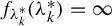 $f_{\lambda ^*_k}(\lambda ^*_k)=\infty $
. It is the set of virtual cycle parameters of order one and hence virtual centers of shell components
 $\Omega _2$
of period two. We assign the label k to each point in
 ${\mathcal V}_1$
and the same label to the component for which it is the virtual center.
The pre-poles
 $p_{k_1k_2}(\lambda )=g_{\lambda ,k_2}(p_{k_1}(\lambda ))$
are defined for all
 $\lambda \in \Sigma \setminus {\mathcal V}_1$
. Because they are holomorphic functions of
 $\lambda $
with non-vanishing derivative, each
 $g_{\lambda , k}$
is an injective function of both
 $\lambda $
and z. Next, we inductively define the sets of virtual cycle parameters of order
 $n-1$
with labeled points by
 $$ \begin{align*} {\mathcal V}_{n-1}=\bigg\{\lambda ^*_{k_{n-1} \ldots k_1} \in \Sigma \setminus \bigcup_{i=1}^{n-2} {\mathcal V}_i \, | \, g_{\lambda ^*_{k_{n-1} \ldots k_1},k_{n-1} \ldots k_1}(\infty)= \lambda ^*_{k_{n-1} \ldots k_1}\bigg\}. \end{align*} $$
The pre-poles
 $p_{k_{n-1} \ldots k_1}(\lambda )$
are defined for all
 $\lambda \not \in {\mathcal V}_{n-1}$
and, as above, move injectively.
We now assign the label
 $k_{n-1} \ldots k_1$
to the shell component of order n for which
 $\lambda ^*_{k_{n-1} \ldots k_1}$
is the virtual center.
Definition 4.6. We call the label
 ${\mathbf k}_n=k_nk_{n-1} \ldots k_1$
assigned to each pre-pole and each virtual cycle parameter its itinerary.
We can also use the labeling of the inverse branches to assign an itinerary to each attractive cycle.
Definition 4.7. For simplicity, we suppress the dependence on
 $\lambda $
and assume the shell component is in
 ${\mathcal M}_{\lambda }$
. Suppose
 $f^n(a_0)=a_0$
for
 $n \geq 1$
, where, by our numbering convention in part (c) of Theorem 4.4,
 $a_0$
is in the asymptotic tract of
 $\lambda $
and
 $a_j=f(a_{j-1})$
,
 $j=1, \ldots n$
. Then for some
 $k_j$
,
 $a_{j-1}= g_{k_j}(a_{j})$
. In fact, there is a unique sequence
 $\{k_1,\ldots , k_{n}\}$
such that
 $$ \begin{align*} a_0= g_{k_{n}} \circ \cdots \circ g_{k_2} \circ g_{k_{1}}( a_0). \end{align*} $$
We say the cycle
 $\mathbf a$
has itinerary
 ${\mathbf k}_n= k_{n}k_{n-1}\ldots k_2 k_1$
.
Proposition 4.8. Let
 $\Omega _n$
be a shell component and suppose for
 $\lambda _0 \in \Omega _n$
, the cycle
 $\mathbf a(\lambda _0)$
has itinerary
 $k_nk_{n-1} \ldots k_1$
. Then for every
 $\lambda \in \Omega _n$
, the itinerary of
 $\mathbf a(\lambda )$
is of the form
 $k_{0,j} k_{n-1} \ldots k_1$
for some
 $j \in {\mathbb Z}$
.
Proof. If the component of the basin
 $\mathbf a(\lambda )$
containing
 $a_j(\lambda )$
is denoted by
 $D_j(\lambda )$
, then for
 $j=1, \ldots n-1$
,
 $f_{\lambda }:D_j(\lambda ) \rightarrow D_{j+1}(\lambda )$
is one to one. Inside
 $\Omega _n$
, the points of the periodic cycle move holomorphically and are related by the inverse branches
 $g_{\lambda ,k_j} : D_{j+1}(\lambda ) \rightarrow D_j(\lambda )$
. The branch is the same for all
 $\lambda \in \Omega _n$
because it is simply connected; in it, the
 $g_{\lambda ,k_j}$
are quasiconformally conjugate and the
 $a_j(\lambda )$
move holomorphically. At the last step in the cycle, however, the map
 $f_{\lambda }:D_0(\lambda ) \rightarrow D_{1}(\lambda )$
is infinite to one and so
 $a_1(\lambda )$
has infinitely many inverses,
 $a_{0,j}(\lambda ) \in D_0(\lambda )$
. They are all in the asymptotic tract of
 $\lambda $
but only one of them can belong to the cycle. Thus although the inverse branch
 $g_j=g_{0,j}$
is well defined for each
 $\lambda $
, the branch that defines the cycle changes as
 $\lambda $
moves in
 $\Omega _n$
.
Above we assigned a label, or itinerary, to the virtual center of each shell component. We now address the questions of the uniqueness of these labels and their relation to the itineraries of their attracting cycles. As we stated above, this is based on Lemma 6.18, which will be proved later, where the inverse branches are defined as single valued functions of
 $\lambda $
.
Proposition 4.9. Every shell component
 $\Omega _n \in {\mathcal M}_{\lambda }$
and
 $\Omega _n' \in {\mathcal M}_{\mu }$
,
 $n>1$
, has a unique label defined by the itinerary of its virtual center
 $\lambda ^*$
, a pre-pole of order
 $n-1$
, where n is the minimal such integer.
Because the shell components of period one have virtual centers that do not belong to the parameter space, we cannot label them in this way. There are only two such points,
 $\rho /2$
and
 $\infty $
, and hence only two such components with no label. To have a label for every component, we arbitrarily assign the label
 $\infty $
to these components.
Proof. The boundary of each shell component
 $\Omega _n$
contains one and only one virtual center
 $\lambda ^*$
and the label
 $ {\mathbf k}_{n-1}= k_{n-1}k_{n-2}\ldots k_1$
of the virtual center is its itinerary. It will follow from the common boundary theorem that it is on the boundary of only one shell component. This is different from the tangent family where pairs of shell components share virtual centers. See e.g. [Reference Chen, Jiang and KeenCJK]. Let V be a neighborhood of
 $\lambda ^*$
and let
 $W=\Omega _n \cap V$
. By Proposition 4.8, the itineraries of the points in W agree except for their first entry. By proposition 6.8 of [Reference Fagella and KeenFK], as
 $\lambda \in W$
tends to the virtual center, the point
 $a_0(\lambda ) = g_j(a_1(\lambda ))$
of the cycle tends to infinity and the point
 $a_1(\lambda )$
tends to the virtual cycle parameter
 $\lambda ^*$
, a pre-pole of order
 $n-1$
with itinerary
 $ {\mathbf k}_{n-1}= k_{n-1}k_{n-2}\ldots k_1$
.
Note that because
 $\lambda \in \mathcal {M}_{\lambda }$
or
 $\mathcal {M}_{\mu }$
, the cycle
 $\mathbf a(\lambda )$
attracts only one of the asymptotic values. Therefore, unlike the tangent family, where both asymptotic values can be attracted by a single cycle of double the period,
 $n-1$
is minimal.
The proof of Corollary 4.5 also implies the following.
Proposition 4.10. Let
 $\lambda ^*$
be the virtual center of a shell component
 $\Omega _n$
and let
 $\Omega _{n+1,i}$
be a sequence of components whose virtual centers
 $\lambda ^*_i$
converge to
 $\lambda ^*$
as i goes to infinity. If the itinerary of
 $\lambda ^*$
is given by
 $ {\mathbf k}_{n-1}= k_{n-1}k_{n-2}\ldots k_1 $
, the itineraries of the
 $\lambda ^*_i$
are given by
 ${\mathbf k}_{n,i}= k_{n-1}k_{n-2}\ldots k_1 k_{0,i} $
.
Remark 4.11. There is an interesting duality here. As we approach the virtual center from inside a shell component of order n, we are taking a limit of cycle itineraries; the first entry in the itinerary (corresponding to the last inverse branch applied) disappears. Thus an itinerary with n entries becomes one with
 $n-1$
entries. However, if we consider the labels of the shell components of order
 $n+1$
approaching the shell component of order n, it is the last entry (corresponding to the first inverse branch applied) that disappears in the limit.
Proof. As above, let V be a small neighborhood of
 $\lambda ^*$
. We may assume it contains no virtual center of order less than
 $n-1$
. The functions
 $g_{\lambda ,k_j}$
that define the virtual cycle
 $a_j(\lambda ^*)$
,
 $j=1, \ldots n-1$
, are defined in
 $V \cap \Omega _n$
where they track the attracting cycle. They also extend to all of
 $V \setminus \{\lambda ^*\}$
by analytic continuation. Also for
 $\lambda \in V \cap \Omega _n$
, the functions
 $a_{0,i}(\lambda )=g_{\lambda ,k_{0,i}}(a_1(\lambda ))$
are defined for all i but for only one i does it belong to the attracting cycle. All of these functions extend to
 $V \setminus \{\lambda ^*\}$
.
Now let W be a neighborhood of infinity and let
 $G(\lambda ,z)$
be a map from
 $V \times W$
to
 ${\mathbb C}$
defined by
 $g_{\lambda ,k_{n-1}} \circ \cdots \circ g_{\lambda ,k_1}(z)$
. By Corollary 4.5, the neighborhood W contains the virtual centers
 $\lambda _i^*$
of a sequence of shell components
 $\Omega _{n+1,i}$
with limit
 $\lambda ^*$
. These are poles
 $p_i^*$
of
 $f_{\lambda _i^*}^{n-1}$
so we can find inverse branches of
 $f_{\lambda }$
, which we denote by
 $g_{\lambda ,k_{0,i}}$
, such that
 $p_i^*=g_{\lambda ^*_i,k_{0,i}}(\infty )$
. It then follows that the itineraries of the
 $\lambda _i^*$
are
 ${\mathbf k}_{n,i}= k_{n-1}k_{n-2}\ldots k_1 k_{0,i}$
, as claimed.
Thus the combinatorics of the pre-poles enable us to label each shell component
 $\Omega _n \in {\mathcal M}_{\lambda }$
and
 $\Omega _n' \in {\mathcal M}_{\mu }$
by the itinerary of its virtual center. If
 $ {\mathbf k}_{n-1}= k_{n-1}k_{n-2}\ldots k_1 $
is the itinerary of the virtual center of a shell component of period n, and we want to emphasize it, we write
 $\Omega _{{\mathbf k}_{n-1}}$
or
 $\Omega _{{\mathbf k}_{n-1}}'$
.
The above discussion, modulo the proof of Lemma 6.18, gives us a proof of the combinatorial structure theorem.
Theorem 4.12. (Combinatorial structure theorem)
The virtual cycle parameters
 $\lambda _{{\mathbf k}_{n}}$
of order n can be labeled by sequences
 ${\mathbf k}_n=k_n k_{n-1} \ldots k_1$
, where
 $k_i \in {\mathbb Z}$
, in such a way that each of the parameters
 $\lambda _{{\mathbf k}_{n}}$
is an accumulation point in
 ${\mathbb C}$
of a sequence of parameters
 $\lambda _{{\mathbf k}_{n+1}} $
of order
 $n+1$
, where
 ${\mathbf k}_{n+1} =k_{n}k_{n-1} \ldots k_1k_{0,j} $
,
 $j\in {\mathbb Z}$
. This combinatorial description of the virtual cycle parameters determines combinatorial descriptions of the sets
 ${\mathcal M}_{\lambda }$
and
 ${\mathcal M}_{\mu }$
.
4.3 Parameter space pictures
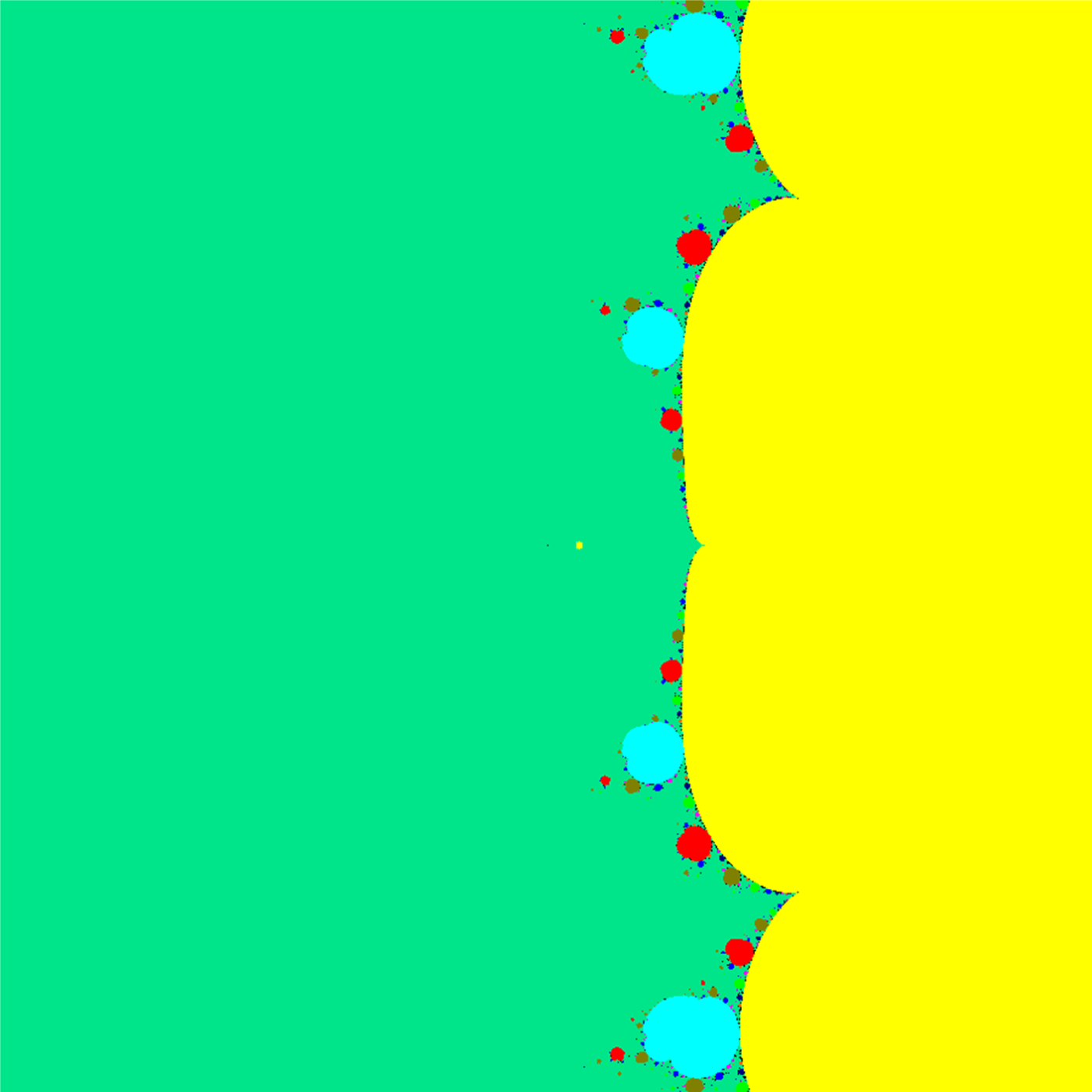
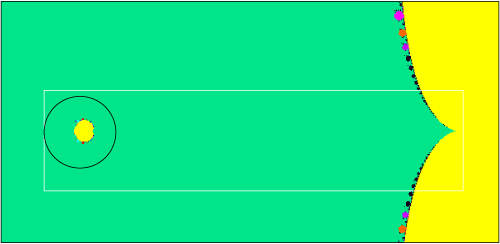
Figure 2 shows a picture of the
 $\lambda $
parameter plane for
 $\rho =2/3.$
The large region on the left (green in the color version) is
 ${\mathcal S}$
where both
 $\lambda $
and
 $\mu $
are attracted to the origin. The unbounded multishaded (multicolored region) on the right in Figure 2 is
 ${\mathcal M}_{\lambda }$
and the small bounded multishaded (multicolored) region inside
 ${\mathcal S}$
is
 ${\mathcal M}_{\mu }$
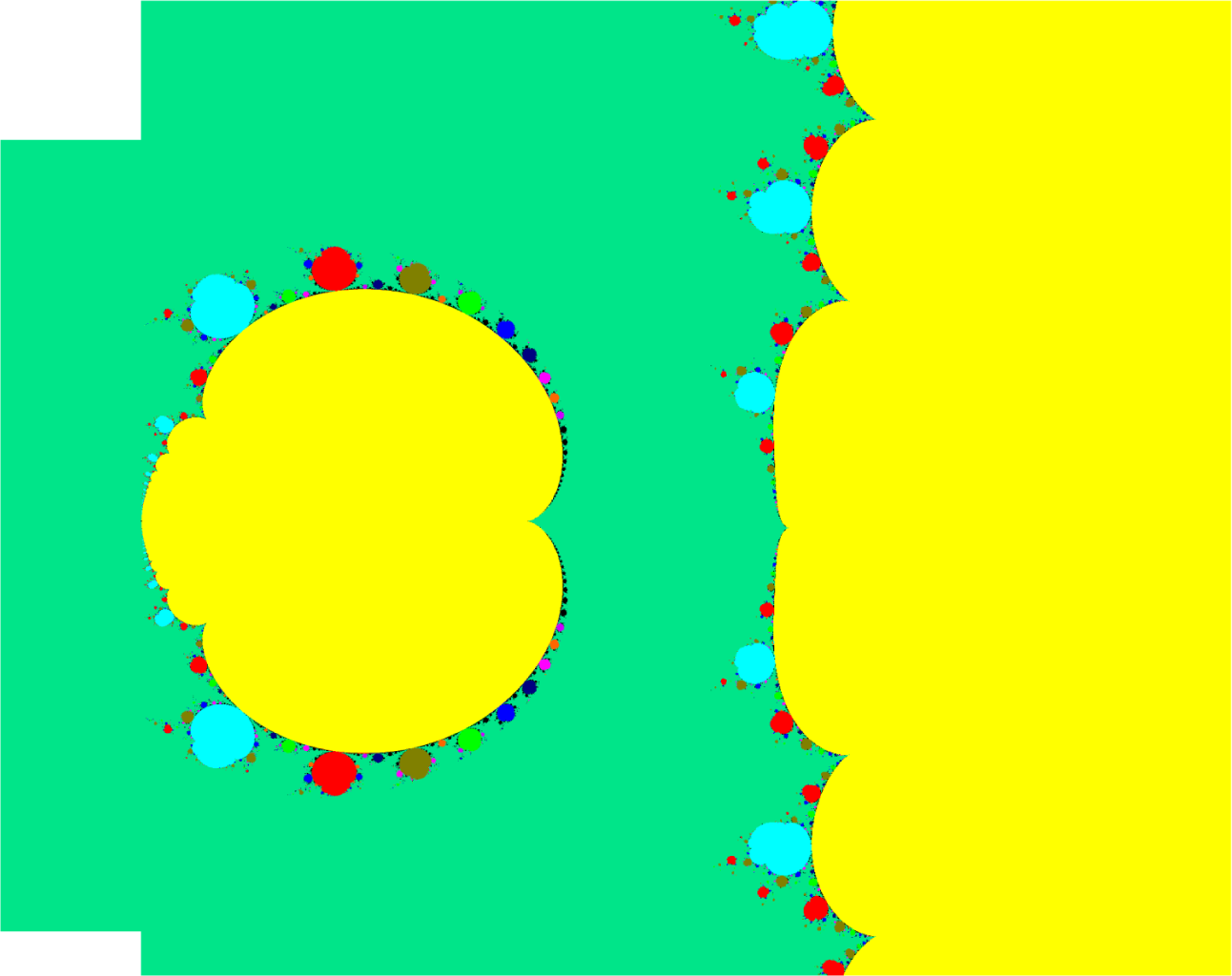
. Since this figure is drawn to scale, in
 ${\mathcal M}_{\mu }$
the different shades (colors other than yellow) are not visible. To make the structure of this region visible and show it is similar to
 ${\mathcal M}_{\lambda }$
’s, in Figure 3 we place a blown up neighborhood of
 ${\mathcal M}_{\mu }$
near
 ${\mathcal M}_{\lambda }$
.
The
 $\lambda $
plane divided into the shift locus and shell components. The large region on the left (green in the color version) is the shift locus
 ${\mathcal S}$
. The region
 ${\mathcal M}_{\mu }$
is the small disk inside it. The region
 ${\mathcal M}_{\lambda }$
is on the right and shell components of different periods are shaded: the large region to the right is period 1; the biggest of the regions attached are period 2; the next smallest period 3, etc. Because
 ${\mathcal M}_{\mu }$
is so small, only the period-1 region is visible.
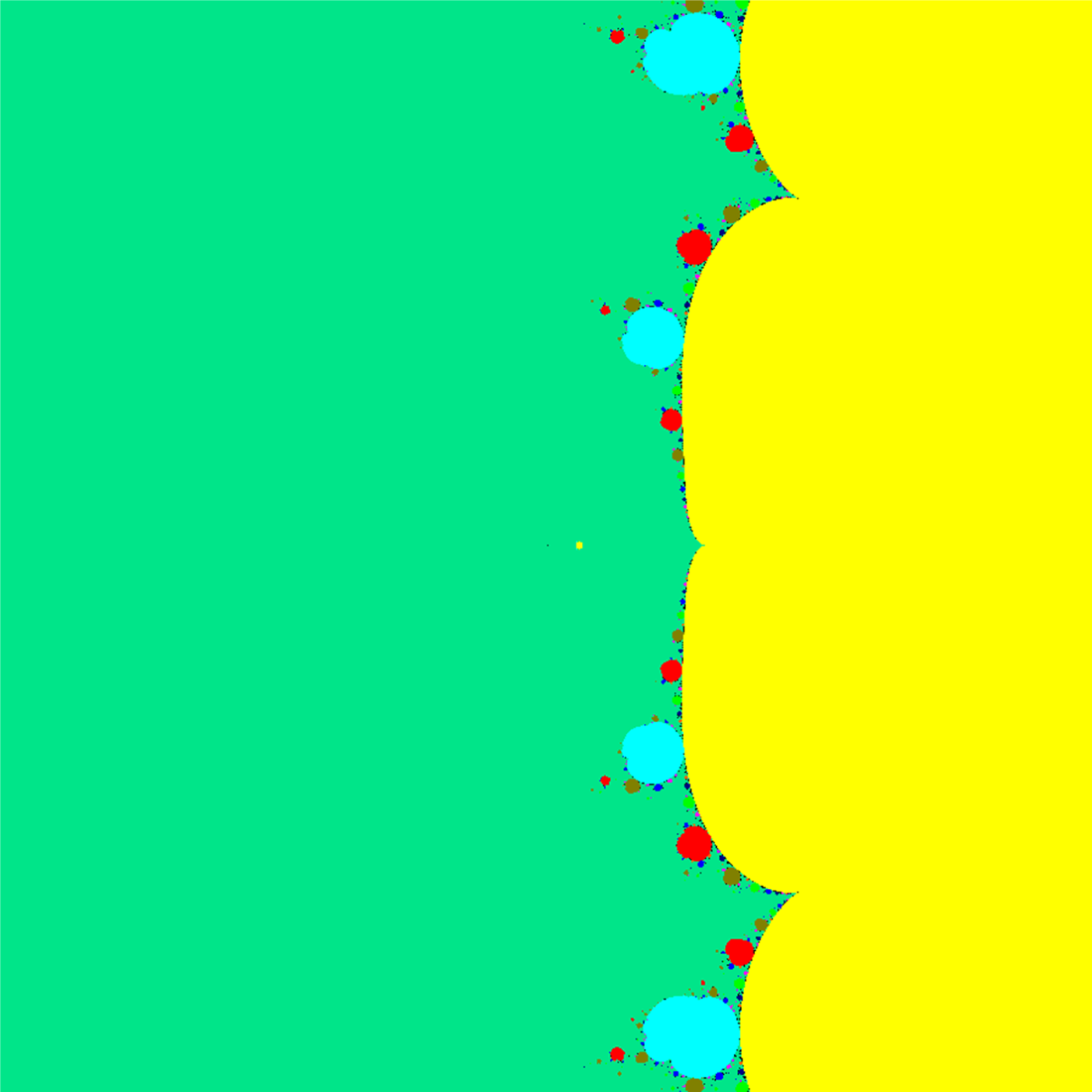
Blow-up of
 ${\mathcal M}_{\mu }$
placed near
 ${\mathcal M}_{\lambda }$
for comparison. The coloring scheme is the same as in Figure 2 and is now visible in the blown-up
 ${\mathcal M}_{\mu }$
.

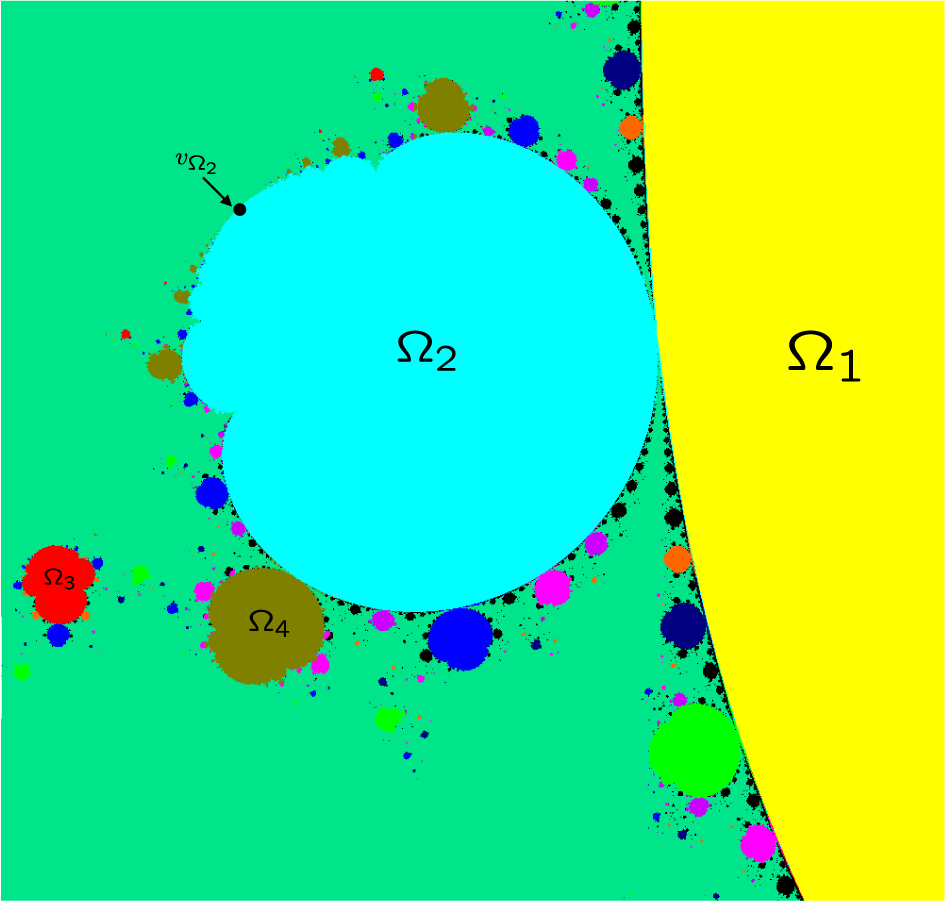
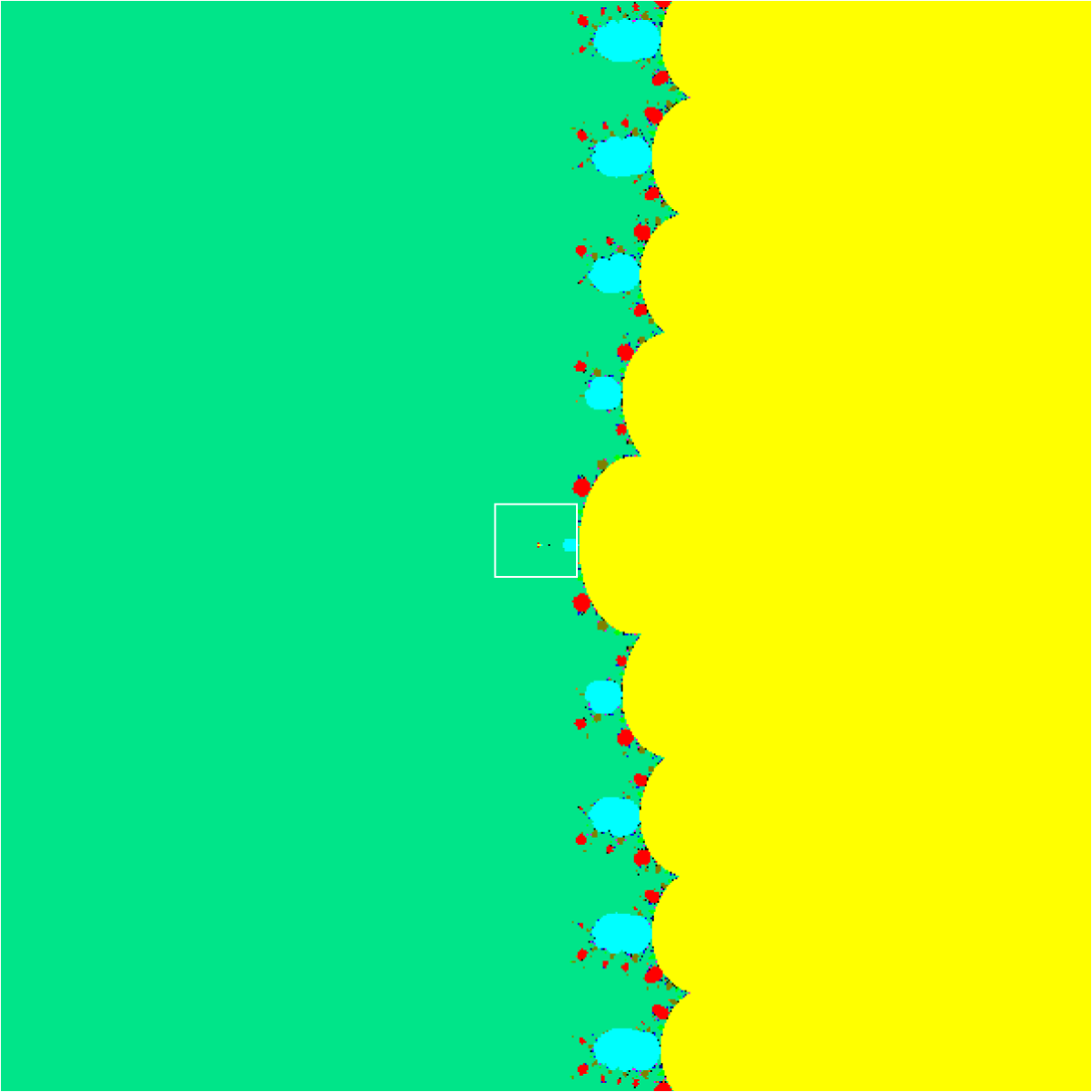
Blow-up of the
 $\lambda $
plane near
 ${\mathcal M}_{\lambda }$
with the periods labeled.

The periods of the shell components decrease with size, with components of the same period shaded similarly. The period one component is on the right. In the color version, the shell components are colored according to their period: yellow is period
 $1$
, cyan is period
 $2$
, red is period
 $3$
and so on. Periods higher than
 $10$
are colored black. Note that there is only one unbounded domain, the yellow period-
 $\kern-1pt 1$
domain on the right,
 $\Omega _1$
; its virtual center is the point at infinity. The virtual center of the period-
 $\kern-1pt 1$
component of
 ${\mathcal M}_{\mu }$
is the leftmost point. It is the singular point
 $\rho /2$
of the parameter space. There is a cusp boundary point of
 $\Omega _1$
on the real axis where the multiplier of the cycle attracted to
 $\lambda $
is
 $+1$
. There are cyan period-
 $2$
components appearing as ‘buds’ off of the yellow component
 $\Omega _1$
where the multiplier of the cycle attracted to
 $\lambda $
is
 $e^{(2m+1) \pi i}$
; each of these has a virtual center with itinerary
 $\mathbf k_1=m$
.
In Figure 4, we see a period-
 $2$
component
 $\Omega _2$
budding off
 $\Omega _1$
. Although
 $M_{\lambda }$
and
 $M_{\mu }$
look disconnected in the figure, as we will prove, they are not. Here we have only computed shell components for periods up to
 $10$
. To make a figure where
 ${\mathcal S}$
and
 ${\mathcal M}_{\lambda }$
look connected would require much more computation and many more colors to show components with much higher periods. What we do see, however, is a period
 $3$
, red component that is not a bud component of the period-
 $\kern-1pt 1$
component. In fact, there are infinitely many such converging to the virtual center of
 $\Omega _2$
marked as v. We postpone a full discussion of the finer structure of the shell components to future work.
5 Boundaries of hyperbolic components and virtual cycle parameters
In this section, we show that each virtual center is a boundary point of both
 ${\mathcal S}$
and either
 ${\mathcal M}_{\lambda }$
or
 ${\mathcal M}_{\mu }$
. To do this, we need to use the concept of transversality.
Definition 5.1. (Transversality [Reference Chen, Jiang and KeenCJK])
Suppose
 $\lambda ^{*}$
is a virtual cycle parameter. Let
 $p^*(\lambda )$
be the holomorphic pre-pole function such that
 $p^*(\lambda ^{*}) =f_{\lambda ^*}^{n-2}(\lambda ^*)$
. Define the holomorphic function,
 $$ \begin{align*} c_n(\lambda )=f_{\lambda}^{n-2}(\lambda)- p^*(\lambda ). \end{align*} $$
We say
 $f_{\lambda }$
is transversal at
 $\lambda ^{*}$
or satisfies a transversality condition at
 $\lambda ^*$
if
 $c_{n}'(\lambda ^{*}) \not =0$
.
Theorem 5.2. (Common boundary theorem)
Every virtual cycle parameter is a boundary point of both a shell component and the shift locus. Furthermore, the family
 $\{f_{\lambda }\}$
is transversal at these parameters.
Remark 5.3. The transversality property translates to the dynamic planes of the functions
 $f_{\lambda }$
as follows. If
 $ f_{\lambda }$
is transversal at
 $\lambda ^{*}$
and if
 $\lambda (t)$
is any smooth path passing through
 $\lambda ^{*}$
at
 $t^{*}$
such that
 $\lambda ' (t^{*})\not =0$
, then the dynamics of
 $f_{\lambda (t)}$
bifurcates at
 $t^{*}$
. In particular, as
 $\lambda (t)$
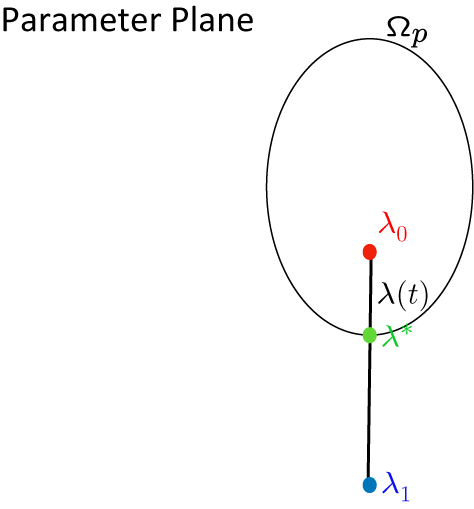
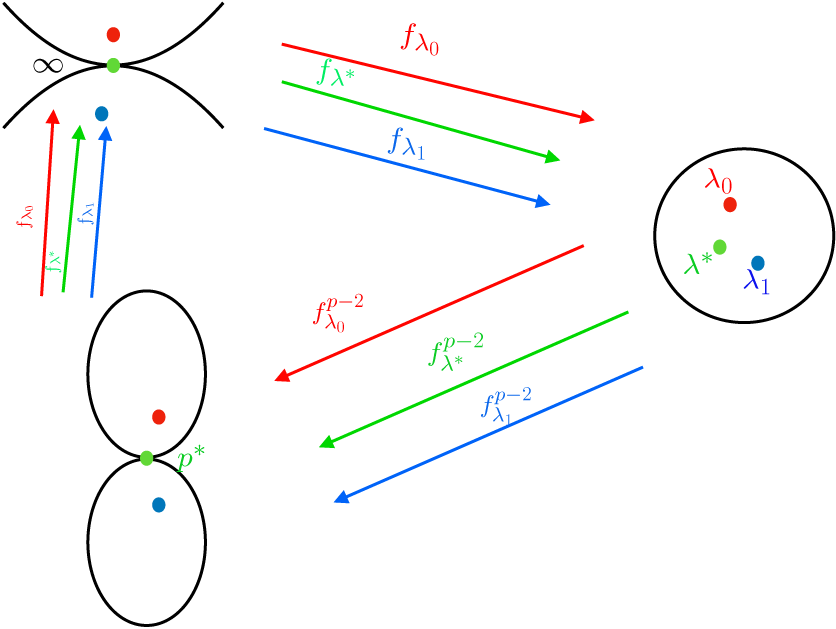
moves from a shell component into the shift locus through the common boundary point, an asymptotic value, say
 $\lambda (t)$
, moves from the attracting basin of an attractive cycle of
 $f_{\lambda (t)}$
, through the pre-pole
 $\lambda ^*$
of the virtual cycle, and into the attracting basin of zero for
 $f_{\lambda (t)}$
. Moreover, if
 $\epsilon $
is small enough so that
 $\lambda (t)$
does not contain any other virtual center when
 $|t-t^*|<\epsilon $
, then
 $t^*$
is the only point in the interval
 $|t-t^*|<\epsilon $
where the dynamics of
 $f_{\lambda (t)}$
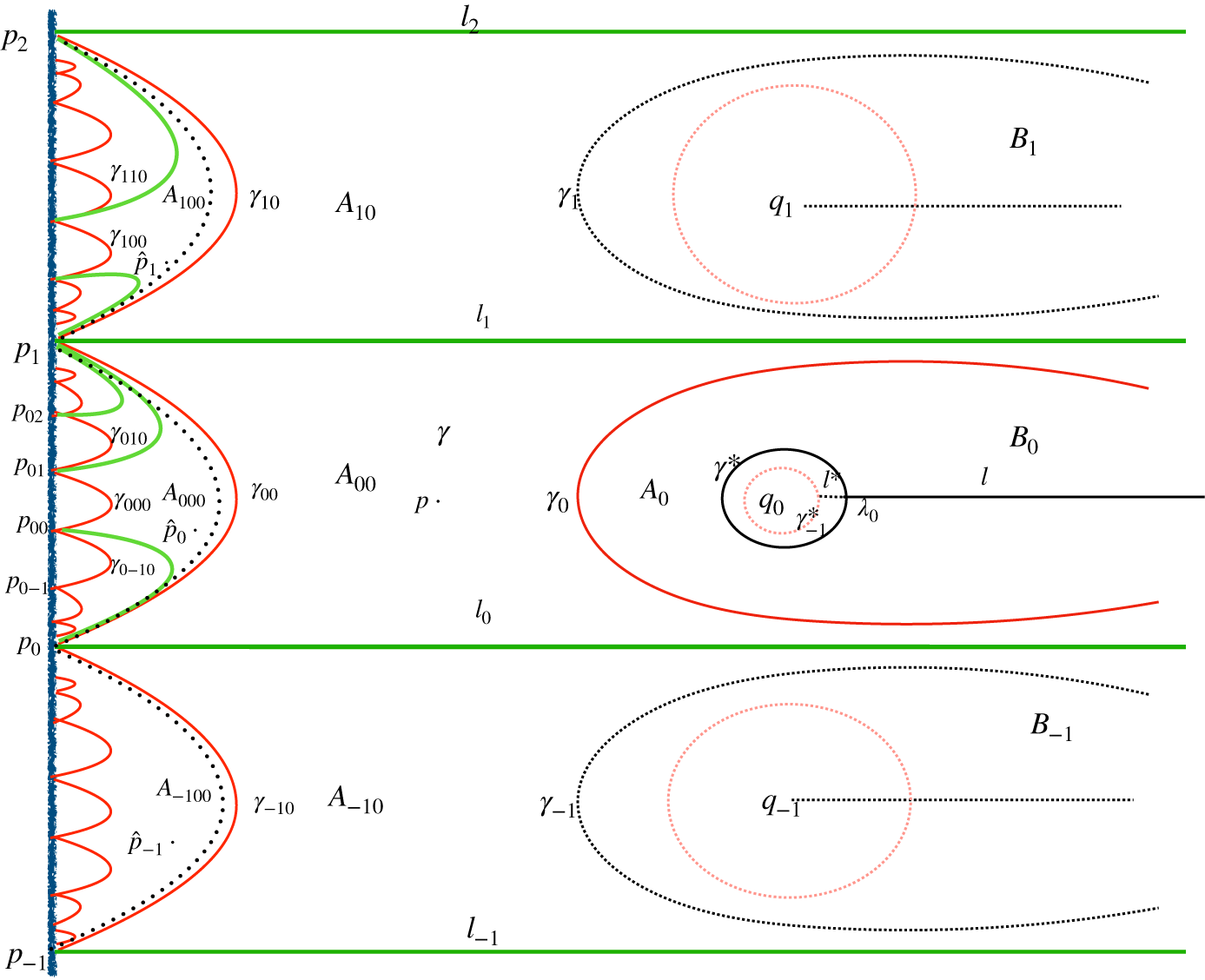
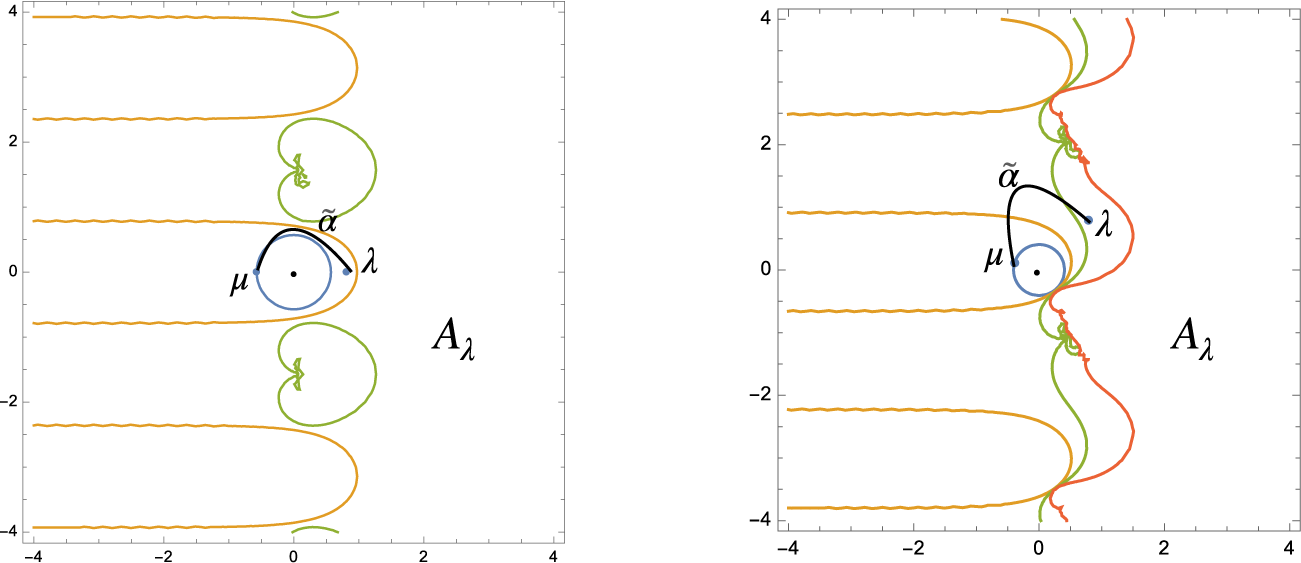
bifurcate. This is illustrated in Figures 5 and 6.
Transversality in the parameter plane.

Transversality in the dynamic plane.

In addition, transversality of
 $f_{\lambda }$
at
 $\lambda ^{*}$
implies that the holomorphic functions defining the poles
 $p_k(\lambda )$
and pre-poles
 $p_{{\mathbf k}_n}(\lambda )$
satisfy
 $p_k'(\lambda ^*) \neq 0$
and
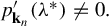 $p_{{\mathbf k}_n}'(\lambda ^*) \neq 0.$
Proof of the common boundary theorem
Let
 $\lambda ^*$
be a virtual cycle parameter. It follows from part (e) of Theorem 4.4, that
 $\lambda ^{*}$
is on the boundary of a shell component. Suppose this component,
 $\Omega _{n}$
, is in
 ${\mathcal M}_{\lambda }$
so that
 $\mu ^{*}$
is in
 $A_{\lambda ^{*}}$
, the attracting basin of
 $0$
, and
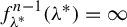 $f_{\lambda ^{*}}^{n-1} (\lambda ^{*})=\infty $
. We can choose U to be a small neighborhood of
 $\lambda ^{*}$
such that
 $\cap _{\lambda \in U} A_{\lambda } $
contains
 $\mu (\lambda )$
for all
 $\lambda \in U$
and
 $a_{n-1}(\lambda )= f_{\lambda }^{n-1} (\lambda )$
is a holomorphic function on U with
 $a_{n-1}(\lambda ^{*})=\infty $
. Because infinity is always a boundary point of the basin
 $A_{\lambda }$
, the open mapping theorem implies that there is a
 $\lambda _{U}\in U$
with
 $\lambda _{U}\in A_{\lambda (U)}$
. This says
 $\lambda _{U} \in {\mathcal S}$
and thus
 $\lambda ^*$
is a boundary point of
 ${\mathcal S}$
.
In [Reference Chen, Jiang and KeenCJK], we proved a transversality theorem for maps in the tangent family,
 $\lambda \tan z$
with
 $\lambda = it$
,
 $t \in {\mathbb R}$
. There
 $\lambda (t)$
is in the imaginary axis, and the proof shows that the function
 $c_n(\lambda (t))$
has no critical point at
 $t^*$
. It involves the use of holomorphic motions and some ideas adapted from [Reference Levin, van Strien and ShenLSS]. The proof can be adapted here by replacing the imaginary axis with a path
 $\lambda (t)$
in
 $\Omega _n$
defined by the condition that the multiplier of the attracting cycle
 $\mathbf a(\lambda )$
has argument equal to
 $2\pi i n$
, for some n. Then the arguments there can be applied and show that as
 $t \to t^*$
in
 $\Omega _n$
,
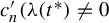 $c_n'(\lambda (t^*) \neq 0$
, and the dynamics bifurcates smoothly. We refer the interested reader to that paper for the details.
An immediate corollary of the common boundary theorem is the following.
Corollary 5.4. Given an itinerary,
 $ {\mathbf k}_{n-1}= k_{n-1}k_{n-2}\ldots k_1$
, there is exactly one component in each of
 ${\mathcal M}_{\lambda }$
and
 ${\mathcal M}_{\mu }$
with that itinerary label.
Proof. Let
 ${\mathbf k}_{n-1}$
be a given itinerary. The pre-poles
 $p_{{\mathbf k}_{n-1}}(\lambda )$
of order
 $n-1$
form a discrete set in dynamic space because they are solutions of
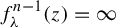 $f^{n-1}_{\lambda }(z)=\infty $
and there is only one with itinerary
 ${\mathbf k}_{n-1}$
. They are on the boundary of
 $A_{\lambda }$
. The virtual centers form a discrete set in parameter space because they are solutions of
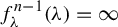 $f^{n-1}_{\lambda }(\lambda )=\infty $
.
We can find a sequence
 $\lambda _j \in {\mathcal S}$
, tending to
 $\partial {\mathcal S}$
as j goes to infinity, such that
 $|f_{\lambda _j}^{n-1}(\lambda _j) -p_{{\mathbf k}_{n-1}}(\lambda )|$
goes to zero as j goes to infinity. It follows that
 $\lim _{j \to \infty } \lambda _j$
is a virtual cycle parameter
 $\lambda ^*$
with itinerary
 ${\mathbf k}_{n-1}$
. By Theorem 5.1, in a small neighborhood of
 $\lambda ^*$
, there is no other virtual center with itinerary
 ${\mathbf k}_{n-1}$
so that the component
 $\Omega _n$
with
 $\lambda ^*$
as a virtual center is the only one in
 ${\mathcal M}_{\lambda }$
with this itinerary.
We obtain a different component
 $\Omega _n'$
if we choose a sequence
 $\lambda _j'$
such that
 $f_{\lambda _j}^{n-1}(\mu _n)$
approaches the pre-pole with this itinerary, but that is the only other possibility. In this case,
 $\Omega _n'$
is in
 ${\mathcal M}_{\mu }$
.
5.1 J-stability and the bifurcation locus
Denote the set of virtual cycle parameters by
 $\mathcal {B}_{cv}$
. By Theorem 4.4, each such parameter is on the boundary of a unique shell component and in §4.2, we used these parameters to enumerate the shell components. Here we will prove that these parameters are dense in the boundary of the shift locus. To do so, we need two definitions.
Definition 5.5. (Holomorphic family)
A holomorphic family of meromorphic maps over a complex manifold X is a map
 ${\mathcal F}:X \times {\mathbb C} \rightarrow \widehat {\mathbb C}$
, such that
 ${\mathcal F}(x,z)=:f_x(z)$
is meromorphic for all
 $x\in X$
and
 $x \mapsto f_x(z)$
is holomorphic for all
 $z\in {\mathbb C}$
.
Definition 5.6. The J-stable set of the family
 $\mathcal {F}_{2}$
, denoted by
 $\mathcal {J}=\mathcal {J}_{\rho }$
, is the set
 $\{\lambda \ |\ f^n_{\lambda }(\lambda )\}$
and
 $f^n_{\lambda }(\mu )$
are well defined in a neighborhood about
 $\lambda $
for all n and form normal families. Its complement is called the bifurcation locus.
Theorem B of [Reference Mané, Sad and SullivanMSS] in our context states the following.
Theorem 5.7. In any holomorphic family of meromorphic maps with finite singular set,
 $\mathcal {J}$
coincides with the set of parameters for which the total number of attracting and superattracting cycles of
 $f_{\lambda }$
is constant on a neighborhood of
 $\lambda $
.
As a corollary (see [Reference Keen and KotusKK, Corollary 3.2]), we have the following.
Proposition 5.8. If
 $\lambda _0 \in \mathcal J$
, then the number of attracting cycles of
 $f_{\lambda _0}$
is locally constant in a neighborhood of
 $\lambda _0$
; in particular,
 $\mathcal J$
is open.
Consider a component U of
 ${\mathcal J}$
. Suppose
 $\lambda $
and
 $\lambda '$
are two points in U and
 $\gamma (t): [0, 1]\to U$
is an analytic curve connecting
 $\lambda $
and
 $\lambda '$
with
 $\gamma (0)=\lambda $
and
 $\gamma (1)=\lambda '$
. In a neighborhood V of
 $\gamma $
with basepoint
 $\lambda $
, the set
 $E_{c}=\{p_{c}\}$
,
 $c\in V$
, of all repelling periodic points of
 $f_{c}$
defines a holomorphic motion,
 $$ \begin{align*} h(z, c) =p_{c}: E_{\lambda } \times V\to {\widehat{\mathbb C}}. \end{align*} $$
The
 $\lambda $
-lemma (see [Reference Gardiner, Jiang and WangGJW, Reference Mané, Sad and SullivanMSS]) implies that the holomorphic motion h can be extended to the closure
 $\overline {E}_{\lambda }$
of
 $E_{\lambda }$
; that is, there is a holomorphic motion
 $$ \begin{align*} H(z,c): \overline{E}_{\lambda } \times V\to {\widehat{\mathbb C}} \end{align*} $$
such that
 $H|E\times V=h$
and
 $H_{\lambda , \lambda '} (z)=H(z, \lambda '): \overline {E}_{\lambda } \to \overline {E}_{\lambda '}$
is a quasiconformal homeomorphism. Because the repelling periodic points of
 $f_{\lambda }$
are dense in the Julia set
 $J_{\lambda }$
, it follows that
 $\overline {E}_{\lambda } = J_{\lambda }$
and
 $$ \begin{align*} H_{\lambda , \lambda '} \circ f_{\lambda } =f_{\lambda '}\circ H_{\lambda , \lambda '} \quad \text{on } J_{\lambda}. \end{align*} $$
Note that the construction of
 $H_{\lambda , \lambda '}$
depends on the choice of the curve
 $\gamma $
and it may not be unique.
We also need the following generation of Montel’s theorem.
Theorem 5.9. (See Theorem
$3.3.6$
in [Reference BeardonBea])

Let D be a domain, and suppose that the functions
 $\phi _1$
,
 $\phi _2$
, and
 $\phi _3$
are analytic in D, and are such that the closures of the domains
 $\phi _j(D)$
are mutually disjoint. If
 $\mathcal {F}$
is a family of functions, each analytic in D, and such that for every z in D and every f in
 $\mathcal {F}$
,
 $f(z)\neq \phi _j(z)$
,
 $j=1, 2, 3$
, then
 $\mathcal {F}$
is normal in D.
The set of virtual center parameters
 $\mathcal {B}_{cv}$
is clearly not contained in
 $\mathcal {J}$
. By Theorem 4.4 and Theorem 5.2, the points in
 $\mathcal {B}_{cv}$
are on the boundaries of both a shell component and the shift locus. In addition, we have the following.
Theorem 5.10. The boundary of
 $\mathcal {J}$
is contained in the closure of
 $\mathcal {B}_{cv}$
, that is,
 $\partial \mathcal {J}\subset \overline {\mathcal {B}_{cv}}$
.
Proof. Because
 $0$
is an attracting fixed point, at least one of the families
 $\{f_{\lambda }^n(\lambda )\}$
and
 $\{f_{\lambda }^n(\mu )\}$
converges to
 $0$
; that is, for each
 $\lambda _0$
, one of them is always normal and, by Proposition 5.8, in a neighborhood of
 $\lambda _0$
, it is the same family that is normal. Suppose
 $\lambda _0\in \partial \mathcal {J}$
; without loss of generality, we may assume that
 $\{f_{\lambda }^n(\lambda )\}$
is not normal at
 $\lambda _0$
.
Let U be any neighborhood of
 $\lambda _0$
. The poles of
 $f_{\lambda ,}$
 $$ \begin{align*} p_k(\lambda)=\frac{1}{2}\log \bigg(\frac{\rho-2\lambda}{\rho}\bigg)+ik\pi, \quad k\in \mathbb{Z}, \end{align*} $$
form a holomorphic family in U. If
 $f^n_{\lambda ,\mu }(\lambda ) \neq p_k(\lambda )$
for any k or
 $\lambda \in U$
, then Theorem 5.9 implies
 $f^n_{\lambda }(\lambda )$
is normal in U. This contradicts the hypothesis that
 $\lambda _0\in \partial \mathcal {J}$
.
The parabolic cusps and Misiurewicz points are contained in the bifurcation locus.
6 Topological structure of the shift locus
In this section, we will show that the shift locus is homeomorphic to an annulus punctured at one point. This puncture corresponds to the point
 $\lambda =0$
, where
 $f_{\lambda }$
is not defined.
Before we discuss this proof, we need a lemma.
Lemma 6.1. Suppose V is Riemann surface homeomorphic to a disk from which a (possibly empty) collection of finitely or countably many pairwise disjoint disks have been removed. Let
 $\lambda $
and
 $\mu $
be two distinct points in V. Then there is a Riemann surface
 $W,$
homeomorphic to a disk minus a countable collection of pairwise disjoint disks, and an infinite degree holomorphic covering map
 $h: W \rightarrow V \setminus \{\lambda , \mu \}$
.
Proof. There exists an embedding
 $e: V\to \widehat {\mathbb {C}}$
such that
 $e(\lambda )=0$
and
 $e(\mu )=\infty $
. Consider the exponential map
 $$ \begin{align*} \mathrm{Exp}(z)=e^z: \mathbb{C}\to \mathbb{C} \end{align*} $$
and set
 $W=\mathrm{Exp}^{-1}(e(V))$
. Each component U of
 $\widehat {\mathbb {C}}\setminus e(V)$
is simply connected and does not contain either
 $0$
or
 $\infty $
. Therefore,
 $\mathrm{Exp}^{-1}(U)$
is the union of infinitely many simply connected open sets so that W is an open set with infinitely many holes. Thus
 $h= e^{-1}\circ \mathrm{Exp}: W\to V$
is the required map.
Remark 6.2. We inductively apply this lemma to construct a family of surfaces and infinite degree covering maps. The direct limit of this process defines a map that is used in a key step of the proof of the main structure theorem.
As in Lemma 6.1, let
 $V_0$
be a topological disk and let
 $\{U_j \}$
be a (possibly empty) collection of finitely or countably many pairwise disjoint disks in
 $V_0$
. Set
 $U_{0}=V_{0}\setminus \bigcup _{j\in {\mathbb Z}} U_{j}$
and fix two points,
 $\lambda _0$
and
 $\mu _0$
, in
 $U_0$
. Applying the lemma, we can find a Riemann surface
 $U_1=V_{1}\setminus \bigcup _{(j_{1}, j)\in {\mathbb Z}^{2}} U_{j_{1}j}$
, where
 $V_{1}$
is a topological disk and the
 $U_{j_{1},j}$
are pairwise disjoint topological disks in
 $V_{1}$
, and an infinite degree holomorphic covering map
 $h_1: U_1 \rightarrow U_0 \setminus \{\lambda _0, \mu _0\}$
.
Iterating this process, we choose points
 $ \lambda _{n-1}, \mu _{n-1} \in U_{n-1} $
and obtain Riemann surfaces
 $U_{n}=V_{n}\setminus \bigcup _{(j_{n},\ldots j_{0})\in {\mathbb Z}^{n+1}} U_{j_{n}\cdots j_{0}}$
, where
 $V_{n}$
is a topological disk and the
 $U_{j_{n}\cdots j_{0}}$
are pairwise disjoint topological disks in
 $V_{n}$
, and holomorphic covering maps of infinite degree
 $$ \begin{align*}h_{n}: U_{n} \to U_{n-1} \setminus \{ \lambda _{n-1}, \mu_{n-1} \}. \end{align*} $$
To carry out the proof on the structure of
 ${\mathcal S}$
, recall the normalized uniformizing map
 $\phi _{\lambda }$
defined in the proof of Proposition 3.1 that conjugates
 $f_{\lambda }$
to a linear map near the origin. We divide the discussion into two parts depending on which of the asymptotic values is on the boundary of
 $O_{\lambda }$
, the domain on which
 $\phi _{\lambda }$
is injective.
-
• Let
${\mathcal S}_{\lambda } =\{ \lambda \in {\mathcal S} | \mu \in \partial {O_{\lambda }} \}$
. -
• Let
${\mathcal S}_{\mu } =\{ \lambda \in {\mathcal S} | \lambda \in \partial {O_{\lambda }} \}$
.


These sets have a common boundary,
 ${\mathcal S}_* = {\mathcal S}_{\lambda } \cap {\mathcal S}_{\mu }$
, or equivalently,
 $$ \begin{align*} {\mathcal S}_*=\{ \lambda \in {\mathcal S}_{\lambda} | \lambda \in \partial{O_{\lambda }} \} = \{ \lambda \in {\mathcal S}_{\mu} | \mu \in \partial{O_{\lambda }} \}. \end{align*} $$
In §3.1, we defined the map
 $I(\lambda )$
which is some kind of the inversion in the circle
 ${\mathcal C}_0$
defined by
 $|z-\rho /2|=|\rho /2|$
. Using this map we have the following.
Proposition 6.3. The common boundary set
 ${\mathcal S}_*$
is invariant under
 $I(\lambda )$
.
Proof. Note that the affine map
 $z\to -z$
conjugates
 $f_{\lambda }$
to
 $f_{I(\lambda )}$
. Therefore, if
 $\phi _{\lambda }(z)$
is the uniformizing map for
 $f_{\lambda },$
then the uniformizing map
 $\phi _{I(\lambda )}$
for
 $f_{I(\lambda )}=f_{\lambda _1,\mu _1}$
is
 $\phi _{\lambda }(-z)$
. Thus,
 $$ \begin{align*} \phi_{I(\lambda)}(\lambda_1)=\phi_{\lambda }(\mu)\quad\text{ and }\quad\phi_{I(\lambda)}(\mu_1)=\phi_{\lambda }(\lambda). \end{align*} $$
It follows that
 $I(\lambda )$
interchanges
 $\mathcal {S}_{\lambda }$
and
 $\mathcal {S}_{\mu }$
and fixes
 $\mathcal {S}_*$
.
Note that the point
 $\lambda = \rho $
is in
 ${\mathcal S}_*$
.
We saw above, in Proposition 3.5, that if
 $\rho $
is real, the invariant circle
 ${\mathcal C}_0$
of the inversion
 $I(\lambda )$
is in
 ${\mathcal S}$
. If
 $\rho $
is real, we can say more.
Proposition 6.4. If
 $\rho $
is real, then
 ${\mathcal S}_*={\mathcal C}_0$
.
Proof. Let
 $\sigma (z)=-\overline {z}$
. Then if
 $\rho $
is real, it is easy to check that for any z,
 $f_{\lambda }\circ \sigma (z)=\sigma \circ f_{\lambda }(z)$
. Therefore,
 $$ \begin{align*} f^n_{\lambda}(\mu)=f^n_{\lambda}(-\overline{\lambda})=-\overline{f_{\lambda}^n(\lambda)} \end{align*} $$
and by Proposition 3.5, they both converge to
 $0$
.
To show
 ${\mathcal S}_*={\mathcal C}_0$
, we need to show that
 $|\phi _{\lambda }(\lambda )|=|\phi _{\lambda }(\mu )|$
, where
 $\phi _{\lambda }$
is the uniformizing map defined above such that
 $\phi _{\lambda }(f_{\lambda }(z))=\rho \phi _{\lambda }(z)$
. We claim, in fact, that
 $\phi _{\lambda }(\mu )=-\overline {\phi _{\lambda }(\lambda )}$
.
Let
 $\phi =\sigma \circ \phi _{\lambda }\circ \sigma (z)$
. We claim that
 $\phi _{\lambda }=\phi $
because
 $$ \begin{align*} \phi(f_{\lambda}(z))&=\sigma \circ \phi_{\lambda} \circ \sigma (f_{\lambda}(z))=\sigma \circ \phi_{\lambda} (f_{\lambda}(\sigma(z)))=\sigma(\rho \phi_{\lambda}(\sigma(z)))\\ &=\rho \sigma\circ \phi_{\lambda}\circ \sigma(z)=\rho \phi(z). \end{align*} $$
Then
 $\phi _{\lambda }(\mu )=\phi _{\lambda }(\sigma (z))=\sigma \phi _{\lambda }(\lambda ))=-\phi _{\lambda }(-\overline {\lambda })$
as claimed.
The following theorem says that the interior
 ${\mathcal S}_{\lambda }^0$
of
 ${\mathcal S}_{\lambda }$
is a topological annulus. It follows that it is connected.
Theorem 6.5. There is a homeomorphism
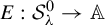 $E: {{\mathcal S}_{\lambda }^0} \rightarrow {\mathbb A}$
, where
 ${\mathbb A}$
is a topological annulus. The inverse map
 $E^{-1}$
extends continuously to all points except one of the boundary components of
 ${\mathbb A}$
.
Remark 6.6. The proof of this theorem is based on a lemma in which we explicitly construct a homeomorphism E from
 ${{\mathcal S}_{\lambda }^0}$
to an annulus. The construction depends on the choice of a particular ‘model map’ in the period-
 $\kern-1pt 1$
component
 $\Omega _1$
.
The proof of the lemma is based on a technique that originally appeared in the unpublished thesis of Wittner [Reference WittnerWit]. The technique, called ‘critical point surgery’, is used to model pieces of the cubic connected locus on the dynamical plane of a quadratic polynomial. In [Reference Goldberg and KeenGK], it was adapted to describe slices of
 $Rat_2$
, the parameter space of rational maps of degree two with an attracting fixed point. Like the
 $Rat_2$
case, we have two singular values, but unlike that case, our singular values are asymptotic values and our maps are infinite degree and have an essential singularity. We choose as our model an
 $f_{\lambda }$
with
 $\lambda $
in the period-
 $\kern-1pt 1$
shell component of
 ${\mathcal M}_{\lambda }$
. This is the unbounded yellow component in Figure 2 and is denoted by
 $\Omega _1$
. As we saw at the end of §3.1, the attracting basin of the fixed point of
 $f_{\lambda }$
is simply connected and completely invariant. Our model space will be the annulus formed by removing a dynamically defined disk from this basin.
Before we give the proof in detail, we give an outline. Below, we assume, as we have been doing, that
 $\rho $
is fixed and all the functions
 $f_{\lambda }$
belong to
 ${\mathcal F}_{2}$
.
-
(1) Because the multiplier map is a universal cover of a shell component to the punctured unit disk, we can find a
$\lambda _0$
in
$\Omega _1 \subset {\mathcal M}_{\lambda }$
such that the multiplier at the fixed point
$q_0$
of
$f_{\lambda _0}$
equals the fixed value
$\rho $
. This choice is convenient because the map
$f_{\lambda _0}$
is quasiconformally conjugate to a map
$\sigma \tan z$
whose Julia set, by [Reference Keen and KotusKK], is a quasiconformal image of the real line. In fact, if we take
$\rho $
real,
$\sigma $
is real, the Julia set of
$f_{\lambda _0}$
is a line parallel to the imaginary axis and the attracting basin of
$q_0$
is a simply connected, completely invariant half-plane containing the asymptotic value
$\lambda _0$
. Following the notation in §3.1, we denote the basin of
$q_0$
by
$K_0$
. -
(2) We make the model space by removing from
$K_0$
a closed dynamically defined topological disk
$\Delta $
which contains the fixed point
$q_0$
in its interior and
$\lambda _0$
on its boundary. We define the map E from
${\mathcal S}_{\lambda }^0$
to
$K_0 \setminus \Delta $
as follows: to each
$\lambda \in {\mathcal S}_{\lambda }^0$
, we construct a map
$\xi _{\lambda }$
from a subset of the attracting basin
$A_{\lambda }$
of
$0$
containing both asymptotic values into the attracting basin
$K_0$
of
$q_0$
such that
$\xi _{\lambda }(0)=q_0$
and
$\xi _{\lambda }(\mu )=\lambda _0$
; we set
$E(\lambda )=\xi _{\lambda }(\lambda )$
. We then prove that E is injective. -
(3) To show E is a homeomorphism, we construct an inverse.
-
• We want to assign a map
$f_{\lambda } \in {\mathcal S}_{\lambda }^0$
to each point p in
$K_0 \setminus \Delta $
. The point p should correspond to the asymptotic value
$\lambda $
of
$f_{\lambda }$
. Given p, we use induction to construct the stable region of a map with two asymptotic values at
$\lambda _0$
and p. At the nth step, we obtain a domain
$U_n$
, homeomorphic to a disk minus an infinite collection of open disks, and a holomorphic map
$Q_n:U_n \rightarrow U_n$
with omitted values
$\lambda _0$
and p. Taking the direct limit of the pairs
$(U_n, Q_n)$
, we obtain a pair
$(U_{\infty }, Q_{\infty })$
, where
$Q_{\infty }:U_{\infty } \rightarrow U_{\infty }$
is a holomorphic covering map with the desired topology; that is, an infinite degree covering map with two asymptotic values. -
• We construct a conformal embedding
$e:U_{\infty } \rightarrow {\mathbb C}$
such that
$e \circ U_{\infty } = f_{\lambda } \circ e$
for a unique
$\lambda \in {\mathcal S}_{\lambda }^0$
such that
$\xi _{\lambda }(\lambda )=p$
. The construction depends on some Teichmüller theory. We give a brief summary of what we need before the construction. -
• We extend this inverse map to the points of
$\partial \Delta \setminus \{\lambda _0 \}$
whose image, by construction, is
${\mathcal S}_*$
. Note that the map is not defined for
$p=\lambda _0$
; its image must be a parameter singularity in
$\overline {{\mathcal S}_*}$
.
-













The proof of Theorem 6.5 is contained in the next subsections.
6.1 The model space
Every point
 $\lambda \in \Omega _1$
corresponds to a function
 $f_{\lambda }$
with a non-zero attracting fixed point denoted by
 $q_{\lambda }$
; its attractive basin is denoted by
 $K_{\lambda }$
. By Propositions 3.1 and 3.6, it is simply connected and completely invariant. In fact,
 $f_{\lambda }$
is quasiconformally conjugate to
 $ t \tan z$
for some real
 $t\geq 1$
whose Julia set is the real line (see [Reference Devaney and KeenDK]), so its Julia set is the quasiconformal image of a line (see Figure 7 where
 $\rho =2/3$
). In Figure 7, the cyan colored region is
 $K_{\lambda }$
and the yellow region is the basin of
 $0$
,
 $A_{\lambda }$
. The black dots are poles on the boundary of
 $K_{\lambda }$
and are in the Julia set. Denote the closure of
 $K_{\lambda }$
by
 $\overline {K_{\lambda }}$
. It is the analogue of the filled Julia set for a quadratic map.
Because the multiplier map
 $\nu $
is a universal covering from
 $\Omega _1$
to
 ${\mathbb D}^*$
, we can find a sequence of points
 $\lambda _j \in \Omega _1$
,
 $j \in {\mathbb Z}$
such that
 $\nu (\lambda _j)=f_{\lambda _j}'(q(\lambda _j))= \rho $
. We choose one, denote it by
 $\lambda _0$
, and set
 $q_{0}=q_{\lambda _0}$
. We set
 $Q(z)=f_{\lambda _0}(z)$
and let
 $K_0$
denote the attracting basin of
 $q_0$
.
In Figure 8, the set
 $\overline {K}_{0}$
is depicted for
 $\rho $
real and
 $\lambda _0$
taken as the real solution to
 $\nu (\lambda _0)=f_{\lambda _0}'(q(\lambda _0))= \rho $
. Because the multipliers of both attracting fixed points,
 $0$
and
 $q_0$
, are the same, there is a real
 $t=t(\rho )$
,
 $\sigma =it$
, such that
 $Q(z)$
and
 $it \tan iz =t \tanh z$
are not only quasiconformally conjugate but affine conjugate and the Julia set of
 $Q(z)$
is a vertical line.
The ‘filled Julia set’ of
 $Q(z)$
. The black dots are poles.

Domains and curves in the construction.

There is a local uniformizing map, which we denote by
 $\phi _0$
,
 $\phi _0: K_0 \rightarrow {\mathbb C}$
, normalized so that
 $\phi _0$
maps
 $q_0$
to
 $0$
,
 $\phi _0'(q_0)=1$
, and
 $\phi _0$
conjugates Q to
 $\zeta \to \rho \zeta $
in a neighborhood of
 $q_0$
. We can extend
 $\phi _0$
to all of
 $K_0$
by analytic continuation. Note that
 $\phi _0(z)=0$
if and only if
 $Q^n(z)=q_0$
for some n.
Let
 $r=|\phi _0(\lambda _0)|$
and let
 $\gamma ^*=\phi ^{-1}_0(re^{i\theta }), \, \theta \in {\mathbb R}$
. It is a simple closed curve; let
 $\Delta $
be the closed topological disk in
 $K_0$
bounded by
 $\gamma ^*$
. Then
 $\phi _0$
is injective on
 $\Delta $
and
 $\lambda _0$
is on
 $\partial \Delta $
.
Lemma 6.7. There is an injective holomorphic map
 $E:{\mathcal S}_{\lambda }^0 \rightarrow K_0 \setminus \Delta $
. Set
 $w=E(\lambda )$
; E satisfies the following.
-
(i) For each
$\lambda \in {\mathcal S}_{\lambda }$
such that
$f_{\lambda }^n(\lambda )=0$
for some n, E maps it to a pre-image of
$q_0$
; that is, if
$w=E(\lambda )$
, then
$Q^n(w)=q_0$
. -
(ii) For each
$\lambda \in {\mathcal S}_{\lambda }$
such that
$f_{\lambda }^n(\lambda )=f_{\lambda }^m(\mu )$
for some
$m,n$
, E maps it to a point in the grand orbit of
$\lambda _0$
; that is, if
$w=E(\lambda )$
, then
$Q^n(w)=Q^m(\lambda _0)$
. -
(iii) As
$\lambda $
tends to the boundary
${\mathcal S}_*$
of
${\mathcal S}_{\lambda }$
,
$w=E(\lambda )$
tends to
$\partial \Delta \setminus \{\lambda _0 \}$
.










Proof. The map E is defined as follows. Given
 $\lambda \in {\mathcal S}_{\lambda }^0$
, we define a conformal homeomorphism
 $\phi _{\lambda }$
from the neighborhood
 $O_{\lambda }$
in the attracting basin
 $A_{\lambda } $
to a disk centered at zero with
 $\phi _{\lambda }(0)=0$
that conjugates
 $f_{\lambda }$
to
 $ \zeta \mapsto \rho \zeta $
. The map is defined up to affine conjugation and depends holomorphically on
 $\lambda $
. We assume here that it is normalized so that
 $\phi _{\lambda }(\mu )=\phi _0(\lambda _0)$
. For each
 $\lambda $
, define a map
 $$ \begin{align*} \xi_{\lambda}=\phi_0^{-1}\circ \phi_{\lambda}: O_{\lambda}\to \Delta. \end{align*} $$
From the definitions of
 $\phi _{\lambda }$
and
 $\phi _0$
, it follows that
 $\xi _{\lambda }(0)=q_0$
and
 $\xi _{\lambda }(\mu )=\lambda _0$
. Because
 $f_{\lambda _0}'(0)=Q'(q_0)=\rho $
, the map
 $\xi _{\lambda }$
is a conformal homeomorphism from
 $O_{\lambda }$
to
 $\Delta $
and it conjugates
 $f_{\lambda }$
to Q.
Now we are ready to define the map E from
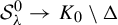 $\mathcal {S}_{\lambda }^0\to K_0\setminus \Delta $
as
 $$ \begin{align*} E(\lambda ) = \xi_{\lambda }(\lambda ). \end{align*} $$
By construction, E satisfies properties (i) and (ii).
Suppose
 $\xi _{\lambda '}(\lambda ')=\xi _{\lambda }(\lambda )$
. The map
 $\xi _{\lambda ', \lambda }=\xi _{\lambda '}^{-1}\xi _{\lambda }=\phi _{\lambda '}^{-1}\phi _{\lambda }$
, restricted to a neighborhood of the origin in the basin
 $A_{\lambda }$
, defines a holomorphic conjugacy between
 $f_{\lambda }$
and
 $f_{\lambda '}$
on this neighborhood. Because
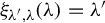 $\xi _{\lambda ', \lambda } (\lambda )=\lambda '$
, we can extend this holomorphic conjugacy by the dynamics of
 $f_{\lambda }$
and
 $f_{\lambda '}$
to a holomorphic conjugacy, which we still denote by
 $\xi _{\lambda ', \lambda }$
, defined on the whole stable set
 $A_{\lambda }$
. Furthermore, by using dynamics of
 $f_{\lambda }$
and
 $f_{\lambda '}$
, we can extend this holomorphic conjugacy to to the Julia set
 $J_{\lambda }$
as a topological conjugacy that fixes infinity. Because
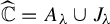 ${\widehat {\mathbb C}}=A_{\lambda }\cup J_{\lambda }$
, if we denote this extension by
 $\xi _{\lambda , \lambda '}$
again, we have
 $$ \begin{align*} \xi_{\lambda ', \lambda }\circ f_{\lambda } = f_{\lambda '}\circ \xi_{\lambda ', \lambda } \quad \text{on } {\widehat{\mathbb C}}. \end{align*} $$
From the discussion on J-stability in §5.1, we can find a holomorphic motion
 $H(z, c): \overline {E}_{\lambda }\times V\to {\widehat {\mathbb C}}$
such that
 $\xi _{\lambda , \lambda '}|\overline {E}_{\lambda } =H_{\lambda , \lambda '}=H(\cdot , \lambda ')$
is a quasiconformal homeomorphism on
 $\overline {E}_{\lambda }=J_{\lambda }$
. On
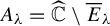 $A_{\lambda }= {\widehat {\mathbb C}}\setminus \overline {E}_{\lambda }$
,
 $\xi _{\lambda , \lambda '}$
is holomorphic and injective, thus it is conformal. Now by a theorem of Rickman (see [Reference RickmanRick, Theorem 1], [Reference Douady and HubbardDH], or [Reference JiangJ, Theorem 5.1]) it follows that
 $\xi _{\lambda , \lambda '}$
is a global quasiconformal mapping of
 ${\widehat {\mathbb C}}$
. It follows from the paper of Zheng (see [Reference ZhengZJ, Theorem 3.1]), that the area of the Julia set
 $J_{\lambda }$
is zero and
 $\xi _{\lambda , \lambda '}$
is a global conformal mapping of
 ${\widehat {\mathbb C}}$
. Because
 $\xi _{\lambda ', \lambda }$
fixes zero and infinity,
 $\xi _{\lambda ', \lambda }(z)=az$
. Equation (5) implies that
 $a=1$
,
 $\lambda =\lambda '$
, which proves that E is injective. Note that as we saw in §2.2, there are two choices for
 $\lambda '$
but if we require that
 $\lambda '$
is the preferred asymptotic value so that
 $\lambda ' \in {\mathcal S}_{\lambda }$
, then
 $\xi _{\lambda ',\lambda }$
is the identity.
Property (iii) follows because as
 $\lambda $
tends to the boundary
 ${\mathcal S}_*$
of
 ${\mathcal S}_{\lambda }$
, the asymptotic value
 $\lambda $
tends toward the leaf of the dynamically defined level curve containing
 $\mu $
in the dynamic plane of
 $f_{\lambda }$
; thus
 $E(\lambda )$
tends to a point on the corresponding level curve,
 $\partial \Delta \setminus \{ \lambda _0 \}$
in
 $K_0$
.
Note that the map
 $E^{-1}$
is not defined at the point
 $\lambda _0$
on
 $\partial \Delta $
because if it were, the asymptotic values of the function corresponding to the image point would be equal. Thus the point omitted by
 $E^{-1}$
would be a parameter singularity, and by continuity, a punctured neighborhood of it would contain points in both
 ${\mathcal S}_{\lambda }$
and
 ${\mathcal S}_{\mu }$
. There are only two parameter singularities,
 $0$
and
 $\rho /2$
; the latter is a virtual center on the boundary of
 ${\mathcal M}_{\mu }$
so small neighborhoods do not contain points of
 ${\mathcal S}_{\lambda }$
. Therefore, the point omitted by
 $E^{-1}$
is
 $0$
. We can extend
 $E^{-1}$
to
 $\lambda _0$
by setting
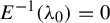 $E^{-1}(\lambda _0)=0$
so that
 $E^{-1}(\partial \Delta )$
is the closed curve
 ${\mathcal S}_* \cup \{0\}$
.
Remark 6.8. The map
 $\xi _{\lambda }$
ties together the attractive basin of the origin in the dynamical space of
 $f_{\lambda }$
and the attractive basin of
 $q_0$
in the dynamical space of Q with the parameter space of
 $f_{\lambda }$
.
6.2 Construction of an inverse for E
6.2.1 Dynamic decomposition of
$K_0$

To define inverse branches
 $R_j$
of Q on the
 $K_0$
, let
 $l^*$
be the gradient curve joining
 $Q(\lambda _0)$
to
 $\lambda _0$
in
 $\Delta $
and let
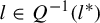 $l \in Q^{-1}(l^*)$
be the curve joining
 $\lambda _0$
to infinity. Remove the line l from
 $K_0$
and define an inverse branch on its complement by the condition
 $R_0(q_0)=q_0$
. Label the other branches as
 $R_j(q_0)=q_0+\pi i j=q_j$
. This is equivalent to choosing a principal branch for the logarithm. Having made this choice, we can extend the
 $R_j$
analytically to all of
 $K_0$
. Denote the pre-images of
 $q_0$
under
 $Q^{-1}$
by
 $q_j$
, enumerated so that
 $q_0$
is fixed, and denote the inverse branch of Q that sends
 $q_0$
to
 $q_j$
by
 $R_j$
. Denote the upper and lower sides of the line l by
 $l^+$
and
 $l^-$
and let
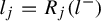 $l_j=R_j(l^-)$
,
 $l_{j+1}=R_j(l^+)=R_{j+1}(l^-)$
. Then
 $R_0$
is a homeomorphism between the open region bounded by the lines
 $l_0$
,
 $l_1$
, and l onto
 $K_0 \setminus l$
and
 $R_j$
,
 $j \neq 0$
is a homeomorphism from the open region between
 $l_j$
and
 $l_j+1$
onto
 $K_0 \setminus l$
.
If
 $\rho $
and
 $\lambda _0$
are real, this choice for the logarithm agrees with the labeling of the poles and inverse branches in §4.2 where
 $R_0=g_{\lambda _0,0}$
, the branch of
 $Q^{-1}=f_{\lambda _0}^{-1}$
that fixes the origin. This is the labeling in Figure 8. If
 $\rho $
and/or
 $\lambda _0$
is not real and a different branch of the logarithm is chosen, there could be a shift by some k in the labeling. It would be the same shift throughout the rest of the paper so would not change the essence of the argument.
Recall that
 $\gamma ^{*}$
is the boundary of
 $\Delta $
in
 $K_0$
and it contains
 $\lambda _0$
. Then, because
 $\lambda _0$
is an omitted value of Q, the curves
 $\{\gamma _{j} \}=R_j(\gamma ^*), \, j \in {\mathbb Z}$
, are a countable collection of bi-infinite disjoint curves whose infinite ends approach infinity asymptotic to the lines
 $l_{j}$
and
 $l_{j+1}$
. Thus
 $R_j(\Delta )$
is an unbounded domain, with boundary
 $\gamma _j$
, that contains
 $q_j$
. Note that
 $R_0(\Delta )$
contains the removed line l. We label the complementary components of the
 $\gamma _j$
as follows (see Figure 8).
-
•
$A_0=R_0(\Delta )$
is the component of the complement of
$\gamma _0$
containing the fixed point
$q_0$
and the point
$\lambda _0$
. -
•
$B_{j}, \, j \in {\mathbb Z} \setminus \{0 \}$
are the components of the complement of
$\gamma _j$
containing the non-fixed pre-images
$q_{j}$
of
$q_0$
and -
•
$C_0$
is the common complementary component in
$K_0$
of
$A_0$
and all the
$B_{j}$
.






To define the second pre-images of
 $q_0$
and
 $\gamma ^*$
, we need two indices. Thus
 $q_{j_2 j_1}=R_{j_2}R_{j_1}(q_0)$
and
 $\gamma _{j_2 j_1} =R_{j_2}R_{j_1}(\gamma ^*)$
, where
 $j_1, j_2, \in {\mathbb Z}$
. They divide
 $K_0$
into domains as follows (see Figure 8).
-
• Because
$A_0$
is simply connected and contains one asymptotic value,
$Q: A_1=Q^{-1}(A_0)\to A_0\setminus \{\lambda _0\}$
is a universal covering. Set
$A_{j0}=R_j(A_0)$
; it is bounded by
$l_j$
,
$l_{j+1}$
, and
$\gamma _{j0}$
. Each
$\{\gamma _{j0}\}$
joins the pole
$R_j(\infty )$
to the pole
$R_{j+1}(\infty )$
; these two poles are different but adjacent because the infinite ends of
$\gamma _0$
are on opposite sides of the line l defining the principal branch. -
• Because
$B_{j_1}$
is simply connected and contains no asymptotic value for any
$j_1\neq 0$
, each component of
$Q^{-1}(\gamma _{j_1})$
is homeomorphic to
$\gamma _{j_1}$
. The curves
$\gamma _{j_2 j_1}$
bound domains containing the pre-images
$q_{j_2 j_1}$
. Label these domains
$B_{j_2 j_1}=R_{j_2}(B_{j_1})$
. -
• There are domains
$C_{j0}=R_j(C_0)$
.







Inductively we have curves
 $$ \begin{align*} \gamma_{j_n \ldots j_1} = R_{j_n}(\gamma_{j_{n-1}} \ldots j_1). \end{align*} $$
and the regions they define are as follows (see Figure 8).
-
•
$A_{n}=R_0(A_{n-1})$
; it contains
$q_0$
and
$\lambda _0$
. It also contains all pre-images of
$q_0$
up to order
$n-1$
but not those of order n. It is bounded by a curve
$Q^{-n}(\gamma _0)$
that is a union of open arcs with endpoints at adjacent pre-poles of order n. These are the red curves without labels closest to the vertical line in Figure 8. -
•
$B_{j_n j_{n-1} \ldots j_1} =R_{j_n}(B_{j_{n-1} \ldots j_1})$
; it contains the pre-image
$q_{j_n j_{n-1} \ldots j_1}$
of
$q_0$
. These are not shown in the figure. They are bounded by a single curve with a boundary point at a pre-pole of order
$n-1$
. -
•
$C_{j_n j_{n-1} \ldots , 0} = R_{j_n}(C_{ j_{n-1} \ldots 0} ) $
.







6.2.2 Inductive construction of the pair
$(U_{\infty }, Q_{\infty })$

See Figure 9.
The point p is in
 $A_{00}$
and the set U is the region to the right of the dotted curves.

-
• Pick
$p \in K_0 \setminus \Delta $
. In Figure 9, p is in
$A_{00}$
. Following the outline above in part (3), we construct a map with the asymptotic values p and
$\lambda _0$
as follows. Let
$\widehat {p}_j=R_j(p)$
; in the figure, the
$\widehat {p}_j$
are in
$A_{j00}$
. Let N be the smallest integer such that p is in
$A_{N} \cup B_{j_N, j_{N-1} \ldots , j_1}$
. The boundaries of the sets in this union are the level sets
$\phi _{0}^{-1}(\rho ^{-N} re^{i\theta })$
where, as above,
$r=|\phi _0(\lambda _0)|$
. For every small
$\epsilon>0$
, one component of the level set
$\phi _0^{-1}( (\rho ^{-N} r +\epsilon )e^{i\theta })$
is an analytic curve, except at the pre-poles of order
$N-1$
. It bounds a simply connected domain containing
$A_N$
; it thus contains the points
$p, q_0, \lambda _0$
and the curves
$\gamma _{j_N, \ldots j_1}$
, but none of pre-images
$\widehat {p}_j$
of p. Fix
$\epsilon $
and denote the resulting domain by U. Its boundary is denoted by the dotted black curve in Figure 9. Because it is contained in the attracting basin of
$q_0$
,
$Q(U) \subset U$
. Moreover, because U does not contain any of the points
$\widehat {p}_j$
,
$p \not \in Q(U)$
. Set
$\widetilde {U}= U \setminus \{\lambda _0 , p\}$
. -
• Lemma 6.1 implies there is a holomorphic unramified covering map
$\Pi _1: U_1 \rightarrow \widetilde {U}$
, where
$U_1$
is a Riemann surface that is topologically a disk minus a countable set of topological disks. -
• Note that
$Q : U \rightarrow Q(U)$
is a holomorphic universal covering map with omitted value
$\lambda _0$
. Set
$U_1'=\Pi _1^{-1}(Q(U))$
; because
$\lambda _0\in Q(U)$
and
$p\notin Q(U)$
, it is a topological disk so that
$\Pi _1 : U_1' \rightarrow Q(U)$
is also a holomorphic unramified covering map that omits the value
$\lambda _0$
. -
• Because both
$\Pi _1$
and Q are regular coverings whose domains are simply connected, we can lift them to obtain a conformal map
$i_1: U\to U_1'$
such that
$\Pi _1 \circ i_1=Q.$
The choice of inverse branch will affect
$i_1$
but the argument works for any choice. We now define
$Q_1: U_1 \rightarrow U_1'$
by
$Q_1= i_1\circ \Pi _1$
. It is an unramified regular infinite to one holomorphic endomorphism and omits the values
$i_1(\lambda _0)$
and
$i_1(p)$
. Moreover, that is,
$$ \begin{align*} Q_1\circ i_1=i_1\circ \Pi_1\circ i_1=i_1\circ Q; \end{align*} $$
$i_1$
conjugates Q and
$Q_1$
, therefore
$Q_1$
fixes
$i_1(q_0)$
.
We may, without loss of generality, assume
$i_1(\lambda _0)=\lambda _0$
,
$i_1(p)=p$
and
${i_1(q_0)=q_0}$
. -
• Now set
$Q_{0}=Q$
,
$U_{0}=U$
, and
$U_{0}'=Q(U)$
. We proceed by induction: we assume that for
$1 \leq j \leq n-1$
, we have the following.-
(1) Domains
$U_j$
, homeomorphic to an open disk from which infinitely many open disks have been removed, and infinite to one unramified covering maps
$\Pi _j: U_j \rightarrow U_{j-1}$
with two asymptotic values. -
(2) Holomorphic endomorphisms,
$Q_j: U_j \rightarrow U^{\prime }_j\subset U_j$
, that are infinite to one, unramified, have one fixed point and two asymptotic values. -
(3) Conformal maps
$i_{j}: U_{j-1} \to U^{\prime }_{j}$
satisfying
$$ \begin{align*} Q_j\circ i_j=i_j\circ Q_{j-1}. \end{align*} $$
For the inductive step, we use Remark 6.2 to obtain the holomorphic unramified covering map
$\Pi _n: U_{n} \rightarrow U_{n-1}$
, where
$U_{n}$
is homeomorphic to
$U \setminus \{U_{j_{n-1} \ldots j_1 j}, \, \, ( j_{n-1}, \ldots , j_1,j) \in {\mathbb Z}^{n} \}$
. As in the first step, we set
$U_{n}'=\Pi _{n}^{-1}(Q_{n-1}(U_{n-1}))$
. Both are unramified coverings with asymptotic values
$$ \begin{align*} Q_{n-1}: U_{n}' \rightarrow Q_{n-1}(U_{n-1}) \quad\text{and}\quad \Pi_{n}:U_n \rightarrow Q_{n-1}(U_{n-1}) \end{align*} $$
$\lambda _0$
and p. Lemma 6.1 implies there are infinitely many choices for a holomorphic isomorphism Making one such choice (the choice does not matter), we define
$$ \begin{align*} i_{n}: U_{n-1} \rightarrow U_{n}'\quad \text{satisfying}\quad \Pi_{n} \circ i_{n}= Q_{n-1} \text{ on } U_{n-1}. \end{align*} $$
$Q_{n} : U_{n} \rightarrow U_{n}$
by
$ Q_{n}=i_{n} \circ \Pi _{n}$
so that Therefore,
$$ \begin{align*} Q_n\circ i_n= i_n \circ \Pi_n\circ i_n=i_n\circ Q_{n-1}. \end{align*} $$
$i_{n}$
conjugates
$Q_n$
to
$Q_{n-1}$
and the induction hypotheses are satisfied, completing the inductive step.
-
-
• The direct limit
$U_{\infty }$
of the system
$(U_n, i_n)$
is the quotient where the equivalence relation is defined by the identifications,
$$ \begin{align*} \bigcup_n U_n / \sim, \end{align*} $$
$ z \sim i_n(z)$
, and the equivalence class is denoted by
$[z]$
. The Riemann surface
$U_{\infty }$
has infinite type. There is an infinite unramified holomorphic covering map
$Q_{\infty }$
defined by that has two omitted values
$$ \begin{align*} Q_{\infty}([z])=[Q_n(z)], \quad z \in U_n \end{align*} $$
$[\lambda _0]$
and
$[p]$
. It also fixes
$[q_0]$
and because the maps
$\Pi _n$
and
$i_n$
are holomorphic, we have
$Q_{\infty }'([q_0])=\rho $
.
Topologically,
$U_{\infty }$
is the complement in
${\mathbb C}$
of a Cantor set C isomorphic to the space of infinite sequences
$\Sigma _{\infty } = s_1, \ldots s_{n-1}, s_n \ldots , s_j \in {\mathbb Z}$
together with the finite sequences
$\Sigma _{n+1}=s_1, \ldots , s_n, \infty $
of length
$n+1$
. The map
$Q_{\infty }$
is conjugate to the shift map on C. See [Reference MoserMo].


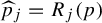



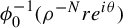
















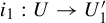










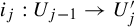


















The final step of the proof is to show there is a conformal embedding
 $e: \, U_{\infty } \rightarrow {\mathbb C}$
such that
 $$ \begin{align*} e \circ Q_{\infty} = f_{\lambda } \circ e \end{align*} $$
for some
 $\lambda \in {\mathcal S}_{\lambda }^0$
with
 $\xi _{\lambda }(\lambda )=\lambda _0$
. To do this, we first give a brief informal review of the results we need from Teichmüller theory and the theory of mapping classes of tori and punctured tori. We refer the reader to [Reference BirmanBir, Reference MasseyMa] for a full discussion and to [Reference Goldberg and KeenGK] for a discussion analogous to what we need here.
6.2.3 Teichmüller theory
Fix
 $\lambda \in {\mathcal S}_{\lambda }^0$
and set
 $f=f_{\lambda }$
.
Definition 6.9. Let
 $QC(f )$
be the set of quasiconformal maps
 $h :{\mathbb C} \rightarrow {\mathbb C}$
such that
 $g=h \circ f \circ h^{-1}$
is meromorphic. Because g is a meromorphic infinite to one unbranched cover of the plane with two omitted values, by the corollary to Nevanlinna’s theorem, Corollary 2.5, it is affine conjugate to a map
 $f_{\lambda '} \in {\mathcal F}_2$
and we choose the conjugacy so that
 $\lambda '$
is the preferred asymptotic value.
We define the Teichmüller equivalence relation on
 $QC(f)$
as follows: elements
 $h_1, h_2$
of
 $QC(f )$
are equivalent if there is an affine map a and an isotopy from
 $h_1$
to
 $a\circ h_2$
through elements of
 $QC(f )$
. The quotient space of
 $QC(f )$
by this equivalence relation is called the Teichmüller space
 $\text{Teich}(f)$
with basepoint f.
Let
 $QC_0(f)$
denote the elements of
 $QC(f)$
that conjugate f to itself and
 $QC_0^*(f)$
those that preserve the marking of the asymptotic values.
Definition 6.10. The mapping class group,
 $MCG(f)$
, is the quotient of
 $QC_0(f)$
by the Teichmüller equivalence relation and the pure mapping class group,
 $MCG^*(f)$
, is the quotient of
 $QC_0^*(f)$
by the Teichmüller equivalence relation. The moduli space and pure moduli space are defined as the quotients
 ${\mathrm {M}}(f) =\text{Teich}(f)/MCG(f)$
and
 ${\mathrm {M}}^*(f) =\text{Teich}(f)/MCG^*(f)$
.
Remark 6.11. Because we are working in a dynamically natural slice of
 ${\mathcal F}_2$
defined by the conditions that
 $0$
is fixed and has multiplier a fixed
 $\rho $
, we restrict our considerations here to the slice
 $\text{Teich}(f, \rho ) \subset \text{Teich}(f)$
of equivalence classes of quasiconfomal maps h such that
 $h \circ f \circ h^{-1}$
has a fixed point with multiplier
 $\rho $
. The mapping class group and pure mapping class group act on
 $\text{Teich}(f,\rho )$
. The
 $\lambda $
parameter plane is identified with the pure moduli space
 ${\mathrm {M}}^*(f,\rho )$
. For readability below, because we always assume we are in this slice, we drop the
 $\rho $
from the notation.
Because the quasiconformal maps conjugate the dynamics, and the dynamics are controlled by the orbits of the asymptotic values, the space
 $\text{Teich}(f_{\lambda })$
is related to the Teichmüller space of a twice punctured torus defined by the dynamics. We explain this here.
Definition 6.12. The points
 $z_1,z_2$
are grand orbit equivalent if there are integers
 $m,n \geq 0$
such that
 $f_{\lambda }^m(z_1)=f_{\lambda }^n(z_2)$
. They are small orbit equivalent if for some
 $n>0$
,
 $f_{\lambda }^n(z_1)=f_{\lambda }^n(z_2)$
. Denote the grand orbit equivalence classes by
 $[z]$
.
Now
 $\phi _{\lambda }(z)=0$
if and only if z is grand orbit equivalent to
 $0$
. Let
 $\widehat {A_{\lambda }}$
denote the complement of the grand orbit of
 $0$
in
 $A_{\lambda }$
. We have the following.
Lemma 6.13. The restriction of
 $\phi _{\lambda }$
to
 $\widehat {A_{\lambda }}$
is a well-defined map from each small equivalence class to a point in
 ${\mathbb C}^*$
.
Proof. If
 $z_1,z_2$
are small orbit equivalent, there is some integer N such that for all
 $n \geq N$
,
 $f_{\lambda }^n(z_1)=f_{\lambda }^n(z_2)$
. Moreover, for all large n,
 $f_{\lambda }^n(z) \in O_{\lambda }$
and, because
 $\phi _{\lambda }$
is injective on
 $O_{\lambda }$
, the lemma follows.
Let
 $\Gamma _{\rho }$
be the group generated by
 $z \mapsto \rho z$
in
 ${\mathbb C}^*$
. The projection
 $\tau _{\rho }: {\mathbb C}^* \rightarrow {\mathbb C}^*/\Gamma _{\rho } = T_{\rho }$
is a holomorphic covering map onto a torus
 $T_{\rho }$
. Following common usage, we say that its modulus is
 $\rho $
. Set
 $T=T_{\rho }$
because
 $\rho $
is fixed in this discussion.
Define the composition of
 $\phi _{\lambda }$
with
 $\tau _{\rho }$
by
 $$ \begin{align*} \Phi_{\lambda }:\widehat{A_{\lambda }} \stackrel{\phi_{\lambda }}\rightarrow {\mathbb C}^* \stackrel{\tau_{\rho}}\rightarrow T. \end{align*} $$
By Lemma 6.13, we see that
 $\Phi _{\lambda }$
identifies
 $\widehat {A_{\lambda }}$
in the dynamical space of
 $f_{\lambda }$
with the torus T because each grand orbit in
 $\widehat {A_{\lambda }}$
maps to a unique point on T. Notice that T depends only on
 $\rho $
and not on
 $\lambda $
. Let
 $\gamma ^*$
be the level curve through the asymptotic value
 $\mu $
in
 $\widehat {A_{\lambda }}$
and
 $\beta $
its projection on T.
Because
 $\lambda \in {\mathcal S}_{\lambda }^0$
, the orbit of
 $\mu $
accumulates on
 $0$
so it cannot be in the grand orbit of
 $0$
. It is possible that
 $\lambda $
is in the grand orbit of zero or that for some
 $m,n$
,
 $f_{\lambda }^n(\lambda )=f_{\lambda }^m(\mu )$
. This can happen only on a discrete set and we assume here that it does not happen for the
 $\lambda $
we chose.
There are two special points on T, the points
 $\lambda ^*=\Phi _{\lambda }(\lambda )$
and
 $\mu ^*=\Phi _{\lambda }(\mu )$
. We mark them so that
 $\lambda ^*$
is the preferred point. Let
 $T^2_{\lambda }= T \setminus \{ \lambda ^*, \mu ^* \}$
. Let
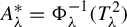 $A_{\lambda }^*=\Phi _{\lambda }^{-1}(T^2_{\lambda })$
; then
 $A_{\lambda }^* \subset A_{\lambda }$
is the complement of the grand orbits of
 $0$
and the asymptotic values. It is easy to see that
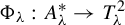 $\Phi _{\lambda }:A_{\lambda }^* \rightarrow T^2_{\lambda }$
is a covering projection.
The Teichmüller space
 $\text{Teich}(T^2_{\lambda })$
is defined as the set of equivalence classes of quasiconformal maps,
 $[H]$
, defined on
 $T^2_{\lambda }$
, where, as above, the equivalence is through isotopy. The pure mapping class group
 $MCG_*(T^2)$
and pure moduli space
 ${\mathrm {M}}^*(T^2)$
based at
 $T^2_{\lambda }$
are defined as for
 $\text{Teich}(f)$
: the pure mapping class group consists of equivalence classes
 $[H]$
that map
 $T^2_{\lambda }$
to itself preserving the marking and the pure moduli space is formed by identifying points congruent under the pure mapping class group. Thus the map
 $\Phi _{\lambda }$
induces a map
 $\Psi : \text{Teich}(f) \rightarrow \text{Teich}(T^2)$
. By standard arguments, see e.g. [Reference McMullen and SullivanMcMSul],
 $\Psi $
is a covering map so there is an injection on fundamental groups which translates to an injection of pure mapping class groups:
 $$ \begin{align*} \Psi_*: MCG_*(f) \rightarrow MCG_*(T^2). \end{align*} $$
Because a quasiconformal map
 $H \in \text{Teich}(T^2_{\lambda })$
is not necessarily the projection by
 $\Phi _{\lambda }$
of an h defined on
 $A_{\lambda }^*$
, we need to characterize those that are. To do this, we need to understand the image
 $\Psi _*(MCG_*(f)) \subset MCG_*(T^2)$
.
First of all, to remain in the slice, we require that
 $\omega (H(T^2_{\lambda }))$
, the torus obtained by applying the ‘forgetful map’
 $\omega $
that fills in the punctures, is conformally equivalent to T and preserves the isotopy class of
 $\beta $
.
Suppose
 $\tilde {\alpha }$
is a curve in
 $A_{\lambda }^*$
with initial point
 $\mu $
and endpoint
 $\lambda $
and
 $[h] \in MCG_*(f)$
. Then
 $h(\tilde {\alpha })$
has the same property. The map
 $H=\Phi _{\lambda } \circ h \circ \Phi _{\lambda }^{-1}$
determines a point in
 $MCG_*(T^2)$
that maps the curve
 $\alpha ^*$
on
 $T^2_{\lambda }$
joining
 $\mu ^*$
to
 $\lambda ^*$
to a curve
 $H(\alpha ^*)$
with the same endpoints.
Every curve
 $\alpha '$
on
 $T^2$
that joins
 $\mu ^*$
to
 $\lambda ^*$
has lifts
 $\Phi _{\lambda }^{-1}(\alpha ')$
whose initial point is at a pre-image of
 $\mu ^*$
; let
 $\tilde {\alpha }'$
be the lift at the asymptotic value
 $\mu $
. The endpoint of
 $\tilde {\alpha }$
is in the grand orbit of
 $\lambda $
, but it is not necessarily at
 $\lambda $
. Therefore, to construct maps in
 $\text{Teich}(f)$
from maps in
 $\text{Teich}(T^2)$
, which we do below, we need to know that we can find those curves
 $\alpha $
whose lift to
 $\mu $
lands at
 $\lambda $
. Let
 $\alpha ^*$
be such a curve on
 $T^2$
.
That we can always find these curves is proved in [Reference BirmanBir], where there is a full treatment of mapping class groups of surfaces. For a more detailed discussion analogous to the situation here, see [Reference Goldberg and KeenGK].
In Figure 10, we show how the region
 $A_{\lambda }$
is divided into fundamental domains that project to T for two different values of
 $\lambda $
. In both,
 $\mu $
is on
 $\gamma ^*$
, the boundary of
 $O_{\lambda }$
, drawn in blue. The orange curves are the first pullbacks of
 $\gamma ^*$
by
 $f_{\lambda }$
. The domain bounded by
 $\gamma ^*$
and one of the orange curves defines a fundamental domain for
 $\Gamma _{\rho }$
. In the left figure,
 $\lambda $
is in that fundamental domain. The green curves are the next pullback, and on the right figure, the red curve is the third pullback and
 $\lambda $
is in a fundamental domain between the second and third pullbacks.
Two examples where the lifted curve is the one we need.

6.2.4 Construction of the embedding e
We now construct the conformal embedding
 $e: \, U_{\infty } \rightarrow {\mathbb C}$
such that
 $$ \begin{align*} e \circ Q_{\infty} = f_{\lambda } \circ e \end{align*} $$
for some
 $\lambda \in {\mathcal S}_{\lambda }^0$
with
 $\xi _{\lambda }(\mu )=\lambda _0$
.
Delete the grand orbits of
 $[q_0], [\lambda _0]$
, and
 $[p]$
from
 $U_{\infty }$
to obtain a domain
 $U_{\infty }^*$
. As we did above for
 $A_{\lambda }$
, we form the projection by the grand orbit equivalence
 $$ \begin{align*} \Phi_{\infty}: U_{\infty}^* \rightarrow T_{\infty}^2 = T \setminus \{ \Phi_{\infty}(p), \Phi_{\infty}(\lambda _0) \}\end{align*} $$
where again, T is a torus of modulus
 $\rho $
.
As above, there is some
 $\alpha _{\infty }$
that is a curve on
 $T^2_{\infty }$
with initial point
 $ \Phi _{\infty }(\lambda _0)$
and endpoint
 $\Phi _{\infty }(p)$
whose lift to
 $Q_{\infty }$
at
 $\lambda _0$
is a curve
 $\tilde {\alpha }_{\infty }$
joining
 $\lambda _0$
to p.
Let
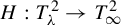 $H: T_{\lambda }^2 \rightarrow T_{\infty }^2$
be an orientation preserving homeomorphism that preserves the labeling of the punctures and satisfies
 $H(\alpha _*)=\alpha _{\infty }$
. Then it lifts to a topological conjugacy h between
 $f_{\lambda }|A_{\lambda } $
and
 $Q_{\infty }$
.

We may assume that H is quasiconformal with Beltrami differential
 $\nu _{T_{\lambda }^2}$
and use
 $\Phi _*$
to lift to a Beltrami differential
 $\nu $
on
 $A_{\lambda } $
compatible with the dynamics. We set
 $\nu =0$
on the complement of
 $A_{\lambda } $
(the Julia set of
 $f_{\lambda }$
) and note that because the map is hyperbolic, this set has measure zero. We now invoke the measurable Riemann mapping theorem [Reference Ahlfors and BersAB] to obtain a quasiconformal homeomorphism
 $g: \widehat {\mathbb C} \rightarrow \widehat {\mathbb C}$
fixing
 $0$
and
 $\infty $
, and so unique up to scale, such that
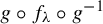 $g \circ f_{\lambda } \circ g^{-1}$
is holomorphic. By Nevanlinna’s theorem, Theorem 2.4, we can assume g is normalized so that
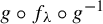 $g \circ f_{\lambda } \circ g^{-1}$
is of the form
 $f_{\lambda (p),\rho (p)}$
for some
 $\lambda (p )$
, where
 $\lambda (p)=g(\lambda )$
and
 $\mu (p)=g(\mu )$
is on the boundary of
 $O_{\lambda (p)}$
, the region of injectivity of the uniformizing map at the origin. Because g is compatible with the dynamics, and both tori
 $T_{\lambda }^2$
and
 $T_{\infty }^2$
have modulus
 $\rho $
; it follows that
 $g'(0)=\rho $
also. Thus
 $\lambda (p) \in {\mathcal S}_{\lambda }^0$
, and the map
 $e=g \circ h^{-1}$
is the required embedding.
To complete the proof, we need to show that the correspondence
 $p \to \lambda (p)$
is an inverse of the map E.

By our construction,
 $i_{\infty }$
is the direct limit of the maps
 $i_n$
. It satisfies
 $$ \begin{align*} e \circ i_{\infty}(p) = \lambda (p). \end{align*} $$
The second asymptotic value of
 $f_{\lambda (p)}$
is
 $\mu (p)$
. By definition,
 $\xi _{\lambda }(\mu (\lambda (p)))=\lambda _0 \text { and} \xi _{\lambda }(\lambda (p))=p \in U_0 \subset K_0$
.
In the non-generic cases, the point p in
 $K_0 \setminus \Delta $
is either in the grand orbit of the fixed point
 $q_0$
or the other asymptotic value
 $\lambda _0$
and the quotient of
 $U_{\infty }$
by the grand orbit relation is a once punctured torus. The construction of the inverse of E is analogous, but simpler in these cases, and again yields a unique
 $f_{\lambda } \in {\mathcal S}_{\lambda }^0$
.
If we choose p on
 $\partial \Delta $
, the function
 $f_{\lambda (p)}$
will have both its asymptotic values on the boundary of
 $O_{\lambda (p)}$
. Only one choice, however, preserves the marking.
By the measurable Riemann mapping theorem, the quasiconformal map g depends holomorphically on the parameter p. Thus, as we vary p analytically along
 $\partial \Delta \setminus \{\lambda _0 \}$
, the image
 $e(p)$
defines an analytic curve
 ${\mathcal S}_*$
in
 ${\mathcal S}$
. The construction fails if
 $p=\lambda _0$
because as p approaches
 $\lambda _0$
, the limit point on the analytic curve in
 ${\mathcal S}$
is a parameter singularity; in the construction of
 $f_{\lambda }$
from the model, as
 $p \to \lambda _0$
,
 $\lambda \to 0$
. Therefore we can extend
 $E^{-1}$
by continuity so that
 $E(0)=\lambda _0$
; therefore
 ${\mathcal S}_* \cup \{0\}$
is homeomorphic to a circle.
Because the model
 $K_0 \setminus \Delta $
is topologically an annulus
 ${\mathbb A}$
, the above paragraph shows that E extends as a map from the boundary component
 ${\mathcal S}_*$
of
 ${\mathcal S}_{\lambda }$
to a boundary component of
 ${\mathbb A}$
.
6.3 Topology of the shift locus
We are now ready to complete the proof of the main structure theorem.
Theorem 6.14. (Topology of the shift locus)
 ${\mathcal S}$
is homeomorphic to a punctured annulus; that is, there is a homeomorphism
 $\Phi : {\mathcal S} \rightarrow \widehat {{\mathbb C}} \setminus \{0,1,\infty \}$
.
Proof. We begin by recalling the relation between
 ${\mathcal M}_{\lambda }$
and
 ${\mathcal M}_{\mu }$
given by the inversion
 $I(\lambda )= -\mu $
defined in §3.1 that shows
 $$ \begin{align*} f_{\lambda }(z)= f_{-\mu}(-z). \end{align*} $$
It follows that if
 $\lambda \in {\mathcal M}_{\lambda }$
and
 $f_{\lambda }^m(\lambda )$
tends to a periodic orbit
 $\mathbf z = \{z_0, z_1, \ldots , z_n \}$
, then
 $f_{-\mu }^m(-\mu )$
tends to the orbit
 $-\mathbf z = \{-z_0, -z_1, \ldots , -z_n \}$
and
 $-\mu \in {\mathcal M}_{\mu }$
. This proves the following.
Proposition 6.15. The inversion
 $I: {\mathcal M}_{\lambda } \rightarrow {\mathcal M}_{\mu }$
defined by
 $$ \begin{align*} I(\lambda )= - \mu = \frac{\lambda }{2\lambda /\rho -1} \end{align*} $$
maps shell components of period n in
 ${\mathcal M}_{\lambda }$
to shell components of period n in
 ${\mathcal M}_{\mu }$
.
This is illustrated in Figure 11. The large green region is the shift locus,
 ${\mathcal M}_{\lambda }$
is the complementary region on the right, and
 ${\mathcal M}_{\mu }$
is the complementary region to the left, surrounded by the shift locus. The circle of inversion is drawn in Figure 11 where
 $\rho =2/3$
. In this figure, because
 $\rho $
is real, by Proposition 6.4, it is
 ${\mathcal S}_*$
. For arbitrary fixed
 $\rho $
,
 ${\mathcal S}$
is the image of
 $\partial \Delta \setminus \{\lambda _{0}\}$
under
 $E^{-1}$
; thus
 ${\mathcal S}_*\cup \{0\}$
, which we still denote as
 ${\mathcal S}_*$
, is a topological circle.
In Theorem 6.5, we saw that
 ${\mathcal S}_{\lambda }$
is homeomorphic to an annulus. One of the complementary components is
 ${\mathcal M}_{\lambda }$
. The other complementary component is bounded by the curve
 ${\mathcal S}_*$
. By Proposition 6.15, I maps
 ${\mathcal S}_{\lambda } \cup {\mathcal M}_{\lambda }$
to
 ${\mathcal S}_{\mu } \cup {\mathcal M}_{\mu }$
; because
 $I({\mathcal M}_{\lambda })={\mathcal M}_{\mu }$
,
 $I({\mathcal S}_{\lambda })={\mathcal S}_{\mu }$
so that
 ${\mathcal S}_{\mu }$
is also an annulus. Because I maps
 ${\mathcal S}_*$
to itself, these annuli share a common boundary component.
Note that although both the invariant circle of inversion
 ${\mathcal C}_0$
and
 ${\mathcal S}_*$
are invariant under inversion, unless
 $\rho $
is real, they are not necessarily the same.
Therefore,
 ${\mathcal S} \cup \{0\}={\mathcal S}_{\lambda } \cup {\mathcal S}_{\mu } \cup {\mathcal S}_* \cup \{ 0\}$
is topologically an annulus. Removing the parameter singularity
 $\lambda =0$
completes the proof.
Immediate corollaries of this theorem are the following.
Corollary 6.16. The sets
 ${\mathcal M}_{\lambda }$
and
 ${\mathcal M}_{\mu }$
are connected.
Corollary 6.17. The full shift locus in
 ${\mathcal F}_2$
has the product structure
 ${\mathbb D}^* \times {\mathbb C} \setminus \{0,1 \}$
.
Figure 12 shows the
 $\lambda $
plane when
 $\rho =-2/3$
. This is another slice in the fibration and shows how the fibers change as the argument of
 $\rho $
changes. The picture is similar to Figure 2 except that we see that the
 ${\mathcal M}_{\lambda }$
is translated vertically and there is a period-
 $2$
component budding off
 $\Omega _1$
on the real axis instead of a cusp.
The
 $\lambda $
plane with the regions
 ${\mathcal M}_{\lambda }$
,
 ${\mathcal M}_{\mu }$
, and the circle of inversion.

The
 $\lambda $
plane when
 $\rho =-2/3$
. Note the position of the period-
 $2$
components.

6.3.1 Single-valued inverse branches
We now prove the lemma we assumed for the proof of the combinatorial structure theorem in §4.2.
Lemma 6.18. There is a simply connected domain
 $\Sigma \in {\mathbb C} \setminus \{0, \rho /2\}$
in which, after a choice of basepoint and branch of the logarithm, the pole functions
 $p_k(\lambda )$
and the inverse branches
 $g_{\lambda ,k}$
can be defined as single-valued functions of
 $\lambda $
.
Proof. In the proof of Theorem 6.14, we showed that
 ${\mathcal S}_{\mu }$
and
 ${\mathcal S}_{\lambda }$
are homeomorphic to annuli with a common boundary component that contains the singularity at the origin. It follows that in a neighborhood of the origin, both asymptotic values are attracted to zero.
Now consider the period-
 $\kern-1pt 1$
shell component
 $\Omega _1'$
of
 ${\mathcal M}_{\mu }$
. It has a virtual center at
 $\lambda =\rho /2$
. Because it is a virtual center, it is on the boundary of both
 ${\mathcal M}_{\mu }$
and
 ${\mathcal S}$
, and so a neighborhood V of
 $\rho /2$
contains points in
 ${\mathcal S}_{\mu }$
.
Applying the inversion,
 $I(V)$
is a neighborhood of infinity intersecting the period-
 $\kern-1pt 1$
component
 $\Omega _1 \in {\mathcal S}_{\lambda }$
and an open set in
 ${\mathcal S}_{\lambda }$
. Thus infinity is on the boundary
 ${\mathcal S}_{\lambda }$
. Because a neighborhood of any point in
 ${\mathcal S}_{*}$
only contains points in
 ${\mathcal S}_{\lambda }$
and
 ${\mathcal S}_{\mu }$
, infinity and zero are on different boundary components. Hence because
 ${\mathcal S}_{\lambda }$
is an annulus, we can find a curve
 $\gamma \subset {\mathcal S}_{\lambda }$
joining zero and infinity. Let W be the component of
 ${\mathbb C} \setminus {\mathcal S}_{*}$
containing
 ${\mathcal M}_{\mu }$
and set
 $\Sigma = {\mathbb C} \setminus (W \cup \gamma )$
. This is a simply connected domain. It contains all the virtual cycle parameters belonging to
 ${\mathcal M}_{\lambda }$
and none of the virtual cycle parameters belonging to
 ${\mathcal M}_{\mu }$
. Therefore, choosing a basepoint
 $\lambda _0 \in \Sigma $
and a branch for
 ${\text {Log}}$
, we can define
 $p_k(\lambda _0)$
as in equation (6) by
 $$ \begin{align*} p_k(\lambda_0)=\frac{1}{2}{\text{Log}} \bigg(\frac{\rho-2\lambda_0}{\rho}\bigg)+ik\pi, \end{align*} $$
and extend analytically to all of
 $\Sigma $
as single-valued functions of
 $\lambda $
. Then, as we did in §4.2, we can define the inverse branches of
 $f_{\lambda }$
as single-valued functions of
 $\lambda $
.
7 Concluding remarks
There are many more questions one can address about the space of functions we have been studying. Below we list some of them and leave an investigation of them to future work.
-
• An important tool in studying the Mandelbrot set is the use of the level curves where the escape rate of the critical value is constant and their gradient ‘external rays’. Can we define the analogue for the set
${\mathcal S}_{\lambda }$
and
${\mathcal S}_{\mu }$
using the level curves of
$\phi _0$
defined on
$K_0$
? There will be infinitely many curves for each level so the structure will be much more complicated. This would lead to more questions such as the following.-
(i) In [Reference Chen, Jiang and KeenCJK2], we used the level curves and their gradients to prove that the virtual centers are accessible points from inside both the shell components and the shift locus. Can we also use it to characterize other types of boundary points of
${\mathcal S}$
such as cusps, root points for bud components, or Misiurewicz points where an asymptotic value lands on a repelling cycle? -
(ii) Can we describe primitive and satellite components in terms of rays in a manner analogous to the discussion for rational maps?
-
(iii) In [Reference Chen, Jiang and KeenCJK], we showed there is a renormalization operator defined for the family
$it \tan z$
where t is real. Are there renormalization operators that can be defined in
${\mathcal F}_2$
?
-
-
• We know that at the virtual centers and Misiurewicz points, the only Fatou component is the attracting basin of the origin. Is the Julia set a Cantor bouquet in the sense of Devaney? Does it have positive measure? Area?
-
• In [Reference Goldberg and KeenGK], the mapping class group of the Teichmüller space
$Rat_2$
is analyzed. The analogous space here is
${\mathcal F}_2$
from which points with orbit relations have been removed. Describe the mapping class group of this space. -
• How do the results here extend to parameter spaces of families of meromorphic functions with more than two asymptotic values, or those with both critical values and asymptotic values?


Acknowledgements
This material is based upon work supported by the National Science Foundation. It is partially supported by a collaboration grant from the Simons Foundation (grant number 523341) and PSC-CUNY awards. We would like to thank the reviewer for his or her careful reading on the first version of this paper. We have taken their comments into account in this version and they have enabled a real improvement.