INTRODUCTION
Depression and anxiety disorders are common clinical symptoms in cancer patients, especially in those experiencing disease progression or advanced stages of disease (Brown et al., Reference Brown, Kroenke and Theobald2010). In fact, depression can be diagnosed in a quarter of all patients with advanced metastatic cancer, while as many as 80% of the psychological and psychiatric morbidities remain unidentified and therefore untreated (Carlson et al., Reference Carlson, Angen and Cullum2004; Vignaroli et al., Reference Vignaroli, Pace and Willey2006; Lo et al., Reference Lo, Zimmermann and Rydall2010). Some clinicians have postulated that cancer patients may experience depression by way of “appropriate sadness.” However, this notion may lead to underestimation of suffering, instigating a kind of therapeutic nihilism and a shortening of the survival of cancer patients (Lloyd-Williams, Reference Lloyd-Williams2000; Satin, Reference Satin2010). Hence, since this state affects so many patients who are particularly vulnerable, it is urgent to study the frequency of this condition in patients being admitted to palliative care units (PCUs). Management rather than cure of physical as well as psychological symptoms is the main focus of palliative care (Rome et al., Reference Rome, Luminais and Bourgeois2011). Since depressed moods, pain, and anxiety are central human concerns, these may be highly significant in palliative care, where patients are confronted with chronic and incurable diseases. To the best of our knowledge, no studies have exclusively addressed the mental health of patients admitted to PCUs. Effective screening for and treatment of depression are essential in patients with advanced cancer (Singer et al., Reference Singer, Danker and Briest2014; Lloyd-Williams, Reference Lloyd-Williams2001).
The coexistence of depression in cancer patients is not only associated with reduced quality of life but also with decreased adherence to treatments, increased numbers of inpatient stays and thoughts of suicide, and poorer survival (Satin, Reference Satin2010; Onitilo et al., Reference Onitilo, Nietert and Egede2006). A causal link between depression and the incidence of malignant disease has long been hypothesized. However, a recently published prospective study among 14.203 persons reported no such association (Lemogne et al., Reference Lemogne, Consoli and Melchior2013).
Inappropriate interpretation of psychiatric symptoms may either lead to overdosing of medication or undertreatment (Cleeland et al., Reference Cleeland, Gonin and Hatfield1994; Nekolaichuk et al., Reference Nekolaichuk, Bruera and Spachynski1999). The aim of our prospective cross-sectional study was to evaluate the frequency and therapeutic implications of psychiatric symptoms in patients admitted to a PCU. Questionnaires were distributed to 68 patients in five PCUs. In addition, the medical histories of patients were also collected, as were the data on the pain and psychopharmacological medications administered. Independent psychiatric evaluations were considered and treatment initiated after a clinical interview. The data were analyzed statistically, and the results are discussed with reference to palliative care and depression in the industrialized world.
METHODS
The study was approved by the local ethics committee.
Study Design, Participants, and Patient Characteristics
A prospective cross-sectional design was employed for our investigation. Patients were recruited from five hospitals with palliative care units in Vienna: the University Hospital of Vienna, Goettlicher Heiland Hospital, Hietzing Hospital, Caritas Socialis Hospice Rennweg, and Saint Elisabeth Hospital. The data were collected at two timepoints between July of 2012 and July of 2013. Patients admitted to the participating PCUs were requested to participate in the study upon admission. Only patients with an estimated life expectancy of more than two months according to the attending physician were included, after they gave their written informed consent. Preexisting psychiatric disorders were assessed on patient-based information as well as from medical reports. Data on ongoing medications and psychopharmacological medications were collected. Clinical as well as demographic characteristics—including age, sex, marital status, oncological disease, duration of illness, and Karnofsky performance status score—were documented either after the interview with the patient or by chart review.
Pilot Study
Before beginning the study, we conducted a pilot study with 12 patients from the palliative care unit at the Medical University of Vienna to test the feasibility of screening patients with validated screening tools. We handed out three questionnaires to each patient: the Beck Depression Inventory (BDI), the ICD-10 Major Depression Inventory, and the Patient Health Questionnaire (PHQ–D). The questionnaires of six patients could be evaluated; the others were answered inadequately or incompletely. Based on this, we feared poor data quality when using many questionnaires and decided to use the PHQ–D, because it is validated for screening and monitoring depression, anxiety, and psychosocial impairment.
Measures
Patient Health Questionnaire
The brief version of the Patient Health Questionnaire (PHQ) consists of 15 items and serves as a tool for screening and monitoring depression, anxiety, and psychosocial impairment. It can be utilized to establish a provisional diagnosis, which is then interpreted according to the individual patient's situation. A proband takes about three minutes for the one-sided brief version, which makes it very suitable for patients receiving palliative care. As a screening and monitoring tool for depression, anxiety, and psychosocial impairment, the short version of the Patient Health Questionnaire in the German language (PHQ–D) was used because of its high reliability, free availability, and wide use. The 15 items include a depression module (9 items), a shortened panic module (5 items), and 1 question about psychosocial impairment. The PHQ–D has been rated as a good psychodiagnostic tool in several validation studies (Spitzer et al., Reference Spitzer, Kroenke and Williams1999; Kroenke et al., Reference Kroenke, Spitzer and Williams2001; Spitzer et al., Reference Spitzer, Williams and Kroenke1994). Based on its original English version—the Prime MD Brief Patient Health Questionnaire—it was translated into German by Loewe and colleagues (Spitzer et al., Reference Spitzer, Williams and Kroenke1994; 1999). The brief version of the PHQ–D is a further development of the Prime MD established by Spitzer et al. (Reference Spitzer, Williams and Kroenke1994). Based on the recommendations of the PHQ–D manual, clinical considerations in the form of a detailed medical history were included to enhance its diagnostic accuracy.
Numeric Rating Scale
The numeric rating scale (NRS) is a one-dimensional tool for assessment of pain. A score of 0 signifies no pain, 1–3 mild pain, 4–6 moderate pain, and 7–10 severe pain. The NRS was rated separately by palliative care patients and their attending physicians after a patient's inclusion in the study.
Karnofsky Performance Status Scale
Karnofsky Performance Status Scale scores range from 100 to 0 that has standard intervals of 10, with 100 signifying perfect health and 0 death. The primary purpose of the scale is to quantify cancer patients' general well-being and activities of daily life. It is also used to determine whether they can receive chemotherapy.
Study Course
The PHQ–D and NRS were explained to the patient by a healthcare professional trained in palliative care and then filled out by the patient. Patients and physicians gave their NRS ratings at the same time. The consumption of pain medication (WHO step I–III drugs, coanalgesics) was determined. Opioid doses were converted to oral morphine equivalents (OMEs). Equianalgesic conversions were performed with an online calculator (http://clincalc.com/opioids) based on the American Pain Society guidelines and critical review papers regarding equianalgesic dosing (Breitbart et al., Reference Breitbart, Chandler and Eagel2000; Anderson et al., Reference Anderson, Saiers and Abram2001; Pereira et al., Reference Pereira, Lawlor and Vigano2001). All ongoing psychopharmacological medications were assessed—including antidepressants, neuroleptics, and benzodiazepines. Furthermore, the use of cannabinoids and anticonvulsants was recorded. All variables were entered into a password-protected database.
Psychopharmacologic Agents
Some 57% of patients (39 of 68) received antidepressants: mirtazapine (18), trazodone (9), venlafaxine (5), sertraline (3), duloxetine (2), amitriptyline (1), and paroxetine (1). Some 40% of patients (27 of 68) received benzodiazepines, 18% (12) received neuroleptic agents, and 12% (8) received cannabinoids.
Statistical Analysis
Correlation of two nominal variables was investigated using the chi-square test. The Kruskal–Wallis test was employed to determine group differences in scaled variables. Two scaled variables were correlated with the Spearman's rank correlation coefficient (ρ). A p less than value 0.05 was considered statistically significant. Due to the exploratory and hypothesis-generating design of our study, no correction of multiple testing was performed (Bender & Lange, Reference Bender and Lange2001). The Statistical Package for the Social Sciences (SPSS, v. 20.0; SPSS Inc., Chicago) was utilized for statistical analysis.
RESULTS
Patient Characteristics
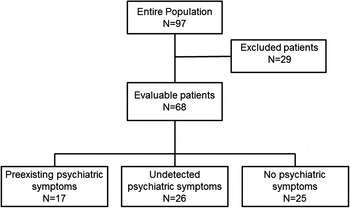
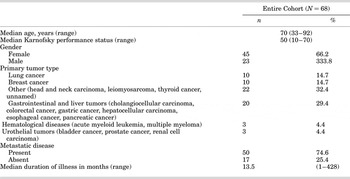
The data on 68 patients with advanced cancer (66% (45 of 68) female, 34% (23) male), with a median age of 70 years (range: 33–92) at inclusion, were available for further analysis. The dropout rate was 30% (29 of 97), with 29 patients not meeting the inclusion criteria (Figure 1). Some 29 patients had to be excluded because: (1) they did not meet the inclusion criteria (n = 18, 62%), (2) their performance status had deteriorated (n = 5, 17%), (3) they withdrew consent (n = 4, 14%), and (4) there were language problems (n = 2, 7%). Metastatic disease was present in 75% (50) of patients. Median duration of illness was 13.5 months (range: 1–428 months). Table 1 presents further patient characteristics.
Flow diagram of the study population.

Patients characteristics

Psychiatric Symptoms Are Common in Patients at a Palliative Care Unit
To determine whether end-of-life patients suffered from psychiatric conditions, the 68 palliative care patients were assessed for psychiatric symptoms. Preexisting psychiatric diseases were assessed by personal interview followed by a PHQ–D questionnaire handed to the patients.
Our results showed that previously undetected psychiatric symptoms were found in patients at a rate of 38%, whereas preexisting psychiatric disorders were evident in 25%. No psychiatric symptoms could be observed in 37% of patients (Figure 1). In addition, no differences could be found between female and male patients in terms of incidence of psychiatric symptoms, either preexisting or previously undetected (p = 0.060, chi-square test). The patients' median age (p = 0.086, Kruskal–Wallis test), median Karnofsky performance score (p = 0.115, Kruskal–Wallis test), and duration of illness (p = 0.0597; Kruskal–Wallis test) did not differ between those without, with preexisting, or with previously undiagnosed psychiatric symptoms. In patients with preexisting psychiatric disorders, the test results indicated the following rates of conditions: depression, 34%; panic disorders, 2%; and other psychiatric diseases, 25%. In patients with undetected psychiatric disorders, the test results indicated a major depressive disorder in 42% (27 of 64), other depressive disorders in 13% (8), and a panic disorder in 5% (3).
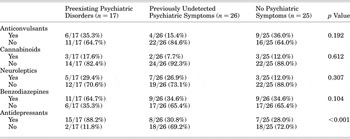
Patients with preexisting psychiatric disorders received antidepressants significantly more often (p ≤ 0.001, chi-square test; see Table 3) than did patients with undetected psychiatric symptoms or those without psychiatric symptoms. Patients with preexisting psychiatric disorders as well as those with undetected psychiatric symptoms experienced significantly greater impairment (p = 0.003, chi-square test) in their activities of daily living than did patients without psychiatric symptoms.
Hence, it appeared that palliative care patients suffered from psychiatric conditions, and we thought it would be interesting to determine whether pain played any role in the development of such disorders.
Psychiatric Symptoms do not Correlate with Pain
Since cancer pain is known to influence patients' physical, psychological, and spiritual life (Lin et al., Reference Lin, Lai and Ward2003), we wished to determine whether pain contributed to the incidence of psychiatric disorders.
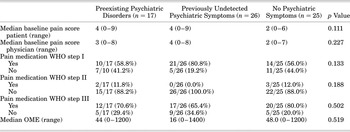
The results with the NRS demonstrated that the median pain score at baseline for all investigated patients was 3 (range: 0–9), and the median pain score at baseline rated by physicians was also 3 (range: 0–8). A significant correlation was observed between patients' and physicians' median NRS scores for intensity of pain (ρ = 0.7, p < 0.001). The median NRS score rated by patients (p = 0.111, Kruskal–Wallis test; see Table 2) or physicians (p = 0.277, Kruskal–Wallis test; see Table 2) revealed no significant differences between patients without, with preexisting, or with undetected psychiatric symptoms.
Pain scale and medication according to psychiatric symptoms

Use of Pain Medication Does Not Correlate with Psychiatric Symptoms
Considering the high pain load in our patients, we wanted to establish whether patients with psychiatric disorders would respond differently to pain management as compared to other palliative care patients.
These results showed that 66.2% (45 of 68) of patients received WHO step I, 7.4% (5) WHO step II, and 72,1% (49) WHO step III pain medications. No correlation was found between psychiatric symptoms (preexisting, undetected, absent) and likelihood of WHO step I (p = 0.133, chi-square test), WHO step II (p = 0.188, chi-square test), or WHO step III (p = 0.490, chi-square test) medication intake. The median OME was 39 (range: 0–1400). OME values did not differ between patients without, with preexisting, or with undetected psychiatric symptoms (p = 0.519, Kruskal–Wallis test). No correlation was found between cannabinoid, anticonvulsive, or neuroleptic medication intake and psychiatric symptoms (p > 0.05, chi-square test; see Table 3). Further, no correlation was observed between patients' median NRS scores for intensity of pain and OME in patients without psychiatric symptoms (ρ = –0.090, p = 0.689), those with preexisting psychiatric symptoms (ρ = 0.540, p = 0.031), and those with previously undetected psychiatric symptoms (ρ = 0.286. p = 0.175).
Psychopharmacologic medication according to psychiatric symptoms

The results indicating that the incidence of psychiatric conditions in palliative care patients was high and that pain management was not directly associated with these conditions are discussed.
DISCUSSION
The present study revealed for the first time a high percentage (38%) of undetected psychiatric comorbidities in patients receiving palliative care. In addition, we showed that pain was not related to these comorbidities and that its relief was independent of psychiatric conditions. Hence, even though the patients were ill for a long time, there was a high incidence of undetected mental illness. Additionally, a significantly higher incidence of psychosocial impairment was also detected in mentally disturbed patients, rendering them incapable of mastering daily functions.
It may be assumed that, despite prolonged disease, mental health symptoms do not receive adequate attention and treatment. Importantly, preexisting psychiatric disorders were also common (25%) among our patients. Those with undetected psychiatric symptoms or preexisting psychiatric comorbidities experienced significantly greater impairment in their activities of daily living than did those without psychiatric symptoms. This underscores the importance of assessing psychiatric disorders in patients admitted to a palliative care unit.
The doctor–patient relationship in a palliative care setting differs from that in other medical fields. In patients close to the end of their lives and in those enduring chronic pain, the individual patient's personality plays a crucial role and influences treatment significantly (Ciaramella et al., Reference Ciaramella, Grosso and Poli2004; Lo et al., Reference Lo, Calzavara and Kurdyak2013; Fasse et al., Reference Fasse, Flahault and Bredart2015; Breitbart, Reference Breitbart2004; Reference Breitbart2006). Considering this fact, diagnosing depression in timely fashion and the treatment options should be given special attention.
In reference to pain and depression, it has been shown that depression increases pain intensity (Iliffe et al., Reference Iliffe, Kharicha and Carmaciu2009). However, in our present study the high prevalence of psychiatric symptoms did not increase self-rating scores of pain or the need for pain medications, as reported in other studies (Workman et al., Reference Workman, Hubbard and Felker2002; Scherrer et al., Reference Scherrer, Salas and Lustman2015; Iliffe et al., Reference Iliffe, Kharicha and Carmaciu2009). Our observation was reaffirmed by the excellent correlation seen between patients' and physicians' median numeric rating scale (NRS) ratings of pain intensity, which may be explained by the specialization of palliative care teams in detection and treatment of pain.
The median NRS rating did not differ significantly between patients without, with preexisting, or with undetected psychiatric symptoms. Oral morphine equivalents did not differ significantly between patients from the aforementioned three categories. Nearly half of the investigated patients presented with previously undetected psychiatric symptoms, further indicating a need to evaluate psychiatric symptoms in palliative care.
Patients with preexisting psychiatric comorbidities received antidepressants and benzodiazepines significantly more often than did patients without or patients with previously undetected psychiatric symptoms. In our study, 57% of patients received antidepressants and 40% were given benzodiazepines. This indicated that psychopharmacologic medications should be carefully assessed and preexisting psychiatric disorders determined. The PHQ–D for assessing mental health was user-friendly, as illustrated by the fact that even gravely ill patients were able to answer promptly. To assist clinicians in recognizing and screening for depression, additional validated questionnaires may be employed, including the BDI (Beck Depression Inventory), the Clinical Interview for Depression (CID), the HAM–D (Hamilton Rating Scale for Depression), the MADRS (Montgomery–Åsberg Depression Rating Scale), the MDI (ICD-10 Major Depression Inventory), the PHD (Patient Health Questionnaire), or a simple-structured interview (DSM–IV) (Whooley et al., Reference Whooley, Avins and Miranda1997; Zimmerman & Mattia, Reference Zimmerman and Mattia1999; Guidi et al., Reference Guidi, Fava and Bech2011).
The limitations of our study have to be clearly stated. Despite the novelty and strength of the hitherto largest sample size involving the population of patients being admitted to a palliative care unit as well as the user-friendly nature of the PHQ–D, our study is limited by its heterogeneous patient population and high dropout rate. Patients receiving palliative care are generally in rather poor condition, and comprehensive assessment might be exhausting and affect the results. This was confirmed in our study population, with a median Karnofsky performance score of 50%. The first Austrian palliative care unit opened in 1992. The growing number of patients needing palliative expertise constitutes the main driver for development and continuous expansion of palliative care in Austria. Generally, palliative care units there are small hospital-based units comprising 8 to 14 beds. They mainly attend to cancer patients, and their principal task is to improve the health of patients with advanced cancer and assist their families in transferring patients to home care. Based on information from Statistics Austria, the mean duration of a patient's stay on a ward is 14 days. Therefore, recruiting a large study population in the field of palliative care is a challenging task. High attrition rates and the marked heterogeneity of patients receiving palliative care make it necessary to recruit large patient sample sizes. However, such recruitment is difficult for practical and ethical reasons (Grande & Todd, Reference Grande and Todd2000).
We recommend larger studies to further investigate mental health in patients receiving palliative care. Based on the data of a feasibility study (n = 12), we decided to use the PHQ–D as the only questionnaire because of its clinical feasibility and simple application for patients. Furthermore, in distinction of other questionnaires, the PHQ–D also assesses psychosocial impairment. Although using a single questionnaire might be limiting, we decided to prevent over-researching the surveyed patients and thereby risking bias due to lack of compliance. The study team understands that information gained by any questionnaire has to include a careful clinical interview and take into account the patient's medical history, which was adhered to carefully. Notwithstanding, in everyday clinical practice in palliative care units, psychopharmacological medications are often prescribed to control such symptoms as anxiety, depressed mood, and insomnia. The results of our study show that patients receiving palliative care commonly receive psychopharmacological medications, suggesting that further in-depth research is necessary. Patients with preexisting psychiatric disorders as well as those with undetected psychiatric symptoms have experienced significantly greater impairment. This is a central concern in palliative care, because the aim is to discharge patients to home care, which is hindered by untreated psychiatric symptoms.
The results of our present investigation highlight the crucial importance of addressing mental health issues in palliative care. It is known that participants in psychosocial end-of-life research are unlikely to experience burden from participation (Pessin et al., Reference Pessin, Galietta and Nelson2008). Nevertheless, treatment should be initiated only after due consideration, based on the available evidence and taking into account the patient's medical history. Depression in patients receiving palliative care should furthermore be counteracted effectively with psychological support, psychotherapy, and psychopharmacological therapy (Lo et al., Reference Lo, Calzavara and Kurdyak2013; Nissim et al., Reference Nissim, Freeman and Lo2012; Walker et al., Reference Walker, Hansen and Martin2014; Gibson et al., Reference Gibson, Lichtenthal and Berg2006). In order to meet the needs of the individual patient, interdisciplinary teams should also take psychiatric comorbidities into account. Psychopharmacological agents are frequently prescribed by nonpsychiatric physicians, which further underlines the necessity of disseminating knowledge about psychiatric diseases and their treatment (Wancata et al., Reference Wancata, Benda and Meise1998). Our data substantiate the need for psychiatrists as consultants and as members of interdisciplinary teams in the field of palliative care (Irwin & Ferris, Reference Irwin and Ferris2008; Jaiswal et al., Reference Jaiswal, Alici and Breitbart2014). The treatment of depressive comorbidities requires comprehensive knowledge of psychopharmacological substances and should be administered by doctors with suitable expertise. Especially in critically ill patients, additional care should be given to avoiding drug interactions, side effects, and reduced quality of life. Common and dangerous errors include short duration of treatment, rapid discontinuation of antidepressants, and quick substance switching without dose adjustment when the patient does not respond or experiences adverse events.
In our study population, mirtazapine was the most frequently prescribed antidepressant. It was found to improve self-rated depression and functional assessment measures in a dose-dependent manner. This was especially true in patients with advanced cancer who were experiencing moderate to severe residual pain despite treatment with opioids (Theobald et al., Reference Theobald, Kirsh and Holtsclaw2002). The further benefits of mirtazapine include its potential antiemetic, antidepressive, appetizing, and sleep-promoting effects (Kapoor, Reference Kapoor2013). Only modest differences in efficacy have been found among common antidepressants, and, as in the general psychiatry setting, the choice of antidepressant therapy in palliative care is largely governed by the potential side-effect profile (Cipriani et al., Reference Cipriani, La Ferla and Furukawa2010). Selective serotonin reuptake inhibitors (SSRI) are the first-line treatment for depression and are generally well tolerated without causing sedation. In addition to gastrointestinal side effects, sexual side effects are common. Selective serotonin/noradrenaline reuptake inhibitors, similar to SSRIs, are also generally well tolerated and may alleviate pain significantly, as do tricyclic antidepressants. However, as tricyclic antidepressants have a strong pharmacological interaction and an unfavorable side-effect profile, they should only be used with care in cancer patients. They are further known for their anticholinergic side effects and the risk of delirium, though they have been shown to be effective in the treatment of pain (Furukawa et al., Reference Furukawa, McGuire and Barbui2002). Citalopram, escitalopram, milnacipran, mirtazapine, and venlafaxine are known for their weak cytochrome P450 (CYP450) inhibitory potential and their safety profile in cancer patients (Miguel & Albuquerque, Reference Miguel and Albuquerque2011).
In conclusion, our results showed that undetected psychiatric comorbidities are common in patients receiving palliative care. Since adequate physical as well as psychological symptom relief is the key concern of palliative care, screening for psychiatric symptoms should be integrated into palliative care assessment in order to optimize treatment and reduce the psychosocial burden of disease. Finally, palliative care extends beyond the limits of ordinary care, and clinicians should offer adequate comfort to their patients at the end of their lives and do their best to protect them from an impersonal and lonely death.
ACKNOWLEDGMENTS
The costs for this project were covered by the research budget of the Medical University of Vienna. The study was performed as part of Eva Katharina Masel's Ph.D. dissertation project for the doctoral program on mental health and behavioral medicine at the Medical University of Vienna. We thank the following institutions for contributing to the study: Goettlicher Heiland Hospital (Dr. Cornelia Stabel), Hietzing Hospital (Dr. Ralph Simanek), Caritas Socialis Hospice Rennweg (Dr. Magdalena Kirchhoff), and Saint Elisabeth Hospital (Dr. Aurelia Miksovsky). The authors also want to thank Professor Aner Gurvitz for critically reading and editing the manuscript.
CONFLICTS OF INTEREST
The authors state that they have no conflicts of interest to declare.