INTRODUCTION
Gujarat has the longest coastline (1600 km) of India with a very rich floral and faunal biodiversity. About 606 fish species have been identified from the state from which 487 belong to the marine environment and 119 belong to fresh water (Barman et al., Reference Barman, Mukherjee and Kar2000). In India, about 110 species of elasmobranchs are found of which 32 species are rays (Raje et al., Reference Raje, Mathew, Joshi, Nair, Mohanraj, Srinath, Gomathy and Rudramurthy2002). According to the Gujarat Ecological Commission (GEC, 1996), about 11 species of rays along with shark and skates contribute to the elasmobranch biodiversity of the state. Moreover, a new report about the distribution of Torpedo sinuspersici, popularly known as marbled electric ray, from Gujarat (Trivedi & Vachhrajani, Reference Trivedi and Vachhrajani2013) is further enriching its biodiversity. The species described in the present study (Neotrygon kuhlii) belongs to the family Dasyatidae and is popularly known as the blue-spotted stingray or Kuhl's stingray. The species is solitary in nature and usually found in deeper water, but also moves to shallower sandy bottom areas near to rocky and coral reef flats during high tide (Michael, Reference Michael1993). This is a venomous species (Halstead et al., Reference Halstead, Auerbach and Campbell1990) which preys on fish, crustaceans and mulluscs (Compagno et al., Reference Compagno, Ebert and Smale1989), and it reproduces by ovoviviparous mode of reproduction (Dulvy & Reynolds, Reference Dulvy and Reynolds1997). It has already been reported from the Red Sea (Last & Compagno, Reference Last, Compagno, Carpenter and Niem1999) and eastern African coasts in the Indian Ocean, Japan coast in the north to Australia (Last & Compagno, Reference Last, Compagno, Carpenter and Niem1999), Samoa (Wass, Reference Wass1984), and Tonga (Randall et al., Reference Randall, Williams, Smith, Kulbicki, Tham, Labrosse, Kronen, Clua and Mann2004) coasts in the southern Pacific Ocean. The distribution range of the species though apparently believed to be across the Indo-Pacific regions, is likely to be for a species complex comprising at least 5 species or more rather than for a single species alone (IUCN, 2013). The genus Neotrygon is represented by 5 species, namely N. annotata (Last, 1987), N. kuhlii (Müller & Henle, 1841), N. leylandi (Last, 1987), N. picta (Last & White, Reference Last, White, Last, White and Pogonoski2008) and N. ningalooensis (Last et al., 2010). From India, the species has already been reported from the Gulf of Mannar of Bay of Bengal (Murugan et al., Reference Murugan, Dhanya, Sarcar, Naganathan, Rajagopal and Balasubramanian2011) and Maharashtra waters of the Arabian Sea (Talwar & Kackar, Reference Talwar and Kacker1984). Till now only three species viz., Dasyatis imbricata, D. zugei and Gymnura poecilura belonging to the family Dasyatidae have been reported from Gujarat waters (GEC, 1996). Since, the species, N. kuhlii has not been reported from Gujarat, this can be considered as a first record from the Gujarat waters of India.
MATERIALS AND METHODS
On 1 October 2013, a single specimen of blue-spotted stingray was landed at Veraval fishing harbour (India) by a single day trawler which was operated in the waters off Veraval at a depth range of 40–50 m. The sample was kept in the ice box and transported to the laboratory. The information on the fishing ground, depth of operation and the gear was collected from the fishermen. Photographs of the sample were taken and its identification was confirmed following criteria given by Compagno (Reference Compagno, Smith and Heemstra1986). Detailed morphometric measurements were noted down and the specimen was deposited in the Zoology Museum, Department of Zoology, M.S. University of Baroda, India (ZL-P5-CH-12).
RESULTS
Type material
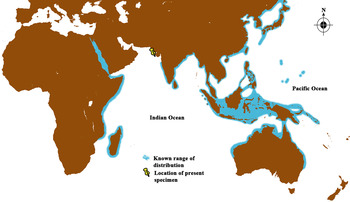
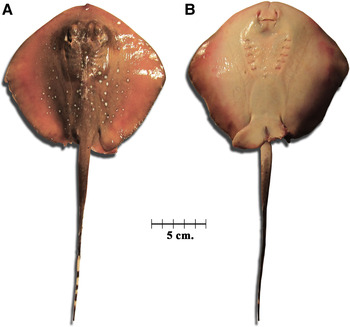
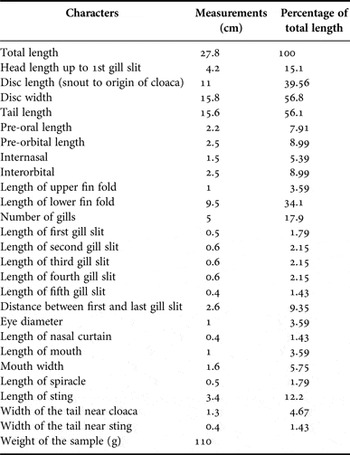
The distribution range of the species as well as location of specimen obtained in the present study is given in Figure 1. The collected specimen was a female measuring a total length of 27.8 cm and weighing 115 g (Figure 2) found to be landed along with other ray species Himantura imbricata and Himantura bleekerii. Measurements of different body parts are given in percentage of total body length in Table 1.
Map showing distribution range of Neotrygon kuhlii and location of specimen obtained in the present study.

Neotryogon kuhlii, female from Gujarat, India: (A) dorsal view; (B) ventral view.

Morphometric measurements of Neotrygon kuhlii collected from the Saurashtra coast of Gujarat.

Diagnosis
The species was reddish-brown in colour in the dorsal side having whitish colour ventrally (Figure 2). The centre of the dorsal side of the body was covered with several bright blue coloured ocelli and black spots scattered laterally. The tail was long with a shorter upper and longer lower fin fold and covered with alternative black and white rings. There was only one long sting on the tail. The snout of the species was pointed and very short. Mouth was located ventrally. Disc was angular with no thorns. It was probably attacked by a predator which had greatly injured one of the pelvic fins.
Remarks
The blue-spotted stingray is believed to have a very wide range of distribution from the western Indian Ocean to the eastern Pacific Ocean (Fahmi & White, Reference White2009). However, there is considerable doubt about the true distribution of the species because of taxonomic issues. Till 2008, the species was known to be under the genus Dasyatis, but Last & White (Reference Last, White, Last, White and Pogonoski2008) placed the species under the genus Neotryogon. It grows up to a maximum length of 700 mm (Compagno et al., Reference Compagno, Ebert and Smale1989). It is a typically marine reef-associated species found at a depth range of 0–90 m (Last & Compagno, Reference Last, Compagno, Carpenter and Niem1999). It has been assessed as ‘Data deficient’ by IUCN (2013). This is not a commercially important species, but sometimes landed as a trawl by-catch. It is sold at a very low price and utilized for its meat by the local people.
ACKNOWLEDGEMENTS
Thanks are expressed to the Indian Council of Agricultural Research (ICAR) for providing a research grant to carry out the research work. We thank the Director, Central Marine Fisheries Research Institute (CMFRI, India), for providing the facilities at the centre. We also thank the HOD Demersal Fisheries Division, CMFRI for his continuous support and encouragement.