Introduction
Depression and anxiety are common following diagnosis of breast cancer (Burgess et al. Reference Burgess, Cornelius, Love, Graham, Richards and Ramirez2005) and this has led to a search for ways to identify patients at risk and for the underlying, and potentially modifiable, psychological processes contributing to the risk. Breast cancer usually occurs in middle-aged and older women but depression and anxiety commonly have onset in adolescence and early adult life (Jaffee et al. Reference Jaffee, Moffitt, Caspi, Fombonne, Poulton and Martin2002). It is possible, therefore, that much of the depression and anxiety seen following breast cancer occurs in women who have experienced previous episodes, and may result from mechanisms associated with recurrent psychopathology. Although several reports have implicated pre-morbid psychiatric history as a risk factor in anxiety or depression after breast cancer treatment, the findings have not been consistent (Dean, Reference Dean1987; Maunsell et al. Reference Maunsell, Brisson and Deschenes1992; Pinder et al. Reference Pinder, Ramirez, Black, Richards, Gregory and Rubens1993; Grassi et al. Reference Grassi, Malacarne, Maestri and Ramelli1997; Morasso et al. Reference Morasso, Costantini, Viterbori, Bonci, Del Mastro, Musso, Garrone and Venturini2001; Gallagher et al. Reference Gallagher, Parle and Cairns2002; Burgess et al. Reference Burgess, Cornelius, Love, Graham, Richards and Ramirez2005). Moreover, psychiatric history was assessed in most studies by methods that did not use research psychiatric interview schedules; for example, relying on clinical records or patients' reports of having received treatment for emotional problems (Dean, Reference Dean1987; Pinder et al. Reference Pinder, Ramirez, Black, Richards, Gregory and Rubens1993; Grassi et al. Reference Grassi, Malacarne, Maestri and Ramelli1997; Morasso et al. Reference Morasso, Costantini, Viterbori, Bonci, Del Mastro, Musso, Garrone and Venturini2001; Gallagher et al. Reference Gallagher, Parle and Cairns2002; Burgess et al. Reference Burgess, Cornelius, Love, Graham, Richards and Ramirez2005).
The question of whether psychiatric disorders following diagnosis of cancer are recurrences of previous episodes is important for understanding causal mechanisms and hence for designing treatments to reduce risk of post-diagnosis psychopathology. In the absence of measurement of previous episodes, predictors of post-diagnosis psychiatric disorder might be assumed to reflect causal processes that could be targeted to reduce subsequent psychopathology. However, if previous episodes are assessed and are shown to be associated with post-diagnosis episodes, then such predictors may turn out to be mediators between previous and subsequent episodes, or they might be merely markers of vulnerability arising from previous episodes. In this study we therefore first examined whether depression and anxiety in the year following breast cancer diagnosis were likely to be recurrences of previous psychopathology. Then we examined three possible predictors of psychopathology after breast cancer – low social support, self-blame, and shame – in order to determine whether they mediated the relationship of previous psychopathology to the psychopathology seen after diagnosis.
Low social support increases vulnerability to depression and high social support acts as a buffer, particularly in women (Sherbourne et al. Reference Sherbourne, Hays and Wells1995). Levels of social support are likely to be particularly important in relation to breast cancer. A woman coping with the diagnosis of breast cancer, followed by surgery and then commonly radiotherapy or chemotherapy or both, faces multiple emotional, social and practical challenges. Social support, and in particular emotional support, protects women to some degree from the risk of depression associated with these challenges (Grassi et al. Reference Grassi, Malacarne, Maestri and Ramelli1997; Ganz et al. Reference Ganz, Desmond, Leedham, Rowland, Meyerowitz and Belin2002; Trunzo & Pinto, Reference Trunzo and Pinto2003; Helgeson et al. Reference Helgeson, Snyder and Seltman2004; Burgess et al. Reference Burgess, Cornelius, Love, Graham, Richards and Ramirez2005). However, depression is associated with subsequent impaired social functioning and marital discord (Gotlib et al. Reference Gotlib, Lewinsohn and Seeley1998; Lewinsohn et al. Reference Lewinsohn, Rohde, Seeley, Klein and Gotlib2003) and hence low social support may be a marker for depression.
The way a person appraises the causes of a major stressor such as breast cancer may affect vulnerability to depression or anxiety. For example, self-devaluative cognitions are associated with depression (Teasdale & Cox, Reference Teasdale and Cox2001). A person's search for causal factors to explain a stressor may be particularly problematic for events that do not have clear-cut origins. Cancer, and breast cancer in particular, is one such stressor for which there are few clearly known causes. Thus it has been hypothesized that blaming oneself for the cancer may predispose to the development of psychopathology. In a prospective study over the first year following the diagnosis of breast cancer, self-blame predicted symptoms of anxiety (Bennett et al. Reference Bennett, Compas, Beckjord and Glinder2005). Equally, self-blame assessed following the diagnosis of breast cancer may be more likely in women who have had previous episodes of depression or anxiety.
It is common in clinical practice for women to express feelings of shame regarding their cancer or its treatment (Margolis et al. Reference Margolis, Goodman and Rubin1990), and previous studies have reported higher levels of shame in women who report histories of maltreatment, and associations between shame and depression (Andrews, Reference Andrews1995; Whiffen & Macintosh, Reference Whiffen and Macintosh2005). Proneness to shame may, however, also be a marker of previous depression.
We conducted a prospective study of depression and anxiety following diagnosis of breast cancer with assessment immediately post-diagnosis and 1 year later in order to test the following hypotheses:
(1) Onset of major depression (MD) and generalized anxiety disorder (GAD) using Diagnostic and Statistical Manual of Mental Disorders (DSM) criteria (DSM MD and GAD) in the year following diagnosis is predicted by MD and GAD before the diagnosis.
(2) Social support, self-blame and shame soon after diagnosis also predict the likelihood of MD and GAD over the following year.
(3) Social support, self-blame and shame soon after diagnosis are, in turn, predicted by DSM MD and GAD before the diagnosis.
(4) Low social support, self-blame and shame mediate the associations between DSM MD and GAD before and after diagnosis.
In order to ensure that the hypotheses were tested in relation to onset of disorder over the year after diagnosis, women with MD or GAD who were in episode at the time of diagnosis were excluded from the analyses.
Method
Participants and recruitment
Participants were female patients of one of two hospitals who had received a diagnosis of primary breast cancer followed by mastectomy or wide local excision. We excluded patients: with metastatic or recurrent cancer; receiving neo-adjuvant chemotherapy or primary endocrine treatment; with insufficient English to consent and complete questionnaires; and who were judged by a clinician or the researcher to be too distressed to take part. Patients were informed about the study by a breast nurse at pre-operative assessment, and were then asked for consent by the female researcher 2–4 days post-operatively before discharge home. The researcher administered questionnaires (see Baseline assessments below) to consenting patients privately, and collected clinical information from patient records. Where patients were unable to complete questionnaires in hospital, or were discharged before 2 days, the procedure was completed as soon as possible after discharge. After using clinical records to exclude participants who had died or developed metastases, the researcher contacted remaining participants 11 months after the initial contact and invited them to participate in the 1-year follow-up assessment.
Measurements
Baseline assessments
Answers to two questions measuring behavioural and characterological self-blame in relation to cancer were summed to indicate self-blame (Glinder & Compas, Reference Glinder and Compas1999). Scores were dichotomized to distinguish those describing no self-blame from those identifying any degree of self-blame on either or both questions. The bodily shame subscale of the Experience of Shame Scale contains four items (Andrews, Reference Andrews1995). Scores were dichotomized to distinguish those of 12 or more (corresponding to a mean response to each item of ‘moderately’ on a four-point Likert scale, scored 1–4: not at all, a little, moderately, very much) from the rest. Perceived emotional support was measured by the Medical Outcomes Study Social Support Survey (Sherbourne & Stewart, Reference Sherbourne and Stewart1991). Patients rated the availability of each of 19 instances of support on a five-point Likert scale (from ‘none of the time’ to ‘all of the time’). Scores were summed for subscales concerning emotional support: emotional/informational support; positive social interaction; and affectionate support. The subscale for tangible support was disregarded. We arbitrarily designated the group in the lowest third of scores as having low support. Other self-report questionnaires are not reported here.
Assessment of MD and GAD
Interviews were conducted at the 1-year follow-up in order to ascertain DSM MD and GAD before diagnosis, and over the follow-up period. For patients with disorder during the follow-up period, we also ascertained whether the disorder was present at the time of diagnosis. The disorders were assessed with the Schedule for Affective Disorders and Schizophrenia (Spitzer & Endicott, Reference Spitzer and Endicott1975). The questions were adapted so that DSM-IV ratings of MD since age 16 years could be made (Hill et al. Reference Hill, Pickles, Burnside, Byatt, Rollinson, Davis and Harvey2001). The interviewers were trained by J.H. who participated in the development and evaluation of the investigator-based version of the measure that was used in this study (Harrington et al. Reference Harrington, Hill, Rutter, John, Fudge, Zoccolillo and Weissman1988). Ratings were reviewed regularly with J.H.
Data analysis
Analyses were by χ2 and multiple logistic regression. Mediation was examined using a modification of the approach outlined by Baron & Kenny (Reference Baron and Kenny1986). Where associations between A and C, A and B, and B and C have all been confirmed, Baron & Kenny argue that B can be considered a mediator of the relationship of A and C if the effect of A becomes non-significant once B is controlled for. A substantial change in the effect of A after controlling for B was also accepted, in order to avoid the risk that the test of B as a mediator was dependent on whether the contribution of A fell below the arbitrary p=0.05 significance level (Hill et al. Reference Hill, Davis, Byatt, Burnside, Rollinson and Fear2000).
Results
Sample characteristics
Of the 474 patients who were approached, 374 (79%) agreed to participate, although 14 (4%) of these subsequently withdrew, and five (1%) supplied too few data to be included in the sample, leaving a sample of 355 patients at the first assessment. After 1 year, nine patients had died or developed metastases. Of the remainder, 14 patients could not be contacted. Of those who were successfully contacted, 35 patients declined to be assessed. Others gave partial data and follow-up interviews were conducted with 260 women, i.e. 75% of those assessed post-operatively who were still eligible. Those providing interviews did not differ from those who did not on age, shame, blame or social support. Because patients occasionally failed to provide sufficient information on all components of the Schedule for Affective Disorders and Schizophrenia, or had failed to provide complete questionnaire data at baseline, numbers available for some analyses were fewer. Numbers were further reduced by omission from analyses of women in episodes of MD (n=10), GAD (n=12) or either MD or GAD (n=19).
Most patients were aged between 51 and 64 years (n=151), but 48 patients were younger and 61 were older. Age was not related to MD or GAD in the year after diagnosis. There was no evidence of collinearity amongst the variables (minimum tolerance=0.57; maximum conditioning index=4.52).
MD and GAD
In the year after diagnosis, MD occurred in 41/260 (16%) women, of whom 10 were in episode at the time of diagnosis. GAD occurred in 35/260 (13%) women of whom 12 were in episode at the time of diagnosis. Before diagnosis, MD occurred in 58/257 (23%) women and GAD occurred in 27/259 (10%).
Hypothesis 1: MD and GAD before diagnosis predict MD and GAD following diagnosis
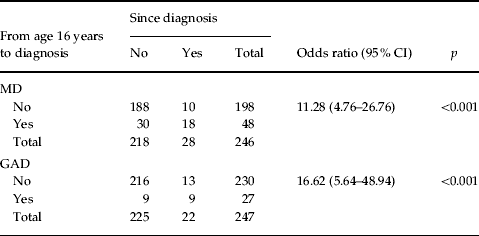
Depression and GAD with onset after diagnosis were each much more likely to occur in women with pre-morbid histories of that disorder (Table 1). Of women with onset of MD following diagnosis, 64% had experienced a previous episode. Of the women with GAD following diagnosis, this was a recurrence in 41%. Overall, among 43 women with a history of MD or GAD when diagnosed with breast cancer, 17 (40%) went on to have an onset of one of these disorders over the next year, contrasted with 16 (8%) of the 195 with no history of disorder [odds ratio (OR) 7.32, 95% confidence interval (CI) 3.30–16.23].
Test of hypothesis 1: relationship of disorder before diagnosis to disorder with onset during 12 months after diagnosis

CI, Confidence interval; MD, major depression; GAD, generalized anxiety disorder.
Hypothesis 2: social support, self-blame and shame predict MD and GAD following diagnosis
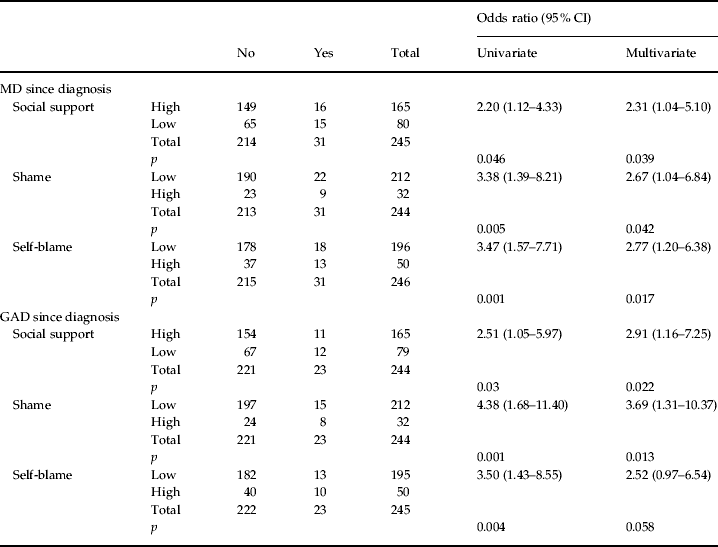
Low social support predicted onset of MD and GAD (Table 2). Low support also predicted whether women would have an onset of MD or GAD following diagnosis within the group with a prior episode since age 16 years. Of the 11 women with a prior history of disorder and low support, eight (73%) had an episode in the year following diagnosis of breast cancer, compared with nine (29%) of the 31 with prior history of disorder and high support (OR 6.52, 95% CI 1.40–30.31, p=0.011). Self-blame and shame at baseline were each also associated with MD and GAD following diagnosis (Table 2). In multivariate analysis (logistic regression), low support, shame and blame all predicted MD, and low support and shame predicted subsequent GAD.
Test of hypothesis 2: prediction of onset of disorder during 12 months after diagnosis by social support, self-blame and shame measured post-operativelyFootnote a

CI, Confidence interval; MD, major depression; GAD, generalized anxiety disorder.
a Odds ratios are shown for univariate analyses and for multivariate analyses in which the variables are examined jointly in logistic regression.
Hypothesis 3: support, blame and shame are associated with MD and GAD before diagnosis
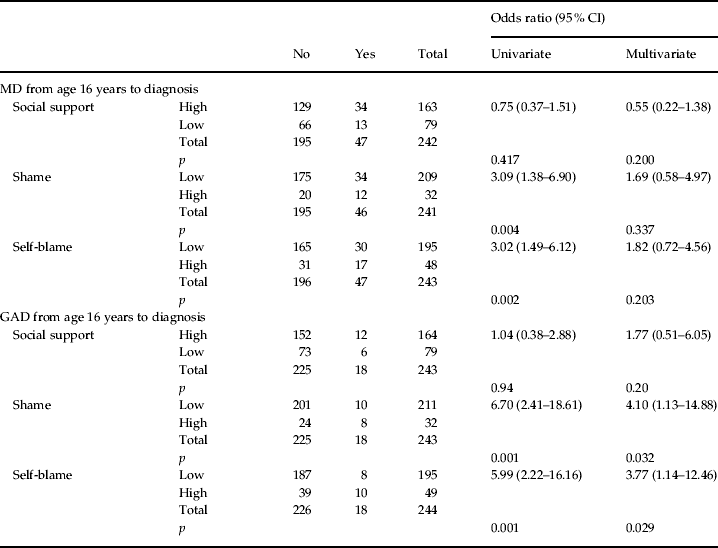
Self-blame and shame were strongly associated with previous MD and GAD but low support was associated with neither (Table 3). In multivariate analysis, self-blame and shame were associated only with previous GAD.
Test of hypothesis 3: prediction of social support, self-blame and shame measured post-operatively by disorder before diagnosisFootnote a

CI, Confidence interval; MD, major depression; GAD, generalized anxiety disorder.
a Odds ratios are shown for univariate analyses and for multivariate analyses in which parallel logistic regression analyses regressed support, self-blame and shame on both MD and GAD.
Hypothesis 4: support, blame and shame mediate the association of disorder before and after diagnosis
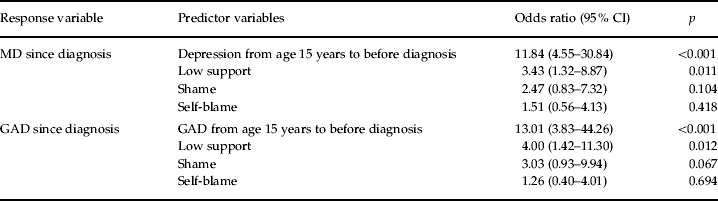
In multivariate analysis, prior MD remained highly significant as a predictor of onset of MD since diagnosis after inclusion of support, blame and shame in the regression, and ORs were not appreciably reduced indicating that support, blame and shame did not mediate the relationship of disorder before and after diagnosis (Table 4). The findings for GAD were very similar. Even after accounting for the strong association between psychiatric disorder before diagnosis and onset over the subsequent year, low social support made an additional and substantial contribution to risk of onset of both MD and GAD (Table 4).
Test of hypothesis 4: results of logistic regression in which the relationship of disorder since diagnosis with pre-morbid disorder reported in Table 1 was re-examined, controlling for psychological variables and support measured post-operatively

CI, Confidence interval; MD, major depression; GAD, generalized anxiety disorder.
Discussion
Using a standardized measure of adult lifetime DSM disorders we found that nearly two-thirds of patients with episodes of MD over the first year following the diagnosis of breast cancer were experiencing recurrences of previous depression, and approximately 40% of patients with episodes of GAD were also experiencing recurrences. This is consistent with previous findings that predictors of depression following breast cancer are similar to those in the general population (Burgess et al. Reference Burgess, Cornelius, Love, Graham, Richards and Ramirez2005) and that rates, but not first onsets, of depression and anxiety are elevated after breast cancer (Gandubert et al. Reference Gandubert, Carriere, Escot, Soulier, Hermes, Boulet, Ritchie and Chaudieu2009). Therefore, while the nature of anxiety and depression when they occur after breast cancer, and specifically the content of the associated cognitions, may reflect the distinctive challenges associated with the disease (Moorey & Greer, Reference Moorey and Greer2002), vulnerability to these problems arises from pre-morbid factors. While these factors were measured in this study as previous depression and anxiety, these in turn may also be reflections of vulnerability occurring earlier in life. For example, child sexual abuse, an established risk for depression in women (Hill et al. Reference Hill, Pickles, Burnside, Byatt, Rollinson, Davis and Harvey2001), may generate the vulnerability to episodes prior to diagnosis.
Our hypothesis that low social support, self-blame and shame would mediate this relationship was convincingly refuted. Indeed, associations of self-blame and shame with subsequent depression and anxiety were accounted for by previous depression and anxiety. Only social support contributed independently to the prediction of depression or anxiety in the year after diagnosis and this did not mediate between prior and post-diagnosis psychopathology. Whereas others have reported that social support was associated with depression during the year after diagnosis, they measured support simultaneously with depression and did not control for history of emotional disorders (Grassi et al. Reference Grassi, Malacarne, Maestri and Ramelli1997) or they inferred history of emotional disorders from patients' reports of treatment (Burgess et al. Reference Burgess, Cornelius, Love, Graham, Richards and Ramirez2005).
The lifetime prevalence rate, for depression of 22%, and for GAD of 10%, was similar to rates reported in general population studies of women (Kessler et al. Reference Kessler, McGonagle, Zhao, Nelson, Hughes, Eshleman, Wittchen and Kendler1994; Hill et al. Reference Hill, Pickles, Burnside, Byatt, Rollinson, Davis and Harvey2001, Reference Hill, Pickles, Rollinson, Davies and Byatt2004). However, we found a lower prevalence of psychological disorder in the 12 months after diagnosis than that reported previously for a breast cancer population: 21% experiencing MD or GAD or both, compared with 48% reported by Burgess et al. (Reference Burgess, Cornelius, Love, Graham, Richards and Ramirez2005). Burgess et al. (Reference Burgess, Cornelius, Love, Graham, Richards and Ramirez2005) assessed patients at 5 and 21 months after diagnosis whereas we assessed patients after 12 months, but the different findings cannot readily be accounted for by this methodological difference. A possible explanation is that they excluded patients aged older than 60 years, a group that accounted for 38% of our sample. Older women are less vulnerable to emotional problems after breast cancer (Salmon et al. Reference Salmon, Hill, Krespi, Clark, Fisher and Holcombe2006).
Strengths and limitations
One strength of the study was that all women receiving a diagnosis of primary breast cancer and treated surgically in two major treatment centres were approached, and there was a high participation rate. Thus the sample is likely to be representative of the population of women with breast cancer. It is the first study to examine prospective predictors of episodes of DSM MD and GAD over the first year following diagnosis, while at the same time accounting for previous episodes.
We were unable to follow-up 25% of eligible women who had taken part in the first assessment. However, they did not differ in the first assessments of mood from those followed up. In the absence of a control group unaffected by cancer we were unable to determine whether there may be an interaction between previous psychopathology and breast cancer. That is, while breast cancer increases the incidence of psychopathology, we do not know whether this effect is greater or smaller in women with previous history of psychopathology. Similarly, we cannot tell the extent to which shame and blame, while being functionally markers of previous emotional disorder, might have been intensified by the experience of cancer. There were also limitations in the way we assessed DSM disorders. Previous episodes were not assessed at baseline, and were not rated independently of knowledge of episodes over the follow-up period. This may have inflated the strength of the association between previous and subsequent episodes.
Implications
Our findings have implications, not only for the study of depression and anxiety following breast cancer, but also for the study of vulnerability to these disorders more generally. Measurement of lifetime depression and anxiety can reveal that predictors, such as self-blame and shame, far from having a causal role, are simply markers of prior psychopathology. Equally, where an effect of a predictor remains after accounting for previous episodes, as was the case in this study for social support, confidence is increased that it may have a causal role (Grassi et al. Reference Grassi, Malacarne, Maestri and Ramelli1997).
The findings highlight the vulnerability of women with previous episodes of depression and anxiety to further mental health problems during the year after diagnosis of breast cancer. Irrespective of whether the cancer has a role in increasing that risk, experiencing an episode of MD or GAD soon after the diagnosis of, and often during treatment for, breast cancer, adds to the suffering of the patient and the burden on the family. Prevention is therefore a worthwhile goal. Furthermore, the strength of the prediction from prior to subsequent psychiatric disorder suggests that a history of previous disorder would be a useful clinical pointer to the need for additional support or psychological treatment as part of the cancer care regimen. Trials of interventions designed to prevent recurrences of depression and anxiety in women with breast cancer are needed.
Acknowledgements
This work was funded by a research grant from Cancer Research UK to P.S., J.H., C.H. and J.F. We are grateful for the enthusiastic cooperation of consultant and specialist nursing staff in Royal Liverpool University Hospital and Whiston Hospital. Preparation of the manuscript was assisted by the award of a Distinguished Fellowship to P.S. from the Institute of Advanced Studies at LaTrobe University, Melbourne.
Declaration of Interest
None.