Suicide – the decision to forego one's personal future – is sometimes perceived as the product of an impulsive, present-focused mind. Indeed, suicidal acts often involve little premeditation, and an important subgroup of suicidal individuals display high trait impulsivity and make shortsighted or negligent decisions (Gibbs et al. Reference Gibbs, Dombrovski, Morse, Siegle, Houck and Szanto2009; McGirr et al. Reference McGirr, Alda, Séguin, Cabot, Lesage and Turecki2009; Dombrovski et al. Reference Dombrovski, Clark, Siegle, Butters, Ichikawa, Sahakian and Szanto2010, Reference Dombrovski, Szanto, Siegle, Wallace, Forman, Sahakian, Reynolds and Clark2011; Clark et al. Reference Clark, Dombrovski, Siegle, Butters, Shollenberger, Sahakian and Szanto2011). Yet, at another end of the spectrum we see carefully planned and executed suicidal acts, particularly in older people (De Leo et al. Reference De Leo, Padoani, Scocco, Billebrahe, Arensman, Hjelmeland, Crepet, Haring, Hawton, Lonnqvist, Michel, Pommereau, Querejeta, Phillipe, Salander-Renberg, Schmidtke, Fricke, Weinacker, Tamesvary, Wasserman and Faria2001; Dombrovski et al. Reference Dombrovski, Szanto, Duberstein, Conner, Houck and Conwell2008, Reference Dombrovski, Szanto, Siegle, Wallace, Forman, Sahakian, Reynolds and Clark2011). The psychological and cognitive underpinnings of premeditated suicidal behavior are less understood. Our earlier behavioral study found evidence that suicide attempters’ decision making aligns with the profile of their real-life suicidal behavior (Dombrovski et al. Reference Dombrovski, Szanto, Siegle, Wallace, Forman, Sahakian, Reynolds and Clark2011). Specifically, individuals with a history of poorly planned suicide attempts demonstrated a shortsighted preference for immediate over delayed rewards, echoing Baumeister's conceptualization of a focus on immediate outcomes as a feature of the suicidal state (Baumeister, Reference Baumeister1990). In contrast, individuals who had carefully planned their suicide attempts demonstrated an intact ability to delay gratification. This study examines neural underpinnings of delayed gratification in suicide attempters in an attempt to further understand decision processes that lead to suicide.
Little is known about neural mechanisms of disadvantageous decision making in suicidal individuals. One likely focus of individual differences is the mesostriatal–paralimbic reward system, thought to represent the subjective value of options (Bartra et al. Reference Bartra, McGuire and Kable2013; Chase et al. Reference Chase, Kumar, Eickhoff and Dombrovski2015). Indeed, our earlier study suggested that impulsivity and poorly planned suicide attempts are paralleled by altered value signals in the paralimbic cortex, particularly the ventromedial prefrontal cortex (vmPFC) (Dombrovski et al. Reference Dombrovski, Szanto, Clark, Reynolds and Siegle2013). A similar neural signature of impulsivity has been observed in problem gamblers (Miedl et al. Reference Miedl, Peters and Büchel2012). It is not known, however, whether premeditated suicide attempts are similarly associated with alterations of value representations. The behavioral evidence of the ability to delay gratification in this group (Dombrovski et al. Reference Dombrovski, Szanto, Siegle, Wallace, Forman, Sahakian, Reynolds and Clark2011) would suggest otherwise. Some studies have argued that the neural signature of this ability resides in cognitive control areas, such as the lateral prefrontal cortex (PFC) (McClure et al. Reference McClure, Laibson, Loewenstein and Cohen2004; Tanaka et al. Reference Tanaka, Doya, Okada, Ueda, Okamoto and Yamawaki2004; Wittmann et al. Reference Wittmann, Leland and Paulus2007). Taken together, these findings suggest different alterations of neural substrates in individuals with impulsive v. more premeditated suicide attempts.
The current study aimed to characterize these different alterations by examining neural correlates of value during delay discounting in suicide attempters. The delay discounting task is ideal for examining how individuals track the values of options as they make choices between smaller immediate and larger delayed amounts of money. Choices on this task incorporate both reward magnitude and its time of delivery into the representation of subjective value (Frederick et al. Reference Frederick, Loewenstein and O'Donoghue2002). Subjective value signals have been observed in the medial orbitofrontal cortex/vmPFC, ventral striatum and posterior cingulate cortex (PCC)/precuneus (Kable & Glimcher, Reference Kable and Glimcher2007; Wittmann et al. Reference Wittmann, Leland and Paulus2007; Weber & Huettel, Reference Weber and Huettel2008). We hypothesized that suicide attempts, particularly poorly planned ones, as well as trait impulsivity would predict altered value representations in the paralimbic cortex, consistent with Dombrovski et al. (Reference Dombrovski, Szanto, Clark, Reynolds and Siegle2013). In addition, different functional mechanisms have been proposed for processing proximal v. distal delays in reward delivery (McClure et al. Reference McClure, Laibson, Loewenstein and Cohen2004; Wittmann et al. Reference Wittmann, Leland and Paulus2007), suggesting that delays surpassing some internal criterion, e.g. >1 year, may result in the rewards being discounted more strongly than the more proximal rewards, e.g. ⩽1 year. If suicidal behavior is accompanied by a more present-focused state (Baumeister, Reference Baumeister1990), this perspective may be reflected in altered temporal representations.
We attempted to characterize the mechanisms behind these alterations by employing two analytic approaches: isolating trial-by-trial value signals and contrasting value-guided choices when the delayed option is proximal v. distant (as in Wittmann et al. Reference Wittmann, Leland and Paulus2007). The latter approach examines more closely how incorporating temporal information into value representations may differ in our groups. In addition, we explored neural correlates of delay discounting as a function of degree of premeditation for the past suicide attempt to test if behavioral differences observed in Dombrovski et al. (Reference Dombrovski, Szanto, Siegle, Wallace, Forman, Sahakian, Reynolds and Clark2011) are paralleled by distinct patterns of neural activity. In addition to non-psychiatric controls, we included a group of depressed non-suicidal individuals to detect an association between decision making and suicidal behavior beyond the effects of depression. We did not predict differences in discounting behavior between non-suicidal depressed and suicide attempter groups because of the aforementioned heterogeneity of the suicide attempters.
Method
Participants
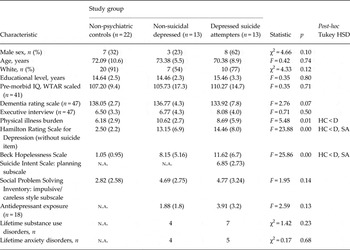
A total of 48 participants aged 46–90 years completed the study: 26 individuals with major depression (13 with and 13 without history of suicide attempt) and 22 healthy controls. All participants provided written informed consent. The University of Pittsburgh institutional review board approved the study. Their demographic, clinical and cognitive characteristics are described in Table 1.
Demographic, clinical and cognitive characteristics

Data are given as mean (standard deviation) unless otherwise indicated.
HSD, Honestly significant difference; IQ, intelligence quotient; WTAR, Wechsler Test of Adult Reading; HC, healthy controls; D, depressed non-suicidal; SA, suicide attempters; n.a., not applicable.
Major depression was diagnosed by the Structured Clinical Interview for DSM-IV Axis I Disorders (SCID) (First et al. Reference First, Gibbon and Williams1995). We excluded individuals with a diagnosis of clinical dementia and/or a score of less than 24 on the Mini-Mental State Examination. Further details on the recruitment of participants and exclusion criteria can be found in the online Supplementary method.
Of the suicide attempters that had engaged in self-injurious act with an intent to die, five had made their first suicide attempt before 50 years of age, two after 50 years of age and six after 60 years of age. Medical seriousness of attempts was assessed using the Beck Lethality Scale (Beck et al. Reference Beck, Beck and Kovacs1975); for participants with multiple attempts, data for the highest-lethality attempt are presented. The suicidal intent of the suicide attempt was measured with Beck's Suicide Intent Scale (SIS; Beck et al. Reference Beck, Shuyler, Herman, Beck, Resnik and Lettieri1974) (mean = 17.42; s.d. = 5.53). The SIS-planning subscale (Mieczkowski et al. Reference Mieczkowski, Sweeney, Haas, Junker, Brown and Mann1993) was used to assess the degree of planning of suicide attempts (mean = 6.85, s.d. = 2.73). A study psychiatrist (A.Y.D. or K.S.) verified a history of suicide attempts, based on the interview, medical records, and information from family members and friends. We excluded participants with significant discrepancies between these sources.
Non-suicidal depressed patients had no current or lifetime history of suicide attempts or suicidal ideation as established by clinical interview, review of medical records, SCID and the Scale for Suicidal Ideation. Participants were excluded from this group if they had a current passive death wish or a history of indirect self-destructive behaviors.
Non-depressed controls were included as the benchmark group. They had no lifetime history of any psychiatric disorder as determined by the SCID.
Clinical and cognitive assessments used to characterize the study groups are described in detail in the online Supplementary method.
Impulsivity, social problem solving and attempt-related impulsivity
Impulsivity is a multifaceted construct (Sharma et al. Reference Sharma, Markon and Clark2013). In this study, we used a self-report measure sensitive to the aspects of trait impulsivity involved in suicidal behavior. The impulsive/careless style subscale of the Social Problem-Solving Inventory (SPSI-ICS) (D'Zurilla & Nezu, Reference D'Zurilla and Nezu1990; Gibbs et al. Reference Gibbs, Dombrovski, Morse, Siegle, Houck and Szanto2009) measures a narrow and hurried approach to social problem-solving situations.
The degree to which suicide attempts were planned (SIS-planning) captures preparation, premeditation, isolation, timing and precautions against discovery (Mieczkowski et al. Reference Mieczkowski, Sweeney, Haas, Junker, Brown and Mann1993). Our past research indicated that the planning of suicide attempts in the elderly is inversely related to the willingness to wait for larger rewards on a delay discounting task (Dombrovski et al. Reference Dombrovski, Szanto, Siegle, Wallace, Forman, Sahakian, Reynolds and Clark2011) and to paralimbic expected value signals (Dombrovski et al. Reference Dombrovski, Szanto, Clark, Reynolds and Siegle2013). In the larger sample of suicide attempters, the SIS-planning subscale was found to be moderately correlated with the SPSI self-report measure of impulsivity.
Discounting task (modified from Wittmann et al. Reference Wittmann, Leland and Paulus2007)
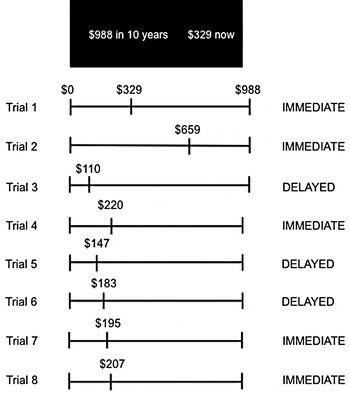
On each trial, participants chose between an immediate smaller monetary reward and a larger delayed monetary reward. The delayed amount was presented in six possible delay conditions (5 days, 30 days, 90 days, 365 days or 1 year, 1095 days or 3 years, 3650 days or 10 years), blocked. The delayed amount remained constant (mean = $1000) within a block but varied between blocks (range $976–$1020) to prevent stereotyped responding. The immediate amount was titrated to the participant's indifference point (Wittmann et al. Reference Wittmann, Leland and Paulus2007), i.e. the magnitude of the smaller immediate reward (SIR) equivalent in value with the delayed discounted reward (DDR). This was done by re-specifying the lower and upper limits for the immediate prospect based on participants’ actions as follows (Fig. 1). Initially, the interval between $0 and the delayed prospect (e.g. $1020) was divided into three parts. On the first trial, participants were presented with an immediate prospect with 1/3 magnitude of this interval ($340) and on the second trial with 2/3 magnitude of this interval ($680). If the participant: (1) rejected the first and second options, the upper interval was used ($680–$1020); (2) rejected the first but accepted the second option, the middle interval was used ($340–$680); (3) accepted both first and second options, the lower interval was used ($0–$340). In the trials that followed, the range of the immediate prospect continued to narrow. Participants completed eight choices within each block, for a total of 48 trials.
Illustration of the incremental narrowing of the interval for smaller immediate reward choice as a function of participants’ choices.

The task necessitates making increasingly more difficult decisions based on computations that incorporate both magnitude and time into subjective value representations. The degree to which individuals value immediate v. delayed rewards, i.e. discounting, has been shown to be trait-like, stable within subjects, and scale with impulsivity (De Wit et al. Reference De Wit, Flory, Acheson, McCloskey and Manuck2007; Kable & Glimcher, Reference Kable and Glimcher2007; Peters & Büchel, Reference Peters and Büchel2009; Miedl et al. Reference Miedl, Peters and Büchel2012). For a given delay and a delayed reward of constant magnitude, more impulsive individuals tend to favor SIRs before expressing preference for the delayed amount, resulting in an indifference point that is lower than for less impulsive individuals.
Data acquisition
Imaging data were collected with a 3-T Siemens Trio Tim scanner located in the MR Research Center at the University of Pittsburgh. For functional image alignment we used a T2*-weighted image depicting blood oxygenation level-dependent (BOLD) contrast (repetition time = 1250 ms, echo time = 28 ms, field of view = 24 cm, flip = 60, 27 4 mm slices). Stimulus presentation and response recording were controlled using E-Prime 2.0 software (Psychology Software Tools, Inc., 2002).
Image preprocessing
Functional images were preprocessed using tools from AFNI (Cox, Reference Cox1996) and the FMRIB software library (FSL; Smith et al. Reference Smith, Jenkinson, Woolrich, Beckmann, Behrens, Johansen-Berg, Bannister, De Luca, Drobnjak, Flitney, Niazy, Saunders, Vickers, Zhang, De Stefano, Brady and Matthews2004). Functional volumes were aligned to the mean functional image using the FSL MCFLIRT program with sinc interpolation, and head motion parameters were estimated. Volumes with scan-to-scan movement over 0.7 mm in any dimension were censored from analyses (<2%). Next, slice-timing correction was performed using FSL slicetimer. Non-brain voxels were removed from functional images by masking voxels with extremely low intensities and by a brain-extraction algorithm implemented in FSL's BET. Anatomical scans were registered to the Montreal Neurological Institute (MNI) 152 template (Fonov et al. Reference Fonov, Evans, McKinstry, Almli and Collins2009) using both affine transformation (FSL FLIRT) and non-linear deformation (FSL FNIRT). The alignment of functional images to each subject's anatomical scan was computed using the white matter segmentation of each image and a boundary-based registration algorithm (Greve & Fischl, Reference Greve and Fischl2009). Functional scans were then resampled into 3 mm-isocubic voxels and warped into the MNI152 template's space using the concatenation of the functional–structural and structural–MNI152 transforms. Images were spatially smoothed using an 8 mm full-width at half-maximum kernel (FSL SUSAN). A 0.008 Hz temporal high-pass filter was then applied to remove slow-frequency-signal changes. Finally, images were normalized to a global-median intensity of 10 000 to allow for comparability of parameter estimates across subjects.
Data analysis
Single-subject analyses employed AFNI's 3dDeconvolve. To verify the presence of robust task-related activation, we contrasted task performance v. fixation by including an event regressor with a duration from the onset of reward options to the time of response (online Supplementary results). Two other models, described below, used parametric modulators convolved with response times.
Model 1: value difference
One approach to modeling value is to assume hyperbolic discounting and calculate the difference between the SIR and the DDR for each trial, the latter being the subject's indifference point. This is appropriate for designs where trials with different delays are interleaved. In the current design, however, the trials were blocked by delay, resulting in the poor fit of the hyperbolic model. This led us to choose a modeling approach free of assumptions about hyperbolic discounting and equivalence of discount rates across blocks. We offer further illustrations of these issues and also describe converging findings from the conventional modeling approach in the online Supplementary method.
Our value difference model included the following regressors: SIR, mean-centered for each block to account for between-block differences, as well as the block mean of SIR. Conceptually, the mean-centered SIR regressor captured trial-wise variation in relative value within each block. Higher values of the mean-centered SIR indicated that the immediate prospect dominated (relatively higher value of SIR), while lower values indicated that the delayed prospect dominated (relatively higher value of larger delayed reward). The block mean represented the between-block variation in value differences, or block-wise scaling parameter of value. Since the SIR was titrated to the subject's indifference point, the block mean also approximated the value of delayed reward. Thus, the inclusion of both of these regressors permits disaggregation of within- and between-block effects of relative value on the neural response (for a related discussion of mean-centering to separate within- v. between-cluster variance in longitudinal models, see Curran & Bauer, Reference Curran and Bauer2011). Delayed reward was constant and was thus not included in the model.
The performance of the value difference model was compared with the traditional model. While the parametric maps for these two models were qualitatively the same, we report the more robust findings from the value difference model. Note that by not incorporating choices, our approach also maintains the separation between value-related computations and subject's behavioral policy on the task, which may not always coincide.
Model 2: longer v. shorter delays
The longer v. shorter delays model contrasted the blocks with longer (>365 days) delays v. shorter (⩽365 days) (adapted from Wittmann et al. Reference Wittmann, Leland and Paulus2007).
Each of the regressors was convolved with the canonical SPM5 double-gamma hemodynamic-response function. The voxelwise BOLD signal was regressed on these estimates in the single-subject analyses using AFNI's 3dDeconvolve (Cox, Reference Cox1996).
For group comparisons we used AFNI's 3dRegAna to regress the β weights against predictors that included depression, history of suicide attempts and age (we verified that results were the same with and without co-varying for age). Results from these analyses were additionally verified by pairwise t test comparisons.
The cluster threshold for whole-brain analysis was set with Monte Carlo simulations based on the residual spatial smoothness of the maps using AFNI's 3dFWHM and 3dAlphaSim programs (Forman et al. Reference Forman, Cohen, Fitzgerald, Eddy, Mintun and Noll1995; Cox, Reference Cox1996) (p voxelwise < 0.001, 22 voxels, yielding p corr < 0.05). Data from surviving clusters were extracted for further functional region of interest analyses. We used the Talairach–Tournoux Atlas for region identification.
Further, where multiple clusters were indexed by group analyses, we identified inter-correlated networks to reduce dimensionality and control type I error. These networks were identified through principal components analyses (using oblique promax rotation to allow for intercorrelation among components) on the cluster-wise β coefficients from single-subject models. We used scree plots to find the number of networks that best accounted for cluster-wise variance in β coefficients.
Ethical standards
All procedures contributing to this work comply with the ethical standards of the relevant national and institutional committees on human experimentation and with the Helsinki Declaration of 1975, revised in 2008.
Results
Behavioral data are reported in the online Supplementary results.
Main effect of task
Task performance compared with fixation elicited a robust activation of visual areas, thalamus, striatum, and lateral frontoparietal and cingulo-opercular networks. The details and the correlations with task performance are included in the online Supplementary results.
Value difference
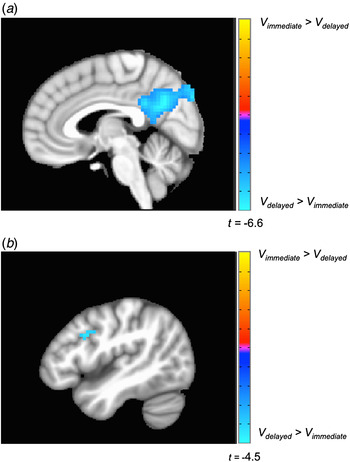
In the entire sample, value difference favoring the delayed option elicited BOLD activity in the bilateral precuneus [Brodmann area (BA) 7] extending into the PCC (BA 30–31), shown in Fig. 2a . No regions responsive to value differences favoring the immediate option were found at the pre-defined threshold. However, at the lower voxelwise threshold of p < 0.005 (p corr < 0.05), we observed activations in the right dorsolateral PFC (online Supplementary results). We performed an additional analysis with trial difficulty (online Supplementary results), determined by how close the two prospects were in subjective value, and found that the response in the precuneus region was greater to easier choices. Hence, the precuneus appears to respond more as delayed prospect increases in subjective value.
(a) Blood oxygen level-dependent response in the whole sample to value difference in the precuneus [Brodmann area (BA) 7]/posterior cingulate cortex (BA 30–31) at p voxelwise < 0.001, p corr < 0.05 [Montreal Neurological Institute (MNI) coordinates: −1, −61, 30; cluster volume = 28 764 mm3; peak t 47 = −6.66]. (b) History of suicide attempts predicted a diminished response of the left dorsolateral prefrontal cortex (BA 9) to the increasing value difference favoring smaller immediate reward (MNI coordinates: −48, 10, 35; cluster volume = 1107 mm3; peak t 44 = −4.60). These findings held when the data were analysed using an alternate model of value difference (see online Supplementary results for more details).

Group comparisons
History of suicide attempts predicted a diminished response of the left dorsolateral PFC (BA 9) to the increasing value difference favoring SIR (Fig. 2b ).
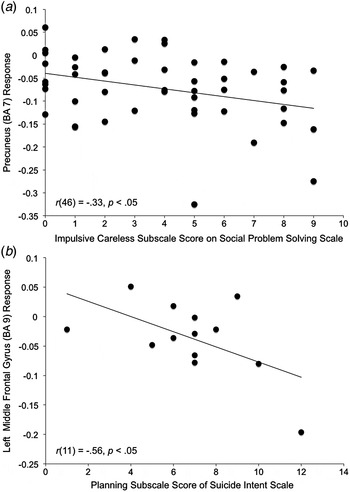
The extent of this alteration was greater in patients with better-planned suicide attempts, measured by the SIS-planning subscale (r 11 = −0.56, p < 0.05) (Fig. 3b ). These findings held when the data were analysed using an alternate model of value difference (see online Supplementary results for more details).
(a) Correlation between impulsiveness/carelessness style subscale scores on the Social Problem Solving scale and activity in the precuneus [Brodmann area (BA) 7] derived from the value difference map. (b) Correlation between Suicide Intent Scale-planning and activity in the left dorsolateral prefrontal cortex (BA 9) derived from the value difference map.

Correlations with impulsivity measures
A negative association of precuneus/PCC response with the SPSI-ICS subscale (r 46 = −0.33, p < 0.05) suggested that in the more impulsive individuals this region that prospects favoring the delayed option elicited greater negative responses (Fig. 3a ). No other relationships, i.e. with geometric mean of the delay discounting parameter or degree of attempt planning, were significant.
Tracking value of choices with longer (>1 year, 1) v. shorter (⩽1 year, 0) delays
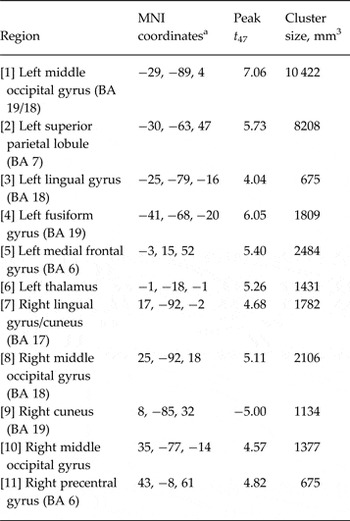
Analyses in the entire sample identified 11 regions responsive to delays >1 year (summarized in Table 2 and illustrated in online Supplementary results).
BOLD response to longer (>1 year) v. shorter delays (⩽1 year) contrast

BOLD, Blood oxygen level-dependent; MNI, Montreal Neurological Institute; BA, Brodmann area; TLRC, Talairach–Tournoux.
a We used the TLRC Atlas and the corresponding TLRC coordinates of the peak voxel to identify the region.
Principal components analysis of cluster-wise individual β coefficients identified four distinct networks of regions activated by longer v. shorter delays contrast. Longer delays were associated with increases in BOLD signal in visual [right lingual gyrus, right and left middle occipital gyrus (BA 18 and 19)], visual attention [left lingual gyrus (BA 18), thalamus, left fusiform gyrus (BA 19)] and motor/somatosensory [left superior parietal lobule (BA7), right precentral (BA 6), left medial frontal gyrus (BA 6)] networks, and with a diminished response in the right cuneus (BA 19). There was a modest positive correlation between the activity in the right cuneus and the geometric mean of the discount rate (r 46 = 0.30, p < 0.05), with more diminished responses for greater discounters (see online Supplementary results for the illustration). The responses in these networks did not correlate with the impulsivity measures.
Group comparisons
History of suicide attempts was associated with the deactivation of the left parahippocampal gyrus (BA 35; MNI coordinates: −24, −26, −16; cluster volume: 594 mm3; t 44 = −4.36) and the left middle occipital gyrus (BA 37; MNI coordinates: −47, −66, −13; cluster volume: 1485 mm3; t 44 = −5.86) to trials with longer delays.
Sensitivity analyses
Group differences for both models (value difference signals in the left dorsolateral PFC and longer v. shorter delay signals in the parahippocampal and left middle occipital gyri) were robust to the effects of possible brain damage from suicide attempts, burden of physical illness, depressive severity, co-occurring substance use and anxiety disorders, exposure to antidepressants, opioids and sedatives, lifetime exposure to electroconvulsive therapy, global cognitive functioning, variability in pre-morbid intelligence, and sex. No covariates were significant. We report the statistical results of these analyses in the online Supplementary results.
Discussion
We investigated the functioning of neural systems that may underlie suicide attempters’ myopia for future outcomes and the ability of some to delay gratification, as participants expressed their preferences for smaller immediate or larger delayed rewards. Choices on this task reflect subjective value comparisons that take into account both magnitude of the reward and its time of delivery (Frederick et al. Reference Frederick, Loewenstein and O'Donoghue2002). Consistent with earlier studies (Kable & Glimcher, Reference Kable and Glimcher2007; Sripada et al. Reference Sripada, Gonzalez, Phan and Liberzon2011; Manning et al. Reference Manning, Hedden, Wickens, Whitfield-Gabrieli, Prelec and Gabrieli2014), the paralimbic cortex (precuneus/PCC) was recruited as the larger delayed rewards increased in value. Additional analyses with trial difficulty suggested that the precuneus appears to respond more as delayed prospects increase in subjective value (thereby reflecting increasingly easier choices). The paralimbic response also scaled with impulsivity: greater difference in PCC responses between earlier and later prospects was seen in the more impulsive individuals. The dorsolateral PFC tracked the value difference for smaller immediate > larger delayed rewards, albeit only at a lower threshold. Unexpectedly, suicide attempts, particularly those that were well-planned, were associated with deactivation of the dorsolateral PFC in response to increasing value of immediate choices. In addition, an exploratory contrast of blocks involving longer v. shorter delays identified visual, attentional and motor/somatosensory networks, partially replicating earlier reports (Wittmann et al. Reference Wittmann, Leland and Paulus2007). Suicide attempters displayed deactivation in the parahippocampal and occipital cortices when a decision had to be made between rewards more than 1 year apart or, alternatively, activation in these regions was higher when a decision had to be made between rewards 1 year or less apart.
Our predictions focused on regions in the valuation and cognitive control networks because altered functioning of these regions has been linked with suicidal behavior (Ernst et al. Reference Ernst, Mechawar and Turecki2009; van Heeringen & Mann, Reference Van Heeringen and Mann2014). Our findings are consistent with the previously observed relationship between individual differences in self-reported trait impulsivity and those in paralimbic representations of subjective value during the discounting performance (Kable & Glimcher, Reference Kable and Glimcher2007; Peters & Büchel, Reference Peters and Büchel2011; Sripada et al. Reference Sripada, Gonzalez, Phan and Liberzon2011). Specifically, in the present study, trait impulsivity predicted greater negative responses of the precuneus/PCC as value difference increasingly favored the delayed prospect. This region was previously found to track the subjective value of intertemporal prospects (Kable & Glimcher, Reference Kable and Glimcher2007; Sripada et al. Reference Sripada, Gonzalez, Phan and Liberzon2011). As shown by Kable & Glimcher (Reference Kable and Glimcher2007), impulsive individuals displayed steeper neurometric discounting curves than the more patient individuals. This was reflected in greater difference in PCC responses between earlier and later prospects in the impulsive than the more patient individuals. The current result is also consistent with our earlier report of blunted learned value signals in the paralimbic cortex (vmPFC and PCC/precuneus) of suicide attempters, particularly those with poorly planned attempts, and individuals high in trait impulsivity during a probabilistic reversal learning task (Dombrovski et al. Reference Dombrovski, Szanto, Clark, Reynolds and Siegle2013). Associations between impulsivity and responses to value difference during this task may be interpreted as a suboptimal integration of temporal information in the valuation network (Bechara et al. Reference Bechara, Dolan and Hindes2002; Miedl et al. Reference Miedl, Peters and Büchel2012).
Value-based choices are also known to be modulated by the regions in the cognitive control network, i.e. lateral PFC (Hare et al. Reference Hare, Camerer and Rangel2009), which also encodes decision-related information (Wallis & Miller, Reference Wallis and Miller2003; Kennerley & Wallis, Reference Kennerley and Wallis2009). This modulation has sometimes been described as top-down control that allows individuals to maintain and pursue goals (Wesley & Bickel, Reference Wesley and Bickel2014), for example, by continuing to choose a larger delayed reward, in spite of the relative increases in the value of the SIR. Although our findings are preliminary given the small sample size, this perspective suggests that altered representations of decision-related variables in the lateral PFC may underlie some aspects of anomalous decision making in suicide attempters. In the present study, a high level of premeditation was paralleled by reduced dorsolateral PFC responses to relative increases in value favoring immediate prospect. This result is consistent with our earlier behavioral finding that immediate rewards had less of an incentive value for individuals with a history of premeditated suicidal behavior (Dombrovski et al. Reference Dombrovski, Szanto, Siegle, Wallace, Forman, Sahakian, Reynolds and Clark2011). It has been suggested that the dorsolateral PFC influences difficult choices, which require self-control (Hare et al. Reference Hare, Camerer and Rangel2009; Cho et al. Reference Cho, Ko, Pellecchia, Van Eimeren, Cilia and Strafella2010; Figner et al. Reference Figner, Knoch, Johnson, Krosch, Lisanby, Fehr and Weber2010; Manning et al. Reference Manning, Hedden, Wickens, Whitfield-Gabrieli, Prelec and Gabrieli2014). For example, Manning et al. (Reference Manning, Hedden, Wickens, Whitfield-Gabrieli, Prelec and Gabrieli2014) demonstrated increased prefrontal activity during rational choices that are contrary to one's dispositional tendencies. This was true among highly conscientious individuals who choose the immediate option. Further, extending behavioral evidence that the ability to delay gratification relies on cognitive control, dorsolateral PFC substrates of working memory and temporal discounting overlap, which points to its more general role in self-control and pursuit of goals (Wesley & Bickel, Reference Wesley and Bickel2014).
One factor at play in a suicidal crisis may be the individual's inability to represent personal future (Yufit et al. Reference Yufit, Benzies, Fonte and Fawcett1970; Brockopp, Reference Brockopp1971; Greaves, Reference Greaves1971; Baumeister, Reference Baumeister1990; Williams et al. Reference Williams, Ellis, Tyers, Healy, Rose and Macleod1996). The contrast of prospects with longer v. shorter delays revealed deactivation in the parahippocampal region in suicide attempters. The parahippocampal gyrus is implicated in spatial navigation (Aguirre et al. Reference Aguirre, Detre, Alsop and D'Esposito1996) but also in prospection, or mental representation of the future, and autobiographical memory (Spreng & Grady, Reference Spreng and Grady2010). The blunted parahippocampal response to remote prospects may, therefore, represent a neural substrate of impaired prospection in suicidal individuals, (Schacter et al. Reference Schacter, Addis and Buckner2007; Peters & Büchel, Reference Peters and Büchel2010, 2011), potentially undermining the deterrents and alternative solutions during the suicidal crisis. Noteworthy, reduced specificity of autobiographical memories, as a consequence of retrieval difficulties, has been linked to diminished problem-solving abilities (Arie et al. Reference Arie, Apter, Orbach, Yefet and Zalzman2008) and, separately, to suicidal behavior (Williams et al. Reference Williams, Ellis, Tyers, Healy, Rose and Macleod1996).
The main limitations of our study are the small sample size and cross-sectional case–control design. Independent of these limitations, our ability to rule out potential confounders (global cognitive function, depressive severity, medication exposure and possible brain injury from suicide attempts), as well as, replication of main neuroimaging findings using different modeling approaches add confidence in the findings.
In conclusion, our small cross-sectional case–control study uncovered three patterns of neural responses potentially underlying altered decision processes in suicidal behavior. First, suicide attempts, particularly better-planned ones, were associated with a lack of modulation of the dorsolateral PFC by increasing subjective value of immediate rewards. Second, paralimbic (precuneus/PCC) responses to value difference favoring the delayed option scaled with trait impulsivity, reflecting the individual differences in the steepness of discounting curves for subjective value. Finally, we found diminished parahippocampal responses in suicide attempters to temporally remote prospects, which we interpreted as evidence of altered prospection. Taken together, these findings suggest that distinct alterations in the way time is integrated into decision making in the brain may mark different cognitive pathways to suicidal behavior.
Supplementary material
For supplementary material accompanying this paper visit http://dx.doi.org/10.1017/S0033291715001890
Acknowledgements
Support for this research comes from K23MH086620, K23MH070471, 5R01MH085651, P30MH90333, P60MD000207, UL1RR024153 and UL1TR000005 from the National Institute of Mental Health, John A. Hartford Foundation, American Foundation for Suicide Prevention, and the University of Pittsburgh Medical Center (UPMC) Endowment in Geriatric Psychiatry, the US Department of Veterans Affairs (S.D.F.)
Mandy Collier, B.S. contributed to data collection and Jonathan Wilson, B.S. provided help with processing. Swathi Gujral, B.S., Natalie Truty, B.S. and Cori Shollenberger, B.S. assisted with recruitment and assessments. Joshua Feldmiller, B.S. assisted with database coordination.
Declaration of Interest
C.F.R. reports receiving pharmaceutical support for National Institutes of Health (NIH)-sponsored research studies from Bristol-Myers Squibb, Forest, Pfizer and Lilly; receiving grants from the National Institute of Mental Health, National Institute on Aging, National Center for Minority Health Disparities, National Heart Lung and Blood Institute, Center for Medicare and Medicaid Services (CMS), Patient Centered Outcomes Research Institute (PCORI), the Commonwealth of Pennsylvania, the John A Hartford Foundation, National Palliative Care Research Center (NPCRC), Clinical and Translational Science Institute (CTSI) and the American Foundation for Suicide Prevention; and serving on the American Association for Geriatric Psychiatry editorial review board. He has received an honorarium as a speaker from MedScape/WEB MD. He is the co-inventor (Licensed Intellectual Property) of Psychometric analysis of the Pittsburgh Sleep Quality Index (PSQI) PRO10050447 (PI: Buysse).