Introduction
Towards the end of the nineteenth century, colonial cities in Asia underwent substantial transformation, as their municipal councils, which had been established across the empire since the 1870s to run local affairs,Footnote 1 strove to introduce modern technologies and utilities as far and as quickly as their budgets permitted. Gas lighting, piped water, and sewage systems were introduced successively in all major cities. Above all, however, urban modernization meant electrification. Electricity, where it appeared, had a tremendous impact upon the structure of the cities and social life within them. It came in two main forms: as lighting and as the driving power for motors and engines. The brilliance of the electric lights once again widened the nocturnal spaces of the people. These spaces, which initially had been created by the gas lanterns, were filled with night markets and fairs, but also with illicit pastimes such as gambling or betting. In factories and workshops, electric light increased safety, but it also made work at night possible, which is why workers occasionally objected to its installation.Footnote 2 Those who could afford it in their private homes often used electricity as a means to display their affluence and status. In Singapore, for instance, the first building to have electricity installed was the residence of the Governor of the Straits Settlements, but when it became available in the centre of the city, Chinese businessmen were quick to have their homes connected too.Footnote 3
The second manifestation of electricity in colonial cities was as a driving power. The electricity supply companies, which normally worked under concessions obtained from the municipalities, had to run their generators all day, but as lighting was required only at night, an outlet for daytime consumption had to found. The tramways, which offered themselves as a way to create further revenues for the companies, perhaps had an even bigger impact upon colonial cities than electric lighting. They not only rearranged the spatial structure of a city by interconnecting its quarters, linking suburbs to the centre, and occasionally even creating new suburban settlements at the urban periphery, they also re-evaluated urban quarters and, most importantly, they provided a cheap, quick, and clean means of transport to the people. Because of this, people soon began to see trams as vehicles of modernity, the use of which became indispensable for everyone who wanted to be up to date.Footnote 4 In consequence, wherever trams began to roll, an ever-increasing number of people travelled on them and with increasing frequency.Footnote 5 In this way, the tramways created the urban transport revolution of the late nineteenth and early twentieth centuries. Given the importance of electricity in general and the tramways in particular in the everyday life of colonial cities, it is astonishing to find that both have received relatively little attention so far. Urban histories often gloss over them or ignore them altogether,Footnote 6 and since few of the original companies survive today, company histories are similarly rare.Footnote 7 It was left to a handful of tramway enthusiasts to collect whatever evidence survived and preserve the memory of the electricity and tramway companies of some of the colonial cities.Footnote 8
Given this unsatisfactory state of research, this paper will analyze and compare the history of the tramways in Singapore and Rangoon. Located in two cities that are similar (and therefore comparable) to each other in more than one respect, the companies developed in a broadly contrasting manner. While the Rangoon Electric Tramway Company (RETCo) became an economically successful enterprise, serving as a medium of mass transport in Rangoon until its throttling in the course of the Second World War, the Singapore Electric Tramways Company (SETCo) ran into financial difficulties within two decades of its establishment. Eventually, it was wound up and taken over by the Shanghai Tramways Company, which agreed to replace trams with trolley-buses and began to remove the tracks from the streets of Singapore immediately after taking over operations. While the case of Rangoon thus followed the general trend of tramway companies around the world and attracted the local population to travel their city in large numbers, the failure of the Singapore Electric Tramways Company defies this trend and will have to be explained.
The advent of the trams
The cities of Singapore and Rangoon were designed and built in the course of the nineteenth century to serve as local administrative and economic centres of the empire. Both were laid out on a chessboard pattern of streets, the centre of which was occupied by buildings of the colonial administration and major businesses. Their social topography followed this colonial design, as the ‘native’Footnote 9 population (including the various groups of immigrants) were allocated to segregated quarters and villages. Singapore's Chinatown bordered the southern fringe of the business district, while the Indian quarter (Dhobi Ghaut) was located on the opposite side of the city, next to the Malay kampong (village), which was situated even further away from the city centre. The European bungalow area initially spread out in the immediate hinterland of the city on its western side (Tanglin district), before it expanded further west into the interior of the island in the second half of the nineteenth century. In Rangoon, the Sule Stupa was singled out as an easily recognizable landmark and focal point of the street grid. Further constructions, such as the Town Hall and the High Court buildings, added to the prominence of the space round the Sule Stupa, while other buildings belonging to the colonial administration were erected in the quarters on the east side of the city. The quarters west of the Sule Stupa housed Chinatown and Little India. Like Singapore's Malay kampong, the Burmese village of Rangoon, Kemmendine (Kyimindaing), was pushed to the urban periphery. It was separated from the city by a band of European bungalow compounds stretching from the banks of the Rangoon river in the west (Ahlone quarter) to Golden Valley, the colonial idyll on the north side of the Shwedagon Stupa.
At the end of the nineteenth century, the two cities were not only similar in layout and importance, but were also inhabited by a population comparable in size and ethnic diversity. For most of the century, Singapore was eclipsed by Penang in terms of economic and political importance, until at the end of the nineteenth century, Singapore rapidly began to overtake its rival. Rangoon's relative backwardness resulted from the peripheral position it held within British India. Burma had been made a province of British India mainly as a matter of convenience and expediency, but its main links to the subcontinent were almost exclusively economic, namely Burma's exports in petroleum and rice to India, and the migration of Indian labourers that came along with Burma's economic exploitation. The massive expansion of rice production in Lower Burma during the second half of the nineteenth century then increased the importance of Rangoon through its rice-mills and port facilities.Footnote 10 While huge amounts rice were shipped through the port, an equally large number of mainly Indian immigrants arrived, consisting of clerks and other educated middle class Indians on the one hand and seasonal workers (coolies) on the other.
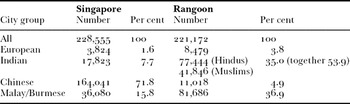
The Census of 1901 returned approximately 221,000 inhabitants for Rangoon and 229,000 for Singapore.Footnote 11 Both populations were ethnically heterogeneous, as Table 1 shows, and it also reveals several further similarities between the two cities. First, the people who might be considered natives—the Burmese in Rangoon, the Malays in Singapore—were a minority in their home towns (this situation was further exacerbated by the above-mentioned marginality of their settlements at the fringe of the respective cities). The Europeans were in a similar minority position, though the distinctiveness of their residential quarters was, unlike that of the Burmese or Malays, a self-chosen segregation. Both the Europeans and natives were outnumbered by immigrant communities, the Chinese in the case of Singapore and the Indians in the case of Rangoon, who made up more than 50 per cent of each city's population.Footnote 12
Ethnic composition of citizens in Singapore and Rangoon

Sources: Walter Makepeace et al. (eds), One Hundred Years of Singapore (London: J. Murray, 1921), Vol. 1, pp. 358–60; Spate and Trueblood, ‘Rangoon’, p. 60.
By the time electricity and electric trams made their appearance, both cities could look back upon a brief history of public transport by way of steam trams. In Singapore, two lines, together six miles in length and inaugurated in 1886, linked the docks of Tanjong Pagar to the business district and Johnston Pier (the passenger port), ultimately extending as far as the Malay and Indian quarters in the north of the city.Footnote 13 The main purpose of the line was apparently to transport goods from the harbour to the warehouses, which lined the banks of the Singapore River, but it also catered for passengers and their luggage. By concentrating on freight transport, the line was intended to offer an alternative to the small, shallow-draft boats owned by Chinese boatmen, who had more or less monopolized the carrying business between the port and the river.Footnote 14 The boatmen, however, proved cheaper and more flexible than the trams, and accompanied by complaints about the noise, soot, and sparks emitted by their engines, the steam trams were decommissioned in 1894.Footnote 15 The Rangoon steam trams enjoyed a slightly longer period of existence. The company was founded in 1883 by John W. Darwood, the son of an entrepreneurial family from Moulmein, which had moved to Rangoon after the second Anglo-Burmese war. Darwood started his career by trading in wood, but he soon moved into the transport business, running Rangoon's largest horse stable.Footnote 16 Having obtained the concession for the steam tramway, he offered services on three short lines in early 1884. In 1889, Darwood sold what appears to have been a successful business to the Calcutta Steam Tramway Company, but soon thereafter complaints about public health and safety similar to those heard in Singapore were raised, and when the company failed to redress them, the municipality eventually revoked the concession in 1899.Footnote 17 At this point Darwood stepped in and repurchased his former business with the promise to convert it to electric traction.
Meanwhile, one of the European consortia eager to find new investment opportunities in the colonies had formed the Singapore Electric Tramways Company, which was registered in London in 1901. Its agent obtained a 35-year concession from the Municipal Commission of Singapore to supply electricity to the city and operate a tramway. The company immediately began to construct a power station and lay the tracks, and in December 1905 the first tramcar, warmly greeted by the public, commenced services between Tanjong Pagar and Rochore.Footnote 18 Five more lines followed, connecting the city centre with the residential quarters and leisure facilities along Singapore's east coast, the railway station on Tank Road (built in 1902), and the dockland in the south. To facilitate the flow of its traffic, the company even agreed to contribute ten per cent of the cost of the newly built Anderson Bridge, which opened in 1910, for the right to lay tracks across the bridge.Footnote 19 At the height of its operation, the track network of the Singapore Electric Tramways Company amounted to some 16 miles, serving around 40 miles of urban roads.Footnote 20
Like all modern technologies, tramways were not universally considered to be useful amenities. Bigger, stronger, and quicker than any other vehicle on the street (even though motorcars had also made their first appearance in Asian cities by the time the trams arrived),Footnote 21 and above all confined to the tracks and therefore unable to evade collisions, they were also seen as a potential danger by many citizens.Footnote 22 Anxieties were understandably greatest among those most likely to lose out economically. In Singapore, these were the Chinese rickshaw-pullers, numbering between 15,000 and 20,000 men, who formed the backbone of the public transport system at the time.Footnote 23 The rickshaw coolies were constant victims of abuse and exploitation by their passengers, by the rickshaw owners, and by the municipality as well; the latter regularly fined individual pullers for reckless driving, neglect or even for the refusal to ‘take a fare’.Footnote 24 To the rickshaw coolies, the tramways were an unwanted competitor, and they consequently resisted the tramcars in various ways. Initially, they tried to derail them by placing stones on the tracks,Footnote 25 but after several of the culprits had been handed out heavy fines by the magistrates, the rickshaw coolies resorted to less expensive (and less dangerous) forms of resistance, mainly by pulling their ‘ricks’ so slowly along the tracks that trams were forced to slow down and amble along. The Singapore Electric Tramways Company repeatedly complained to the police and the municipality about their behaviour.Footnote 26
In the course of time, however, this physical resistance turned into fierce economic competition, mainly fought by way of tariffs. Rickshaws were clearly slower and less comfortable than trams when it came to serving the suburbs or running over long distances, but they were much more flexible in getting around the city centre. Here, the pullers made every effort to retain their share of the customers, mainly by undercutting the Singapore Electric Tramways Company's fares, which, as a result, had to adjust its ticket prices on several occasions during the early years of its operation.Footnote 27 This in turn diminished the company's revenues and placed it in a vicious circle from which the company could not escape in the long run. It has been claimed that it was the competition with Singapore's ‘rickshaw interest’—the rickshaw owners and pullers combined—that was the major cause for the bankruptcy of the Singapore Electric Tramways Company, an argument to which this paper shall return later.
The Rangoon Electric Tramway Company began their operations almost exactly one year after the Singapore company. Again, the lines in downtown Rangoon mainly followed the routes established by the steam tram. One line connected the Shwedagon Stupa with the city and the inland ferry terminals, another line provided links to the docklands on Strand Road, the railway station, and Rangoon's major market, the Surattee Bazaar. The existing tracks were extended in two directions. One extension ran to the northwestern fringe of the city, to Ahlone, where the company's power station and car sheds were located, and proceeded to the Burmese village, Kemmendine. In the east, new tracks connected Monkey Point to the system, where the ferries across the river to Syriam ended, and then ran north to the terminus near the racecourse. At its height in the mid-1930s, the network comprised some 40 miles of predominantly double track.Footnote 28 Where the topography prevented the running of tramways, for instance in the hilly area north of the Shwedagon Stupa, motor buses from 1913 and, after 1931, trolley buses were employed. In the years before the Second World War, the latter gradually replaced trams in downtown Rangoon as well.
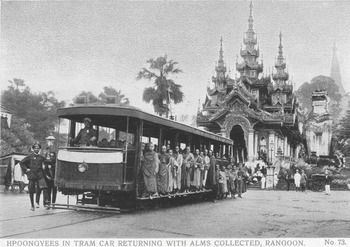
The network of tracks illustrates the Rangoon Electric Tramway Company's attention to the needs of the local population. The line to the Shwedagon Stupa, for instance, facilitated access to the religious monument for visitors, pilgrims, and street hawkers. Even monks used trams for their alms rounds, as a picture postcard from the early 1910s shows (see Figure 1 above). The racecourse also attracted crowds whenever it became the venue for horse races or polo matches.Footnote 29 The Strand Road line served all major docks and piers, both for inland water transport (an important feature in the deltaic region of Lower Burma) and overseas shipping. Along the Pazundaung River beyond Monkey Point, the tram passed by many of the city's major rice-mills besides serving the jetties to Syriam. This town, located on the opposite bank of the Pazundaung River, was home to Burma's two most important oil companies, the Burma Oil Company and the Asiatic Oil Company.
Buddhist monks at the Shwedagon Stupa terminus.

Not satisfied with meeting the needs of the Rangoon population by serving most of the city's residential, industrial, and religious sites, the Rangoon Electric Tramway Company went still further in its efforts to offer the best services to its customers. In 1909, a new trailer was taken into service to convey coffins and other funerary accoutrements of well-to-do citizens and Buddhist monks.Footnote 30 This car made headlines in Singapore as well, where the editor of the Free Press recorded that the Rangoon Electric Tramway Company had acquired the car due to public demand, describing it as a ‘handsome structure with Burmese carving surmounted with figures of the Seven Nats’.Footnote 31 On its trial run in November 1909, the car excited considerable interest and was well patronized thereafter. In Singapore, the report predictably resulted in several ‘Letters to the Editor’ proposing that the Singapore Electric Tramways Company provide the same service, but the company seemed to know its customers best and ignored the suggestions.
The tramways in operation
The resistance of the rickshaw-pullers in Singapore notwithstanding, the tramways created considerable public interest wherever they appeared. There is ample evidence for that interest in the reports and letter pages of local newspapers, as tramways came to be seen as symbols of modernity, being regularly referred to as the ‘most modern means of conveyance’ or examples of ‘up-to-date technology’.Footnote 32 As the case of the Rangoon funeral car demonstrates, trams were in fact not only conveyors of a modern way of living, but also purveyors of a modern way of dying. The image of a clean, swift, comfortable, and reliable mode of transport was one of the reasons why tramways could cause the ‘urban transport revolution’ mentioned above. This means that they could not only win over the passengers from the vehicles they replaced (namely the steam trams, horse trams or horse-drawn omnibuses), but they could also mobilize in considerable numbers people who had not used public transport previously. In addition, the trams induced customers to travel more frequently. As a result, the overall mobility of urban society increased substantially. However, while the Rangoon tramways complied with this general pattern, the case of Singapore presents an altogether different example.
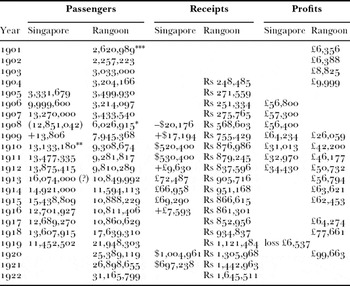
To begin with, Table 2 (see below) once again shows how tramways increased intra-urban mobility. In Singapore, the trams carried almost ten million people and this figure gradually increased. The main aim of the steam trams was to transport goods, but the trams were intended to transport people, thus diverting a good deal of the passenger traffic away from the rickshaws. The trams also created new passengers on routes to outlying quarters such as Rochore or by serving the emerging leisure facilities on the east coast.Footnote 33 There may have been an overall increase in people's mobility in Singapore, but most of the passenger traffic remained divided between the rickshaws and the trams. This was in contrast to Rangoon, where in their first year the electric trams almost doubled the passenger numbers of the steam trams; subsequently this figure increased steadily. The number of rickshaws on the streets of Rangoon was considerably lower than in Singapore,Footnote 34 so most of this growth was achieved in exactly the manner described previously, and trams indeed revolutionized Rangoon's inner-urban mobility. The second phenomenon that emerges from the data in Table 2 is the way in which the First World War affected the economic performance of the companies. In 1915, the last year in which the Singapore Electric Tramways Company's passenger numbers grew, it conveyed some 15 million people.Footnote 35 Thereafter, the figures more or less stagnated at around 13 million, a downturn from which the company never recovered. Business in Rangoon similarly stagnated during the war years, but it seems that the war only temporarily arrested growth, for the figures grew massively as soon as peace was restored. Already by 1918, the Rangoon Electric Tramway Company counted 21 million passengers, and in the 1930s its customers regularly exceeded 40 million people.Footnote 36
Passenger figures and receipts

* According to Arnold Wright, 20th Century Impressions of Burma (London: Lloyds, 1910), p. 302, in 1908 the Rangoon Electric Tramway Company had 7,839,164 passengers and earned Rs 745,834, although these seem to be the figures for 1909.
** According to the company's annual reports for 1908 and 1909, the increase in passengers for these years were 13,806 and 268,332 respectively (The Economist, 4 May 1910, p. 5; and 10 May 1911, p. 5), leading to 12,865,848 passengers in 1909 and 12,851,042 in 1908. The Administration Report of the Singapore Municipality for the Year 1912 (Singapore: Times Press, 1913), p. 7, gives a figure of 13,133,180 passengers for 1910.
*** ‘Rangoon Steam Tram 1901–04’, Manchester Guardian, 22 January 1906, p. 3 (net profits).
Although these figures are relatively easy to obtain, a social profile of tramway customers is harder to establish. Given that the trams were meant to facilitate mass transport, it seems natural to assume that the majority of the population would also form the bulk of the customers. Indeed contemporary newspaper reports suggest that this was the case. When the Rangoon business opened, it was said that traffic was ‘brisk all day, Burmese and other Asiatics [were] tremendously pleased with the new cars’.Footnote 37 The picture postcards mentioned above, showing schoolgirls and Buddhist monks, add further substance to the impression that the trams were popular and carried all classes of society. Similarly, it was noted that a ‘mixture of races’ rode on the trams in Singapore,Footnote 38 with the Chinese forming the bulk of the passengers.Footnote 39 Just as in Rangoon, children used the trams, even for their daily commute to school.Footnote 40
Although relying on the local population to patronize the trams may have made sense economically, it ran the risk of alienating European passengers. This would not have made much difference had the Europeans not dominated large segments of the public sphere. Through their various connections and control of the media—through the press, clubs, civic associations, and so on—they were able to create and spread a more negative image of the trams, which in the case of Singapore ultimately resulted in the European middle class shunning the trams.Footnote 41 Unlike the rickshaw-pullers, who objected to and obstructed the trams for economic reasons, the Europeans put safety concerns at the top of their list of complaints. The columns of the local press were full of reports and notices complaining about broken overhead wires, violations of speed regulations, and traffic accidents in which people or animals were injured.Footnote 42 These accusations were subsequently superseded by complaints of a more general nature, which concerned the behaviour of native passengers who smoked or put their feet on the seats,Footnote 43 or which denounced the tramcars as leaky, noisy, and dirty.Footnote 44 Instead, the Europeans opted for the motorcar which provided the virtues of modern mobility—speed, comfort, and freedom—without requiring them to interact with the natives. The motorcar made its appearance in Singapore towards the end of the nineteenth century and became the Europeans’ conveyance of choice. When the Singapore Automobile Club was formed in 1907, it was by and large an all-white association—the first owner of a motorcar in Singapore, the Sultan of Johore, was made an honorary member—and, with particular irony, J. H. Garratt, General Manager of the Singapore Electric Tramways Company, served as its Treasurer.Footnote 45
The way in which the trams were used and perceived by the Singaporean public illustrates that they did indeed serve as platforms on which issues of social status and race were fought over, represented by the questions of separate first and second class carriages, and front seats. In fact, finding a place to sit or not could itself prove to be an issue.Footnote 46 Observers noted several instances of the delight shown by Chinese men or members of the native classes at having a seat when Europeans had to stand.Footnote 47 The next issue to arise came with the establishment of first and second class fares. The company had initially planned to introduce three distinct classes, but found it impractical to make that system work on the trams.Footnote 48 As a result, the trams offered only two different classes, which could be used by any passenger paying the appropriate fare. The Europeans, however, felt that their special status had not been taken into proper consideration and demanded that a certain number of seats be reserved for them. This kicked off a lively debate in the columns of the local press,Footnote 49 in which numerous readers voiced their opinions, drawing on their experiences with tramway companies in other Asian cities such as Calcutta and Manila. A recurring theme was the demand that the two front benches be reserved for Europeans.Footnote 50
The Singapore Electric Tramways Company had little room to manoeuvre, as it needed both the patronage of the Europeans, who dominated public opinion, and the Chinese and other Asians who formed the bulk of their passengers. Moreover, it seemed dangerous to offend the Chinese, given that many of them had begun to nurture anti-Western attitudes as a result of events back in China.Footnote 51 To reserve seats for Europeans did not seem advisable therefore, but the initial arrangement was inadequate to contain the contest for status fought out on the cars. Occasionally, this contest became physical, involving insults and even violence. In one instance, a European tried to remove a Chinese passenger from his seat on the front bench by brute force. Though he failed to do so, the conductor threw the assailant out at the next stop and he was also subsequently tried and fined by the Magistrate's Court.Footnote 52 The collateral effect of the event was that the company began to experiment with higher-priced front seats on the most patronized sections of the route.Footnote 53 This could not, of course, bring an end to the way in which travelling in a modern manner became a significant means of expressing one's status and self-respect. For many passengers, riding on a tram had as much to do with speed and comfort as with politics and prestige.
The decline of the Singapore Electric Tramways Company
So far, it appears that the reasons for the failure of the Singapore Electric Tramways Company were twofold. On the one hand, the company became trapped in the race relations of a colonial city whose aspiring non-European middle class was unwilling to sit in the back rows, while, on the other hand, the battle against the rickshaw coolies who formed the backbone of the city's passenger transport could not be won. However, these social and economic factors have to be set against the politics of urban transport and, as far as electricity is concerned, public utilities. At this point, the decisions and attitudes of the Municipal Council will have to be taken into account, and it will be argued that the crucial actor in driving the Singapore Electric Tramways Company into bankruptcy was the Municipal Board of Commissioners. The bone of contention between the company and the municipality was the proposed scheme to supply electricity to the Tanglin area, the residential quarter for mainly Europeans situated immediately to the northwest of the city.
As part of its concession, the Singapore Electric Tramways Company had begun to supply electricity to the municipality at an agreed price. At the beginning, the electrical grid by and large followed the tramway tracks, and the first homes to boast electric lights or fans—duly celebrated by the local pressFootnote 54—were all in the city centre. As hotels strove to offer all the amenities of modern life, factories began to install electric motors and engines, and especially as electric fans replaced punkahs (ceiling fans), consumer demand for electricity picked up tremendously. Consequently, the Singapore Electric Tramways Company had to increase the capacity of its generators twice before the First World War to cope with the growing consumption.Footnote 55 During this period, and especially after 1913, the municipality profited greatly from the clause in the agreement that stipulated that they would pay lower rates per Board of Trade (BoT) unit (the modern kWh) when electricity distributed during the year exceeded a certain amount.Footnote 56 Understandably, the company was reluctant to commit itself to a scheme that would have put their resources and generating capacities under even greater stress. It took much pressure from the municipality to force the Singapore Electric Tramways Company into signing up to the Tanglin scheme in 1912, and subsequently the company preferred to remain inactive regarding the scheme, an attitude for which the outbreak of the war provided a convenient excuse.
Even though the war allowed the Singapore Electric Tramways Company to temporarily ignore the contracted scheme, its effects nevertheless became crucial in deciding the company's fate in a different way. In 1913, when nothing indicated what was to come, the company and the municipality agreed on a new contract, which provided for lower electricity rates to come into effect in January 1916. By then coal prices had begun to soar massively and the company appealed several times to the municipality to postpone the start of the contract or agree to electricity rates that covered the cost of its generation.Footnote 57 The municipality was well aware of the economic situation and particularly of the cost of coal as its own gas company faced a similar problem.Footnote 58 Minding their own business first, the commissioners decided to switch off almost half the streetlights in order to reduce the expenditure on coal,Footnote 59 but the commissioners remained adamant that the Singapore Electric Tramways Company should follow the letter of the contract.Footnote 60 Some of the commissioners made no secret of the fact that this decision was in retaliation for similar behaviour by the company on an earlier occasion: in 1905, the first year electricity was available in Singapore, the municipality had subscribed to take 300,000 BoT units from the company, but could take only about half of this amount for lack of customers and proper supply lines. Still, the company had insisted on the full payment, even for the electricity not consumed.Footnote 61
Apart from the question of tit-for-tat, the decision of the Municipal Board had an economic rationale as well. This can be seen from the annual reports of the Municipal Registrar of vehicles (the head of the ‘Hackney Carriage and Jinrickshaw Department’, as it was called). For instance, the returns for 1908 show a total income of S$ 15,724,564, to which the more than 20,000 rickshaws contributed S$ 87,352, bullock carts S$ 31,947, hand-drawn carts S$ 12,522, and fines handed out for reckless driving or negligence S$ 11,291. The 70 tramcars (at S$ 12 each), with their 321 drivers and conductors (S$ 2.30 each), together accounted for a mere S$ 157,830.Footnote 62 Figures from subsequent years are not substantially different. Even though the Singapore Electric Tramways Company had to pay the municipality a royalty on its annual profit, the company's business was on the whole financially irrelevant for the municipality. In addition, it was potentially dangerous and a burden to other street traffic, as overhead wires could fall or the tracks on the streets could cause accidents. It appears that the commissioners tolerated the Singapore Electric Tramways Company for as long as they were unable to run their own system to generate electricity, but got rid of the whole business at the earliest opportunity.
Their moment came at the end of the war. The Singapore Electric Tramways Company had financially run dry after two years of stagnating passenger figures (see Table 2). Providing practically free electricity to the city also prohibited the necessary maintenance works on the track system, the rolling stock, and the electricity grid. As complaints about worn-out tracks and run-down carriages grew after the war,Footnote 63 decreasing passenger figures further added to its financial troubles, and above all, the commissioners now began to press for the implementation of the Tanglin scheme, which the Singapore Electric Tramways Company simply could not afford to do.Footnote 64 Faced with this situation, the municipality called for a public investigation to find out whether the company was still acting in accordance with its contractual obligations. The report threw a lifeline to the Singapore Electric Tramways Company by suggesting the abolition of the competing motorbuses, but it also recommended that the necessary maintenance and restoration work on the tracks and rolling stock be effected within two years.Footnote 65 This was unacceptable to the shareholders back in Britain, who were unwilling to invest more money in the company. Recognizing the difficult situation of the Singapore Electric Tramways Company, the members of the Singapore Municipal Council used the opportunity to withdraw what little support they had retained for the company and negotiated a new deal with the Shanghai Electric Tramways Company. Under this arrangement, the Shanghai company took over the Singapore Electric Tramways Company's transport business and replaced the trams with trolley buses, while the supply of electricity became the responsibility of the municipality. Planning for the new power station at St James Park began soon after,Footnote 66 and the removal of the tramway tracks and poles, seen by many commissioners and ordinary Singaporeans as obstructions to a freer flow of urban traffic, began almost immediately.Footnote 67 In April 1925, the chairman of the Singapore Electric Tramways Company, Sir Frank Swettenham, formally announced the liquidation of the company.Footnote 68 The decision of the Municipal Council created a new urban traffic regime, which had winners on almost every side. The municipality acquired the right to generate and distribute electricity; the Chinese ‘rickshaw interest’—the owners and the coolies—regained their former strength; the Singaporean public could choose between cheap and swift transport (the rickshaws and the trolley buses); and the middle class and Europeans drivers of motorcars found their status reconfirmed. The only losers were the Singapore Electric Tramways Company and its shareholders.
Conclusion
Electric tramways were an important part of the improvement of cities in the period between circa 1890 and 1920. They rearranged the spatial structure of cities by bringing outlying villages into the orbit of the city centres and revalued existing urban quarters according to their access to transport. To the people, trams brought swift, comfortable, and reliable transport, which was normally well patronized. As more people began to travel more often, trams initiated a kind of urban transport revolution which resulted in a massive growth in the mobility of citizens. These phenomena occurring in Western (i.e. European or American cities) could also be observed in Asia, where electric trams appeared only a few years later than in Western cities.
This paper has focused on two Asian cities, which offered themselves for comparison because of several identical characteristics. Singapore and Rangoon were both of similar size and ethnic composition, and trams began to ply their streets almost at the same time. However, the two cities showed one remarkable difference, as the Rangoon tram company followed the general pattern and became a successful enterprise, whereas the Singapore tram company went bankrupt in less than two decades.
The existence of a huge fleet of rickshaws, which dominated passenger transport through their flexibility and cheapness, is often considered to be the major reason for this failure. However, as this paper has shown, economic competition with the rickshaws was responsible for only a part of the company's failure, and the political economy of public transport and municipal decision-making played their part too. The relations between the company and the commissioners had been strained almost from the beginning, and when, as a result of the First World War, the company's financial situation deteriorated to the point where it could no longer comply with the commissioners’ plans for the development of the city, the Municipal Council began to work systematically towards throttling the company. The generation of electricity became a municipal enterprise, while the transport business was taken over by a new company deploying trolley buses instead of trams. By the time the Singapore Electric Tramways Company was finally dissolved, the tracks had already disappeared from the city.