Introduction
Sudden sensorineural hearing loss is a significant problem that affects 8–15 persons out of 100 000 every year.Reference Hughes, Freedman, Haberkamp and Guay1, Reference Mattox and Simmons2 However, its natural history is unknown and few studies have been performed.Reference Rauch, Halpin, Antonelli, Babu, Carey and Gantz3 It is a manifestation of an underlying pathology and not a disease per se. Furthermore, little is known about treatment efficacy, very little about its impact on patient quality of life (QoL) and almost nothing about the effects of intratympanic steroid treatment. There is no definitive treatment. However, intratympanic steroid administration should be considered a valid treatment option.Reference Rauch, Halpin, Antonelli, Babu, Carey and Gantz3 Most reports of sudden sensorineural hearing loss accurately describe audiological outcomes alone, and disregard its general impact. Furthermore, most authors have reported short-term follow-up data, and a critical review of long-term treatment is lacking. We therefore performed a long-term follow-up study of patients treated with local steroids and investigated the effect of treatment on QoL.
Methods
Our study cohort included patients with sudden sensorineural hearing loss who did not respond to standard therapy and had been treated with intratympanic steroids more than four years previously. We selected 27 refractory sudden sensorineural hearing loss patients from the database compiled in our preliminary study (before 2009). Of 27 patients contacted by telephone, only 14 were enrolled for this follow-up study. Thirteen were not enrolled because three had died, one probably of a vascular event; five lived too far away from our hospital, so refused to participate in this study; and we were unable to contact five.
All participants underwent vestibular examination (videonystagmography with caloric testing) and audiological evaluation (tonal audiometry and tympanometry). We did not score speech discrimination because it had not been included in the previous study.
Pure tone average (PTA) at four frequencies (500, 1000, 2000 and 3000 Hz) was evaluated for all the patients and compared with PTA after intratympanic steroids to obtain a value for the difference in PTA between directly after intratympanic steroid treatment and follow up. All participants completed the modified Glasgow Benefit Inventory to evaluate QoL changes after intratympanic steroids. The Glasgow Benefit Inventory was designed to assess the patient's perceived benefit from otolaryngological interventions. The Glasgow Benefit Inventory is commonly applied once after management in ENT evaluations.Reference Robinson, Gatehouse and Browning4 It includes 18 questions about the change in health status resulting from intervention. Responses are based on a five-point Likert scale, and the average is calculated to give a final score range of −100 to +100. Negative scores represent a worse outcome, zero represents no change and positive scores represent an improved outcome.
In addition, the 18 questions are divided into 3 sections: 12 questions are general, 3 relate to social support and 3 relate to physical health. Consequently, the Glasgow Benefit Inventory produces three subscales (general, social support and physical health), in addition to a total score. All subscore values range from −100 to +100. The final score indicates how intratympanic steroids have modified the QoL.Reference Kyrodimos, Aidonis, Skalimis and Sismanis5 We therefore used the Glasgow Benefit Inventory test to delineate different aspects of each patient's QoL.
Statistical evaluation
Student's t-test was performed to compare mean PTA values (initial PTA, post-intratympanic steroid PTA and PTA at follow up). Univariate analysis was performed using the Mann–Whitney U test for continuous variables (age, change in PTA, Glasgow Benefit Inventory) and the χReference Mattox and Simmons2 test for ‘nominal’ variables (sex, presence or absence of vertigo, presence or absence of tinnitus). Continuous variables were reported as means ± standard deviation (SD). For all tests, p < 0.05 was considered statistically significant. Data analysis was performed using StatView 5 release 5.0.1. SAS Institute Inc. 100 Sas Campus Dr, Cary, NC 27513, Stati Uniti.
Results
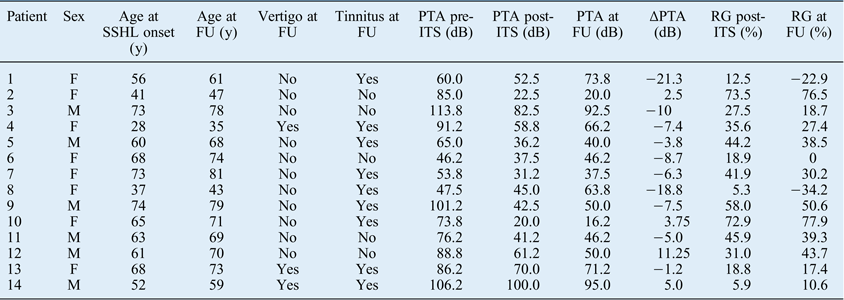
When sudden sensorineural hearing loss occurred, the 14 patients (8 women and 6 men) were aged 28–74 years (mean ± SD, 58.4 ± 14.3); the age range at follow up was 35–81 years (64.9 ± 14.2 years). Participants were treated with intratympanic steroids between July 2003 and December 2007, and followed up from November 2011 to March 2012. The follow-up period varied from 5 to 9 years, with an average of 77 months. Clinical data are summarised in Table I.
Demographic and audiological data

SSHL = sudden sensorineural hearing loss; y = year; FU = follow up; PTA = pure tone average; ITS = intratympanic steroids; RG = relative gain
ΔPTA = PTA post-ITS − PTA at FU
RG post-ITS = PTA pre-ITS − PTA post-ITS / PTA pre-ITS
RG at FU = PTA pre-ITS − PTA at FU / PTA pre-ITS
During follow-up anamnesis, two patients reported benign paroxysmal positional vertigo involving the posterior semicircular canal: in one patient, this was on the same side as the hearing loss and in the other patient, it was on the opposite side. One patient reported contralateral sudden sensorineural hearing loss occurring six years after the first event (with complete, spontaneous recovery), an atrial fibrillation episode and a stroke two years after the first sudden sensorineural hearing loss event. During follow up, two out of three participants died from a major vascular event (i.e. stroke), one in their sleep.
The follow-up vestibular examination was negative in 6 out of 14 patients (43 per cent) and showed labyrinth deficit in 7 patients (50 per cent). Of the latter group, four had deficits on the same side as the sudden sensorineural hearing loss and three on the opposite side. One patient, who had had a stroke the year before, presented a pathological picture with central characteristics in the vestibular test.
In the entire patient cohort, the mean initial PTA was 78.21 ± 21.6 dB, the mean post-intratympanic steroid PTA was 50.9 ± 22.66 dB and the mean PTA at follow up was 54.91 ± 23.67 dB. The mean PTA change between intratympanic steroid treatment and follow up was −4.82 ± 8.85 dB, whereas the mean relative gain at follow up (change in PTA value between before intratympanic steroid treatment and follow up divided by PTA before treatment) was 35.95 ± 22.42 dB (Table I).
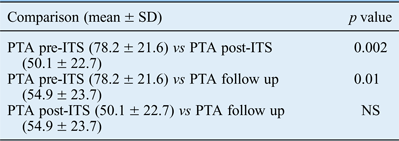
The post-intratympanic steroid PTA, PTA at follow up, relative gain post-intratympanic steroids and relative gain at follow up are summarised in Table I. Comparisons between relative gain post-intratympanic steroids and at follow-up are summarised in Table II. The Student's t-test showed no statistically significant differences between the post-intratympanic steroid PTA and PTA at follow up. This result confirms that a stable hearing improvement was obtained with intratympanic steroid therapy. There were statistically significant differences between PTA values before and after intratympanic steroid treatment (p = 0.002), and between PTA pre-intratympanic steroids and PTA at follow up (p = 0.01) (Table I).
Comparison of relative gain after intratympanic steroids and at follow up
SD = standard deviation; PTA = pure tone average; ITS = intratympanic steroids; NS = not significant
In contrast, the mean PTA showed a slight decline (−4.82 ± 8.85 dB) as a result of hearing deterioration in 10 out of 14 patients (71 per cent) at follow up (−9.0 ± 6.3 dB). Eight of these 10 patients were aged over 60 years, so it is likely that the hearing loss was caused by presbycusis. The remaining four patients (28.6 per cent) showed a small improvement in hearing (5.6 ± 3.9 dB).
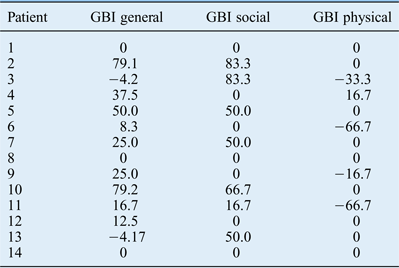
The Glasgow Benefit Inventory data showed general satisfaction within the patient group; however, the mean physical subscale score was negative (−12.8 ± 26.4 dB) (Table III). The general Glasgow Benefit Inventory score was not significantly associated with the presence of tinnitus or dizziness, or with patient age. We also investigated possible correlations between the three Glasgow Benefit Inventory subclasses (general, social and physical) and the change in PTA before and after intratympanic steroid treatment. This change did not correlate with the Glasgow Benefit Inventory social or physical subscales, but strongly correlated with the general subscale (p = 0.0023).
Glasgow benefit inventory subscales scores in the study group
GBI = Glasgow Benefit Inventory
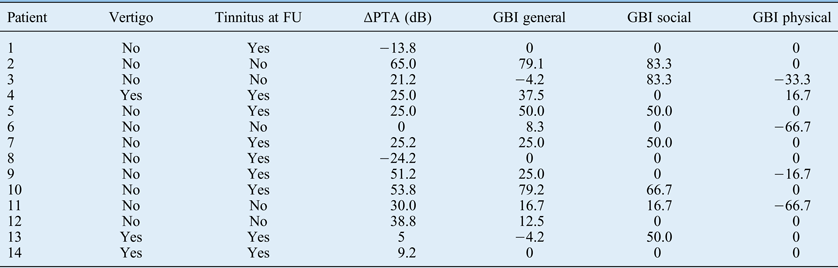
The presence of tinnitus and vertigo or dizziness among the study cohort is shown in Table IV.
Comparison of tinnitus, vertigo and glasgow benefit inventory scores
FU = follow up; GBI = Glasgow Benefit Inventory
ΔPTA = PTA post-ITS − PTA at FU
Discussion
Sudden sensorineural hearing loss constitutes an audiological emergency. From a clinical viewpoint, despite its dramatic presentation, sudden sensorineural hearing loss is usually the presenting symptom of an unidentified underlying pathophysiology. Long-term patient follow up is therefore recommended to identify underlying causes that may not be evident at initial presentation.Reference Stachler, Chandrasekhar, Archer, Rosenfeld, Schwartz and Barrs6
In general, there is too much focus on the pathology and not enough on taking a holistic view of the patient. All clinicians with experience of these patients know that the happiest patient is not always the one with the best recovery.
We therefore decided to investigate the ‘real’ impact of this condition on the patient. Traditional audiological evaluations of treatment efficacy are associated with a rigorous evaluation of the patient's QoL. For sudden sensorineural hearing loss patients, each treatment outcome should be weighed against the probability of spontaneous recovery. Furthermore, the lack of a well-defined pathophysiological process and the high rate of spontaneous resolution (up to 60 per cent of cases) hamper assessment of the therapeutic efficacy of any given therapy. There is currently a lack of clinical literature on the impact of sudden sensorineural hearing loss on the patient's QoL. Most studies limit the evaluation to audiological outcomes, and only describe problems affecting different aspects of sudden sensorineural hearing loss such as definition, outcome criteria and treatment modality. There are only a few reports on the impact that sudden sensorineural hearing loss can have on a patient's daily life.Reference Carlosson, Hall, Lind and Danermark7 Furthermore, data on its natural history are scarce, and concerns about delayed recovery or recurrence can negatively affect the overall QoL.
Approximately 20 per cent of patients who do not respond to treatment show at least partial improvement during the following months.Reference Yeo, Lee, Jun, Park and Park8 Several reports indicate the possibility of delayed recovery.Reference Vrabec9 Patients are often concerned about the possibility of a second event, and usually request information about possible outcomes. These concerns often considerably reduce their QoL. To further complicate the management of these patients, long-term follow-up data are scarce.Reference Kallinen, Laurikainen, Bergroth and Grenman10, Reference Furuhashi, Matzuda, Asahi and Nakashima11 There are reports that improvements in hearing following treatment become stable over time. However, Kallinen et al. who studied a large cohort of patients by means of a questionnaire, found hearing deterioration in 28 per cent of patients.Reference Kallinen, Laurikainen, Bergroth and Grenman10 In contrast, Furuhashi et al. performed a more rigorous re-evaluation of 88 patients more than 10 years after the onset of sudden sensorineural hearing loss and reported that recurrence was rare.Reference Furuhashi, Matzuda, Asahi and Nakashima11
• Sudden sensorineural hearing loss affects 8–15 persons out of 100 000 every year
• Its natural history is unknown
• We reviewed 14 patients who were not responsive to standard therapy and had been treated with intratympanic steroids within 4 years
• Patients were assessed using audiovestibular and QoL tests
• Hearing improvements obtained with therapy were stable over time
• Hearing improvements can be associated with poor QoL even in the presence of audiological success
Our data confirm that stable hearing improvement is obtained after intratympanic steroid administration. No recurrence occurred in our case series, and only 2 out of 14 patients experienced considerable hearing deterioration (in both cases, salvage intratympanic therapy was ineffective). Thus, any effective therapy appears to lead to complete ‘functional’ recovery. Sometimes complete recovery is achieved, and hearing status then evolves independently of the sudden sensorineural hearing loss episode. Furthermore, in our series, an underlying cause was suspected in three patients during follow up. Their history (atrial fibrillation and/or stroke) suggests that sudden sensorineural hearing loss was caused by a vascular event. No potential causes were identified in the other patients. These data support the conclusion of Lin et al. that sudden sensorineural hearing loss should be considered a warning sign of impending stroke, especially in older people.Reference Lin, Chao and Lee12 On these grounds, we recommended that such patients are referred for further evaluation and, if necessary, cardiovascular protection.
Our study is obviously limited by its small cohort size. Nevertheless, our data are worth noting because they describe a specific patient population with a significant follow-up period. QoL evaluation using a modified Glasgow Benefit Inventory showed that patients can feel satisfied regardless of hearing outcome. As expected, patients who regained social hearing level were more satisfied than patients without serviceable functional hearing. This test measures the change in health status produced by a surgical procedure. For this measure, health status is defined as a general perception of well-being, including psychological, social and physical aspects.Reference Robinson, Gatehouse and Browning4 Given that sensitivity to change was critical, we decided to ask patients about the change in health status resulting from the procedure. If we consider the general index, which evaluates the overall perception of the patient, we observe a direct relationship between audiological improvement and QoL improvement in our series. In this context, we have anecdotal evidence that patients with worsening hearing complained of an impaired QoL, while no QoL change was mentioned by patients with stable hearing. In our assessment, improvement in the social aspect of QoL was unrelated to hearing improvement (also see Table IV). Even when considerable hearing improvement was obtained, no significant improvement in QoL was observed. Furthermore, regardless of hearing status or improvement, patients reported a reduction in the physical index, indicating that patients feel a general worsening of hearing status resulting from the onset of sudden hearing loss. In other words, the presence of such an event impairs the patients’ QoL. Although not investigated in this study, it would be interesting to evaluate this parameter in a larger patient cohort, possibly including those with spontaneous recovery. Our data can be partly explained by the lack of information given to patients regarding possible hearing evolution. In addition, the presence of tinnitus and vertigo or dizziness (both typical factors that influence QoL) seemed not to affect QoL in our case series. Unfortunately, no clear conclusions can be drawn from our data for this specific subset because of the very small number of patients studied (see Table IV). The lowest physical QoL scores were reported by three patients without tinnitus. Another drawback of our study is that we did not apply the Glasgow Benefit Inventory immediately after therapy. We therefore have no data regarding patients’ perceptions at that time. In our opinion, long-term data can be influenced by many factors other than hearing outcome. Thus, long-term data probably do not represent the ‘real’ impact of the therapy on QoL. Similar observations have been reported for head and neck cancer patients.Reference Robinson, Gatehouse and Browning4 Immediately after therapy, these patients are usually satisfied and do not complain of any problems. However, especially in such chronic conditions, the sense of gratitude decreases with time, while the number of complaints increases. This type of pattern can also happen after intratympanic steroid therapy. Future prospective studies will help us to understand the real role of intratympanic steroids in determining the QoL of sudden sensorineural hearing loss patients.
Conclusion
Sudden sensorineural hearing loss has a devastating effect on a patient's daily life. This event can be associated with a poor QoL, even in the presence of audiological success. Detailed and honest counselling should be considered a key element in patient management, and seems to be beneficial even after audiological failure. However, many questions remain. What is the role of supportive specialistic therapy? In which patients can it be really beneficial? What is the role of acoustic rehabilitation with hearing aids? More comprehensive evaluations using larger patient cohorts are needed to address these questions.