INTRODUCTION
The communication skills of physicians delivering bad news about cancer, such as an advanced cancer diagnosis, can affect the degree of a patient's distress (Uchitomi et al., Reference Uchitomi, Mikami and Kugaya2001; Schofield et al., Reference Schofield, Butow and Thompson2003; Morita et al., Reference Morita, Akechi and Ikenaga2004). However, many physicians do not have a standard strategy for delivering bad news to patients (Baile et al., Reference Baile, Buckman and Lenzi2000) and find it difficult to communicate bad news with cancer patients and their relatives (Fujimori et al., Reference Fujimori, Oba and Koike2003).
Therefore, communication skills training (CST) has been designed to enhance physicians' communication skills when delivering bad news and has been shown to improve both the objective performance of physician and subjective ratings of their confidence about communicating with patients (Baile et al., Reference Baile, Kudelka and Beale1999; Fallowfield et al., Reference Fallowfield, Jenkins and Farewell2002; Jenkins & Fallowfield, Reference Jenkins and Fallowfield2002; Back et al., Reference Back, Arnold and Baile2007; Lenzi et al., Reference Lenzi, Baile and Costantini2010). However these CST programs do not necessarily have a strong theoretical basis (Girgis et al., Reference Girgis, Sanson-Fisher and Schofield1999; Cegala & Lenzmeier, Reference Cegala and Lenzmeier Broz2002) and reflect patient preferences (Butow et al., Reference Butow, Kazemi and Beeney1996; Parker et al., Reference Parker, Baile and de Moor2001). Consequently, the provision of CST cannot always improve patients' distress and satisfaction with care (Shilling et al., Reference Shilling, Jenkins and Fallowfield2003; Fellows et al., Reference Fellowes, Wilkinson and Moore2004). Meanwhile, patient preferred communication features have been linked with lower psychological distress and higher satisfaction levels (Schofield et al., Reference Schofield, Butow and Thompson2003). Therefore, interventions in enhancing physicians' communication skills that are based on the patients' preferences are needed (Cegala et al., Reference Cegala and Lenzmeier Broz2002; Schofield et al., Reference Schofield, Butow and Thompson2003).
According to our previous reports about patient preferences for physicians' styles of communicating bad news, cancer patients have preferred that physicians communicate bad news while taking into account setting up the supportive environment of the interview, giving consideration on how to communicate the bad news, providing various information which patients would like to know, and providing reassurance and emotional support to patients and their relatives (Fujimori et al., Reference Fujimori, Akechi and Akizuki2005; Reference Fujimori, Akechi and Morita2007; Reference Fujimori and Uchitomi2009). We also suggested the most difficult communication issues for physicians in clinical oncology were breaking bad news (for example, a diagnosis of advanced cancer, recurrence, and stopping anti-cancer treatment), providing emotional support, and dealing with patients' emotional responses (Fujimori et al., Reference Fujimori, Oba and Koike2003).
The purposes of this study were to develop a CST workshop program for oncologists to improve patient preferred communication skills when breaking bad news based on the previous studies and to evaluate preliminary feasibility the CST program on the objective performances of physicians and the subjective ratings of their confidence about the communication with patients at the pre- and post-CST.
METHODS
CST Program Development
The CST program was designed to aim that oncologists learn to patients' perceive preferences and needs for communication of each patient, based on our previous surveys on the preferences of Japanese cancer patients regarding the disclosure of bad news (Fujimori et al., Reference Fujimori, Akechi and Akizuki2005; Reference Fujimori, Akechi and Morita2007; Reference Fujimori and Uchitomi2009). The conceptual communication skills model was consisted of four dimensions, referred to as SHARE: S, setting up the supporting environment of the interview; H, make consideration for how to deliver the bad news; A, discuss about various additional information which patients would like to know; and RE, provision reassurance and addressing the patient's emotion with empathic responses. Especially, the program stressed RE, because it is the most important patient preference (Fujimori et al., Reference Fujimori, Akechi and Morita2007; Fujimori & Uchitomi, Reference Fujimori and Uchitomi2009) and also one of the most difficult communication skills for physicians (Fujimori et al., Reference Fujimori, Oba and Koike2003). The conceptual model had been confirmed content validity by two psychiatrists, a psychologist and two oncologists who were experienced attending staff in clinical oncology with knowledge about communication between patients and oncologists.
The program is participants' centered approach and consisted of a 1-hour computer-aided didactic lecture with text and video, 8-hours role plays with simulated patients, discussions and an ice-breaking; a total of 2-days, based on previous studies (Fujimori et al., Reference Fujimori, Oba and Koike2003; Fellows et al., Reference Fellowes, Wilkinson and Moore2004) and discussion about feasibility by two psychiatrists and a psychologist who were experienced attending staff in clinical oncology with knowledge about communication between patients and oncologists. The program provides the suitable communication in the three situations of breaking bad news to patients: diagnosis of advanced cancer, recurrence, and stopping an anti-cancer treatment. These situations were found difficult to deal with in practice by physicians (Fujimori et al., Reference Fujimori, Oba and Koike2003). To role-play, many scenarios were drawn up tailored to each participants' specialties. The participants were divided into groups of four each with two facilitators.
The facilitators were psychiatrists, psychologists, and oncologists, all of whom had had clinical experience in oncology for 3 or more years and had participated in specialized 30-hours training workshops on facilitating workshops on communication skills in oncology. The simulated patients, who had had experience in medical school for 3 or more years, were also participated 30-hours training workshops. To strengthen in improving physicians' empathic responses, facilitators lead a discussion and role plays on the potential needs and emotion of the patient and communication which patients prefer physicians' empathic responses during a lecture and discuss the SPs express during role plays.
Evaluation of the CST Program
Participants
Oncologists in Japan attended the CST program at National Cancer Center Hospital East. All participants were expected by their hospital directors and local district medical directors to promote palliative care in their hospitals and surrounding area. After giving written informed consent, the oncologists participated in the study.
Measurement
The Objective Performance of Communication Skills
Before and after participating in the workshop, oncologists' performances, such as behaviors and utterances, were recorded using a video-camera during a consultation with simulated patients, while they were asked to tell a patient an inoperable advanced cancer. Their consultation video files were assessed in random order by two blind-raters independently, who trained more than 60-hours in order to standardize the interpretation and application of the assessment based on the manuals, using two assessment tools. First, we prepared the 32 items for the impressions of participants' performances during simulated consultation, which were based on the patient preferences: setting up the supporting environment of the interview, consideration for how to deliver the bad news, discussing additional information, and providing reassurance and addressing the patient's emotion with empathic responses (Fujimori et al., Reference Fujimori, Akechi and Morita2007). The average Spearman correlation coefficients of each intra-coder were 0.79 and 0.76. The average Spearman correlation coefficient of inter-coder was 0.78, except for five items which showed the correlation coefficients were less than 0. Thus, we only evaluated 27 items.
The Roter interaction analysis system (RIAS) (Roter et al., Reference Roter, Hall and Kern1995) was also used for analyzing the objective utterances of communication skills. The RIAS has 42 mutually exclusive items for physicians and patients' utterances. In the RIAS, the unit of analysis is the “utterance,” defined as the smallest discriminable speech segment. Every utterance is assigned to one of the mutually exclusive items that were aligned with our training, and then researchers condense them into fewer theoretically meaningful clusters depending on the purpose of their studies. The Japanese version of RIAS was used to evaluation of consultations in Japanese oncology setting by Ishikawa et al. (Reference Ishikawa, Takayama and Yamazaki2002). In this study, we focused on the 23 items and added three items; silence, warning sign, and ask for perception about bad news, of the following behaviors for physicians; setting up the interview, medical and the other information given, active listening, and reassurance and empathic responses. The average Spearman correlation coefficients of each intra-coder were 0.86 and 0.82. The average Spearman correlation coefficient of inter-coder was 0.83, except for one item which showed the correlation coefficients were less than 0. Thus, we only analyzed 25 items.
Confidence in Communication with Patients
Confidence in communication with patients was assessed with a questionnaire consisting of 21 items by Baile et al. (Reference Baile, Lenzi and Kudelka1997). It measures the self-efficacy of communication skills in breaking bad news. All items were rated on a 10-point Likert scale from 1 to 10, ranging from “not at all” to “extremely.” The previous studies had adopted this questionnaire to evaluate CST programs (Fujimori et al., Reference Fujimori, Oba and Koike2003; Baile et al., Reference Baile, Lenzi and Kudelka1997).
Burnout
The Maslach Burnout Inventory (MBI) is a well validated, self-administered, and a standardized instrument for evaluating burnout (Maslach & Jackson, Reference Maslach and Jackson1986). The Japanese version of MBI was validated by Higashiguti et al. (Reference Higashiguchi, Morikawa and Miura1998). It consists of 22 items and three subscales: depersonalization (five items), personal accomplishment (eight items), and emotional-exhaustion (nine items). Each item was measured on a seven-point Likert scale ranging from 0 to 6 according to frequency with which feeling/attitudes are experienced.
Evaluation of the Workshop
Nine components of the workshop (lecture on communication skills, giving feedback to others, getting feedback from others, using role play, facilitators' general approach, facilitators' suggestion, simulated patients, scenarios, and relevance of the workshop to their own clinical practice) were evaluated. Each item was measured on a 11-point Likert scale from 0 to 10, ranging from “not at all” to “usefulness” (Fujimori et al., Reference Fujimori, Oba and Koike2003).
Procedure
Before the workshop, participants were informed about this study and gave consent in writing for participant of this study. After that, they were required to participate in a simulated consultation in which they were asked to give the diagnosis of inoperable advanced cancer to a simulated-patient and to complete a pre-training survey regarding demographic characteristics, confidence in communication with patients, and MBI. Demographic characteristics included age, sex, marital status, specialty, clinical experience, and clinical experience in oncology. After workshop, participants were required to participate in a simulated consultation similar to the first, fill in the questionnaires consisted of confidence in communication, and evaluate the workshop. Three-months after the workshop, all participants were asked to answer a set of questionnaires that consisted of confidence and MBI.
Analysis
The scores of participants' possessed skill at pre-CST were compared using paired t-test with the scores at post-CST. We also estimated the confidence of participants and compared the rating score at pre-CST with post-CST and 3-months after CST using repeated measures analysis of variances (ANOVAs). When ANOVAs showed a significant difference, post hoc tests were performed. Each factor score of MBI was compared at pre-CST with 3-months after CST using t-test. The statistical analysis was used the SPSS 19.0 software.
RESULTS
Participant Characteristics
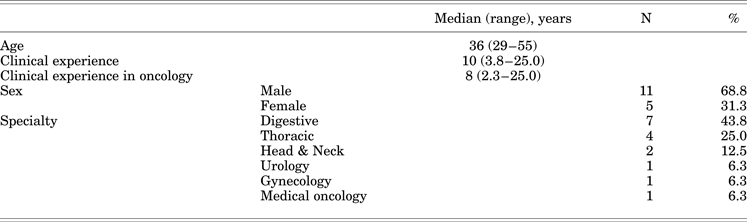
Sixteen oncologists participated in the workshop. Their characteristics were shown in Table 1.
Participant characteristics (N = 16)

Performance of Communicating Bad News
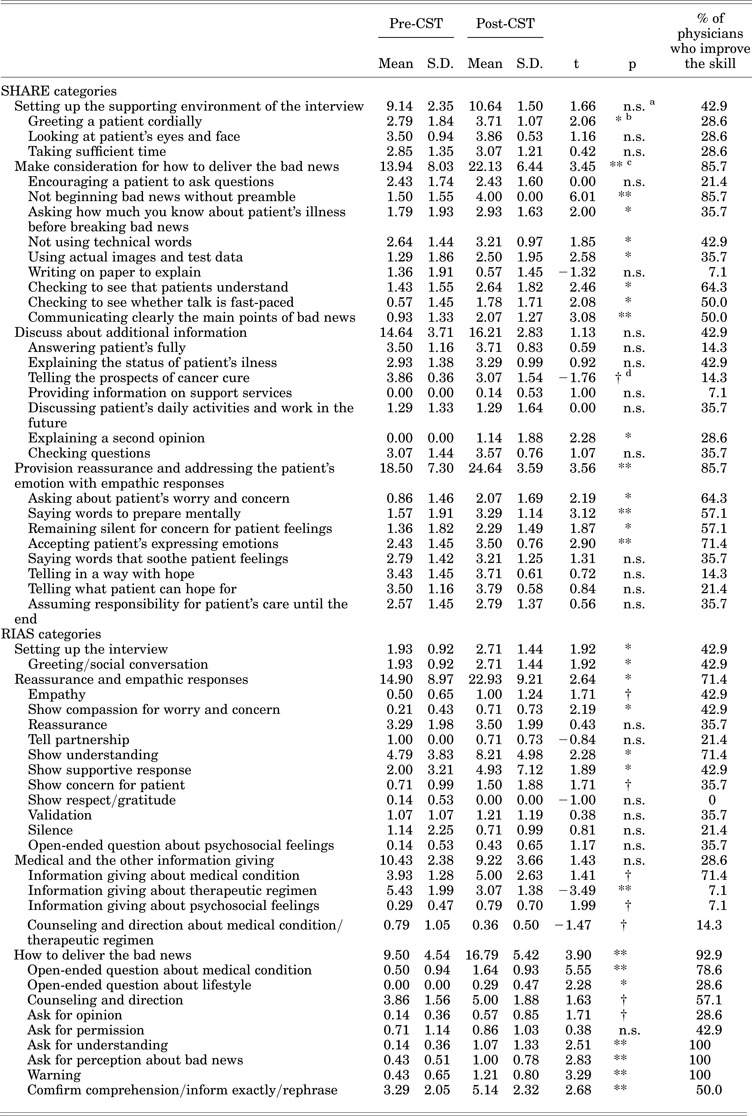
In each pair of bad news consultations, the score of 13 out of 27 categories of SHARE significantly increased, related to mainly “make consideration for how to deliver the bad news” and “provision reassurance and addressing the patients' emotion with empathic responses” (Table 2). In each participant, the mean of 9.7 skills were had higher score at the post-CST. In RIAS, the utterances assigned 11 of 25 categories significantly increased, related to “setting up interview,” “reassurance and empathic responses,” “medical and the other information giving,” “reassurance and empathic responses,” and “how to deliver the bad news” (Table 2). The utterances of each participant increased in the mean of 10.5 skills at post-CST.
Mean Score of Total Peformances for Physicians During Consultations by Assessing SHARE and RIAS Categories
a: n.s.= not significant
b: *p < .05
c: **p < .01
d: †p < .10
Confidence for Communicating Bad News
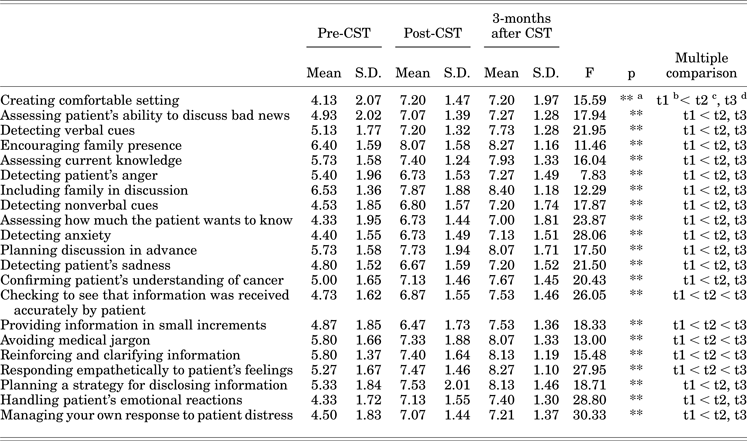
All items of the confidence related to communication with patient of participants were significantly higher scores at post-CST than at pre-CST and maintained at the high level in 3-months after CST (Table 3).
Scores of the Participants' Self-Rating Confidence Scale for Communication with Patient
a: **p < .01
b: t1 = Pre-CST
c: t2 = Post-CST
d: t3 = 3 months after CST
Burnout
Compared with pre-CST, the mean score of all subscales at 3-months after CST decreased (emotional exhaustion: 11.64 ± 3.77 and 10.29 ± 3.75, respectively; p = 0.04, depersonalization: 18.60 ± 9.41 and 14.47 ± 9.48, respectively; p = 0.08, personal accomplishment: 33.13 ± 9.65 and 28.80 ± 12.66, respectively; p = 0.01).
Evaluation of the Workshop
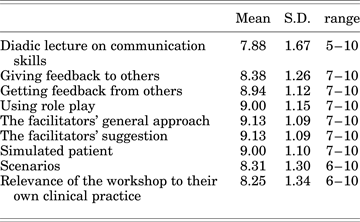
Participants reported to form a high estimate (mean scores; 7.88–9.13) of all CST components (Table 4).
Usefulness of the CST Program
DISCUSSION
This study developed CST program based on patient preferences and the newly developed CST program seemed feasible and potentially effective and might be applied to medical education for physicians, especially in Japanese culture which are characterized by a family-centered communication style, an emotionally demanding patient preference and a little more ‘paternalistic’ physician-patient relationship (Fujimori et al., Reference Fujimori, Akechi and Akizuki2005; Reference Fujimori, Akechi and Morita2007; Reference Fujimori and Uchitomi2009).
Two assessment tools for performances, which are the SHARE as an assessment of impressions of participants' performances and the RIAS as an assessment of participants' utterances, showed the similar results. As we intended, our developed CST program might be strengthened in improving physicians' empathic responses and active listening skills. Especially, more than 70% of participants have improved performances of “not beginning bad news without preamble” and “accepting patient's expressing emotions” categories of SHARE, and “show understanding,” “open-ended question about medical condition,” “ask for understanding,” “ask for perception about bad news,” and “warning” categories of RIAS. Taken together with these results, the newly developed CST program might be expected for physicians to be able to provide an emotional support for patients, resulting in their reduce distress such as depression and anxiety.
In contrast, physicians' behaviors and utterances related to most categories of “discussing about additional information” of SHARE did not change between pre- and post-CST. One possible reason might be that participants of this study might have already had these communication skills, because the scores of “telling the prospects of cancer care” category of SHARE had been already rated high scores at pre-CST. Another possible reason might be that this program does not have insufficient effect on “providing information of support services” of SHARE. Most participants might not have enough knowledge about the psychosocial support services and daily activities. If so, it might be effective to add in the CST program a lecture of information which most patients had not possess.
All subjective confidence ratings about communication increased significantly after CST and maintained 3-months after it. This result showed that this CST program allowed participants to work on these areas in a manner that was inspiring confidence, and had an either equaling or surpassing efficacy on participants' confidence compared to our previous program which showed 18 of 21 items had improved after CST and maintained 3-months after CST (Fujimori et al., Reference Fujimori, Oba and Koike2003).
As the results of participants' burnout, the emotional-exhaustion and depersonalization showed positive changes 3-months after CST, however the personal accomplishment also decreased significantly. This result did not replicate the result of our previous study which showed participants' emotional-exhaustion worsened 3-months after CST (Jenkins & Fallowfield, Reference Jenkins and Fallowfield2002) and this CST program was suggested improving the physicians' emotional-exhaustion and depersonalization, like the speculations in previous studies that physicians' burnout had decreased after CST (Baile et al., Reference Baile, Lenzi and Kudelka1997; Ramirez et al., Reference Ramirez, Graham and Richards1995). Although this study also cannot explain the reason why the participants' personal accomplishment for their job decreased 3-months after CST, it is possible that participants have intensified their attempts to be empathic with patients and realized that the consultations were more challenging. It might have to be assessed at longer follow-up to provide a more satisfactory explanation of the phenomenon.
The participants evaluated the CST program fully positively on all components, suggesting that they were generally satisfied with the content, methodology, and facilitators of the workshop: a learner-centered model as well or better as our previous study (Fujimori et al., Reference Fujimori, Oba and Koike2003). These results of this study showed the CST program suggested to useful to physicians.
Two limitations of this study should be noted. First, this preliminary study did not set up the control group and the participants are small because the aims of this study were development and feasibility evaluation of CST program based on patient preferences. Our next step study will perform randomized control trial, as the results of this study suggested a newly developed CST program was the feasible and potentially effective. Second, this study did not evaluate the impact of this CST program on patients' outcomes such as patients' distress and satisfaction. Future research efforts should be evaluated the patients' outcomes.
In conclusion, a newly developed CST program based on patient preferences is suggested being feasible and potentially effective on communication behaviors of oncologists, confidence in communicating with patients, and emotional exhaustion. A randomized control study to conclude the developed CST program is effective was needed further.