Non-technical Summary
Ground squirrels diversified on the central Great Plains as grasslands expanded during the Pliocene and Pleistocene (5.33 million to 11,700 years before present). This diversification is well documented in southwestern Kansas but not farther north and east on the central Great Plains. In this study, I describe Early Pleistocene (2.58–2.00 Ma years before present) ground squirrels from three localities in northeastern Nebraska. These fossils provide the earliest records for some lineages of ground squirrels, either globally or on the central Great Plains and indicate that species adapted to grasslands probably originated first in the northeast Great Plains before spreading south and west. One of these ground squirrels probably represents a species otherwise only known from younger Pleistocene deposits in the mountains of Colorado. I also describe a new ground squirrel that differs considerably from all other described species and place it in a new genus.
Introduction
Ground-dwelling squirrels (Rodentia, Sciuridae, Xerinae, Marmotini) radiated extensively in North America during the Late Miocene through Early Pleistocene (Hemphillian, Blancan, early Irvingtonian land mammal ages), probably in response to expanding grasslands at that time (Goodwin, Reference Goodwin, Janis, Gunnell and Uhen2008). Late Miocene and Pliocene fossils represent extinct species and in some cases genera; extant species with a fossil record first appear in the Pleistocene (e.g, Goodwin and Martin, Reference Goodwin and Martin2017).
In the Meade Basin, southwestern Kansas (Fig. 1), a diverse ground squirrel assemblage displays step-wise “modernization” during the Pliocene to Early Pleistocene: the Pliocene assemblage dominated by granivores and omnivores gave way to an assemblage dominated by grassland taxa (Goodwin and Martin, Reference Goodwin and Martin2017), with many taxa displaying dental specializations for abrasive diets (Goodwin, Reference Goodwin2009). Fossils of Urocitellus Obolenskij, Reference Obolenskij1927, first appear regionally in the latest Blancan (Borchers local fauna; Fig. 1), with other taxa characteristic of regional grasslands today—Poliocitellus Howell, Reference Howell1938, Ictidomys tridecemlineatus (Mitchill, Reference Mitchill1821), and Cynomys Rafinesque, Reference Rafinesque1817 (Goodwin and Martin, Reference Goodwin and Martin2017)—first appearing in the early Irvingtonian. Similar “modernization” is evident in the record of arvicolid rodents: Microtus, with ever-growing cheek teeth, first appears in the early Irvingtonian of the Meade Basin (Martin et al., Reference Martin, Peláez-Campomanes, Honey, Fox, Zakrzewski, Albright, Lindsay, Opdyke and Goodwin2008). This stepwise “modernization” was coincident in time and likely causally related to the final phase in regional development of C4-dominated grasslands documented isotopically from soil carbonates (Fox et al., Reference Fox, Honey, Martin and Peláez-Campomanes2012).
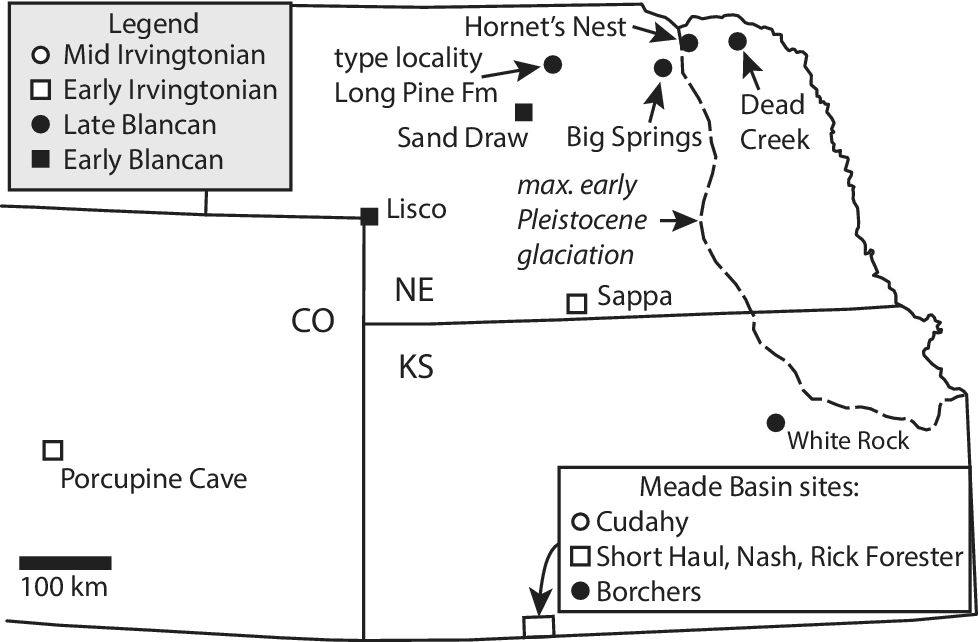
Map of late Blancan fossil localities examined for this study (Big Springs, Hornet’s Nest, Dead Creek), regional comparative localities from the early Blancan through mid Irvingtonian, and the type locality for the Long Pine Formation. Redrawn from a map generated in Google Earth Pro. Boundary of Early Pleistocene (“pre-Illinoian”) glaciation from Roy et al. (Reference Roy, Clark, Barendregt, Glasmann and Enkin2004, fig. 1).

Figure 1. Long description
A geographical map showing state borders for C O, N E, and K S. A legend in the top-left corner defines four symbols: open circles for Mid Irvingtonian, open squares for Early Irvingtonian, solid circles for Late Blancan, and solid squares for Early Blancan.
* In Northwest N E, a solid circle marks the type locality for Long Pine F m, and a solid square marks Sand Draw.
* In Northeast N E, a cluster of solid circles includes Hornet’s Nest, Big Springs, and Dead Creek.
* A dashed line runs North to South through Eastern N E and K S, labeled as the max. early Pleistocene glaciation boundary.
* Along the N E and K S border, a solid square marks Lisco and an open square marks Sappa.
* In Southwest K S, a solid circle marks White Rock.
* A secondary legend in the bottom-right identifies Meade Basin sites: Cudahy (open circle), Short Haul, Nash, Rick Forester (open square), and Borchers (solid circle). An arrow points from this legend to a square on the Southern K S border.
* In Western C O, an open square marks Porcupine Cave.
* A scale bar in the bottom-left represents 100 km.
Pliocene–Early Pleistocene ground squirrels are less well known farther north and east on the Great Plains. Available fossils indicate differences from the Meade Basin in species composition. For example, Otospermophilus boothi (Hibbard, Reference Hibbard, Skinner and Hibbard1972) is known from the early Blancan of Nebraska (Sand Draw, Lisco) and late Blancan of northeastern Kansas (White Rock; Eshelman, Reference Eshelman1975) but was absent from multiple fossil-rich Blancan sites in the Meade Basin (Fig. 1; Goodwin and Martin, Reference Goodwin and Martin2017). Also, regional fossils hint at earlier “modernization” than in the Meade Basin with Cynomys first appearing in the late Blancan at White Rock (Eshelman, Reference Eshelman1975) but early Irvingtonian of the Meade Basin (Goodwin and Martin, Reference Goodwin and Martin2017). Perhaps these differences in species composition and timing of species turnover were influenced by environmental gradients associated with onset of Early Pleistocene glaciation on the eastern Great Plains (Fig. 1), with the earliest of several Early Pleistocene regional tills dated at >2.0 my BP (Roy et al., Reference Roy, Clark, Barendregt, Glasmann and Enkin2004) or ca. 2.4 my BP (Rovey and McLouth, Reference Rovey and McLouth2015).
Here, I report diverse ground squirrel assemblages from three Early Pleistocene (late Blancan) localities in northeastern Nebraska, with all three adjacent to or within the region that experienced Early Pleistocene glaciation (Fig. 1). These fossils corroborate the transitional nature of Early Pleistocene assemblages, confirm differences in ground squirrel faunas between southwestern Kansas and northeastern Nebraska, support the hypothesis that grassland taxa appeared earlier in northeastern Nebraska than in southwestern Kansas, and provide the earliest records for multiple lineages, including the genus Poliocitellus, and the earliest regional record for the crown clade within the genus Marmota. Finally, I describe a new genus and species of ground squirrel with distinctive dentition and likely mode of life.
Geological and paleontological setting
Geological time units
I follow Janis et al. (Reference Janis, Gunnell and Uhen2008) with two subdivisions of the Blancan Land Mammal Age: early (ca. 4.75 to ca. 2.5 my BP) and late Blancan (ca. 2.5 to ca. 1.9 my BP), the latter equivalent to Blancan V in Bell et al. (Reference Bell, Lundelius, Barnosky, Graham, Lindsay, Ruez, Semken, Webb, Zakrzewski and Woodburne2004). The Blancan was considered roughly equivalent to the Pliocene prior to 2009, when the International Commission of Stratigraphy lowered the base of the Pleistocene from ca. 1.8 to ca. 2.6 my BP (Gibbard et al., Reference Gibbard, Head and Walker2010). Thus, late Blancan localities once assigned to the Late Pliocene are now Early Pleistocene in age. The Early Pleistocene (ca. 2.6 to ca. 0.8 my BP) also includes the early Irvingtonian Land Mammal Age (ca. 1.9 to ca. 0.85 my BP; Irvingtonian I in Bell et al., Reference Bell, Lundelius, Barnosky, Graham, Lindsay, Ruez, Semken, Webb, Zakrzewski and Woodburne2004).
Geological and paleontological setting
Fossils were collected from three localities in northeastern Nebraska: Big Springs in Antelope County; Hornet’s Nest in Knox County, located about 40 km NE of Big Springs; and Dead Creek in Cedar County, located about 50 km E of Hornet’s Nest (Fig. 1). Fossil-bearing sedimentary units at Big Springs (an extensive bed of silt; Voorhies, Reference Voorhies1987) and Hornet’s Nest (fine-grained gravel lenses; Voorhies personal communication, reported by Rogers, Reference Rogers1984) were within larger sand and gravel units assigned to the Long Pine Formation (Rogers, Reference Rogers1984; Voorhies, Reference Voorhies1987), a formation described from exposures ~120 km west of Big Springs (Fig. 1; Skinner and Hibbard, Reference Skinner and Hibbard1972). In contrast, the fossiliferous unit at Dead Creek was reported as eolian silt with vertebrate burrows (Voorhies and Goodwin, Reference Voorhies and Goodwin1989).
Differences in sedimentary context indicate different environments of deposition, interpreted to be alluvial for Big Springs (overbank) and Hornet’s Nest (fluvial) but an upland paleosol for Dead Creek (Voorhies, Reference Voorhies1987; Voorhies and Goodwin, Reference Voorhies and Goodwin1989). These depositional differences were consistent with bulk fossil abundances. For example, fish and amphibians represented ~70% of fossils from Hornet’s Nest but only ~15% of fossils from Dead Creek (Voorhies and Goodwin, Reference Voorhies and Goodwin1989).
All three localities were assigned to the late Blancan based on co-occurrence of taxa with first and last occurrences during the late Blancan (summarized in Voorhies, Reference Voorhies1987; Voorhies and Goodwin, Reference Voorhies and Goodwin1989). This was further supported by a fission track date of ca. 2.5 my BP obtained on glass shards from fossil-bearing sediments at Big Springs (Voorhies, Reference Voorhies1987). An undated ash just above fossil-bearing sediments at Dead Creek was questionably identified as the Pearlette type B (Borchers) ash (Voorhies and Goodwin, Reference Voorhies and Goodwin1989), dated elsewhere at ca. 2.0 my BP (Boellstorff, Reference Boellstorff1973; Naeser et al., Reference Naeser, Izett and Wilcox1973). This ash was not observed at Hornet’s Nest but was present at the appropriate position (just below a till, at approximately the same elevation) in a section nearby (Voorhies and Goodwin, Reference Voorhies and Goodwin1989). If this ash is properly identified as Pearlette type B, Dead Creek and Hornet’s Nest may be slightly younger than Big Springs. Consistent with this hypothesis, the fossil-bearing silt at Dead Creek yielded normal paleomagnetism, perhaps indicating deposition during the Reunion event ca. 2.15 my BP; fossil-bearing sediments at Hornet’s Nest were not investigated for paleomagnetism (Voorhies and Goodwin, Reference Voorhies and Goodwin1989).
All three localities yielded abundant vertebrate remains, but only the herpetofaunas from Big Springs and Hornet’s Nest have been comprehensively reviewed (Rogers, Reference Rogers1984). Selected mammals—arvicoline rodents (Zakrzewski, Reference Zakrzewski, Genoways and Dawson1984), lagomorphs (White, Reference White1988; White, Reference White1991), and single-species accounts of the extinct armadillo, Dasypus bellus (Voorhies, Reference Voorhies1987) and the bat Lasiurus sp. (Czaplewski et al., Reference Czaplewski, Bailey and Corner1999)—have been reported from Big Springs. Also, several mammals with paleoenvironmental or biostratigraphic significance were listed but not described (Voorhies, Reference Voorhies1987; Voorhies and Goodwin, Reference Voorhies and Goodwin1989). Thus, much remains unknown about mammals from these sites.
Based on herpetofaunas, Rogers (Reference Rogers1984) inferred a permanent river, open river valley, and adjacent upland tall-grass prairie at Big Springs; and a moist, more wooded habitat perhaps with adjacent tall-grass prairie at Hornet’s Nest. Based on climate-sensitive vertebrate fossils, including the presence of southern taxa such as an armadillo (Dasypus bellus), a tapir (Tapirus sp.), and a large tortoise (Geochelone sp.), Voorhies (Reference Voorhies1987) inferred a warmer paleoclimate with milder winters than at present for Big Springs. In contrast, Voorhies and Goodwin (Reference Voorhies and Goodwin1989) inferred a cold, upland paleoenvironment for Dead Creek, although the taxonomic basis for this inference was not specified.
Consistent with paleoenvironmental variation during the late Blancan of Nebraska, carbon isotopes from tooth enamel indicate substantial C4 vegetation in horse diets in early late Blancan sites that also have giant tortoises (notably at Big Springs) but more C3-focused horse diets at a later late Blancan site that lacked giant tortoises (South Wind Prospect locality; Passey et al., Reference Passey, Cerling, Perkins, Voorhies, Harris and Tucker2002). This isotopic variation was likely influenced by onset of glaciation in eastern Nebraska, with multiple glacial advances and retreats reported during the Early Pleistocene (Roy et al., Reference Roy, Clark, Barendregt, Glasmann and Enkin2004). Fossil-bearing sediments at Hornet’s Nest and Dead Creek both underlie glacial tills, directly so at Hornet’s Nest (Voorhies and Goodwin, Reference Voorhies and Goodwin1989), but the ages of these tills are not known.
Materials and methods
Staff and volunteers from the University of Nebraska State Museum (UNSM) collected and wet-screened bulk sediment samples and removed and initially sorted fossils taxonomically. All ground squirrel teeth, dentaries, or maxillae that I found in the UNSM collection from Hornet’s Nest (n = 41) and Dead Creek (n = 22) were examined, except for a few teeth that were exceedingly worn, corroded, or broken. In contrast, all dentaries or maxillae with informative teeth but only a subset of isolated teeth from Big Springs (n = 123) were examined to practically complete my study during limited time; the Big Springs collection has hundreds of additional isolated teeth of ground squirrels.
Diagnostic teeth were photographed digitally in occlusal view and often in buccal (from the cheek) and lingual (from the tongue) views as well, with scale, through a Leica MZ8 microscope with camera attachment. Digital photographs were stored in a FileMaker Pro database (www.filemaker.com). Images were used for morphological description and comparative analysis with large datasets of fossil and modern specimens, leveraging databases described elsewhere (Goodwin, Reference Goodwin2009; Goodwin and Martin, Reference Goodwin and Martin2017). Dental terminology of cheek teeth follows Bryant (Reference Bryant1945, p. 278) and is illustrated in Figure 2.1–2.3 (uppers) and Figure 3.1 (lowers). Note that the protolophid of Bryant (Reference Bryant1945) is elsewhere termed the anterior cingulum (e.g., Black, Reference Black1963, fig. 3) or anterolophid (e.g., Sinitsa and Pogodina, Reference Sinitsa and Pogodina2019, fig. 2).
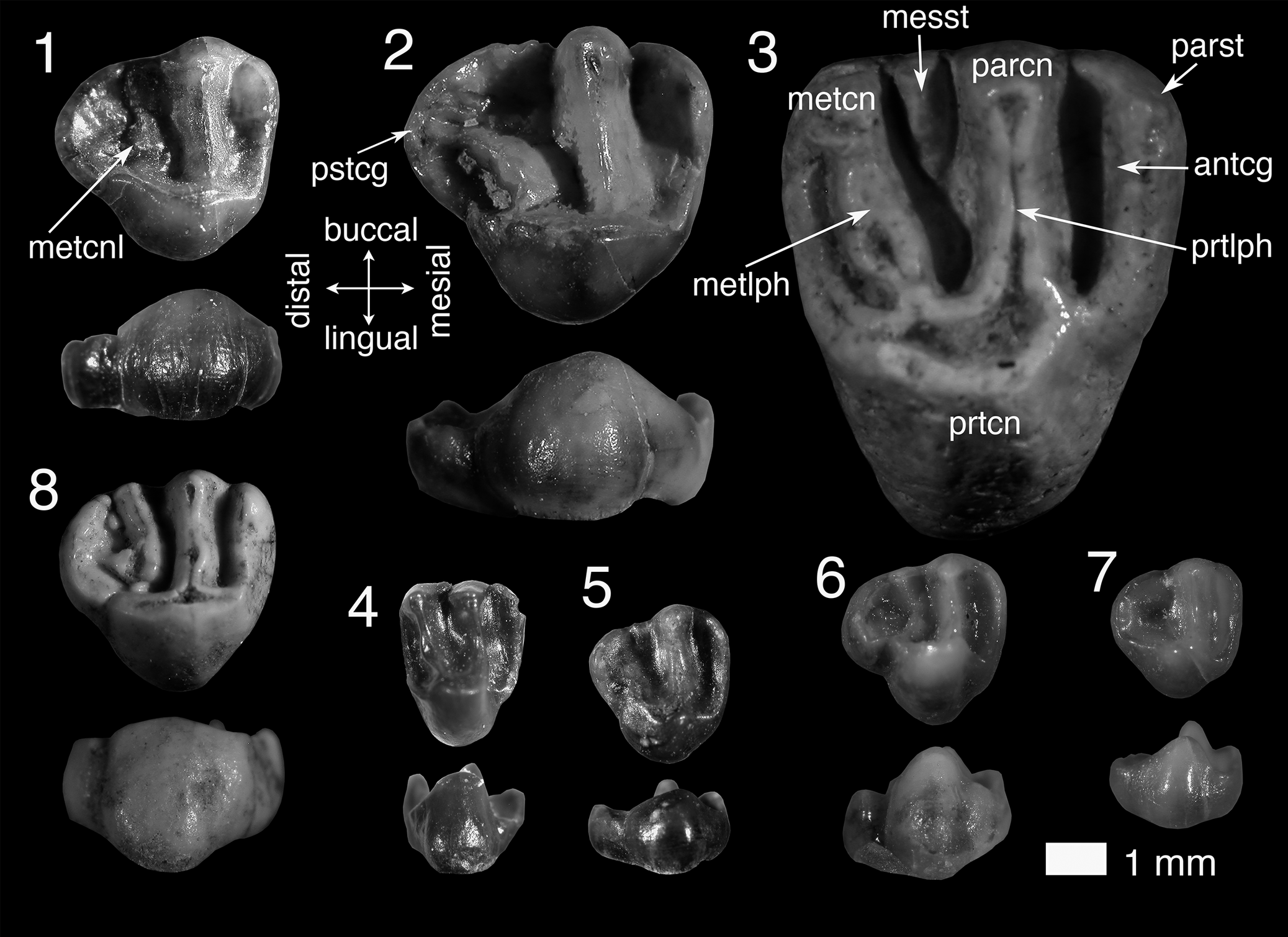
Upper cheek teeth, scale bar applies to all. All fossils displayed as right teeth (left specimens are reversed) in occlusal view; lingual views provided for many teeth (below the occlusal view). Orientation diagram (mesial-distal, buccal-lingual) applies to occlusal views. Dental terminology labeled on (1–3). (1) LM3 of Otospermophilus cf. O. boothi from Big Springs (UNSM 101868, reversed). (2) RM3 of Marmota sp. from Dead Creek (UNSM 98829). (3) LM1 or M2 of Paenemarmota barbouri from Big Springs (UNSM 101856, reversed). (4) RM1 or M2 and (5) LM3 of Poliocitellus sp. from Hornet’s Nest (UNSM 98882 and 98873 reversed, respectively). (6) RM3 of Urocitellus cf. U. richardsonii from Big Springs (UNSM 101863). (7) RM3 of Ictidomys cf. I. meadensis from Big Springs (UNSM 101893A). (8) RM3 of Nebraskocitellus voorhiesi n. gen. n. sp. from Big Springs (UNSM 101890). Abbreviations: antcg = anterior cingulum, messt = mesostyle, metcn = metacone, metcnl = metaconule, metlph = metaloph, parcn = paracone, parst = parastyle, prtcn = protocone, prtlph = protoloph, pstcg = posterior cingulum.

Figure 2. Long description
The multi-panel display contains eight numbered fossil specimens. An orientation diagram in the upper center indicates buccal-lingual and mesial-distal axes.
* Specimen 1 at the top left shows a large occlusal surface with an arrow pointing to the metcnl. Below it is a rounded lingual view.
* Specimen 2 shows a wide occlusal surface with an arrow pointing to the pstcg on the distal-buccal edge. Below is a bulbous lingual view.
* Specimen 3 is the largest, located on the right. It features extensive labeling. From the top right moving clockwise: parst, antcg, prtlph, prtcn at the base, metlph, metcn, and messt at the top center.
* Specimen 4 and 5 are smaller teeth in the lower center. Each has a narrow occlusal view above a small, peaked lingual view.
* Specimen 6 and 7 are small teeth on the lower right, showing simplified occlusal basins and corresponding lingual profiles.
* Specimen 8 on the far left middle shows a complex occlusal pattern with multiple ridges and a broad lingual base below.
A white rectangular scale bar in the bottom right corner represents 1 mm. All teeth are oriented as right-side specimens.
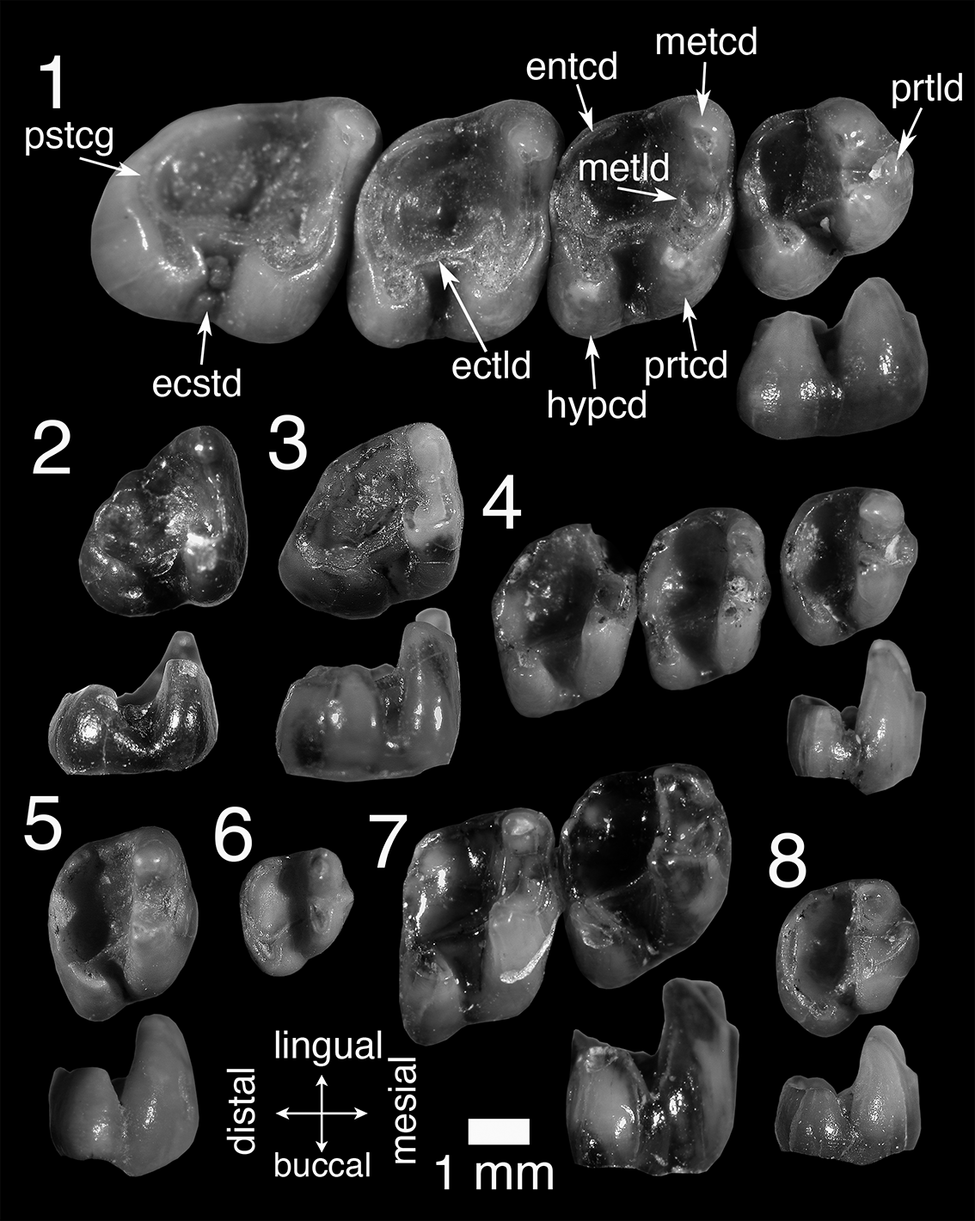
Lower cheek teeth, scale bar applies to all. All fossils portrayed as right teeth (left specimens reversed) in occlusal view; buccal views provided for selected teeth (below occlusal view). Orientation diagram (mesial-distal, buccal-lingual) applies to occlusal views. Dental terminology labeled on (1). (1) Lp4–m3 (reversed) of Otospermophilus cf. O. boothi from Big Springs (UNSM 101853) including buccal view of p4. (2) Lm3 of Poliocitellus sp. from Hornet’s Nest (UNSM 98876, reversed). (3) Lm3 of Urocitellus cf. U. richardsonii from Hornet’s Nest (UNSM 98860, reversed). (4) Rp4–m2 of U. cf. U. richardsonii from Big Springs (UNSM 101862) with buccal view of p4. (5) Rp4 of Urocitellus sp. (large) from Big Springs (UNSM 100096). (6) Rp4 of Ictidomys cf. I. meadensis from Big Springs (UNSM 101896). (7) Rp4–m1 of ?Cynomys cf. ?C. andersoni from Big Springs (UNSM 101889) with buccal view of p4. (8) Rp4 of ?Poliocitellus sp. (large) from Big Springs (UNSM 100094). Abbreviations: ectld = ectolophid, ecstd = ectostylid, entcd = entoconid, hypcd = hypoconid, metcd = metaconid, metld = metalophid, prtcd = protoconid, prtld = protolophid, pstcg = posterior cingulum.

Figure 3. Long description
The photograph contains eight numbered panels of fossilized teeth against a black background. A 1 millimeter scale bar and an orientation diagram (mesial-distal, buccal-lingual) are located at the bottom center.
* Panel 1: A row of four teeth (p 4 through m 3) in occlusal view with a buccal view of p 4 below. Labels identify anatomical features: p s t c g (posterior cingulum) on the distal edge; e c s t d (ectostylid) on the buccal margin; e c t l d (ectolophid) connecting the protoconid and hypoconid; e n t c d (entoconid) and m e t c d (metaconid) on the lingual side; m e t l d (metalophid) and p r t l d (protolophid) near the mesial end; and h y p c d (hypoconid) and p r t c d (protoconid) on the buccal side.
* Panel 2: A single m 3 tooth in occlusal view with a buccal view below.
* Panel 3: A single m 3 tooth in occlusal view with a buccal view below.
* Panel 4: Three teeth (p 4 through m 2) in occlusal view with a buccal view of p 4 below.
* Panel 5: A single p 4 tooth in occlusal view with a buccal view below.
* Panel 6: A single p 4 tooth in occlusal view.
* Panel 7: Two teeth (p 4 and m 1) in occlusal view with a buccal view of p 4 below.
* Panel 8: A single p 4 tooth in occlusal view with a buccal view below.
Scaled photos were measured with GraphicConverter (www.lemkesoft.de/en/products/graphicconverter/). The following dimensions were measured from occlusal photos (depicted in Goodwin and Martin, Reference Goodwin and Martin2017, fig. 3): lengths of all cheek teeth; widths of upper cheek teeth from the buccal margin of the paracone to the lingual margin of the protocone; trigonid widths of lower cheek teeth from the lingual margin of the metaconid to the buccal margin of the protoconid; and, for p4, talonid width from the lingual margin of the entoconid to the buccal margin of the hypoconid. In addition, for unworn to lightly worn p4s, crown height of the protoconid was measured in buccal view, from tip to crown base of the protoconid. Metric data were analyzed graphically and statistically, using SPSS Statistics 29 (www.ibm.com/products/spss).
Genus and species assignments were based on qualitative and quantitative comparisons with extant and fossil species. I followed the taxonomy of Helgen et al. (Reference Helgen, Cole, Helgen and Wilson2009) when assigning fossil species to genera. Traditionally, most North American ground squirrels have been assigned to the Holarctic Spermophilus Cuvier, Reference Cuvier1825, but Helgen et al. (Reference Helgen, Cole, Helgen and Wilson2009) split this paraphyletic genus into eight presumably monophyletic genera, seven from North American (marked in Table 1), with only the Eurasian clade bearing the name Spermophilus. Thus, extinct North American ground squirrels once attributed to Spermophilus must be reassigned.
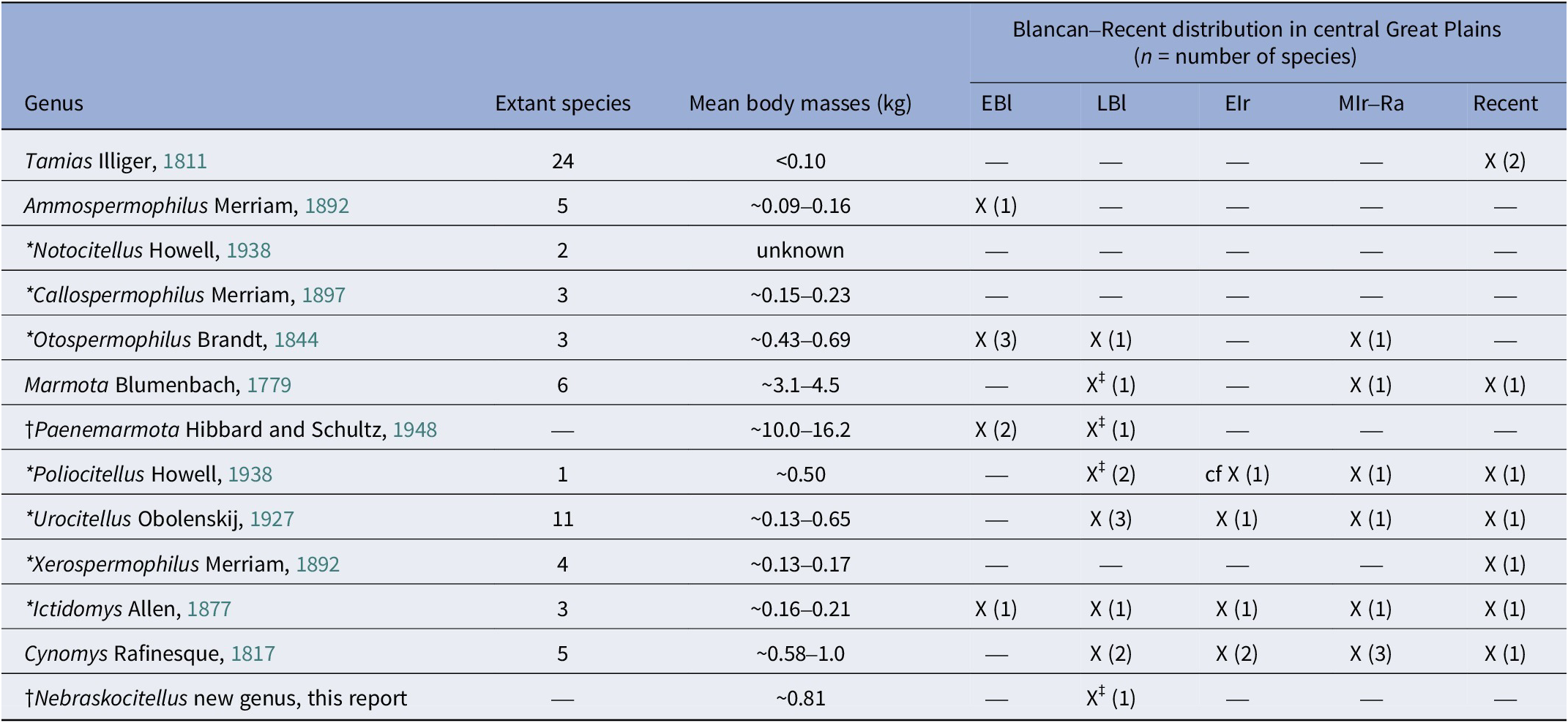
Genera of marmotine ground squirrels from North America, including all extant and two extinct Blancan genera. Numbers of extant North American species from Thorington et al. (Reference Thorington, Koprowski, Steele and Whatton2012). Within extant genera, mean masses of species are for extant North American species only, derived from Hayssen (Reference Hayssen2008) using methodology of Goodwin and Bullock (Reference Goodwin and Bullock2012). For two extinct genera, mean masses were estimated from L p4 based on scaling in Goodwin and Bullock (Reference Goodwin and Bullock2012). Stratigraphic distribution in central Great Plains (i.e., Kansas and Nebraska) from Goodwin (Reference Goodwin, Janis, Gunnell and Uhen2008), Goodwin and Martin (Reference Goodwin and Martin2017), this report, and personal study of museum collections. * = previously in paraphyletic Spermophilus, † = extinct genus, ‡ = first reported in this study from the central Great Plains during a given stratigraphic interval. EBl, early Blancan; EIr, early Irvingtonian; LBl, late Blancan; MIr–Ra, middle Irvingtonian–Rancholabrean

Table 1. Long description
The table contains 13 rows of genera. Columns include Genus, Extant species count, Mean body masses in k g, and distribution across E B l, L B l, E I r, M I r to R a, and Recent periods.
* Tamias: 24 species, mass less than 0.10 k g, present only in Recent (2 species).
* Ammospermophilus: 5 species, mass 0.09 to 0.16 k g, present in E B l (1 species).
* Notocitellus: 2 species, mass unknown, no distribution data.
* Callospermophilus: 3 species, mass 0.15 to 0.23 k g, no distribution data.
* Otospermophilus: 3 species, mass 0.43 to 0.69 k g, present in E B l (3), L B l (1), and M I r minus R a (1).
* Marmota: 6 species, mass 3.1 to 4.5 k g, present in L B l (1), M I r minus R a (1), and Recent (1).
* Paenemarmota (extinct): mass 10.0 to 16.2 k g, present in E B l (2) and L B l (1).
* Poliocitellus: 1 species, mass 0.50 k g, present in L B l (2), E I r (1), M I r minus R a (1), and Recent (1).
* Urocitellus: 11 species, mass 0.13 to 0.65 k g, present in L B l (3), E I r (1), M I r minus R a (1), and Recent (1).
* Xerospermophilus: 4 species, mass 0.13 to 0.17 k g, present only in Recent (1).
* Ictidomys: 3 species, mass 0.16 to 0.21 k g, present across all five intervals (1 species each).
* Cynomys: 5 species, mass 0.58 to 1.0 k g, present in L B l (2), E I r (2), M I r minus R a (3), and Recent (1).
* Nebraskocitellus (extinct): mass 0.81 k g, present in L B l (1).
Reassignment of some fossils is difficult: ground squirrels are conservative dentally, often evolve convergently, and likely were less divergent early in their histories. Given widespread use of Spermophilus prior to 2009, I use “Spermophilus” for extinct ground squirrels that have not yet been assigned to genus but emphasize that this has no phylogenetic meaning. Of note, both Spermophilus johnsoni Hibbard, Reference Hibbard, Skinner and Hibbard1972, and Spermophilus meltoni Hibbard, Reference Hibbard, Skinner and Hibbard1972, from the Blancan Sand Draw local fauna have not yet been reassigned generically. The holotypes of both species have heavily worn teeth (Hibbard, Reference Hibbard, Skinner and Hibbard1972) that complicate generic comparisons.
To facilitate comparison across extant and fossil species, I used mean body-mass estimates of extant species derived from Hayssen (Reference Hayssen2008) and estimated mean body masses for fossil species based on the scaling relationship of the length of p4 and length of P4 with body mass across extant species (Goodwin and Bullock, Reference Goodwin and Bullock2012).
Repositories and institutional abbreviations
All fossils reported in this study are from the University of Nebraska State Museum (UNSM), Lincoln, USA. Comparisons are also made to fossil or recent specimens from the Frick Collection of the American Museum of Natural History (F:AMNH), New York, USA; University of Michigan Museum of Zoology (UMMZ), Ann Arbor, USA; and University of Kansas Biodiversity Institute and Natural History Museum (KU for extant specimens, KUVP for fossils), Lawrence, USA.
Systematic paleontology
Family Sciuridae Fischer de Waldheim, Reference Fischer de Waldheim1817
Subfamily Xerinae Osborn, Reference Osborn1910
Tribe Marmotini Pocock, Reference Pocock1923
Remarks
The Holarctic clade Marmotini includes 13 extant genera and 95 extant species (Thorington et al., Reference Thorington, Koprowski, Steele and Whatton2012) with greatest diversity in North America (Table 1). The clade is diverse ecologically: for example, mean body masses of extant North American species range from <0.10 kg to ~4.5 kg, with species of extinct Paenemarmota Hibbard and Schultz, Reference Hibbard and Schultz1948, larger still (estimated up to ~16.2 kg; Table 1).
Seven genera and eight species occur today on the central Great Plains of Kansas and Nebraska (Table 1; based on Thorington et al., Reference Thorington, Koprowski, Steele and Whatton2012). Five of these genera were present regionally during the Pliocene–Pleistocene sequence of the Meade Basin, Kansas, along with two extralimital extant genera (the antelope squirrels of the arid West and Southwest, Ammospermophilus Merriam, Reference Merriam1892; and the semi-arid, western rock squirrels, Otospermophilus Brandt, Reference Brandt1844), as well as the extinct Paenemarmota (Table 1; Goodwin, Reference Goodwin, Janis, Gunnell and Uhen2008; Goodwin and Martin, Reference Goodwin and Martin2017).
Here, I report eight genera and 10 species of ground squirrels from three late Blancan localities in northeastern Nebraska, with eight species co-occurring at Big Springs (Table 2). These species display wide variation in tooth size and proportions (Fig. 4.1), inferred body masses (Table 2), and dental morphology; and they likely occupied diverse niches. The taxonomic sequence that follows reflects (1) molecular phylogenies that place Otospermophilus and Marmota as most basal, Urocitellus and Poliocitellus as intermediate in position, and Ictidomys and Cynomys as most crownward among the extant genera reported in this study (e.g., McLean et al., Reference McLean, Bell, Allen, Helgen and Cook2019); (2) plausible phylogenetic relationship between Paenemarmota and Marmota (Polly et al., Reference Polly, Cardini, Davis, Steppan, Cox and Hautier2015); and (3) uncertain taxonomic position of a new genus and species described herein.
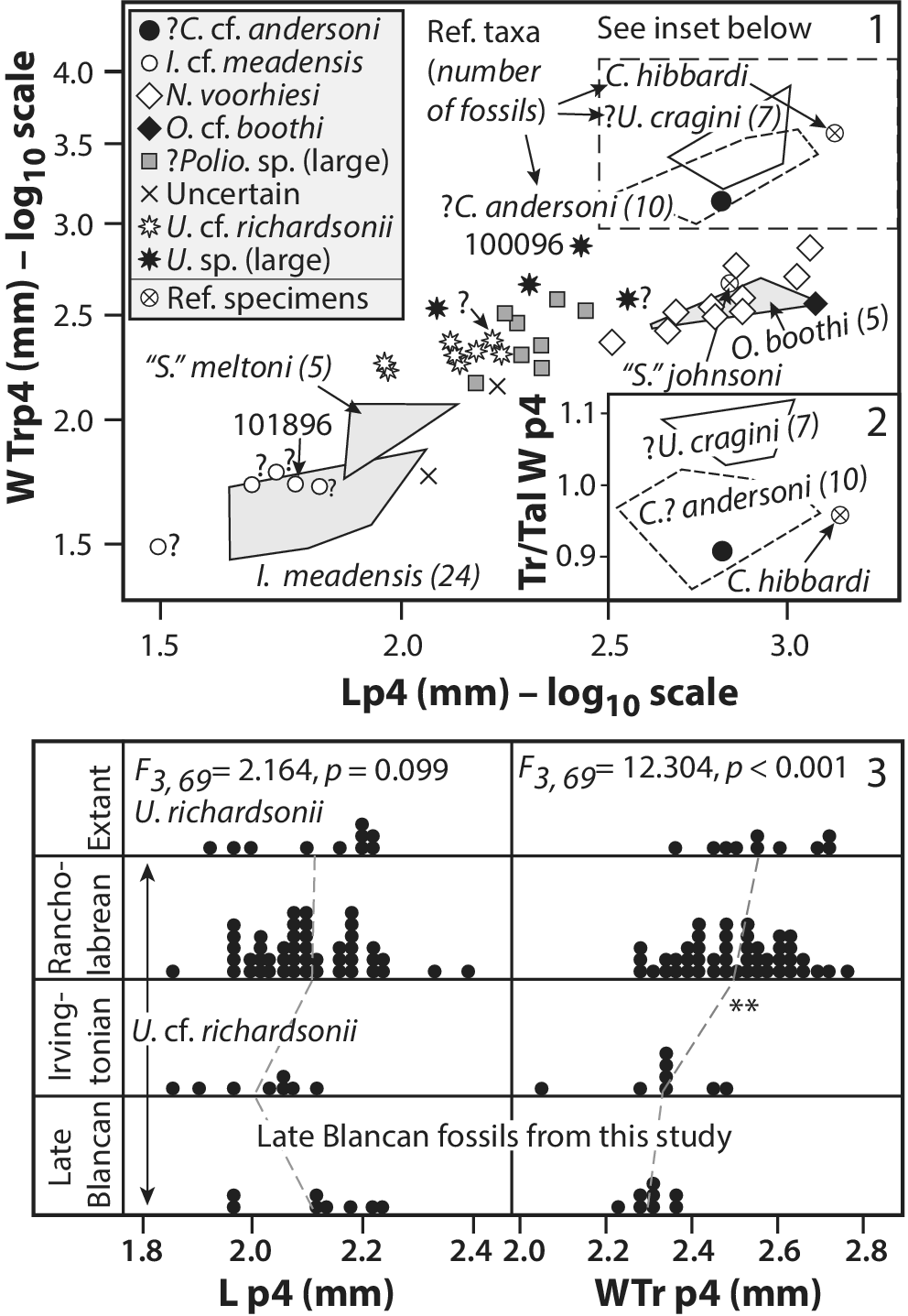
(1) Trigonid width versus tooth length of p4s from the three localities in this study plotted by species and compared with reference taxa depicted as polygons (envelopes of variation) or circles with an X (single specimens). (2) Ratio of trigonid to talonid widths versus tooth length of p4 for ?Cynomys cf. ?C. andersoni from Big Springs compared to reference taxa (inset in (1)). Reference samples: ?C. andersoni from Generator Dome, Porcupine Cave, early Irvingtonian, CO; C. hibbardi from Sappa, early Irvingtonian, NE (based on synonymy of C. sappaensis Goodwin, Reference Goodwin1995, and C. hibbardi in Goodwin and Martin, Reference Goodwin and Martin2017); I. meadensis from Borchers, late Blancan, KS; Otospermophilus boothi from Blancan sites in KS and NE; ?U. cragini from Borchers, late Blancan, KS; and “Spermophilus” meltoni and “S.” johnsoni from Sand Draw, early Blancan, NE. Fossils questionably assigned to species (labeled with question mark) receive comments in Supplemental Appendix 2. (3) Stratigraphic samples of U. cf. U. richardsonii compared to each other and extant U. richardsonii on length and trigonid width of p4. All late Blancan fossils are from this study; Irvingtonian and Rancholabrean fossils are from multiple localities in Kansas and Nebraska. **difference between stratigraphic samples significant at p < 0.01.

Figure 4. Long description
Panel 1 is a scatter plot on a log sub 10 scale. The x-axis is L p 4 (m m) ranging from 1.5 to 3.0. The y-axis is W Tr p 4 (m m) ranging from 1.5 to 4.0. Data points and shaded polygons represent different taxa. I. meadensis clusters in the lower left (1.5 to 2.0 on x-axis). S. meltoni and S. johnsoni occupy the center. O. cf. boothi and N. voorhiesi cluster in the upper right (2.5 to 3.0 on x-axis). A dashed box in the upper right indicates an inset.
Panel 2 is the inset from panel 1. The x-axis is L p 4 (m m) and the y-axis is Tr / Tal W p 4 ranging from 0.9 to 1.1. It shows specific data points for C. hibbardi, C. ? andersoni, and ? U. cragini.
Panel 3 is a multi-row dot plot comparing U. cf. richardsonii across four stratigraphic levels. The left column shows L p 4 (m m) from 1.8 to 2.4. The right column shows W Tr p 4 (m m) from 2.0 to 2.8. The rows, from bottom to top, are: Late Blancan, Irvingtonian, Rancholabrean, and Extant. Dashed lines connect the mean values across these time periods, showing a rightward shift (increase in size) from the Irvingtonian to the Rancholabrean and Extant samples. A double asterisk indicates a significant difference between stratigraphic samples at p < 0.01.
Fossils referred to each species are given in Supplemental Appendices 1 and 2 (upper and lower dentition, respectively). In each appendix, specimens are organized alphabetically by genus and species, locality, element, and catalog number (all UNSM numbers). I also provide dental dimensions when available to facilitate further analysis and comments for selected specimens, notably those with questioned taxonomic assignment.
Genus Otospermophilus Brandt, Reference Brandt1844
Type species
Sciurus grammurus Say in James, Reference James1823, p. 72 by original designation.
Otospermophilus cf. Otospermophilus boothi (Hibbard, Reference Hibbard, Skinner and Hibbard1972)
Reference Hibbard, Skinner and Hibbard1972 Spermophilus (Otospermophilus) boothi Hibbard, p. 82.
Reference Kurtén and Anderson1980 Spermophilus boothi; Kurtén and Anderson, p. 213.
Holotype
UMMP V57273, fragments of skull, maxillae with R and L P3–M3, R dentary with I, p4–m3 (Hibbard, Reference Hibbard, Skinner and Hibbard1972, fig. 31) from the Sand Draw local fauna, Brown County, NE, Blancan Land Mammal Age.
Remarks
Otospermophilus boothi (Hibbard, Reference Hibbard, Skinner and Hibbard1972) is a large ground squirrel from the early and late Blancan of Nebraska and the late Blancan of northeastern Kansas (Hibbard, Reference Hibbard, Skinner and Hibbard1972; Eshelman, Reference Eshelman1975; Goodwin, Reference Goodwin, Janis, Gunnell and Uhen2008). Four fossils from Big Springs resemble the holotype as follows: the M3 exhibits a low but distinct metaloph with slightly swollen metaconule (Fig. 2.1); and on lower cheek teeth, the width of p4 across the trigonid is substantially less than width across the talonid, the metalophids of m2 and m3 are incomplete, not fully enclosing a small trigonid valley, and the p4 displays moderate crown height (Fig. 3.1).
The Big Springs squirrel differs from Otospermophilus boothi in several respects. In contrast to the holotype, the M3 lacks a mesostyle between paracone and metacone (Fig. 2.1); the p4 exhibited a more swollen protolophid, forming a small anteroconid; lower molars displayed a small but distinct ectostylid between protoconid and hypoconid, best developed on m3; and p4 and m3 lacked the small swelling (mesoconid) midway along the ectolophid (Fig. 3.1). Finally, the Big Springs p4 falls at the upper end of variation in tooth length for O. boothi (Fig. 4.1). Thus, the Big Springs fossils are referred to O. cf. O. boothi.
Genus Marmota Blumenbach, Reference Blumenbach1779
Remarks
A lightly worn M3 from Dead Creek represents Marmota, a clade of large-bodied marmots of North America and Asia (Table 1). Assignment to Marmota is supported by large tooth size and the prominent, continuous, distally arcing metaloph that connects the protocone with the posteroloph near the distalmost point of the tooth (Fig. 2.2), the latter features often present on M3s across multiple Old and New World species (personal observation) and possibly on the Early Pleistocene Marmota arizonae Hay, Reference Hay1921, based on a grainy photograph of the skull in ventral view (Hay, Reference Hay1921, pl. 123, fig. 7).
Two extant marmots have ranges that approach or incorporate the central Great Plains: Marmota flaviventris (Audubon and Bachman, Reference Audubon and Bachman1841), a widespread species of high-elevation grassy habitats of the American West that occurs as far eastward as southeastern Wyoming and western South Dakota (Thorington et al., Reference Thorington, Koprowski, Steele and Whatton2012); and Marmota monax (Linnaeus, Reference Linnaeus1758), a marmot that ranges broadly across eastern North America and, in the north, westward into Alaska. Marmota monax is found today in eastern Nebraska (Thorington et al., Reference Thorington, Koprowski, Steele and Whatton2012). M3s of M. flaviventris usually display the prominent, distally arcing metaloph evident on the Dead Creek M3 (11 of 12 specimens) whereas M3s of M. monax do so less frequently (3 of 11 specimens). In tooth dimensions (L = 5.4 mm, W = 5.1 mm), the Dead Creek M3 falls within variation of both M. flaviventris and M. monax in length [X̅ (sd) min–max (n) in mm: 5.2 (0.40) 4.6–5.8 (12), 5.5 (0.40) 4.8–6.1 (10), respectively] and width [5.2 (0.25) 4.9–5.7 (12), 5.6 (0.44) 4.8–6.1 (10), respectively].
The Dead Creek M3 could represent early Marmota flaviventris or M. monax. In either case, it represents the crown clade within Marmota (the clade that includes the most recent common ancestor of extant marmots and all its descendants; see Polly et al., Reference Polly, Cardini, Davis, Steppan, Cox and Hautier2015, fig. 9.2). As such, Marmota sp. from Dead Creek represents the oldest occurrence of crown Marmota on the central or northern Great Plains.
Genus Paenemarmota Hibbard and Schultz, Reference Hibbard and Schultz1948
Type species
Paenemarmota barbouri Hibbard and Schultz, Reference Hibbard and Schultz1948
Paenemarmota barbouri Hibbard and Schultz, Reference Hibbard and Schultz1948
Reference Hibbard and Schultz1948 Paenemarmota barbouri Hibbard and Schultz, p. 19, pls. 1–3.
Holotype
KUVP 6994, left dentary with I, p4–m3. KUVP Locality 22, Rexroad Formation, sec. 34, T.34S, R.30W (Hibbard and Schultz, Reference Hibbard and Schultz1948), Blancan Land Mammal Age.
Remarks
Paenemarmota barbouri Hibbard and Schultz, Reference Hibbard and Schultz1948, is a giant ground squirrel with a wide geographic range during the Blancan (Repenning, Reference Repenning1962; Goodwin, Reference Goodwin, Janis, Gunnell and Uhen2008). One large M1 or M2 (L = 6.96 mm, W = 8.48) from Big Springs fell within the size range of measured M1s or M2s for P. barbouri (n = 11 for combined M1 and M2–L: X̅ = 7.5 mm, SD = 0.52 mm, range = 6.7–8.4 mm; W: X̅ = 8.6 mm, SD = 0.69 mm, range = 7.5–9.5 mm). The tooth was larger than a single M1 (L = 6.7 mm, W = 8.1 mm) that I measured from Paenemarmota sawrockensis (Hibbard, Reference Hibbard1964), a species only known from the late Hemphillian and early Blancan (Voorhies, Reference Voorhies1988; Goodwin, Reference Goodwin, Janis, Gunnell and Uhen2008).
In addition to very large size, other features shared with Paenemarmota include a prominent anterior cingulum, protoloph, and metaloph. However, the mesostyle of the M1 or M2 from Big Springs forms a short, buccolingually elongate ridge in the central valley between the paracone and metacone (Fig. 2.3) that is more expanded buccolingually than in all other M1s or M2s of Paenemarmota examined for this feature (n = 15). One lower incisor fragment from Big Springs likewise represents a giant ground squirrel (incisor depth = 6.75 mm) and displays fine longitudinal grooves on the enamel face as in P. barbouri (Hibbard and Schultz, Reference Hibbard and Schultz1948; Repenning, Reference Repenning1962).
Although Paenemarmota is present in the late Blancan of Texas (Dalquest, Reference Dalquest1975), it was previously known from the early but not late Blancan in Kansas and Nebraska (Goodwin, Reference Goodwin, Janis, Gunnell and Uhen2008; Goodwin and Martin, Reference Goodwin and Martin2017). Thus, the Big Springs fossils represent the first record of the genus from the late Blancan of the central Great Plains. Based on tooth size and stratigraphic position, the Big Springs fossils likely represent P. barbouri, the only member of the genus known elsewhere from the late Blancan.
Genus Urocitellus Obolenskij, Reference Obolenskij1927
Type species
Spermophilus eversmanni Brandt, Reference Brandt1841, by original designation.
Urocitellus cf. U. richardsonii (Sabine, Reference Sabine1822)
Figures 2.6, 3.3, 3.4, 5.1
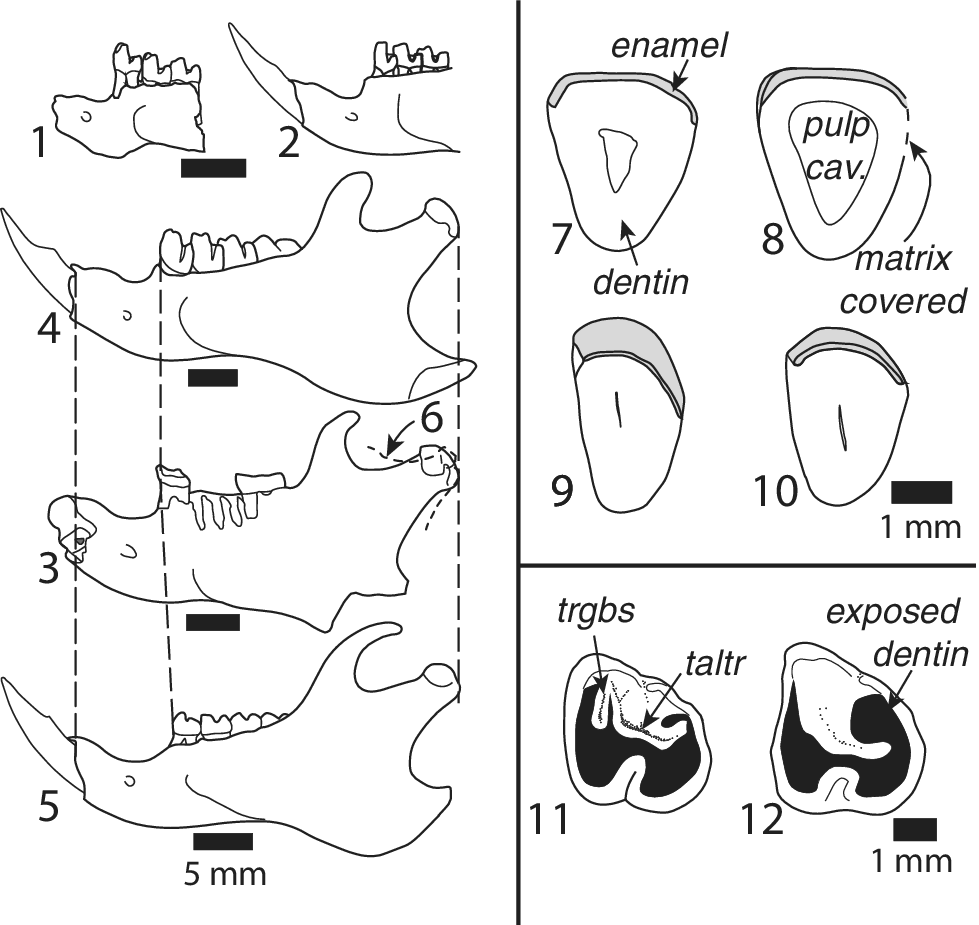
Comparison of dentaries (1–6; all scale bars represent 5 mm) depicted as L dentaries, lower incisors in cross-section (7–10; scale bar applies to all), and worn m3s (11, 12; scale bar applies to both). (1) R dentary fragment (reversed) of Urocitellus cf. U. richardsonii (UNSM 101862) from Big Springs compared with (2) extant Urocitellus elegans (UMMZ 87353; R dentary, reversed; sketch of anterior segment; scale bar shared by (1, 2). (3–5) Sketches of L dentaries scaled to be equivalent in length from the dorsal margin of the incisor’s alveolus to the posterior margin of the condyle (two limiting vertical dashed lines); each sketch with individual 5-mm scale. (3) Nebraskocitellus voorhiesi n. gen. n. sp. (UNSM 101872) from Big Springs compared with (4) extant Cynomys ludovicianus (KU 127925), (5) extant Otospermophilus variegatus (Erxleben, Reference Erxleben1777) (UMMZ 108354), and (6) condyloid process of “Spermophilus” johnsoni (F:AM 87466, holotype) traced as a dotted line from a published drawing (Hibbard, Reference Hibbard, Skinner and Hibbard1972, fig. 32B) after the drawing was scaled between vertical dashed lines (scale bar was not provided in the published drawing). (7, 8) Cross-sections of broken lower R incisors of N. voorhiesi n. gen. n. sp. (UNSM 101867 [holotype] and 101858, respectively) compared with incisor cross-sections of (9) extant O. variegatus (KU 51760; L incisor, reversed) and (10) fossil “S.” johnsoni (F:AM 87466, holotype; L incisor, reversed). (11) Heavily worn L m3 of N. voorhiesi n. gen. n. sp. (UNSM 101872; abbreviations: trgbs = trigonid basin, taltr = talonid basin trench) compared with (12) heavily worn L m3 of “S.” johnsoni (F:AM 87466, holotype).

Figure 5. Long description
The illustration is organized into three distinct areas.
Left Column (Dentaries):
- Panels 1 and 2 at the top show small fragments of Urocitellus dentaries with a shared 5 mm scale bar.
- Panels 4, 3, and 5 are stacked vertically, aligned by dashed vertical lines to show relative proportions. Panel 4 (Cynomys) is at the top, panel 3 (Nebraskocitellus) is in the middle, and panel 5 (Otospermophilus) is at the bottom. Each has an individual 5 mm scale bar.
- Panel 6 is a dotted line overlay on the posterior of panel 3, indicating the condyloid process of Spermophilus johnsoni.
Top-Right Quadrant (Incisor Cross-sections):
- Four teardrop-shaped cross-sections are arranged in a grid with a 1 mm scale bar.
- Panel 7 (top-left) labels the outer layer as enamel and the inner core as dentin.
- Panel 8 (top-right) labels the central void as pulp cav. and a side notch as matrix covered.
- Panels 9 (bottom-left) and 10 (bottom-right) show similar structures for comparison.
Bottom-Right Quadrant (Molar Wear):
- Two occlusal views of m 3 molars are shown with a 1 mm scale bar.
- Panel 11 (left) uses arrows to point to the t r g b s (trigonid basin) and t a l t r (talonid basin trench).
- Panel 12 (right) shows a similar molar with a large dark area labeled as exposed dentin.
Reference Sabine1822 Arctomys richardsonii Sabine, p. 589 [For listing of synonyms in the literature of modern Urocitellus richardsonii, see Michener and Koeppl, Reference Michener and Koeppl1985, p. 1].
Reference Kent1967 Citellus kimballensis Kent, p. 18, figs. 1–3.
Holotype
Holotype not designated. Type locality: Carlton House, Saskatchewan, Canada.
Remarks
Fossils from all three localities were identified as Urocitellus cf. U. richardsonii, a species common in middle Irvingtonian and later faunas of the central Great Plains and possibly present in the latest Blancan Borchers local fauna (Goodwin and Martin, Reference Goodwin and Martin2017). Today, U. richardsonii is widespread across the northern Great Plains and extends as far southeast as extreme northwestern Iowa (Thorington et al., Reference Thorington, Koprowski, Steele and Whatton2012).
Assignment of these late Blancan fossils to Urocitellus is supported by M3s with prominent metaloph and strong distal deflection of the posterior cingulum (Fig. 2.6); lower cheek teeth with mesiodistally compressed, high-crowned trigonids (Fig. 3.3 and 3.4); and m3s with a distinct trench along the buccal margin of the talonid basin and a posterior cingulum that abruptly deflects mesiobuccally distal to the hypoconid (Fig. 3.3).
In length of p4, this late Blancan squirrel did not differ statistically from later Pleistocene samples of Urocitellus cf. U. richardsonii or from extant U. richardsonii (Fig. 4.3, left panel); in trigonid width of p4, the late Blancan and Irvingtonian samples did not differ from each other but were significantly narrower than Rancholabrean and extant samples (p ≤ 0.001; Fig. 4.3, right panel). U. cf. U. richardsonii differs from ?U. cragini (Hibbard, Reference Hibbard1941a) (latest Blancan Borchers local fauna) in much smaller tooth size (Fig. 4.1) and in tooth proportions: in U. cf. U. richardsonii from this study, trigonid width is usually less than talonid width on p4 (data not displayed), whereas in ?U. cragini, trigonid width is greater than talonid width (Fig. 4.2).
Assignment to the lineage of Urocitellus richardsonii seems probable, but two factors support tentative assignment. First, U. richardsonii shows overlap in dental morphology with its sister species, Urocitellus elegans (Kennicott, Reference Kennicott1863) (Goodwin, Reference Goodwin2002). Urocitellus elegans today occupies open habitats in the central Rockies and northern Basin and Range (Zegers, Reference Zegers1984) and was present in montane central Colorado by the middle Irvingtonian (Goodwin, Reference Goodwin2002). Second, fossils are underived relative to extant U. richardsonii in proportionally lesser trigonid widths (Fig. 4.3, right panel) and a shallower, less abrupt depression of the dorsal surface of the diastema anterior to p4 (compare Fig. 5.1 with 5.2). Although I tentatively recognize an early, underived segment of the U. richardsonii lineage, fossils might represent a stem species of Urocitellus not directly in the lineage of U. richardsonii.
Urocitellus sp. (large)
Remarks
One high-crowned, molariform p4 from Big Springs represents a second species of Urocitellus that differs metrically from U. cf. U. richardsonii in larger tooth size and proportionally greater trigonid width (UNSM 100096; labeled in Fig. 4.1). In contrast to extant Urocitellus and fossil U. cf. U. richardsonii, this p4 displays a complete protolophid that merges with the metaconid without interruption (Fig. 3.5), a feature characteristic of the latest Blancan ?Urocitellus cragini (Hibbard, Reference Hibbard1941a) and all extant and most fossil Cynomys (Goodwin and Hayes, Reference Goodwin and Hayes1994). However, this p4 differs from those of ?U. cragini and all Cynomys in much smaller size (Fig. 4.1). Three additional p4s from Dead Creek (n = 1) and Hornet’s Nest (n = 2) likewise represent a large-sized Urocitellus (Fig. 4.1) but lack the distinctive, complete protolophid of UNSM 100096 (Fig. 3.5). I conservatively assign all four to the same species, here referred to as Urocitellus sp. (large), but recognize that two species may be present.
Multiple other fossils were assigned to Urocitellus sp. (large). In addition to size (larger than equivalent fossils of U. cf. U. richardsonii), the following attributes support this assignment: lower cheek teeth with compressed trigonids, m3s with a distinct trench along the buccal margin of the talonid basin and a posterior cingulum that abruptly deflects mesiobuccally distal to the hypoconid, and the maxilla with a triangular infraorbital foramen with an outer wall that slopes ventrolaterally from its dorsal origin. M3s assigned to this species differ from those of ?U. cragini by lesser buccal extension of the parastyle on M3 (Goodwin and Hayes, Reference Goodwin and Hayes1994, fig. 3A).
In tooth size, Urocitellus sp. (large) resembles a poorly known, undescribed ground squirrel from Borchers, Urocitellus “morph A” (Goodwin and Hayes, Reference Goodwin and Hayes1994; Goodwin and Martin, Reference Goodwin and Martin2017). However, two P4s assigned to Urocitellus sp. (large) differed from the P4 of “morph A”: the anterior cingulum tapers progressively from the buccal margin to its lingual terminus about three-quarters of the way across the mesial face of the tooth and is not restricted to the buccal one-half of the tooth as in “morph A” (Goodwin and Hayes, Reference Goodwin and Hayes1994, fig. 4C). I leave these fossils unassigned to species.
Genus Poliocitellus Howell, Reference Howell1938
Type species
Arctomys franklinii Sabine, Reference Sabine1822, by original designation.
Poliocitellus sp.
Remarks
Several cheek teeth from Hornet’s Nest represent a small species of Poliocitellus, which today includes only Poliocitellus franklinii (Sabine, Reference Sabine1822), an endemic ground squirrel of the central and northern Great Plains that occupies tall-grass prairie (Thorington et al., Reference Thorington, Koprowski, Steele and Whatton2012). Poliocitellus lorisrusselli (Hibbard, Reference Hibbard and Churcher1976) from the middle Irvingtonian of Kansas represents a temporal segment of the same lineage that averaged smaller in size, which Goodwin and Martin (Reference Goodwin and Martin2017) considered to be a junior synonym of P. franklinii. Teeth from Hornet’s Nest share the following features with extant and fossil Poliocitellus: relatively low-crowned cheek teeth (Fig. 2.4 and 2.5), unlike the high-crowned teeth of Urocitellus (e.g., Fig. 2.6); complete but low metaloph on P4 through M2 (Fig. 2.4), unlike the interrupted metaloph of Ictidomys; and M3s that lack the strong posterior expansion and prominent, buccally extending metaloph characteristic of Urocitellus cf. U. richardsonii (Sabine, Reference Sabine1822) (compare Fig. 2.5 and 2.6).
The Hornet’s Nest cheek teeth resemble Irvingtonian more than extant Poliocitellus franklinii in two features. First, in tooth size (e.g., length M3: X̅ = 2.55 mm, SD = 0.18 mm, n = 2), teeth of this squirrel closely resembled Irvingtonian fossils from Kansas and Nebraska (X̅ = 2.60 mm, SD = 0.16 mm, n = 5) but are distinctly smaller than teeth of extant specimens (X̅ = 2.89 mm, SD = 0.17 mm, n = 6). Second, one of 2 M3s assigned to Poliocitellus sp. (UNSM 98873) has a low metaloph with slight distal deflection (Fig. 2.5) also evident on one M3 identified as Poliocitellus from the middle Irvingtonian Cudahy locality, southwestern Kansas (fig. 7.3 in Goodwin and Martin, Reference Goodwin and Martin2017), a feature not observed in extant P. franklinii inspected for this feature (n = 6).
Two m3s questionably assigned to this taxon, including one from Dead Creek, are low-crowned and have a broadly open buccal valley, as in extant and fossil Poliocitellus franklinii. They differ from all other m3s of Poliocitellus that I examined in the distinct “conulids” along the distolingual margin of the tooth, prominent deflection of the lingual margin at the entoconid, and rugosity on the floor of the talonid basin (Fig. 3.2).
?Poliocitellus sp. (large)
Remarks
Fossils from all three localities represent an additional species provisionally identified as ?Poliocitellus sp. (large), with cheek teeth ~15–20% larger than those of Poliocitellus sp. (measurements in Supplemental Appendices 1 and 2). The p4s average slightly larger than those of U. cf. U. richardsonii (Fig. 4.1) and differ from the latter in the more robust, lower crowned trigonid (Fig. 3.8 compared with Fig. 3.4), the latter features resembling p4s of Poliocitellus. Other features resembling those of Poliocitellus include: m3s with a robust trigonid and continuously curved posterior cingulum distal to the hypoconid; upper M1 and M2 with a complete metaloph, swollen metaconule, and in one of 2 specimens a mesostyle; and M3 lacking the prominent metaloph and strong distal deflection of the posterior cingulum characteristic of species of Urocitellus. In contrast, a lower dentary from Big Springs assigned to this species (UNSM 54133; Supplemental Appendix 2) is substantially more robust and exhibits a proportionally shorter diastemal region than dentaries of Poliocitellus. I thus provisionally assign these fossils to ?Poliocitellus sp. (large). This material warrants further study; it probably represents a species new to science.
Prior to this study, the earliest confirmed record of Poliocitellus was from the middle Irvingtonian Cudahy and equivalent local faunas of Kansas, although the lineage may have been present by the early Irvingtonian (Goodwin and Martin, Reference Goodwin and Martin2017). Thus, fossils reported here represent the earliest global record of the genus and likely indicate the co-occurrence of two species of Poliocitellus, hinting at a previously unknown, small radiation in the Early Pleistocene with subsequent extinction to yield only one extant species, P. franklinii.
Genus Ictidomys Allen, Reference Allen, Coues and Allen1877
Type species
Sciurus tridecemlineatus Mitchill, Reference Mitchill1821, assigned by Merriam, Reference Merriam1895.
Ictidomys cf. I. meadensis (Hibbard, Reference Hibbard1941a)
Reference Hibbard1941a Citellus meadensis Hibbard, p. 203, pl. 1, figs. 2 and 7.
Reference Hibbard1941b Citellus howelli Hibbard, p. 347, fig. 6.
Reference Kurtén and Anderson1980 Spermophilus howelli; Kurtén and Anderson, p. 212.
Reference Kurtén and Anderson1980 Spermophilus meadensis; Kurtén and Anderson, p. 214.
Reference Goodwin and Martin2017 Ictidomys meadensis; Goodwin and Martin, p. 1248.
Holotype
KUVP 6169, right dentary with p4–m2 from Borchers, Meade County, KS (Hibbard, Reference Hibbard1941a, pl. 1, fig. 2). Paratype KUVP 6119, left maxillary fragment with P4–M2 from Borchers, Meade County, KS (Hibbard, Reference Hibbard1941a, pl. 1, fig. 7). Blancan Land Mammal Age.
Remarks
A small ground squirrel from Big Springs closely resembles Ictidomys meadensis (Hibbard, Reference Hibbard1941a), otherwise known from multiple Blancan localities in the Meade Basin including the late Blancan Borchers local fauna (Goodwin and Martin, Reference Goodwin and Martin2017) but shows some similarities to “Spermophilus” meltoni from the early Blancan Sand Draw local fauna of northcentral Nebraska. Two of 3 small M3s display a continuous ridge from the protoloph to the posterior border of the tooth (Fig. 2.7), but this ridge is interrupted by a sharp notch in a third M3. The latter feature is present in about 60% of M3s of I. meadensis from Borchers (see Goodwin and Martin, Reference Goodwin and Martin2017, fig. 7.1). The M3 was not reported for “S.” meltoni (Hibbard, Reference Hibbard, Skinner and Hibbard1972).
Qualitatively, lower cheek teeth of this small Big Springs squirrel resemble both Ictidomys meadensis and “Spermophilus” meltoni as follows: p4 distinctly narrower across the trigonid than across the talonid (Fig. 3.6); low to moderate crown height on all molars; a metalophid that encloses a small trigonid pit on m1 but not m2 or m3; m2 with a distolingual margin that follows a gradual arc; and m3 with a relatively small hypoconid that does not deflect mesially as in Urocitellus. Metrically, the small p4 from Big Springs (UNSM 101896; labeled in Fig. 4.1) plots within the envelope of variation of I. meadensis from Borchers but near the upper limit of variation in trigonid width; it falls outside the envelope of variation of “S.” meltoni from Sand Draw (Fig. 4.1). Taken together, qualitative and metric evidence is most consistent with assignment of the small fossils from Big Springs to I. meadensis, although assignment to “S.” meltoni cannot be ruled out. Thus, these fossils are assigned to I. cf. I. meadensis.
A small squirrel is also present at Dead Creek and Hornet’s Nest, with 3 of 4 p4s from these localities likewise plotting within or near the envelop of variation of Ictidomys meadensis from Borchers but near the upper bound of variation in trigonid width (Fig. 4.1). A fourth p4 is substantially smaller (Fig. 4.1) but its dimensions may be affected by heavy wear. Despite metric similarity with I. meadensis, most of these small fossils (all 4 from Dead Creek and 4 of 5 from Hornet’s Nest) are questionably assigned to the species because they differ from typical morphologies in the Borchers sample of I. meadensis or the Sand Draw sample of “Spermophilus” meltoni (see comments in Supplemental Appendices 1 and 2). These differences include: P4 with the protocone offset distally to the protoloph (UNSM 98887) or more mesiodistally compressed protocone (UNSM 98874); M1 or M2 with more mesiodistally compressed protocone (UNSM 98888); and p4 with a flattened versus convex distal border and more lingually extended entoconid (UNSM 98883), proportionally lesser talonid width (UNSM 98884), or more prominently delimited anteroconid (UNSM 98897). These fossils may represent one or more different species.
Genus Cynomys Rafinesque, Reference Rafinesque1817
Type species
Cynomys socialis Rafinesque, Reference Rafinesque1817, by original designation [= Cynomys ludovicianus (Ord, Reference Ord, Guthrie, Ferguson, Knox and Ord1815)].
?Cynomys cf. ?Cynomys andersoni Goodwin, Reference Goodwin and Barnosky2004
Reference Goodwin and Barnosky2004 ?Cynomys andersoni Goodwin, p. 180, fig. 17.4.
Holotype
DMNH 28320, left dentary with m1–m3. Generator Dome locality, Porcupine Cave, Park County, CO, Irvingtonian Land Mammal Age (Goodwin, Reference Goodwin and Barnosky2004).
Remarks
A dentary fragment with p4 and m1 from Big Springs represents a large ground squirrel with high-crowned, moderately wide teeth (Fig. 3.7) that could represent a large species of Urocitellus or small species of Cynomys. Candidate taxa include ?Urocitellus cragini (Hibbard, Reference Hibbard1941a) and Cynomys hibbardi Eshelman, Reference Eshelman1975, both known from the late Blancan of the central Great Plains (Borchers and White Rock, respectively; see Fig. 1); and ?Cynomys andersoni Goodwin, Reference Goodwin and Barnosky2004, otherwise known from the early to middle Irvingtonian of Colorado (Goodwin, Reference Goodwin and Barnosky2004; see Fig. 1). Metrically, the p4 of the Big Springs fossil falls within the envelope of variation for p4s of ?C. andersoni in plots of trigonid width versus tooth length (Fig. 4.1) and the trigonid/talonid ratio versus tooth length (Fig. 4.2), but it exhibits a substantially lower trigonid/talonid ratio than p4s of ?U. cragini (Fig. 4.2). The Big Springs p4 is ~11% smaller than one p4 of C. hibbardi; both have a trigonid/talonid ratio < 1.0 (Fig. 4.2).
Qualitatively, the Big Springs ground squirrel differs from ?Urocitellus cragini and Cynomys hibbardi in the notably incomplete protolophid on p4, separated from the metaconid by a distinct notch (Fig. 3.7). This notch was more pronounced on the Big Springs fossil than typical for most p4s of ?C. andersoni, but some specimens of the latter displayed a small notch. It differs from C. hibbardi in the lack of rugosity on the floor of the talonid of m1 (Fig. 3.7), a feature that it shares with ?U. cragini and ?C. andersoni. Overall, metric and qualitative comparisons are most consistent with identification as ?C. cf. ?C. andersoni.
Genus Nebraskocitellus new genus
Type species
Nebraskocitellus voorhiesi n. gen. n. sp. by monotypy.
Diagnosis
The diagnosis given for the species serves as diagnosis for the genus due to monotypy.
Etymology
Name derived from Nebraska (location of type) and ground squirrel (Latinized form of ziesel, German for ground squirrel; Palmer, Reference Palmer1904).
Remarks
The genus Nebraskocitellus n. gen incorporates a single species of ground squirrel from the Early Pleistocene of northeastern Nebraska with divergent dental morphology. Its phylogenetic placement in Marmotini is uncertain.
Nebraskocitellus voorhiesi new species
Figures 2.8, 5.3, 5.7–5.8, 5.11, 6
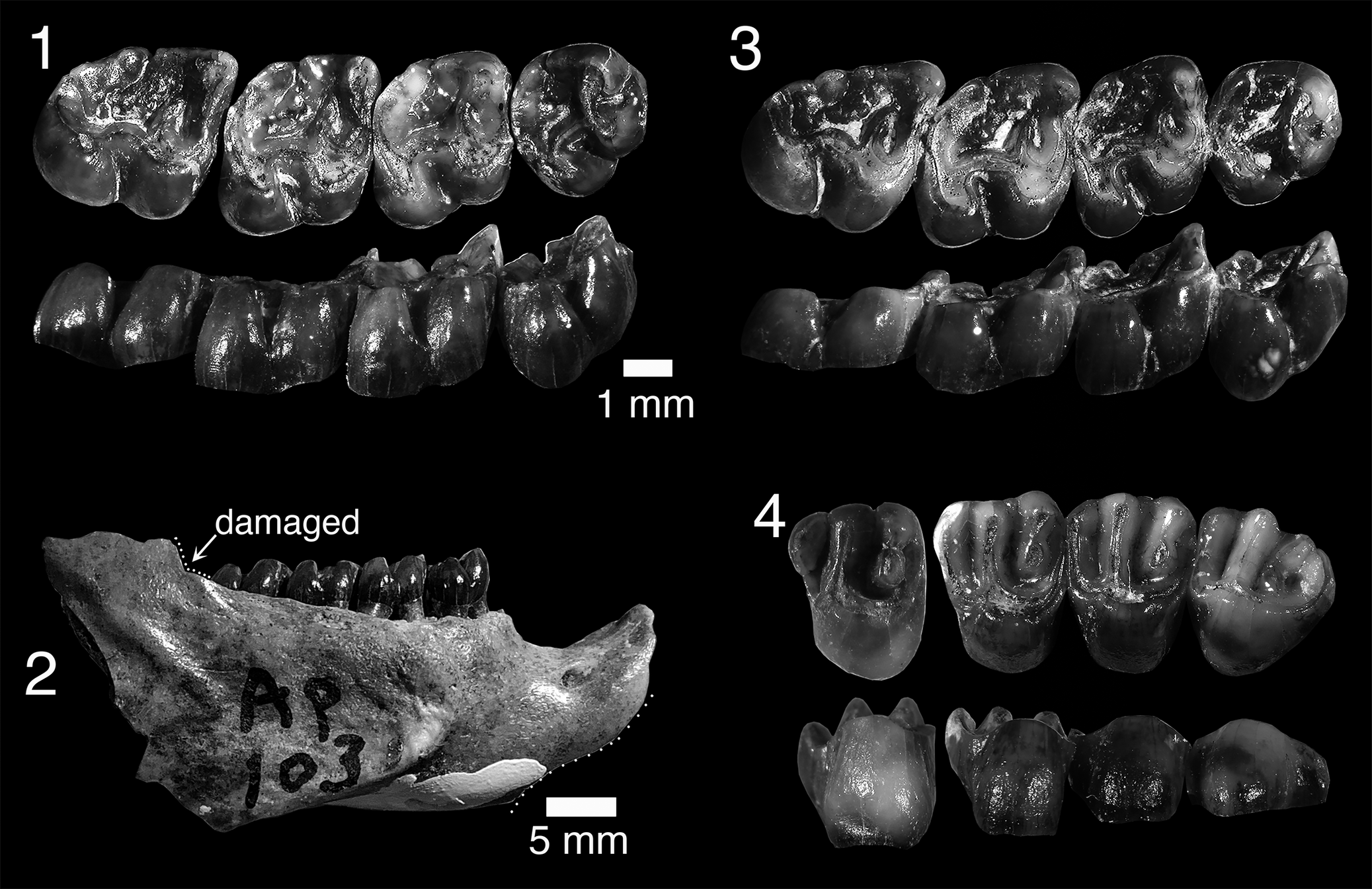
Nebraskocitellus voorhiesi n. gen. n. sp., all from Big Springs locality. (1, 2) UNSM 101867, holotype R dentary with incisor fragment and p4–m3 (mesial to the right) with (1) occlusal (upper) and buccal (lower) views of R p4–m3 and (2) lateral view of dentary. Dotted lines depict damage not obvious in photo. (3) UNSM 101858, R p4–m3 in occlusal (upper) and buccal (lower) views. (4) Composite L P4–M3 (R P4 reversed: UNSM 101873; L M1–M3: UNSM 101899) in occlusal (upper) and lingual (lower) views, mesial to the left. 1-mm scale bar applies to all dental photos; 5-mm scale applies to dentary photo.

Figure 6. Long description
A four-panel collection of black and white photos showing dental fossils.
Panel 1 at the top left shows specimen U N S M 101867. The top row is an occlusal view of four teeth (p 4 to m 3) with complex ridges and cusps. The bottom row shows the same teeth in a buccal view, highlighting the vertical height of the crowns. A 1 millimeter scale bar is positioned to the right.
Panel 2 at the bottom left shows a lateral view of the right dentary (jawbone) labeled A P 103. The bone is thick with a curved lower margin. A dotted line and arrow point to a damaged area behind the tooth row. A 5 millimeter scale bar is at the bottom right.
Panel 3 at the top right shows specimen U N S M 101858. Similar to panel 1, it displays an occlusal view above a buccal view of the p 4 to m 3 tooth row. The teeth show significant wear on the grinding surfaces.
Panel 4 at the bottom right shows a composite of left P 4 to M 3 teeth. The top row is the occlusal view and the bottom row is the lingual view. These upper teeth have a more rounded, bulbous shape compared to the lower teeth in panels 1 and 3. The 1 millimeter scale bar from panel 1 applies here as well.
Holotype
R dentary with incisor fragment, p4–m3 (UNSM 101867) from Big Springs local fauna, Blancan Land Mammal Age.
Diagnosis
Moderately large ground squirrel; dentary with robust, somewhat shortened diastema; lower incisor roughly triangular in cross section with broad, flattened external enamel face; p4–m3 moderately high-crowned with little difference in crown height of the trigonid and talonid; p4–m3 with robust conids and lophids, a prominent notch along lingual margin mesial to the entoconid, well-developed trench in the talonid basin along the distal margin of the trigonid and lingual margin of the ectolophid and bounded by band of rugose enamel of talonid floor; m1 with metalophid that usually joins distal surface of metaconid to enclose prominent, semi-circular to oval trigonid valley; m2–m3 with pronounced metalophid that forms robust, lingually directed ridge extending >1/2 way across the talonid on m3 and bounding a buccolingually elongate trigonid valley that usually is not closed at its lingual terminus and that is not substantially elevated above the floor of talonid.
Description
P3 is not known for Nebraskocitellus voorhiesi n. gen. n. sp. P4–M2 each bear a robust protocone that is especially expanded mesiodistally on P4; a complete protoloph; and a shortened metaloph with prominent, swollen metaconule that fails to merge with the protocone at its lingual end (Fig. 6.4). On P4, the anterior cingulum is roughly teardrop-shaped, abruptly tapers lingually, and is restricted to the buccal half of the tooth (Fig. 6.4). On M1–M3, the anterior cingulum does not abruptly taper lingually and extends farther lingually than on P4 (Fig. 6.4). No mesostyle is evident between the protocone and metacone on P4 (n = 3); a small mesostyle is present on M1 and M2 (Fig. 6.4).
All M3s (n = 8) bear a prominent, complete metaloph that extends from the distobuccal surface of a mesiodistally elongate protocone to the buccal margin of the tooth (Figs. 3.8, 6.4). In 3 of 8 specimens, a distally projecting spur extends from the metaloph toward the posterior cingulum (Fig. 2.8). In 2 of 8 M3s, a small mesostyle is present just distal to the paracone.
The dentaries of Nebraskocitellus voorhiesi n. gen. n. sp. are robust and bear a stout anterior segment beneath the diastema that is relatively short compared to the length of the jaw (Figs. 5.3, 6.2). The coronoid process of the dentary arises at or posterior to the m3 in lateral view, with dorsal and posterior orientation (Fig. 5.3). The mental foramen opens about halfway between the anterior border of the p4 alveolus and the incisor alveolus (Figs. 5.3, 6.2).
The lower incisor of Nebraskocitellus voorhiesi n. gen. n. sp. bears a broad, flattened enamel face and a somewhat triangular cross section (Fig. 5.7, 5.8). Lower cheek teeth are moderately high-crowned with little difference in crown height of the trigonid and talonid (e.g., Fig. 6.1 buccal view). Each lower cheek tooth bears robust conids and lophids and a pronounced talonid trench that extends along the distal margin of the trigonid and lingual margin of the ectolophid (Fig. 6.1, 6.3). A prominent notch is evident in the lingual margin of each lower cheek tooth, just mesial to the entoconid (Fig. 6.1, 6.3). A prominent, low ridge of rugose enamel extends from the lingual margin just distal to the metaconid obliquely across the talonid toward the hypoconid. This rugose ridge is bounded mesially and buccally by the talonid trench and distally by a narrow valley confluent with the notch mesial to the entoconid (Fig. 6.1, 6.3).
The p4 bears a small but pronounced protolophid that is sometimes swollen to form a small anteroconid (Fig. 6.1, 6.3). The protoconid and metaconid are appressed together, and therefore the width of the p4 across the trigonid is substantially less than width of the tooth across the talonid. The m1 to m3 all display a pronounced metalophid. On m1, this metalophid characteristically joins the posterior surface of the metaconid and thus encloses a prominent trigonid pit that is circular to oval in outline (Fig. 6.1, 6.3). On m2 and m3, the buccal arm of the metalophid forms a robust, lingually extended ridge that parallels the protolophid and bounds a prominent, buccolingually elongate trigonid valley that usually is not closed at its lingual terminus (Fig. 6.1, 6.3). The trigonid valley is not much elevated above the talonid basin. The robust, elongate buccal arm of the metalophid, the buccolingually elongate trigonid valley, and the talonid trench, remain visible even on m3s with heavy wear (Fig. 5.11).
Etymology
Specific epithet recognizes Michael R. Voorhies for his contribution to the study of fossil mammals from Nebraska.
Remarks
Nebraskocitellus voorhiesi n. gen. n. sp. is distinctive. The broad, flattened enamel face of the lower incisors (Fig. 5.7, 5.8) differs from the distinctly curved enamel face of all other ground squirrels, modern and fossil, that I have examined for this feature (e.g., Fig. 5.9, 5.10). This gives the lower incisor a somewhat triangular cross-sectional shape versus the teardrop shape characteristic of other ground squirrels. The robust, lingually elongate, buccal arm of the metalophid, and correspondingly elongate trigonid valley on m2 and m3 (Fig. 6.1, 6.3), likewise differ from those in modern and fossil representatives of extant genera. In most extant ground squirrels, the buccal arm of the metalophid is short and descends abruptly, either extending to the floor of the talonid (thus bounding a short trigonid valley that is open lingually) or merging with the distal face of the trigonid (bounding a short trigonid valley closed lingually).
Resembling Nebraskocitellus voorhiesi n. gen. n. sp., the m3 of extant Cynomys exhibits a lingually extended metalophid that bounds an elongate trigonid valley. But in Cynomys, this valley is fully closed and is elevated well above the floor of the talonid, unlike in N. voorhiesi. Nebraskocitellus voorhiesi n. gen. n. sp. also resembles Cynomys in its robust dentary with a proportionally shortened diastemal region and more dorsally projecting coronoid process (compare Fig. 5.3 and 5.4) compared with many ground squirrels (e.g. Otospermophilus; Fig. 5.5).
In tooth size, Nebraskocitellus voorhiesi n. gen. n. sp. resembles Otospermophilus boothi and “Spermophilus” johnsoni (Fig. 4.1), ground squirrels described from the early Blancan Sand Rock local fauna of northcentral Nebraska (Hibbard, Reference Hibbard, Skinner and Hibbard1972; see Fig. 1). However, O. boothi and “S.” johnsoni (Fig. 5.10) lack the flattened enamel face of the lower incisors. Otospermophilus boothi exhibits a talonid basin trench as in N. voorhiesi n. gen. n. sp. but lacks the prominent notch mesial to the entoconid and the robust, lingually extended metalophid and elongate trigonid valley on m2 and m3 (compare Fig. 3.1 with Fig. 6.1 and 6.3). The type of “S.” johnsoni has heavily worn cheek teeth, but the m3 shows no evidence of an extended metalophid, elongate trigonid, or deep basin trench (Fig. 5.12), all features visible on a similarly worn m3 of N. voorhiesi (Fig. 5.11). Also, the condylar process of the dentary in “S.” johnsoni abruptly deepens anterior to the condyle (Fig. 5.6) compared to that of N. voorhiesi n. gen. n. sp. (Fig. 5.3).
Nebraskocitellus voorhiesi n. gen. n. sp. resembles Parapaenemarmota oregonensis (Shotwell, Reference Shotwell1956), a giant ground squirrel from the late Hemphillian of Oregon (Martin, Reference Martin1998), in the complete metalophid enclosing a prominent trigonid valley on m1, talonid trench and rugose enamel on talonid floor of p4 and m1, and complete metaloph on M3. It differs from P. oregonensis in the more well-developed notch mesial to the entoconid, the more abrupt drop of the dorsal surface of the dentary anterior to p4, and placement of the mental foramen about one-half versus two-thirds the distance between the alveoli of p4 and incisor (based on description in Martin, Reference Martin1998). The distinctive lower incisor and m3 are unreported for P. oregonensis.
Nebraskocitellus voorhiesi n. gen. n. sp. resembles Paenemarmota barbouri and P. sawrockensis in the talonid trench and rugose enamel on the talonid floor of p4–m3 and the robust, lingually elongate metalophid of m3 that bounds a buccolingually elongate trigonid valley that is not much elevated above the floor of the talonid. It differs from P. barbouri and P. sawrockensis in the complete metaloph on M3 (notably incomplete in the latter two species), flattened and non-striated enamel face of the lower incisor, and more triangular shape of m3, which appears less strongly triangular in Paenemarmota because the entoconid of m3s is typically placed more lingually than on m3s of N. voorhiesi. Nebraskocitellus voorhiesi n. gen. n. sp. differs markedly from all three of these giant ground squirrels (P. oregonensis, P. barbouri, and P. sawrockensis) in much smaller tooth size.
The systematic position of Nebraskocitellus voorhiesi n. gen. n. sp. is uncertain, but two hypotheses deserve consideration. First, perhaps N. voorhiesi evolved during the rapid, late Neogene radiation that yielded Cynomys. As noted above, these taxa share features of the dentary as well as robust, lingually extended metalophids on m2 to m3. They also have body masses that are much larger than the those of the lined ground squirrels (Ictidomys), which are likely the closest extant relatives of Cynomys (McLean et al., Reference McLean, Bell, Allen, Helgen and Cook2019). This hypothesis implies that N. voorhiesi n. gen. n. sp. diverged from the most recent common ancestor of Cynomys before the late Blancan, when C. hibbardi and ?C. andersoni first appear.
Alternatively, perhaps Nebraskocitellus voorhiesi n. gen. n. sp. originated during the late Neogene radiation that yielded the giant ground squirrels, Parapaenemarmota and Paenemarmota. This hypothesis implies that N. voorhiesi originated outside Paenemarmota because it lacks diagnostic features of that clade, such as very large body size and heavily striated enamel on lower incisors. This hypothesis indicates an origin before the late Hemphillian.
Specimens of uncertain taxonomic placement
I was unable to place some fossils taxonomically because of morphological overlap between taxa, unusual morphologies that did not align with known species, lack of association with diagnostic teeth, or heavy wear/corrosion. To facilitate further study, these fossils are listed at the end of each Supplemental Appendix (as uncertain spp.) with comments on why each specimen was not assigned to species.
Discussion
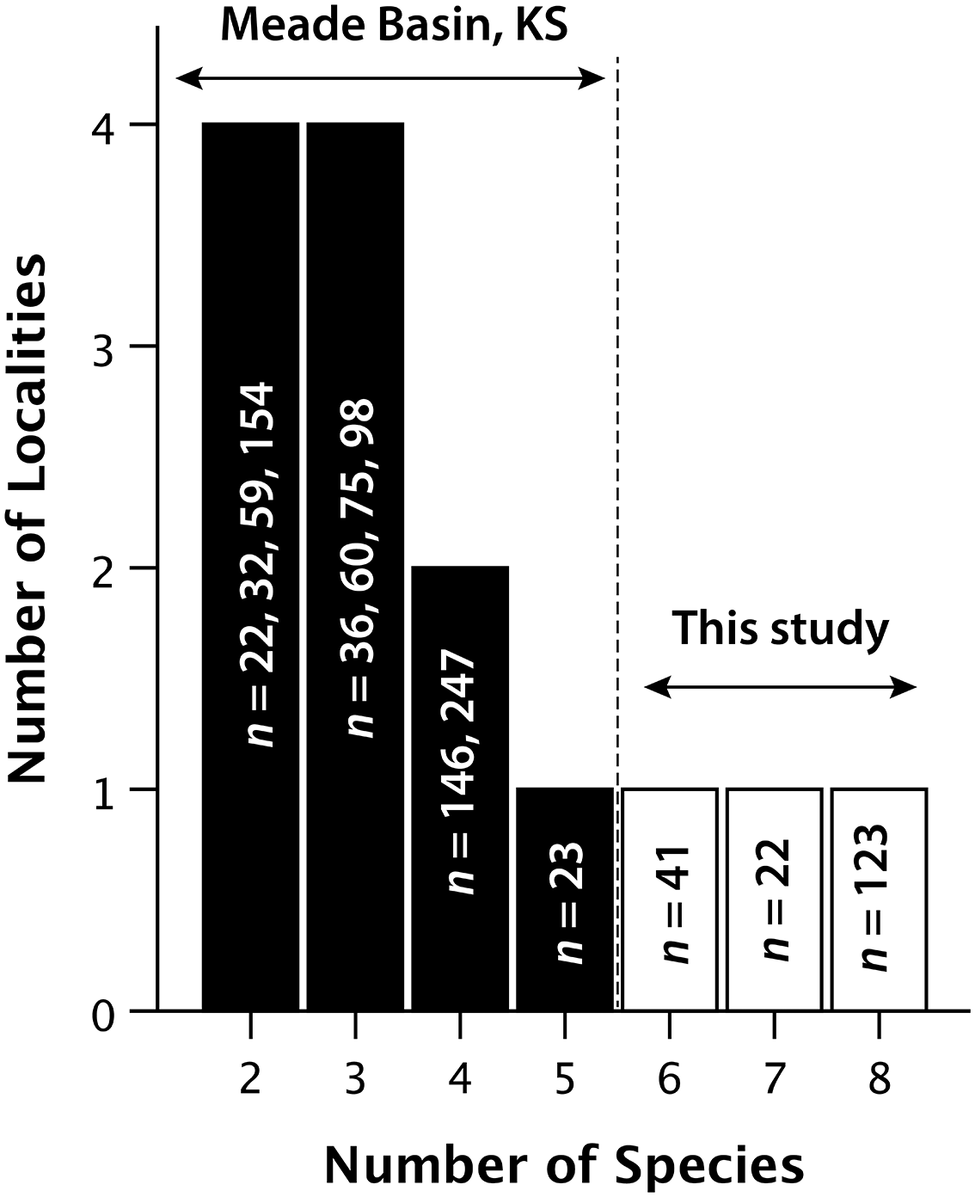
Late Blancan ground squirrel assemblages from northeastern Nebraska display high species diversity: all three localities yielded more species per locality (n ≥ 6; Table 2) than 36 squirrel-bearing local faunas from the Blancan to Rancholabrean sequence of the Meade Basin, Kansas (Goodwin and Martin, Reference Goodwin and Martin2017, table 1), including 11 local faunas with comparable numbers of fossil ground squirrels (> 20; Fig. 7). These assemblages also display high paleoecological diversity, with body masses differing by nearly 2 orders of magnitude at Big Springs (Table 2) and dietary niches likely ranging from granivores (e.g., Otospermophilus cf. O. boothi and I. cf. I. meadensis with relatively low-crowned teeth) to grazers (e.g., species of Urocitellus and ?Cynomys with high-crowned teeth; see Goodwin, Reference Goodwin2009). Nebraskocitellus voorhiesi n. gen. n. sp. may have had an unusual niche based on its unique incisor morphology with broad, flattened enamel face (Fig. 5.7, 5.8). Elevated diversity cannot be attributed to better sampling: multiple ground squirrel assemblages from the Meade Basin were also represented by large fossil samples yet with lower taxonomic diversity (Fig. 7). Also, there is no reason to expect greater time-averaging of faunas in northeastern Nebraska than in southwestern Kansas. The elevated diversity in northeastern Nebraska probably is real.
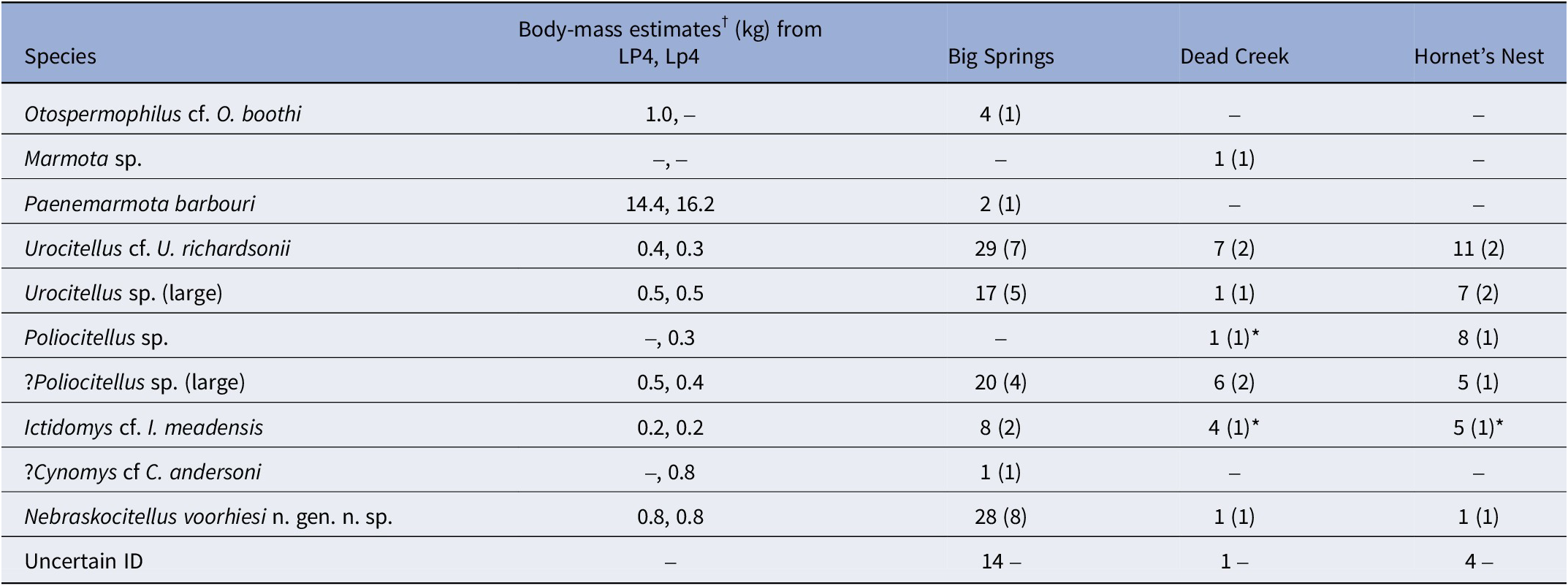
Ground squirrel taxa from three early Pleistocene localities in northeastern Nebraska. Numbers represent number of specimens (minimum number of individuals). Taxonomic sequence follows the text. † = Body masses inferred from dimensions of teeth in this study except for Paenemarmota barbouri, obtained from Goodwin and Bullock (Reference Goodwin and Bullock2012). * = Taxon identified at that location with question.

Table 2. Long description
The table contains 11 rows of data across 5 columns. Numbers in the locality columns represent the number of specimens followed by the minimum number of individuals in parentheses.
* Otospermophilus cf. O. boothi: Body mass 1.0, dash; Big Springs 4 (1); Dead Creek dash; Hornet’s Nest dash.
* Marmota sp.: Body mass dash, dash; Big Springs dash; Dead Creek 1 (1); Hornet’s Nest dash.
* Paenemarmota barbouri: Body mass 14.4, 16.2; Big Springs 2 (1); Dead Creek dash; Hornet’s Nest dash.
* Urocitellus cf. U. richardsonii: Body mass 0.4, 0.3; Big Springs 29 (7); Dead Creek 7 (2); Hornet’s Nest 11 (2).
* Urocitellus sp. (large): Body mass 0.5, 0.5; Big Springs 17 (5); Dead Creek 1 (1); Hornet’s Nest 7 (2).
* Poliocitellus sp.: Body mass dash, 0.3; Big Springs dash; Dead Creek 1 (1) asterisk; Hornet’s Nest 8 (1).
* ?Poliocitellus sp. (large): Body mass 0.5, 0.4; Big Springs 20 (4); Dead Creek 6 (2); Hornet’s Nest 5 (1).
* Ictidomys cf. I. meadensis: Body mass 0.2, 0.2; Big Springs 8 (2); Dead Creek 4 (1) asterisk; Hornet’s Nest 5 (1) asterisk.
* ?Cynomys cf C. andersoni: Body mass 0.8, dash; Big Springs 1 (1); Dead Creek dash; Hornet’s Nest dash.
* Nebraskocitellus voorhiesi n. gen. n. sp.: Body mass 0.8, 0.8; Big Springs 28 (8); Dead Creek 1 (1); Hornet’s Nest 1 (1).
* Uncertain ID: Body mass dash; Big Springs 14 dash; Dead Creek 1 dash; Hornet’s Nest 4 dash.
Distribution of local faunas from the Meade Basin, KS (dark bars) and this study (open bars) by number of ground-squirrel species per locality. For the Meade Basin, only localities with >20 specimens of ground squirrels were included. Numbers within each bar represent numbers of ground squirrel fossils per locality.

Figure 7. Long description
A vertical bar chart with the Y axis labeled Number of Localities ranging from 0 to 4 and the X axis labeled Number of Species ranging from 2 to 8. A dashed vertical line separates the data into two groups.
Left group: Meade Basin, K S (dark bars).
- At 2 species: 4 localities. Fossil counts (n) are 22, 32, 59, and 154.
- At 3 species: 4 localities. Fossil counts (n) are 36, 60, 75, and 98.
- At 4 species: 2 localities. Fossil counts (n) are 146 and 247.
- At 5 species: 1 locality. Fossil count (n) is 23.
Right group: This study (open bars).
- At 6 species: 1 locality. Fossil count (n) is 41.
- At 7 species: 1 locality. Fossil count (n) is 22.
- At 8 species: 1 locality. Fossil count (n) is 123.
These late Blancan ground squirrel assemblages exhibit stratigraphically transitional composition with both Pliocene (e.g., Otospermophilus cf. O. boothi, Paenemarmota barbouri, I. cf. I. meadensis) and Pleistocene–Recent species (e.g., U. cf. U. richardsonii, ?C. cf. ?Cynomys andersoni). Notably, Big Springs includes both the latest occurrence of P. barbouri from the central Plains and one of the earliest global records of Cynomys, the other being C. hibbardi from White Rock (Eshelman, Reference Eshelman1975); Dead Creek has the earliest record of crown Marmota from the central Plains; and all three localities have abundant U. cf. U. richardsonii, a species that may have been present by the latest Blancan Borchers local fauna but which is otherwise known from the middle Irvingtonian and later (Goodwin and Martin, Reference Goodwin and Martin2017), and earliest global records of Poliocitellus, the prior earliest record being middle (or perhaps early) Irvingtonian (Goodwin and Martin, Reference Goodwin and Martin2017).
These observations suggest that regional “modernization” of the ground squirrel assemblage on the central Great Plains began earlier in the northeast than in the southwest. I speculate that both elevated Early Pleistocene diversity and early “modernization” in northeastern Nebraska compared with elsewhere on the central Plains may be associated with fluctuating environments adjacent to glaciers that periodically advanced and retreated beginning in the Early Pleistocene (Fig. 1; Roy et al., Reference Roy, Clark, Barendregt, Glasmann and Enkin2004; Rovey and McLouth, Reference Rovey and McLouth2015). This speculative association may warrant further study.
Assemblages from all three localities share four and possibly five species (Table 2) even though fossils were collected from different depositional environments that sampled different habitats and perhaps climatic conditions (see Geological and Paleontological Setting). This suggests a core, somewhat stable regional ground squirrel fauna during the late Blancan. Some differences across localities plausibly represent accidents of sampling. For example, the restriction of Paenemarmota barbouri and ?C. cf. ?Cynomys andersoni to Big Springs may simply reflect regional rarity; both are represented by ≤ 2 specimens at Big Springs (out of 123 fossils examined; Table 2).
Despite shared taxa, the three assemblages differ in some respects. For example, absence of Poliocitellus sp. from the well-sampled Big Springs locality suggests its absence or rarity in contrast to its relative abundance at Hornet’s Nest (Table 2). Also, the small squirrel identified as I. cf. I. meadensis from Big Springs differs in some respects from the small squirrel at Hornet’s Nest and Dead Creek (see species account and Supplemental Appendices 1 and 2). These observations are consistent with stratigraphic and paleomagnetic evidence that Hornet’s Nest and Dead Creek may be slightly younger than Big Springs (see Geological and Paleontological Setting).
The late Blancan presence of ?Cynomys cf. ?C. andersoni at Big Springs is puzzling given that the species is otherwise known only from the early to middle Irvingtonian of Colorado (Porcupine Cave; Goodwin, Reference Goodwin and Barnosky2004), ~750 km to the west and south (Fig. 1) and in a substantially different physical environmental context (high-elevation basin of the Rocky Mountains versus grasslands of the Great Plains). Biogeographically, C. hibbardi is more plausible given its presence on the central Plains during the late Blancan (White Rock) and early Irvingtonian (Sappa; Fig. 1). Even so, morphometric and morphological details of the single fossil from Big Springs are most consistent with identification as ?C. andersoni versus C. hibbardi. Consistent with this interpretation, at Porcupine Cave, ?C. andersoni is most abundant (and almost restricted to) older deposits (estimated ages: ca. 1.0–0.78 Ma; Barnosky and Bell, Reference Barnosky, Bell and Barnosky2004) that also yield two rare taxa with possible affinities for the Great Plains: plausibly I. meadensis and a species with similarities to Otospermophilus rexroadensis (Hibbard, Reference Hibbard1941b) from the early Blancan of the Meade Basin, KS (Goodwin, Reference Goodwin and Barnosky2004). These observations suggest that several Blancan ground squirrels of the central Great Plains shifted (or retracted) their ranges to higher elevation habitats in the Rocky Mountains during the early Irvingtonian.
If ?Cynomys andersoni was present at Big Springs, three morphologically derived ground squirrels of similar size were present on the central Plains during the late Blancan: ?U. cragini in southwestern Kansas (Borchers), C. hibbardi in northern Kansas (White Rock), and ?C. cf. ?C. andersoni in northeastern Nebraska (Big Springs; Fig. 1). This points to complex biogeographic patterning on the central Plains during the late Blancan.
Nebraskocitellus voorhiesi n. gen. n. sp. differs strikingly from all other ground squirrels I have examined, fossil or extant. Its shortened, robust dentary below the diastema and stout, vertically oriented coronoid process resemble Cynomys, but it lacks the hypsodonty and elevated, fully enclosed trigonid pits of lower m3s of Cynomys. Its robust, extended, but typically incomplete metalophid and rugose talonid with prominent basin trench on m3 are reminiscent of Paenemarmota, but it is much smaller and lacks striated incisors of Paenemarmota. Finally, its lower incisors with broad, flattened external surfaces appear to be unique. Its spatial localization to northeastern Nebraska may reflect incomplete sampling or perhaps regional endemism. Such regional endemism is found today: P. franklinii is restricted to the northeastern and northcentral Great Plains today (Ostroff and Finck, Reference Ostroff and Finck2003) although its range extended farther south and west to southwestern Kansas during the Irvingtonian (Goodwin and Martin, Reference Goodwin and Martin2017).
In summary, the three late Blancan ground squirrel assemblages reported here display high species and ecological diversity within a region that was periodically glaciated beginning in the Early Pleistocene. These assemblages include both Pliocene and Pleistocene taxa; record first regional or global appearances of several lineages; yield biogeographically informative–and puzzling–taxa; and include a morphologically novel ground squirrel described here as Nebraskocitellus voorhiesi n. gen. n. sp.
Acknowledgments
Staff and volunteers from the UNSM collected and taxonomically sorted fossils that made this study possible. R G. Corner and R. Secord provided access to collections at the UNSM. The Office of Research and Creative Scholarship, Andrews University, supported research at the UNSM. W. Korth and M. Sinitsa provided helpful review of an earlier draft of the manuscript.
Competing interests
The author declares none.
Data availability statement
Supplemental Appendices 1 and 2 are available from Dryad Digital Repository: https://doi.org/10.5061/dryad.34tmpg519.