Introduction
Early school success may be used to predict individuals' later life. School success is affected by many factors, for instance motivation, attention or memory, learning deficits or IQ. Special talents in certain subjects require also creativity. The onset of psychosis is often in early adolescence when major physical and behavioral changes occur (Paus et al., Reference Paus, Keshavan and Giedd2008). Males have a higher risk of onset of schizophrenia in early adulthood (van der Werf et al., Reference van der Werf, Hanssen, Köhler, Verkaaik, Verhey, van Winkel, van Os and Allardyce2014). The onset of psychosis is often preceded by premorbid prodromal symptoms. Changes in cognition or IQ manifesting already in childhood or adolescence before the prodrome have been reported (Kremen et al., Reference Kremen, Buka, Seidman, Goldstein, Koren and Tsuang1998; Davidson et al., Reference Davidson, Reichenberg, Rabinowitz, Weiser, Kaplan and Mark1999). Information on school success could be used to search these predictors: such information can easily be obtained on a population level and is thus applicable in large epidemiological studies.
Sometimes poor school success may indicate cognitive impairment characteristic for the trajectory to psychosis. Low and especially deteriorating premorbid IQ in childhood or puberty has been seen to precede the appearance of psychotic symptoms in adulthood (Kremen et al., Reference Kremen, Buka, Seidman, Goldstein, Koren and Tsuang1998; Fuller et al., Reference Fuller, Nopoulos, Arndt, O'Leary, Ho and Andreasen2002; Matheson et al., Reference Matheson, Shepherd, Laurens and Carr2011). Some studies show a linear dose–response relationship between decreasing IQ and increased risk of psychosis (David et al., Reference David, Malmberg, Brandt, Allebeck and Lewis1997; Davidson et al., Reference Davidson, Reichenberg, Rabinowitz, Weiser, Kaplan and Mark1999; Khandaker et al., Reference Khandaker, Barnett, White and Jones2011), whereas others suggest that IQ influences the risk of psychosis most strongly at the lowest range of IQ distribution (Schulz et al., Reference Schulz, Sundin, Leask and Done2014). The relationship between lower than average IQ and psychosis might depend on a third factor, such as obstetric complications (Sussmann et al., Reference Sussmann, McIntosh, Lawrie and Johnstone2009; Di Prinzio et al., Reference Di Prinzio, Morgan, Björk, Croft, Lin, Jablensky and McNeil2018).
Bipolar disorder has been associated with excellent school performance (MacCabe et al., Reference MacCabe, Lambe, Cnattingius, Sham, David, Reichenberg, Murray and Hultman2010). Excellent grades are not solely due to high IQ but also motivation and productivity, which is also higher in hypomania. Less evidence exists about good school performance and the risk of schizophrenia and other psychoses (Isohanni et al., Reference Isohanni, Järvelin, Jones, Jokelainen and Isohanni1999; MacCabe et al., Reference MacCabe, Lambe, Cnattingius, Torrång, Björk, Sham, David, Murray and Hultman2008). The occurrence of different prodromal symptoms and types of psychosis seems to differ by gender. Gender differences in cognition in the premorbid phase and during illness have been suggested but less studied (Barajas et al., Reference Barajas, Ochoa, Obiols and Lalucat-Jo2015). One study suggested that men with first-episode psychosis had a higher IQ than women (Hui et al., Reference Hui, Leung, Chang, Chan, Lee and Chen2016). High IQ might affect the course of illness, e.g. suicide risk in psychotic disorder has been found to be higher in those with good school success (Alaräisänen et al., Reference Alaräisänen, Miettunen, Lauronen, Räsänen and Isohanni2006; Nordentoft, Reference Nordentoft2007). However, high childhood IQ predicts a better outcome in subjects who later develop schizophrenia (Munro et al., Reference Munro, Russell, Murray, Kerwin and Jones2002).
In order to obtain more information about the association between school success and psychoses, it is worthwhile to explore both superior and inferior performers. The aim of this study was to study how teacher-assessed learning deficits or special talents in certain school subjects are associated with later self-reported psychotic-like symptoms and with the occurrence of psychoses in the Northern Finland Birth Cohort 1986 among boys and girls. We hypothesized that learning deficits would associate with more psychotic-like symptoms and with psychosis, whereas special talents would not associate with the outcomes.
Methods and material
Study population
The Northern Finland Birth Cohort 1986 is a longitudinal birth cohort including 9362 mothers and their 9432 live-born children with an expected date of birth between 1 July 1985 and 30 June 1986 in Northern Finland (Järvelin et al., Reference Järvelin, Hartikainen-Sorri and Rantakallio1993). Subjects who denied the use of their data (n = 256) and those with a known diagnosis of intellectual disability (n = 115) were excluded. This was done based on knowledge concerning the association between intellectual disability and psychoses reported previously (Myrbakk and von Tetzchner, Reference Myrbakk and von Tetzchner2008).
Learning deficits and special talents in childhood
At the age of 8 years, a postal questionnaire concerning school behavior and performance was sent to the teachers with permission from the parents (Taanila et al., Reference Taanila, Ebeling, Kotimaa, Moilanen and Järvelin2004). Teachers replied with information on learning deficits and special talents about 4193 (86.0%) of the boys and 4036 (88.9%) of the girls. School success was assessed based on this questionnaire, and the final sample included 8229 individuals.
Learning deficits and special talents of the subjects were assessed on the basis of no/yes questions. Learning deficits included difficulties in reading, writing, or mathematics. Special talents were assessed both in academic and non-academic subjects. Special talents included creativity-related talents: music, drawing, athletics, craft, oral presentation, and acting and written presentation. Information about mathematical talent was gathered from answers to open questions about pupils' talents. The general success in school was graded to be either below average, average, or above average.
Prodromal symptoms in adolescence
A questionnaire about subjects' lifestyles and habits was given to them during their clinical 16-year examination in 2001–2002 (Mäki et al., Reference Mäki, Koskela, Murray, Nordström, Miettunen, Jääskeläinen and Veijola2014).
Prodromal symptoms include both mild psychotic-like and unspecific psychiatric symptoms, which are associated with increased risk of transition to psychosis. The lack of specificity makes it challenging to separate the pre-psychotic state from some other mental disorders. The PROD-screen is an easily applicable tool for assessing the prodromal symptoms in clinical work and also for screening healthy individuals for prospective population-based study. The simplicity of the PROD-screen is however to the detriment of its power to detect specific pre-psychotic symptoms. The questionnaire included the PROD-screen, which consists of 21 questions (no/yes) screening psychotic-like (prodromal) symptoms, of which 12 are considered as specific symptoms for psychosis (Heinimaa et al., Reference Heinimaa, Salokangas, Ristkari, Plathin, Huttunen, Ilonen, Suomela, Korkeila and McGlashan2003). Others include symptoms such as depression and anxiety that are also associated with pre-psychotic states, although they are less specific (Therman et al., Reference Therman, Heinimaa, Miettunen, Joukamaa, Moilanen, Mäki and Veijola2011). The total score of the specific symptoms was used in the current study and the score was dichotomized (0–3 v. over 3 points), based on previous research. About half of the future psychotic cases scored over 3 points in the PROD-screen, odds ratio (OR) (95% confidence interval, CI) for psychosis risk being 2.36 (95% CI 1.68–3.31) (unpublished result). PROD-screen has been found to classify correctly 77% of prodromal cases (Heinimaa et al., Reference Heinimaa, Salokangas, Ristkari, Plathin, Huttunen, Ilonen, Suomela, Korkeila and McGlashan2003). The 12 specific items have Cronbach's α value of 0.69 in the current sample. The missing information due to replying only to some of the PROD-screen questions was taken into consideration in the analyses by assuming that the subject replied to the missing items with the same yes/no percentages as in the filled part of the questionnaire. Ruling out the subjects (0.5%) who did not reply to more than two specific items or to three of the total items, the screening information was available from 3225 (68.7%) boys and 3341 (75.7%) girls.
Psychoses in adolescence and early adulthood by 30 years of age
The information about psychoses was derived from multiple sources of register data: the Care Register for Healthcare (1998–2015), Primary Healthcare Outpatient Registers (2011–2015), Specialized Care Outpatient Registers (1998–2015), register for disability pensions from the Finnish Centre for Pensions (1998–2013), and register for reimbursable medication from the Social Insurance Institute (1998–2005).
Possible confounding factors
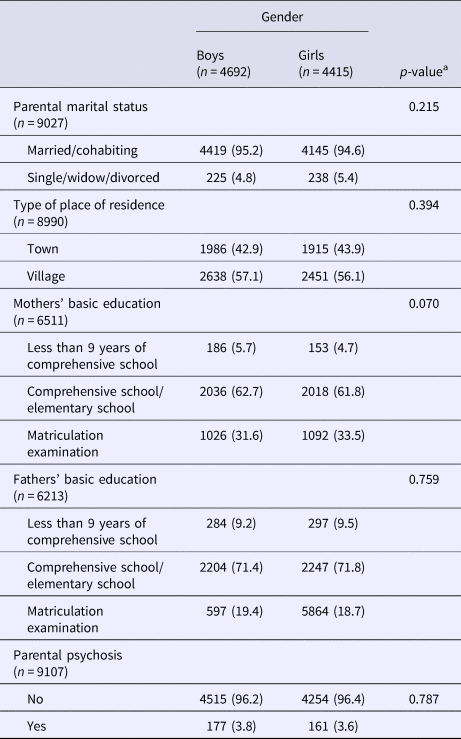
The distribution of family background factors by gender is seen in Table 1. The presented data consist of possible confounding factors which could affect the rates of prodromal symptoms or psychoses; these were selected based on earlier studies. These items were included in the regression models as covariates. The data included gender, parental psychosis (no/yes) (Keskinen et al., Reference Keskinen, Marttila, Marttila, Jones, Murray, Moilanen, Koivumaa-Honkanen, Mäki, Isohanni, Jääskeläinen and Miettunen2015), family type (married/cohabiting or single/divorced) (Chen et al., Reference Chen, Wang, Heeramun-Aubeeluck, Wang, Shi, Yuan and Zhao2014), and parental education (<9 years of comprehensive school/comprehensive or elementary school/matriculation examination) (Frissen et al., Reference Frissen, Lieverse, Marcelis, Drukker and Delespaul2015). Family type information was collected from a questionnaire made during pregnancy by the 24th gestational week. Information about parental education was collected from a questionnaire delivered to the parents when the subjects were 16 years old. Information on parental psychosis was collected from different registers [Care Register for Healthcare (1998–2015), Primary Healthcare Outpatient Registers (2011–2015), Specialized Care Outpatient Registers (1998–2015), and Finnish Center for Pensions (1998–2013)].
Family characteristics [n (%)] by gender in the Northern Finland Birth Cohort 1986

a Calculated using Pearson's χ2-test.
Statistical methods
The statistical difference between genders regarding family background factors and the prevalence of learning deficits and special talents was assessed by using Pearson χ2 tests. OR were calculated using binary logistic regression for having more than three specific PROD-screen items and for having psychoses for those with learning deficits or special talents. Hazard ratios (HR) were calculated using Cox regression models with time of death and emigration as censoring points. Adjusted OR and HR were calculated using parental marital status, basic education, psychosis, and family's place of residence as covariates. All results are presented by gender because school variables and outcome variables differed by gender. IBM SPSS Statistics 24.0 was used in the analyses. P-values <0.05 were considered as statistically significant.
Attrition analysis
Attrition in the questionnaire to teachers (pupils' age 8) and the self-reported PROD-screen (pupils' age 15–16) was assessed regarding family type (marital status of the mother), type of residence (urban/rural), mother's and father's education (<9 years/9–12 years/more than 12 years), and parental psychosis (no/yes). Teachers' assessment was available for 91.0% of the boys and 92.4% of the girls. PROD-screen was available for 70.4% of the boys and 76.7% of the girls. Regarding boys, participants and non-participants differed significantly in most family background factors in both follow-up surveys, whereas among girls the only significant finding was that those with married mothers participated more at age 15–16 years. Differences between the groups of participants and non-participants can be seen in online Supplementary Tables S1 and S2.
Results
Prevalence of special talents and learning deficits
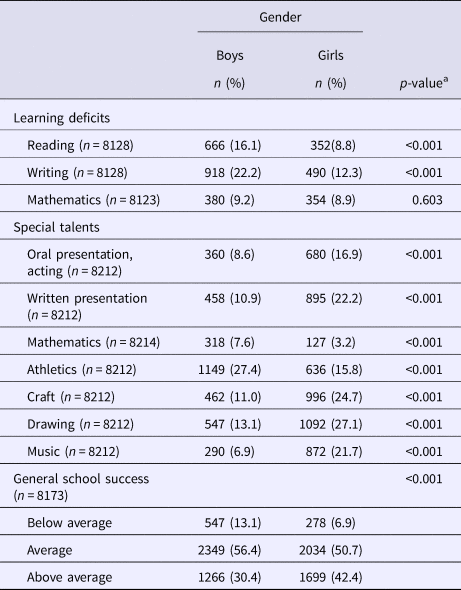
The prevalence of learning deficits and special talents by gender is presented in Table 2. Overall, boys had more learning deficits and less special talents than girls. The prevalence of different learning deficits differed between 9.2% and 22.2% in boys and between 8.8% and 12.3% in girls. Regarding special talents, the range was between 6.9% and 27.4% in boys and between 3.2% and 27.1% in girls. In athletics and mathematics boys were more frequently talented than girls. However, boys were assessed to perform generally less well at school than girls. Of the boys, 13.1% were assessed to be below average while the percentage for girls was 6.9%. Above average performance was registered in 30.4% of boys and 42.4% of girls.
Learning deficits, special talents, and general school success at the age of 8 years by gender in the Northern Finland Birth Cohort 1986

a Calculated using Pearson's χ2-test.
Prodromal symptoms in adolescence
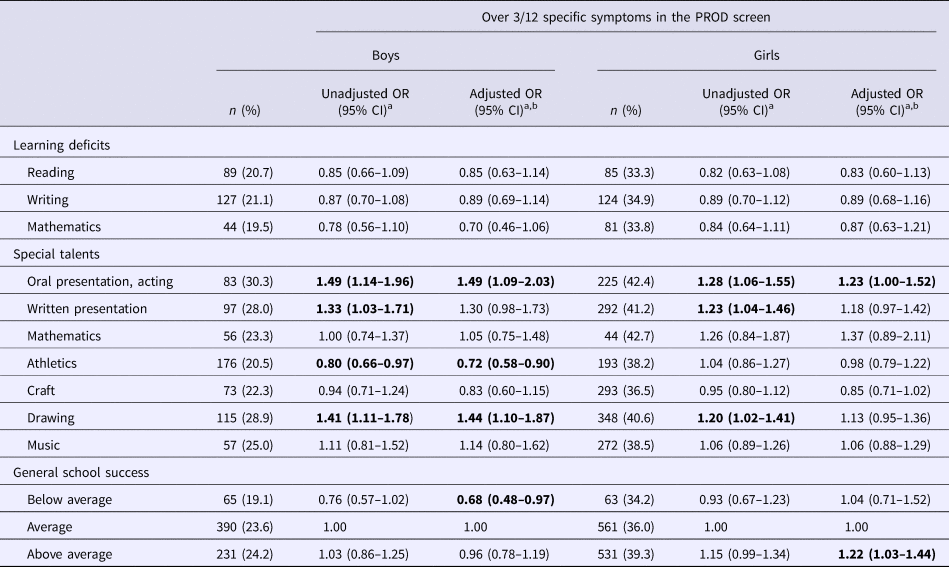
The number of subjects who had at least three specific PROD-screen items with unadjusted and adjusted OR according to childhood school variables is presented in Table 3. Learning deficits in childhood were not associated with having a PROD-score above 3 reported in adolescence. Those with special talents in oral presentation, written presentation, and drawing had higher ORs for having a PROD-score above 3. After controlling for confounding factors, the association remained with oral presentation for boys and girls and drawing for boys. The adjusted ORs for oral presentation were 1.49 (95% CI 1.14–1.96) for boys and 1.23 (1.00–1.52) for girls and for drawing 1.44 (1.10–1.87) for boys. Talent in athletics appeared to be protecting for boys lowering the adjusted OR to 0.72 (0.58–0.90). The results with general school success showed the same trend; the prevalence of prodromal symptoms decreased with below average boys and increased with above average girls: the adjusted ORs were 0.68 (0.48–0.97) for boys and 1.22 (1.03–1.44) for girls.
The psychotic-like symptoms (PROD-screen) at the age of 15–16 years according to scholastic traits at age 8 years in the Northern Finland Birth Cohort 1986

CI, confidence interval; OR, odds ratio.
Statistically significant (p < 0.05) findings are in bold.
a Calculated by using binary logistic regression model.
b Adjusted for parental marital status, basic education, psychosis, and family's place of residence as covariates.
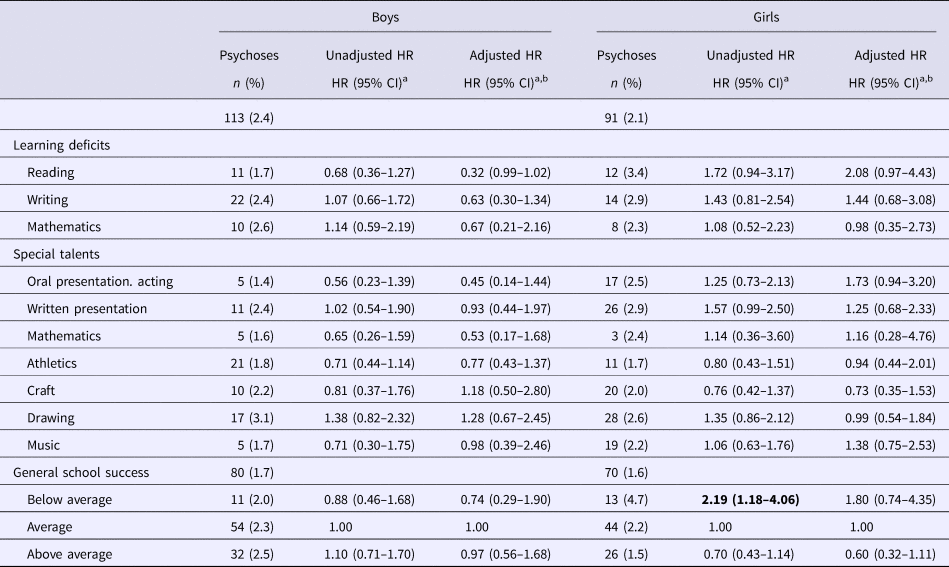
Psychoses in adulthood
Table 4 shows the number of psychoses experienced by age 30 with unadjusted and adjusted HR according to school variables. In total, 2.4% of boys and 2.1% of girls received a psychosis diagnosis during the follow-up until the age of 30 years. Of the 214 cases with psychoses, 69 (46 boys) had schizophrenia, 49 (18 boys) affective psychosis, and 96 (55 boys) other psychoses. Learning deficits and special talents in childhood were not associated significantly with psychoses in adulthood (until the age of 30 years). However, some gender differences were observed. In girls, a higher number of psychoses was observed with succeeding below average at school, having problems in reading and being talented in oral presentation. With boys the trend was opposite; the same variables were associated with lower psychosis rates.
The occurrence of psychoses by the age of 30 years according to scholastic traits at age 8 years in the Northern Finland Birth Cohort 1986

CI, confidence interval; HR, hazard ratio.
Statistically significant (p < 0.05) findings are in bold.
a Calculated by using Cox regression model.
b Adjusted for parental marital status, basic education, psychosis, and family's place of residence as covariates.
Discussion
Main findings
Surprisingly, learning deficits in childhood were not associated with prodromal symptoms in adolescence or with subsequent psychoses in the Northern Finland Birth Cohort 1986 sample. Prodromal symptoms appeared to be associated only with good school success (such as talent in oral presentation and drawing). Special talent in athletics decreased the prevalence of psychotic-like symptoms in boys.
Learning deficits
In this general population-based birth cohort, about every 10th child or up to every fifth boy and every eighth girl had experienced some learning deficits at the age of 8 years. None of the learning deficits were associated with prodromal symptoms in adolescence or with later psychoses. Sometimes learning deficits reflect low IQ, but social, motivational, attention problems, and personality-related factors are also important aspects affecting learning deficits. Similarly, in the meta-analysis of premorbid intelligence and schizophrenia, some studies have not found a significant connection (Walker et al., Reference Walker, McConville, Hunter, Deary and Whalley2002; Khandaker et al., Reference Khandaker, Barnett, White and Jones2011). Consistently but not significantly lower prodromal symptom scores among subjects with learning deficits and respectively high scores among talented subjects show a trend that may arise from the subjects' ability to describe their symptoms.
In the Finnish school system, many different forms of special support are directed toward children with problems in learning and could possibly act as a protecting factor (Ström and Hannus-Gullmets, Reference Ström, Hannus-Gullmets, Cameron and Thygesen2015). In personalized curriculums, learning goals are set to be realistic concerning the students' abilities and restrictions. Special support can give students with learning deficits the experience of succeeding, and thus could prevent social isolation which could be assumed to be positive for mental health. Unfortunately, studies about the possible connections between learning deficits, special education, and mental health are scarce.
Ruling out subjects with known intellectual disability from the analyses could explain the results of this study, this was done based on the significant number of intellectually disabled subjects in the learning deficits group and on evidence showing that intellectual disability is a risk factor in itself (Jacobson, Reference Jacobson1990). In studies including intellectually disabled subjects, the risk-increasing effect of learning deficits may be overestimated.
In this study, we investigated early learning deficits detected at the age of 8 years. Early learning deficits were chosen to reveal their effect on psychosis risk, avoiding the confounding effect of cognitive deterioration characteristics on the trajectory of the illness itself.
Special talents
Several special talents in childhood were associated with subsequent increased prodromal symptoms in adolescence. These talents (oral and written presentation and drawing) can be representations of intelligence but also of creativity. Higher performance in verbal learning and fluency is associated with a liability to bipolar disorder, but not to schizophrenia. Verbal fluency could have improved evolutionary fitness and its association with bipolar disorder could offer one explanation of why bipolar disorder has persisted in the population (Higier et al., Reference Higier, Jimenez, Hultman, Borg, Roman, Kizling, Larsson and Cannon2014). In one study, subjects who later developed schizophrenia excelled in drawing and arts at the age of 12 (Helling et al., Reference Helling, Ohman and Hultman2003).
The link between creativity and mental disorders is supported by many studies, suggesting that the link is strongest with affective disorders (Andreasen, Reference Andreasen1987). A particular link to affective disorders could explain why only prodromal symptoms but not psychoses were affected. Because of the non-specific character of the PROD-screen discussed later in this article, subjects with high scores also include those experiencing affective rather than psychotic symptoms. Different special talents (or types of creativity) are suggested to have separate links to bipolarity and schizotypy–schizophrenia spectrum disorders (Richards, Reference Richards2001). Intelligent and verbally talented individuals can also be thought to be more able to describe their sensations leading to higher self-reporting of symptoms. The self-reporting of symptoms has found to be affected by cognitive ability and personality factors (Enns et al., Reference Enns, Larsen and Cox2000).
Most previous studies about creativity and mental disorders have been in relation to adults, showing that some mental disorders are more frequent in artists (Andreasen, Reference Andreasen1987; Jamison, Reference Jamison1989; Kyaga et al., Reference Kyaga, Lichtenstein, Boman, Hultman, Långström and Landen2011). In a recent large Swedish register study, it was found that artistic creativity at high school or university associated with later mental health problems (MacCabe et al., Reference MacCabe, Sariaslan, Almqvist, Lichtenstein, Larsson and Kyaga2018). Interestingly, they found visual arts to associate with psychosis as we did in the current study. Special talents emerging during childhood could allow the assessment of causality but have been less studied. Our result suggests that special talents emerging already during childhood could relate to mental health in adolescence.
Some theories have been suggested to explain the mechanism underlying the link between creativity (or special talents) and mental disorder, one being the shared genetic vulnerability model. This model suggests that some hereditary traits such as reduced latent inhibition are common for creativity and psychopathology, increasing the amount of information processed consciously (Baruch et al., Reference Baruch, Hemsley and Gray1988; Carson, Reference Carson2011). Simultaneous manifestation of protective factors, such as high IQ, controls the processing of this information increasing creativity and protecting against the formation of mental disorders (Carson, Reference Carson2011). Horwood et al. (Reference Horwood, Salvi, Thomas, Duffy, Gunnell, Hollis, Lewis, Menezes, Thompson, Wolke, Zammit and Harrison2008) found in their ALSPAC birth cohort study that low IQ measured at the age of 8 years was associated with increased psychotic-like symptoms at the age of 12 years, but a weaker association was also observed with high IQ. However, the risk of schizophrenia declines with increasing IQ (Zammit et al., Reference Zammit, Allebeck, David, Dalman, Hemmingsson, Lundberg and Lewis2004). In our study, the increase was also observed only in psychotic-like symptoms, not in actual psychoses.
The status of athletics as a protecting factor could be explained by the known positive effect of physical activities on mood and mental health (Wiles et al., Reference Wiles, Jones, Haase, Lawlor, Macfarlane and Lewis2008; Griffiths et al., Reference Griffiths, Kouvonen, Pentti, Oksanen, Virtanen, Salo, Väänänen, Kivimäki and Vahtera2014) or as selection process relating to minor motor difficulties associating also with psychosis risk (Filatova et al., Reference Filatova, Koivumaa-Honkanen, Khandaker, Lowry, Nordström, Hurtig, Moilanen and Miettunen2018). Physical activity has been linked with psychosis risk also in the current birth cohort (Koivukangas et al., Reference Koivukangas, Tammelin, Kaakinen, Mäki, Moilanen, Taanila and Veijola2010).
Psychotic-like symptoms
Despite its simplicity, PROD-screen has been shown to be useful in evaluating psychosis risk (Heinimaa et al., Reference Heinimaa, Salokangas, Ristkari, Plathin, Huttunen, Ilonen, Suomela, Korkeila and McGlashan2003). The four prodromal symptoms regarding social withdrawal are more frequent in patients with first-episode psychosis than in patients with non-psychotic disorders and in controls. Although the patients had experienced less of these symptoms compared with patients with psychosis, those with non-psychotic disorder had experienced more social withdrawal-associated symptoms in adolescence than the controls (Mäki et al., Reference Mäki, Koskela, Murray, Nordström, Miettunen, Jääskeläinen and Veijola2014).
The selection of the cut-off point of 3/12 specific symptoms can be justified based on the proven consistency with the more complex SIPS screening tool. However, the screen is designed for clinical settings, and it remains unclear what should be the cut-off point when the screen is applied to epidemiological settings.
Psychoses
To our surprise, we did not find any school variables in childhood to correlate with an increase in later psychoses despite the results concerning the prodromal symptoms. One explaining factor could be the young age of our sample, in which not all the vulnerable individuals have yet become ill. Symptoms screened in the PROD-screen are also much more common in the population than psychosis diagnoses consistently with the continuum hypothesis of psychotic symptoms. According to this hypothesis, the occurrence of psychotic symptoms is continuous in the population, varying from mild forms to more severe ones (Verdoux and van Os, Reference Verdoux and van Os2002). The increase in PROD-score but not in the psychosis rate could be a manifestation of milder, but still clinically relevant symptomatology. It is also possible that other factors such as student's temperament affected teachers' ratings (Mullola et al., Reference Mullola, Ravaja, Lipsanen, Alatupa, Hintsanen, Jokela and Keltikangas-Järvinen2012). Regarding talented individuals, it has been found that creative individuals have more some positive schizotypal symptoms more frequently than others (Nelson and Rawlings, Reference Nelson and Rawlings2010).
In our study, all psychosis diagnoses were included, not only schizophrenia. With regard to premorbid intelligence as a risk factor, some studies have shown that low premorbid intelligence is a risk factor only for schizophrenia, not for affective psychoses (Agnew-Blais et al., Reference Agnew-Blais, Seidman, Fitzmaurice, Smoller, Goldstein and Buka2017). In general, it has been found that schizophrenia and affective psychoses have slightly different risk profiles (see e.g. Jääskeläinen et al., Reference Jääskeläinen, Juola, Korpela, Lehtiniemi, Nietola, Korkeila and Miettunen2017). Although most risk factors overlap, the level of the risk increasing effect is often found to be greater with schizophrenia. Furthermore, less evidence is available concerning antecedents for affective psychoses (Laurens et al., Reference Laurens, Luo, Matheson, Carr, Raudino, Harris and Green2015). This could partly explain why early learning deficits, most probably also associated with lower intelligence, did not predict psychoses in our sample.
Strengths and limitations
One strength of our study is the extensive data, the included survey data have good participation rates and the follow-up for psychosis diagnoses was based on nationwide registers with no attrition. Also the prospective design of the study is an advantage; information about the large general population-based study sample has been gathered starting from birth, resulting in an extensive follow-up time of 30 years. The study has very good participation rates both in childhood and adolescent surveys and we were able to use extensive nationwide registers to detect psychoses. Teachers are in general well trained and competent to evaluate pupils' school performance such as talents (Bracken and Brown, Reference Bracken and Brown2006), although there can be factors such as gender and student's temperament which may affect the ratings (Mullola et al., Reference Mullola, Ravaja, Lipsanen, Alatupa, Hintsanen, Jokela and Keltikangas-Järvinen2012).
Limitations of our study include the young age of the sample which explains the small number of psychosis cases. Evaluating the risk by PROD-screen also imposes some limitations. These are the PROD-screens' non-specificity in predicting psychoses and its use as a screening tool rather than in the clinical setting for which it was originally designed. Screening these symptoms on a population level does not have as strong predictive power for psychoses as using the screen in clinical settings and with chosen subjects. It is also possible that response bias may explain some of the results as those children are more diligent (and thus rated highly by teachers) and may be more likely to report psychotic experiences.
Conclusion
Surprisingly, learning deficits in childhood did not increase psychotic-like symptoms in adolescence or later psychosis rate in this large general population-based birth cohort, unlike in most previous studies. Learning problems are not always associated with increased risk of psychosis, which might be due to the special support given in school, such as remedial instruction, studying in small groups or guidance of a school helper, designing personalized curriculums or giving challenged students more time to finish compulsory education. The higher prevalence of psychotic-like symptoms in talented children may reflect a different kind of relationship of school success with psychotic-like symptoms compared with full psychoses.
Supplementary material
The supplementary material for this article can be found at https://doi.org/10.1017/S0033291719000825
Acknowledgements
We thank all cohort members and researchers who have participated in the study.
Financial support
This work was supported by the Brain and Behavior Research Fund, the Academy of Finland (grant numbers 268336, 278286); EU QLG1-CT-2000-01643 (EUROBLCS) (grant number E51560); NorFA (grant numbers 731, 20056, 30167); and USA/NIHH 2000 G DF682 (grant number 50945).
Conflict of interest
None.