Importance of goose feathers
Geese feathers are a renewable animal product that exceeds all other textile filling materials in regards to their quality properties (Schneider, Reference SCHNEIDER1991). Owing to their peculiar structure and down content, goose feathers are excellent thermal insulators (Schneider, Reference SCHNEIDER1995) with an optimal ability to accumulate and dissipate heat (Schneider, Reference SCHNEIDER1991). Goose feathers are more hygroscopic than synthetic fillers (Pingel, Reference PINGEL2004) and can therefore also absorb moisture from coetaneous respiration and evaporate it gradually later on (Von Luttitz, Reference VON LUTTITZ1990). The extreme elasticity and low bulk density of goose feathers are further advantages. Owing to these characteristics, goose feathers and down are suitable for the filling of bedding (e.g. pillows, quilts) and clothes (Schneider, Reference SCHNEIDER1991).
Besides meat, liver and egg production, waterfowl is used as a valuable source of feathers and down (Pingel, Reference PINGEL2010). In 2000, the value of world trade of 55,000 tons of down and feather was US$600 million. The largest exporter was China with a share of 22,500 tons (52.5%) of the total export (42,800 tons). It was followed by Taiwan with 9,000 tons, and Thailand and Hungary with 3,000 tons each (Wezyk and Cywa-Benko, 2002, op cit. Pingel, Reference PINGEL2010). Feather and down is largely obtained either after the slaughter of waterfowl as a by-product or from small-scale farms by harvesting from live ducks and geese at the time of moulting. The harvesting of feathers from fattening geese kept on pastures and from breeder duck and geese flocks in the non-laying period can be an additional source of income (Pingel, Reference PINGEL2010).
The volume of trade in feathers and down is not detailed separately by species (e.g. duck, goose) or by the type of harvesting (i.e. by hand or machine after slaughter). From the size of waterfowl flocks, it can be deduced that the higher part of traded feathers and down comes from the duck and only a very small percentage (1 to 2%) of total goose feathers and down produced is in fact removed from live birds.
During the course of slaughter, feathers and down is exposed to various unfavourable effects which degrade its quality. In the slaughterhouse the birds are bled, dipped in hot water and plucked by machine. Therefore during the slaughter procedure the plumage can be contaminated by blood and excreta (Schneider, Reference SCHNEIDER1991). Improper adjustment and operation of the plucking machine may also damage the plumage. Notably, barbs or parts of the vane may get torn away, the vane may become deformed and contaminated unnecessarily (e.g. when using paraffin wax dipping for plucking) or undergo physical and/or chemical damage (Ménesi et al., Reference MÉNESI, SZEKÉR and TAKÁTS1964). Recovery of the original properties of feathers and down requires completion of expensive procedures (Schneider, Reference SCHNEIDER1991) included washing, rinsing, centrifugation, drying, cooling and sorting (Ádám, Reference ÁDÁM2001). There are therefore the reasons for the lower quality of scalded feathers compared to those gathered from live animals (Kozák, Reference KOZÁK1999a).
Goose feather and down is superior to the feathers from other waterfowl (Ménesi et al., Reference MÉNESI, SZEKÉR and TAKÁTS1964). Particularly valuable are the fully mature feathers and down harvested from well-nourished geese at the time of moulting (Ádám, Reference ÁDÁM2001). Only the mature feathers are removed/harvested from the geese at time of moulting (Schneider, Reference SCHNEIDER1991), therefore feathers with bloody quills are relatively rare (Schneider, Reference SCHNEIDER1995). Broiler geese are usually slaughtered after fattening at 8 weeks of age when a substantial portion of their feathers are still not fully mature. At this time 23% of the plumage is immature, 22% is approximately mature and only 55% is fully mature (Zielinska and Baczkowska, 1973, op cit. Szado et al., Reference SZADO, PAKULSKA and KAPKOWSKA1995). During manual feather harvesting, the proportion of immature feathers is very small at less than 2% (Ménesi et al., Reference MÉNESI, SZEKÉR and TAKÁTS1964). Only feathers and down from the belly, breast, flanks and the back are gathered from the geese while the rest (i.e. neck, wing and tail feathers), which are sought after by the bedding industry, are left.
Compared to the first plucking (moulting), the quantity of feathers and down collected increases on the second and third plucking in growing geese and adult geese (Bielinski, 1979, op cit. Pingel, Reference PINGEL1990). Feathers harvested on the second occasion are also larger in size (Kozák et al., Reference KOZÁK, MONOSTORI, KARSAI and PÉCSI2010b) than those gathered on the first pluck (Kozák et al., Reference KOZÁK, MONOSTORI, ÁCS and PÉCSI2010a). Downs harvested from older geese are also larger in size (Szado et al., Reference SZADO, PAKULSKA and KAPKOWSKA1995) therefore the weight of their plumage is also higher (Szado, 1972, op cit. Szado et al., Reference SZADO, PAKULSKA and KAPKOWSKA1995). The feathers and down harvested by hand are damaged less during the cleaning and washing procedure and thus are more valuable and have approximately 40% higher sales value than those from slaughtered birds (i.e. the industrial product).
Historical background
Man is known to have utilised bird feathers since the pre-history. However, the regular use of poultry feathers commenced only after domestication, notably with the making of feather filled bedclothes (Ménesi et al., Reference MÉNESI, SZEKÉR and TAKÁTS1964). The use of feathers for making bedclothes was developed after Celtic-Roman tradition and was subsequently taken over by the Romans (Mártha, Reference MÁRTHA1968). Thus, the use of pillows and coverlets containing feathers and down has a long tradition of some 2000 years (Pingel, Reference PINGEL2004).
The contemporary agricultural literature in the first century A.D. contains information regarding feather production, and that flocks provide the geese breeder with feathers twice a year; in autumn and spring. A Hungarian publication from 1830 mentions three feather harvestings per annum (Mártha, Reference MÁRTHA1968).
In the middle ages the plucking of live geese was much more widespread than nowadays. Those who dealt in feathers or ‘plumes’ were known as ‘plumers’ (Serjeantson, Reference SERJEANTSON2002). Regular feather harvesting has been practiced for a long time in countries breeding geese such as Czechoslovakia, Hungary, Poland (Schneider, Reference SCHNEIDER1991), Romania, Soviet Union, Ukraine, France and China. In China; the biggest feather trading country in the world, the harvesting of feathers from live geese commenced much later, beginning in 1905, unlike European practices (Kozák and Monostori, Reference KOZÁK and MONOSTORI1992a). Recently, feather harvesting has begun in Cuba (Valdivié, Reference VALDIVIÉ2004). Thus, feather harvesting has a long historical past and its geographical spread is considerable.
Biological bases of feather harvesting
Feathers become worn-out and broken over time and therefore have a finite life. They are normally replaced once or twice a year with new feathers (Hoyo et al., 1992). This periodically repeated process is referred to as ‘moulting’.
Moulting is a complicated biological process regulated mainly by the endocrine glands. A moult is initiated by increased thyroxine hormone production by the thyroid gland. Under hormonal influence, the blood supply of the feather follicles, from which the feathers develop (Széky, Reference SZÉKY1973), will recede, the pulp of quill, basal naked part of the shaft, will dry up and an intense keratinisation will commence at the foot of the quill around the umbilical hole (Kiss, Reference KISS1976). Through this the contact between the quill and follicle completely ceases and the feather attains maturity. At the same time the pressure of cellular proliferation indicative of a new growth of feather will push out the old feather (Schneider, Reference SCHNEIDER1995). Feather harvesting is also facilitated by the fact that the poultry skin is innervated to a less extent and thereby less sensitive than mammalian skin (Schwarze and Schröder, Reference SCHWARZE and SCHRÖDER1979; Schneider, Reference SCHNEIDER1995).
Moulting means that animals shed their old feather cover and replace it with a new one (Horn, Reference HORN1981). Notably, feathers will become dead in a certain period after attaining maturity and will fall out at regular intervals (Széky, Reference SZÉKY1973). In wildfowl, moulting is related to the changing of seasons (Hoyo et al., 1992) though the period and degree of moult differ considerably by species and mode of life (Fehér, Reference FEHÉR2000). Wildfowl undergo a continuous and protracted moult in the interest of flight, whereas, in domestic poultry, moulting is confined to a shorter period as a result of selection for work (Horn, Reference HORN1981). There is a considerable difference between wild and domestic geese in the intensity and duration of moulting and the number of moults per year (Kozák, Reference KOZÁK1999a).
Day old wild and domestic goslings are covered with down. Moulting of this fluffy plumage commences during the first three weeks of life in wild goslings and during 3 to 5 weeks of age in domestic goslings. Some weeks after the first moult of wild goslings a second moult commences that lasts through autumn until winter and corresponds only to a partial moult. All wild goose species over one year of age moult once a year after termination of the brooding period (Kozák, Reference KOZÁK1999a).
In domestic geese the first true feathers attain maturity by 8 to 10 weeks of age, after which the first moult of the covert feathers commences (Kozák, Reference KOZÁK1999a). After a further 6 to 7 weeks the feathers reach full maturity once again (feathers require approximately 44 days to attain full maturity) and undergo another moult. In breeding geese, moulting commences after the termination of egg production and with the passing of 6 to 7 weeks the feathers attain maturity and subsequently moult (Schneider, Reference SCHNEIDER1995). With growing geese and breeding geese during the non-laying period the process of feather maturation and moulting occurs three times in succession during the summer. Thus feather harvesting implies a mode of use of one goose product that is nothing more than the removal of the feathers geese will drop anyway during natural moulting (Szentirmay, Reference SZENTIRMAY1968).
Feather harvesting from live geese is a traditional activity practiced for years, and grounded biologically. The manual removal of feathers from live geese is based on the inherent feathering and moulting characteristics of the domestic goose species. Feather harvesting can only be done at the natural moulting time, when the feathers are already fully mature and would normally be removed by the bird itself or naturally sloughed off in some days afterwards (Schneider, Reference SCHNEIDER1991). This exact date will be determined at any time by the actual condition of the geese flock (Kozák, Reference KOZÁK1999a). Once the feathers are mature, the start of the moult is indicated by the increasing amount of fallen feathers visible on the ground of the barn, runway or pasture (Schneider, Reference SCHNEIDER1991; Kozák, Reference KOZÁK1999a). A good way to determine the appropriate time for feather harvesting is to test the bird by pulling out a few feathers randomly from different parts of body such as the breast, belly, flanks and back (Szentirmay, Reference SZENTIRMAY1968). If these feathers appear mature (i.e. no blood marks) at any sites then it is the correct time to harvest.
Feathers are fully mature when the quill is sticking very loosely in the follicles and easy to remove without force (Schneider Reference SCHNEIDER1991; Szentirmay, Reference SZENTIRMAY1968). The feathers pulled out are free from tissue debris or fat at the base/root (Schneider, Reference SCHNEIDER1991), the quill appears dry, clean (Szentirmay, Reference SZENTIRMAY1968), hard and glassy transparent (Ménesi et al., Reference MÉNESI, SZEKÉR and TAKÁTS1964) as the pulp has been crisped to a loose membrane (Csukás, Reference CSUKÁS1955). The rachis is free from blood and its hollow section is empty and devoid of the livid-reddish colour typical of the immature (‘blood’) feather (Schneider, Reference SCHNEIDER1991). The base of quill is fully keratinized at this point in the moult cycle (Schneider, Reference SCHNEIDER1995).
The practice of feather harvesting is grounded by the innate feature of water-flow to renew their plumage which man has recognised and improved for many years. The goose (Anser anser) and swan goose (Anser cygnoides) domesticated 6000 and 4000 years ago, respectively, has developed the new trait of increased ability for feather production (via more frequent moults). This may be as a result of selection work, environmental conditions, and regular feather harvesting (2 to 3 times a year) over 2000 years, as well as appropriate flock management (Kozák and Monostori, Reference KOZÁK and MONOSTORI1992b). Thus, feather harvesting from live geese is feasible due partly to the moulting process (a feature inherent in avian species) and partly to the shortened period of feather maturation in domestic geese (about 44 days), concomitant with the repeated moults each year. Wild geese lack this latter trait.
During feather harvesting from live geese, feathers are removed only from some parts of the body (i.e. breast, belly, flanks, and back) and only partially (Kozák, Reference KOZÁK1999a). The plumage has been reported to comprise only 4.0 to 5.6% of the live weight of geese (Von Luttitz, Reference VON LUTTITZ1990). According to our estimations however, the total share of feathers and down within the live weight was 2.06% at the first harvesting and 3.10% and 3.50% for the second and third harvests, respectively. The corresponding figures for adult geese in sequence of harvesting were 2.07%, 1.94% and 2.88%, respectively (Kozák, Reference KOZÁK1999a).
The expert removal of feathers has no adverse effects on egg production or egg fertility (Schneider, Reference SCHNEIDER1995). Owing to many years of selection, day old gosling production has increased from year to year, and harvesting feathers from geese takes place three times during the rearing period and adulthood in the previous year (Kozák and Monostori, Reference KOZÁK and MONOSTORI1992b). In 1969 the Hungarian Upgraded Goose breed produced 8.66 day old goslings per layer whilst in 1999 they produced 33.94 goslings per head. With Grey Landes geese, one day old gosling production increased from 14.82 to 24.38 per layer during the same period. The Hungarian Upgraded Goose, which is selected for feather production, yielded 34.16 day old goslings per layer in 1990, meanwhile feather harvests from geese four times in the previous year amounted to a total of 512.6 g of feather and down per layer. These improvements in productivity traits reveal that serial feather harvesting done through successive generations has not caused any harm to the geese or to prolificacy traits (Kozák and Monostori, Reference KOZÁK and MONOSTORI1992b).
Moreover, experimental results have demonstrated that feather harvesting done at the appropriate time and in the correct manner has no adverse effects on geese or their health status. Clinical examination of the stress response to feather harvesting (i.e. measuring the level of blood glucose and plasma corticosteroid) has proven that careful removal of feathers at the appropriate time, using the correct procedure does not cause distress to geese, as this may influence their health status or comfort (Janan et al., Reference JANAN, KOZÁK, RUDAS, TÓTHNÉ MAROS and TÓTH2003). Under stress, the suprarenal cortex releases cortisone and other corticoids in the blood, the liver releases glucose in the blood and thus elevates the blood glucose level (Janan et al., Reference JANAN, BÓDI, BÁRDOS, OPPEL and KARSAINÉ KOVÁCS2001). The blood concentrations are indicative of the level of stress (Janan et al., Reference JANAN, KOZÁK, RUDAS, TÓTHNÉ MAROS and TÓTH2003) or distress as used as a measure of animal welfare. It was concluded from the experimental results that feather harvesting has a similar effect on blood glucose levels as blood sampling. Body weight and weight gains have also been unaffected by the live plucking of geese (Janan et al., Reference JANAN, BÓDI, BÁRDOS, OPPEL and KARSAINÉ KOVÁCS2001).
The removal of feathers may have a favourable effect on the carcass quality to a certain extent (Schneider, Reference SCHNEIDER1995), due to increases in feed intake and weight gains by geese concomitant with a higher elasticity of their skin and a lower incidence of skin injuries (Schneider, Reference SCHNEIDER1991).
Campaign of welfare criticism
In Western Europe animal activist movements have increased and protests against feather harvesting from live animals occur more and more vigorously, particularly after the story of the ‘Kassensturz’ Editorial Office, shown on Swiss television channel DRS on 15th October 1991 (Kozák, Reference KOZÁK1999a; Reference KOZÁK1999b).
A similar aggressive attack was made on geese keepers at the beginning of 2009, when the Swedish television channel TV4 presented images on geese injured during the feather harvesting which were recorded with a hidden camera. Hungary was named as the place of the feather harvesting, so the offence against the Hungarian geese keepers was promptly reported in the Hungarian television M1 News on the 2nd of February 2009 (Czerny, Reference CZERNY2009). In the Swedish report a Danish corporation was mentioned which trades in bedding made from Hungarian goose feathers. The head of the Danish corporation informed the Swedish TV, that according to their information, their Hungarian partners handle the geese ethically. At the sight of the presented images, the Swedish minister of agriculture raised this issue in Brussels (Czerny, Reference CZERNY2009; Valkó, Reference VALKÓ2009), stating ‘The European Committee should suggest the general prohibition of live geese plucking in the European Union’ (Hirado.hu, Reference HIRADO.HU2009).
The Swedish television program has caused heavy losses in the Hungarian feather trade since approximately three-quarters of the feather imports into Scandinavian countries originate from Hungary. On account of this, the president of the Hungarian Poultry Products Council considered this as an insult against the Hungarian producers (Palugyai, Reference PALUGYAI2009). The Swedish film also caused a general uproar in Hungarian animal activist organisations. Thus, a report was filed with the Prosecutor General to identify the place of the recording and to ascertain who was actually responsible for the distress caused to the geese, and against the Swedish reporter for being an accomplice in the crime (Czerny, Reference CZERNY2009).
Previous to the Swedish film, a German paper also reported on poor-welfare feather harvesting, naming South-Hungary as the place of the feather harvest. In this article, the representative of the ‘Greens’ indicated the feather harvesting and geese-cramming as a sad activity which has been a tradition and an approved practice in some European countries, but that the European Union should suspend it (Nachtsheim, Reference NACHTSHEIM2008). The Website of the ‘Four Paws’ Animal Welfare Society presented a method of feather harvesting referring to Hungarian practices (Vier Pfoten, Reference VIER PFOTEN2008) not conforming with animal welfare rules.
The German Down and Feather Producing Association has since stated that the Association collaborating with the Hungarian and German government and researchers has elaborated a regulating system for geese keeping and the harvesting of mature feathers, and included it in the Convention for the Protection of Animals (VDFI, Reference VDFI2009). According to this system and label, standards started the audit of Hungarian geese farms in the summer of 1996 (Kozák, Reference KOZÁK1999b).
On 30 June 2009, a group of the ‘Four Paws’ reported about illegal live plucking of geese using machines in a goose farm near Hamburg. On account of the injured geese found, the animal welfare activists brought charges against the responsible firm and the veterinarian of the local authority for violating the German animal laws. At the same time they urged customers to boycott the goose products coming from this farm (Bakos, Reference BAKOS2009). This organization in the previous years violently attacked goose breeders in the press –nearly in most cases groundless (Anonymous, Reference ANONYMOUS2010).
In Hungary the machine harvesting of feathers from live animals is prohibited in regard to animal welfare issues.
Consumers tend to take information from non-scientific, but extremely well funded organisations at face value. In spite of their clear objectives, these groups cannot be considered objective or unbiased. Moreover, single interest, ‘fanatic’ animal activists display frightening images often obtained illegally in the media or on their web pages. These records insinuate that they represent the common procedures of the poultry industry whilst examples of good practices are not shown (Hunton, Reference HUNTON2008).
Indeed, compliance with animal protection and welfare law is in the interest of all producers. Any attitudes compromising animal welfare are not only unlawful but unethical and are met with general condemnation from the industry.
Animal welfare regulations for humane feather removal
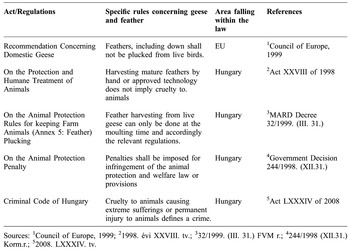
Many regulations and acts have been raised on the protection of animals within the European Union and also in Hungary (Table 1). Part of the EU animal protection regulations applies to most animals kept for farming purposes. These provide rules for the protection of farm animals on the farm (Council Directive 98/58/EC), during transport (Council Directive 91/628/EEC), at time of slaughter (88/306/EEC Council Decision; Council Directive 93/119/EC) and the minimum criteria for on-farm animal welfare audits (2000/50/EC Commission Decision). Naturally, these rules apply also to the geese keeping.
Council Directive 98/58/EC on the protection of animals kept for farming purposes (enacted on the 20th July 1998) includes general rules for the protection of animals. Accordingly ‘animal’ means any animal bred or kept for the production of food, wool, skin or fur or for other farming purposes. The Community legislation lays down minimum standards. National governments may adopt more stringent rules provided they are compatible with the concerning EU provisions of law (Council Directive 98/58/EC).
In 1976, the Council of Europe adopted the European Convention for the protection of animals kept for farming purposes. The Standing Committee composed of Representatives of the Parties of the Convention, was responsible for the elaboration and adoption of more detailed recommendations concerning different species of animals (Council of Europe, Reference COUNCIL OF EUROPE1992). On the 22nd June 1999, the Standing Committee of the European Committee adopted a Recommendation on the keeping of domestic geese and swan geese and their crossbreds. Article 23, point 3 of the Community Regulation stipulates that ‘feathers, including down shall not be plucked from live birds’ (Council of Europe, Reference COUNCIL OF EUROPE1999).
Legislation concerning goose and feather plucking/harvesting.

Sources: 1Council of Europe, Reference COUNCIL OF EUROPE1999; 21998. évi XXVIII. tv.; 332/1999. (III. 31.) FVM r.; 4244/1998 (XII.31.) Korm.r.; 52008. LXXXIV. tv.
In the course of joining the EU, Hungary signed the European Convention on the Protection of Animals Kept for Farming Purposes and passed it in a government decision (147/2004. (V.4.) Korm. r.). However, ‘the humane removal of feathers’ Hungary considers as national issue (FVM, Reference FVM2003). Scilicet, ‘the harvesting of mature goose feathers by hand or by licensed technology’, is not prohibited by the Hungarian Animal Protection Act (1998. évi XXVIII.tv. 6.§/2; Act XXVIII of 1998, Article 6, Section 2). Therefore feather harvesting procedures performed this way are not considered as cruelty to animals by the law. The appropriate time and conditions under which the practice of harvesting feathers from live geese carried out (i.e. housing, feeding, stress-free working, catching birds, method for pulling out of the feathers and down, parts of body to be plucked) are strictly regulated by the decree linked to the Animal Protection and Welfare Act (32/1999. (III.31.) FVM r.).
Also in the Hungarian legislation great attention is paid to the biological characteristics of the domestic goose, the physiology of moulting (Kozák and Monostori, Reference KOZÁK and MONOSTORI1992a) and the economical-social issues (A Magyar Köztársaság Kormánya, Reference A MAGYAR KÖZTÁRSASÁG KORMÁNYA1997). Compliance with the law is supervised by the animal health authority. The audit can be performed at any time, but at least once a year, and the Ministry of Agriculture and Rural Development is informed of the results of the audit (20/2002. (III.14.) FVM r.).
Any production practice non-compliant with the provisions of law is strictly penalised by the national laws (Valkó, Reference VALKÓ2009). Section 266/B (1) of the Criminal Code of Hungary on ‘Cruelty to Animals’ declares, that ‘Any person who is engaged in the unjustified abuse or mistreatment of vertebrate animals resulting in permanent damage to the animal's health in the animal's destruction is guilty of misdemeanour punishable by up to two years’ imprisonment, community work or a fine’ (2004: X. tv.). The term ‘cruelty to animals’ is also codified in the Hungarian Animal Protection Act. Accordingly, ‘cruelty to animals: unnecessary, painful abuse of the animal or any intervention, treatment or restriction of the animal's needs to the extent that causes continued fear, or is detrimental to the animal's health’ (1998. XXXVIII. tv. 3.§. 4.; Act XXXVIII. 1998. Article 3, Section 4). Violation of the Act can be fined and ‘the sum of the penalty may vary between 5000-150000 HUF’ (244/1998. (XII.13). Korm. r. 2§.; Government Decision 244/1998. (XII.13). Article 2). With the passage of the Criminal Code amendment (enacted on 11 December 2008) more strict sanctions have been taken. Accordingly, aggravated cruelty to animals causing extreme sufferings to the animals defines a crime punishable by imprisonment up to three years’ (2008. évi LXXXIV. tv.). Thus, non-compliance with the provisions concerning feather harvesting and cruelty of animals also entails sanctions in Hungary.
In the interest of effectuating the animal protection issues, the Advisory Board for Animal Protection is also officiating accordingly the Animal Protection Act (10/1999. (I.27.) FVM r.). Moreover, the institution of Civil Ombudsman for Animal Protection was also established on the 1st of January 2009, on the initiative and with the subsidy of the White Cross Animal Protection Society. The objective of the Ombudsman is to promote the Hungarian animal protection law to develop independently within the frame of the European Union regulations, but disregard any campaigns harmful to the relations between animal breeders and animal protectionist’ (Szilágyi, Reference SZILÁGYI2009).
Conclusions
The gathering or collecting of feathers from the live animal at time of moulting cannot be taken as ‘plucking’ but rather ‘harvesting’. This procedure is biologically based on the inherent moulting character of domestic geese (i.e. frequent moults and hence increased feather production). It is technically based on the natural change of feathers, a phenomenon occurring naturally to shed the old feather coat. This makes it possible to harvest the easily removable, fully mature feathers from the live geese without inflicting any harm to the goose or its well-being or production, as evidenced by clinical and productivity data.
It is postulated that the European Union legislation should therefore be modified according to these facts regarding feather production. The Hungarian legislation approves the harvesting of feathers from the live animal, and hence from geese, but strictly specifies the conditions under which the practice is carried out. A similar possibility seems also desirable for the national legislation of other EU member states with long traditions in feather production. In this way the plucking of feathers could be defined by law as a punishable act whilst, the harvesting of feathers performed at time of moulting under appropriate conditions as an action approved by the law.