Introduction
Investigations into the influence of age on the clinical expression of mood disorders typically rely on comparisons of ill individuals grouped by current age. This approach, however, confounds age of onset with current age and thus cannot be used to assess intra-individual changes over time. Age of onset in adolescence or early adulthood is strongly associated with high familial loadings for mood disorder (Mendlewicz & Baron, Reference Mendlewicz and Baron1981; Weissman et al. Reference Weissman, Wickramaratne, Merikangas, Leckman, Prusoff, Caruso, Kidd and Gammon1984, Reference Weissman, Warner, Wickramaratne and Prusoff1988; Kupfer et al. Reference Kupfer, Frank, Carpenter and Neiswanger1989; Lyons et al. Reference Lyons, Eisen, Goldberg, True, Lin, Meyer, Toomey, Faraone, Merla-Ramos and Tsuang1998; Zisook et al. Reference Zisook, Lesser, Stewart, Wisniewski, Balasubramani, Fava, Gilmer, Dresselhaus, Thase, Nierenberg, Trivedi and Rush2007), while onset in late adulthood may be associated with atherosclerotic changes in the brain (Krishnan et al. Reference Krishnan, Hays and Blazer1997; de Groot et al. Reference de Groot, de Leeuw, Oudkerk, Hofman, Jolles and Breteler2000), with early-onset Alzheimer's disease (Alexopoulos et al. Reference Alexopoulos, Meyers, Young, Mattis and Kakuma1993) and with other medical conditions that become more likely with age. Thus, the age period during which a mood disorder first appears may reflect fundamental differences in the pathophysiology of the illness and such differences may have sustained influences on the disorder's course. Once the disorder is manifest, though, its course may evolve as the individual ages, either through changes in life circumstances typical of passage from one age period to another, or through age-related changes in the underlying pathophysiology of the disorder.
For instance, both a younger age of onset (Giles et al. Reference Giles, Jarrett, Biggs, Guzick and Rush1989) and a younger current age (Lundquist, Reference Lundquist1945; Gonzales et al. Reference Gonzales, Lewinsohn and Clarke1985; Coryell et al. Reference Coryell, Endicott and Keller1991) have been associated with higher recurrence rates in major depressive disorder (MDD), particularly with recurrences accompanied by stressors (Hammen et al. Reference Hammen, Davila, Brown, Ellicott and Gitlin1992; Coryell et al. Reference Coryell, Winokur, Maser, Akiskal, Keller and Endicott1994). Is the sort of MDD that begins in adolescence or early adulthood inherently more prone to recurrence than is MDD that begins later? Or do higher recurrence rates in youth result from physiological and/or environmental risk factors that are more likely during adolescence or early adulthood than later in life?
The possibility of age-related changes in morbidity has a more practical importance for patients who, understandably, would like to know the ways in which their illness is likely to change as they grow older. Unfortunately, the literature has very little to offer in answer to such questions. The requisite study must be sufficiently descriptive of symptom levels over time and have a duration that encompasses substantially different age periods. The numbers of subjects followed must also be large enough to allow for comparisons of separate age groupings. Mood disorders may well evolve differently in the transition from early adulthood to middle years than they do from the middle years to old age.
We are aware of only four efforts to prospectively follow individuals with mood disorder using multiple assessments over a period longer than 10 years (Angst, Reference Angst1998; Brodaty et al. Reference Brodaty, Luscombe, Peisah, Anstey and Andrews2001; Angst et al. Reference Angst, Gamma, Sellaro, Lavori and Zhang2003; Coryell et al. Reference Coryell, Solomon, Turvey, Keller, Leon, Endicott, Schettler, Judd and Mueller2003). None of these have examined long-term changes in symptom quality or intensity in separate age cohorts. The following report uses data from one of these four studies to determine whether patients with non-bipolar MDD show changes in depressive morbidity as they move from their mid-twenties to their mid-forties, from their late thirties to their late fifties, and from their late fifties to their mid-seventies. If an early onset indicates a depressive illness that is inherently more persistent or recurrent, then younger individuals should experience more morbidity than older individuals, both early in follow-up and as they age. If, instead, youth itself, rather than age at onset, predisposes to greater depressive morbidity, then the younger subjects should experience less morbidity as they age.
Methods
Subjects
The National Institute of Mental Health Collaborative Program of Psychobiology of Depression recruited patients who met research diagnostic criteria (RDC) (Spitzer et al. Reference Spitzer, Endicott and Robins1978) for MDD, mania or schizo-affective disorder as they sought treatment at any of five academic centers from 1978 to 1981 (Coryell et al. Reference Coryell, Solomon, Turvey, Keller, Leon, Endicott, Schettler, Judd and Mueller2003). Because the study was originally designed to test genetic hypotheses, inclusion required participants to be white. They were also required to be aged ⩾18 years, knowledgeable of their biological parents, and English speaking. All participants provided informed consent.
The following analysis is limited to subjects who lacked any history of mania, hypomania or schizo-affective mania, or of schizo-affective depression, mainly schizophrenic subtype when they entered the study and who did not develop those syndromes during follow-up. Those who met RDC for the mainly affective or ‘other’ subtype of schizo-affective disorder were retained for this analysis because the definition overlaps almost entirely with that of DSM-IV criteria for MDD with mood-incongruent psychotic features. Subjects were further limited to those who completed 20 years of follow-up.
Procedures
Raters used the Schedule for Affective Disorders and Schizophrenia (SADS; Endicott & Spitzer, Reference Endicott and Spitzer1978) to establish current and lifetime diagnoses at intake according to the RDC. SADS ratings integrated information from patient interview, informant interview when this was available, and medical record review.
Follow-up assessments occurred semi-annually for the first 5 years following intake and annually thereafter. Raters used information from direct patient interview and from medical records to complete the Longitudinal Interval Follow-up Evaluation (LIFE) (Keller et al. Reference Keller, Lavori, Friedman, Nielsen, Endicott, McDonald-Scott and Andreasen1987) during the first 2 years, the LIFE II during years 3 through 5, and the Streamlined Longitudinal Interval Continuation Evaluation (SLICE) in year 6 and beyond. The latter two instruments differed from the LIFE in the omission of some psychosocial measures.
Each RDC syndrome that was active at intake, or that developed during follow-up, was thereafter assigned a weekly psychiatric symptom rating (PSR). Interviewers identified change points in symptom intensity and quantified symptom levels for the interval using a six-point scale for MDD, mania, schizo-affective depression or schizo-affective mania. A score of ‘1’ indicated no symptoms, ‘2’ indicated the presence of no more than one or two symptoms to a mild degree, ‘5’ indicated a full syndrome and ‘6’ a relatively severe, full syndrome. Scores of ‘3’ and ‘4’ indicated the continued presence of an episode with less than the number of symptoms necessary for an initial diagnosis. The end of an episode required 8 consecutive weeks of PSR ratings no greater than 2 and a new episode required that the subject again meet criteria for definite MDD or schizo-affective depression. Depressive morbidity was quantified as the percentage of weeks in episodes of MDD or schizo-affective depression during prospective follow-up.
Data analytic procedures
Age at intake was used to assign patients into young (18–29 years), middle (age 30–44 years) and oldest (>44 years) groups. These age ranges were chosen beforehand to approximate contrasting age periods. Depressive morbidity over time was quantified as the percentage of weeks during which an individual was in an episode of MDD or schizo-affective depression according to the convention that the PSR for either was greater than ‘2’. A one-way analysis of variance (ANOVA) was used to compare age groups by morbidity levels. To determine whether depressive symptom morbidity changed differentially over time by age group, the 20 years of follow-up were grouped into 5-year periods. The SAS (SAS Institute, Inc., Cary, NC, USA) general linear models (GLM) procedure tested whether age groups differed in any of the four follow-up periods. A repeated-measures ANOVA then tested for time effects (differences across the 5-year segments) and for time×group effects. Additional analyses tested for time×sex effects on both outcome measures. Because the distribution in percentages of weeks ill varied across age groupings and follow-up periods, we also used the proportion of individuals who were in episodes for greater than 50% of weeks in each 5-year period to depict possible changes in morbidity levels over time.
To determine whether age of onset predicted depressive morbidity independent of current age we next introduced this variable into logistic regression models on the proportion of time in episodes over the 20 years of follow-up. Age of onset was then added to the previously described GLM models to determine whether it predicted changes over time in depressive morbidity in all subjects together or within any of the three age groups.
All correlations are presented as Spearman coefficients. A two-tailed α level of 0.05 was used for each of the tests reported below. No correction was made for multiple testing.
Results
Of 603 patients who met the above criteria for non-bipolar MDD at study entry, 120 (19.9%) died within the next 20 years and 37 and 55 converted to bipolar I and bipolar II disorder, respectively, 171 (28.4%) were lost to follow-up, leaving 220 subjects who were followed for at least 20 years.
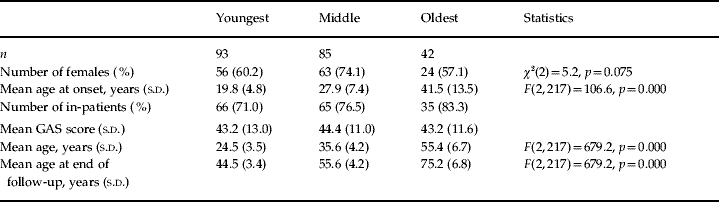
Of patients who retained an RDC diagnosis of non-bipolar MDD at the end of 20 years of follow-up, 93 were aged <30 years when they entered the study, 85 were aged 30–44 years, and 42 were aged ⩾45 years (Table 1). These three groups did not differ by sex, the proportion that were in-patients, or by Global Assessment Scale scores (Endicott et al. Reference Endicott, Spitzer, Fleiss and Cohen1976) for the week preceding intake.
Status at intake by age grouping
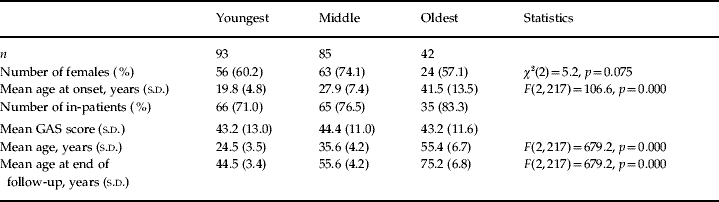
s.d., Standard deviation; GAS, Global Assessment Scale.
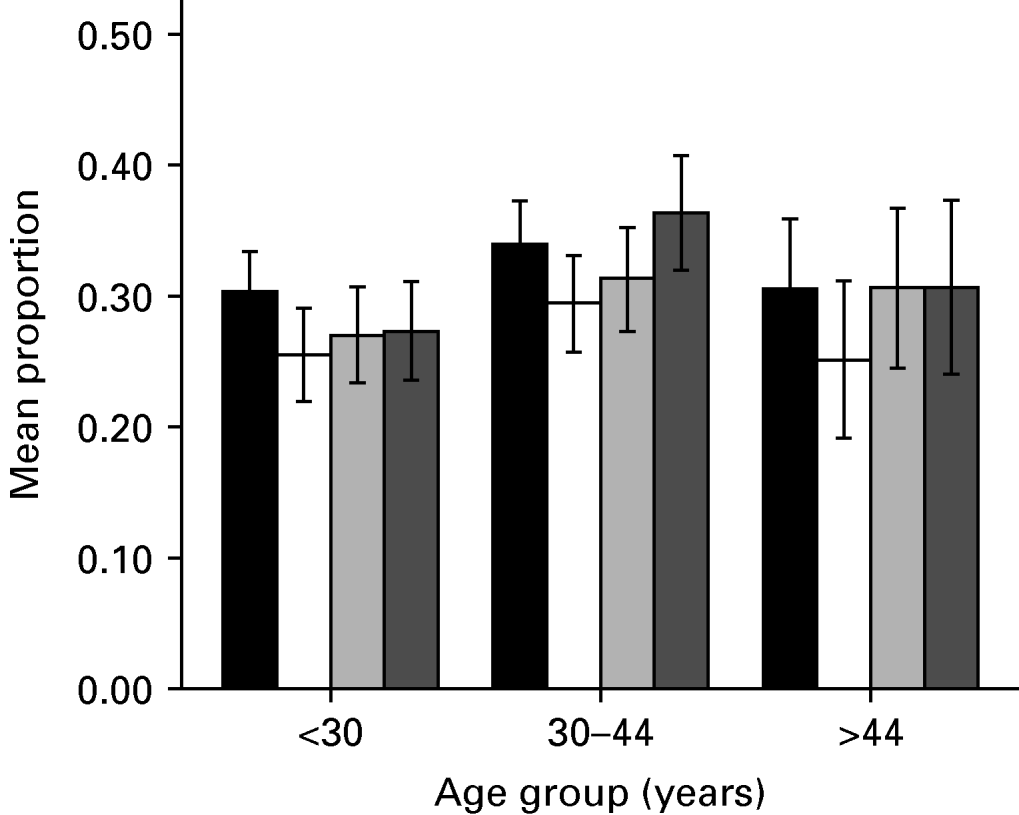
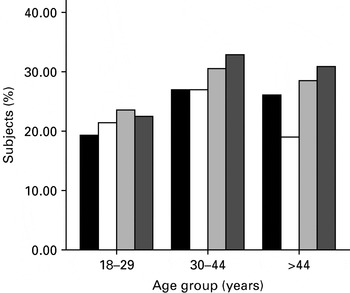
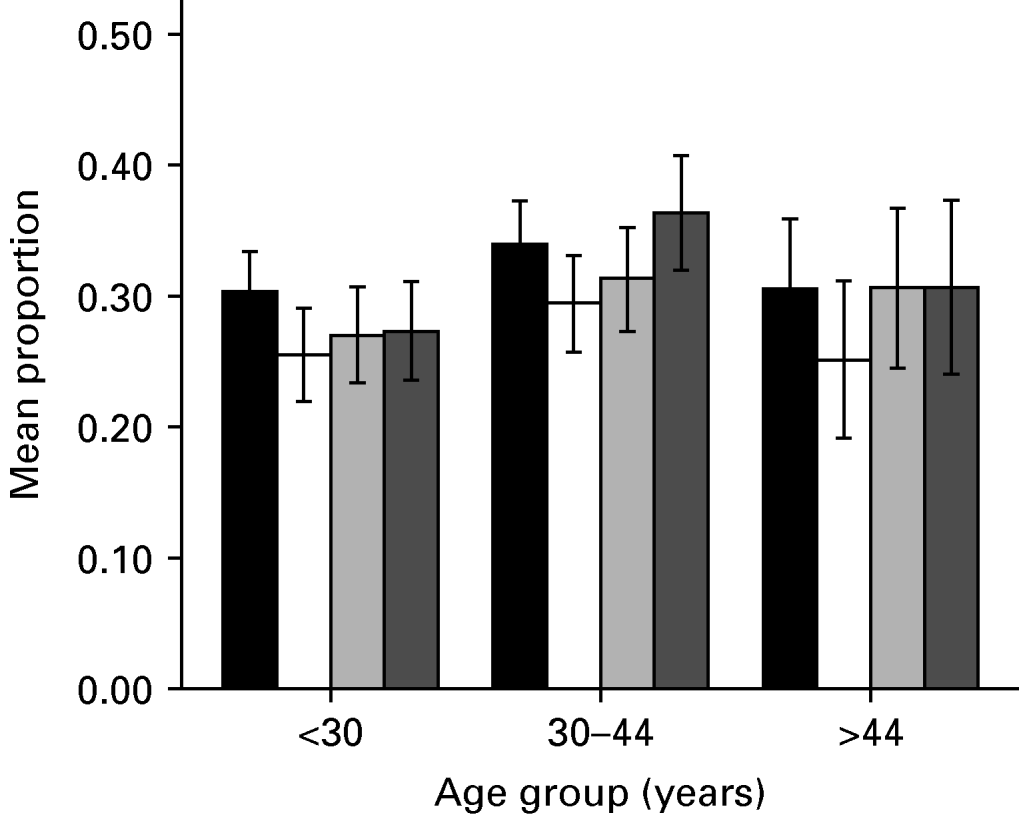
The mean proportion of weeks in episodes of MDD or schizo-affective depression over the entire 20 years of follow-up were 34.6 (s.d.=30.4), 38.7 (s.d.=28.7) and 32.8 (s.d.=33.8), respectively, for the young, middle and oldest groups [F(2,217)=0.685, p=0.505]. With the three age groups combined, no consistent trend appeared to indicate increasing or decreasing morbidity across the four follow-up periods; mean values for percentage of weeks ill were 31.8 (s.d.=31.7), 26.9 (s.d.=34.7), 29.3 (s.d.=31.7) and 31.5 (s.d.=39.7), respectively, for the first to last 5-year periods [F(3, 217)=2.4, p=0.0655]. As illustrated in Fig. 1, there was likewise no consistent trend in morbidity level across the four follow-up periods in any of the three age groups. The GLM procedure showed no interaction of age group and follow-up period in percentage time ill [F(6, 651)=0.34, p=0.8918]. Fig. 2 shows that, likewise, no temporal trends emerged for increasing or decreasing morbidity when this was expressed as the proportion of patients in each year who experienced more than 50% of weeks ill.
Proportion of weeks in depressive episodes over 5-year periods by age group. ▪, Proportion of weeks depressed through year 5; □, proportion of weeks depressed through years 5–10;  , proportion of weeks depressed through years 10–15;
 , proportion of weeks depressed through years 16–20. Values are means, with standard errors represented by vertical bars.
Percentage of subjects in episodes for the majority of weeks. ▪, Years 1–5; □, years 6–10; , years 11–15; , years 16–20.

Inclusion of sex in the above models revealed a time×sex interaction for time ill percentage [F(3, 214)=3.67, p=0.0131]. Further exploration revealed that this interaction was present in the youngest group [F(3, 273)=3.23, p=0.0229] but was absent in the middle [F(3, 249)=1.16, p=0.3237] and oldest groups [F(3, 120)=1.83, p=0.1447]. Within the youngest group both measures showed tendencies for depressive symptoms to increase in women and to decrease in men but neither of these were significant.
With age groups combined, age at intake was not predictive of subsequent symptom persistence [F(1, 218)=0.080, p=0.777]. With age of onset added to the regression model age at intake and age of onset had positive (t=2.514, p=0.013) and negative (t=−3.087, p=0.002) relationships, respectively, with subsequent symptom persistence. Age of onset was negatively associated with percentage time ill over the 20 years of follow-up in the young (t=−2.48, p=0.015), but not in the middle (t=−1.28, p=0.203) and oldest (t=−1.46, p=0.151) groups though the direction of the relationship was consistent. Curve fitting applied to the plot of age of onset against time ill in the youngest group revealed a substantially better fit for a quadratic curve (p=0.006) than for a linear one (p=0.015) and visual inspection indicated that morbidity increased rapidly with ages of onset of ⩽18 years. The 40 subjects who both entered the study before age 30 years, and who recalled an age of onset of ⩽18 years, showed no temporal trends over the four follow-up periods, though. Mean percentage times depressed were 35.8 (s.d.=33.4), 29.0 (s.d.=36.0), 33.7 (s.d.=40.5) and 33.8 (s.d.=41.0) in the first through the last follow-up period, respectively.
Because the length of follow-up necessarily entailed sample attrition, the above analyses were repeated with the inclusion of 258 subjects who failed to complete 20 years of assessments, whether through death or refusal. Age groups did not differ significantly by mean proportions of time depressed in any of the four follow-up periods in this larger sample. Nor did the age groups differ by change in time depressed across the four follow-up periods (F=0.383, p=0.683).
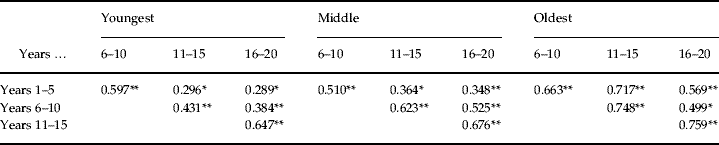
Within each of the age groups, correlations between 5-year epochs in percentage time ill decreased as intervals widened but remained highly significant (Table 2). Moreover, the young, middle and oldest groups had progressively greater inter-period correlations. Overall mean values for these were 0.44 (s.d.=0.15), 0.51 (s.d.=0.13) and 0.66 (s.d.=0.10), respectively [ANOVA F(2, 15)=4.4, p=0.032] and the difference between the youngest and oldest groups was significant (Tukey's post-hoc p=0.029).
Relationships (Spearman correlations) between subsequent follow-up periods in percentage time ill by age group
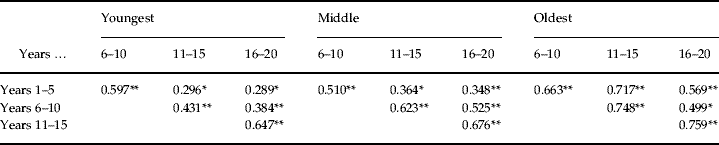
* p<0.01, ** p<0.001.
Discussion
Time spent in major depressive episodes showed constancy over a 20-year period regardless of whether subjects were transitioning from their mid-twenties to their mid-forties, from their mid-thirties to their mid-fifties, or from their fifties to their seventies. Though this presentation obscures a considerable heterogeneity of courses among subjects, the overall absence of any pathoplastic effect of age on depressive morbidity is striking and suggests that, at least among patients who seek treatment at tertiary care centers, getting older neither worsens nor improves symptom load in MDD.
A difference between men and women emerged for the youngest group such that men tended to improve with time and women tended to worsen. This was unexpected and, though a time×sex interaction existed, symptom persistence did not significantly change with age in either sex. Speculation on the meaning of this interaction thus should await replication in another sample.
As noted earlier, some reports have associated younger age with higher risks for relapse in MDD (Gonzales et al. Reference Gonzales, Lewinsohn and Clarke1985; Giles et al. Reference Giles, Jarrett, Biggs, Guzick and Rush1989; Coryell et al. Reference Coryell, Endicott and Keller1991). Such findings imply that levels of depressive morbidity were higher over time in younger individuals if it is assumed that younger individuals did not have shorter episode durations. Whether that was so or not is unclear as these studies did not address the effects of age on episode duration, nor did they describe the proportions of time ill. The results of these earlier reports are therefore not inconsistent with those described here.
Symptom persistence showed significant within-individual stability over time in all three age groups but stability across time was greater in the oldest group than in the youngest. Thus, the tendency of an individual's depressive illness to persist or recur appears to declare itself early and to be an enduring quality. That this is least so in the youngest group suggests than environmental influences have greater importance in the course of illness in this age period.
One of the caveats necessary here concerns comparability with other samples. Approximately three-quarters of the individuals described were in-patients at tertiary academic centers when they entered the study from 1979 through 1981. Regarding applicability to other in-patient samples it is reassuring that the overall mean percentage time ill in our sample, 31.7%, closely resembles the percentage time ill, 32.8%, that described the course of an in-patient sample recruited at a British academic center and followed for 8–11 years (Kennedy et al. Reference Kennedy, Abbott and Paykel2004). That sample also showed stability in group symptom levels over time. Yet, the course of both samples may differ substantially from those of out-patients seen by private mental health providers, and perhaps more so from those treated by primary-care providers, or those who do not seek treatment at all. There is evidence that the milder and more transient episodes that often result in no treatment are more common in younger individuals (Coryell et al. Reference Coryell, Endicott, Winokur, Akiskal, Solomon, Leon, Mueller and Shea1995, Reference Coryell, Haley, Endicott, Solomon, Leon, Keller, Turvey, Maser and Mueller2002; Solomon et al. Reference Solomon, Leon, Mueller, Coryell, Teres, Posternak, Judd, Endicott and Keller2005). If so, such episodes may become less frequent with age.
In addition, the recruiting centers for this study were geographically limited to the Midwest and the Northeast and, because the study was designed to explore the genetics of affective illness, participants were limited to Caucasians. The findings thus may not fully apply to a more geographically or ethnically diverse population. Finally, 20% of the subjects died within 20 years of study entry and another 44% were lost to follow-up. Non-random attrition could also have had an effect on our results.
Another caveat concerns the sensitivity to lower levels of depressive symptoms of the measures used in these analyses. We adopted conventional methods of tracking MDD over time in which 8 weeks at PSR symptom levels of 1 or 2 indicated a recovery and a full major depressive syndrome was then necessary before PSR values higher than 2 could be recorded. Within these periods of ‘recovery’, symptoms of intermittent depressive disorder or minor depression were doubtless active at times in a number of subjects. The existing literature, though, did not lead us to expect these milder depressive symptoms to differ by age in their persistence. Moreover, because the conventions used here have been extensively applied in previous studies, their use here facilitates the comparison of results across studies.
The control of treatment is not feasible in long-term studies but the medications taken by these subjects were carefully monitored and have been described in earlier reports (Keller et al. Reference Keller, Lavori, Klerman, Andreasen, Endicott, Coryell, Fawcett, Rice and Hirschfeld1986; Dawson et al. Reference Dawson, Lavori, Coryell, Endicott and Keller1998; Leon et al. Reference Leon, Solomon, Mueller, Endicott, Rice, Maser, Coryell and Keller2003; Solomon et al. Reference Solomon, Leon, Mueller, Coryell, Teres, Posternak, Judd, Endicott and Keller2005). After the first year of follow-up many subjects took no antidepressants, or did so only intermittently. Moreover, the antidepressants being used were predominantly tricyclics (Coryell et al. Reference Coryell, Endicott, Winokur, Akiskal, Solomon, Leon, Mueller and Shea1995, Reference Coryell, Haley, Endicott, Solomon, Leon, Keller, Turvey, Maser and Mueller2002). Selective serotonin re-uptake inhibitors (SSRIs) came into use only later in the observation period. While the results of some studies have indicated that the efficacy of tricyclic antidepressants differs from that of SSRIs in certain patient groups defined by age, sex or severity (Grigoriadis et al. Reference Grigoriadis, Kennedy and Bagby2003; Joyce et al. Reference Joyce, Mulder, Luty, McKenzie and Rae2003; Parker et al. Reference Parker, Parker, Austin, Mitchell and Brotchie2003; Baca et al. Reference Baca, Garcia-Garcia and Porras-Chavarino2004), none of these findings have reached broad consensus. Thus, though our conclusions cannot be generalized with certainty to patients taking currently available antidepressants, there appears to be no particular reason that they should not apply.
In summary, data from this long-term, high-intensity follow-up indicate that age of onset, but not current age or ageing itself, influences prospectively observed morbidity levels as measured by the proportions of weeks in MDD episodes. The persistence of symptoms in a given age period, though, predicts the persistence of symptoms many years later, particularly in older individuals.
Acknowledgements
The present study was conducted with the current participation of the following investigators: M. B. Keller, M.D. (Chairperson, Providence, RI, USA); W. Coryell, M.D. (Co-Chairperson, Iowa City, IA, USA); D. A. Solomon, M.D. (Providence, RI, USA); W. Scheftner, M.D. (Chicago, IL, USA); J. Endicott, Ph.D., A. C. Leon, Ph.D. and J. Loth, M.S.W. (New York, NY, USA); J. Rice, Ph.D. (St Louis, MO, USA). Other current contributors include H. S. Akiskal, M.D., J. Fawcett, M.D., J. G. Fiedorowicz, M.D., L. L. Judd, M.D., P. W. Lavori, Ph.D., J. D. Maser, Ph.D., P. Schettler, Ph.D. and T. I. Mueller, M.D.
This manuscript has been reviewed by the Publication Committee of the Collaborative Depression Study and has its endorsement. The data for this manuscript came from the National Institute of Mental Health (NIMH) Collaborative Program on the Psychobiology of Depression – Clinical Studies. The Collaborative Program was initiated in 1975 to investigate nosologic, genetic, family, prognostic and psychosocial issues of mood disorders, and is an ongoing, long-term multidisciplinary investigation of the course of mood and related affective disorders. The original principal and co-principal investigators were from five academic centers and included: G. Klerman (deceased), M.D. (Co-Chairperson), M. Keller, M.D. and R. Shapiro (deceased), M.D. (Massachusetts General Hospital, Harvard Medical School); E. Robbins (deceased), M.D., P. Clayton, M.D., T. Reich (deceased), M.D. and A. Wellner (deceased), M.D. (Washington University Medical School); J. Endicott, Ph.D. and R. Spitzer, M.D. (Columbia University); N. Andreasen, M.D., Ph.D., W. Coryell, M.D. and G. Winokur (deceased), M.D. (University of Iowa); J. Fawcett, M.D. and W. Scheftner, M.D. (Rush-Presbyterian-St. Luke's Medical Center). The NIMH Clinical Research Branch was an active collaborator in the origin and development of the Collaborative Program with Martin M. Katz, Ph.D., Branch Chief as the Co-Chairperson and Robert Hirschfeld, M.D. as the Program Coordinator. Other past collaborators include J. Croughan, M.D., M. T. Shea, Ph.D., R. Gibbons, Ph.D., M. A. Young, Ph.D. and D. C. Clark, Ph.D.
Declaration of Interest
None.