Introduction
Thyroid carcinoma is rare; however, it is the most common endocrine cancer in Ireland, and accounted for 0.9 per cent of all invasive cancers registered between 2006 and 2010 (1.4 per cent of all female cancers and 0.5 per cent of all male cancers). 1 The aetiology of thyroid cancer remains unknown, but several risk factors have been identified, including radiation exposure, female sex and diet (high fat and/or iodine deficient). Genetic variations such as BRAF mutations and RET proto-oncogene mutations, and syndromes such as familial adenomatous polyposis and multiple endocrine neoplasia (types IIA and B), also have an association. Endemic goitre and Hashimoto's thyroiditis have been implicated.Reference Levi, Franceschi, La Vecchia, Negri, Gulie and Duruz 2 , Reference Holm, Blomgren and Löwhagen 3 Conversely, smoking has an inversely proportional relationship.Reference Kitahara, Linet, Beane Freeman, Check, Church and Park 4 Nuclear radiation is a well-described cause, as demonstrated by the Chernobyl disaster, which showed a 5–6 fold increase in thyroid cancer amongst those who were aged less than 16 years at the time.Reference Brenna, Tronko, Hatch, Bogdanova, Oliynik and Lubin 5
The incidence of thyroid cancer is increasing worldwide, but the reason for this is uncertain. The evidence remains conflicting; particularly, it is unclear whether it represents a true increase in thyroid cancer cases or whether it is a result of increased screening alone.Reference Davies and Welch 6 The vast majority of studies support a true increase of patients being diagnosed with subclinical or occult disease. For example, in Korea, some centres have reported the proportion of patients undergoing surgery with tumours of less than 1 cm in size increasing from 14 per cent to 56 per cent over a 10-year period (1995–2005).Reference Ahn, Kim and Welch 7 In the USA, the incidence of papillary thyroid cancer increased from 3.5 to 12.5 per 100 000 over 36 years, and in 65.1 per cent of these cases the tumours were less than 2 cm in size.Reference Morris, Sikora, Tosteson and Davies 8 However, in contrast to these findings, other studies comparing tumour characteristics amongst incidentally discovered thyroid cancer cases (via non-thyroid related imaging) with non-incidentally discovered tumours have been unable to demonstrate a significant difference in size, pathology or stage at presentation between the two groups.Reference Yoo, Chaikhoutdinov, Mitzner, Liao and Goldenberg 9 The mortality rate has remained the same.Reference Brito and Davies 10
An important factor that has been under much consideration is patient race, and the widespread variation between racial groups in terms of age at diagnosis, histological subtype, stage at presentation, response to treatment and disease-free survival rates. It is a current area of interest for oncologists, epidemiologists and surgeons. We sought to examine race as a confounding factor, and to evaluate its influence on age at diagnosis, stage of disease and recurrence rates where possible. This may be useful in clinical practice in order to identify an at-risk population and to assess differences in response to treatment.
Materials and methods
Aims
This systematic review aimed to define the aetiologies of thyroid cancer with specific reference to ethnicity, and to identify its impact on diagnosis, therapy and outcomes.
Study design and reporting guidelines
A systematic review of cohort studies was conducted, following the Meta-analysis Of Observational Studies in Epidemiology (‘MOOSE’) guidelines.Reference Stroup, Berlin, Morton, Olkin, Williamson and Drummond 11
Literature search
A comprehensive literature search was performed using the following databases: Medline; Embase; the Cochrane Library; the Surveillance, Epidemiology and End Results (‘SEER’) Program; ‘Cancer in Australia: an overview 2012’ (Australian Institute of Health and Welfare); the Pennsylvanian Cancer Registry; and the National Cancer Registry Ireland.
The key search terms were ‘thyroid’, ‘carcinoma’ and ‘race’. The references of any relevant articles were also searched for possible additional studies. The search was restricted to papers published during or after 1980, as there was a paucity of data on the topic of race in thyroid cancer prior to this year and we also wanted to adequately reflect the changes in enhanced imaging practices.
Inclusion and exclusion criteria
We reviewed retrospective and prospective cohort studies published on the topic of adult thyroid carcinoma that examined risk factors and outcomes. Only those that involved an analysis of ethnicity were included. Patients were aged over 18 years with histologically confirmed thyroid malignancy.
Racial groups were defined as Caucasian, black, Asian or Pacific Islander, American Indian or Alaskan Native, Hispanic, and non-Hispanic. These are in keeping with those racial groups used by the Surveillance, Epidemiology and End Results Program database.Reference Howlader, Noone, Krapcho, Garshell, Miller and Altekruse 12 ‘Hispanic’ captures Cuban, Mexican, Puerto Rican and Spanish Hispanic and Latino people. ‘Asian’ captures a person with origins in the Far East, Southeast Asia, the Indian Subcontinent, China, Korea, Japan, the Philippines, Samoa, India, Pakistan, Bangladesh, Sri Lanka, Nepal and Bhutan. For the purposes of our study, we excluded American Indian or Alaskan Native and non-Hispanic groups, in order to enhance the relevance for the other countries involved. Any other racial groups were excluded as it was felt that they were not adequately represented for subgroup analyses.
Exclusion criteria were: studies including paediatric thyroid carcinoma patients, studies lacking specific subgroup analysis for racial groups, studies on benign pathology and those that included replicated data.
Publication language was not one of the exclusion criteria; however, all included studies were published in English language and translation was therefore not required.
Study selection
Article titles were reviewed by the primary author. If the title suggested it may fulfil the inclusion criteria, the abstract was perused to determine the study's eligibility for analysis in this project. The full text was subsequently examined to establish its suitability according to the inclusion and exclusion criteria. A second reviewer, with no conflict of interest, independently checked the articles for inclusion and to examine those with any issues as to their suitability. Duplicate data extraction was also performed.
Data extraction
Data extraction was carried out by the primary author. Subgroup analyses of patients diagnosed with thyroid carcinoma included: age at diagnosis, gender and histological subtypes. Any studies referring to treatment and disease-free survival or recurrence rates were included. This is presented in the narrative as there is considerable heterogeneity in the reporting of these outcomes.
Quality assessment
The majority of data available are retrospective, and, as such, selection and reporting bias was expected. The Newcastle–Ottawa Scale was used to critically appraise the quality of the studies in a quantitative manner. This is a useful tool for the quality assessment of non-randomised cohort studies.Reference Wells, Shea, O'Connell, Peterson, Welch and Losos 13 A study with a score of less than 5 out of 9 is considered to be of poor quality. A second reviewer also calculated the score for confirmation, in an attempt to reduce the risk of bias.
Data analysis
Statistical analysis was difficult given the heterogeneity of data reporting. Where possible, the results were pooled and relevant outcomes were displayed as a percentage of the whole.
The primary outcome measure was the impact of race on the prevalence of thyroid cancer. There was some variation in the country of origin in relation to the racial groups; these papers were identified and excluded. Confounding variables such as age, gender, socioeconomic status, education level, histological subtype, and stage at diagnosis were examined and discussed. Secondary outcomes of interest were disease-free survival and recurrence rates, although these were not included in all studies.
Results
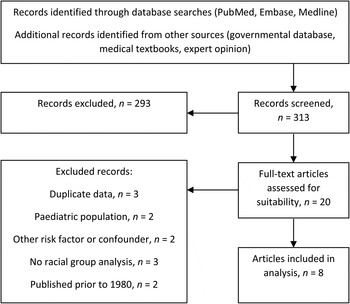
A comprehensive search of databases (Figure 1) yielded a total of 313 studies describing the epidemiology of thyroid cancer. Of these, 293 were deemed unsuitable and subsequently excluded, with 20 records proceeding to screening for inclusion. After screening, 12 of these studies were excluded; 3 were duplicates from the Surveillance, Epidemiology and End Results Program database, 2 analysed paediatric populations, 2 analysed radiation exposure and 1 looked at iodine deficiency. Two studies were published prior to 1980. Racial group analysis was not available in three additional studies.
Flow diagram of study selection.

A total of eight studies met the inclusion criteria and were included in the analysis. The average Newcastle–Ottawa Scale score was 5.2 out of 9.
The studies included ones identified from the Surveillance, Epidemiology and End Results Program 17 database,Reference Howlader, Noone, Krapcho, Garshell, Miller and Altekruse 12 and four other American studiesReference Harari, Li and Yeh 14 – Reference Brown, Lee, Brown and Waddell 17 that were not included in the Surveillance, Epidemiology and End Results Program. Two studies from the UK were also included.Reference Findlayson, Barnes, Sayeed, McIver, Beral and R Ali 18 , Reference Galm, Minhas, Cullen and Griffiths 19 The South African Cancer Registry was reviewed and the relevant data were extrapolated. 20 Of note, all of the data were biased towards developed countries and therefore may not accurately reflect worldwide trends.
The publication dates of the studies ranged from 1980 to 2008. A total of 611 777 patients were included in this review. All patients had histologically diagnosed thyroid cancer and were aged over 18 years.
The data were stratified by age, gender and racial group. Race and ethnicity information for thyroid cancer cases was based primarily on information contained in patients' medical records. This was based on information obtained directly from the patient, or was determined by the admissions staff or other administrative personnel based on surname or maiden name, birthplace, or race or ethnicity of parents, which represented a source of bias. In future research, prospective data collection and contemporaneous collation of these data directly from the patient would be preferable.
There was considerable variation in reporting and it was therefore not possible to pool the results from all eight studies; hence, a narrative systematic review of the available literature was undertaken. Setting a priori criteria for data handling was not possible. The authors consolidated the data where possible and expressed the results in percentages.
Patient population
Where possible, data were collated and percentages were calculated, but statistical analysis was not undertaken.
There was some heterogeneity of reporting with regard to specific racial groups, particularly between the UK and USA studies. This reflects varying major immigrant populations between the study countries of origin. In order to enhance uniformity of the terms, the term ‘non-Hispanic whites' was replaced with ‘Caucasian’, and the term ‘non-Hispanic blacks’ was replaced with ‘black’. To promote cohesion of the data between the UK, USA and South African studies, the group ‘Chinese’ and the group ‘South East Asian’ in the UK studies were replaced with ‘Asian’. This is in keeping with those countries of origin delineated by the North American Association of Central Cancer Registries algorithm. 21
In general, the labels ‘race’ and ‘ethnicity’ were poorly defined, and the two terms were often used interchangeably. Other racial or ethnic groups involved in the various studies were termed ‘coloured’, 20 but these were not included in our analysis as this term was poorly defined and could therefore not be incorporated into another group. In the larger of the UK studies,Reference Findlayson, Barnes, Sayeed, McIver, Beral and R Ali 18 ethnicity information was missing in 16.7 per cent of thyroid cancer registrations, but similar results found in sensitivity analysis suggested that this did not affect their results.
Some studies had differing methods of reporting age, with some reporting median age,Reference Howlader, Noone, Krapcho, Garshell, Miller and Altekruse 12 , Reference Moo-Young, Panergo, Wang, Patel, Duh and Winchester 15 , 20 and others grouping age into the dichotomies of over 50 years and under 50 years, or over 45 years and under 45 years.Reference Harari, Li and Yeh 14 , Reference Brown, Lee, Brown and Waddell 17 , 20 Only three studies provided information regarding the age-standardised incidence rate per 100 000 person years in each racial group.Reference Harari, Li and Yeh 14 , Reference Brown, Lee, Brown and Waddell 17 , 20
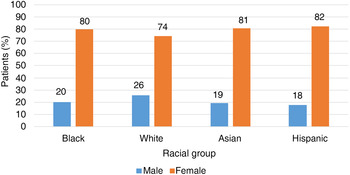
The number of patients in each different racial group stratified by gender is shown in Figure 2. One paper was excluded because it did not analyse for gender,Reference Reitzel, Nguyen, Li, Xu, Regan and Sturgis 16 and a total of 55 360 patients were pooled. It is important to note that not all studies reported all four racial groups and, in Figure 2, Asians and Hispanics are under-represented. Four of the eight studies included the Hispanic group and seven included the Asian group. Taking this into account, some provisional projections can be formulated from the data. Female sex predominated in all groups, and this has been well documented. The highest proportion of women was seen in the Asian and Hispanic groups. The white group tended to have a higher rate of male sex patients than the other racial groups (male:female ratio of 26:74 per cent vs 18:82 per cent in the Hispanic group.)
Gender variation across racial groups.

No real conclusions regarding age can be made from the above findings; six studies analysed for age, but there was great variation in how this was presented. However, from the limited data available, it seems that white people tend to have an advancing age when they are diagnosed, and the Hispanic population tends to get thyroid cancer at an earlier age when compared to other racial groups (Hispanic vs Caucasian: median ages of 44 vs 49 years,Reference Howlader, Noone, Krapcho, Garshell, Miller and Altekruse 12 and 38 vs 47 yearsReference Moo-Young, Panergo, Wang, Patel, Duh and Winchester 15 ).
As previously discussed, it is hypothesised that the variation in incidence of thyroid cancer across racial groups occurs not only because of differences between the individuals at a genetic level but also because of environmental factors. Socioeconomic status was a factor taken into consideration in four studies.Reference Harari, Li and Yeh 14 , Reference Reitzel, Nguyen, Li, Xu, Regan and Sturgis 16 – Reference Findlayson, Barnes, Sayeed, McIver, Beral and R Ali 18 In the American studies, the results were conflicting.
One of the American studies analysed 4625 patients with an equal access healthcare system, concluding that there was no difference between blacks and Caucasians in relation to their age at presentation, tumour size and survival.Reference Brown, Lee, Brown and Waddell 17 Black patients tended to have a lower rate of lymph node involvement; this was the only statistically significant difference (p < 0.001). Another American study showed significant differences in stage of presentation, with black patients and those of a lower socioeconomic status having a worse outcome.Reference Harari, Li and Yeh 14 These patients had a higher percentage of metastatic disease when compared with white patients (odds ratio = 1.36; confidence interval = 1.01–1.84). In addition, the unadjusted overall survival rates were lower in black patients versus white patients, and this was statistically significant (p < 0.001). The comparison between these two papers suggests that socioeconomic status and access to healthcare resources does greatly influence outcomes in thyroid cancer.
Another American study from Texas showed that an increase in the proportion of smaller tumours (2 cm or less in size) in black patients in low and high socioeconomic groups was not as significant as in Caucasians.Reference Reitzel, Nguyen, Li, Xu, Regan and Sturgis 16 The black patients may not be experiencing the same effect of enhanced diagnostic imaging, possibly because of differing access to healthcare services.
In the larger UK study, the results showed that black patients in the lower socioeconomic groups (quintiles 2–5) had a higher incidence of thyroid cancer when compared to white patients in the lower socioeconomic groups (age-standardised rate per 100 000 person years was 3.9 vs 2.0).Reference Findlayson, Barnes, Sayeed, McIver, Beral and R Ali 18 The highest rate of incidence, however, was seen in wealthy (quintile 1) Asian patients (age-standardised rate per 100 000 person years was 4.9). There were no data on survival rate.
Tumour characteristics
Only four studies included analysis on histology.Reference Howlader, Noone, Krapcho, Garshell, Miller and Altekruse 12 , Reference Moo-Young, Panergo, Wang, Patel, Duh and Winchester 15 , Reference Brown, Lee, Brown and Waddell 17 , Reference Findlayson, Barnes, Sayeed, McIver, Beral and R Ali 18 Anaplastic disease was mentioned in only one of the studies and no cases were reported.Reference Howlader, Noone, Krapcho, Garshell, Miller and Altekruse 12 One study only mentioned differentiated thyroid carcinoma and did not analyse race by histological subtype.Reference Harari, Li and Yeh 14 Another did not include analysis but stated that the papillary subtype predominated.Reference Galm, Minhas, Cullen and Griffiths 19
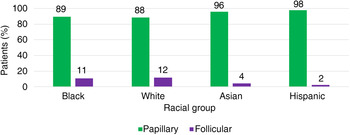
Four studies (comprising 47 073 patients) reported on the papillary and follicular (differentiated thyroid carcinoma) histological subgroups,Reference Howlader, Noone, Krapcho, Garshell, Miller and Altekruse 12 , Reference Reitzel, Nguyen, Li, Xu, Regan and Sturgis 16 , Reference Galm, Minhas, Cullen and Griffiths 19 , 20 and the cumulative results are shown in Figure 3.
Histological subtype by racial group.

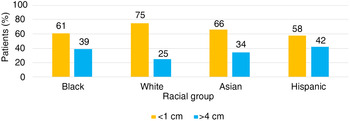
There was a paucity of information regarding pathological tumour characteristics, with up to 50.4 per cent of the information missing in the study that included it.Reference Reitzel, Nguyen, Li, Xu, Regan and Sturgis 16 This study contained information on tumour size and stage, but stratified for socioeconomic group rather than race, and was excluded from pooling. The remaining information was obtained from 3 US studies involving 4775 patients.Reference Howlader, Noone, Krapcho, Garshell, Miller and Altekruse 12 , Reference Moo-Young, Panergo, Wang, Patel, Duh and Winchester 15 , Reference Galm, Minhas, Cullen and Griffiths 19 The available information regarding tumour size has been collated and is summarised in Figure 4.
Tumour size by racial group.

Large tumours can be a sign of late detection or aggressive disease. This is a very important prognostic variable in determining staging, and thence treatment and five-year survival rate. Our data suggest that white people have a higher proportion of smaller tumours. This may reflect earlier detection via a screening pathway. The Hispanic population has a larger proportion of patients with tumours over 4 cm in size, followed closely by black patients. The data show a major discrepancy between the racial groups.
Another prognostic variable is the presence of lymph node metastasis. A total of 12 296 patients were analysed from the same studies in terms of their lymph node status;Reference Howlader, Noone, Krapcho, Garshell, Miller and Altekruse 12 , Reference Moo-Young, Panergo, Wang, Patel, Duh and Winchester 15 , Reference Galm, Minhas, Cullen and Griffiths 19 the results are shown in Figure 5.
Lymph node status by racial group.

Only one study made reference to surgical management and radiological therapy between black and white patients.Reference Brown, Lee, Brown and Waddell 17 A total of 4625 patients were analysed. Total thyroidectomy was the most commonly used treatment, and the proportions were similar in both groups (65.3 per cent vs 63.3 per cent for black vs white patients). This was followed by lobectomy (27.7 per cent vs 27.5 per cent for black vs white patients). The proportions of patients receiving radiation therapy was also similar in both groups (56.5 per cent vs 51.8 per cent for black vs white patients; p = 0.76). Of note, these data come from an equal access healthcare system and therefore socioeconomic status is not taken into account.
In terms of survival rate, it was anticipated that not all studies would have adequate information, as a period of at least five years is recommended.Reference Perros 22 Only two studies had figures on overall five-year survival.Reference Brown, Lee, Brown and Waddell 17 , Reference Findlayson, Barnes, Sayeed, McIver, Beral and R Ali 18 The first study included data obtained from an equal access healthcare system in the USA, and included only black and white patients (n = 4625). The five-year survival rate was excellent for both groups (97 per cent for black patients and 96 per cent for Caucasians (p = 0.273)) However, in the other study, which took socioeconomic status into consideration, overall survival in black patients was worse compared with Caucasian patients (hazard ratio = 1.38; p = 0.006) This suggests that socioeconomic status and access to healthcare greatly influence outcomes in thyroid cancer.
Discussion
This review highlights many unanswered questions regarding the increasing worldwide incidence of thyroid cancer. Our assimilated analysis offers one of the largest reviews on this topic. The differences by subtype cannot be explained by known risk factors alone, and establishing the determinants of this variation with individual-level data of exposures may offer fresh insights into aetiology. The lack of individual exposure analysis introduces uncertainty and bias, and prospective cohort studies that collect information on individual exposures are required to address this.
Inverse associations have been seen between thyroid cancer and smoking and alcohol consumption, but this is in contrast to other malignancies.Reference Kitahara, Linet, Beane Freeman, Check, Church and Park 4 High body mass index (BMI) is associated with the development of thyroid cancer in both men and women.Reference Kitahara, Platz, Freeman, Hsing, Linet and Park 23 , Reference Kim, Kim, Chol, Sohn, Kim and Jin 24 Obesity is a health problem that has steadily increased with changes in diet and with populations leading a sedentary lifestyle. The epidemic shows considerable racial variation, with black women and Caucasian men being at highest risk.Reference Flegal, Carroll, Kuczmarski and Johnson 25 Pacific Islands countries such as Tonga, Samoa and Fiji are reaching significant proportions, with up to 80 per cent of the populations being overweight. 26 It would be of interest to assess whether these risk factors are reflected equally amongst differing racial groups, and perhaps more specific ethnic subgroup analysis may be useful.
The rarer histological subtypes such as medullary and anaplastic disease have shown significant variation across racial groups, but the data are seriously lacking. In a Surveillance, Epidemiology and End Results Program study with 2033 patients from 1973 to 2006, 78 per cent of those patients with medullary type disease were Caucasian and 8 per cent were black.Reference Panigrah, Roman and Rosa 27 Another Surveillance, Epidemiology and End Results Program study demonstrated that black patients are 2.3 times more likely to get anaplastic disease, which of course confers an extremely poor prognosis.Reference Hollenbeak, Wang, Schneider and Goldenberg 28
There is a need for improved reporting involving all malignant histological subtypes and risk factors, such as BMI, with a clear consensus of how it should be performed. This would enable pooling of data and provide information on worldwide thyroid cancer trends. The establishment of a cancer registry is a key first step in healthcare planning, helping to identify manpower needs, facilities and research to create an effective cancer control programme. Cancer registries play an important role in the development of draft national policy guidelines for prevention and control. They provide more comprehensive and accurate clinically relevant information on patient characteristics than can be obtained from mortality data, and they are therefore essential for basic research.
Several problems exist with the development of cancer registries, such as lack of funding or resources, lack of follow up, the unavailability of census data, lack of data processing facilities, and maintenance of confidentiality. It is generally easier to commence with a hospital- or pathology-based registry, and, ideally, the objective should be to establish a population-based cancer registry. The extra difficulties and expense are outweighed by the enhanced validity and usefulness of the data generated.Reference Vasecchi and Steliarova-Foucher 29
Clinicians need to take the implications of socioeconomic status into consideration during the investigation and management of thyroid cancer, especially for those in minority racial groups as they tend to have poorer outcomes and compliance.Reference Zevallos, Xu and Yiu 30
Over-diagnosis occurs when a condition that would otherwise not go on to cause symptoms or death is diagnosed, including non-aggressive or slowly progressive cancers.Reference Welch and Black 31 In a Canadian study, the rates of diagnosis varied up to four times across the medical geographic regions of Ontario, and were strongly related to the variation in rates of the use of discretionary medical tests including diagnostic ultrasound.Reference Hall, Irish, Groome and Griffiths 32 Further research is required to identify reasons for variations in the ordering of tests. Thyroid cancer fulfils the criteria for over-diagnosis,Reference Hall, Walker, Siemens and Schneeberg 33 and clinicians are encouraged to adhere to local guidelines when choosing patients for thyroid ultrasound and when deciding which patients should proceed to biopsy.
Conclusion
The variations amongst incidence and outcomes of thyroid cancer in racial groups are most likely a result of a number of interrelating factors, including genetic, environmental and modifiable lifestyle factors. The data suggest major discrepancies in the presentation, treatment and outcomes in thyroid cancer associated with race and socioeconomic status. This needs to be addressed at a political level. There are little data regarding rarer histological subtypes such as anaplastic disease, and patients at risk should be identified as there is a major survival disadvantage.
Given the lack of important prognostic information and data regarding individual patient exposures, it is difficult to draw any conclusions from the available studies. Further aetiological investigation, particularly regarding individual patient risk factors, is required. This would provide vital information concerning treatment options and overall survival, and help to improve patient outcomes. There should be a clear consensus as to how to report these findings, including the other associated risk factors, in order to provide a reflection of worldwide patterns.