Obsessive-compulsive disorder (OCD) is a disorder characterised by recurring, unwanted thoughts, ideas or sensations (obsessions) and the performance of time-consuming repetitive behaviours (compulsions; American Psychiatric Association [APA], 2013). The obsessive-compulsive core dimensions model of OCD posits that compulsions are driven by either the need for harm avoidance, or to counteract an internal sense of incompleteness (Summerfeldt, Reference Summerfeldt2004). Incompleteness has been associated with feelings of tension, discomfort, and the desire to perform tasks perfectly (Pietrefesa & Coles, Reference Pietrefesa and Coles2009). A compulsion motivated by incompleteness may involve, for example, a person seeing an object in ‘not quite the right place’, thus they proceed to pick it up and put it back down to reduce the feelings of ‘not just rightness’ (Salkovskis, Reference Salkovskis1991; Summers, Fitch, & Cougle, Reference Summers, Fitch and Cougle2014). These perceptually associated phenomena have been termed ‘not just right experiences’ (NJREs; Coles, Frost, Heimberg, & Rhéaume, Reference Coles, Frost, Heimberg and Rhéaume2003).
Using self-report questionnaires, Coles et al. (Reference Coles, Frost, Heimberg and Rhéaume2003) and Coles, Heimberg, Frost, and Steketee (Reference Coles, Heimberg, Frost and Steketee2005) demonstrated that NJREs were more strongly related to OCD symptoms when compared to features of social anxiety, depression or trait anxiety, and Ghisi, Chiri, Marchetti, Sanavio, and Sica (Reference Ghisi, Chiri, Marchetti, Sanavio and Sica2010) found a significant association between NJRE severity and OC symptoms in an undergraduate sample after controlling for perfectionism and general distress. Researchers using both clinical (Ecker & Gönner, Reference Ecker and Gönner2008; Tolin, Brady, & Hannan, Reference Tolin, Brady and Hannan2008; Viar, Bilsky, Armstrong, & Olatunji, Reference Viar, Bilsky, Armstrong and Olatunji2011) and analogue samples (Coles et al., Reference Coles, Heimberg, Frost and Steketee2005; Pietrefesa & Coles, Reference Pietrefesa and Coles2009), have demonstrated strong, unique relationships between NJREs and the need for symmetry. Researchers have reported similar findings using behavioural tasks, such as arranging books on a bookshelf, or viewing a cluttered, disorganised space (Coles et al., Reference Coles, Frost, Heimberg and Rhéaume2003; Fitch & Cougle, Reference Fitch and Cougle2013). Most recently, Summerfeldt, Gilbert, and Reynolds (Reference Summerfeldt, Gilbert and Reynolds2015) investigated the obsessive-compulsive need for symmetry in terms of incompleteness and aesthetic sensitivity using visually manipulated colour and balance preference paradigms. Those higher in trait incompleteness reported greater symmetry-related concerns and higher aesthetic sensitivity in their chosen preferences of black-and-white shapes using an Assessment for Preference of Balance task (BT; Wilson & Chatterjee, Reference Wilson and Chatterjee2005).
There is also evidence that NJREs play a key role in other OCD symptom expressions, such as checking. Zor, Szechtman, Hermesh, Fineberg, and Eilam (Reference Zor, Szechtman, Hermesh, Fineberg and Eilam2011) found that individuals with OCD carried out a significantly greater amount of non-functional behaviours at the end of tasks, driven by incompleteness motivations associated with NJREs as opposed to harm avoidance. Across three in vivo studies Cougle, Fitch, Jacobson, and Lee (Reference Cougle, Fitch, Jacobson and Lee2013) found checking symptoms uniquely predicted undergraduate student participants’ viewing discomfort and urge to straighten while looking at a cluttered table. In the second study, self-report measures of incompleteness were predictive of checking urges following a stove check task and using an NJRE induction protocol. In study 3, individuals in the incompleteness induction condition with elevated dispositional checking displayed a heightened urge to check the stove, when compared to the control condition. In regard to OCD washing, Wahl, Salkovskis, and Cotter (Reference Wahl, Salkovskis and Cotter2008) found OCD washers were more likely to terminate washing when it ‘felt right’. Similarly, Cougle, Goetz, Fitch, and Hawkins, (Reference Cougle, Goetz, Fitch and Hawkins2011) found that frequency and intensity of NJREs was predictive of hand-washing duration, even after controlling for prewash anxiety.
While NJREs are subjective experiences that may occur over different sensory domains (Summerfeldt, Reference Summerfeldt2004), laboratory studies have primarily focused on the visual system (e.g., Coles et al., Reference Coles, Heimberg, Frost and Steketee2005). Recently, however, Summers et al. (Reference Summers, Fitch and Cougle2014) employed a large undergraduate sample (n = 284) to examine NJREs across visual, auditory, and tactile sensory modalities. Task discomfort and urge to counteract were measured across four in vivo tasks, and the relationship between NJREs, OC symptoms, and perfectionism was examined. Task ratings across all sensory stimuli were uniquely associated with validated self-report measures of NJREs, OC symptoms, and the maladaptive domains of perfectionism, even after controlling for negative affect and pretask discomfort. However, the researchers noted that their study lacked a control condition, that is, a ‘just right experiences’ (JRE) condition. They also recognised that the tactile and auditory stimuli could have been contaminated by visual information.
In order to overcome these limitations and further examine the relationship between OC symptoms, NJREs, and perfectionism, this study will employ a JRE condition and will also include a blindfold in the non-visual conditions. This research will also assess anxiety sensitivity (AS). NJREs involve a considerable amount of arousal, and research has demonstrated that AS plays an important role in OCD. Patients with OCD have reported significantly greater levels of AS when compared with healthy matched controls (Taylor et al., Reference Taylor, Zvolensky, Cox, Deacon, Heimberg, Ledley and Cardenas2007; Wheaton et al., Reference Wheaton, Deacon, McGrath, Berman and Abramowitz2012) and are more likely to engage in rituals or behaviours so as to avoid anxiogenic triggers (Olatunji & Wolitzky-Taylor, Reference Olatunji and Wolitzky-Taylor2009). Higher levels of AS have been associated with functional impairment in individuals with OCD, and this relationship is mediated by OC symptom severity (Storch et al., Reference Storch, Wu, Small, Crawford, Lewin, Horng and Murphy2014). To date, three studies have examined the link between AS subfactors in relation to OCD symptom dimensions (Calamari, Rector, Woodard, Cohen, & Chik, Reference Calamari, Rector, Woodard, Cohen and Chik2008; Wheaton et al., Reference Wheaton, Deacon, McGrath, Berman and Abramowitz2012; Raines, Oglesby, Capron, & Schmidt, Reference Raines, Oglesby, Capron and Schmidt2014). Symmetry-related OC symptoms that are most closely related to maladaptive beliefs of perfectionism were uniquely predicted by both physical and cognitive AS dimensions in an undergraduate sample (Wheaton et al., Reference Wheaton, Deacon, McGrath, Berman and Abramowitz2012). This is consistent with Summerfeldt's (Reference Summerfeldt2004) incompleteness motivation of compulsions, suggesting feelings of imperfection exacerbate anxiety and distress and thus serve as a higher-order vulnerability factor for OCD (Coles et al., Reference Coles, Frost, Heimberg and Rhéaume2003; Calamari et al., Reference Calamari, Rector, Woodard, Cohen and Chik2008). However, this is yet to be examined in a laboratory setting.
Further, while a strong correlational relationship has been established between OC symptoms and perfectionism (e.g., Wu & Cortesi, Reference Wu and Cortesi2009) and OC symptoms and AS separately (e.g., Wheaton et al., Reference Wheaton, Deacon, McGrath, Berman and Abramowitz2012), little is known about the interaction between these three variables. Given that OC symptomatology and perfectionism have been associated with negative affectivity such as AS (Frost & DiBartolo, Reference Frost, DiBartolo, Flett and Hewitt2002), further investigation of this relationship seems appropriate. As such, this study will examine the relationship between OC symptoms, NJREs, perfectionism and AS. In order to carry out all our objectives, a number of predictions are made.
Hypothesis 1
Consistent with previous findings (Coles et al., Reference Coles, Frost, Heimberg and Rhéaume2003; Summers et al., Reference Summers, Fitch and Cougle2014), it is hypothesised that task ratings for discomfort and urge to counteract stimuli during NJREs would be positively associated with self-report measures of NJREs, OC symptom domains of checking, washing, ordering and obsessing, maladaptive perfectionism, and AS; and these relationships would remain after controlling for negative affect and pretask discomfort. In particular, the ratings of NJREs would be more strongly correlated with the motivational domain of incompleteness, as opposed to harm avoidance.
Hypothesis 2
Consistent with, and extending Summers et al. (Reference Summers, Fitch and Cougle2014), it was predicted that task ratings on NJREs would be significantly higher for individuals in the NJRE groups when compared to the control JRE groups, regardless of whether anxiety sensitivity had been induced or not.
Hypothesis 3
Extending previous research, it was predicted that the relationship between task ratings on NJRE and maladaptive perfectionism would be moderated by an individual's level of AS. This suggests that individuals with higher levels of trait maladaptive perfectionism perform worse on the NJRE tasks, partly due to their levels of AS. Finally, extending previous research, it is hypothesised that the relationship between task ratings on NJREs and maladaptive perfectionism would be moderated by an individual's level of AS.
Method
Participants
One hundred and thirty-three first-year undergraduate psychology students enrolled at the University of Sydney volunteered to participate in this study in exchange for course credit. One participant was excluded due to failure to complete the NJRE tasks. The final sample consisted of 132 participants. It was comprised of 37 males and 95 females, with an age range of 17 to 56 years (M = 20.37, SD = 6.01).
Design
The study employed a 2 (NJRE condition: experimental [NJRE] vs. control [JRE]) × 2 (anxiety sensitivity: induced vs. control) between-subjects design.
Materials
Depression Anxiety Stress Scale — 21 Item Revision (DASS-21; Henry & Crawford, Reference Henry and Crawford2005)
The DASS-21 is a shortened version of the original DASS-42 (Lovibond & Lovibond, Reference Lovibond and Lovibond1995). The DASS-21 was used to gather information on symptoms of baseline depression and anxiety only. Participants were asked to rate on a 4-point Likert scale from 0 (never) to 3 (almost always) how much each item applied to them over the past week. Scores can range from a total of 0 to 63, while scores on each dimension subscale can range from 0 to 21, with a higher score indicating greater symptom severity. The internal consistency coefficients for each subscale have been demonstrated as excellent, ranging from α = .88–.94 (depression) and α = .82–.87 (anxiety; Henry & Crawford, Reference Henry and Crawford2005).
Obsessive-Compulsive Inventory — Revised (OCI-R; Foa et al., Reference Foa, Huppert, Leiberg, Langner, Kichic, Hajcak and Salkovskis2002)
The OCI-R is an 18-item questionnaire that assesses six of the primary obsessions and compulsions related to OCD. Respondents were required to rate on a 5-point Likert scale ranging from 0 (not at all) to 4 (extremely) how much the experience caused them distress or bother in the past month. Scores can range from 0 to 72, where a higher score indicates a greater likelihood of the presence of OCD. Neutralising and hoarding items were excluded from the analysis, as the neutralising subscale has exhibited poor psychometric properties (Hajcak, Huppert, Simons, & Foa, Reference Hajcak, Huppert, Simons and Foa2004), and hoarding has now been considered its own separate disorder in the Diagnostic and Statistical Manual of Mental Disorders, 5th Edition (DSM-5; APA, 2013). The OCI-R has demonstrated sound psychometric properties in a non-clinical sample, with a Cronbach's alpha of .88, as well as good construct validity (Hajcak et al., Reference Hajcak, Huppert, Simons and Foa2004).
Obsessive-Compulsive Core Dimensions Questionnaire (OC-CDQ; Summerfeldt, Kloosterman, Antony, & Swinson, Reference Summerfeldt, Kloosterman, Antony and Swinson2014)
The OC-CDQ consists of 20 items assessing the two core dimensions of OCD, 10 of which measure incompleteness and 10 that evaluate harm avoidance. Participants are asked to rate how applicable each statement is to how they typically think, feel and act on a 5-point Likert scale from 1 (never applies) to 5 (always applies). Scores on the total scale can range from 20 to 100, while scores on the individual subscales can range from 10 to 50. The OC-CDQ has been shown to be a reliable and valid measure for measuring the OC dimensions of harm avoidance and incompleteness in non-clinical college populations (incompleteness α = .91; harm avoidance α = .89) with good convergent validity.
Symmetry, Ordering and Arranging Questionnaire (SOAQ; Radomsky & Rachman, Reference Radomsky and Rachman2004)
A measure of ordering and arranging, and the need for symmetry and exactness was obtained using the SOAQ, a 20-item, self-report questionnaire. Participants are asked to rate each item from 0 (not at all) to 4 (extremely) specifying the degree to which the individual agrees with the statement, with a total score ranging from 0 to 80 and higher scores indicating greater endorsement of symmetry-related behaviours. This scale has demonstrated excellent internal consistency (α = .96) as well as very good convergent and divergent validity scores (Radomsky & Rachman, Reference Radomsky and Rachman2004).
Frost Multidimensional Perfectionism Scale (FMPS; Frost, Marten, Lahart, & Rosenblate, Reference Frost, Marten, Lahart and Rosenblate1990)
The FMPS is a 35-item questionnaire assessing six domains: concern over mistakes, doubts about actions, parental criticism, parental expectation, personal standards, and organisation. Participants are asked to rate on a 5-point Likert scale the extent to which they agree with the statement ranging from 1 (strongly disagree) to 5 (strongly agree). The final score is computed by summing all items together except for the organisation subscale, with a total range of 29 to 145, and with higher scores indicating greater perfectionistic tendencies. The total score has exhibited strong convergent validity as a measure of perfectionism and excellent internal consistency (α = .90; Frost et al., Reference Frost, Marten, Lahart and Rosenblate1990).
Not Just Right Experiences Questionnaire — Revised (NJRE-Q-R; Coles et al., Reference Coles, Heimberg, Frost and Steketee2005)
The NJRE-Q-R is a 19-item, self-report measure designed to assess NJREs experienced during the past month. The first 10 items include items such as ‘I have had the sensation after getting dressed that parts of my clothes (tags, collars, pant legs, etc.) did not feel just right’. Respondents are then asked to concentrate on the most recent NJRE and rate on a scale from 1 (absence) to 7 (extreme) the frequency, intensity, distress, rumination, urge and responsibility. The last 9 items can range from 9 to 63, with a higher score indicating greater overall symptom severity. Good internal consistency has been demonstrated for the first 10 items (α = .79; Coles et al., Reference Coles, Heimberg, Frost and Steketee2005) as well as good discriminant and convergent validity with OCD symptoms.
Anxiety Sensitivity Index-3 (ASI-3; Taylor et al., Reference Taylor, Zvolensky, Cox, Deacon, Heimberg, Ledley and Cardenas2007)
The ASI-3 consists of 18 items designed to assess beliefs about feared consequences associated with anxious arousal across three subscales; physical, cognitive, and social. Respondents are asked to rate on a scale from 0 (very little) to 4 (very much) how strongly they agree with each statement. Scores on the total scale can range from 0 to 72, with a higher score indicating greater overall anxiety sensitivity. Scores on the individual subscales can range from 0 to 24. The ASI-3 has demonstrated excellent reliability and validity indices, with a high overall internal consistency rating of α = .89, and good subscale ratings (physical α = .83; cognitive α = .86; social α = .79; Taylor et al., Reference Taylor, Zvolensky, Cox, Deacon, Heimberg, Ledley and Cardenas2007).
Procedure
The experiment consisted of four stages: questionnaire completion, anxiety manipulation, NJRE task completion, and manipulation check. For the anxiety conditions, a digital video camera was set up at the front of the room as participants entered the room.
Anxiety manipulation
Following the completion of the relevant questionnaires, instructions were given both orally and in written form to participants in the anxiety condition informing them that after testing had concluded they would be given 6 minutes of preparation time after which they would be required to deliver a 3-minute speech that would be videotaped by the experimenter. This methodology has previously been successfully used in research (Phillips & Giancola, Reference Phillips and Giancola2008). The exact wording of the script presented was as follows:
You will be taking part in a portion of the study that deals with testing your thinking style. We are interested in your ability to think quickly with limited time for preparation. Research has shown that these skills are related to your performance on the following tests. For this task you must quickly prepare and then deliver a short speech about what you like and dislike about your body while standing in front of a video camera that will record your speech. You will have 6 minutes to prepare a 3-minute speech. This will take place immediately after you complete the following tasks. It is very important that you think about the speech you are about to give. This has been shown to improve performance on the following tasks. This clock will now give you a 6-minute countdown. You will have this time to prepare your speech in your mind. When the 6 minutes are up, you will begin the following tasks.
Control condition (no anxiety)
Participants who had been allocated to the no anxiety control condition were given the following information both orally and in written form following completion of the questionnaires: ‘You will now experience a 6-minute waiting period before you begin the following tasks. Please sit quietly until you are given further instructions.’ After the allocated time had elapsed, participants in both conditions were presented with a questionnaire that asked ‘On a scale of 0–10, how anxious do you feel right now? (0 being not at all, 10 being extremely anxious)’ to assess pretask anxiety.
NJRE task completion
Following this, participants were instructed to begin the NJREs. Before each task, participants were asked to rate their baseline levels of discomfort on a scale of 0 (not at all) to 100 (extremely). After exposure to the stimuli, participants were asked to indicate their level of discomfort and urge to counteract this on a scale of 0 (not at all) to 100 (extremely). In order to reduce the potential for carryover effects, or order biases, the tasks were completed in a randomly counterbalanced order, with a completely unrelated word-search task performed for 2 minutes between tests. This methodology had previously been employed by Summers et al. (Reference Summers, Fitch and Cougle2014).
Visual NJRE task
In order to evoke visual NJREs, participants in the NJRE conditions were asked to direct their attention to a cluttered, disorganised table that contained everyday items including pens, books, magazines, post-it notes, rubber bands, paper clips, and paper scraps. The control JRE conditions were simply exposed to an arranged and organised table of the same everyday objects.
Auditory NJRE task
In order to evoke auditory NJREs, participants listened to a clip of the nursery rhyme ‘Frère Jacques’ played out of tune with a guitar and piano for 1 minute and 20 seconds through headphones while wearing a blindfold. Participants in the JRE control conditions listened to the original in-tune guitar and piano version of this nursery rhyme for 1 minute and 20 seconds while wearing a blindfold.
Tactile coat NJRE task
In order to evoke tactile NJREs, participants in the NJRE conditions were asked to put on an oversized lab coat and button it in an asymmetric manner, as well as rolling up one sleeve to the elbow and stand still for a total of 10 seconds while blindfolded. Those in the JRE conditions were provided with an appropriate size (medium or extra large) coat and asked to simply put it on and do the top three buttons up with a blindfold on and remain standing for 10 seconds.
Tactile hand wipe NJRE task
In the second tactile condition, participants in the NJRE condition were blindfolded and asked to wipe the back of their non-dominant hand with a moist hand wipe and then place both hands on the table for 10 seconds. Participants in the control JRE conditions were also blindfolded and asked to wipe both hands with the moist hand wipe and place them on the table for the 10 seconds.
Manipulation check
After the participants had completed the NJRE tasks, participants in both conditions were presented with one final questionnaire that asked ‘On a scale of 0–10, how anxious do you feel right now? (0 being not at all, 10 being extremely anxious)?’ Following this, participants in the anxiety conditions were asked to indicate either ‘yes’ or ‘no’ whether they were convinced they would actually have to give a videotaped speech following the tasks.
Results
Preliminary Analyses
Clinical measures
There were significant differences reported between groups in the mean score on the OCI-R washing subscale F(3, 128) = 2.697, p = .049; OC-CDQ incompleteness subscale F(3, 128) = 3.62, p = .015; SOAQ F(3, 128) = 3.172, p = .027; and the NJRE-Q-R count F(3, 128) = 4.052, p = .009 and severity subscales F(3, 128) = 3.09, p = .029. Given that these measures are important variables for investigation, they are included in all main between-group analyses as covariates, rather than excluding them.
Manipulation check
The mean reported level of anxiety post-NJRE task performance was 3.32 (SD = 2.85). Individuals in the anxiety conditions reported a mean score of 4.77 (SD = 2.84), which was statistically significantly higher than those in the control conditions with a mean rating of 1.93 (SD = 2.06); t(130) = 6.6, p < .001. Further ANOVA contrast analyses revealed that participants in the NJRE + anxiety condition reported the highest mean anxiety rating (M = 5.67, SD = 2.68) when compared to the other three conditions, on average F(1, 128) = 49.23, p < .001.
The second manipulation check revealed that of the 65 participants allocated to one of the anxiety conditions, 12.3% reported they did not believe the manipulation. However, there were no significant differences between anxiety rating scores as a function of whether or not the individual believed the manipulation, t(63) = .284, p = .504.
Main Analysis
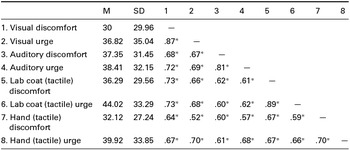
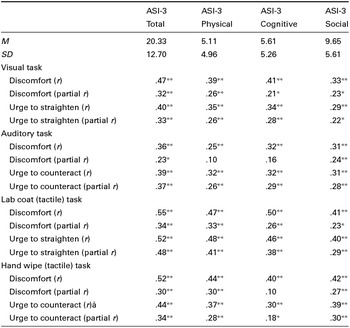
Intercorrelational analyses of task discomfort and urge to counteract during the NJRE tasks are presented in Table 1. Across all the four tasks, moderate to strong relationships were observed between ratings of post-task discomfort and urge to counteract or straighten (p < .01).
Descriptives and Intercorrelational Analyses of NJRE Task Performances

Note: Discomfort = Task discomfort; Urge = Urge to straighten/counteract.
* p < .01.
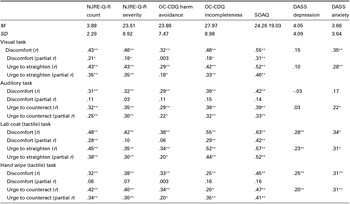
In order to assess the validity of the NJRE tasks, a series of correlations were performed between task ratings and existing measures of NJREs (NJRE-Q-R; OC-CDQ), presented in Table 2. As predicted, self-report measures of NJREs were strongly correlated with task ratings, including discomfort and urge to counteract stimuli; rs = .20–.55, ps < .05. While strong relationships between NJRE task performance and the OC-CDQ harm avoidance subscale were observed (rs = .29–.38, ps < .01), these correlations were largely reduced or no longer significant when controlling for pretask discomfort and the DASS variables. The pattern of correlations between NJREs and the OC-CDQ incompleteness subscale demonstrated significantly stronger relationships across task performance (rs = .25–.55, ps < .01). Very strong associations were observed between the SOAQ and NJRE task ratings (rs = .39–.63, ps < .01).
Correlational and Partial Correlationalϒ Analyses of NJRE Task Ratings and Self-Report Measures of NJREs, Depression and Anxiety

Note: NJRE-Q-R = Not Just Right Experiences Questionnaire-Revised; OC-CDQ = Obsessive-Compulsive Core Dimensions Questionnaire; SOAQ = Symmetry, Ordering and Arranging Questionnaire; DASS = Depression, Anxiety, Stress Scale-21; ϒpartial correlations for ‘discomfort’ controlling for pretask discomfort, DASS depression and DASS anxiety; partial correlations for ‘urge to counteract/straighten’ controlling for DASS depression and DASS anxiety.
* p <. 05; **p < .01.
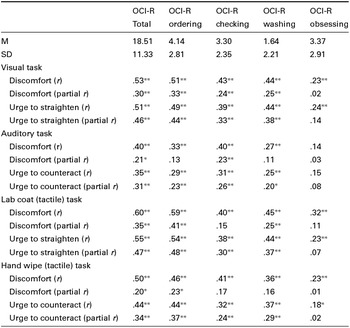
The relationship between NJRE task ratings and OCD symptoms of interest including ordering, checking, washing, and obsessing are presented in Table 3. As hypothesised, moderate to strong relationships were observed between ordering (rs = .29–.59, ps < .01), checking (rs = .31–.23, ps < .01), and washing (rs = .25–.45, ps < .01), and the majority of these relationships remained significant in partial correlation analyses, aside from a few exceptions for post-task discomfort. Contrary to prediction, the obsessing subscale demonstrated a weak to moderate relationship with NJRE task performance, and all these relationships were no longer significant after controlling for the DASS variables and pretask discomfort.
Correlational and Partial Correlationalϒ Analyses of NJRE Task Ratings and Self-Report Measures of OCD Symptoms

Note: OCI-R = Obsessive-Compulsive Inventory Revised; ϒpartial correlations for ‘discomfort’ controlling for pretask discomfort, DASS depression and DASS anxiety; partial correlations for ‘urge to counteract/straighten’ controlling for DASS depression and DASS anxiety.
* p < . 05; **p < .01.
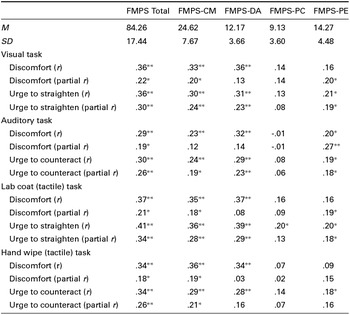
Correlations were also examined between NJRE task ratings and maladaptive domains of perfectionism, as presented in Table 4. In line with prediction, all task ratings were strongly correlated with the FMPS total score (rs = .29–.41, ps < .01), with all relationships remaining significant in partial correlation analyses. Interestingly, the concern over mistakes (rs = .23–.36, ps < .01) and doubts about actions (rs = .28–.39, ps < .01) subscales demonstrated the strongest associations with NJRE task performance, while the parental criticism and parental expectations subscales revealed weak to non-significant relationships across task performance, particularly in the partial correlational analyses.
Correlational and Partial Correlationalϒ Analyses of NJRE Task Ratings and Self-Report Measures of Perfectionism Dimensions

Note: FMPS = Frost Multidimensional Perfectionism Scale (CM = Concern over Mistakes; DA = Doubts about Actions; PC = Parental Criticism; PE = Parental Expectations); ϒpartial correlations for ‘discomfort’ controlling for pretask discomfort, DASS depression and DASS anxiety; partial correlations for ‘urge to counteract/straighten’ controlling for DASS depression and DASS anxiety.
* p < .05; **p < .01.
Finally, correlations between NJRE task ratings and AS were evaluated and are presented in Table 5. As hypothesised, strong correlations were observed between NJRE task performance and the ASI-3 total score (rs = .36–.55, ps < .01), which remained significant after covariate inclusion. An examination of each subscale individually revealed strong relationships with the dependent variables, including physical (rs = .25–.48, ps < .01), cognitive (rs = .30–.50, ps < .01), and social (rs = .29–.42, ps < .01). Additionally, these remained significant in the partial correlational analysis, with the exception of the correlation between auditory discomfort and the physical and cognitive subscales, as well as discomfort experienced using the hand wipe and the auditory subscale.
Correlational and Partial Correlationalϒ Analyses of NJRE Task Ratings and Self-Report Measures of Anxiety Sensitivity

Note: ASI-3 = Anxiety Sensitivity Index-3; ϒpartial correlations for ‘discomfort’ controlling for pretask discomfort, DASS depression and DASS anxiety; partial correlations for ‘urge to counteract/straighten’ controlling for DASS depression and DASS anxiety.
* p < . 05; **p < .01.
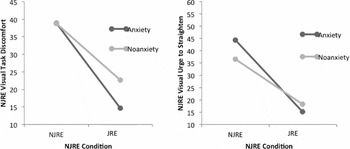
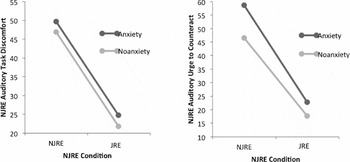
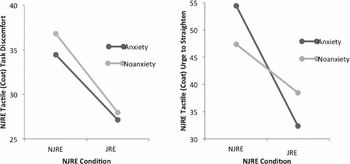
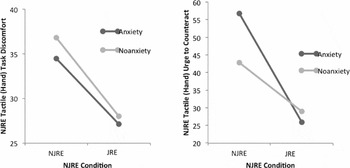
For the main effect of NJRE conditions, averaged across anxiety induction and covariates, participants in the experimental NJRE group gave significantly higher ratings of discomfort when compared to those in the control JRE groups. This was significant across all sensory stimuli post-task discomfort ratings including visual, MD = 20.22; F(1, 121) = 37.12, p < .001; auditory, MD = 25.08; F(1, 121) = 35.92, p < .001; tactile lab coat, MD = 11.77, F(1, 121) = 10.53, p < .01; and tactile hand wipe, MD = 8.08, F(1, 121) = 5.056, p < .05. Similarly, participants in the NJRE conditions gave significantly higher ratings of urge to counteract or straighten across all the sensory tasks when compared to their JRE counterparts, including visual, MD = 33.17; F(1, 122) = 57.44, p < .001; auditory, MD = 32.43; F(1, 122) = 55.67, p < .001; tactile lab coat, MD = 15.52; F(1, 122) = 11.26, p < .01; and tactile hand wipe, MD = 22.37; F(1, 122) = 21.84, p < .001.
Contrary to prediction, however, there was no significant main effect for AS on any of the task discomfort measures, including visual, F(1, 121) = 1.27, p = .263, auditory (F < 1), tactile lab coat (F < 1), or tactile hand wipe (F < 1). Also, there was no significant difference found on task ratings of urge to counteract or straighten between AS conditions, including visual, F(1, 122) = 1.56, p = .214, auditory, F(1, 122) = 3.75, p = .055, tactile lab coat (F < 1), and tactile hand wipe, F(1, 122) = 1.22, p = .271. Figures 1 through 4 represent each dependent variable in the respective orders.
Visual task discomfort and urge to straighten across NJRE and JRE conditions as a function of anxiety sensitivity.

Auditory task discomfort and urge to counteract across NJRE and JRE conditions as a function of anxiety sensitivity.

Tactile (coat) task discomfort and urge to counteract across NJRE and JRE conditions as a function of anxiety sensitivity.

Tactile (hand) task discomfort and urge to counteract across NJRE and JRE conditions as a function of anxiety sensitivity.

Eight separate hierarchical linear regressions were performed in order to examine whether the maladaptive domains of perfectionism differentially influenced NJRE task performance as a function of AS.
Visual NJRE task performance
The visual discomfort experimental condition accounted for a significant portion of the total variance (R 2 = .24, p < .001), while negative affect (ΔR 2 = .35, p < .001), maladaptive perfectionism (ΔR 2 = .03, p = .006), and AS (ΔR 2 = .03, p = .001) each explained significant added variance. The interaction between maladaptive perfectionism and AS did not explain a significant amount of variance beyond any other predictors in the model (p = .362). Similarly, the results for visual urge to straighten indicated that condition and negative affect initially explained a significant portion of the variance (R 2 = .38, p = .003), and the addition of maladaptive perfectionism (ΔR 2 = .05, p = .001) and AS (ΔR 2 = .04, p = .002) accounted for a further significant amount of variance. However, the addition of the interaction did not explain any extra significant variance (p = .8). Therefore, contrary to prediction, AS did not act as a moderator between maladaptive perfectionism and visual NJRE task performance.
Auditory NJRE task performance
For auditory task discomfort, the experimental condition accounted for a significant amount of the variance (R 2 = .31, p < .001), and the addition of negative affect significantly increased the predictive power (ΔR 2 = .16, p < .001). Maladaptive perfectionism (ΔR 2 = .03, p = .014) and AS (ΔR 2 = .03, p = .003) significantly increased the variance accounted for; however, the interaction did not account for any significant further variance (p = .65). The analysis of auditory urge to counteract revealed that condition and negative affect primarily explained a significant amount of the total variance (ΔR 2 = .38, p < .001). Maladaptive perfectionism (ΔR 2 = .04, p = .005) and AS (ΔR 2 = .06, p < .001) explained significant further variance. However, the addition of the interaction in the final model did not explain any added variance, contrary to prediction (p = .733).
Tactile coat NJRE task performance
For tactile coat task discomfort, experimental condition and negative affect accounted for a significant amount of the total variance (R 2 = .44, p < .001). Maladaptive perfectionism then explained an additional significant portion of the variance (ΔR 2 = .02, p = .034), above which AS accounted for a further significant increase in variance (ΔR 2 = .05, p < .001). However, against prediction, the interaction between maladaptive perfectionism and AS was not significant (p = .689). Similarly for the DV of tactile coat urge to straighten, condition predicted a significant amount of variance (R 2 = .10, p = .001), and the addition of negative affect explained further significant variance (ΔR 2 = .09, p = .001). Maladaptive perfectionism (ΔR 2 = .08, p < .001) and AS accounted for a further significant variance increase in the urge to straighten the coat (ΔR 2 = .12, p < .001). However, the added interaction term in the final step did not explain any further variance beyond the predictors in the models (p = .908). Therefore, contrary to prediction, AS did not act as a moderator between maladaptive perfectionism and either tactile coat NJRE task performance.
Tactile hand NJRE task performance
For tactile hand task discomfort, experimental condition and negative affect accounted for a significant amount of the total variance (R 2 = .47, p < .001). Maladaptive perfectionism did not explain any additional significant variance in the DV (ΔR 2 = .02, p = .059). When AS was entered, the resulting model accounted for significant additional variance in hand wipe discomfort (ΔR 2 = .04, p = .002); however, the interaction did not explain any significant further variance (p = .85). In the analysis of tactile hand urge to counteract as the DV, experimental condition accounted for a significant portion of variance (R 2 =.19, p < .001), and the addition of negative affect added significant predictive power (ΔR 2 = .08, p = .001). Maladaptive perfectionism (ΔR 2 = .04, p = .011) and AS (ΔR 2 = .06, p = .001) respectively explained a significant further amount of variance in urge to counteract. However, the interaction between maladaptive perfectionism and AS was not significant, contrary to prediction (p = .903).
Discussion
As hypothesised, NJRE task ratings, including discomfort and urge to counteract stimuli, were positively associated with self-report measures of NJREs, OC symptoms, maladaptive perfectionism, and AS. This is consistent with previous findings of significant relationships between NJRE severity ratings and OC symptoms in similar size undergraduate samples (Coles et al., Reference Coles, Frost, Heimberg and Rhéaume2003; Coles et al., Reference Coles, Heimberg, Frost and Steketee2005). The pattern of correlations indicated that while the separate sensory tasks are related, they are also somewhat discrete experiences. This supports the suggestion that NJREs are highly subjective (Coles et al., Reference Coles, Frost, Heimberg and Rhéaume2003). Task ratings displayed moderate associations with self-report measures of NJREs, including the NJRE-Q-R and OC-CDQ, providing further evidence for the validity of these measures. These relationships largely remained after controlling for negative affect and pretask discomfort, mirroring the findings of Summers et al. (Reference Summers, Fitch and Cougle2014). Also in accordance with prediction, stronger and more consistent task ratings were observed between NJRE task ratings and measures of dispositional incompleteness when compared to dispositional harm avoidance. This suggests discriminant validity between the two central motivational domains of OCD, as proposed in the obsessive-compulsive core dimensions model by Summerfeldt (Reference Summerfeldt2004).
Furthermore, the observed significant relationship between task performance and self-report ratings on a dispositional measure of symmetry provides added support for the incompleteness motivational domain of OCD (Summerfeldt, Reference Summerfeldt2004). Consistent with findings from other non-clinical studies, this model suggests that compulsive behaviours can arise from internal beliefs about the need for perfection, symmetry, and completeness in the immediate environment (Ecker & Gönner, Reference Ecker and Gönner2008; Pietrefesa & Coles, Reference Pietrefesa and Coles2009). This may explain why strong relationships were also observed with the checking and washing expressions of OCD. Individuals who experience a heightened motivation for perfection and balance are driven by these incompleteness motivations and thus are more likely to carry out a series of non-functional behaviours — for example, repeated checking, ordering, and washing compulsions — in order to counteract these feelings (Cougle, Fitch, Jacobson, & Lee, Reference Cougle, Fitch, Jacobson and Lee2013; Wahl, Salkovskis, & Cotter, Reference Wahl, Salkovskis and Cotter2008).
Contrary to prediction, the obsessing subscale exhibited a weak relationship with overall NJRE task performance. A possible explanation for this is that while obsessional symptom patterns are related to NJREs (Taylor et al., Reference Taylor, McKay, Crowe, Abramowitz, Conelea, Calamari and Sica2014), the behavioural manipulations performed in this study did not effectively elicit covert obsessional thoughts. As hypothesised, ratings of discomfort and urge to counteract the sensory-specific stimuli were strongly correlated with measures of maladaptive perfectionism. In particular, these relationships were strongest for concern over mistakes and doubts about actions domains, or the proximal indicators of maladaptive perfectionism, while weaker relationships were observed with the distal indicators of perfectionism, parental expectations, and parental criticism (Antony, Purdon, Huta, & Swinson, Reference Antony, Purdon, Huta and Swinson1998). This concurs with findings that suggest the proximal indicators of perfectionism account for more variance in NJREs and OC symptoms, thus accounting for greater variability in task performance (Moretz & McKay, Reference Moretz and McKay2009). In addition, this indicates that while perfectionism and NJREs are often examined together, feelings of ‘sensory incompleteness’ are quantitatively different from perfectionism domains.
While the literature has established a link between AS and OC symptoms, this study conducted a novel investigation into the relationship between NJREs and AS. As hypothesised, strong relationships were observed between NJREs and each facet of AS, particularly the cognitive subscale. This offers support for the theoretical mechanism believed to underlie AS: the fear of cognitive dyscontrol (Purdon, Reference Purdon, Abramowitz, McKay and Taylor2008). This data both extends and replicates previous results that have shown a relationship between maladaptive beliefs of perfectionism, symmetry-related OC symptoms, and AS (Wheaton et al., Reference Wheaton, Deacon, McGrath, Berman and Abramowitz2012).
In accordance with the second hypothesis, participants in the NJRE conditions demonstrated significantly higher task ratings across all stimuli when compared to their control condition counterparts. While existing literature has focused mainly on the visual system, the results provide new evidence demonstrating that the induction of NJREs causes increased feelings of discomfort and urge to counteract, even after controlling for dispositional levels of NJREs. Additionally, this provides further support for the intrinsic sensory-affective disturbance proposed to be present in the cases of OCD typified by incompleteness (Summerfeldt et al., Reference Summerfeldt, Kloosterman, Antony and Swinson2014) and the resulting motivation for problematic behaviour, such as performing ritualistic compulsions (Tallis, Reference Tallis1996).
Contrary to prediction, no significant relationship was found between the AS and control conditions on any of the task stimuli. To date, AS has not been examined in the context of NJREs. Having previously demonstrated strong relationships with OC symptoms in general, it was thought that inducing anxiety in individuals would make them more likely to engage in rituals or behaviours in order to avoid the supposed negative consequences, thus resulting in higher scores on NJRE task ratings (Olatunji & Wolitzky-Taylor, Reference Olatunji and Wolitzky-Taylor2009). In this study, induced anxiety did not worsen performance on NJREs. While the anxiety manipulation was found to be effective in heightening anxious arousal, a possible explanation for this non-significant result is that only dispositional AS has an effect on NJRE task performance. Although unanticipated, however, this may provide further evidence for the validity of the OCD core dimensions model (Summerfeldt, Reference Summerfeldt2004). In an analogue sample, harm avoidance has demonstrated a stronger relationship to nervousness-anxiety symptoms, whereas incompleteness has been associated with feelings of tension, perfection desires, and discomfort (Pietrefesa & Coles, Reference Pietrefesa and Coles2009). The exclusivity of the incompleteness motivations to NJREs is perhaps why induced anxiety had no effect on overall task performance.
The hypothesis that dispositional AS would moderate the relationship between maladaptive perfectionism and NJRE task performance was not supported. Across all sensory stimuli, higher levels of maladaptive perfectionism predicted significantly poorer performance on task ratings, while controlling for condition, negative affect, and pretask discomfort, except for discomfort experienced during the hand-wiping task. The dominant theories that explain the role of perfectionism in OCD assert that heightened perception of responsibility for negative events results in the performance of compulsions in order to prevent possible associated consequences (Bouchard, Rhéaume, & Ladouceur, Reference Bouchard, Rhéaume and Ladouceur1999). Theoretically, this may explain why studies have found significant associations between perfectionistic beliefs and OC symptom expressions of washing, checking, and ordering (Myers, Fisher, & Wells, Reference Myers, Fisher and Wells2008; Wu & Cortesi, Reference Wu and Cortesi2009).
The analyses also revealed that dispositional AS uniquely predicted performance on NJRE tasks, whereby those higher in AS gave higher task ratings across all the sensory-specific stimuli. This finding suggests that individuals who have the perceptual tendency to fear bodily sensations associated with anxious arousal are more likely to give higher ratings of discomfort and urge to counteract (Calamari et al., Reference Calamari, Rector, Woodard, Cohen and Chik2008). However, the hypothesis that AS would moderate the relationship between maladaptive perfectionism and NJRE task performance was not supported. It was predicted that higher levels of AS would hinder the performance on NJREs for individuals who scored higher on dispositional measures of maladaptive perfectionism compared to those who scored lower on this measure. This was based on the premise that separately, previous studies have found strong relationships between heightened maladaptive perfectionism and AS in OCD symptoms (e.g., Lee et al., Reference Lee, Prado, Diniz, Borcato, da Silva, Hounie and do Rosário2009; Wheaton et al., Reference Wheaton, Deacon, McGrath, Berman and Abramowitz2012). While heightened levels of each variable individually contributed to poorer performance on NJREs task ratings, there was no support for an interactive effect between the two.
Overall, the findings support Summerfeldt's (Reference Summerfeldt2004) core dimensions model. Individuals who are dispositionally higher in maladaptive perfectionism and AS are more likely to hold cognitive biases towards completeness and the need for perfectionism and thus complete compulsions with the motivation of eliminating the sensory imperfection in their surrounding environment (Calamari et al., Reference Calamari, Rector, Woodard, Cohen and Chik2008). This, in turn, serves as a higher-order vulnerability factor for OC symptomatology. However, according to the results of this study, these two variables remain largely independent in their influence on NJRE task performance, as AS does not alter the strength of the relationship between maladaptive perfectionism and NJRE task ratings. Incompleteness motivations appear to be exclusive to NJREs, as demonstrated in the NJRE between-groups difference. However, the null-effect of induced AS may be attributed to the theoretical similarity of this construct to harm avoidance motivations, which have been linked more closely to anxiety disorders (Pietrefesa & Coles, Reference Pietrefesa and Coles2009).
This study utilised a more ecologically valid methodology so as to overcome previously cited limitations (Summers et al., Reference Summers, Fitch and Cougle2014). Also, between-group analyses and regression analyses provided novel information about the directionality and causality of NJRE task performance, eliminating constraints of purely correlational designs. This study also assessed the link between different dispositional traits, including perfectionism, OC symptoms, and AS and how these relationships affect performance on NJRE task ratings. While the links between these variables have been explored individually, this study sought to combine them in order to gain a better understanding of mechanisms underlying the heterogeneous presentation of OCD.
Some limitations should be noted. While the sample size employed was considered adequate in comparison with other key correlational studies (e.g., Coles et al., Reference Coles, Heimberg, Frost and Steketee2005; Summers et al., Reference Summers, Fitch and Cougle2014), a statistical decision was made to control for a number of variables in order to eliminate potential between-group confounds. This raises important issues in terms of the suitability of the number of predictors in the regression analyses and variables controlled for in the ANCOVAs. This may potentially explain why the interaction was not found to be significant, and results should be interpreted with sample size in mind, as well as considered for replication in larger sample sizes. Our use of aggregate scores of maladaptive perfectionism and AS when examining their predictive and interactive power on the NJRE task performance limits the specific conclusions that can be drawn. Since both perfectionism and AS have been recognised as multidimensional constructs, with each domain having a differential relationship with OC symptoms (Calamari et al., Reference Calamari, Rector, Woodard, Cohen and Chik2008; Lee et al., Reference Lee, Prado, Diniz, Borcato, da Silva, Hounie and do Rosário2009), it would be useful for future studies to explore these subscales more specifically; in particular, the perfectionism domains of doubts about actions and concern over mistakes, and the AS cognitive facet in the context of NJREs.
The findings have important clinical implications. The current gold-standard treatment intervention for OCD, exposure and response prevention (ERP) aims to address the underlying cognitions associated with a feared outcome. Results of this study have demonstrated two key preliminary findings that could be integrated into current therapeutic techniques in order to increase efficacy. First, it is evident that heightened levels of perfectionism and AS perpetuate compulsions. Previous studies have demonstrated that higher levels of perfectionism have been associated with poorer treatment outcomes in clinical patients, particularly those high in the doubts about actions subscale (Chik, Whittal, & O'Neill, Reference Chik, Whittal and O'Neill2008). This suggests that increased dispositional maladaptive perfectionism is potentially acting as a barrier to effective treatment of OCD and requires cognitive restructuring. Additionally, addressing heightened levels of AS has proven to be particularly effective in managing OCD symptoms. Interventions using psychoeducation and interoceptive exposure to feared bodily sensations have demonstrated rapid reductions in AS symptoms and long-lasting effects (Keough & Schmidt, Reference Keough and Schmidt2012). As both perfectionism and AS appear to play a principal role in exacerbating impairment and increasing OC symptom severity, addressing these heightened levels in cognitive therapy could help with enhanced tolerability and faster habituation to fearful situations, thus enhancing the effectiveness of ERP. Additionally, targeting cognitions prior to engaging in exposure therapy, in combination with mindfulness-based stress reduction, may help to reduce premature dropout and increase engagement and the efficacy of OCD treatments (Abramowitz, Reference Abramowitz2006; Fairfax, Reference Fairfax2008).
Second, NJREs appear to be exclusively motivated by incompleteness as a result of sensory-affective disturbances. Treatment paradigms using ERP typically require individuals to articulate a feared consequence. OCD patients who are unable to articulate these fears trended towards poorer treatment outcomes (Foa, Abramowitz, Franklin, & Kozak, Reference Foa, Abramowitz, Franklin and Kozak1999). Acknowledging the sensory-affective disturbances that are likely to be the underlying mechanism of these feelings of incompleteness would allow treatment programs to focus on these cognitions rather than external stimuli. Further, given the important role of NJREs in OCD, the traditional ERP strategy may need to be modified (Sica et al., Reference Sica, Bottesib, Orsuccia, Pieraccioli, Sighinolfid and Ghisib2015). Elucidating sensory-specific stimuli, such as exposing the individual to out-of-tune auditory tones and working to habituate them to the associated ‘not just right’ feelings over many sessions may enhance treatment outcomes.
In sum, the findings provide support for the core dimensions motivational model of OCD and suggest that addressing maladaptive perfectionism and AS in cognitive or mindfulness-based therapy prior to exposure treatment may prove beneficial. Alternatively, adapting treatment paradigms such as ERP to address specific sensory-affective disturbances and incompleteness motivations may also assist in the successful treatment and management of this debilitating condition.