




No CrossRef data available.
Article contents
Improvement of a face perception deficit via subsensory galvanic vestibular stimulation
Published online by Cambridge University Press: 16 December 2005
Abstract
The remediative effect of galvanic vestibular stimulation (GVS) was investigated in a patient who, following right hemisphere damage, is profoundly unable to recognize faces. We administered a two-alternative forced choice match-to-sample task in which the patient had to choose which of two faces matched a sample face presented directly above, while bipolar, transcutaneous current was applied to the left and right vestibular nerves at a level below the patient's sensory threshold. Performance improved beyond the chance-level observed prestimulation, and relied on reversing the electrode polarity across two separate blocks of trials, such that each mastoid received positive current for one block and then negative charge for the next. Although our study involved only a single case, the data provide preliminary evidence that a deficit in perceptual face matching can be reduced by GVS. This raises the intriguing possibility that other unilateral visual disorders may also respond in such a manner. (JINS, 2005, 11, 925–929.)
Information
- Type
- BRIEF COMMUNICATIONS
- Information
- Journal of the International Neuropsychological Society , Volume 11 , Issue 7 , November 2005 , pp. 925 - 929
- Copyright
- © 2005 The International Neuropsychological Society
INTRODUCTION
Patients with damage to ventral, posterior parts of the brain are especially prone to deficits in face perception (Bodamer, 1947). Although there is no effective treatment, there is a growing consensus that some acquired unilateral disorders may respond to peripheral nerve stimulation (Volpe et al., 2000; Kimberley et al., 2004). For example, stimulation of the vestibular nerves can temporarily ameliorate the symptoms of visuo-spatial neglect, a disorder in which the sufferer fails to respond to visual stimuli falling on the contralesional side of space (Vallar et al., 1997). Given that disorders of face processing can also arise after unilateral damage (De Renzi et al., 1994), and that the cortical areas associated with face stimuli are strongly activated by vestibular stimulation (Bense et al., 2001), it seemed possible that the method might also restore aspects of face perception.
Vestibular input can be manipulated via either caloric or optokinetic stimulation (see Kerkhoff, 2003). However, these forms of stimulation induce nystagmus and distraction and do not translate well to the clinical setting. One procedure that overcomes these shortcomings is galvanic vestibular stimulation (GVS). An additional benefit is that electric current can be applied at extremely low levels that are undetectable to the patient. GVS involves the delivery of transcutaneous currents to the mastoid bones, which in turn modulate underlying vestibular outputs from the semicircular canals and otoliths (Coats, 1972). These outputs project via the eighth cranial nerve to nuclei in the pons and medulla, which indirectly feed a large cortical network that is distributed mainly across the parietal and temporal lobes. Neurons in this network are both bi-modal (i.e., vestibular-visual) and purely visual, and seem important for visuo-spatial analysis and ocular-motor control (Bense et al., 2001). The idea is that vestibular stimulation can induce corrective changes in these cortical regions by boosting activity in either damaged or intact compensatory circuits (see Robertson & Murre, 1999). In line with this, a recent study reported temporary remediation of visual neglect in fourteen, acute stroke patients (Rorsman et al., 1999). However, there has been no attempt to extend this finding to other kinds of patients, so it remains unclear if the effects of GVS are specific to the mechanics of neglect.
METHOD
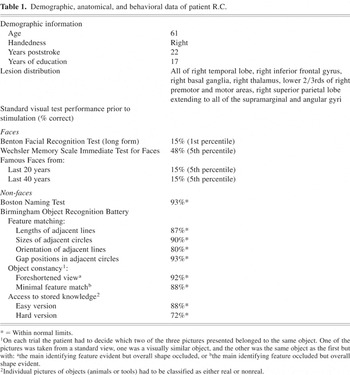
The patient R.C. endured an embolic infarct of the right middle cerebral artery in 1983 that rendered him unable to recognize close relatives by facial appearance, or perform standard face recognition tests above chance. See Figure 1 and Table 1 for further details.

Patient computed tomagraphy (CT) scan shown upward from the level of inferior temporal gyrus. The left and right sides of the brain are labeled with L and R, respectively.
Demographic, anatomical, and behavioral data of patient R.C.

To examine the effects of GVS on face perception, we administered a simultaneous match-to-sample task, in which two horizontally aligned faces appeared directly below a sample face. On each trial, one face was identical to the sample while the eyes and mouth of the other were inverted. The patient pressed one of two buttons (marked “left” and “right”) with the index and middle finger of his right hand, respectively, to indicate the match. Ten digitized gray-scale images of male faces were selected from the face database provided by the Max-Planck Institute for Biological Cybernetics, Tuebingen, Germany. The target appeared equally often in the left and right position but varied randomly across trials. Stimuli appeared on an opaque background for 3500 ms, after which there was a blank screen lasting until an unspeeded response was made. Each intact face served twice as the sample image generating a total of 20 trials, and the order of presentation was randomized across experiments.
Bipolar, direct current was delivered via a stimulus isolator to a pair of 3-cm2 carbon-rubber, self-adhesive, electrodes that were placed over the right and left mastoid processes.a
Ethical approval was obtained from the Boston VA Healthcare System IRB, and the patient provided written informed consent to participate.
RESULTS
To assess whether improvement had occurred, we first established the patient's baseline level of accuracy prior to stimulation. His accuracy on the face-matching task was 40% which is within 1 standard error (SE) of chance (50%) for a binomial distribution based on twenty observations.b

, where p and q = the expected proportion of correct (0.5) and incorrect (0.5) responses, and n = number of observations (20). At a p value of .05, one standard error (SE) from the absolute chance level of 50% corresponds with 39% and 61%.
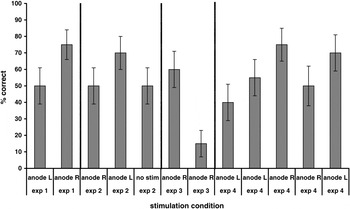
In Experiment 1, stimulation was first administered with the anode and cathode positioned on the left and right mastoids, respectively. This was associated with a response accuracy of 50% (see Fig. 2). After a 15-min break, we switched the positions of the electrodes and observed a 25% significant increase in accuracy, t(19) = 2.9, p < .01. To assess whether improvement was dependent on the direction of polarity reversal, we conducted another experiment one week later with the anode placed initially on the right and then, after a break, on the left. We observed the same pattern as before; performance in block 1 was at 50%, and then significantly increased to 70% in block 2, t(19) = 2.2, p < .05. In a third block conducted after another 15-min break, we reran the experiment without any stimulation to check for practice effects. As can be seen, performance dropped back down to 50%. In Experiment 3, we conducted two blocks with the anode remaining on the right mastoid to assess whether the improvement resulted from switching electrode polarity or because it simply takes two blocks of trials before improvement occurs. Performance in block 1 was 60%, which lay within the window of chance, t(19) = 1.5, p = .16, and in fact showed a sharp drop in block 2, t(19) = 3.6, p < .01. In a fourth experiment we looked to corroborate these findings. We first showed that keeping the anode on the same side (this time on the left) for two successive blocks did not move performance significantly beyond 50%; accuracy was 40% in block 1, t(19) = 1.5, p = .16, and 55% in block 2, t(19) = 1.0, p = .33. A further t test showed that this 15% increase was not statistically significant, t(19) = 1.8, p = .08. In the next block we reconfirmed the basic effect by showing a significant increase from 50% to 75% when the anode was switched to the right, t(19) = 2.9, p < .01. As predicted, accuracy declined to 50% during a second block of anode right trials, t(19) = 2.9, p < .01. This latter finding was important because it showed that the sharp, and somewhat perplexing, drop observed under the same conditions in Experiment 3 was not replicable, and likely representative of a Type II error. In a final block, we reversed polarity and again saw a significant rise from 50% to 70%, t(19) = 2.2, p < .05.

Response accuracy (with standard deviation bars) as a function of stimulation condition. All blocks of trials were separated by a 15-min interval. The first three experiments were each separated by 1 week, with the fourth occurring 6 weeks later.
DISCUSSION
We have shown that the failure to perform a simple face-matching task can be temporarily overcome after two, brief, consecutive sessions of subsensory GVS. This confirms a tight coupling between the visual and vestibular systems; impairment to the former can be reduced by altering input to the latter. Though we have shown the effect in only one subject with a limited number of experimental trials, our data give reason to now explore the broader effects of GVS on prosopagnosia.
We note that improvement rested on a different stimulation procedure to that used to treat neglect, in which the anode must always be placed on the side of the intact left hemisphere. Furthermore, there was no instance in which successive blocks of repeated polarity invoked improvement. Rather, improvement only came about after both vestibular nerves were stimulated, irrespective of which side first received positive charge. In recent times, it has become clear that normal face perception involves the operation of both cerebral hemispheres (de Gelder & Rouw, 2001). It is possible that, via diaschisis, the very extensive, unilateral damage sustained by R.C. interrupted face processing in both hemispheres, which in turn led to the need for bilateral stimulation. Importantly, brain-imaging studies have shown that while vestibular stimulation activates both cerebral hemispheres, activation is much greater on the side that receives positive stimulation (Dieterich et al., 2003; Fink et al., 2003). If true, then each hemisphere may have needed direct anodal stimulation before the level of activation was sufficient for recovery to occur. It will now be important to determine if this boundary condition results from R.C.'s particular pattern of brain damage or whether it holds for other patients who experience problems perceiving faces. For example, face perception deficits are more commonly associated with damage to the “fusiform face area” in temporal-occipital cortex (see Rhodes et al., 2004), which was spared in R.C. It will be of particular interest to stimulate patients with damage to this region, as this will inform us as to whether the regions directly implicated in face perception must be intact for improvement to occur. From a more practical standpoint, a separate issue will be to establish the long-term safety of repeated stimulation.
ACKNOWLEDGMENTS
This work was supported by the National Institute of Neurological Disease and Stroke Grant 2 R01 NS 029342-08 A2 and by the Medical Research Service VA Merit Review Awards to William Milberg and Regina McGlinchey. We thank Dr. Kristine Lundgren of the Boston University Harold Goodglass Aphasia Research Center for referring the patient.
References
REFERENCES
Bense, S.,
Stephan, T.,
Yousry, T.A.,
Brandt, T., &
Dieterich, M.
(2001).
Multisensory cortical signal increases and decreases during
vestibular galvanic stimulation (fMRI).
Journal of Neurophysiology,
85,
886–899.Google Scholar
Bodamer, J.
(1947).
Die prosop-agnosie.
Archiv für Psychiatrie und Nervenkrankenheiten,
179,
6–53.Google Scholar
Coats, A.C.
(1972).
Limit of normal of the galvanic body-sway test.
Annals of Otology, Rhinology and Laryngology,
81,
410–416.Google Scholar
de Gelder, B. &
Rouw, R.
(2001).
Beyond localisation: A dynamical dual route account of face
recognition.
Acta Psychologica,
107,
183–207.CrossRefGoogle Scholar
De Renzi, E.,
Perani, D.,
Carlesimo, G.A.,
Silveri, M.C., &
Fazio, F.
(1994).
Prosopagnosia can be associated with damage confined to the right
hemisphere: An MRI and PET study and review of the literature.
Neuropsychologia,
32,
893–902.Google Scholar
Dieterich, M.,
Bense, S.,
Lutz, S.,
Drzezga, A.,
Stephan, T.,
Bartenstein, P., &
Brandt, T.
(2003).
Dominance for vestibular cortical function in the non-dominant
hemisphere.
Cerebral Cortex,
13,
994–1007.Google Scholar
Fink, G.R.,
Marshall, J.C.,
Weiss, P.,
Stephan, T.,
Grefkes, C.,
Shah, N.J.,
Zilles, K., &
Dieterich, M.
(2003).
Performing allocentric visuo-spatial judgments with induced
distortion of the egocentric reference frame: An fMRI study with clinical
implications.
NeuroImage,
20,
1505–1517.Google Scholar
Kerkhoff, G.
(2003).
Modulation and rehabilitation of spatial neglect by sensory
stimulation.
Progress in Brain Research,
142,
257–271.Google Scholar
Kimberley, T.J.,
Lewis, S.M.,
Auerbach, E.J.,
Dorsey, L.L.,
Lojovich, J.M., &
Carey, J.R.
(2004).
Electrical stimulation driving functional improvements and cortical
changes in subjects with stroke.
Experimental Brain Research,
154,
450–460.Google Scholar
McGlinchey-Berroth, R.,
Milberg, W.P.,
Verfaellie, M.,
Alexander, M., &
Kilduff, P.
(1993).
Semantic processing in the neglected visual field: Evidence from a
lexical decision task.
Cognitive Neuropsychology,
10,
79–108.Google Scholar
Rhodes, G.,
Byatt, G.,
Michie, P.T., &
Puce, A.
(2004).
Is the fusiform face area specialized for faces, individuation or
expert individuation?
Journal of Cognitive Neuroscience,
16,
189–203.Google Scholar
Robertson, I.H. &
Murre, J.M.J.
(1999).
Rehabilitation of brain damage: Brain plasticity and principles of
guided recovery.
Psychological Bulletin,
125,
544–575.CrossRefGoogle Scholar
Rorsman, I.,
Magnusson, M., &
Johansson, B.B.
(1999).
Reduction of visuo-spatial neglect with vestibular galvanic
stimulation.
Scandinavian Journal of Rehabilitation Medicine,
31,
117–124.Google Scholar
Vallar, G.,
Guariglia, C., &
Rusconi, M.L.
(1997).
Modulation of the neglect syndrome by sensory stimulation.
In
P. Thier &
H.O. Karnath (Eds.),
Parietal lobe contributions to orientation in 3D space.
Heidelberg:
Springer Verlag.
Volpe, B.T.,
Krebs, H.I.,
Hogan, N.,
Edelstein, O.L.,
Diels, C., &
Aisen, M.
(2000).
A novel approach to stroke rehabilitation: Robot-aided sensorimotor
stimulation.
Neurology,
54,
1938–1944.Google Scholar
Wilkinson, D.,
Ko, P.,
Kilduff, P.,
McGlinchey, R., &
Milberg, W.
(2005).
A case of prosopagnosia without object agnosia.
Submitted.

Patient computed tomagraphy (CT) scan shown upward from the level of inferior temporal gyrus. The left and right sides of the brain are labeled with L and R, respectively.
Demographic, anatomical, and behavioral data of patient R.C.
Response accuracy (with standard deviation bars) as a function of stimulation condition. All blocks of trials were separated by a 15-min interval. The first three experiments were each separated by 1 week, with the fourth occurring 6 weeks later.
 You have
Access
- 37
- Cited by