Introduction
Adzuki bean (Vigna angularis [Willd.] Ohwi & H. Ohashi) is a summer legume crop that has traditionally been cultivated in East Asia and northern South Asia (Isemura et al., Reference Isemura, Kaga, Konishi, Ando, Tomooka, Han and Vaughan2007). Adzuki bean is a quantitative short-day (SD) plant with a critical photoperiod of 12–13 h. Great progress has been made in understanding the flowering pathway in Arabidopsis thaliana and more than 180 Arabidopsis genes that regulate flowering time have been identified (Fornara et al., Reference Fornara, de Montaigu and Coupland2010). In this study, we performed de novo assembly of RNA sequences expressed in the leaves and flowers of adzuki bean and identified putative homologues of the Arabidopsis genes involved in circadian clock and photoperiodic flowering.
Materials and methods
Leaf triplets and flowers at the V4 stage were harvested from V. angularis accession IT213134 in daytime under SD (12 h light–12 h dark) conditions for RNA isolation. The purified mRNA was fragmented, and the RNA fragments were used to construct template-sequencing libraries. Each library was sequenced using the Illumina Hiseq™ 2000 platform to produce paired-end sequences of approximately 5 Gb. Transcript de novo assembly was performed using the program Trinity (Grabherr et al., Reference Grabherr, Haas, Yassour, Levin, Thompson, Amit, Adiconis, Fan, Raychowdhury, Zeng, Chen, Mauceli, Hacohen, Gnirke, Rhind, di Palma, Birren, Nusbaum, Lindblad-Toh, Friedman and Regev2011), and the Perl script available in Trinity (transcripts_to_best_scoring_ORFs.pl) was used to identify the coding sequences. Complete coding sequences were translated into protein sequences using the Transeq software in the EMBOSS package (Rice et al., Reference Rice, Longden and Bleasby2000).
Results and discussion
Transcriptome sequencing and de novo assembly in adzuki bean
Illumina sequencing of two libraries from the leaves and flowers of adzuki bean generated 7,668,523,172 total bases, constituting 75,925,972 short reads with an average length of 101 bp (Table S1, available online). Due to the absence of adzuki bean reference genome, de novo assembly was performed to construct transcripts. A total of 86,353 and 51,811 contigs were constructed from the leaf and flower complementary DNA (cDNA) libraries, respectively. Among these, 59,860 contigs were full-length cDNA sequences, with an average N50 of 1627 bp. The number of complete cDNAs in flowers was five times less than that in leaves owing to the low sequencing depth of the leaf cDNA library.
Conservation of Arabidopsis genes involved in circadian clock and photoperiodic flowering in adzuki bean
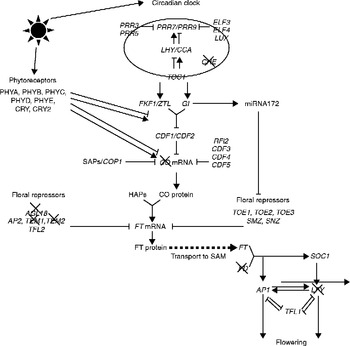
The photoperiodic flowering pathway is mediated by a complex interaction between an internal rhythm, the circadian clock, and external light signals (Piñeiro and Jarillo, Reference Piñeiro and Jarillo2013). A list of genes with demonstrated involvement in the circadian clock-based photoperiodic flowering pathway was obtained from the literature, including 84 Arabidopsis genes (Fig. 1; Tables S2 and S3, available online). The 59,860 genes of adzuki bean were subjected to a BLASTP search to identify putative homologues involved in the photoperiodic flowering pathway, with an e-value cut-off of 1 × 10− 5. Our analysis revealed that a large proportion of the Arabidopsis photoperiodic flowering genes are probably conserved in adzuki bean and that most of the genes have more than two homologues (Fig. 1; Table S3, available online). However, we could not detect the homologues of six Arabidopsis genes in adzuki bean, including TEMPRANILLO 1 (TEM1) and TEMPRANILLO 2 (TEM2), AGAMOUS-LIKE 18 (AGL18), FLOWER LOCUS D (FD), CCA1 HIKING EXPEDITION (CHE) and LEAFY (LFY) (Fig. 1; Table S3, available online). One of reasons for the absence of homologues of these genes in adzuki bean may be gaps in the gene coverage of cDNA libraries. Considering the expression oscillation of photoperiodic flowering genes, incomplete sampling for particular cell types such as a shoot apical meristem (SAM), developmental stages and photoperiodic conditions may also have affected these results.
Diagram of the circadian clock and photoperiodic flowering pathway in Arabidopsis. Genes lacking full-length complementary DNA homologues in adzuki bean are indicated by ‘X's. These genes include CHE, CO, FD, LFY, AGL18, TEM1 and TEM2. Standard arrows represent positive regulatory relationships and T-arrows represent negative regulatory relationships. See Table S1 (available online) for a list of gene names and abbreviations.

In plants, there is an array of photoreceptors including red/far-red PHYTOCHROME (PHY) photoreceptors and CRYPTOCHROMES (CRYs) that perceive blue and ultraviolet light. Adzuki bean contains putative homologues of these photoreceptors. The Arabidopsis circadian clock consists of central regulatory loops, where two myeloblastosis (MYB) transcriptional regulators of CIRCADIAN CLOCK-ASSOCIATED 1 (CCA) and LATE ELONGATED HYPOCOTYL (LHY) repress the expression of the pseudo-response regulator (PRR) TIMING OF CAB EXPRESSION 1 (TOC1, also known as PRR1) in the morning (Imaizumi, Reference Imaizumi2010). Additional essential genes have been proposed to function in interconnected morning and evening feedback loops, including the other members of the TOC1 family, i.e. PRR3, PRR5, PRR7 and PRR9, CHE, EARLY FLOWERING 3 (ELF3), EARLY FLOWERING 4 (ELF4), LUX ARRHYTHMO (LUX) or PHYTOCLOCK (PCL), and GIGANTEA (GI) (Imaizumi, Reference Imaizumi2010). All molecular frames of the circadian clock, with the exception of CHE, are likely to be conserved in adzuki bean (Fig. 1). CHE is a TEOSINTE-LIKE1, CYCLOIDEA, and PROLIFERATING CELL FACTOR1 (TCP) transcription factor (Imaizumi, Reference Imaizumi2010). Adzuki bean was predicted to lack a homologue of CHE.
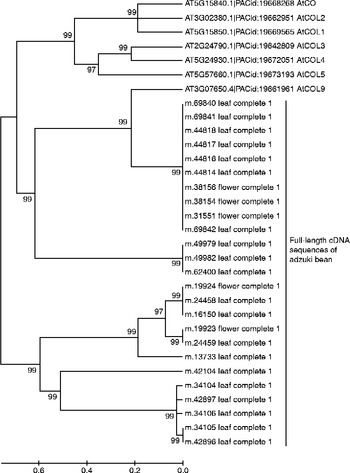
In Arabidopsis, the CONSTANS (CO) gene, which encodes a zinc finger and CONSTANS, CO-like, and TOC1 (CCT) domain-containing transcription factor, is a key player in the photoperiodic pathway (Lagercrantz, Reference Lagercrantz2009). We utilized CO and six CO-LIKE (COL) genes to identify the adzuki bean homologues of CO (Fig. 2). There are 25 highly homologous matches to CO or COL in adzuki bean (Fig. 2; Table S3, available online). The cladogram in Fig. 2 shows that CO and COL1 to COL5 only form one clade, which does not contain any adzuki bean genes. Half of the adzuki bean homologues fall within the COL9 clade and the others are more divergent from the Arabidopsis COL genes. These results indicate the absence of CO gene in adzuki bean, consistent with the previous reports in other legumes (Hecht et al., Reference Hecht, Foucher, Ferrándiz, Machnight, Navarro, Morin, Vardy, Ellis, Beltrán, Rameau and Weller2005; Ono et al., Reference Ono, Ishida, Yamashino, Nakanishi, Sato, Tabata and Mizuno2010; Kim et al., Reference Kim, Kang, Lee and Lee2013).
Phylogenetic analysis of CONSTANS-LIKE (COL) genes in adzuki bean. A neighbour-joining tree of concatenated B-box and CCT domain nucleotides is shown. Bootstrap values from 1000 replicates are indicated as a percentage above each branch. cDNA, complementary DNA.

SD and long-day (LD)-responding plants have evolved different mechanisms to regulate the activation of a floral pathway integrator (FPI) gene FLOWER LOCUS T (FT) (Jarillo and Piñeiro, Reference Jarillo and Piñeiro2011), but increased FT expression is required in both types of plants, indicating that FT is a highly universal promoter of flowering (Lagercrantz, Reference Lagercrantz2009). FT and its homologues encode a phophatidylethanolamine-binding protein (PEBP) (Wigge, Reference Wigge2011). The FT homologues contain TWIN SISTER OF FT (TSF), TERMINAL FLOWER 1 (TFL1), MOTHER OF FT AND TFL1 (MFT1), BROTHER OF FT AND TFL1 (BFT) and TERMINAL FLOWER 2 (TFL2). Adzuki bean was found to have two putative homologues of the Arabidopsis members of the PEBP gene family. The FT protein in SAM forms a complex with FD encoding a basic-leucine zipper (bZIP) transcription factor. In adzuki bean, a FD homologue was not detected in either of the cDNA libraries. Another FPI, SUPPRESSOR OF OVEREXPRESSION OF CONSTANS 1 (SOC1, also known as AGAMOUS-LIKE 20), is up-regulated by the complex FT/FD (Lagercrantz, Reference Lagercrantz2009). SOC1 is a MCM1-AGAMOUS-DEFICIENS-SRF (MADS)-box transcription factor. Eleven adzuki bean homologues of SOC1 were detected, but these genes also exhibited high homologies with other AGAMOUS-LIKE genes. LFY plays a dual role in flower development as both an FPI and a meristem identity gene in Arabidopsis (Parcy, Reference Parcy2005). LFY encodes a plant-specific transcription factor and functions downstream of SOC1. We could not identify a homologue of LFY in the adzuki bean gene sets.
In addition, four photoperiodic flowering genes, E1–E4, have been isolated in soybean. E2 (GmGI) is orthologous to Arabidopsis GI (Watanabe et al., Reference Watanabe, Xia, Hideshima, Tsubokura, Sato, Yamanaka, Takahashi, Anai, Tabata, Kitamura and Harada2011), and E3 (GmPHYA3) and E4 (GmPHYA2) are the homologues of phytochrome A (Liu et al., Reference Liu, Kanazawa, Matsumura, Takahashi, Harada and Abe2008; Watanabe et al., Reference Watanabe, Hideshima, Xia, Tsubokura, Sato, Nakamoto, Yamanaka, Takahashi, Ishimoto, Anai, Tabata and Harada2009). E1 encodes a low-copy protein with a nuclear localization signal and a B3 domain-related region, which is expressed under LD conditions (Xia et al., Reference Xia, Watanabe, Yamada, Tsubokura, Nakashima, Zhai, Anai, Sato, Yamazaki, Lü, Wu, Tabata and Harada2012). Among these genes, only E1 did not have a homologue in the adzuki bean grown under SD conditions.
Supplementary material
To view supplementary material for this article, please visit http://dx.doi.org/10.1017/S1479262114000252
Acknowledgements
This work was carried out with the support of “Cooperative Research Program for Agriculture Science & Technology Development (Project title: PJ008060, Project No. PJ00806003)”, Rural Development Administration, Republic of Korea.