INTRODUCTION
Parkinson’s disease (PD) is the second most neurodegenerative disease in terms of frequency after Alzheimer’s disease (AD) (Hirtz et al., Reference Hirtz, Thurman, Gwinn-Hardy, Mohamed, Chaudhuri and Zalutsky2007). At the neuropathological level, PD is characterized by Lewy body pathology and the neurodegeneration of dopaminergic neurons in the substantia nigra pars compacta. However, it is now widely recognized that PD evolves into a multisystem disorder that extends beyond the substantia nigra pars compacta, affecting both the central and peripheral nervous systems (Foffani & Obeso, Reference Foffani and Obeso2018). PD is characterized by the cardinal motor symptoms rigidity, resting tremor, and bradykinesia, but also have additional motor signs and non-motor characteristics, including cognitive symptoms. Mild cognitive impairment in PD (PD-MCI) affects around 30% in the early stages of the disease (Monastero et al., Reference Monastero, Cicero, Baschi, Davì, Luca, Restivo and Nicoletti2018) and increases to over 50% depending on the illness progression (Galtier, Nieto, Lorenzo, & Barroso, Reference Galtier, Nieto, Lorenzo and Barroso2016). Moreover, PD-MCI is considered as a risk factor for dementia development (PDD), with a high conversion rate to PDD in the years following PD-MCI diagnosis (Galtier et al., Reference Galtier, Nieto, Lorenzo and Barroso2016; Hoogland et al., Reference Hoogland, Boel, de Bie, Geskus, Schmand and Dalrymple-Alford2017). In addition, other risk factors have been well documented, including older age, disease severity, or educational level (Marinus, Zhu, Marras, Aarsland, & van Hilten, Reference Marinus, Zhu, Marras, Aarsland and van Hilten2018). Side of disease onset was also studied, although the results available are not conclusive (Erro et al., Reference Erro, Santangelo, Picillo, Vitale, Amboni, Longo and Pellecchia2013). The prevalence of PDD increases from 28% after 5 years of evolution to 80% after 20 years of the disease (Hely, Reid, Adena, Halliday, & Morris, Reference Hely, Reid, Adena, Halliday and Morris2008).
Subjective cognitive decline (SCD) is common in the elderly and recent evidence suggests that it is associated with an increased risk for future cognitive decline and AD dementia (Dillen et al., Reference Dillen, Jacobs, Kukolja, Richter, von Reutern, Onur and Fink2017; Scheef et al., Reference Scheef, Spottke, Daerr, Joe, Striepens, Kölsch and Jessen2012; Visser et al., Reference Visser, Verhey, Knol, Scheltens, Wahlund, Freund-Levi and Blennow2009). SCD is also frequent in PD patients (Lehrner et al., Reference Lehrner, Moser, Klug, Gleiß, Auff, Pirker and Pusswald2014) and plays a central role in the diagnosis of PD-MCI. A gradual decline in cognitive ability perceived and reported by either the patient or informant, or observed by the clinician is an inclusion criterion according to the Movement Disorders Society (MDS) criteria for PD-MCI diagnosis. However, the number of investigations that have focused on the study of SCD in the context of PD is still limited and even less so the investigations that have been focused on PD-SCD and its relationship with objective cognitive performance. Previous results showed that PD-SCD patients, compared to patients without SCD (PD-nSCD), exhibited a more significant annual decline in different cognitive functions including visuospatial process and lexical access (Hong et al., Reference Hong, Sunwoo, Chung, Ham, Lee, Sohn and Lee2014). Moreover, PD-SCD was associated with a higher rate of conversion to PD-MCI compared to PD-nSCD (Erro et al., Reference Erro, Santangelo, Barone, Picillo, Amboni, Longo and Vitale2014; Hong et al., Reference Hong, Sunwoo, Chung, Ham, Lee, Sohn and Lee2014). Recently, Galtier, Nieto, Lorenzo, and Barroso (Reference Galtier, Nieto, Lorenzo and Barroso2019) conducted the first long-term follow-up study of PD-SCD and its relationship with dementia development. In the above study, the percentage of patients who developed PDD in the PD-MCI group was 50%. Moreover, the percentage of PD-SCD who developed PDD was 33.3%, more than double that of PD-nSCD.
The results available suggest that PD-SCD and PD-MCI can be considered as risk factors for developing PDD. Thus, the early identification of changes in specific cognitive domains, which are associated with a differential risk of cognitive decline, should be a crucial objective for researchers and also for clinicians. Different investigations have focused on the role of posterior cortically based functions as predictors of cognitive impairment progression and dementia development (Williams-Gray et al., Reference Williams-Gray, Evans, Goris, Foltynie, Ban, Robbins and Barker2009, Reference Williams-Gray, Mason, Evans, Foltynie, Brayne, Robbins and Barker2013). Among these cognitive domains, visuospatial and visuoperceptual (VS-VP) functions, which have been associated with temporoparietal cerebral regions (Tranel, Vianna, Manzel, Damasio, & Grabowski, Reference Tranel, Vianna, Manzel, Damasio and Grabowski2009), have recently gained attention. VS-VP functions have been measured in PD by instruments such as the Judgment of Line Orientation test (JLOT) or the Facial Recognition Test (FRT). JLOT is a visuospatial test, which requires individuals to make judgments regarding the relative spatial orientation of pairs of line segments. Ska et al. (Reference Ska, Poissant and Joanette1990) proposed a qualitative analysis of performance in JLOT as a complementary procedure to measure VS-VP functions. Specifically, the authors proposed an analysis of error types in JLOT that may provide useful information in order to discriminate between normal aging and AD patients. The results of the above study showed that some errors were specific to AD patients, which is interpreted as a manifestation of a significant visuospatial deficit.
Regarding PD patients, only two cross-sectional studies have been conducted to study the error pattern in the JLOT and the results are not conclusive. Finton, Lucas, Graff-Radford, and Uitti (Reference Finton, Lucas, Graff-Radford and Uitti1998) reported differences between PD patients and normal controls in only two error types. The proportion of severe errors in single oblique lines within the same quadrant was more frequent in PD patients compared to the control group, whereas the proportion of mild intraquadrant errors in one line presented an opposite pattern, showing a higher frequency in normal subjects. Similarly, Montse, Pere, Carme, Francesc, and Eduardo (Reference Montse, Pere, Carme, Francesc and Eduardo2001) also reported a higher frequency of mild intraquadrant errors in the normal control group and a higher proportion of severe errors in single oblique lines in PD patients. However, PD patients showed a higher proportion of other severe errors, including errors in two oblique lines within the same quadrant (lines displaced without maintaining the initial spacing between both) and errors in horizontal lines which were not reported by Finton et al. (Reference Finton, Lucas, Graff-Radford and Uitti1998). These discrepancies are difficult to interpret because data about neurological characteristics are limited and information regarding other cognitive domains or the proportion of PD patients with MCI are not available.
There are no previous studies, to the best of our knowledge, that have focused on studying the error pattern of the JLOT in PD patients with SCD and MCI by a long-term follow-up study. Therefore, the aims of this study were: (1) to investigate qualitative components of VS-VP functions by the error type analysis of the JLOT and the FRT in patients with PD-MCI and PD-SCD and (2) to explore which of these qualitative components of VS-VP functions at the baseline better predict the development of PDD after a mean follow-up of 7.5 years. The hypothesis of the study is that the PD-MCI group, compared to the controls and PD-nSCD, will present a higher proportion of severe errors that will be better predictors of dementia development than the overall test score. The PD-SCD group will present mild difficulties in VS-VP functions, compared to controls and PD-nSCD.
METHODS
Subjects
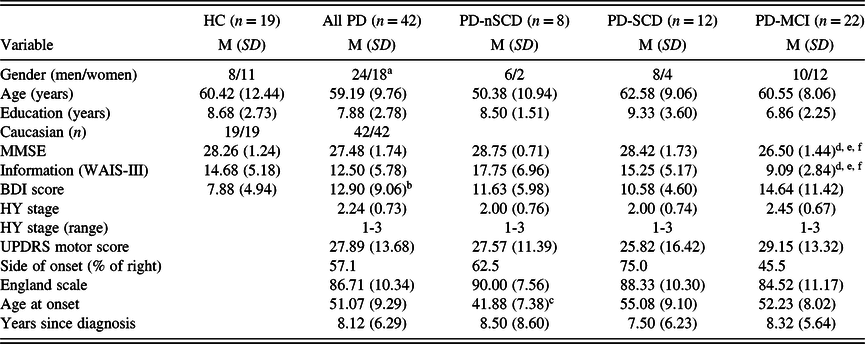
This study is part of a larger research project developed by the School of Psychology, University of La Laguna, in collaboration with the Department of Neurology, N.S. La Candelaria University Hospital. The sample consisted of 42 PD patients and 19 healthy controls (HC). Patients were recruited by a neurologist specializing in movement disorders, and were evaluated in the “on” state. The Hoehn & Yahr Scale (Hoehn & Yahr, Reference Hoehn and Yahr1967) and the Unified Parkinson’s Disease Rating Scale (UPDRS) (Fahn & Elton, Reference Fahn, Elton, Fahn, Marsden, Goldstein and Calne1987) were included as part of the assessment protocol. All the patients were diagnosed according to the clinical criteria for the diagnosis of PD (Hughes, Daniel, Kilford, & Lees, Reference Hughes, Daniel, Kilford and Lees1992). The exclusion criteria applied were as follows: (a) dementia associated with PD (Emre et al., Reference Emre, Aarsland, Brown, Burn, Duyckaerts, Mizuno and Dubois2007) or global cognitive deterioration defined by the Mini-Mental State Examination (MMSE) score <24 (Folstein, Folstein, & McHugh, Reference Folstein, Folstein and McHugh1975), (b) history of major psychiatric disorder, (c) drug or alcohol abuse, (d) visual and/or auditory perception disorders limiting the ability to take the test, (e) history of stroke and/or head injury with loss of consciousness, and (f) deep brain stimulation surgery. All patients were taking antiparkinsonian drugs: 3 patients received a monotherapy with dopamine agonist, 19 patients were treated with dopamine agonist and levodopa, and 21 patients received different combinations of levodopa, dopamine agonists, catechol-O-methyltransferase (COMT) inhibitors, monoamine oxidase inhibitors, and amantadine. Groups were matched on demographic data such as age, gender, education, manual preference, and estimated IQ (Information subtest) (Wechsler, Reference Wechsler1997a). The Beck Depression Inventory was administered for the assessment of mood state (Beck, Ward, Mendelson, Mock, & Erbaugh, Reference Beck, Ward, Mendelson, Mock and Erbaugh1961) (Table 1). All participants were informed about the aims of the investigation, participated voluntarily, and gave their informed consent. The data were obtained in accordance with the regulations of the local ethics committee and in compliance with the Helsinki Declaration for Human Research.
Demographic data and clinical characteristics

n = number of the samples in each group; HC = healthy controls; PD = Parkinson’s disease; PD-nSCD = PD patients without subjective cognitive decline; PD-SCD = PD patients with subjective cognitive decline; PD-MCI = PD patients with mild cognitive impairment; M = mean; SD = standard deviation; MMSE = Mini-Mental State Examination; WAIS-III = Wechsler Adult Intelligence Scale – Third Edition; BDI = Beck Depression Inventory; HY = Hoehn & Yahr scale; UPDRS = Unified Parkinson’s Disease Rating Scale.
a Pearson’s chi-squared test was not significant.
b The comparison between HC and PD groups was significant.
c The comparison between PD-nSCD and PD-SCD was significant.
d The comparison between HC and PD-MCI was significant.
e The comparison between PD-nSCD and PD-MCI was significant.
f The comparison between PD-SCD and PD-MCI was significant.
Neuropsychological Assessment
Patients and controls were evaluated with the following protocol of cognitive tests, grouped by domains. Attention was examined using the Digit Span Backward (Wechsler, Reference Wechsler1997b) and the Stroop Color-Word Test (Golden, Reference Golden1978). Executive functions were assessed by phonemic (FAS) and semantic (animals) fluency tests (Benton, Hamsher, & Sivan, Reference Benton, Hamsher and Sivan1989) and the Wisconsin Card Sorting Test (WCST) (Heaton, Reference Heaton1981). Memory was assessed by the California Verbal Learning Test (CVLT) (Delis, Kramer, Kaplan, & Ober, Reference Delis, Kramer, Kaplan and Ober1987) and the 8/30 Spatial Recall Test (8/30 SRT), a 7/24 SRT adaptation (Barbizet & Cany, Reference Barbizet and Cany1968). In the 8/30 SRT, the subjects must learn the spatial location of eight black circles displayed in a matrix of 6 × 5 boxes. When the sheet is removed, the subject must place the eight circles in the corresponding locations on an empty matrix. As in the CVLT, the 8/30 SRT includes five trials of learning and two trials of delayed recall (short and long-term). Language was assessed by the Naming Test, a task of 20 pictorial visual stimuli representing actions (Druks & Masterson, Reference Druks and Masterson2000).
Visuospatial and Visuoperceptual Function Analysis
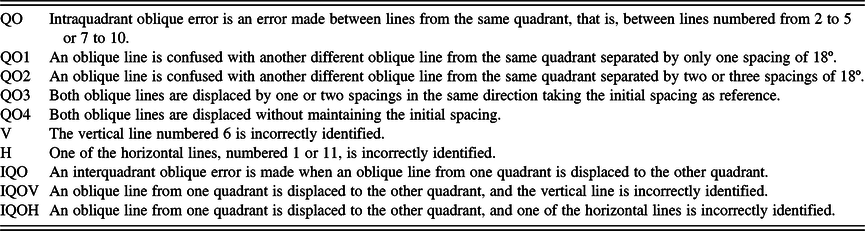
VS-VP functions were examined using a simplified version of the Block design subtest (WAIS-III, 6 designs simplified version) (Wechsler, Reference Wechsler1997a), the JLOT(15 items simplified version) (Benton, Hamsher, Varney, & Spreen, Reference Benton, Hamsher, Varney and Spreen1983) and the FRT(13 items simplified version) (Benton et al., Reference Benton, Hamsher, Varney and Spreen1983). In the JLOT, the participants had to make judgments regarding the relative spatial orientation of pairs of line segments. Each item includes a pair of target lines and 11 lines as possible answers positioned in a semicircle, separated by an angle of 18°. An answer is considered correct when the inclination of the two lines is estimated. The total correct scores were registered for each participant. Furthermore, the errors were classified using the procedure developed by Ska et al. (Reference Ska, Poissant and Joanette1990), which describes different error types: (1) intraquadrant oblique errors, (2) vertical and horizontal errors, (3) interquadrant oblique errors, and (4) interquadrant oblique error in combination with vertical or horizontal errors. All the error types are described in Table 2. In order to study the qualitative analysis of performance in JLOT, the proportion of each error type was calculated by the following equation: (No. of errors in one type/No. of total errors) × 100. Moreover, the percentage of participants who made at least one error per type were analyzed. In the FRT, the participants had to recognize unfamiliar faces. Each item included seven pictures of unfamiliar faces. One of the pictures is the target, and the rest are the possible answers. The task is structured in degrees of increasing difficulty. Therefore, in the first part, the participant only has to recognize a picture which is the same as the target, which are displayed in identical front views. While, in the second part, the participant has to recognize three pictures, which are displayed in side views or in front views taken under different lighting conditions. The simplified version which includes 13 items was used in the present study. The first six items are displayed in front views, the following four are shown in side views and the last three are displayed in front views taken under different lighting conditions (Lezak, Howieson, Bliger, & Tranel, Reference Lezak, Howieson, Bliger and Tranel2012). The total correct scores were registered for each participant. In addition, the errors were classified according to the difficulty levels of the items: (1) simple errors, (2) side view errors, and (3) light view errors. Regarding the analyses of the types of errors, the same procedure described for the JLOT was followed.
Error types in JLOT (Ska et al., Reference Ska, Poissant and Joanette1990)

Diagnosis of PD-SCD, PD-MCI, and Dementia
The PD-SCD was established on the basis of a semi-structured interview, published previous by the authors (see Galtier et al., Reference Galtier, Nieto, Lorenzo and Barroso2019 for detailed information). The patient and care partner provided their subjective opinions regarding whether the patient had experienced changes in each of the following cognitive functions: attention, memory, spoken language, naming, written language, visuoperceptual skills, and executive functions. For each domain, the interviewer provided specific examples of what might indicate impairment in each domain. Regarding PD-MCI diagnosis, the criteria proposed by the MDS were applied (Litvan et al., Reference Litvan, Goldman, Tröster, Schmand, Weintraub, Petersen and Emre2012). Impairment in neuropsychological tests is demonstrated by the performance of 1.5 standard deviations or more below the mean of the control group. The absence of significant functional decline was confirmed based on a structured interview and clinical impression of the subject’s general cognitive function. The patients’ follow-up assessments were to a mean of 7.5 (6.3–8.4) years after the baseline. A diagnosis of PDD was made on the basis of the MDS criteria (Emre et al., Reference Emre, Aarsland, Brown, Burn, Duyckaerts, Mizuno and Dubois2007). Decreased global cognitive functioning and deficits severe enough to impair daily life should be present, according to level 1 of the MDS criteria (Dubois et al., Reference Dubois, Burn, Goetz, Aarsland, Brown, Broe and Emre2007).
Statistical Analysis
A nonparametric statistic was used to study differences between groups because the Shapiro–Wilk W test showed that data deviated from the standard normal distribution. The Mann–Whitney and Kruskal–Wallis tests were used to compare the means in pairs of groups and multiple groups, respectively. If the Kruskal–Wallis test result was significant, the two-tailed Mann–Whitney U test was used to assess the paired difference between groups (with the Bonferroni correction for multiple comparisons applied). Chi-squared tests were used for categorical data. Logistic regression analyses were conducted to examine the pattern of errors in VS-VP functions as predictors of dementia development. The independent predictive values of the variables were expressed in Odds Ratio (OR) with 95% Confidence Interval (CI). p < .05 was set as the level of statistical significance. All the analyses were performed with SPSS-PC software version 24.0 for Windows.
RESULTS
Demographic and clinical characteristics of PD patients and controls are shown in Table 1. Groups did not differ in age, years of education, and estimated IQ. PD patients were classified as PD-SCD or PD-MCI according to the results of the interview and the MDS Task Force criteria, respectively. Twelve patients (28.6%) were classified with a diagnosis of PD-SCD and 22 patients (52.4%) met the criteria for PD-MCI. The neuropsychological performance for HC and PD patients (PD-nSCD, PD-SCD, and PD-MCI) is available as Supplementary Material. Regarding the performance for VS-VP functions, the results showed that the PD-MCI group performed poorly compared to the HC, PD-nSCD, and PD-SCD groups in JLOT. The PD-MCI and PD-SCD groups also performed poorly compared to the HC group in the FRT.
Analyses of Visuospatial and Visuoperceptual Errors
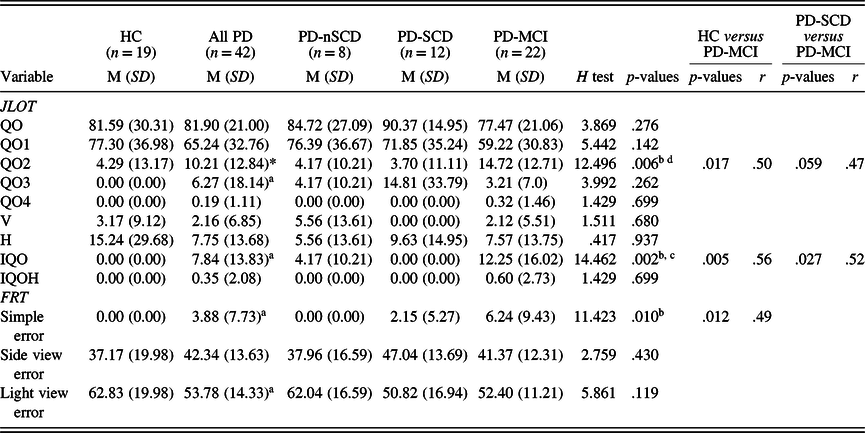
Error type analysis in JLOT showed that participants performed eight of the possible error types proposed by Ska et al. (Reference Ska, Poissant and Joanette1990). In this regard, no participant made IQOV errors (Table 3). All the PD groups made a significantly greater proportion of QO3 and IQO errors compared to the HC group. Moreover, a no significant trend was found in the proportion of PD patients who made QO2 errors compared to the HC group. The paired difference between groups showed that the PD-MCI group made a significantly greater proportion of QO2 errors compared to the HC group. The PD-MCI group also made a greater proportion of QO2 errors compared to the PD-SCD group, however, it was not significant after Bonferroni correction (p = .059). Moreover, the PD-MCI group performed a significantly greater proportion of IQO errors compared to the HC and PD-SCD groups. Regarding the proportion analysis of error types in FRT, the results also showed several differences between groups (Table 3). All the PD groups made a significantly greater proportion of simple and light view errors compared to the HC group. The paired difference between groups showed the PD-MCI group made a significantly greater proportion of simple errors compared to the HC group.
Proportion analysis of visuospatial and visuoperceptual (VS-VP) errors in PD patients and HC

n = number of the samples in each group; HC = healthy controls; PD = Parkinson’s disease; PD-nSCD = PD patients without subjective cognitive decline; PD-SCD = PD patients with subjective cognitive decline; PD-MCI = PD patients with mild cognitive impairment; M = mean; SD = standard deviation; JLOT = Judgment of Line Orientation Test; FRT = Facial Recognition Test.
a The comparison between HC and PD groups was significant.
b The comparison between HC and PD-MCI was significant.
c The comparison between PD-SCD and PD-MCI was significant.
d PD-SCD versus PD-MCI not significant after Bonferroni correction.
* A statistical trend in QO2 was found in the comparison between HC and PD groups (p = .053).
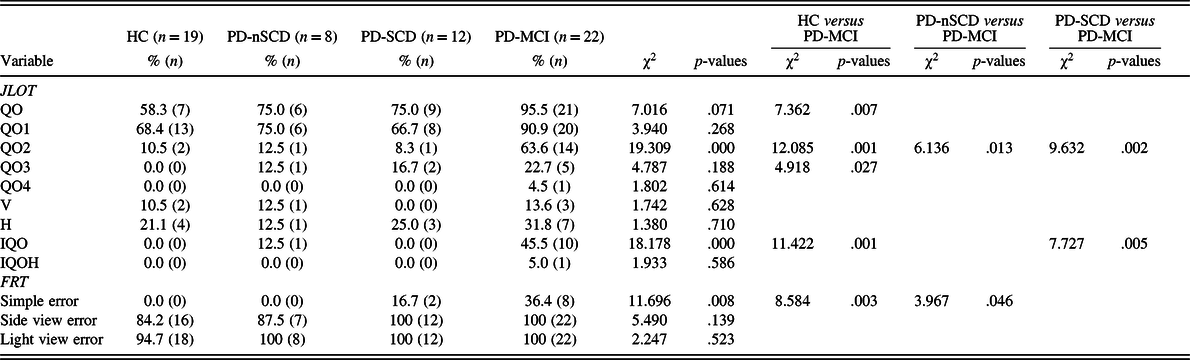
In addition, the percentage of participants per group who made at least one error per type were analyzed (Table 4). The paired difference between groups showed a significantly greater percentage of PD-MCI patients (63.6%) who made QO2 errors compared to PD-SCD (8.3%), PD-nSCD (12.5%), and HC subjects (10.5%). All patient groups made QO3 errors, which were not made by the HC subjects. However, only the comparison between PD-MCI and HC subjects was significant. Moreover, the results showed a significantly greater percentage of PD-MCI patients who made IQO errors (45.5%), compared to PD-SCD and HC subjects, who did not perform this error type. Moreover, only one PD-nSCD patient made IQO errors. Regarding the FRT results, the paired difference between groups showed a significantly greater percentage of PD-MCI patients (36.4%) who made simple errors compared to PD-nSCD and HC subjects who did not perform this error type.
Analysis of the participants who made at least one error per type in VS-VP tests

n = number of the samples in each group; HC = healthy controls; PD = Parkinson’s disease; PD-nSCD = PD patients without subjective cognitive decline; PD-SCD = PD patients with subjective cognitive decline; PD-MCI = PD patients with mild cognitive impairment; M = mean; SD = standard deviation; JLOT = Judgment of Line Orientation Test; FRT= Facial Recognition Test.
Additionally, the relationship between the side of disease onset and VS-VP functions was explored. PD groups (left and right-onset) did not differ in JLOT and FRT total score and error type (Supplementary Material).
VS-VP Functions as Predictors of PD Dementia Development
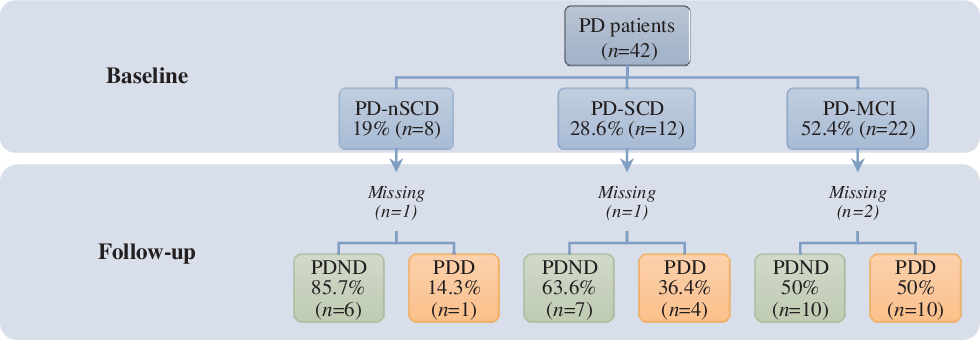
Conversion to dementia during the follow-up study was more frequent in patients with PD-MCI (50%) compared to patients with PD-SCD (36.4%) and more frequent in the PD-SCD group compared to patients with PD-nSCD (14.3%). The baseline clinical characteristics and cognitive performance of patients who converted to dementia and those who did not are available as Supplementary Material. PD-MCI was an independent predictor of dementia (OR = 6.00; 95% CI, .607–59.326). Four PD patients (9.5%) did not participate in the follow-up study (Figure 1).
Percentage of patients that developed dementia.

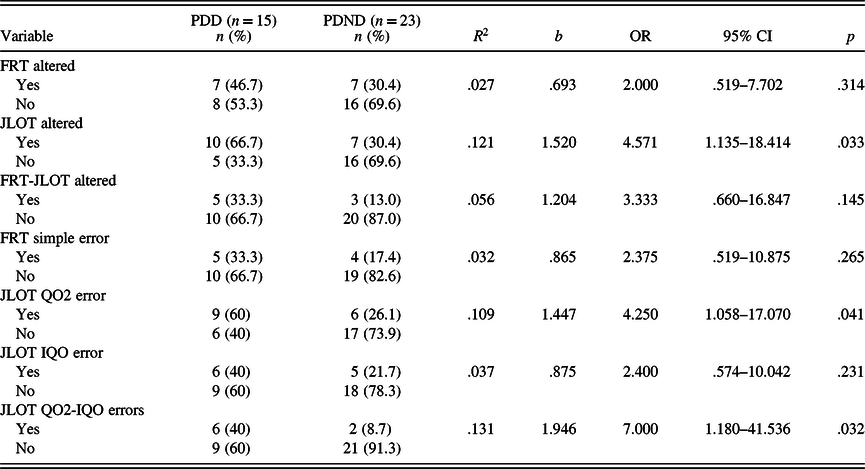
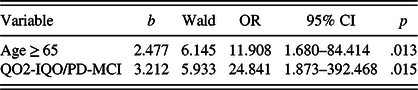
Logistic regressions were used to explore the pattern of errors in VS-VP functions, including different error types and combinations of them as predictors of dementia development. According to the results shown in Table 5, an altered JLOT (OR = 4.57) was a significant predictor of dementia. However, an altered FRT and the combination of altered FRT-JLOT were not significant. As regards the pattern of error types, QO2 errors (OR = 4.25) as well as the combination of QO2 and IQO errors (OR = 7.00) were significant as an independent predictors of dementia. The remaining VS-VP error types were not significant. Stepwise logistic regression analysis was conducted in which PD-MCI diagnosis, QO2-IQO errors (yes/no), age ≥ 65, Information subtest, PD duration, age at onset of the disease, UPDRS motor score, and side of disease onset were included as independent variables, whereas the dementia development was the dependent variable. The forward stepwise method was used to exclude nonsignificant variables. The results showed that QO2-IQO errors (p = .018) and the age ≥ 65 (p = .013) significantly contributed to the prediction. PD-MCI diagnosis (p = .248), Information subtest (p = .211), PD duration (p = .878), age at onset of the disease (p = .732), UPDRS motor score (p = .841), and side of disease onset (p = .066) did not reach statistical significance (Supplementary Material). New logistic regression was conducted to explore whether PD-MCI diagnosis in combination with QO2-IQO errors (yes/no) added an increased risk to the development of dementia. The patients were grouped by the new variable QO2-IQO/PD-MCI into the following categories: QO2-IQOyes/PD-MCI, QO2-IQOno/PD-MCI, and QO2-IQOyes/PD-nMCI and QO2-IQOno/PD-nMCI. The categories were included in the regression model as dummy variables. In addition, age ≥ 65, Information subtest, PD duration, age at onset of the disease, UPDRS motor score, and side of disease onset were also included in the regression analysis as independent variables. The forward stepwise method was used to exclude nonsignificant variables. The results revealed that the combination of PD-MCI and QO2-IQO errors (QO2-IQOyes/PD-MCI) was significant as an independent predictor of dementia (p = .015). The age ≥ 65 also contributed significantly to the model (p = .013). However, Information subtest (p = .142), PD duration (p = .600), age at onset of the disease (p = .409), UPDRS motor score (p = .825), and side of disease onset (p = .227) did not reach statistical significance (Table 6).
VS-VP functions as predictors of PD dementia development

n = number of the samples in each group; PDD=PD patients with dementia in the follow-up study; PDND=PD patients without dementia in the follow-up study; OR=Odds Ratio; CI=Confidence Interval; FRT=Facial Recognition Test; JLOT=Judgment of Line Orientation Test.
Logistic regression model with PD dementia as the dependent variable

Forward stepwise method was employed. Information subtest, PD duration, age at onset of the disease, UPDRS motor score, and side of disease onset did not reach statistical significance and were excluded to the logistic regression. Model parameters: Cox and Snell’s R 2 = .33, Chi-squared statistic = 14.471, p = .006; OR = Odds Ratio; CI = Confidence Interval; QO2-IQO/PD-MCI = Combination of PD-MCI diagnosis and QO2-IQO errors.
DISCUSSION
The aim of the study was to investigate qualitative components of VS-VP functions by the error type analysis of the JLOT and the FRT in a sample of patients with PD-MCI and PD-SCD. Moreover, there was an analysis of the clinical value of these qualitative components as predictors of dementia development. Concerning the error analysis of the JLOT, QO1 were the most frequent mistakes in all groups, accounting for 60% of the mistakes in PD-MCI patients and reaching percentages above 70% in PD patients without MCI and healthy subjects. This type of error is defined as an oblique line that is confused with another oblique line separated by only one spacing and is considered as the mildest mistake. The PD-MCI patients made more severe intraquadrant errors (QO2) compared to normal subjects accounting for 14% of these errors in the PD-MCI group, whereas the percentages were less than 5% in the remaining groups. PD-MCI patients also made 12% of interquadrant oblique errors (IQO), whereas this type of mistake was virtually nonexistent in the remaining groups. This pattern of errors suggests that PD-MCI patients present more difficulties in visuospatial processing observable not only by a poor total score in the JLOT, but also by the presence of intraquadrant and interquadrant severe errors, which are virtually nonexistent in PD patients without MCI. With respect to PD-SCD patients, although no significant differences were found in the proportion of the different error types, the percentages of QO3 errors were more frequent in PD-SCD patients (15%), compared to the PD-MCI patients (3%), PD-nSCD (4%), and control subjects (0%). It is possible that with larger samples statistically significant differences will be found, which were not found in the present study because of the relatively small sample size. In any case, the presence of QO3 errors in PD-SCD, considered as more complex mistakes than QO1 errors, but less severe than QO2 or IQO errors, which are especially present in PD-MCI patients, could be interpreted as an initial level of visuospatial difficulties (Ska et al., Reference Ska, Poissant and Joanette1990). This result, although preliminary, is of interest because the total score of JLOT was similar in PD-SCD and HC, with a virtually equal mean in both groups.
With respect to FRT, PD-MCI and PD-SCD patients performed poorly in the total score compared to normal subjects. The analysis of errors showed that PD-MCI patients presented misjudgments in the recognition of faces presented in identical front views. This error type, which is considered as the simplest error type, was also present in PD-SCD patients, although in a small proportion, but it was nonexistent in the PD-nSCD group and in normal subjects. Once again, the present results suggest a differential pattern of VS-VP functions impairment in PD-MCI patients, which is observed not only by the poor performance in the FRT total score, but also by the presence of mistakes in the simpler items.
An alternative approach was to study the percentage of subjects who made at least one error per type. This analysis provides information about the presence or not of the different error types in PD subgroups and control subjects. With regard to the JLOT, 63.6% of the PD-MCI patients made QO2 errors, whereas the percentages in the remaining groups were around 10%. In addition, IQO errors, a type of mistake nonexistent in PD patients without MCI and in healthy subjects were present in 45.5% of the patients with PD-MCI (10/22). In the FRT, errors in items in which the subject must recognize the faces taken under different positions or taken under different lighting conditions are common in PD patients and also in control subjects. However, simple errors were only made by PD-MCI patients (36.4%) and in the PD-SCD group (16.7%). Thus, a high number of the PD-MCI patients made severe errors in both tests administered to evaluate VS-VP functions in the present study. A notably relevant result is the data about the JLOT errors: severe QO2 and IQO mistakes, practically nonexistent in PD patients without MCI and normal subjects, not only were more frequent in PD-MCI, as discussed previously, but were also made by a significant percentage of these patients. These results are of interest since, for example, IQO errors accounted for only 12% of the total mistakes in the PD-MCI group but were present in 45.5% of these patients.
The available literature about the qualitative analyses of JLOT errors is extremely limited. Some authors have focused on the study of AD patients reporting different results. Ska et al. (Reference Ska, Poissant and Joanette1990) showed that severe intraquadrant errors (QO2 and QO4) and mistakes in horizontal and vertical lines were much more numerous in AD patients than in the control subjects. In addition, only AD patients presented interquadrant errors (IQO) and combined mistakes in oblique and vertical/horizontal lines (IQOV and IQOH). A subsequent study failed to replicate the results reported by Ska et al. (Reference Ska, Poissant and Joanette1990). Finton et al. (Reference Finton, Lucas, Graff-Radford and Uitti1998) conducted an error type analysis of the JLOT in a sample of patients with AD, PD, and normal controls. The results showed that some errors tended to occur in a greater number of AD patients than normal controls, although these differences did not reach statistical significance. The discrepancies with the study of Ska et al. (Reference Ska, Poissant and Joanette1990) probably reflect differences in demographics or cognitive status between both the samples.
With respect to PD patients, the results of the present study are partially coincident with previous investigations which reported that PD patients, when compared to normal subjects, showed a greater proportion of QO2 (Finton et al., Reference Finton, Lucas, Graff-Radford and Uitti1998; Montse et al., Reference Montse, Pere, Carme, Francesc and Eduardo2001) and QO3 errors (Finton et al., Reference Finton, Lucas, Graff-Radford and Uitti1998). In the present study, PD-MCI patients made more QO2 mistakes, whereas the QO3 errors were more frequent in PD-SCD group. However, Finton et al. (Reference Finton, Lucas, Graff-Radford and Uitti1998) found that a high percentage of patients made errors in vertical lines, whereas Montse et al. (Reference Montse, Pere, Carme, Francesc and Eduardo2001) reported that PD patients also committed a greater proportion of mistakes in both oblique lines, which are displaced without maintaining the initial spacing (QO4) and more errors in horizontal lines. These results were not replicated in the present study. These discrepancies can be interpreted as a consequence of differences in the methodological approach. In the study conducted by Finton et al. (Reference Finton, Lucas, Graff-Radford and Uitti1998), information concerning neurological impairment or motor symptoms is not included, nor is information about the duration of illness or age at diagnosis. On the other hand, in the investigation conducted by Reference Montse, Pere, Carme, Francesc and EduardoMontse et al. (2001), the sociodemographic and clinical characteristics of the PD sample are similar to those in the present study with one important exception: patients with a highly advanced degree of neurological impairment (Hoehn & Yahr stage 4 and 5) were included in the study of Montse et al. (Reference Montse, Pere, Carme, Francesc and Eduardo2001). The lack of detailed information about clinical variables and cognitive status in the study of Finton et al. (Reference Finton, Lucas, Graff-Radford and Uitti1998) and data available about the neurological stage in the investigation conducted by Montse et al. (Reference Montse, Pere, Carme, Francesc and Eduardo2001) means that it is probable that patients with different degrees of cognitive impairment may have been included in the previous studies. The evolution of cognitive symptoms, which can be present since the early stages of the disease, have been related to multiples factors including the degree of neurological impairment, duration of illness or educational level, among others.
The second objective of the present investigation was to study the clinical value of qualitative analysis in VS-VP functions as a predictor of dementia development. The study of cortical atrophy patterns has shown that PD patients with a parietotemporal pattern of atrophy have a worse cognitive performance compared to those who have mainly anterior atrophy (Uribe et al., Reference Uribe, Segura, Baggio, Abos, Marti, Valldeoriola and Junque2016) and that this pattern is even detectable in the early stages of the disease (Uribe et al., Reference Uribe, Segura, Baggio, Abos, Garcia-Diaz, Campabadal and Junque2018). Moreover, performance in VS-VP functions, assessed with instruments such as the JLOT and the FRT, has been associated with cortical thickness reductions in lateral occipital, parietal and temporal regions (Baggio et al., Reference Baggio, Segura, Sala-Llonch, Marti, Valldeoriola, Compta and Junqué2015; Garcia-Diaz et al., Reference Garcia-Diaz, Segura, Baggio, Uribe, Campabadal, Abos and Junque2018b), and changes in the default-mode network of PD-MCI patients displaying increased connectivity with medial and lateral occipitoparietal regions have been related with a worse performance in VS-VP functions, and with occipital reductions in cortical thickness (Baggio et al., Reference Baggio, Segura, Sala-Llonch, Marti, Valldeoriola, Compta and Junqué2015). In a recent longitudinal study, PD-MCI patients showed a greater progression of cortical thinning in posterior regions, compared with PD patients with normal cognition, which correlated with performance in VS-VP tests (Garcia-Diaz et al., Reference Garcia-Diaz, Segura, Baggio, Marti, Valldeoriola, Compta and Junque2018a). In line with these results, two cognitive patterns have been described in PD patients: (1) the executive dysfunction profile, which is associated with frontostriatal dysfunction, dopamine depletion, and COMT genotype and (2) the posterior cortically based cognitive profile, including dysfunction in VS-VP functions, which is linked to nondopaminergic neurotransmitters, and microtubule-associated protein tau (MAPT) genotype, with the latter having an increased risk of developing dementia (Williams-Gray, Foltynie, Brayne, Robbins, & Barker, Reference Williams-Gray, Foltynie, Brayne, Robbins and Barker2007; Williams-Gray et al., Reference Williams-Gray, Evans, Goris, Foltynie, Ban, Robbins and Barker2009). These results were subsequently confirmed in a 10-year follow-up study (Williams-Gray et al., Reference Williams-Gray, Mason, Evans, Foltynie, Brayne, Robbins and Barker2013)
The results here are coincident with previous studies reporting that an altered performance in the JLOT is associated with an increased risk to the development of PDD. However, there are no previous studies that have focused on the error type analysis of the JLOT and FRT as a risk factor for dementia development in PD patients. The data reported in the present investigation shows that the combined presence of two error types (QO2/IQO) in JLOT was related to a greater risk of PDD development (OR = 7.00), compared to the test total score (OR = 4.57). However, considering that almost all of these mistakes were present in PD-MCI patients and that the clinical value of PD-MCI as a risk factor to dementia development has been recognized, an important question is whether QO2/IQO errors can be considered as a more useful predictor of dementia, compared to PD-MCI diagnosis. The results showed that PD-MCI diagnosis was associated with a risk of dementia development (OR = 6.00), although this was less than the risk associated with the presence of QO2/IQO errors. Moreover, the combination of both PD-MCI diagnosis and QO2/IQO errors was associated with a high risk, greater than that observed if only the presence of QO2/IQO mistakes were considered. As expected, age ≥ 65 also contributed significantly to the regression model (Marinus et al., Reference Marinus, Zhu, Marras, Aarsland and van Hilten2018). In the authors’ opinion, these results are especially relevant considering that the JLOT is one of the most widely used tests in scientific studies and also by the clinicians to evaluate VS-VP functions in PD patients and that the evolution of cognitive impairment and dementia development means a significant cause of decreased quality of life and increased caregiver burden (Duncan et al., Reference Duncan, Khoo, Yarnall, O’Brien, Coleman, Brooks and Burn2014; Leroi, McDonald, Pantula, & Harbishettar, Reference Leroi, McDonald, Pantula and Harbishettar2012).
A limitation of the present study is that the sample size is relatively small, especially in the PD-nSCD group. Therefore, studies with larger samples could confirm these findings.
In summary, the present investigation is the first to conduct an analysis of VS-VP errors in a sample of PD patients with SCD and MCI, and also is the first to study the clinical value of the error pattern in the JLOT and FRT as a risk factor to dementia development in a follow-up study. PD-MCI patients showed a differential pattern of VS-VP errors characterized by a high incidence of severe intraquadrant and interquadrant misjudgments, which are virtually nonexistent in PD patients without MCI. PD-SCD patients showed mild difficulties in VS-VP functions, observable by the FRT performance and by a greater frequency of certain JLOT errors, less severe than those found in PD-MCI patients, but not present in the PD-nSCD group. Finally, the coexistence of QO2/IQO errors in PD patients with MCI can be considered as a useful predictor of PDD development, more so than a PD-MCI diagnosis alone. In the authors’ opinion, PD patients with MCI and this particular pattern of visuospatial deficits might need to be more closely monitored.
Acknowledgments
This study was supported by a ULL-CajaCanarias grant.
CONFLICT OF INTEREST
The authors have nothing to disclose.
SUPPLEMENTARY MATERIAL
To view supplementary material for this article, please visit https://doi.org/10.1017/S1355617720001216.