Introduction
Congenital heart disease (CHD) is the most common birth defect and affects 8 to 12 infants per 1000 live births.Reference Hoffman 1 Moreover, CHD accounts for 30 to 50% of birth defect-induced infant mortality.Reference Hoffman and Kaplan 2 , Reference Pradat, Francannet, Harris and Robert 3 Tetralogy of Fallot (TOF) is the most common form of cyanotic CHD, with an incidence of 0.5/1000 births.Reference Hoffman, Kaplan and Liberthson 4 , Reference Marelli, Mackie, Ionescu-Ittu, Rahme and Pilote 5 Ventricular septal defect (VSD) is one of the commonest acyanotic congenital malformations of the heart, accounting for up to 40% of all cardiac anomalies.Reference Penny and Vick 6
There are only a few reports in the literature investigating the role of oxidative stress in children with CHD. Rokicki et al.Reference Rokicki, Strzałkowski, Kłapcińska, Danch and Sobczak 7 showed that although superoxide dismutase and catalase activities were not different, glutathione peroxidase activity was significantly lower and the levels of oxidant molecules (malondialdehyde and uric acid) were significantly higher in infants with cyanotic heart defects. Ercan et al.Reference Ercan, Cakmak, Kösecik and Erel 8 demonstrated that the level of oxidative stress in children with cyanotic CHD was significantly higher than in the acyanotic group. Pektaş et al.Reference Pektaş, Koca, Pektaş and Köken 9 reported that children with CHD with left-to-right shunts have significantly higher total oxidant status and oxidative stress index. There is also evidence showing that oxidative stress in pregnancy contributes to CHD.Reference Hobbs, Cleves, Zhao, Melnyk and James 10 Vidya et al.Reference Vidya, Suma, Bhat, Gladwin and Chand 11 showed that the extent of DNA damage was increased in children with cyanotic CHD when compared with acyanotic cases, and this increase is probably caused by an increase in oxidative stress. Since TOF is characterised by frequent episodes of hypoxia due to cyanosis and hypoxia is associated with an increase in the level of oxidants and a simultaneous decrease in the level of antioxidants,Reference Srujana, Begum, Rao, Devi, Jyothy and Prasad 12 TOF can also contribute to oxidative stress. Thiols act as antioxidants, and their levels decrease in order to neutralise free radicals.Reference Erel and Neselioglu 13 Thiols can undergo oxidation in the presence of oxidants and form disulphide bonds, which can be reduced back to thiol groups; thus, dynamic thiol-disulphide homeostasis is maintained.Reference Erenler and Yardan 14 To the best of our knowledge, there is no study showing the role of dynamic thiol/disulphide homeostasis in children with TOF or VSD.
The aims of this present study were to determine the possible contributions of thiol/disulphide homeostasis and nitric oxide to the pathophysiology of TOF or VSD. Dynamic serum thiol-disulphide homeostasis was determined measuring whole dynamic SH groups which may provide an advantage from measuring only GSH level or redox couples (such as reduced/oxidised glutathione, GSH/GSSG, and cysteine/cystine, Cys/CySS) separately.
Methods
Study populations
A total of 47 children aged between 3 months and 18 years with TOF (n = 24, 14 boys, 10 girls) or VSD (n = 23, 12 boys, 11 girls) who were admitted to the Pediatric Cardiology Department of the Gaziantep University Hospital, between February 2018 and July 2018, were enrolled in this study. Additionally, 47 healthy children (26 boys and 21 girls) selected from the hospital’s outpatient clinic with normal echocardiography were included as age-, sex-, and body mass index-matched controls.
Patients with a history of significant arrhythmia, pulmonary disease, anaemia, congenital anomalies, infection, metabolic or genetic disease, abnormal renal function, taking drugs including vitamins and antioxidants, and smokers were excluded from the study.
All subjects underwent a cardiac examination including electrocardiography and echocardiographic examination. The diagnosis of patients with congenital heart defects was made by echocardiography in all patients.
Vivid S6 and Vivid E9 (GE Healthcare, Wauwatosa, WI, USA) echocardiograph equipment with 3-, 6-MHz, and matrix transducers were used in this study. A standardised cross-sectional and Doppler echocardiography examination was performed with multiple orthogonal apical, parasternal, and subcostal views with the patient in the supine and left lateral decubitus position. Two-dimensional, M-mode, Doppler echocardiographic investigations were performed by the same paediatric cardiologist (O.B.).
The study protocol was approved by the local ethics committee, and informed consent was obtained from the parents or guardians of both the patients and the controls. The present research was conducted according to the principles described in the Declaration of Helsinki.
Blood samples
Blood samples were taken from the patients and controls after overnight fasting. Laboratory analyses were done within 30 minutes after blood collection. For thiol/disulphide and nitric oxide analyses, venous blood samples were withdrawn into tubes containing EDTA, stored for 20 minutes for clotting, and their serum were separated by cold (at 4 °C) centrifugation at 1500 g for 10 minutes, placed into plain tubes and then stored at −80 °C until analysis.
Thiol/disulphide measurements
The serum native thiol (–SH) and total thiol (–SH + –S–S–) levels were measured using commercially available kits (Rel Assay Diagnostics; Mega Tip Ltd, Gaziantep, Turkey). These spectrophotometric methods, developed by Erel and Neselioglu,Reference Erel and Neselioglu 13 were assayed in an auto-analyser. The reducible disulphide bonds were first reduced to free-form functional thiol groups. The unused reductant, sodium borohydride, was consumed and removed with formaldehyde, and all of the thiol groups, including the reduced and native ones, were measured after reacting with 5,5′-dithiobis-(2-nitrobenzoic) acid (DTNB). Half of the difference between the total and native thiols yielded the dynamic disulphide (–S–S) content.
Nitric oxide analysis
Nitrate and nitrite are the primary oxidation products of nitric oxide, and the stable nitrate/nitrite levels in plasma are generally used as an index of nitric oxide production.Reference Wennmalm, Benthin and Edlund 15 The technique (nitric oxide/ozone chemiluminescence) used in our study converts nitrate/nitrite back to nitric oxide and measures the nitric oxide level in a gaseous form. The serum samples were deproteinised with absolute ethanol at 0°C in a 1:2 v/v mix, incubated 30 minutes at 0°C followed by centrifugation at 14,000 rpm for 5 minutes. The pellets were discarded, and the supernatant was used to measure nitric oxide levels by the nitric oxide/ozone chemiluminescence technique (Model 280i NOA; Sievers Instruments, Boulder, CO, USA). Samples and standards were injected into the purge vessel to react with the reducing agent (vanadium III chloride dissolved in 1 M HCl at 95°C), which converted nitrite, nitrate, and S-nitroso compounds to nitric oxide. The resultant nitric oxide from the reaction vessel was measured under pure nitrogen. Nitric oxide concentration of the sample was calculated by comparison with the standard curve (obtained with sodium nitrate). The NOAnalysis™ software (version 3.21; Sievers, Boulder, CO, USA) was used for data collection and analysis.
Statistical analysis
All values are shown as the mean ± SD or percentage. The Kolmogorov–Smirnov test was used to verify whether the data were distributed normally. Additionally, the Bartlett test was used to determine whether the SDs of the groups were equal. Mann–Whitney U-test was used for data with abnormal distribution or Bartlett assumption test was significant. Otherwise, the differences between mean values of two groups were analysed using an unpaired Student’s t-test. One-way ANOVA was utilised to compare more than two groups when assumptions of normality and variance homogeneity were met. Then, a post hoc Student-Newman–Keuls test was used for multiple comparisons. When these assumptions were not satisfied, Kruskal–Wallis test was applied for comparison of more than two groups, and Dunn’s multiple comparisons test was used as a post hoc test. Gender and incidence of surgery of the two groups were analysed using Fisher’s exact test and chi-square test, respectively. Pearson’s test was used to assess for correlations, but Spearman correlation analysis was used for data with abnormal distribution. GraphPad Instat (version 3.05; GraphPad Software Inc., San Diego, CA, USA) statistical software was used. A value of p < 0.05 denoted a statistically significant difference.
Results
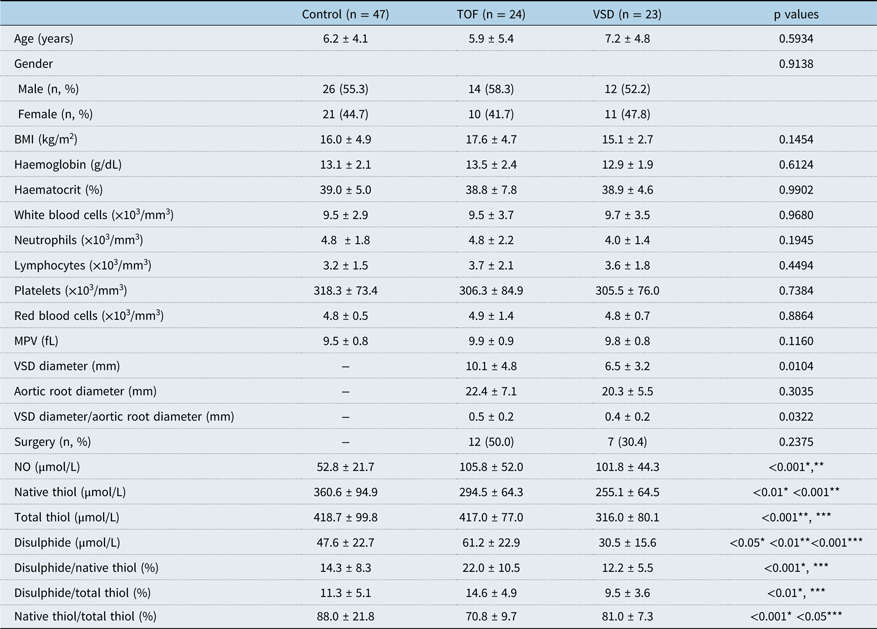
Demographic, clinical, and laboratory features of both control and patient groups are presented in Table 1. Compared with the controls, the average age, gender, BMI, haemoglobin, haematocrit, white blood cells, neutrophils, lymphocytes, platelets, red blood cells, mean platelet volume, and aortic root diameter in the patients group were similar (p > 0.05 for all). A total of 12 (50.0%) patients in the TOF group and 7 (30.4%) patients in the isolated VSD group had a history of previous surgery to correct their cardiac defects. While three patients had pulmonary hypertension, heart failure developed only in one of the patient in the VSD group. In the VSD group, majority of the patients (n = 16, 69.6%) had perimembraneous type, while the rest of the patients had muscular type (n = 7, 30.4%).
Demographic, clinical, and laboratory data of the children with TOF, children with VSD, and in healthy controls

BMI = body mass index; MPV = mean platelet volume; NO = nitric oxide; TOF = tetralogy of Fallot; VSD = ventricular septal defect
Data show mean ± SD or percentage.
* control versus TOF.
** control versus VSD.
*** TOF versus VSD.
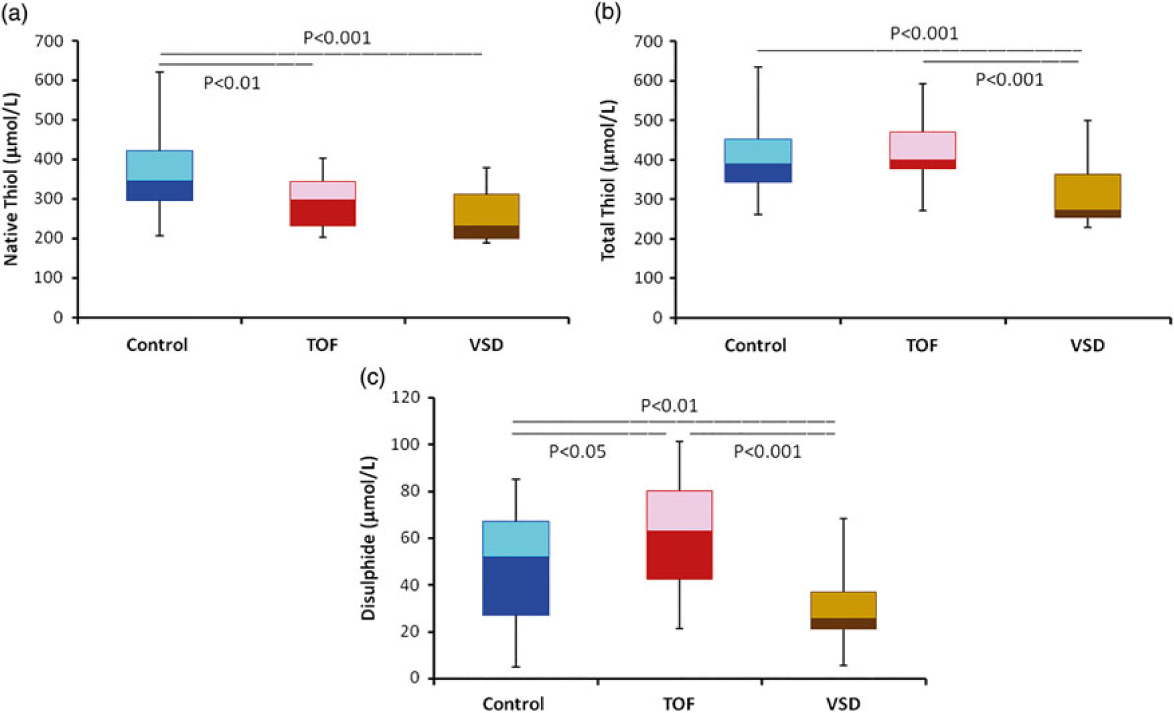
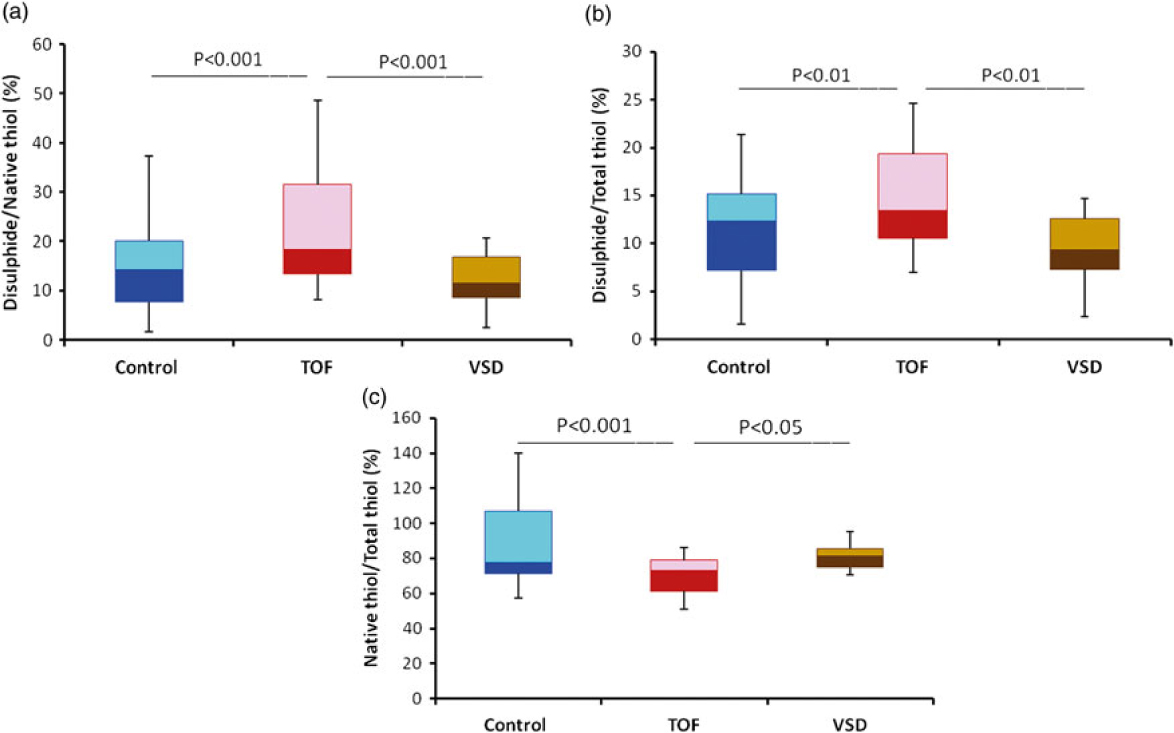
Figures 1 and 2 illustrate the distribution of the native thiol, total thiol, and disulphide levels between the study groups. There were marked reductions in native thiol levels in both the TOF (p < 0.01) and VSD groups (p < 0.001) when compared with controls (Fig 1a). Total thiol levels were not different from the controls in the TOF group, but were significantly reduced in the VSD group (p < 0.001) when compared with both the control and the TOF groups (Fig 1b). Disulphide levels were elevated in the TOF group (p < 0.05) but were significantly decreased in the VSD group (p < 0.01) when compared with control (Fig 1c). Disulphide/native thiol, and disulphide/total thiol ratios were increased in the TOF group (p < 0.001 and p < 0.01, respectively), but not in the VSD group (Fig 2a and b). The native thiol/total thiol ratio was significantly decreased in the TOF group (p < 0.001) when compared with controls. However, there was no change in native thiol/total thiol ratio in the VSD group (Fig 2c).
Box plots of native thiol ( a ), total thiol ( b ), and disulphide levels ( c ) between the study groups. Lower and upper margins of each box represent 25th and 75th percentiles, respectively; horizontal lines in the middle of the boxes represent median value; and whiskers represent lowest and highest values. TOF = tetralogy of Fallot; VSD=ventricular septal defect.

Box plots of disulphide/native thiol ( a ), disulphide/total thiol ( b ), and native thiol/total thiol ratios ( c ) between the study groups. Lower and upper margins of each box represent 25th and 75th percentiles, respectively; horizontal lines in the middle of the boxes represent median value; and whiskers represent lowest and highest values. TOF = tetralogy of Fallot; VSD = ventricular septal defect.

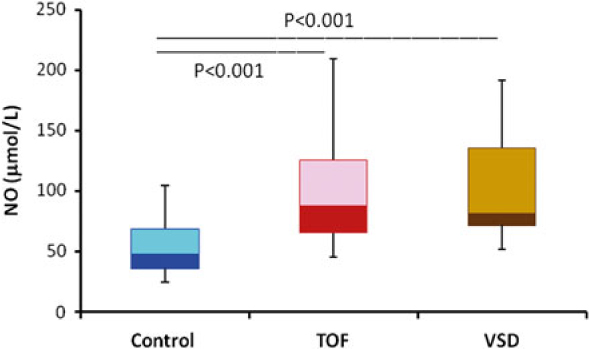
Figure 3 shows nitric oxide levels in the study groups. We found marked increases in nitric oxide levels in both the TOF (p < 0.001) and VSD groups (p < 0.001) when compared with controls.
Box plot of NO levels between the study groups. Lower and upper margins of each box represent 25th and 75th percentiles, respectively; horizontal lines in the middle of the boxes represent median value, and whiskers represent lowest and highest values. TOF=tetralogy of Fallot; VSD=ventricular septal defect.

There was no significant correlation between thiol/disulphide parameters and haematocrit, white blood cells, neutrophils, lymphocytes, platelet counts, mean platelet volume, VSD diameter, and nitric oxide levels (p > 0.05 for all values).
Discussion
The results of our study demonstrate for the first time the involvement of dynamic thiol/disulphide homeostasis in children with TOF and VSD. We show that the native thiol, total thiol, and disulphide levels are all decreased in patients with VSD. However, decreased native thiol and enhanced disulphide levels were observed in patients with TOF. While disulphide/native thiol and disulphide/total thiol ratios were elevated, native thiol/total thiol ratio was diminished in the TOF group. We found marked augmentation of nitric oxide levels in both the TOF and VSD groups. These data demonstrate increased nitric oxide production and imbalance of thiol/disulphide homeostasis which may contribute to the pathogenesis of TOF and VSD.
Previous studies showed that enhanced oxidative stress due to imbalance between prooxidant and antioxidant reactions appears to be associated with CHD pathology in infants.Reference Rokicki, Strzałkowski, Kłapcińska, Danch and Sobczak 7 – Reference Pektaş, Koca, Pektaş and Köken 9 , Reference Pirinccioglu, Alyan, Kizil, Kangin and Beyazit 16 Plasma total antioxidant status, total oxidant status, and oxidative stress index were all significantly higher in cyanotic patients including TOF when compared with acyanotic patients and controls.Reference Ercan, Cakmak, Kösecik and Erel 8 However, there were no significant differences between these parameters when comparing healthy controls and children with acyanotic heart diseases.Reference Ercan, Cakmak, Kösecik and Erel 8 Hypoxia in children with TOF reduces the antioxidant reserve capacity, leading to a greater susceptibility to the oxidative stress of ischemia. Increased malondialdehyde levels were found in the children with CHD.Reference Rokicki, Strzałkowski, Kłapcińska, Danch and Sobczak 7 , Reference Pirinccioglu, Alyan, Kizil, Kangin and Beyazit 16 Total antioxidant capacity was also shown to be significantly diminished in both cyanotic and acyanotic groups with CHD.Reference Pirinccioglu, Alyan, Kizil, Kangin and Beyazit 16 Elevated malondialdehyde is thought to be the indication of free-radical-mediated damage in lipid membranes as a result of chain reactions, leading to harmful changes in cells, including the impairment in myocardial function.
Constitutive nitric oxide synthase was reported to exist in the mammalian heart and to be regulated by the contractile state of the heart or shear stress.Reference Hattler, Oddis and Zeevi 17 Nitric oxide produced from endothelial nitric oxide synthase is important for cardiomyocyte maturation and proliferation during neonatal heart development.Reference Lepic, Burger, Lu, Song and Feng 18 Furthermore, nitric oxide has also been shown to promote cardiomyogenesis.Reference Bloch, Fleischmann and Lorke 19 Congenital atrial and ventricular septal defects can result from deficiency in endothelial nitric oxide synthase as shown in a mice study.Reference Feng, Song and Lu 20 In the present study, we observed marked increases in serum nitric oxide levels in patients with TOF and VSD. Elevated nitric oxide results from increased basal release of endothelial nitric oxide due to high pulmonary blood flow. Takaya et al.Reference Takaya, Teraguchi, Nogi, Ikemoto and Kobayashi 21 also reported that endogenous nitric oxide is upregulated in children with VSD. However, no marked changes in plasma nitrite and nitrate levels were observed in patients with left-to-right shunt.Reference Gorenflo, Zheng and Pöge 22 Nitric oxide rapidly interacts with superoxide to form peroxynitrite which can oxidise a wide variety of biomolecules including thiols.Reference Demiryürek, Cakici and Kanzik 23 Collectively, these data imply that nitric oxide and peroxynitrite can contribute to thiol/disulphide homeostasis in TOF and VSD.
Accumulating evidence indicates that disulphide bonds play important roles in the conformation and stability of proteins and peptides. Through an unfolding or misfolding of the protein, disulphides may regulate protein function and enzyme activity.Reference Ba, Burkholz, Schneider, Jacob and Hughes 24 Vidya et al.Reference Vidya, Suma, Bhat, Gladwin and Chand 11 , Reference Vidya, Suma, Bhat, Chand and Rao 25 showed that reactive oxygen species accumulation triggered by hypoxia causes DNA damage. Thus, there is a linear correlation of severity of the anomaly involved with the degree of DNA damage, as evidenced by lesser extent of DNA damage in isolated septal defect and greater in septal defect with great vessel anomaly. Collectively, these data suggest that disrupted thiol/disulphide homeostasis may contribute to the pathophysiology of TOF and VSD.
One of the limitations of our study was the relatively small sample size of the groups. Another important limitation of this study is that we included both repaired and unrepaired lesions. Therefore, we were unable to differentiate whether or not the dynamic thiol/disulphide status of the patient groups might be related to the associated shunt lesions versus some underlying component of the genetic pathophysiology of these defects.
Conclusion
Our results showed that elevated nitric oxide levels and impaired thiol/disulphide homeostasis may have a role in the pathogenesis of TOF and VSD. Increased oxidative stress can lead to the depletion of endogenous thiol levels in CHD. Our data may also generate a basis for further studies evaluating the effect of thiol-based therapy to avoid oxidative stress-mediated effects in CHD.
Author ORCIDs
Abdullah T. Demiryürek, https://orcid.org/0000-0002-9994-8541
Acknowledgements
None.
Financial Support
This research received no specific grant from any funding agency, commercial, or not-for-profit sectors.
Conflict of Interest
None.
Ethical Standards
The authors assert that all procedures contributing to this work comply with the Helsinki Declaration of 1975, as revised in 2008, and has been approved by the institutional committees (Gaziantep University Ethics Committee for Clinical Studies).