Inkosi yinkosi ngabantu. (A chief is a chief by the people.) - Zulu saying
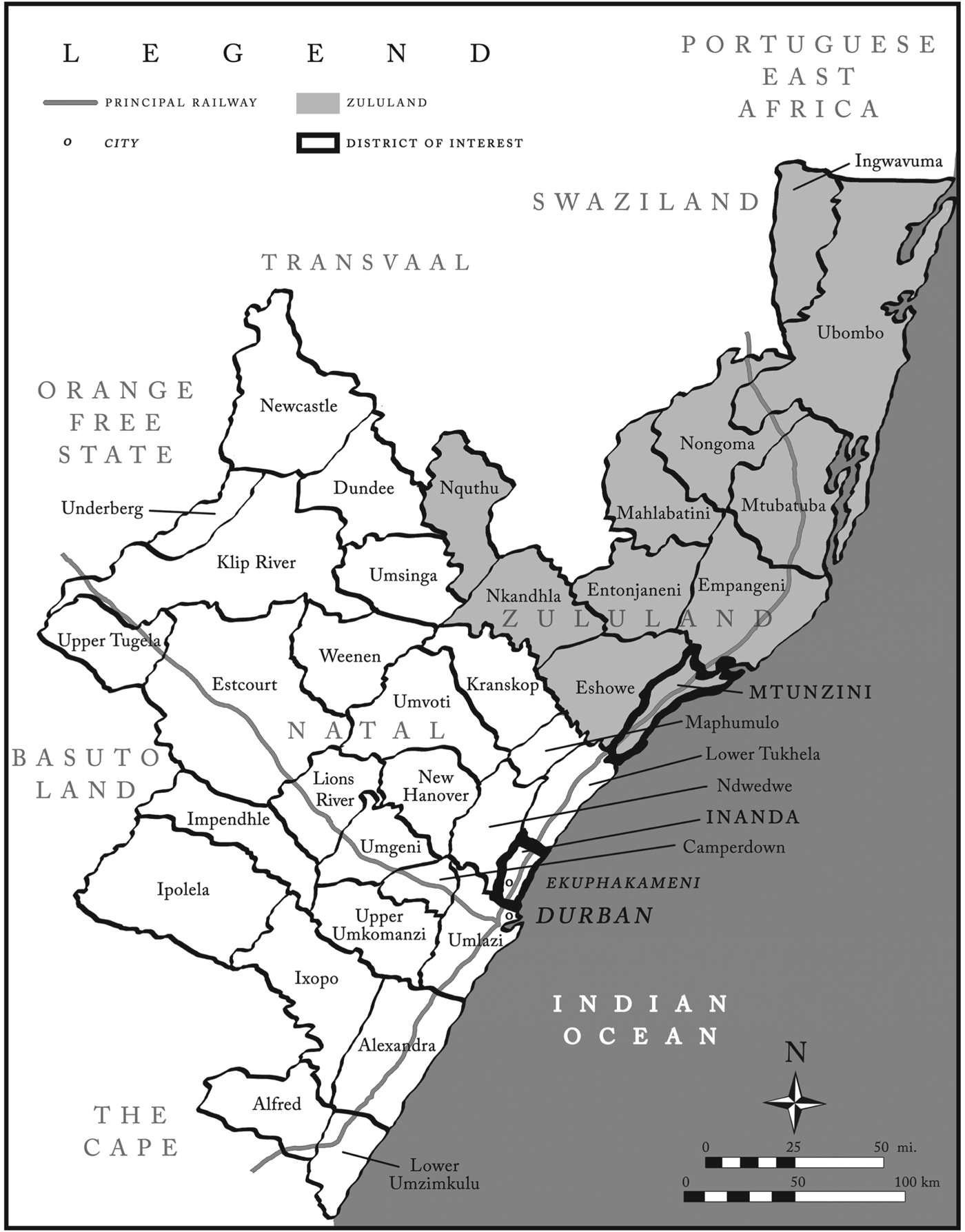
Between Mtunzini, in Zululand, and Ekuphakameni, just outside of Durban in Natal, lie nearly 130 kilometers of hills green with grass and sugarcane.Footnote 1 (See Fig. 1) Before the extension of the railroad into Mtunzini and beyond in 1904, this distance required several days to cross, with rivers to ford and roads that often washed out. Even after the extension of the railroad, as speed seemed to shrink distance, this journey was far longer than the average person (and especially the average woman) from the region made. And yet, by the 1930s, hundreds of women from Mtunzini regularly made this trip. They left their homes and male relatives behind to visit Ekuphakameni, the Elevated Place, that in the 1910s had become the headquarters of iBandla lamaNazaretha – now often shortened as the Nazaretha or referred to as the Nazareth Baptist Church (NBC).Footnote 2 In so doing, these women contributed to the growth of one of the largest faith-healing, prophetic churches in Southern Africa.
Natal and Zululand, South Africa c. 1910, with principal railways. District boundaries in bold indicate the distance traveled to Ekuphakameni by women from Mtunzini. Map courtesy of Al Duncan.

At first a description of women leaving home may seem to offer yet another example of how cities, schools, and churches encouraged African women to run away.Footnote 3 Many women who joined the Nazaretha were, indeed, ‘runaways’, who had left home despite the coalescence of patriarchal interests working to limit their mobility. However, the women from Mtunzini traveled on different terms because almost all of them came from areas where their chiefs supported the Nazaretha and, by extension, the women's travels to its holiest site. Some of their chiefs had donated land as worship space for the religious community; other chiefs had agreed to hold cattle that belonged to Isaiah Shembe, the great prophet and healer who founded the church; and a few even made the journey to Ekuphakameni themselves despite the complicated hierarchies in African politics that dictated who should travel to see whom.Footnote 4
Examples of women and chiefs sharing interests are largely missing from the historiography of traditional authority and gender in Africa in the twentieth century. This historiography identifies the changing people who made a chief a chief, generally assuming, as Mahmood Mamdani has argued, that the number of people became smaller and that chiefly rule became more despotic during the colonial period.Footnote 5 Since the publication of Martin Chanock's Law, Custom, and Social Order, many scholars have seen the codification of customary law as one of the most important vehicles for chiefs' dwindling popular base because older African men and white officials developed legal codes that subordinated junior men and women.Footnote 6 Such an ‘accommodation of patriarchs’, to borrow Jeff Guy's phrase, had its limits, as Chanock acknowledged but did not pursue in depth. More recently, scholars such as Benedict Carton and Thomas McClendon have built upon Chanock's analysis, providing further detail about the space that women and junior men in South Africa staked out as they challenged patriarchal authority despite the new laws put into place to bolster it. Migrant work and participation in a cash economy allowed younger men to escape from their fathers' influence, urbanizing areas provided new places to hide, and the pluralism of the colonial legal system offered forums for people to challenge African husbands, fathers, and chiefs.Footnote 7
Because customary law proved insufficient at propping up African patriarchal authority, the historiography of gender has shown how many older African men – and sometimes older women as well – turned to a moralizing discourse that juxtaposed the better behavior of young men and women in the past with their poor behavior in the present.Footnote 8 Like many discourses of conservatism in the face of dramatic change, this one romanticized tradition in an effort to exert control. Young men bore some of the weight of this discourse, but women shouldered a larger burden of it as chiefs, fathers, and husbands fretted that they were losing influence over not only the men who left home for work but the women who were supposed to stay behind in the rural reserves as well. Indeed, many African men and white officials saw women's presence in rural areas as a precondition for male migrant workers to return from industrializing regions and crafted policies accordingly. The high stakes of women's continued presence in rural areas meant that their mobility – and often relatedly, their sexuality – became targets of shared patriarchal anxiety. Because African patriarchs associated churches (as well as cities and schools) with women leaving home, one chief's complaint that churches ‘made whores of our children’ was a blunt iteration of a common refrain.Footnote 9
The pervasiveness of negative associations between women's movement and their morality makes the case of the Nazaretha in Mtunzini all the more intriguing. Worship with the church depended upon regular travel, but Nazaretha women from Mtunzini were not, at least in the eyes of their chiefs, like those described by Dorothy Hodgson and Sheryl McCurdy as ‘wayward’ and ‘wicked’.Footnote 10 Nor did these women exert agency by challenging traditional authority in the spaces that colonialism opened, as McClendon's and Carton's work might make us suspect they would. Instead, the history of the Nazaretha in Mtunzini casts fresh light on relationships between chiefs and women driven by overlapping interests and accommodation, instead of antagonism and conflict, as they responded to deteriorating conditions in rural areas.
In order to rethink the connections between chiefs and women, this article draws significantly on Nazaretha oral traditions. These oral traditions are defined by their performative qualities and the social work that they did and continue to do. From very early on in church history, speaking publicly about Isaiah Shembe's healing and prophecies provided one way to distinguish a member of the church from someone who came just to try Shembe's medicine. Church members explained how and why they began to believe in the prophet at church events in front of other believers. ‘Testimony’ is, as a result, another word that describes these accounts because people sought to tell the truth about Shembe through their stories. They are also oral traditions because of the role they have played in documenting the history of a community of believers across generations.Footnote 11
Members of the church have consciously cultivated – albeit in different ways at different times – the preservation of church oral traditions by recording them on paper. Isaiah Shembe himself recognized the power of writing for preservation, and encouraged literate church members to write their testimonies in notebooks as well as send them as letters to the editor to be published in Zulu-language newspapers.Footnote 12 After the first prophet's death in 1935, subsequent Nazaretha leaders embarked upon periodic projects to create a more formal written archive of church oral traditions. These projects reflected later leaders' modernizing ambitions as well as efforts to control memory within the Nazaretha community.Footnote 13 Church leaders' collaboration with foreign missionary scholars in the 1980s yielded the most extensive written collection of these traditions.Footnote 14
Most of the oral traditions recounted by the Nazaretha are stories of healing and miracles, but they bear marks of this world even as their explanations of events transcend it. In some cases, it is possible to corroborate the dates and events these traditions describe with other sources. But, more broadly, these oral traditions articulate dynamics of authority, relationships, and situations that resonated with speakers and listeners. They offer interpretations of how people made sense of their world.Footnote 15 Using such an understanding of their qualities, oral traditions suggest that nowhere in the church community were relationships between chiefs and women stronger than in Mtunzini, where, as mentioned, hundreds of women adopted the new faith and many of the district's chiefs showed firm support for the church.
To be sure, the backing of women and chiefs mattered almost everywhere the faith-healing church grew. From its establishment in 1906, chiefs provided land on which church members worshipped, lived, and sought healing. In places where chiefs did not support the Nazaretha – often because of debates about women's involvement in the church – its growth initially floundered. Women, moreover, formed the most important demographic as the Nazaretha established the network of sacred sites that transformed the religious community into one of the most significant institutions moving people and ideas in Southern Africa. Although the demographics of Nazaretha membership changed significantly in the first few decades after the founding of the church, estimates suggested that, well into the 1920s, women and children made up as much as 95 per cent of the religious community.Footnote 16
The growth of the church in Mtunzini offers the best evidence of the conditions that allowed chiefs and women to forge connections. As the site of Zululand's leper colony – what better symbol of avoidance – perhaps no district in Natal and Zululand exposed the limits of the South African state more than Mtunzini. Much of the district was so isolated from government surveillance that John Dube, the prominent Natal politician and cofounder of the African National Congress, ran an illicit sugar plantation there for decades.Footnote 17 As the magistrate of the district conceded in 1913, most of the chiefs of the region did not know about the codes of law that the British and then the government of Natal imposed after they annexed the territory.Footnote 18 But railroads and industry transformed the region in other ways. Social and economic change wrought havoc despite the weak influence of the South African state. The church provided explanations of these events and remedies, giving chiefs and women important options in difficult circumstances. In this context, six temples, or worship sites, grew in the district in the 1920s and 1930s.Footnote 19 Nowhere else could one find such a concentration of Nazaretha projects on chiefly land.
MTUNZINI AMID THE ‘OPENING’ OF ZULULAND
Isaiah Shembe, the founding prophet of the Nazaretha, arrived in Natal from the Orange Free State in 1906 claiming to be God's messenger as evidenced by his ability to heal and his calls for repentance. Today, church members are adamant that Shembe helped promote tradition as a path to virtue, giving people ways to preserve their identities as Africans even as they became Christians.Footnote 20 Inspired by the Holiness movement, Shembe placed less emphasis on the kinds of transformations that an earlier generation of missionaries had required as evidence of conversion to Christianity. Proponents of the movement, which emerged from Methodist revivals in the United States in the nineteenth century, preached of the need for ‘sanctification’ and ‘baptism by the Holy Spirit’ in order to fulfill the requirements of Christian life. As evidence of sanctification, they looked for inward, instead of outward, signs of the work of the Holy Spirit—signs that crossed barriers of race, class, nationality, gender, and education. As a result, the movement's more radical foreign missionaries, in the words of one historian, ‘granted religious authority to Chinese men, Indian girls, spirit-filled Zulus, working class Chileans, female evangelists, and African-American leaders', among others.Footnote 21 This approach encouraged Shembe, in turn, to preach that the spirit might take hold of someone and that the body had to be ready for baptism, whether or not that body were clothed in a three-piece suit and had been living in a square house.Footnote 22 Many Africans who rejected or could not afford the material trappings required for conversion in other denominations found this message appealing. However, church oral traditions that describe the founding of this religious community suggest that initially Shembe's most powerful messages had to do with his claims to heal people's physical, social, and spiritual ailments, and his belief that healing came from God. His words resonated with many people who believed, understandably in the context of early twentieth-century South Africa, that their own medicines no longer worked. They were also dubious of the kinds of interventions proposed by state officials who, in rapid succession, would discipline them with violence and then claim to help them with vaccinations and hospitals.Footnote 23
The tremendous growth of the Nazaretha in Mtunzini had its origins in the circumstances that people in the region faced amid the changing political economy of the early twentieth century. Isaiah Shembe's message of healing resonated because so many people found themselves in difficult situations, confronting new kinds of challenges. Some of their problems – notably, the departure of young men for migrant work – surfaced throughout South Africa. Others, such as outbreaks of malaria, hit Mtunzini especially hard. Women and chiefs weathered these problems differently, but their circumstances gave them reasons to see each other as potential allies and, eventually, reasons to support the church as well.
Zululand had been subject to British political authority since 1887. The decision to assume greater influence in the region came after almost a decade of warfare for the Zulu people and their allies – first with the British and then among themselves. The civil war that followed in the aftermath of the Anglo-Zulu War proved a defining moment of the region. Before this time, men from the Zulu kingdom had not gone away for migrant work. After it, they did.Footnote 24 That said, a number of other changes sped up the processes that drew the people of the Zulu kingdom into a new political economy, including the introduction of taxes, the spread of the devastating cattle disease rinderpest, and the opening of Zululand for white settlers. The latter proved especially important in Mtunzini.
In 1904, the Zululand Lands Delimitation Committee made recommendations for an avaricious (if ordered) land grab for white settlers in Zululand. Committee members reported that ‘[t]hose who are under the impression as many appear to be that [there exist] undulating plains suitable for European occupation are sadly mistaken’. Most of the Africans living in Zululand had the mixed blessing of being in places that the commission deemed ‘frightfully rugged, broken or barren and fever-stricken’, which meant that, as long as they stayed there, they would be less subject to the possibility of outside intervention.Footnote 25 But in the small portion of land that the committee had deemed desirable, change came rapidly – indeed, more rapidly than anywhere else in Natal and Zululand – and spilled over into the surrounding regions despite the lines cordoning them off on maps.
As a result of the ‘opening’ of Zululand, by 1930 white-owned farms in Mtunzini produced over 30,000 tons of sugar a year.Footnote 26 Such rapid expansion of the sugar industry in the region had important demographic consequences. The prerogatives of sugar cultivation led to the expropriation of the most fertile land in the district for the use of white planters. Sugar planters working in southern Natal had already established a pattern of using Indian indentured servants and African migrant laborers, and they pursued the same tack when they moved into Mtunzini. As Africans from Mtunzini cramped into tighter quarters on less productive land, many men from the region used the railroads to seek work in Natal and the Transvaal while sugar plantation owners used the same lines to bring in workers from elsewhere.Footnote 27 By 1913, women already outnumbered men by nearly 4,000 in Mtunzini; in a district with only 20,000 people, this made women more than 60 per cent of the total population of Africans. The annual pleas made by labor recruiters for men from Mtunzini skewed these demographics further.Footnote 28
With the expansion of sugar cultivation came a host of health problems. Malaria raged due to the new arrangements of people, water, and mosquitoes that the growth of commercial agriculture facilitated. In 1905, within months of Zululand opening for white settlement, public health officials documented a surge in malaria unlike anything they had seen in decades. Periodic outbreaks would persist until the introduction of DDT after the Second World War. Making matters worse, rates of sexually transmitted infections increased along the railroad lines, with syphilis reaching epidemic proportions by 1910. Official reports also noted a rise in alcoholism as people made cheap home-brewed liquors from treacle. Other problems were more localized or slower to show their effects, if still potentially devastating. For example, refineries polluted the water supply, temporarily sickening people.Footnote 29 These physical illnesses offered but one indication of poor health in communities where people believed in potential connections between the physical, spiritual, and social.
All those left behind grappled with new insecurities, but women bore disproportionate burdens because of the lack of formal channels funneling them away from rural areas and because of their places in the sinking rural economy. Women and children had historically been responsible for producing most of the agricultural goods that kept African communities alive, the stuff of subsistence. As if expropriation of the best land were not enough, the region experienced a series of ecological disasters over several decades, including periods of swarming locusts and devastating drought. People remembered this as the ‘time of queues’ as they waited in line for government-distributed mealies in order to survive.Footnote 30 Seasonal work cutting cane did provide a number of women with the opportunity to earn wages, but this meager income went toward purchasing goods in stores.
At the same time, traditional pathways to authority, adulthood, and respectability were in jeopardy for women because of the changing nature of the cattle economy and related crises about marriage. Although the total number of cattle in Mtunzini recovered quickly from rinderpest and East Coast fever, the cattle economy became more and more unequal, with a few cattle owners holding far more than the vast majority of the population. Young women complained that their say in finding marriage partners diminished as their fathers negotiated marriages with anyone who could offer ilobolo (bridewealth), whatever his age or however unattractive he might have been to his future bride.Footnote 31 Some women responded to these circumstances by running away from rural areas with the men they loved. Although doing so came with a cost to their reputations, women understood the diminishing rewards for chastity and respectability, which had usually taken the form of higher bridewealth prices. Once these women arrived in cities, however, they faced a new set of challenges, and frequently turned to illegal work (for example, beer brewing and prostitution) to support themselves.Footnote 32 Colonialism might have given women more possibilities, but most of them came with difficult consequences.
Many chiefs faired poorly as well. Some proved adept at finding ways to exert control over the new currencies of authority: cash, labor, and land. As the 1920s and 1930s progressed and a state of crisis became the state of things, their situations became more precarious. The Department of Native Affairs (NAD) used the dire agricultural situation in southern Zululand to introduce highly unpopular betterment schemes. Government officials expected chiefs to help implement them. This left chiefs, once again, wedged between the demands of colonial officials and their people. (For chiefs' efforts, occasional rewards came in the form of ‘loyalty’ medals – a dubious distinction.) Chiefs faced challenges during this period, too, from the other traditional authorities empowered by the process of making customary law: izinduna (headmen). Aron MacKinnon's work suggests that izinduna were the ones who ‘increasingly represented the interests of commoners and maneuvered in the interstices of divided loyalty’. Occasionally even prominent abanumzana (male family heads) would act as rogue chiefs who ‘usurped court duties, collected fines and fees for land allocation, [and] recruited labor for the mines’.Footnote 33 So fragile was chiefly authority in the region that, in a rare moment of foresight, the NAD scaled back some of its initiatives to avoid actions that would ‘practically kill the chiefs’.Footnote 34
As different as women's and chiefs' problems were in some respects, their circumstances had important similarities. Not only were they anchored to rural areas in ways that young men were not, but, as chiefs faced challenges from important men in their communities, in some cases, alliances with important women mattered all the more. Codes of native law lumped all women into the status of ‘perpetual minors’ subject to the authority of a male household head, whether that household head were a father, husband, brother, or even a son.Footnote 35 In so doing, they flattened out distinctions among African women and denied them the privileges that status and old age had once afforded. But the disappearance of women's authority in legal codes did not translate automatically into the loss of authority in lived experience. Especially in contexts of succession disputes, archival evidence points to the mothers of chiefs, in particular, as formidable allies for their sons.Footnote 36 The mechanics of these alliances in everyday life – and not just in the context of political transitions – are not well understood, but the women in chiefly families might have served as liaisons between chiefs and their increasingly female constituencies.
Chiefs and women also shared an interest in looking for solutions to common problems and, ultimately, in healing. Both groups had reason to search for new kinds of medicine in order to respond to bad conditions. Ideally, chiefs continued to be, in the eyes of their people, managers of public health and responsible for maintaining the health of their communities. This role did not stem from chiefs' abilities to heal: instead, it derived from their willingness to find appropriate healers during times of crisis. The most common of these healers were rainmakers, but, as the Bambatha rebellion had shown, chiefs could still play a mediating role in bringing in other kinds of medicine makers too.Footnote 37 By extension, chiefs' unwillingness to perform this role or inefficacy at it could result in political instability and challenges to their authority. Women, on the other hand, had historically served as important barometers of public health. A spike in new kinds of spirit possession among women in Zululand served as but one indication that something was very wrong.Footnote 38
Despite potential space for common ground, women and chiefs did not find it everywhere. Nazaretha experiences elsewhere in Zululand suggest that chiefs' relationships with white magistrates acted as a hindrance. Before moving into Mtunzini in the early 1920s, Nazaretha missionaries established temples in Nongoma and Eshowe, the two districts in the region subject to the strongest government surveillance because of the presence of the Zulu royal family in Nongoma and Eshowe's status as the headquarters for the colonial administration in Zululand. Conflict erupted over the control of women's movement and behavior in both districts. In Nongoma, a headman complained to the magistrate about young women who were ‘touched by the Gospel and became Christians’, arguing that Shembe would ‘take their women’.Footnote 39 Similarly, in Eshowe, a chief explained to the magistrate that ‘complaints had been made by the whole of the tribe regarding the enticement of their women from the control of their husbands and kraal heads. Several women had disappeared and could not be found.’Footnote 40 In each place, events unfolded in ways made predictable by the historiography, with conflict between men and women facilitating patriarchal alliances between chiefs and white officials as African men sought to reassert their authority.
Even in regions with a stronger state presence, magistrates still depended upon Africans to participate meaningfully in the economy of information. After all, magistrates likely would not have known about the work of the Nazaretha if African men had not told them. But, once they did know, officials in these districts worked in partnership with chiefs to destroy temple sites and to enforce a ban on Shembe. Most officials had either less ability to act upon their decisions or less interest in monitoring the affairs of chiefs than they did in Nongoma and Eshowe, whether because of limited budgets, poor language skills, or concerns about disease in their districts. This was certainly the case as the church moved into other parts of Zululand, including Mtunzini, in the 1920s.
THE NAZARETHA IN MTUNZINI, c. 1920–48Footnote 41
Because of the association of the railway with the outflow of men from rural areas, Zulu speakers often referred to it as a ‘loose woman that causes men to wander’.Footnote 42 The railway did, indeed, take many men away, but it also brought to Mtunzini new ways of thinking about how to make people's lives better as those left behind struggled with difficult circumstances. Shembe's message began to take root in Mtunzini among people searching for new ideas about the sources of good and evil as well as the causes of misfortune. And, like other churches around the world with links to the Holiness movement, the Nazaretha promised a better life right away if one accepted its tenets. In Mtunzini in the aftermath of the opening of Zululand, conditions had deteriorated to such an extent that many people viewed meeting basic material needs as miraculous events and proof of God's favor. Indeed, the immediacy of so many people's concerns makes divorcing the spiritual from the social or the economic unhelpful in understanding the growth of the Nazaretha. Although the church would eventually attract men and women, chiefs and commoners, oral traditions underscore the ways that the church provided chiefs and women, in particular, with important options in the context of rural decline and challenges to traditional authority.
For women, taking part in the church gave them choices about their health, living arrangements, affiliation, and relationships to their families that few other religious communities or institutions in segregationist South Africa could provide. For example, the church allowed any poor person to seek healing, but it also allowed women to take the ‘quest for therapy’ into their own hands.Footnote 43 Oral traditions from the region underscore frustration with ineffective and expensive medicine, suggesting that many people welcomed Shembe's willingness to heal for free. In one case, a family came to Shembe after paying ‘70 pounds sterling to native doctors, but they were unable to help’.Footnote 44 Others marveled that Shembe ‘charge[d] neither money nor cattle’.Footnote 45 Most people in the region had little expendable income or livestock but, for women, the lack of fees proved especially important because they had less control than men over these scarce resources. Shembe's willingness to heal without charging fees also mattered all the more for women because not everyone took their complaints of ill health seriously. The different forms of spirit possession that affected young women often provoked dismissive responses from older men and women in rural communities, but Shembe saw these diseases as real symptoms of deeper evils.Footnote 46 The same applied to women's infertility, which could lead to debates about causality that ripped families apart.Footnote 47 The church allowed women to pursue their own remedies, with or without the support of their families.
The religious community offered women other potential benefits as well, one of the most significant among them being the space that Ekuphakameni and other church settlements provided. The founding of Ekuphakameni in the 1910s had been a singular achievement in the history of Southern Africa, as a group comprising mainly African women contributed to the purchase of a piece of land where they could live and pursue a range of options away from their homes and families. Above all else, going to Ekuphakameni involved agreeing to take part in a new kind of community defined by shared beliefs. But it could also be a place where women from Mtunzini went when they were unhappy at home or wanted to visit husbands or sweethearts who had sought work in nearby Durban.Footnote 48 Church land also gave women, with or without children, a place to go to rest and relax. As agricultural production faltered and their burdens increased, taking a break at Ekuphakameni might have provided something akin to leisure for very poor, rural African women.Footnote 49
Women did not always have to travel as far as Ekuphakameni for a place to go during difficult times. Church teachings reminded the Nazaretha to care for the least-of-these, repeatedly admonishing them to remember the widows and orphans of the community. This commitment produced projects on chiefly land in Mtunzini. In the Mzimela chiefdom, the largest in the district, Chief Ntshidi explained the presence of a woman named Jabulisiwe, who had come to live there alone in 1939, saying he allowed her to stay on his land ‘because she was sick’ and ‘because she has no one to look after her’.Footnote 50 In the nearby Nzuza chiefdom, which hosted an annual gathering for all of the Nazaretha each October, the chief had set aside land where, at any time of year, ‘mothers [most likely widows] … stood there overnight’.Footnote 51 In the past, such women had usually been absorbed into the families of male relatives, whether brothers-in-law, fathers, or sons, but the agricultural crises of the early twentieth century made it difficult for many families to feed additional mouths. Much as foreign mission stations had in the nineteenth century, the church gave women some choice about their living arrangements, but it also gave them places of last resort if they simply had nowhere else to go.
The experiences of single women who moved to chiefly land point to the ways that the church allowed women to embed themselves in new communities and even find new ways to make families at a time when older forms of community and family were under stress. A rigid division based on sex, marital status, and, often relatedly, age ordered church worship, making one's primary affiliations in the religious community with members of the same sex. Groups of married women, unmarried women, and men met on different days of the month for worship services and sat separately at the Sabbath services that brought them all together. At the very least, these groupings afforded rural women – and, to a lesser extent, men – a new social outlet. By the 1920s, moreover, Shembe and other Nazaretha leaders had begun arranging marriages for the religious community.Footnote 52 As the population of men in rural areas dwindled, the ability to draw upon an extensive network of church members to search for a marriage partner would have been appealing for many women.
The Nazaretha community also made ample space, however, for women who were not married or did not want to find a marriage partner. Church members recognized the spiritual authority of women of all ages, but, in some respects, the ‘maidens’ of the community commanded more authority than married women, as evidenced by the prominence of unmarried women in church history. In Mtunzini, church members learned of the examples of Linah Mntungwa and Agagi Shozi, two maidens who had been early Nazaretha converts. An oral tradition recalled how Shozi ‘built this village [Emgangeni], and she preached the Gospel, and members of the Roman Catholic Church were converted’, while Mtungwa regularly traveled in a small entourage with the prophet and his closest associates.Footnote 53 Shozi eventually found a husband in a marriage arranged by Shembe, and her role in the church thereafter became more obscure. Linah Mntungwa never married, and her role in the church evolved with her age. At some point, she stopped traveling and became responsible for watching over and teaching young women at Ekuphakameni.Footnote 54 Whether they ever married or not, the church celebrated the work of unmarried women, providing them with alternative channels for respectability when social and economic change had lessened marriage possibilities.
The social options the church afforded women may help explain why they so often attempted to convince men, chiefs included, of the authority of the prophet. In some cases, women recognized Shembe as divine or offered him shelter after men initially dismissed him.Footnote 55 In others, women missionaries arrived before Shembe, offering blessings and healing in his name.Footnote 56 More usually, women who were healed by Shembe helped bring their male relatives into the faith. In the Biyela chiefdom, Chief Magemegeme Dube's mother and aunts began to worship with the Nazaretha shortly after church missionaries arrived in the region. As a result, when the chief's sister Mangqanguza, like many other young women in the area, ‘was possessed by a departed spirit’, they suggested that she seek healing from Shembe at Ekuphakameni. She left Mtunzini a ‘mad girl’ but came home healed. When her brother, the chief, saw her improvement, he decided to seek Shembe's help because he was ‘sick in the head and in the stomach’. After his experience with Shembe, Chief Dube began to believe in this new form of medicine as well.Footnote 57 In the neighboring Mathonsi chiefdom, infertility encouraged the chief's female relatives and then the chief himself to seek Shembe's help. First, the chief's mother suggested that her daughter-in-law who had ‘eaten already many medicines’ go to see Shembe in the hope of being healed. The Mathonsi family explained the pregnancies that followed as Shembe's miraculous work.Footnote 58
A series of compromises, many of which reflected the concerns of African patriarchs, facilitated chiefs' acceptance of the Nazaretha. For example, although Shembe believed that polygamy caused ‘poverty’ and ‘aversions’, he allowed it in the church but encouraged men to consider carefully the number of wives for which they could provide.Footnote 59 The Nazaretha also earned tolerance from some chiefs because they proposed solutions to the vexing problems at the nexus of women's religious affiliation, mobility, and morality that had caused so many complaints from African men. Church members not only spoke about the importance of chastity before marriage (as foreign missionaries did), but they also policed women's sexuality through a rigid system of chaperoning and supporting the practice of virginity testing among the unmarried women of the community.Footnote 60 Some women certainly would have resented this intrusion, but others likely saw utility in revitalizing this dwindling practice. Virginity testing allowed them to disassociate their morality from their mobility as much as it allowed chiefs and fathers to police their sexuality. It allowed them, in other words, to assert that they could be virtuous women even if they left home.Footnote 61 It was no coincidence that areas with strong support for the church saw a resurgence in virginity testing.Footnote 62 Remarkably, as a result of these efforts, by the 1950s, Nazaretha women and girls had reputations as the ‘most chaste’ and ‘more virtuous … than can be found in many African Christian Churches in South Africa’ – despite the extent to which they traveled for church events.Footnote 63 Still, this trade of monitoring sexuality for women's freedom of movement did not assuage all worried fathers and husbands.Footnote 64
Even within hagiographic church oral traditions there is evidence that some people in Mtunzini were less willing to accept the Nazaretha, whether because of its influence on local women or because of other strains over affiliation and space. Debates about where church members would worship, for example, revealed people's concerns about competition for scarce grazing and gardening land.Footnote 65 Also, in one instance, after a worship spot had been chosen, it burned to the ground. The fire might have been accidental. Because people attempted arson elsewhere to send a message to Shembe, the possibility remains that this fire was intentional, especially since men in the region had ‘insulted [Shembe] with obscene accusations’ and ‘suspected that he would do something evil’.Footnote 66
Chiefs not only risked losing sway with some of their people (and especially men) by supporting the church, but they also risked seeing their own family members leave home. As the example of Chief Dube's sick sister illustrated, chiefs' wives, daughters, mothers, and sisters traveled to Ekuphakameni too. At an important church event at Ekuphakameni in 1939, a survey of the women present indicated that there were more women from Mtunzini than from any other district and that several of them were from chiefly families.Footnote 67 Such journeys, as long as they did not lead to permanent departure, perhaps offered a compromise between chiefs in Mtunzini (and possibly other husbands and fathers) hoping to hold on to the people they had left and women itching for opportunities to leave home, whether to worship, see their husbands, find marriage partners, or just take a break from household burdens. Chiefs' willingness to accept temporary departures may reflect something of a truism relating to notions of hegemony: that by making the terms of their relationships with women more flexible, chiefs who supported the church in Mtunzini salvaged their relevance. Whether they did so in the hope of encouraging men to return or in recognition of the shifting demographics of their constituents remains unclear.
Chiefs in Mtunzini had other reasons to support the Nazaretha, many of which reflected their precarious situations within the South African government. At a time when people throughout Zululand and Natal blamed chiefs for their problems, Shembe offered explanations of decline and poor health that did not implicate chiefs. He argued that the conquest of South Africa was part of a providential plan and that, at a time designated by God, African leadership would be restored.Footnote 68 In the meantime, Shembe also promised medicine not just for sick individuals but also for vulnerable social relationships. Fewer relationships were more susceptible than those between chiefs and their people because of the series of catastrophes that had shaken the moral and epistemological foundations of everyday life. Shembe offered chiefs in the region blessings, for example, saying, ‘May the Lord scatter all the diseases, which are in this village. May the chief be well together with his children and with his tribe.’Footnote 69 In sum, then, supportive chiefs within the Nazaretha community gained an ideological argument for their place in the government as well as a means of restoring their roles in healing and, thus, their relationships with their people.
Through ritual, church members encouraged time for events that promoted collective identity among chiefs and their people but that had fallen by the wayside because of the demographic and economic shifts of the early twentieth century. Church dances provide one of the clearest examples. The geography of dance in the early twentieth century exposed the movement of male migrant laborers. As dances became more rare in rural areas, they proliferated in the urban and industrializing regions where young men moved to find work and began to take part in company dances as well as migrant workers' dance competitions.Footnote 70 From its founding, the Nazaretha had, however, used dance as a means of worshipping God. After preaching in one chiefdom in Mtunzini, church members suggested that a dance should take place. The people in the chiefdom wondered how they would dance after not having done it for so long; they ‘asked, “Where should we get a dancing dress? Because nobody does still have a man's loin covering of old cat's skin, and our bunches of feathers worn on the head are eaten by mites.”’ Church members danced anyway, if without all of the trappings to which people in Mtunzini were accustomed. Others, including the chief, eventually joined in the ceremony.Footnote 71 Such public events could serve as spaces for protest and criticism of chiefly authority, as they often had in the past. But they could also reaffirm a connection between the chief and his people. This dance in Mtunzini seemed to do so: ‘[W]hen the people saw their chief performing the war dance, they shouted praises.’Footnote 72
The celebrations elicited by a chief's war dance suggest another element of the Nazarethas' potential appeal: participation in the religious community allowed chiefs to act with some measure of defiance against the government. Given the difficult situations chiefs found themselves in – caught between the expectations of white officials and their people – many chiefs looked for compromises, or ways to keep their titles and state salaries without antagonizing their followers. Unlike churches established by foreign missionaries, the Nazaretha involved no government sanction, making its presence dissident in the eyes of most state officials. By permitting its work, chiefs showed that they were not simply pawns of the government. In Mtunzini, chiefs who supported the church demonstrated this to their people when, in 1940, after nearly two decades of work in the region, the magistrate finally stumbled upon church endeavors. After this happened, chiefs engaged in what Shula Marks has described as ‘the politics of the mask’, pleading ignorance and selectively describing their involvement with the church while continuing to support it when out of the earshot of the magistrate.Footnote 73 The magistrate's newfound knowledge did place some limitations on church projects but, beyond that, the magistrate was not in a position to do much more other than to make complaints about chiefs ‘for not reporting the presence of this sect … and what was going on there’ and to warn each one that he ‘would be well advised to dissociate himself entirely from the activities of the sect’.Footnote 74 This stood in stark contrast to what had happened in Eshowe and Nongoma, where magistrates and chiefs worked in partnership to check Shembe's authority.
Other scholars have seen instrumental motivations behind chiefly conversion, arguing that chiefs who supported the Nazaretha ‘instructed and exhorted their constituencies into submission to their rule, not only as a secular obligation but also as a spiritual virtue’. This, in turn, transformed their ‘subjects into communities of devout believers, bound by religious obligation to political governability’.Footnote 75 Although some chiefs manipulated ideas of divine sanction, in the era of segregation at least, affiliation with the Nazaretha came with risks and rewards for chiefs and their constituents – especially women. Accommodation characterized these relationships more than coercion, which helps explain how congregations in Mtunizini grew to be among the largest communities of Nazaretha worshippers.Footnote 76
CONCLUSION
The history of the Nazaretha in Mtunzini complicates the historiography of antagonism among genders, generations, and traditional authority in early twentieth-century South Africa. In some places, debates about the Nazaretha entrenched divisions between men and women. In contrast, Mtunzini's experience of social and economic change fostered conditions that allowed the Nazaretha to flourish as chiefs and women found a vehicle for overlapping – if not always shared – interests.
Whether chiefly accommodation of women's interests extended beyond allowing them to take part in church activities and traveling to Ekuphakameni is not clear. Moving forward in the effort to understand women's relationships with chiefs, there are tantalizing, if still fragmentary, bits of evidence that suggest that chiefs reached out to women through other means as well. Although beyond the scope of this article, the records of chiefs' courts in Mtunzini from the late 1930s and early 1940s show some chiefs taking strong stances against male perpetrators of domestic violence and men who abandoned their families. Moreover, at least a few women used chiefs' courts in ways that were not allowed under the code of native law, appearing in court without a male representative and receiving damages as well as control of their own property.Footnote 77 Scholars may well find that the records of chiefs' courts provide surprising evidence despite the very codes that were supposed to guide these relationships in segregationist South Africa.
Of course, in the 1940s, the social basis of chiefly authority shifted again. In South Africa, Durban was at the forefront of the rise of townships, the experiments in race-based modern planning that defined the experiences of so many Africans in the second half of the twentieth century. Although women remained a disproportionate number of people in the reserves of Natal and Zululand throughout the twentieth century, townships gave them new channels through which to move – and stay – away from rural areas. Between 1936 and 1946, the number of African women living in Natal's towns nearly tripled.Footnote 78 Chiefly authority also changed because of policies of apartheid and separate development. As wards and districts became homelands, traditional authority came to mean something different, with the state supporting what made a chief a chief in new ways. Even amid these transformations, accommodation and not just coercion could likely be found where scholars might least expect it.Footnote 79 Acknowledging this may help demystify the lingering salience of traditional authority today.