CHD influences the whole life of affected children. The effects could be due to not only heart lesions but also concomitant genetic defects, nutritional disorders, and emotional problems. The effects of CHD on growth are well studied, with some authors having shown different degrees of failure to thrive in children with CHD. Reference Noori, Nakhaey Moghaddam, Teimouri, Boryri and Hassanabady1–Reference Moradian, Pouraliakbar, Mahdavi, Ghadrdoost, Faritous and Fard3 Developmental delays constitute another aspect of involvement in cases suffering from CHD. Reference Marino, Lipkin and Newburger4 Be that as it may, puberty, which is one of the most important dimensions of development, has been less studied in patients with CHD. In the present study, we assessed pubertal status in children with CHD in a high-volume tertiary centre and compared the results with the pubertal charts for a domestic, normal population. Reference Razzaghi Azar, Moghimi and Sadigh5
Methods
The present cross-sectional study recruited consecutive patients with CHD aged between 6 and 18 who were admitted to Rajaie Cardiovascular Medical and Research Center (Tehran, Iran) for any diagnostic or therapeutic workup. Patients with concomitant genetic disorders or important extracardiac diseases were excluded. The study protocol was approved by the ethics committee of the centre. An informed consent form was filled and signed by the children’s parents/legal custodians as part of the fulfilment of the inclusion criteria.
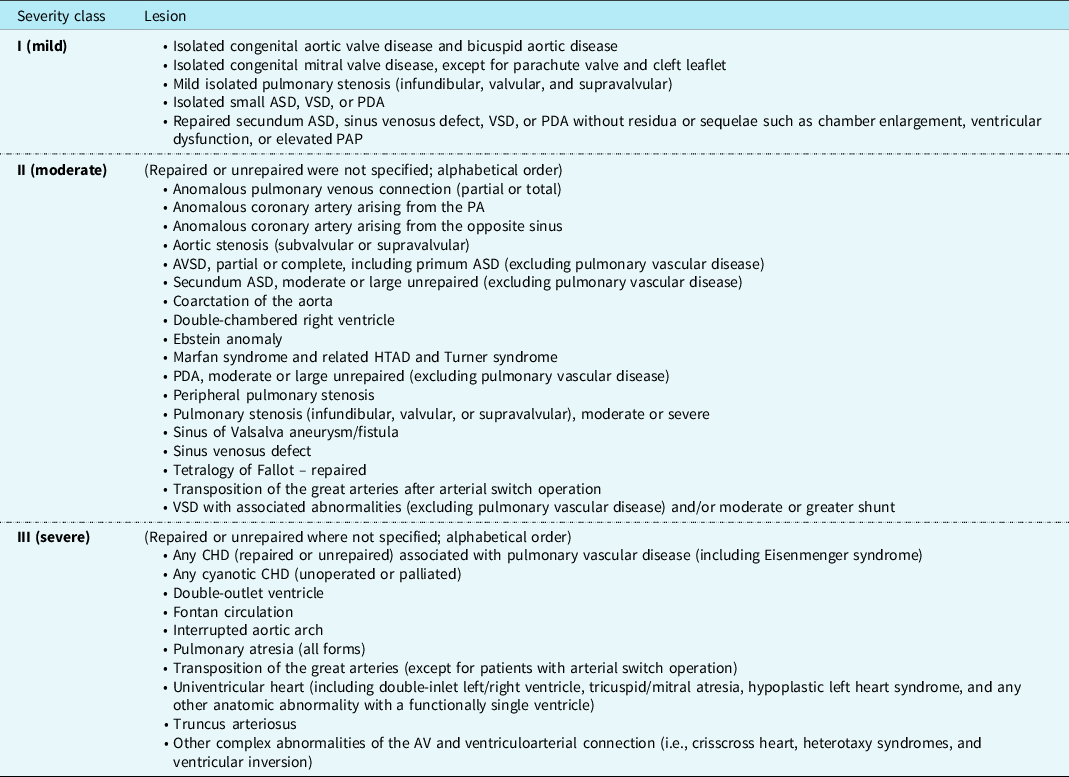
All the patients were carefully examined by a paediatric cardiologist, and their cardiac diagnosis was confirmed using their history, examination, and paraclinical data. All the patients had an echocardiography report by an expert paediatric cardiologist. The severity of CHD was classified as simple, moderate, and great, according to the 2020 guideline of the European Society of Cardiology (Table 1). Reference Baumgartner, De Backer and Babu-Narayan6 The children were thereafter examined by an endocrinologist for pubertal stages, and the data were recorded for statistical analysis. The age at menarche was added to the data based on the reports by the patients or their parents/legal custodians provided that it was recorded in their personal files.
The second Tanner stages for pubarche (P2), thelarche (B2), and gonadarche (G2) were regarded as the pubertal onset. Reference Marshall and Tanner7,Reference Marshall and Tanner8 Precocious puberty was applied to B2 aged less than 8 for female patients and G2 aged less than 9 for male patients. Reference Garibaldi and Chemaitilly9 Delayed puberty was defined as failure of development of any pubertal feature by 13 years of age in girls or by 14 years of age in boys. Reference Garibaldi and Chemaitilly9
The median age for each pubertal stage was compared with that reported for the normal Iranian population. Reference Razzaghi Azar, Moghimi and Sadigh5
Statistical analysis
The results were reported as the median (10th–90th percentiles) for age across pubertal stages or the median (1st–3rd percentiles) for other quantitative variables across sexes. Categorical variables were summarised by absolute frequencies and percentages. Amongst cumulative logit models for ordinal responses, proportional odds models were applied for factors associated with pubertal stages according to sex. The associations were expressed as odds ratios with 95% confidence intervals. For the statistical analyses, the SPSS software, version 18.0, for Windows (SPSS Inc., Chicago, IL, USA) and SAS, version 9.2, for Windows (SAS Institute Inc., Cary, NC, United States of America) was used. All P-values were considered as two-tailed with the statistical significance defined by a P-value of 0.05 or less.
Results
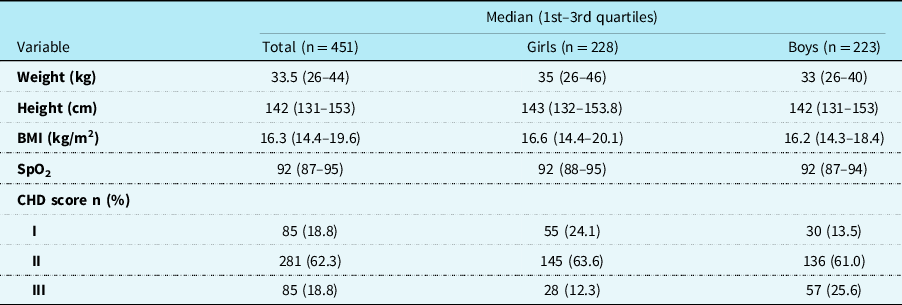
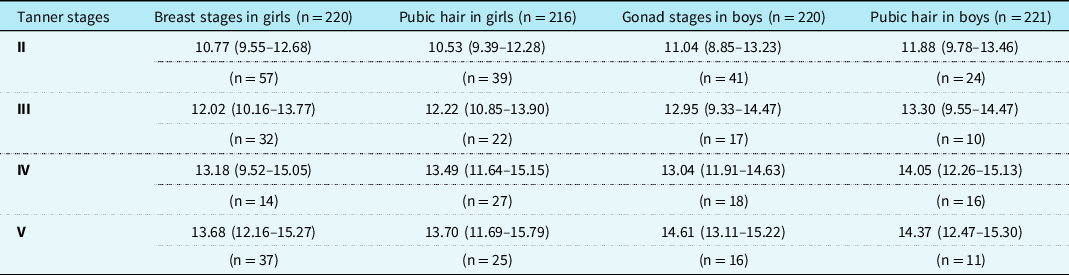
The current investigation enrolled 451 children: 228 (50.6%) boys and 223 (49.4%) girls. The median (10th–90th percentiles) age was 10.79 (8.02–14.28) years for the girls and 10.72 (8.05–14.03) years for the boys. The weight, height, body mass index, peripheral capillary oxygen saturation (SpO2), and CHD categories of the study population are summarised in Table 2. The median (10th–90th percentiles) age for each pubertal parameter is shown in Table 3.
CHD classification regarding severity in the present study

ASD = Atrial septal defect; AV = Atrioventricular; CHD = Congenital heart disease; HTAD = heritable thoracic aortic disease; PA = Pulmonary artery; PAP = Pulmonary arterial pressure; PDA = Patent ductus arteriosus; VSD = Ventricular septal defect.
Quartiles of the quantitative variables and CHD score frequencies in the study population

BMI = Body mass index; CHD = Congenital heart disease; SpO2 = Peripheral capillary oxygen saturation.
Median (10th–90th percentiles) age for pubertal stages in the study population

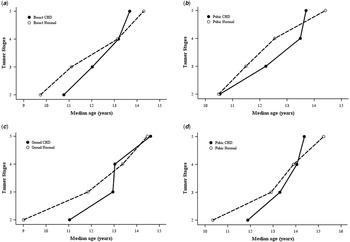
The median (10th–90th percentile) ages at B2 and P2 in the girls were 10.77 (9.55–12.68) and 10.53 (9.39–12.28) years, respectively, which were higher than the median ages of 9.74 (8.23–11.94) and 10.49 (8.86–12.17) years reported for B2 and P2, correspondingly, in the normal female population.
The median (10th–90th percentile) ages at G2 and P2 in the boys were 11.04 (8.85–13.23) and 11.88 (9.78–13.46), correspondingly, which were higher than the median ages of 9.01 (6.00–11.84) and 10.34 (6.84–13.10) years reported for G2 and P2, respectively, in the normal male population. The median (10th–90th percentiles) age for each pubertal parameter is shown in Table 3. Comparison of the findings between our patients and the normal population is illustrated in Fig 1(a–d).
Comparison of the median age for pubertal stages in the patients with CHD and the normal population are illustrated herein. ( a ) Tanner stages of breast development in the girls. ( b ) Tanner stages of pubic hair development in the girls. ( c ) Tanner stages of scrotal development in the boys. ( d : Tanner stages of pubic hair development in the boys. The filled circles and solid lines are related to the cases with CHD, and the empty circles and dotted lines are related to the normal population.

Precocious puberty was observed in three girls and five boys, and delayed puberty was observed in two girls and two boys.
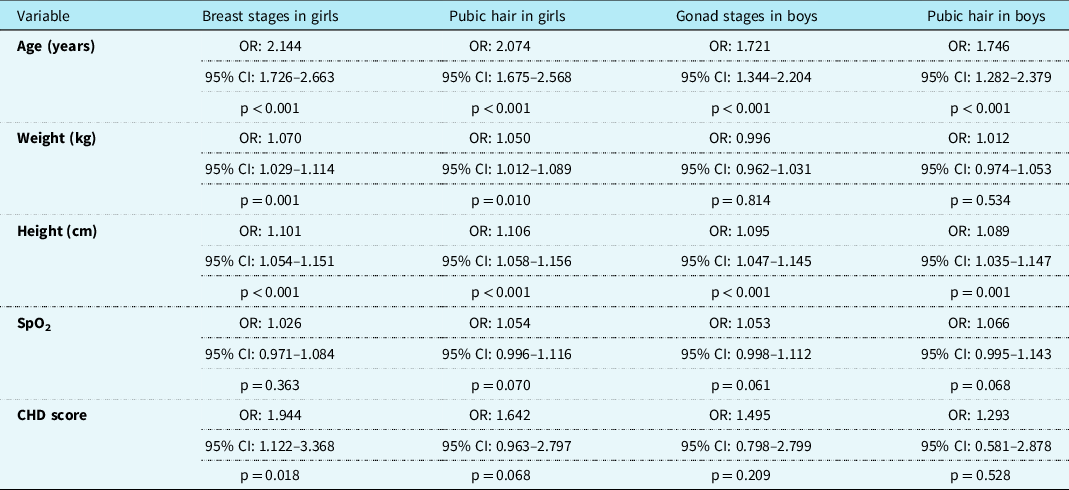
Factors associated with pubertal stages in both sexes are depicted in Table 4. As can be seen, there were positive associations between the age and height of the patients with CHD and their pubertal stages in either gender. In the girls, a positive correlation was also observed between the pubertal stages and the body weight and the CHD score (Table 4). The median age for each pubertal stage was compared with that of a normal population. To overlook the genetic and social factors, an Iranian report with a high-volume sample was used for the comparison.
Factors associated with pubertal stages in the study population

CHD = Congenital heart disease; CI = Confidence interval; OR = Odds ratio; SpO2 = Peripheral capillary oxygen saturation.
Discussion
Growth retardation and delayed puberty are common problems in children with chronic diseases. Reference Pozo and Argente10 Pubertal delays could happen through various mechanisms such as malnutrition, stress, emotional deprivation, recurrent infections, and side effects of chronic medications. Reference Currie11–Reference Soliman, De Sanctis, Elalaily and Bedair13 Growth retardation and its relationship with the different types of CHD have been shown by some investigators. Reference Noori, Nakhaey Moghaddam, Teimouri, Boryri and Hassanabady1–Reference Moradian, Pouraliakbar, Mahdavi, Ghadrdoost, Faritous and Fard3 The Baltimore–Washington Infant Study evaluated the relationship between CHD and birth weight in a large population. It reported that children with the tetralogy of Fallot, the atrioventricular septal defect, and the hypoplastic left heart syndrome had greater birth weight deficits. Another study by Jacobs et al showed no difference between cyanotic and acyanotic infants apropos birth weight deficits. In both of the aforementioned studies, infants with the transposition of the great arteries had normal birth weights. Concerning postnatal growth, some studies have demonstrated a higher frequency of growth failure in cyanotic patients. Reference Dündar, Akçoral and Saylam14–Reference Cohen, Bush and Ferry16 Moreover, the crucial role of the growth state in pubertal status has been previously demonstrated. Reference Mauras17
The existing literature contains a dearth of data on pubertal status in patients with CHD; nonetheless, some investigations have shown the influence of hypoxaemia on puberty. Reference Drenthen, Hoendermis and Moons18,Reference Khajali, Ziaei and Maleki19 We found a considerable delay in pubertal onset in children with CHD. Our findings also showed a significant correlation between CHD severity and pubertal retardation. While the majority of our patients had not significant cyanosis, their pubertal delay may be explained by the effects of chronic illnesses and their related mechanisms.
While puberty is a longitudinal process, the present investigation is a cross-sectional study. Notably, the principal article Reference Razzaghi Azar, Moghimi and Sadigh5 that we draw upon for comparison had a cross-sectional design too. It is also worthy of note that we excluded genetic factors by comparing our findings with previous reports from Iran rather than other nations and races.
Our results showed precocious and delayed puberty in only a few patients; the sample size precluded statistical comparison with the normal population.
We observed a strong positive correlation between the pubertal stage and body height in both genders. The finding could be a fact as growth acceleration is a part of puberty in both genders.
The age of pubertal completion in the study population was almost similar to the normal population. The finding should be confirmed by further large investigations before any scientific discussion.
Study limitations
As was mentioned above, we performed a cross-sectional study on puberty, which is a longitudinal process. The fact that we could not find a newer study on the Iranian population is another limitation to our study. Moreover, we were unable to determine the exact age at menarche as an important stage of female puberty in a significant number of our patients, which was partly due to the cross-sectional design of our study and the premenarche age of some of our patients at the time of examination. Some older girls and their families had failed to record the exact time of menarche, and the mentioned dates were not reliable, which explains why we excluded them from the analysis. Blood sampling requires permission, and exposing patients to X-rays is unethical. Indeed, had we been able to measure sex hormones and bone ages and evaluate thyroid and renal functions, all of which affect the pubertal status, our findings would be more robust. Additionally, while gestational data and birth weight may be relevant to puberty, we had no access to such data.
Conclusions
Regardless of the severity of CHD, pubertal onset could be delayed in affected children by comparison with a normal population. Girls with lower body weights may have longer delays in pubertal onset. The pubertal process is not significantly worse in children with complex CHD and those with lower SpO2.
Acknowledgements
The authors express their gratitude to the pediatric cardiology nurses for their valuable cooperation.
Financial support
This work received no specific grant from any funding agency, commercial, or not-for-profit sectors.
Conflicts of interest
None.
Ethical standards
The authors assert that all procedures contributing to this work comply with the ethical standards of the Iranian guidelines on human experimentation and with the Helsinki Declaration of 1975, as revised in 2008, and has been approved by the Rajaie Cardiovascular Medical and Research Center committee.
Author contributions statement
Z.G.H.: did all endocrine examinations and contributed to article writing; Z.K.H.: evaluated cardiac diseases in the study population older than 15 years and contributed to article writing; M.D.: evaluated cardiac diseases in the study population younger than 15 years and contributed to article writing; Z.F.: scheduled the cases for examination and recorded the data; M.M.: evaluated cardiac diseases in the study population younger than 15 years and contributed to article writing; M.S.H.: did statistical analyses.