In spite of a recent dramatic growth in research on orthographic effects in second language (L2) phonology (Bassetti, Hayes-Harb, & Escudero, Reference Bassetti, Hayes-Harb and Escudero2015), little is known about the extent of orthographic effects on L2 speech production in experienced L2 speakers. Thus far, most research has investigated orthographic effects on speech production in beginners (Browning, Reference Browning2004; Rafat, Reference Rafat2011) or in novel languages (Davidson, Reference Davidson2010; Hayes-Harb, Nicol, & Barker, Reference Hayes-Harb, Nicol and Barker2010; Pytlyk, Reference Pytlyk2011; Young-Scholten, Akita, & Cross, Reference Young-Scholten, Akita, Cross, Robinson and Jungheim1999). When experienced L2 speakers are studied, research mostly investigates their production of novel words/pseudowords (Escudero, Hayes-Harb, & Mitterer, Reference Escudero, Hayes-Harb and Mitterer2008; Escudero & Wanrooij, Reference Escudero and Wanrooij2010). This focus on the early stages of L2 learning is found in descriptive studies, which often investigate beginner learners, as well as in experimental research, because using artificial languages or pseudowords allows researchers to control confounding variables and to address the acquisition of a wider variety of phonemes. However, overreliance on beginners, novel languages, and pseudowords may result in overestimating orthographic effects on phonology. For instance, previous studies of bilinguals found orthographic effects with L2 pseudowords but not familiar words (Piske, Flege, MacKay, & Meador, Reference Piske, Flege, MacKay and Meador2002). Furthermore, many studies only investigated orthographic effects on a specific aspect of L2 speech production, such as spirantisation (Zampini, Reference Zampini1994), flaps (Vokic, Reference Vokic2011), or word-final voiceless consonants (Young-Scholten, Reference Young-Scholten, Burmeister, Piske and Rohde2002). There is then a need for studies that investigate a variety of orthographic effects in experienced learners producing real words.
This paper reports a series of studies that investigated orthographic effects on the production of English words in Italian experienced instructed learners of English as a second language (ESL). Participants were young adults (aged 16–19) who had been learning English as a school subject for around 10 years, with average age of onset of around 7 years. Italians were selected because it has been argued (Erdener & Burnham, Reference Erdener and Burnham2005) that native users of phonologically transparent orthographies may rely on orthographic forms more than native users of less transparent orthographies.
In order to provide a systematic view of the nature and extent of the phenomenon, we investigated various orthographic effects, used different tasks, and measured various related variables. In terms of phenomena under analysis, we looked at orthographic effects at the level of segments (epenthetic consonants and vowel length), morphemes (pronunciation of the past tense and past participle markers), and words (production of homophonic pairs). In terms of tasks, we used reading aloud because this task has been widely used in research on orthographic effects on L2 speech production. However, in half of our studies, we compared reading aloud with word repetition, in which production occurs after listening to a native speaker's model pronunciation of the target word, to test whether acoustic input in addition to orthographic input before production may reduce orthographic effects. We also included a task in which the target forms are not presented either auditorily or orthographically. In this verb paradigm production, participants were shown the written base form of a verb, but the target forms (the past simple and past participle markers) were not present in the input, and were produced by the participant. Because this was an exploratory study that aimed at investigating a variety of phenomena, we also measured various learner- and word-level variables that may relate to orthographic effects, such as learners’ length of study with native-speaking teachers and words’ spoken-to-written frequency ratio.
There were four studies. Study 1 aimed at measuring the extent to which L2 speakers add epenthetic consonants corresponding to so-called silent letters, such as adding a [b] to [læm] because of its spelling <lamb>. Study 2 investigated the effects of vowel spelling on vowel duration, namely, whether L2 speakers produce the same target vowel as longer when it is spelled with a vowel digraph than with a singleton vowel letter, such as pronouncing [iː] as longer in duration in the word seen than in scene. Study 3 looked at the effects of morphemic spelling on speech production, specifically whether the written form <ed> affects L2 speakers’ production of the past tense and past participle markers –ed. Study 4 investigated whether L2 speakers produce homophonic words differently because they are spelled differently; for instance, producing the homophonic words son and sun (both /sʌn/) with different vowels. Results revealed pervasive effects of orthographic forms on pronunciation. Task-modulated orthographic effects, as effects, were stronger in reading aloud than in the word-repetition task, whereas learner- and word-level variables did not seem to play an important role.
ITALIAN PHONOLOGY AND ORTHOGRAPHY
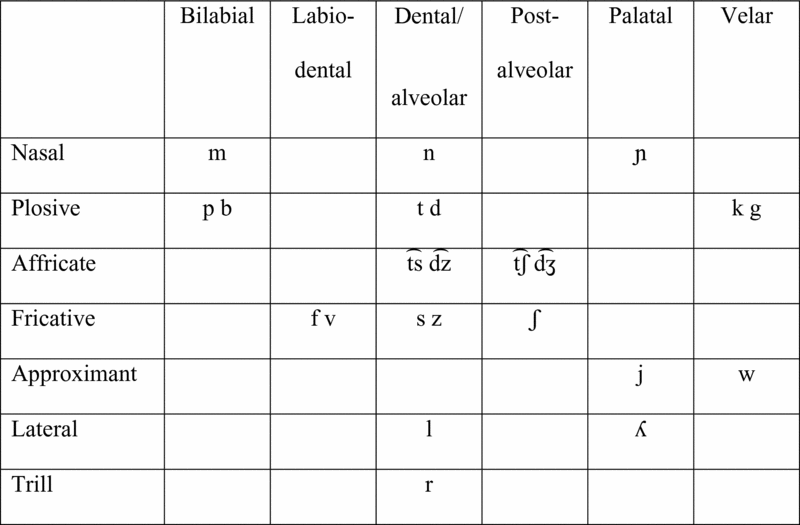
In the consonant inventory of Standard Italian (see Figure 1) there are 23 phonemes (Rogers & d’Arcangeli, Reference Rogers and d’Arcangeli2004; the phoneme inventory is consistent regardless of regional variation, Bertinetto & Loporcaro, Reference Bertinetto and Loporcaro2005). Italian then differs from standard English because some consonant phonemes are not present (/θ, ð, ʒ, ɹ, ŋ, and h/), and consonant-final words are rare (Bertinetto & Loporcaro, Reference Bertinetto and Loporcaro2005).
Consonant phoneme inventory of Standard Italian based on Bertinetto and Loporcaro (Reference Bertinetto and Loporcaro2005) and Rogers and d’Arcangeli (Reference Rogers and d’Arcangeli2004).

In Standard Italian there are 7 monophthongal vowels, and vowel length is not contrastive (Rogers & d’Arcangeli, Reference Rogers and d’Arcangeli2004). In Standard British English there are 12 monophthongal vowels, which can be broadly grouped into long and short (for a more detailed discussion, see Roach, Reference Roach2004). Figure 2 shows Italian and English vowels. For instance, it shows that English /iː/ is very similar to Italian /i/ and English /uː/ to Italian /u/.
Vowel chart showing (circles) Standard Italian monophthongs and (squares) Standard British English monophthongs. Chart based on Roach (Reference Roach2004) and Rogers and d’Arcangeli (Reference Rogers and d’Arcangeli2004).
Italian has a phonologically transparent orthography, whereas English has one-to-many grapheme–phoneme and phoneme–grapheme correspondences as well as morphemic spelling, and it is therefore a more phonologically opaque orthography (Cook & Bassetti, Reference Cook, Bassetti, Cook and Bassetti2005).
STUDY 1—ORTHOGRAPHY-INDUCED EPENTHESIS: EFFECTS OF “SILENT LETTERS”
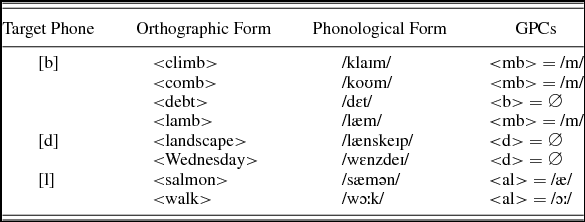
The orthographic forms of some English words contain so-called silent letters. A silent letter is a letter that has a zero phonetic correspondence, such as <b> in <lamb> (/læm/) or <l> in <walk> (/wɔːk/; this <l> is part of the grapheme <al>, which corresponds to /ɔː/). We have opted to use the term silent letters because this is familiar to most readers; for a more detailed discussion, see Carney (Reference Carney1994) and the list of grapheme–phoneme correspondences (GPCs) in Table 1. Silent letters may lead L2 learners to add sounds that do not exist in native speakers’ phonological input, for instance, producing lamb as [læmb]. This is then a case of orthography-induced epenthesis, which is the addition of a sound where it has a graphemic but no phonological correspondence (see Hall, Reference Hall, van Oostendorp, Ewen, Hume and Rice2011, for a discussion of different forms of epenthesis).
List of target words used in Study 1, including target phone, orthographic and phonological form, and grapheme–phoneme correspondences (GPCs)

There is limited evidence of orthography-induced epenthesis in L2 speech in published research. This is in spite of epenthesis being a well-known effect of orthographic forms in L2 learners (Wells, Reference Wells2000). In her report of pronunciation errors in a group of Italian primary school children reading English words, Browning (Reference Browning2004) found that all children produced [l] when reading the word walk. However, Browning's study only described the pronunciation of this one word in beginner learners. It is not clear whether silent letters cause phone addition in experienced L2 learners, and whether they affect other phones apart from [l] and other words apart from walk. Furthermore, orthography-induced epenthesis may be more common in reading aloud than in other tasks. Previous research found that orthographic effects are stronger when orthographic forms are present during speech production, both with a novel language (Young-Scholten & Hannahs, Reference Young-Scholten, Hannahs, Hannahs and Young-Scholten1997) and with novel words in a known L2 (Rafat, Reference Rafat2011), but not with experienced learners producing known words (Bassetti, Reference Bassetti2014).
The present study then investigated silent letter-induced epenthesis in learners with more than 10 years of L2 English learning experience, using a series of words containing one of three different silent letters, in order to measure the extent of orthography-induced epenthesis. We also compared orthographic effects on the production of the same words in two tasks, one that presented the words’ orthographic forms (reading aloud) and one that presented first the word's orthographic form and then a native speaker's production (word repetition with orthographic and acoustic input). We hypothesized that hearing a native speaker's model production of the target word immediately before production, and after the orthographic form has been removed from sight, would reduce the number of silent letters produced. Finally, the study tapped into the relationship between orthographic effects on speech production and a number of learner-level and word-level variables, such as the word's cognate status, and spoken and written frequency.
Method
Participants
Participants were 14 Italian native-speaking high-school learners of English, with no reported language or reading impairments. The average age was 17 years, 10 months (17;10, range = 16;7–19; 3 participants did not respond); half were females. As is normal in Italian classrooms, 1 participant was bilingual (with French); in this and in all studies reported in this paper, bilinguals were included because their performance did not differ from monolinguals’. Respondents had been studying English for an average of 11 years and 2 months (M = 134 months, SD = 22), with a mean age of onset of 6;8 (range = 3;5–12;9). On average, participants had studied with native teachers for 39 months (including both school and private lessons; range = 0–100) and had spent 5 weeks in English-speaking countries (range = 0–28). Respondents reported spending some time listening to English (Mdn = 3 hr/week) and no or very limited time reading English (Mdn = 0). A nativelike pronunciation was “important” or “very important” for all but 1 respondent. Participation was voluntary and unpaid.
Materials
The targets were eight English words that contained one of the three silent letters <b> (four words), <d>, and <l> (two words each; for a list of materials see Table 1). The regular GPCs of each of these graphemes (<b> = /b/, <d> = /d/, <l> = /l/) apply to 99% of English words (Carney, Reference Carney1994), and these are the only correspondences in Italian. All silent letters occurred within a consonant letter sequence, so that producing the corresponding extra phone resulted in a biconsonantal word-final cluster (e.g., /bt/ in debt; five words) or word-internal consonant sequence (e.g., /lm/ in salmon; three words). Two words had Italian cognates in which the target letter is pronounced: debt (Italian <debito>, /ˈdebito/) and salmon (<salmone>, /salˈmone/). In order to norm materials, five English native speakers performed the reading-aloud task to ensure that they did not produce phones corresponding to silent letters. Two additional words were then eliminated from analysis because all of the native speakers pronounced their silent letters (grandson and sandwich, both pronounced with [d]), leaving the eight words described above.
Tasks
All participants performed a word-reading task followed by a word-repetition task. Both tasks provided orthographic input, but in the latter task this disappeared and was followed by acoustic input.
READING-ALOUD TASK
Trials consisted of the presentation of a written word inside a black frame in the center of a computer screen. Participants were asked to read the word aloud, and then mouse-click inside the frame to reveal the next word. There was no time-out condition.
WORD REPETITION WITH ACOUSTIC AND ORTHOGRAPHIC INPUT
As in the previous task, a written word was presented inside a black frame in the center of the screen. When participants mouse-clicked on a button in the lower right-hand side corner of the screen, the written word disappeared, and simultaneously the participant heard a recording of the word produced by a native speaker of Standard British English. Participants produced the word, and then mouse-clicked inside the frame to reveal the next word.
Procedure
Participants were tested individually in a quiet, light room in their school during normal school hours. Instructions were provided orally in their first language (L1) by the researcher. All participants saw the same series of 37 words on the computer screen in the same order, including the 8 silent letter words described above, the 2 words subsequently eliminated from analysis, 24 words from Study 4 below, and 3 filler words. The order of words in the list was randomly determined, and all participants saw the words in the same order in both tasks. Stimulus presentation was controlled by the PsyScope X software (Cohen, MacWhinney, Flatt, & Provost, Reference Cohen, MacWhinney, Flatt and Provost1993). Participants interacted with the PowerBook MacIntosh laptop computer using a mouse. They heard stimuli on closed-cup headphones, and their responses were recorded using a Shure SM58 microphone connected to a digital recorder (Micro BR, Boss Corp.).
Data analysis
A trained phonetician (the second author) produced semidetailed International Phonetic Alphabet transcription using auditory analysis, listening to each word in isolation. Each word was then coded as epenthetic or nonepenthetic, and the nature of the added phone was noted. Another trained phonetician transcribed and coded 25% of data (four participants). The Cohen κ revealed good (Landis & Koch, Reference Landis and Koch1977) agreement between the two phoneticians’ codings (κ = 0.69, p < .001). Statistical analyses were performed using SPSS 19 and 21.
Results
On average, each of the eight target words was pronounced with an added phone by 85% of participants in the reading-aloud task, and by 56% in the word-repetition task.
The percentage of words produced with an added phone was analyzed using a t test with task (word reading aloud; word repetition with acoustic and orthographic input) as a within-group factor. There were more epentheses in the reading-aloud task (M = 6.79, SD = 0.58) than in the word-repetition task (M = 4.50, SD = 1.45), t (13) = 6.19, p < .001, Cohen d = 1.94.
To test the relationship between orthographic effects and learner-level variables, for each participant the mean percentage of words with epenthesis was entered into a series of correlations with length of study, length of study with native-speaking teachers, length of stay abroad, difference between hours spent listening and hours spent reading, and perceived importance of pronunciation. No correlations were found.
To test the relationship between orthographic effects and word-level variables, we obtained spoken and written frequencies from frequency lists based on the British National Corpus (a collection of 100 million words from contemporary written and spoken sources in British English). We then calculated a spoken-to-written frequency ratio for each word, by dividing the spoken by the written frequency. The mean percentage of added phones in the reading-aloud task and the repetition task were entered into correlations with the word's spoken-to-written frequency ratio. The ratio was negatively correlated with the percentage of epentheses in the reading-aloud task (r = –.95, p = .0002) and in the repetition task (r = –.78, p = .023).
Discussion
L2 learners with more than 10 years of English language instruction produced high numbers of phone additions caused by the orthographic form of L2 words containing silent (zero correspondence) letters. Results are in line with previous evidence from primary school children reading aloud the word walk (Browning, Reference Browning2004). In the present study of experienced learners, the percentage of participants who added [l] when reading walk was lower that among Browning's children (100%), but still very high (86%). It appears that the pronunciation of silent letters is a common phenomenon not only among beginning L2 learners but also among experienced instructed learners.
Effects were found with most of the words tested, especially in reading aloud. In the reading-aloud task, all tokens of <b> were produced in the four target words containing this silent letter (minus one participant's production of the word lamb). Almost all participants produced /mb/ clusters and /bt/ clusters, even though in English /mb/ and /bt/ are not permissible in word-final position, and <b> following <m> has zero phonetic correspondence (unless there is a morpheme boundary). In 33% of tokens in which word final <b> was pronounced, participants were judged auditorily by the phonetician (second author) to have resyllabified the /b/ through the addition of a prop vowel (i.e., a word-final epenthetic vowel). It is then possible to predict that orthography-induced epenthesis would occur in all word-final <mb> words, such as crumb, dumb, limb, and bomb, among others, beyond the ones we tested. Epenthesis was rare in Wednesday, which was produced with an added [d] by only two participants in the reading-aloud task and one in the repetition task. This may be due to an early age of acquisition (although the same does not apply to walk, another early learned word), to difficulty in pronouncing the resulting sequence of consonants, or to the low level of transparency of this word's orthographic form, leading L2 speakers to read the word as a whole rather than decoding it grapheme by grapheme.
Exposure to native speaker spoken input immediately before production reduced the effects of orthography, because the number of added phones was higher in reading aloud than in word repetition. Although this was to be expected, the finding was interesting for two reasons. First, many papers on orthographic effects on L2 phonology use reading aloud as a task. Our findings show that this practice may result in overestimating orthographic effects. Second, in line with our prediction, orthographic effects were reduced after hearing a native speaker production, compared to reading aloud; however, participants still realized many silent letters even immediately after hearing a native speaker model. A small number of words were produced with added phones in both tasks; for instance, 71% of participants produced an [l] when repeating walk (compared to 86% when reading aloud). However, with most words, the percentage of added phonemes in the repetition task was half that of the reading-aloud task. This confirms previous findings with beginner learners and novel words (Rafat, Reference Rafat2011; Young-Scholten & Hannahs, Reference Young-Scholten, Hannahs, Hannahs and Young-Scholten1997). The results, however, differ from previous findings by Bassetti (Reference Bassetti2014), who found no difference in orthographic effects on consonant duration between a reading-aloud task and a delayed word-repetition task. There could be various reasons for this difference. First, it is possible that immediate but not delayed word repetition reduces orthographic effects. This could be because delayed word repetition eliminates the traces of native speaker's phonological input, and forces participants to retrieve the word's phonological form from their mental lexicon, whereas immediate repetition is affected by traces of the model. It has also been argued that orthographic representations are activated to facilitate memorization of spoken materials (Alario, Perre, Castel, & Ziegler, Reference Alario, Perre, Castel and Ziegler2007). Orthographic effects could then be stronger in delayed than immediate repetition because the former requires memorization. Second, it could be that added phones are more salient than consonant duration, so that upon hearing a native speaker's production learners realize that the native speaker is not producing a phone (as in the present study), but they do not realize that the native speaker's consonant has shorter duration than theirs (as in Bassetti, Reference Bassetti2014). Whatever the reason, the reduced orthographic effects in the repetition task may be only temporary effects. Participants had been using most of these words for years, and they still produced them with epenthetic consonants. It is then possible that a high incidence of silent letters is an artifact of the reading-aloud task, but it is also possible that a low incidence of orthographic effects is an artifact of the immediate word-repetition task. Future research could then investigate the interaction between orthographic effects on the one hand and stimuli and task on the other.
Looking at word-level and learner-level variables, only the words’ spoken-to-written frequency ratio seems to be linked to orthographic effects, whereas neither the words’ cognate status nor any of the learner variables were. Cognate status had no effects in the two words tested in this study, because the two cognates did not behave differently from noncognates. In the repetition task, almost all participants produced a [b] in cognate debt (<debito>), compared with around 50% for the other words containing silent <b>. In contrast, fewer participants added [l] when repeating the cognate salmon (<salmone>) than the noncognate walk. It then appears that phone addition occurs independently of L1 phonological forms. Another likely factor is age of acquisition of the target word; words learned at an early age may be frozen forms, not necessarily learned with orthographic input.
There was a negative correlation between words’ spoken-to-written frequency ratios and mean percentage of epenthesis, showing that phone addition is more likely in words that occur more often in writing than in speaking. The correlation was stronger and the effect size larger in the reading-aloud task than in the repetition task. It is possible that word-level variables play a smaller role with immediate repetition because learners are simply imitating the native speaker's input. Finally, there was no correlation between the learners’ percentage of epenthesis and language learning-related variables such as age of onset of learning and length of study with native-speaking teachers. Future research could further investigate these and other variables that may be related to orthographic effects.
STUDY 2—SEGMENTAL EFFECTS: ORTHOGRAPHIC EFFECTS ON VOWEL DURATION
The second study aimed at testing orthographic effects on vowel duration. Specifically, we tested the hypothesis that the number of vowel letters in the orthographic form of a word affects spoken vowel duration in the word production of speakers of L2 English. We used pairs of words containing the same target vowel, represented by either a singleton vowel letter or a vowel digraph. We compared the duration of the vowel in such pairs as scene and seen, both of which contain the target vowel /iː/ but with the contrasting orthographic forms <e> and <ee>. If orthographic forms affect pronunciation, participants should realize the same vowel as shorter in duration when it is spelled with a singleton letter and longer in duration when it is spelled with a digraph, for instance, producing a short [i] in scene and a long [iː] in seen.
A large body of research shows that L2 speakers’ perception and production of vowels and consonants are affected by their L1 (for reviews, see Best & Tyler, Reference Best, Tyler, Munro and Bohn2007; Zampini, Reference Zampini, Edwards and Zampini2008). Simplifying considerably, beginner learners tend to perceive and produce L2 vowels and consonants as the closest equivalent phonemes in their L1. Italian learners of English would then initially produce both the English /ɪ/ and the English /iː/ as the Italian /i/, so that ship /ʃɪp/ and sheep /ʃiːp/ would both be pronounced [ʃip]. As speakers gain experience with an L2, their production and perception of L2 vowels becomes more nativelike (Flege, Bohn, & Jang, Reference Flege, Bohn and Jang1997; Flege, MacKay, & Meador, Reference Flege, MacKay and Meador1999). In general, quantitative (durational) differences between vowels are easier for L2 learners to perceive and produce than are qualitative differences, such as vowel height and frontness (Bohn, Reference Bohn and Strange1995; Escudero & Boersma, Reference Escudero and Boersma2004; Nimz, Reference Nimz2011). For Italian speakers in particular, durational differences in vowels may be easy to acquire for two reasons. First, it has been argued that the perception of L2 contrasts that differ along a particular acoustic dimension (such as duration) is facilitated by having L1 contrasts that differ along the same dimension (Brown, Reference Brown and Archibald2000). Italian has a length distinction in consonants, so that, for instance, a short /t/ and a long /tː/ distinguish the words /note/, “night,” and /notːe/, “note” (Clark & Yallop, Reference Clark and Yallop1995), and Italians produce long and short consonants in L2 English words (Bassetti, Reference Bassetti2014). Second, context-dependent length distinctions have been shown to facilitate the production and perception of durational differences in vowels in L2 speakers (Krebs-Lazendic & Best, Reference Krebs-Lazendic and Best2013), and Italian has long vowels in accented word-internal open syllables (Bertinetto & Loporcaro, Reference Bertinetto and Loporcaro2005; d’Imperio & Rosenthall, Reference d’Imperio and Rosenthall1999). More proficient Italian learners of English may therefore distinguish word pairs such as ship and sheep with vowel duration alone, realizing ship as [ʃip] and sheep as [ʃiːp].
It is possible that Italian learners of English rely on English orthographic forms, assuming that double vowel letters represent long monophthongs, as in <sheep> = /ʃiːp/, and single vowel letters represent short monophthongs, as in <ship> = /ʃip/. This is for various reasons. First, orthographic forms help if learners cannot perceive English vowel length categorically because length is not contrastive in their native phonology. Second, English orthographic forms provide an obvious, if not always reliable, clue to vowel duration. In particular, vowel digraphs consisting of the same vowel letter repeated twice reliably represent long vowels. The default correspondences are <ee> = /iː/ (this correspondence holds in 98% of words containing this grapheme, except before <r>) and <oo> = /uː/ (88%; Carney, Reference Carney1994). Third, because Italian has one-to-one correspondences between graphemes and phonemes in both directions, Italian ESL learners may assume that a vowel digraph must represent a different vowel from a single vowel letter. Fourth, double vowel letters in Italian (e.g., <zoo> and <cooperare>) are pronounced as a quickly rearticulated vowel (Bertinetto & Loporcaro, Reference Bertinetto and Loporcaro2005).
There is limited and inconsistent evidence of orthographic effects on Italians’ pronunciation of L2 English vowels. Browning (Reference Browning2004) reports that number of vowel letters did not affect Italian primary schoolchildren's pronunciation. They all pronounced a short [u] in book and foot, and pronounced the same vowel in lip as in leap. However, it is likely that such beginner learners had not discovered the qualitative and quantitative differences in English vowels. More advanced learners could instead produce vowels of different duration, and rely on orthography to decide which vowel to produce. Piske et al. (Reference Piske, Flege, MacKay and Meador2002) were arguably the first to report orthographic effects on vowel production in Italian speakers of English. Participants were early or late bilinguals (had emigrated to the United States in childhood or adulthood) and reported frequent or unfrequent use of English. Piske et al. tested participants’ production of L2 English /ɪ/, /ɛ/, and /ʊ/, whose spellings <i>, <e>, and <o> represent /i/, /e/, and /o/ in L1 Italian. Orthographic forms affected pronunciation in late but not in early bilinguals. Of more importance, orthographic effects were found in pseudowords but not in real words, possibly (as Piske et al. suggested) because the task (creating a pseudoword by inserting a spoken vowel in a /b_do/ frame) may have encouraged an orthographic strategy. Although orthographic effects were not found in early bilinguals, and in late bilinguals they only appeared in pseudowords, in instructed learners effects may be found in the production of real words. Furthermore, Piske et al. tested the pronunciation of three vowels that have different GPCs in Italian and English. This study instead tested Italian learners’ use of orthography to distinguish duration rather than quality. There is reason to believe that orthographic forms may affect the pronunciation of short and long monophthongs. A study that investigated Italian experienced instructed learners of English (Bassetti, Reference Bassetti2014) found effects of number of consonant letters on spoken consonant duration, because Italian learners of English produced the same consonants as 50% longer in duration if spelled with a consonant digraph than with a singleton letter, for instance, producing a longer [tː] in kitty than in city. This effect was found even though consonant length is not contrastive in English (but Italian has a singleton-geminate contrast). It is then possible that Italians will produce long vowels in words spelled with vowel digraphs.
The present study then tested the effects of vowel spelling on spoken vowel duration. We hypothesized that Italian experienced learners of English would produce the same spoken long vowel as longer in duration if spelled with a vowel digraph than if spelled with a singleton vowel letter. We tested this hypothesis by manipulating the number of vowel letters in word pairs containing the same target long vowel. For instance, we predicted that Italian ESL speakers would pronounce the target vowel /iː/ as longer in duration if spelled with a digraph (e.g., <ee> in seen) than if spelled with a singleton letter (e.g., <e> in scene). If the same target vowel is produced as longer when spelled with two than with one letter, this would demonstrate orthographic effects on spoken vowel duration.
Method
Participants
Participants were 15 Italian native-speaking high school learners of English (males = 10), aged on average 16;9 (range = 15;10–17;10), with no reported language or reading impairment. Three were bilinguals with French, Polish, or Spanish. Respondents had been studying English for an average of 9 years and 4 months (M = 112 months, SD = 38; 3 participants did not respond). The mean age of onset of acquisition was 7;11 (M = 95 months, SD = 26). Half of the respondents had only studied English with nonnative teachers, for the other half the mean length of study with native teachers was 3;10. Five respondents had never studied English abroad, while the others had a mean stay abroad of 2 weeks (range = 1–7 weeks). Respondents reported spending five times more hours per week listening to (Mdn = 5 hr) than reading (Mdn = 1 hr) English. A nativelike pronunciation was “important” or “very important” for 83% of respondents. Participation was voluntary and unpaid.
Materials
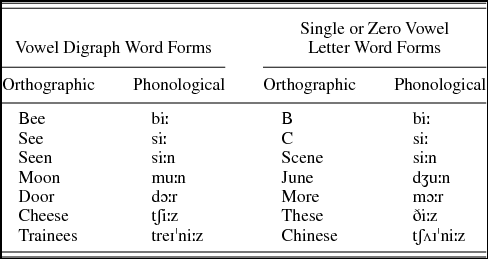
Targets were seven English word pairs (see Table 2). Within each pair, the two words contained the same target long vowel, spelled with either a vowel digraph or a singleton (or zero) vowel letter, as in seen and scene (both /siːn/). The target vowels were /iː/ (five pairs), /uː/, and /ɔː/ (both one pair). All vowel digraphs contained the same vowel letter repeated twice (<ee> or <oo>, including one occurrence of <oor> = /ɔː/). The vowels occurred either in a word-internal closed syllable (/CVːC/, five pairs) or in word-final position (/CVː/, two pairs). This was done in order to avoid L1 interference, because Italian vowels are lengthened in accented word-internal open syllables (Bertinetto & Loporcaro, Reference Bertinetto and Loporcaro2005; d’Imperio & Rosenthall, Reference d’Imperio and Rosenthall1999). There were three homophonic pairs (e.g., scene and seen) and four near minimal pairs (e.g., June and moon). In near minimal pairs, the target vowel was in word-final position or followed by the same final consonant within each pair, because in English consonant voicing may affect the duration of the preceding vowel (Chen, Reference Chen1970; Klatt, Reference Klatt1976). All pairs were monosyllabic, except one pair that was disyllabic with the target vowel in stressed preconsonantal position. In most single-letter words, the target vowel length was marked as long by a word-final <e>, as in scene. This rule is probably known to English speakers, at least insofar as children are taught that final silent <e> “makes the vowel say its name” (e.g., Davies, Dillon, & Dillon, Reference Davies, Dillon and Dillon1993). However, we predicted that Italian ESL learners would not be aware of this because, according to their teacher, they are not taught this rule, and orthographic forms in their native orthography are linear, unlike the English <e> that affects the duration of a preceding vowel. Two additional defective word pairs were eliminated from analysis. In one pair (choose and excuse), one noun token was often pronounced as a verb; in the other pair (heel and he’ll), more than 50% of the tokens could not be segmented because the vocalic portion could not be clearly defined. In order to norm materials, we tested seven English native speakers to ensure that spelling did not affect their vowel duration. Vowels spelled with a digraph were 3% longer than those spelled with a singleton letter. The difference approached but did not reach significance, t (6) = –2.25, p = .066, r = .68. This is below the noticeable difference of 5 ms in test samples of 90 ms reported by Nooteboom and Doodeman (Reference Nooteboom and Doodeman1980): a vowel needs to be 6% acoustically longer to be perceived as audibly longer.
Target word pairs used in Study 2, including phonological and orthographic forms

Task and procedure
Participants performed a reading-aloud task. They received a printed list of words, and produced each word three times within a carrier phrase. All participants read the words in the same order. The carrier phrase was used in order to obtain consistent speech rate and to place the target word in the nuclear position within the intonational phrase. The three repetitions were used to obtain a mean duration for each target vowel. Participants were tested individually in a quiet, light room in their school during normal school hours.
Data analysis
The onset and offset of each vocalic portion were marked using techniques consistent with Turk, Nakai, and Sugahara (Reference Turk, Nakai, Sugahara, Sudhoff, Lenertova, Meyer, Pappert, Augurzky and Mleinek2006) in order to provide an acoustic measurement of vowel length. The cues used differed depending on the adjacent segment(s); for example, onset of periodicity following a voiceless fricative and increase in formant strength following a nasal. Techniques were consistent for similar contexts. Another trained phonetician transcribed and coded 25% of data (4 participants). The two phoneticians had very high levels of agreement (r = .99, p < .001).
Results
The mean duration of the target vowels was analyzed using a t test with vowel spelling (single vowel letter and double vowel letter) as a within-group factor. Vowels spelled with digraphs had longer duration (M = 237 ms, SD = 58) than vowels spelled with single letters (M = 208 ms, SD = 47), t (14) = –5.35, p = .0001, Cohen d = 1.60.
For each participant, a mean long–short vowel ratio was calculated by dividing the mean duration of double-letter vowels by the mean duration of singleton-letter vowels. Overall, digraph vowels were pronounced with 14% longer duration than were single-letter vowels (M = 1.14, SD = 0.10).
The long–short vowel ratio was entered into a series of correlations with language learning-related variables and word spoken-to-written frequency ratios, but no correlations were found.
Discussion
In line with predictions, participants produce the same target long vowel as longer in duration when it is spelled with a vowel digraph than with a singleton vowel letter. This shows that L2 orthographic forms affect vowel length in L2 speakers’ production in a reading-aloud task. Results confirm predictions that experienced Italian speakers of L2 English can produce vowels with different lengths, even though vowel length is not contrastive in their native language, in line with evidence that L2 learners can perceive and produce vowel duration (Bohn, Reference Bohn and Strange1995; Escudero & Boersma, Reference Escudero and Boersma2004; Nimz, Reference Nimz2011). Findings show that Italians rely on orthography to determine the length of English vowels, in line with results from Piske et al.'s (Reference Piske, Flege, MacKay and Meador2002) pseudoword reading-aloud task, and in line with findings that Italian pronounce consonant digraphs as long consonants in English (Bassetti, Reference Bassetti2014). Italians are likely to rely on orthographic forms because vowel digraphs mostly represent long vowels in English and/or because they represent co-articulated double vowels in Italian, and because part of a general tendency among native users of phonologically transparent orthographies to rely on orthographic forms. However, English orthography can be misleading to these learners. In all the words spelled with a singleton vowel, vowel length was actually indicated by a word-final <e>, which lengthens and changes the quality of the preceding vowel, as in <Chinese> and <June>. However, participants appear to have been unaware of this rule, possibly because they had not been explicitly taught it and because their native orthography does not provide examples of nonlinear correspondences.
Effects were found with all but one of the word pairs, with the digraph vowel being produced as between 8% and 39% longer than the singleton vowel. The only exception was the pair these–cheese. Participants produced these with a very long [iː] (M = 229 ms, SD = 66). According to the school's head of English (personal communication), students are trained to produce these with a long vowel, as the only way to distinguish it from singular this. However, native speakers also produced a longer vowel in these than in cheese.
STUDY 3—MORPHEME-LEVEL EFFECTS: ORTHOGRAPHIC EFFECTS ON THE PRODUCTION OF THE PAST TENSE AND PAST PARTICIPLE MARKERS
The third study aimed at testing orthographic effects on the pronunciation of morphemes. In English regular verbs, the past tense marker and past participle marker are consistently spelled as <ed> (with some changes to the spelling of the stem). This spelling does not reflect the three allophonic realizations of the morpheme: syllabic /Vd/ when the stem ends in /t/ or /d/, /t/ when the stem ends in a voiceless segment except /t/, and /d/ when the stem ends in a voiced segment except /d/ (with a very small number of exceptions). The morphemic spelling <ed> retains spelling constant in the face of allomorphic variation (Carney, Reference Carney1994). English children need time to learn to spell the three allomorphs as <ed> (Beers & Beers, Reference Beers, Beers, Templeton and Bear1992; Bryant, Nunes, & Bindman, Reference Bryant, Nunes, Bindman and Blachman1997), whereas adult L2 learners learn this early on (Cook, Reference Cook, Bergh, Herriman and Mabärg2004). It is however possible that learners’ production of the English past tense and past participle markers is affected by the orthographic form <ed>.
The Italian primary school children in Browning's report (Reference Browning2004) produced /boild/ as disyllabic [boil.ed] in line with its spelling <boiled>. However, this may be due to low levels of proficiency. This study then tested experienced learners of English producing the past and past participle forms of known verbs in an oral verb production paradigm, whereby the target form ed was not presented in either the orthographic or the phonological form. Both in English and in Italian <d> corresponds to /d/, and <e> represents a vowel, which to Italians is most likely to be /e/. We therefore hypothesized that the orthographic form <ed> would affect production in two ways: the voiceless [t] would be replaced by voiced [d], and [t] and [d] would be pronounced with an added epenthetic vowel.
Method
Participants
Participants were 15 Italian native-speaking high school learners of English (1 was bilingual with Filipino), with no reported language or reading impairments. The average age was 16;9 (range = 16;3–18; 3 participants did not respond); 10 were males (1 did not respond). Respondents had been studying English for an average of 10 years and 5 months (SD = 33 months), with a mean age of onset of 6;4 (range = 3;3–11;3). The median length of study with native teachers was 22 months (range = 3–196). Participants had spent on average 2 weeks in English-speaking countries (range = 0–8). The self-reported English listening time (Mdn = 5 hr/week) was much longer than the reading time (Mdn = 1 hr/week). All respondents considered a nativelike pronunciation “important” (75%) or “very important” (25%). Participation was voluntary and unpaid.
Materials, task, and procedure
The targets were 21 regular verbs (see Table 3). There were three levels of orthography–phonology regularity. Five verbs had stems ending with a /t/ or /d/ sound (“/Vd/-verbs”). In these verbs, the past tense marker <ed> is produced as an unstressed syllable [Vd], matching the spelling, and a likely production is [əd]. We predicted that participants would pronounce these past tenses as [Vd] (including various realizations such as [əd], [ɪd], [ed], [ɛd]). Six verbs (“/d/-verbs”) ended in a voiced consonant, so that the inflected forms should be realized with a voiced [d] (e.g., seemed [siːmd]), matching the spelling of the consonant but not of the vowel. We predicted that participants would produce these forms with an added vowel [Vd]. Ten verbs (“/t/-verbs”) ended in a voiceless consonant, so that the past tense marker should be realized with a voiceless [t] (e.g., helped [helpt]), which does not match the spelling of either the vowel or the consonant. We predicted that participants would produce the [t] as [d], in line with the spelling, possibly with an epenthetic vowel. The verb list also included 6 irregular verbs, which acted as foils.
List of target verbs used in Study 3

The task was a verb paradigm-production task. Participants received a printed sheet containing the base form of the verbs in alphabetical order, and they were instructed to produce the base form, the past simple, past participle, and third-person singular form of each verb. Responses were recorded using a Shure SM58 microphone connected to a digital recorder.
Data analysis
Semidetailed auditory transcriptions were made for each of the 588 valid tokens by a trained phonetician (second author; 7% of the 630 tokens were either not produced or not analyzable). Simple past and past participle forms of the same verb did not differ; therefore, the two were entered in the same analysis. The International Phonetic Alphabet transcriptions were coded as targetlike or nontargetlike as follows: [Vd]-verbs were coded as targetlike if realized as either [Vd] or [əd]; /d/-verbs as [d]; and /t/-verbs as [t]. A linguistically trained native speaker rated each past tense on a 7-point scale of nativelikeness.
Results
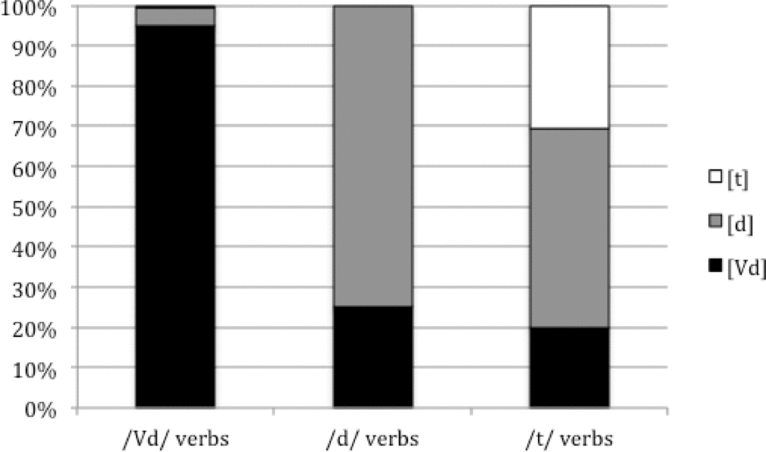
Results confirmed that listeners produced /Vd/-, /d/-, and /t/-verbs with a [Vd] ending to varying degrees, indicating some vowel addition and voicing to match the orthography (the actual vowels produced varied: [əd], [ɪd], [ed], and [ɛd]). Figure 3 shows the percentage of type of realization of the past tense and past participle markers by type of verb. Participants showed an almost ceiling performance in verbs ending with a voiced consonant and whose inflected form contains a vowel in line with the spelling <ed> (/Vd/-verbs); almost all markers were produced as the target [Vd] (M = 95%, SD = 3%). The percentage of targetlike productions was lower (M = 75%, SD = 7%) in verbs ending with a voiced consonant whose inflected form has no vowel (/d/-verbs); only one in four was produced with an added vowel [Vd]. The lowest percentage of targetlike tokens was in verbs whose stem ends with a voiceless consonant (/t/-verbs; M = 28%, SD = 8%). Of these, about one-third were produced with the target [t], but two-thirds were produced with voiced [d], and a third of these also had an added vowel [Vd] (one token was produced as [Vt]).
Percentage of type of phonetic realization by type of verb's phonological form.
The percentages of targetlike tokens were analyzed using an analysis of variance with type of verb's phonological form (/Vd/-verbs, /d/-verbs, and /t/-verbs) as a within-groups factor. There was a main effect of type of phonological form, F (2, 28) = 30.96, p < .001, partial η2 = 0.69. Bonferroni post hoc tests revealed that the percentage of targetlike productions was lower in verbs ending with a voiceless than a voiced consonant (both comparisons of /t/-verbs with /Vd/-verbs and with /d/-verbs, p < .001). There was no difference between the two types of verbs with stems ending in voiced consonants (/Vd/- and /d/-verbs). Nativelikeness ratings were also descriptively highest for /Vd/-verbs (Mdn = 4.90), followed by /d/-verbs (Mdn = 4.40), with /t/-verbs rated lowest (Mdn = 4.20). However, a Friedman test did not reveal significant differences, χ2 (2) = 0.53, ns.
The results showed high levels of variation among both items and participants. Among participants, two did not produce a single [t] form in /t/-verbs, while one produced it in almost all such verbs. To explore possible reasons for this variation, we entered participants’ percentages of targetlike tokens in a series of correlations with learner-level variables. Percentage of targetlike tokens correlated with length of study with native-speaking teachers (r = .87, p = .005). No other correlations were found.
There was also word-level variation. Among the /t/-verbs, the percentage of [Vd] productions ranged from 0% for ask and like to 47% for enforce. For the six /d/ verbs, the percentage of tokens with an added vowel ranged from 0% (believe) to 50% (comb and turn). To test the relationship between orthographic effects and word-level variables, we calculated a spoken-to-written frequency ratio for the inflected form and the base form of each verb. The verbs’ spoken-to-written frequency ratio did not correlate with the percentage of targetlike productions. We also considered the phonetic environment of the stem final position and whether the base form ended in an orthographic <e>, but there were too few tokens of any environment to make any statistical comparisons.
Discussion
In line with predictions, there appears to be a link between the orthographic form of the past tense and past participle markers and English L2 learners’ speech production. Orthography–phonology inconsistencies are linked to voicing (of /t/-verbs), and possibly to vowel epenthesis (of /d/- and /t/-verbs).
The voiced production of target /t/ most likely happened because <d> represents /d/ both in L1 Italian and in 99% of English words containing this grapheme; the correspondence <d> = /t/ is unattested, and <ed> corresponds to /t/ only in the past tense and past participle markers (Carney, Reference Carney1994). These results are also in line with Young-Scholten's (Reference Young-Scholten, Burmeister, Piske and Rohde2002) finding that English learners of German produce word-final voiceless /t/ as voiced if spelled with <d>. As an alternative to this orthographic explanation, the addition of a vowel could be due to phonological interference from the syllable structure of the native language, which is mostly CV(CV. . .). However, these effects can be attributed at least partly to orthography. First, Study 1 found that Italians produce word-final consonant clusters. Second, if epenthetic vowels were added to facilitate production of the target sound, then [t] should have been produced as [Vt]. Instead, all markers containing an epenthetic vowel were produced as [Vd] (with just one example of [Vt]).
Learners-level variables possibly played a role, because two participants did not produce a single [t] past tense. However, the only correlation was between the percentage of targetlike productions and length of study with native-speaking teachers. Word-level variables may also have affected production. The verbs’ spoken-to-written ratio did not correlate with targetlike production percentages. However, the only two /t/-verbs that were never produced as [Vd] were ask and like, which were the two verbs whose inflected form had with the highest spoken frequency (216 occurrences per million words for ask and 52 for like in the British National Corpus). A possible explanation is that for our L2 learners, the inflected forms of verbs with high spoken frequency are addressed in the lexicon rather than assembled, that is to say stored as units rather than computed (for a short discussion of the issue, see, e.g., Marslen-Wilson, Reference Marslen-Wilson and Gaskell2007); however, our results are too limited to be used as evidence for this widely researched possibility. In addition, the actual vowels produced in [Vd] tokens varied, as participants produced <ed> as [ɛd], [ɐd], [ɪd], [əd], and [ɜd]. The added vowels were consistent within participant, and there were no effects of word-level variables such as the presence of word-final <e>. We then looked at possible effects of the phonological environment at the end of the stem to which the past tense marker attached, but no conclusive results were possible with such a small sample of verbs. Future research could investigate whether phonological context modulates orthographic effects; for instance, comparing stems ending with a nasal or a liquid.
STUDY 4—WORD-LEVEL EFFECTS: ORTHOGRAPHIC EFFECTS ON THE PRONUNCIATION OF HOMOPHONES
The fourth study aimed at testing orthographic effects on the pronunciation of words. We examined L2 speakers’ pronunciations of English homophonic words to test whether their productions maintained them as homophones despite differences in orthography. For instance, sun and son are both pronounced /sʌn/ in Received Pronunciation (albeit not, for instance, in Northern varieties); however, we predicted that L2 Italian speakers would pronounce these two homophones differently. This could be for one or both of two reasons. First, in their native orthography, different orthographic forms represent different phonological forms. L2 speakers may therefore assume that two English words that have different spellings must also have different pronunciations. Second, L2 speakers may read one or both homophonic words using GPCs that do not apply to that word. The result would be that L2 speakers map two different phonological forms onto two homophones; for instance, pronouncing /sʌn/ as [sɔn] when spelled <son> because the default correspondence for <o> is /ɒ/, whose closest Italian phoneme is /ɔ/, and pronouncing it as /ʌ/ when spelled <sun>, in analogy with run and gun. If such effects were to be found, they could only be due to orthography, because such effects only occur in homophones but not in homonyms. There is no reason to expect different pronunciations of homonymous pairs, such as palm (tree) and palm (hand), which share both phonological and orthographic forms. Different pronunciations are only to be expected when the orthographic forms differ.
The present study then tested L2 learners with 10 years’ learning experience producing a series of homophonic word pairs. There were two tasks: word reading aloud and word repetition with orthographic and acoustic input. The aim was to test whether more homophonic pairs are produced when participants are producing words immediately after hearing a native speaker model, compared to only seeing the word's orthographic form.
Method
Participants, tasks, and procedure
Participants, tasks, and procedure were the same as in Study 1 above. Words appeared one at a time, together with the words described in Study 1. Participants were not made aware that some of these words belonged to homophonic pairs.
Materials
Materials consisted of 12 pairs of homophonic words (see Table 4). Within each pair, the two words had the same pronunciation but different spellings, such as <sun> and <son>, both pronounced /sʌn/ in received pronunciation. Most pairs were monosyllabic (e.g., sun–son), except one disyllabic (aloud–allowed) and one trisyllabic pair (principle–principal). In two pairs (hire–higher and flour–flower) the two words had different numbers of syllables; however, the expected productions were homophonic. The average word length was 5.17 letters (SD = 1.61, range 3–9) and 3.58 phonemes (SD = 1.72, range 2–9). Two words had Italian cognates that could result in nonhomophonic realizations of English word pairs: court (Italian <corte>, /ˈkorte/, possibly leading to the realization of <r>, contrasting with caught) and principal (<principale>, /printʃiˈpale/, possibly leading to realizing <pal> in principal as /pal/, contrasting with principle). In order to norm materials, we tested seven British English native speakers and confirmed that their realizations of each word pair were homophonic. Although native respondents spoke varieties of northern English, no differences between their productions and received pronunciations were expected other than the words won and one, which are homophones in received pronunciation but not in northern English.
List of homophonous word pairs used in Study 4, including phonological form and orthographic forms

Analysis
Seven pairs (5% of data) were eliminated from analysis because participants had failed to produce one or both words. A trained phonetician (the second author) performed an auditory phonetic transcription of the target words using the International Phonetic Alphabet. Based on these transcriptions, each word pair was coded as “homophonic” or “nonhomophonic.” Pairs were coded as homophonic if they contained the same phonemes, regardless of whether targetlike or not. Another trained phonetician (the same as in Study 2) transcribed and coded 25% of data (four participants); Cohen κ revealed strong agreement between the two phoneticians’ ratings (κ = 0.75, p < .001). Codings were entered into statistical tests as described below.
Results
Overall, participants produced on average 40% of word pairs as nonhomophonic (range = 23%–55%). However, the mean percentage of nonhomophonic pairs was twice as high in the reading-aloud task (M = 57%, range = 30%–82%) than in the word-repetition task with orthographic and acoustic input (M = 23%, range = 8%–33%).
The percentage of homophonic word pairs produced with nonhomophonic realizations was analyzed using a t test with task (word reading aloud and word repetition with acoustic and orthographic input) as a within-group factor. Participants pronounced more homophonic pairs with nonhomophonic realization in the reading-aloud task than in the word-repetition task, t (13) = 8.94, p < .001, r = .93.
For each participant, the percentage of homophonic pairs produced as nonhomophones was entered into a series of correlations with language learning-related variables. No correlations were found. We also entered each pair's spoken-to-written frequency ratio in correlations with the percentage of nonhomophonic pair productions; however, no correlations were found.
Discussion
Participants on average produced almost half of homophonic pairs with nonhomophonic realizations. It is possible that native users of a transparent orthography assume that different orthographic forms should correspond to different phonological forms. These different realizations of the same phonological form appear to be due to application of one or a combination of inappropriate GPCs, including GPCs invented by the learners, English GPCs that do not apply to the target word, and Italian GPCs. For instance, <ght> in caught was realized as [gt], [tʃ], [f], or [s] (the targetlike GPCs being <augh> = /ɔː/ and <t> = /t/; Carney Reference Carney1994). This could be due to the learner applying the English <gh> = /g/ or <augh> = /f/ correspondences, which do not apply in this context, or even inventing their own GPCs, such as <ght> = [tʃ] or [s]. The most frequent cause for nonhomophony with our materials was different realizations of the same vowel. For instance, in the reading task, 93% of realizations of the pair sun–son were not homophonic because almost all participants pronounced the vowel in son as [ɔ]. Similarly, the vowel /ɔː/ was pronounced as [oʊ] or [aʊ] in sauce, and with seven different realizations in source, including [ɜː] and [ɔ]. These vowel productions are likely caused by combinations of English GPCs, Italian GPCs, invented GPCs, and phonological or phonetic factors. Looking at consonants, Italian GPCs by themselves did not result in nonhomophony and were rarely applied (e.g., realizing <w> as [v] in wood and would), except one pair, which was often produced as nonhomophonic because one word contained a consonant digraph that was realized as a long consonant ([lː] in allowed vs. [l] in aloud). This was in line with previous findings that Italians produce long consonants in English words spelled with double consonant letter (Bassetti, Reference Bassetti2014). Finally, it should be noted that in two pairs, one word contained the grapheme <r> (e.g., sauce–source), so the pairs were homophonic in received pronunciation but not in rhotic varieties of English such as North American. These varieties may have affected the learners’ phonologies, even though the native model in the word-repetition task was British English. While the causes for nonhomophonic pronunciation are varied, the result is that Italian learners of English pronounce homophonic words differently, and the explanation is that homophonic words, unlike homonyms, are spelled differently.
The number of nonhomophonic realizations decreased between the reading-aloud task and the repetition task (mean decrease = 34%, SD = 14%). It appears that removing orthographic forms and exposing L2 speakers to a native model just before production reduce orthographic effects. These results confirm findings of research on beginner learners and novel words (Rafat, Reference Rafat2011; Young-Scholten & Hannahs, Reference Young-Scholten, Hannahs, Hannahs and Young-Scholten1997), as well as the results of our Study 1. It should also be noticed that there was much variation. Among participants, the decrease ranged between 12% and 55%. However, this decrease did not correlate with any of the learner-level variables analyzed. Variation was also evident among word pairs. For the pair sun–son, the decrease was from 93% to 7%. In contrast, the number of geminates produced in aloud–allowed was the same from task to task, and the nonhomophonic realizations of sauce–source only decreased from 100% to 86%. There were no effects of word-level variables. Cognate status had no effect, because the two pairs containing a cognate did not differ from other pairs, and spoken-to-written frequency ratios did not correlate with percentages of nonhomophonic productions. It is unclear why a native model affects the pronunciation of some words but not others.
GENERAL DISCUSSION
The present study aimed at measuring the effects of the orthographic forms of English words on the spoken production of English segments, morphemes, and words in experienced instructed learners, using tasks with different levels of orthographic and phonological input. Participants were affected by orthographic forms in a number of ways: they added sounds corresponding to so-called silent letters, pronounced the same vowel as longer if spelled with a vowel digraph than with a singleton letter, produced past tense and past participle markers with voiced consonants and often added vowels in line with the orthographic form of the morpheme, and produced homophonic word pairs with nonhomophonic realizations, reflecting their different orthographic forms.
The phonological realizations of segments, morphemes, and words in this study could not be predicted on the basis of what we know about L2 phonology and particularly L1 phonology transfer, and they are almost exclusively caused by orthographic forms. L1 phonological transfer could not result in an added [b] in lamb, in a shorter vowel in scene than in seen, in the realization of the past tense and past participle marker /t/ as voiced, or in two different realizations of /sʌn/. Some of the effects we found are probably due to factors other than orthography; for instance, the epenthetic vowel in the realization of the past tense and past participle markers /t/ and /d/. However, research on orthographic effects can add much to what we know about L2 phonology based on purely phonological factors. Given the pervasive effects of orthography found in this study among experienced learners, it is argued that models of L2 phonological development should take into account orthography as an important variable affecting L2 speech production, which has mostly not been done so far.
Such pervasive effects are surprising in learners who had been receiving formal instruction in L2 English for more than half of their lives. While previous research had found orthographic effects with novel languages, beginner learners, and pseudowords, we found effects with experienced learners producing real words. Such effects are also unexpected in a group of L2 speakers who almost unanimously agreed that a nativelike pronunciation was important to them and reported spending five times more time listening to English than reading it. We are not claiming that these participants are representative of all L2 learners. Their native orthography is highly phonologically transparent, and it is therefore likely that the strong orthographic effects we found may not occur in learners with less transparent native orthographies. Future research should investigate this possibility with direct comparisons. Furthermore, we are not claiming that effects are exclusively due to orthographic input. Orthographic input may be reinforced by orthography-influenced phonological input from fellow students and possibly teachers. Future research could investigate the extent of orthography-influenced production in the L2 classroom.
Orthographic effects were found across tasks, whether the target sounds were presented in orthographic form (reading aloud), phonological form (word repetition), or not presented (verb paradigm production). Where we compared reading aloud and immediate word repetition, predictably effects were stronger in reading aloud. Clearly, removing the orthographic form and providing a native model to imitate reduces orthographic effects on word production. Future research should then manipulate the type and timing of input during testing. However, L2 phonology researchers should bear in mind the effects of task. Much L2 phonology research has used reading aloud as the standard task. The difference in orthographic effects found in our studies between reading aloud and immediate repetition tasks militates against the pervasive use of reading aloud in L2 speech production research, because such studies may overestimate orthographic effects. In contrast, if researchers use immediate word repetition, they may underestimate orthographic effects.
Various learner- and word-level variables were measured to test whether they may interact with orthographic effects; however, in most cases no relationships were found. For instance, contrary to expectations, words’ cognate status and learner's length of study had no bearing. The most promising of these variables for future research appears to be the spoken-to-written frequency ratio, and possibly length of study with native-speaking teachers. Future research should also investigate the effects of words’ age of acquisition, because the amount of spoken and written input may vary at different stages of learning.
Acknowledgments
The authors are grateful to Marianna Kaimaki for acoustic analyses, to Stephanie Vincent for auditory judgments, and to Becky Taylor for feedback on a previous version of this paper. This study was supported by a Pump Priming Fund by the Department of Education, University of York.