Introduction
The lacrimal sac is a uniquely placed structure which lends itself to both external and endonasal approaches for dacryocystorhinostomy (DCR), performed to treat nasolacrimal duct obstruction. The first reported DCR was performed in 1893 by Caldwell, using the intranasal route.Reference Caldwell1 However, it was the external approach described more than a decade later (in 1904) by TotiReference Toti2 which gained popularity and acceptance.
Interest in the endonasal approach was revived almost 100 years later with the advent of the rigid endoscope. From the early work of Steadman (1985)Reference Steadman3 and McDonogh and Meiring (1989),Reference McDonogh and Meiring4 endonasal DCR gradually evolved from a simple nasal approach to the lacrimal sac into a highly specialised surgical field. Innovations and adjuvant techniques have included powered instruments,Reference Wormald5 a variety of lasers (including argon,Reference Massaro, Gonnering and Harris6 KTP and carbon dioxide)Reference Gonnering, Lyon and Fisher7, optic fibre localisation of the lacrimal sac,Reference Zhou, Zhou, Li and Wang8, Reference Manerath, Guichard and Kyadavongs9 silicone stenting,Reference Angrist and Dortzbach10, Reference Apaydin, Fisenk, Karayalcin, Akar and Saka11 and mitomycin C application to prevent stoma stenosis.Reference Zilelioglu, Ugurbas, Anadolu, Akiner and Akturk12
However, such adjunctive techniques are not without their drawbacks, including cost, training requirements, surgical complexity, complications and failure rates. Even so, these techniques are used either singly or in combination in many centres, often routinely.
In this study, we aimed to assess the efficacy of endoscopic DCR using conventional instruments without the use of any adjunctive techniques, and to evaluate the role of this cost-effective technique in comparison with other, more sophisticated procedures. We focused on meticulous surgical technique, involving complete exposure and marsupialisation of the lacrimal sac.
Materials and methods
This prospective study was conducted from January 2006 to December 2008.
We included in the study all patients presenting with epiphora, chronic dacryocystitis, mucocele and acute-on-chronic dacryocystitis. We excluded all cases with presaccal obstruction (ascertained by probing), obvious lower lid laxity and suspected malignancy.
The study group comprised 71 patients who underwent 78 consecutive endonasal DCR procedures during the study period. Of these patients, 50 were female and 21 male.
All patients were assessed by detailed clinical history-taking and thorough clinical examination, which included lacrimal irrigation and probing of the canaliculi. Dacryocystography was not routinely performed as the level of obstruction was assessed by lacrimal irrigation and probing. Diagnostic nasal endoscopy was performed routinely to detect deviated nasal septum and to exclude concomitant sinonasal disease.
Surgical procedures were mainly performed under local anaesthesia. General anaesthesia was only used for the four paediatric cases (5.1 per cent) in the study.
The nasal cavity was packed with gauze strips soaked in 4 per cent lignocaine with 1:10 000 adrenaline. The lateral wall of the nose, anterior to the uncinate process and the attachment of the middle turbinate, was then infiltrated with 2 per cent lignocaine with 1:200 000 adrenaline. Using Plester's flap knife, two horizontal incisions were made in the lacrimal area, one approximately 8 mm above the attachment of the middle turbinate and the other just above the inferior turbinate. These two incisions were joined anteriorly to elevate a rectangular flap. The thin lacrimal bone was then identified and removed using a ball probe or Plester's flap knife. Straight and curved Kerrison's punches were used to remove the ascending process of the maxilla. Often, a 3 mm osteotome and hammer were additionally necessary for bone removal. Bone was removed until the medial wall of the lacrimal sac was completely exposed. A pneumatised agger nasi was often encountered and opened as the bone removal extended superiorly.
After complete exposure of the medial wall of the sac, gentle external pressure was applied on the sac in the region of the medial canthus, causing the sac wall to bulge into the nasal cavity. The medial wall of the lacrimal sac was then incised vertically with an angled keratome. Horizontal incisions were made at the upper and lower extent of the vertical incision to create anterior and posterior flaps, laying open the whole lacrimal sac. These flaps were apposed on the lateral nasal wall to completely cover any exposed bone. Care was taken to limit the anterior extent of the nasal mucosal flap incision, in order to avoid bony exposure when the lacrimal sac flap was placed in apposition with the nasal mucosa flap. Lacrimal syringing and probing were then performed to confirm patency and to identify the common canalicular opening.
Nasal packing was performed in all cases.
Post-operative care and follow up
The nasal pack was removed after 24 hours, lacrimal syringing performed and the patient discharged with a 7-day course of oral antibiotics and saline nasal drops.
Syringing was repeated after five days.
The patients were then reviewed after three weeks and subsequently once every three months for at least a year. At each follow-up appointment, patients were assessed for improvement of symptoms, and also underwent lacrimal syringing and nasal endoscopy to confirm the patency of the rhinostomy.
Success was defined as resolution of epiphora and chronic dacryocystitis together with a patent lacrimal system (on irrigation), one year post-operatively.
Observations and results
During the study period, 78 consecutive endonasal DCR procedures were performed in 71 patients. Fifty patients were female (70.4 per cent) and 21 male (29.6 per cent); their ages ranged from four to 69 years, with a mean ± standard deviation (SD) of 41 ± 16 years. Of these 78 procedures, 67 were primary DCRs (85.9 per cent) and 11 were revision DCRs (14.1 per cent). Patients' duration of symptoms ranged from one to nine years, with a mean ± SD of 30 ± 13 months. Sixty-one cases (78.2 per cent) presented only with epiphora, while 13 (16.6 per cent) presented with epiphora and swelling and four (5.1 per cent) presented with epiphora and lacrimal fistula.
Septoplasty was performed in five cases (6.4 per cent) for surgical access. Two patients had corneal ulceration at the time of presentation, which healed after surgery. One patient had systemic sarcoidosis treated with systemic steroids (methylprednisolone 1 mg/kg body weight). One patient had epiphora following facial trauma sustained one year previously, and presented with a healed depressed midfacial fracture. Both these last two patients had successful outcomes following surgery.
After a minimum follow-up period of one year, 74 cases (94.9 per cent) had successful outcomes whereas four (5.2 per cent) had persistent epiphora (see Table I). Of the four failed cases, one had symptoms of epiphora but a patent lacrimal system on syringing, indicating anatomical patency but physiological failure. Success rates were 90.9 per cent (10/11) for revision cases and 95.5 per cent (64/67) for primary cases.
DCR case results
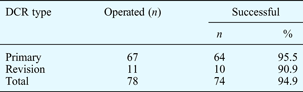
DCR = dacryocystorhinostomy
Five cases had lower lid oedema in the immediate post-operative period, which subsided within 24 hours. Two cases had bleeding from the lower punctum in the immediate post-operative period, which ceased within approximately 2 hours of surgery.
Discussion
It is now a known and accepted fact that DCR is the treatment of choice for chronic dacryocystitis. This procedure can be performed via the external or the endoscopic endonasal approach.Reference Hartikainen, Antila, Varpula, Puukka, Seppa and Grenman13 Endonasal DCR has well known advantages in that it avoids external scarring, division of the medial canthal ligament and disruption of the pump action of the lacrimal sac. It has minimal morbidity and less risk of intra-operative bleeding. It also enables direct access to the rhinostomy site, reducing tissue injury. It can also be performed during acute dacryocystitis as it has a shorter operating time and an easy access route.Reference Whittet, Shun-Shin and Awdry14–Reference Eloy, Bertrand, Martinez, Hoebeke, Watelet and Jamart16
However, there has been a concern that endonasal DCR may not have the same success rate as external DCR.Reference Hartikainen, Puukka, Seppa and Grenman17 This has been attributed to such factors as difficulty in identifying the sac intranasally, incomplete bone removal, insufficient exposure and inadequate opening of the sac; in contrast, the high success rate of external DCR is attributed to complete bone removal medial to the sac, and complete anastomosis of the sac wall to the nasal mucosa.Reference Wormald5, Reference Wormald, Kew and Van Hasselt18
An endoilluminator light probe passed through the punctum is often used to identify the sac intraoperatively.Reference Cokkeser, Evereklioglu and Er19, Reference Onerci, Kountakis, Jacobs and Gospath20 We did not use this method, relying instead on the anatomical position of the sac, which is fairly constant. The major portion of the sac is situated above and anterior to the attachment of the middle turbinate. The sac extends from approximately 8.8 mm above to 4.1 mm below the attachment of the middle turbinate.Reference Wormald, Kew and Van Hasselt18 Removal of the thin lacrimal bone which consistently lies anterior to the uncinate process exposes the posteromedial part of the lacrimal sac and the adjoining upper part of the duct. The rest of the sac can then be exposed by removing the frontal process of the maxilla anterior and superior to the attachment of the middle turbinate.
Various methods of bone removal have been described, including lasers, powered microdrills and ‘cold steel’ instruments (either Kerrison's punches or a hammer and chisel).Reference Wormald5, Reference Cokkeser, Evereklioglu and Er19 The part of the bone adjacent to the sac, above the level of the middle turbinate attachment, is very thick and must be removed adequately. This can be achieved by the use of a powered drill or chisel.Reference Wormald5 Lasers are expensive, requiring special training and have lower success rates.Reference Metson, Woog and Puliafito21, Reference Bartley22
We used cold steel instruments for bone removal. A ball probe was used to remove the thin lacrimal bone in the lower part; Kerrison's straight and curved punches were then used to remove the ascending process of the maxilla up to the attachment of the middle turbinate. As the bone became thicker, an osteotome and hammer were used to create a large bony opening until the sac was completely exposed. In our series, pneumatised agger nasi was encountered in eight cases (10.2 per cent). The sac was then incised with a keratome. Anterior and posterior flaps, created to lay open the sac completely, were then approximated to the nasal mucosa. This aided healing by primary intention between the sac and nasal mucosa.Reference Wormald5
We identified the common canaliculus in all cases by lacrimal probing following the opening of the sac and creation of mucosal flaps. Identification of the common canaliculus by probing is an important step and serves as a guide for adequate sac exposure, as two-thirds of the sac lies below the common canaliculus.Reference Wormald5 The lower incision has often been defined at the level of the midpoint of the middle turbinate.Reference Wormald5 In our series, the lower incision was made just above the attachment of the inferior turbinate. This ensured complete exposure of the sac wall, including its lower limit at the junction of the nasolacrimal duct, helping to avoid sump syndrome.Reference Onerci, Kountakis, Jacobs and Gospath20
In addition to DCR, many surgeons use adjunctive procedures.
Application of antimitotic agents (e.g. mitomycin C and 5-fluorouracil) has been used to prevent fibrosis and closure of the lacrimal sac ostia.Reference Zilelioglu, Ugurbas, Anadolu, Akiner and Akturk12
Silicone tube stents are often routinely used, with success rates of 85 to 99 per cent.Reference Wormald5, Reference Hartikainen, Puukka, Seppa and Grenman17, Reference Cokkeser, Evereklioglu and Er19 However, the disadvantages associated with silicone intubation include chronic infection, peripunctal granulation, canalicular laceration, granuloma formation in the nasal cavity, lacrimal punctal adhesions, corneal irritation, intranasal discomfort and increased operating costs.Reference Onerci, Kountakis, Jacobs and Gospath20, Reference Allen and Berlin23–Reference Brookes and Oliver26 Liao et al. Reference Liao, Kao, Tseng, Chen and Hou27 have advocated routine stenting as well as mitomycin C application, reporting a success rate of 95.5 per cent for external DCR.
• Endonasal dacryocystorhinostomy (DCR) is often performed together with adjunctive techniques (e.g. bicanalicular silicone stenting)
• In this study, 78 DCRs were performed (67 primary and 11 revision), with a success rate of 94.9 per cent overall and 90.9 per cent for revision cases
• The procedures were performed using conventional ‘cold steel’ instruments, without adjunctive techniques, maintaining meticulous surgical technique (including complete exposure of the lacrimal sac and creation of mucosal flaps)
In our study, we used neither of these techniques to prevent stenosis of the stoma, and we achieved a total mean success rate of 94.9 per cent. Even our revision cases had a success rate of 90.9 per cent, without the use of stents. Earlier studies have recommended silicone intubation in cases involving common canalicular scarring, a large valve of Rosenmuller (formed at the junction of the common canaliculus and the lacrimal sac), and a small, contracted or scarred lacrimal sac.Reference Allen and Berlin23, Reference Jokinen and Karja28 In our centre, silicone stenting is performed in cases with presaccal obstruction; such cases were excluded from the present study. Reserving the use of stents for indicated cases only, thereby avoiding routine use in all DCR cases, can help avoid the associated extra cost and complications. However, more randomised controlled studies are required to evaluate the indications for bicanalicular stenting.
The common causes for endonasal DCR failure are: a small bony ostium; scarring and granuloma formation at the rhinostomy site; creation of a small rhinostomy; sump syndrome; and development of adhesions between the middle turbinate and the lateral wall.Reference Welham and Wulc29 Of the 11 revision cases in our study, we observed that six had inadequate bone removal (with small and/or low rhinostomies), three had thick sac walls, and one had a completely intact bony covering of the lacrimal sac (probably due to non-identification of the sac during previous surgery, or subsequent bony regrowth). Our one failed revision case had a small and severely fibrosed sac, the patient having had symptoms for nine years. Three of our failed cases underwent revision surgery but were not included in this study due to insufficient follow up.
We did not observe any major complications other than lower lid oedema and bleeding from the lower punctum. Other reported complications include sump syndrome (when the rhinostomy is high), haemorrhage, adhesions between the traumatised nasal surfaces and, rarely, damage to the lamina papyracea.Reference Onerci, Kountakis, Jacobs and Gospath20
The uncinate process limits the posterior extent of the sac and is a reliable and safe landmark (see Figure 1).Reference Onerci, Kountakis, Jacobs and Gospath20, Reference Tsirbas and Wormald30 The uncinate process was not removed or damaged in any of our cases. This prevented complications such as damage to the lamina papyracea (with ensuing prolapse of orbital fat), and also avoided the occurrence of adhesions between the middle turbinate and the lateral wall.
Endoscopic photograph of the stoma three months after surgery. CC = common canaliculus; L = marsupialised lacrimal sac; UP = uncinate process; MT = middle turbinate

Conclusion
Endonasal DCR success rates are comparable to those of external DCR when there is complete sac exposure, adequate bone removal, and good lacrimal and nasal mucosal apposition. Comprehensive knowledge of regional anatomy facilitates sac identification and exposure, even without the use of special instruments. Meticulous surgical technique can ensure high success rates with the use of conventional cold steel instruments alone, without the use of any adjunctive procedures, making endonasal DCR cost-effective and reliable even in revision cases. The routine use of stents can be avoided, being reserved only for indicated cases, in order to prevent stent-related complications.