Chest pain is a common cause of admissions in paediatric outpatient clinics and paediatric emergency departments. Most studies in the literature have shown that chest pain usually results from non-cardiac aetiologies in healthy children. Specifically, psychogenic chest pain is frequent among adolescents. Reference Aygun, Aygun, Uysal, Aygun, Dursun and Irdem1-Reference Anwar and Kavey3 News of deaths at young ages caused by cardiac pathologies and family members suffering from cardiac problems are common sources of concern for patients and their families as well as most medical practitioners, making this one of the most common reasons for cardiology consultations.
Exercise stress tests are often planned for children with non-specific chest pain in order to distinguish cardiac pathologies, treadmill testing being the most convenient form in children. Reference Anwar and Kavey3 We have often observed that successful completion of treadmill testing, besides exclusion of potential cardiac pathologies, helps children appreciate their own effort capacity and promotes their sense of well-being.
Reassurance of these patients and their families plays a key role in the management of non-cardiac chest pain. Reference Shaddy4 Nonetheless, there are no sufficient data to provide scientific basis for this approach. We aimed to investigate whether negative treadmill testing and reassurance from cardiology professionals help relieve these children’s anxiety. To the best of our knowledge, our study is the first to provide quantitative data for the reassuring effect of negative treadmill testing.
Method
This study was designed as a prospective cohort study and approved by the institutional ethical board (No: 2022/7). We studied 50 children (aged 11.8 ± 3.0 years, range 7–17 years; 24 females, 26 males) admitted to our outpatient clinics with a chief complaint of non-specific chest pain between 09 March, 2022 and 01 August, 2022. All subjects had negative history for chronic diseases, drug use, or additional complaints related to any other organ systems. Physical examination, electrocardiographic, and echocardiographic evaluations were also negative and treadmill testing was planned. Patients were asked to fill Revised Children’s Depression and Anxiety Scale before treadmill testing.
After filling in Revised Children’’s Anxiety and Depression Scale, patients were taken to treadmill testing under the supervision of a specialist doctor and technician. Treadmill testing was done with the standard Bruce protocol and a standard instrument (Schiller Cardiovit CS-200 Excellence, CH). Patients with any organic cause for chest pain, arrhythmias or need for further imaging or treatment were excluded from the study. Treadmill testing was successfully completed without any findings in 50 patients. These patients were informed that cardiac evaluation was completely normal; 1–7 days after these sessions, they were asked to fill the Revised Children’’s Depression and Anxiety Scale again.
All data were statistically analysed with SPSS version 22.0. Distribution of basic depression and anxiety points before and after treadmill testing was tested for normal distribution by Shapiro–Wilk test. Only social phobia points were normally distributed (p > 0.05), and paired t-test results were interpreted. For other subgroups with anxiety disorders, non-parametrical tests were investigated by the Wilcoxon test.
Results
Girls were significantly older than boys (p < 0.05). Average points for depression and anxiety scales/subscales before and after treadmill testing are summarised in Table 1. Total anxiety and total anxiety + depression points were significantly lower after as compared to before treadmill testing (p < 0.05) (Fig 1). Scores for separation anxiety, panic, social phobia, or obsessive-compulsive disorder were not significantly different (p > 0.05) (Table 1).
Total anxiety and total anxiety + depression scores decrease significantly after treadmill testing.

Average points for depression and anxiety scale/subscales

* Paired t-test was interpreted for social phobia; z-values were obtained by Wilcoxon test in other subgroups.
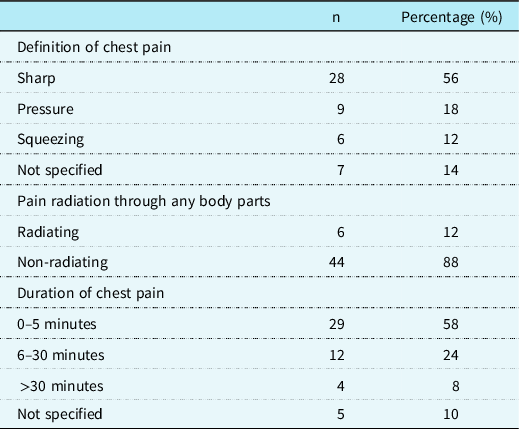
Table 2 demonstrates the characteristics of chest pain in our study group. Most of our patients had experienced sharp, non-radiating chest pain of short duration, referring to idiopathic or musculoskeletal chest pain.
Characteristics of chest pain in our study group

During the initial Revised Children’’s Anxiety and Depression Scale evaluation, eight patients (16%) had high anxiety scores and nine patients (18%) had high anxiety and depression scores. These patients did not respond to reassurance after treadmill testing and were referred for psychiatric evaluation. Mean age of children with high scores was 13 ± 2.26 and 75 % of them were girls.
Discussion
Revised Children’s Depression and Anxiety Scale was first designed in 2000 by Chorpita and colleagues to assess anxiety and depression symptoms in children. Reference Chorpita, Yim, Moffitt, Umemoto and Francis5 It is a 47-question survey with answers 0 to 3: 0 = never, 1 = sometimes, 2 = often and 3 = always. Revised Children’’s Depression and Anxiety Scale was adapted to Turkish language and validation studies were done by Gormez et al. in 2017. Reference Gormez, Kilincaslan and Orengul6 Revised Children’’s Depression and Anxiety Scale has a Cronbach’s alpha value of 0.86 for major depressive disorder and 0.75–0.85 for anxiety disorders subtypes.
Patients of all ages feel concerned when they experience any complaint possibly related to heart diseases. Rohani et al. investigated 250 adults before exercise stress test and found 42% had anxiety symptoms and 31% had depressive symptoms. Reference Rohani, Akbari and Zarei7
Many studies in the literature demonstrate that children rarely have cardiac condition-related chest pain. Evangelista et al. investigated 50 patients between ages 5 and 21 and found 76% of them had musculoskeletal pain, 12% exercise-induced asthma, 8% gastrointestinal problems and 4% psychogenic chest pain. Reference Evangelista, Parsons and Renneburg8 Percentage of psychogenic chest pain among children seems to differ in similar studies. For instance, Pissarra et al. retrospectively investigated 798 children admitted to emergency departments with chest pain and found 21.6 % had psychogenic chest pain. Female gender, adolescent age, positive family history, previous stressful event, and normal physical examination were significantly related with psychogenic chest pain. Reference Pissarra, Pereira, Amorim, Neto, Lourenço and Santos9 Similarly, in a recent study, 352 children with chest pain admitted to the paediatric emergency department were thoroughly investigated and 9.3 % were found to be psychogenic. Similar to our study group, most of their patients described their chest pain as sharp, like stabbing (59.9%) or as pressure (27.2%). Reference Yildirimcakar, Omay and Açar10 Lipsitz et al. found psychogenic aetiologies in 56%, whereas Tunaoglu et al. found 75% in their studies. Reference Lipsitz, Masia and Apfel11,Reference Tunaoglu, Olgunturk, Akcabay, Oguz, Gucuyener and Demirsoy12 A review by McDonnell showed psychogenic causes in 2–19% of children with chest pain. Reference McDonnell, White and Grady13 Another study showed that 20.5 % of children with chest pain had panic disorders, and anxiety and depressive symptoms were common comorbidities. Reference Milov and Kantor14 In a recent study, Aygun et al. reported psychogenic aetiologies in 28% of 782 children with chest pain. Reference Aygun, Aygun, Uysal, Aygun, Dursun and Irdem1
It is reasonable to think that the type of the study centre (emergency department or outpatient clinic) can affect percentage of psychogenic chest pain. It seems likely that higher numbers of psychogenic chest pain patients were seen initially at the emergency departments and these patients were referred preferentially to psychiatrists. In the literature, cardiac aetiologies were found in 3% of such patients in emergency departments and in 6–7% in paediatric cardiology outpatient clinics. Reference Zavaras-Angelidou, Weinhouse and Nelson15-17
It is easily observed that chest pain and psychogenic symptoms have a bidirectional relationship. Psychogenic symptoms can be somatised as chest pain, as chest pain can cause psychogenic symptoms like anxiety. Hiscock et al conducted a study in a third-level hospital emergency department to find out the reasons for families to bring their children to emergency department with anxiety and depressive symptoms. They reported most common reasons being hearing a medical opinion of trusted healthcare professionals, finding no alternative options, despair, ensuring the safety of their children, excluding a potential medical threat. Reference Hiscock, Connolly and Dunlop17 Lipsitz et al. found higher anxiety symptoms in children with non-cardiac chest pain than in the asymptomatic control group. Reference Lipsitz, Masia-Warner and Apfel2 In a study reporting considerably higher percentage of anxiety, Kenar et al compared 76 children with non-cardiac chest pain with 51 healthy volunteers and reported anxiety levels were significantly higher (79%) in the non-cardiac chest pain group. Reference Kenar, Orun, Yoldas, Kayali, Bodur and Karademir18 We found 16% (n:8) of our patients had anxiety symptoms and 18% (n:9) had anxiety + depression symptoms before treadmill testing. These give us enough reasons to underline offering psychogenic evaluation for selected cases.
We also observed a higher frequency of elevated anxiety and anxiety + depression scores in females. Six of 8 patients with anxiety and seven of nine patients with anxiety + depression were girls. Psychogenic chest pain seems to be more common among girls and adolescents in current literature. Reference Kenar, Orun, Yoldas, Kayali, Bodur and Karademir18
One of our limitations was not evaluating parents and families for their children’s anxiety. The parents or caregivers are also worried when children report heart-related complaints. Akrivopoulou et al. found high scores of anxiety among families even when they are referred to cardiologists for innocent murmurs. Reference Akrivopoulou, Gkentzi, Fouzas, Vervenioti, Dimitriou and Karatza19 They thought murmurs were indicative of a serious heart condition, 48% thought their children would be unable to participate in sports or make any physical activities. Reference Akrivopoulou, Gkentzi, Fouzas, Vervenioti, Dimitriou and Karatza19 Children with chest pain are often restricted from physical activities by their families or teachers. Reference Selbst, Ruddy, Clark, Henretig and Santulli20-Reference Kaden, Shenker and Gootman23 Even children themselves avoid forceful physical activities or change their behaviour accordingly. Lipsitz et al. demonstrated that children were restricted from climbing stairs, going to sleep, maintaining sleep, sports participation, and staying in school. Reference Lipsitz, Gur, Albano and Sherman21 Kaden et al. showed 44% of children developed behavioural changes like carrying a heavy backpack, fast walking, sports activities in children experiencing chest pain. Reference Kaden, Shenker and Gootman23 On the contrary, our study aims to show most of the time these behavioural changes are not necessary.
Most treadmill tests result normal in patients with non-specific chest pain. Anwar et al. reported 97.5% of exercise stress tests showed normal electrocardiographic monitorisation in children tested for various reasons, most commonly chest pain. Reference Anwar and Kavey3
It is noteworthy that researchers reported different outcomes for chest pain in children. Some think that healthy and informed patients nonetheless feel emotional stress and anxiety, complaining about chest pain even 1–2 years after their negative cardiac evaluation. Reference Anwar and Kavey3 Another study showed that patients applied to different departments, even different hospitals, if they experienced unexplained chest pain. Reference Pantell and Goodman24 We evaluated our patients with Revised Children’’s Depression and Anxiety Scale with 1–7 days intervals. Further studies may focus on periodic re-evaluations in larger patient populations.
In our study, children were able to observe their own effort capacity in a trusted environment, under supervision of healthcare professionals, feeling safe and comforted by reassurance. We also believe that exclusion of possible heart diseases may have helped significantly relieve the anxiety. To the best of our knowledge, this is the first study in the literature.
Conclusion
Chest pain is a common yet concerning complaint in children. Its management consists of exclusion of organic cardiac causes and reassurance of patients and their families. We showed quantitatively that successful completion of treadmill testing relieves anxiety and helps reassure children with chest pain.
Acknowledgements
None.
Financial support
This research received no specific grant from any funding agency, commercial or not-for-profit sectors.
Conflict of interest
None.
Ethical standards
All of the patients and their families signed a consent form for their data being used for scientific purposes. The authors assert that all procedures contributing to this work comply with the ethical standards of the relevant national guidelines on human experimentation and with the Helsinki Declaration of 1975, as revised in 2008.