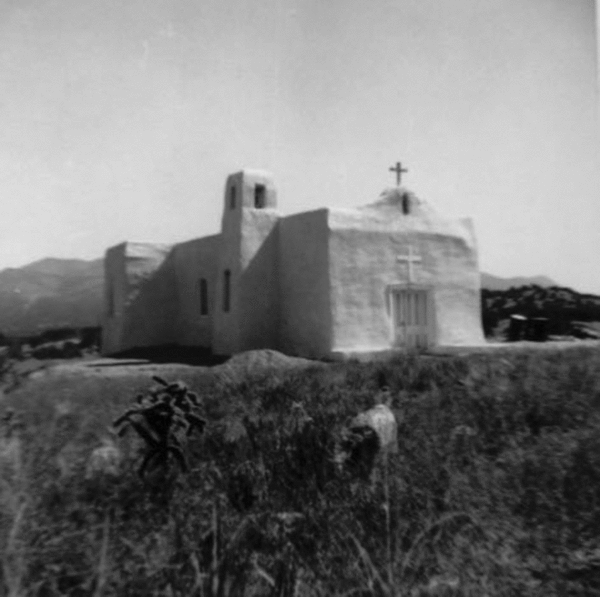
In the summer of 1924, townspeople recount, 14-year-old Manuel Chávez built models of colonial New Mexico mission churches in the dirt outside Our Lady of Guadalupe Church in the village of Peña Blanca.Footnote 1 He was staying with the Franciscan friars after expressing his desire to enter the seminary, where he would become the first native New Mexico Hispano to be ordained a Franciscan priest in the centuries since the Spanish colonization. Still a boy, but one who was about to embark on a life-changing path, the small missions he playfully constructed in the dirt and staunchly protected foretold the strategy of rematerialization that would characterize his future: he would become a pioneering Franciscan historian who organized and interpreted the vast collection of Catholic Church documents from the colonial period in New Mexico through the twentieth century. The author of two dozen books and over 600 shorter works, Fray Angélico Chávez (1910–1996) was a visual artist, literary figure, historian, genealogist, translator, and church restorer—one of New Mexico's foremost twentieth-century intellectuals.Footnote 2
While written texts are key to the reconstruction of history and the chief mode of dissemination and preservation of historical findings, Fray Angélico's historiography crucially involved strategies for rematerializing New Mexico history. As he created a robust written record of that narrative, he also embodied it materially, as a strategy of reenactment. As a twentieth-century scholar, he could not physically return to the colonial period, but he could and did engage in practices of reconstruction that increased understanding of the past and helped to preserve it for the future—he gave it a visual material presence beyond the historical narrative.
This crucial component of Fray Angélico's historical scholarship is rooted in early childhood experiences that introduced him to Franciscanism and the history of the colonial Southwest. From May 1911 to December 1914 he lived in San Diego, where his father worked as a foreman and carpenter on the Panama California Exposition that opened there in 1915. He visited Mission San Diego de Alcalá, the first of the California missions, built in 1769, and learned about Fray Junípero Serra. His family recounted that the precocious four-year-old would wander the streets reading the street signs. He may also have seen several of the artistic reconstructions of New Mexico history being built for the exposition: the reproductions of the 1629 Franciscan mission at Ácoma and the Taos Pueblo building, Carlos Vierra painting his large murals in the Mayan Cities cycle, scenes of Santa Fe by Vierra and Chapman, the 14 oil paintings of the missions of New Mexico by Vierra, and Gerald Cassidy's murals in the California Building, later awarded an exposition gold medal. These material representations of New Mexico history and its key Franciscan component helped to shape Chávez's scholarly interest in the subject and his historiographic strategy of rematerialization.
Back in New Mexico, he excelled in school, in part because of having learned English in San Diego. Now he saw other rematerializations of the colonial period that greatly affected him. Unlike the prolific contemporary historian Marc Simmons, who for decades has lived in an adobe house near Cerrillos, New Mexico, without electricity or modern heat as one mode of experiencing some of what the colonial inhabitants underwent, Chávez's family did not have to recreate such living conditions. In later life, he remembered the extremely cold winters in Mora, New Mexico, the scarcity of food, and the difficulties of drawing water from the well and using the outhouse in winter. “Growing up like that taught me a lot about the Spanish people who had settled the land originally. They were truly a penitente people. They lived in a penitente land, and hardships were a way of life.”Footnote 3
During summers spent in Santa Fe with an aunt and uncle, the young Chávez witnessed the public's excitement at the opening of the new Museum of Fine Arts in 1917, modeled in part on the church and convent at Ácoma and in part on the church at Laguna Pueblo. The mural cycle in the museum's St. Francis Auditorium would become a model for murals Chávez would later paint in his parish church. Between 1919 and 1922, La Fonda Hotel was rebuilt in Pueblo style in the center of town, and during that period, he witnessed the return of the Franciscans to New Mexico and to St. Francis Cathedral, beginning with the naming of Franciscan Albert Daeger as archbishop in May 1919. “So when I used to come to Mass and I'd see [the friars] dressed like that, I'd say, ‘Oh, here they are.’ But I didn't say anything to them until I was ready to go [to the seminary],” Chávez explained, noting that the material presence of the Franciscans in New Mexico at that time influenced his life's vocation and work.Footnote 4
Reasserting Hispano Ethnicity as a Franciscan-in-Training
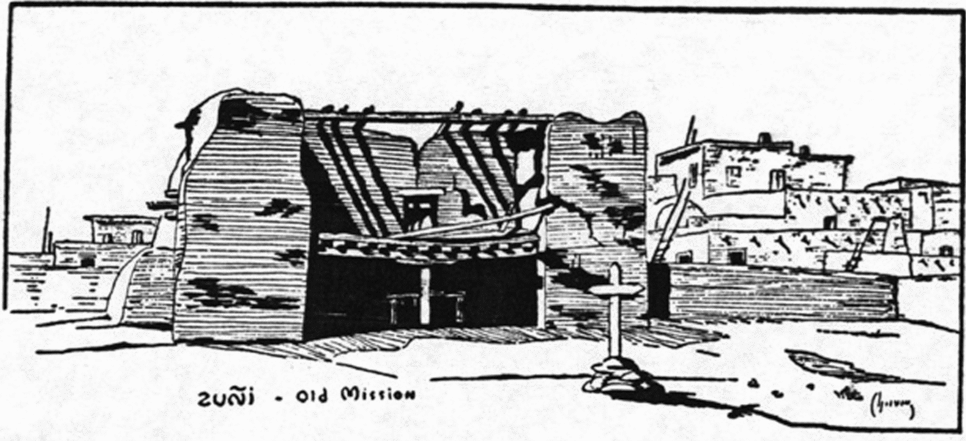
After a momentous cross-country train trip, accompanied by the new Franciscan archbishop Albert Daeger, the young Manuel entered St. Francis Seraphic Seminary in Cincinnati in 1924, and continued his religious training for the next 13 years at Mt. Airy Novitiate in Cincinnati and at Duns Scotus College in Detroit. During his time in the high school seminary in Cincinnati, Chávez engaged in early strategies of rematerialization as a means of asserting his ethnicity and overcoming homesickness. He expressed his artistic talent by painting scenes of the Southwest that he gave to friends and relatives and drawing pen-and-ink illustrations to accompany the poems, stories, and articles he wrote. The 14-year-old boy had made models of the New Mexico missions out of dirt in Peña Blanca, and the seminarian now drew images of them for calendars, articles, and other publications. His early attempts at writing about New Mexico history in the seminary were often augmented with images he created, for example, the ten drawings of New Mexico's Franciscan missions for his 1934 article “Old Missions in New Mexico” and a drawing of the old mission at Zuni for a 1931 Franciscan calendar (Figure 1).Footnote 5 When he playfully painted the face of Dolores del Rio on a portrait of St. Anthony he was asked to retouch in the seminary, he was not merely joking but also conjoining the important Franciscan historical figure with the famous Mexican film star as a way of asserting his ethnicity in the Midwestern seminary, which was steeped in Germanic culture.
Fray Angélico Chávez, Pen-and-Ink Drawing of Zuni Mission, 1930

When Chávez entered the Mt. Airy novitiate in 1929, taking on the Franciscan habit, undergoing tonsure, and assuming a religious name, he substantively placed himself into the history of the Southwest as a Franciscan who would later write the narrative of the history in which he was now participating. He included in his religious name the antiquated title “Fray,” thereby becoming Fray Angélico Chávez; his name itself signaled a strong material marker of the centuries-old presence of the religious order in Southwestern history. Although the religious garb had changed color since the colonial period, donning it nonetheless materially inserted him into that history. The poems, fiction, and essays he wrote throughout his years of religious training included abundant references to Southwestern history, although sometimes errors appeared. This period, along with his first five years of work as a missionary priest in northern New Mexico after his 1937 ordination, saw a blossoming of his creative talents as an artist and a writer of fiction, poetry, drama, essays and spiritual tracts. He would bring these multiple talents to the serious historical work he began in earnest after returning from World War II in 1945.
After completing the novitiate, Chávez continued to exercise his creative talents at Duns Scotus College in Detroit. In 1931 he was author, costume and set designer, lead, narrator, and solo singer in the play The Beloved Crusader, which the college staged to recognize the 700th anniversary of the death of St. Anthony of Padua. Franciscan history from centuries ago came alive in this public performance, with Chávez's creative imprint on numerous aspects of the production.Footnote 6 His earlier transgressive alteration of the painting of St. Anthony in the seminary now blossomed into an expansive and dynamic portrayal of this key Franciscan saint, whom he recognized as linked with his own ancestors from the Iberian Peninsula. During this period he also wrote poems about Franciscan history, and his first novel, Guitars and Adobes, which recounted early New Mexico history. It was published serially in St. Anthony Messenger in 1931–32 under the pseudonym F. Chalmers Ayers.Footnote 7
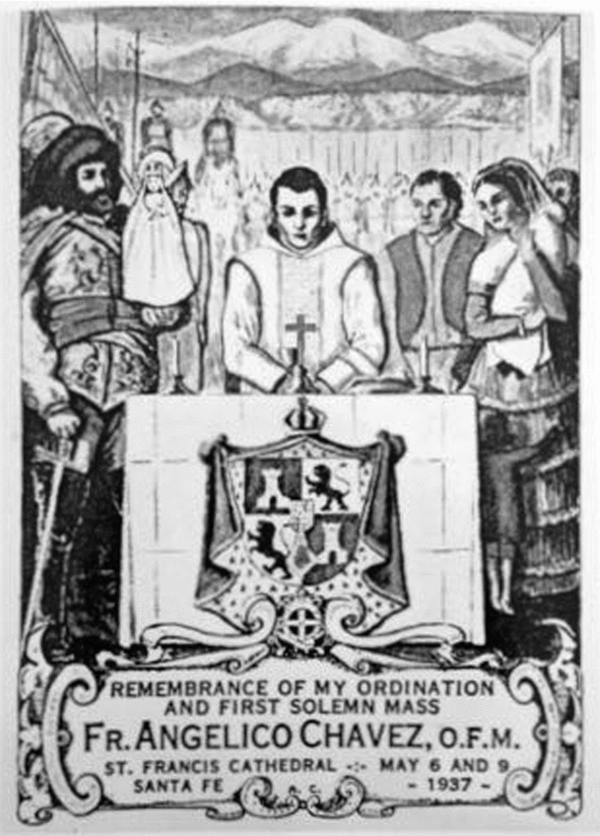
Chávez returned to New Mexico in May 1937 for his ordination at St. Francis Cathedral in Santa Fe. As befit the first native Hispano to become a Franciscan priest in the centuries of Hispanic presence in New Mexico, he painted a remembrance card for the occasion that materially located him within this history (see Figure 2).
Remembrance of My Ordination, by Fray Angélico Chávez, 1937
Using shades of brown to pay tribute to Franciscanism, he depicted the first Mass in Santa Fe after Diego de Vargas’s reconquest of the area in 1693. To the celebrant's right, as Chávez noted on the back of the card, Capitán Don Bernardino de Chávez holds the statue of La Conquistadora after the successful battle against the Indians. As the descendant of this soldier, and the first “spiritual descendant” of the Franciscan padres, Chávez superimposed an image of himself as celebrant of his first mass on that of the padre who said the first mass after the reconquest. He drew the Spanish royal coat of arms in the foreground, with soldiers holding the Spanish flag and the banner of Our Lady of Remedies on the right and left. Chávez wrote on the back: “On these days, in the Kingdom of the Royal City and Cathedral of St. Francis, he is raised to the holy priesthood.”Footnote 8
Having placed himself in the history of Spain and Franciscanism in New Mexico, Fray Angélico would continue that legacy for decades to come through his own Franciscan ministry as well as his work in church renovation, the revival of past traditions and material religious culture, the documentation and writing of history, and continuing artistic and literary creation.
Church Preservation and Franciscan Reenactment
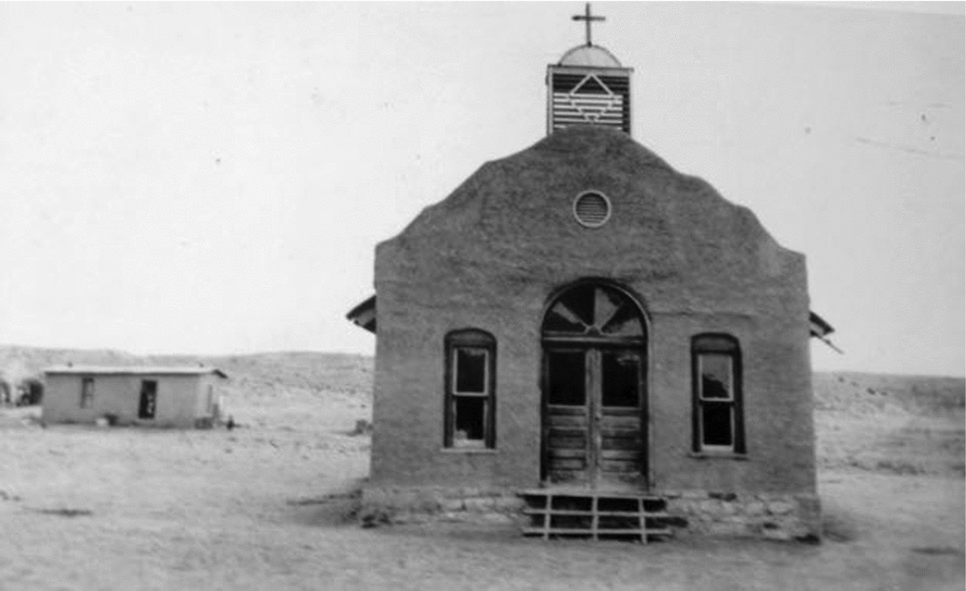
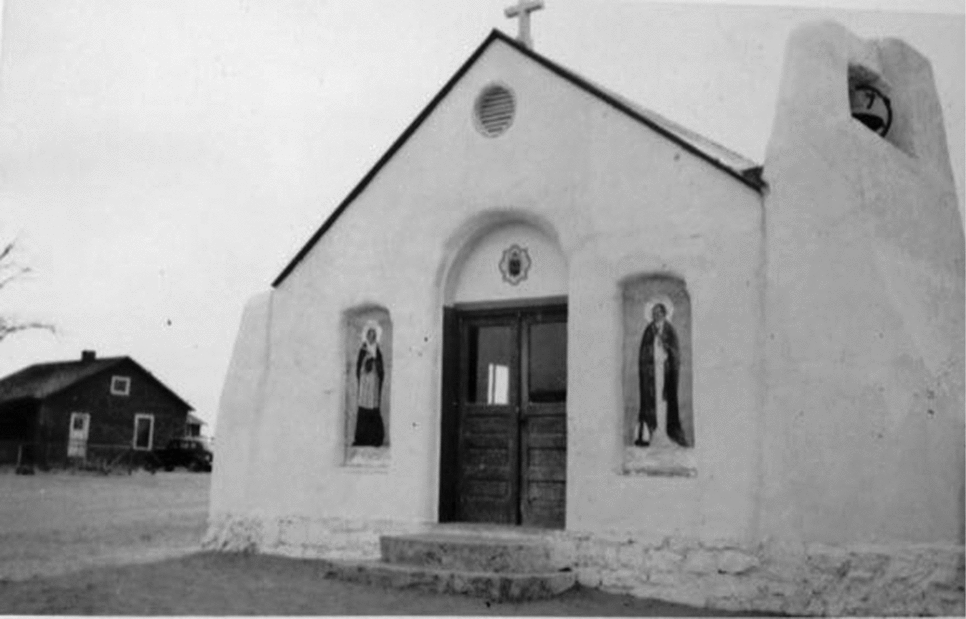
His first assignment after ordination was as a missionary at Peña Blanca, ministering to the Hispano and Native American peoples. But Chávez was not satisfied with ordinary ministry: he wanted to relive and rematerialize Franciscan history. He began immediately to renovate local churches, following St. Francis's example and the work of the early Franciscans in building the simple chapels in the far northern reaches of ‘La Nueva México.’ He renovated the deteriorating nineteenth-century chapel at Domingo Station and the church at Peña Blanca, painting large murals with the faces of his mentors, Franciscan archbishop Albert Daeger (who built the original chapel at Domingo Station) and Father Jerome Hesse. Figure 3 shows the church before Chávez's renovation; Figure 4 shows the renovation.
Chapel of Santa Dorotea, Domingo Station, New Mexico, Before Renovation
Chapel of Santa Dorotea, Domingo Station, After Renovation, with Mural Paintings by Fray Angélico Chávez, 1938
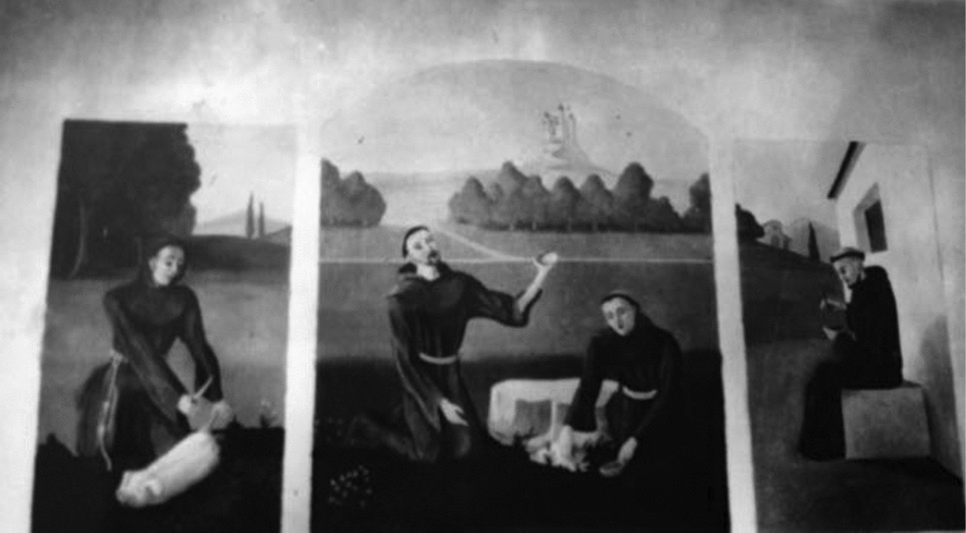
In 1938 in the refectory at Peña Blanca he executed a stunning set of murals of the life of St. Francis, modeled on the Carlos Vierra paintings in St. Francis Auditorium of the Santa Fe Museum of Art (see Figure 5).
Brother Juniper, Francis and Masseo, [and] Francis from the Life of St. Francis Mural Cycle, by Fray Angélico Chávez, Peña Blanca Refectory, New Mexico, 1938
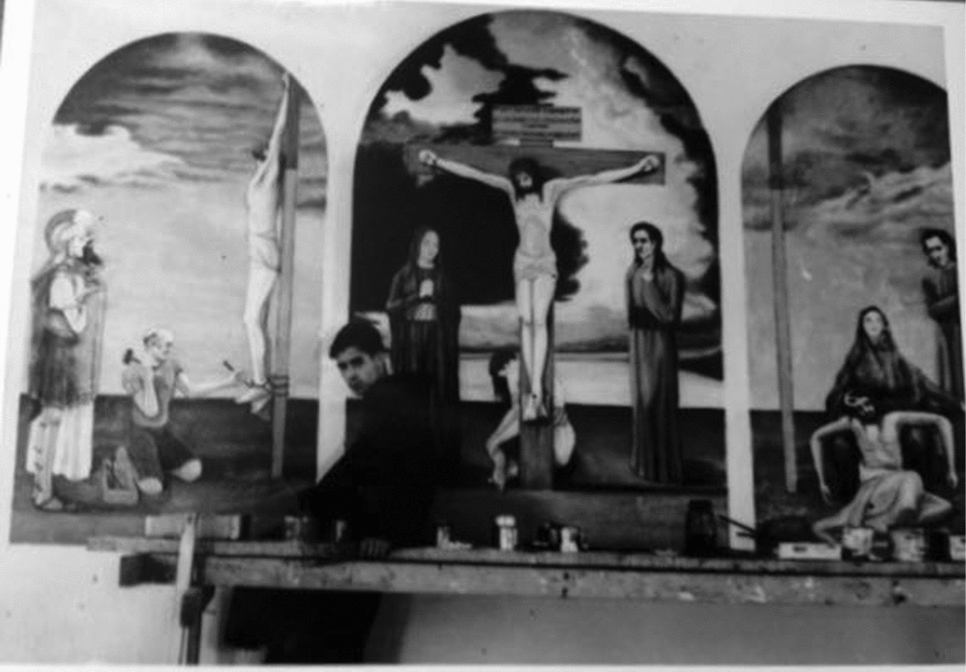
Next, he painted stunning life-size murals of the Stations of the Cross in triptychs inside the church at Peña Blanca, integrating the faces of the local townspeople into the visual narrative of the Passion (Figure 6).
Fray Angélico Chávez in Front of the Crucifixion Triptych, Our Lady of Guadalupe Church, Peña Blanca, 1939
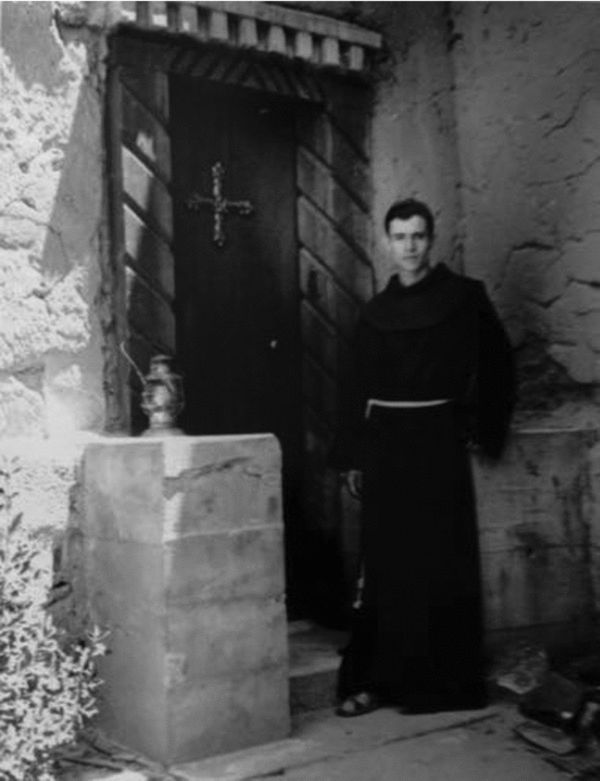
As if these laborious interventions into the preservation and reenactment of Franciscan history and biblical narratives were not enough, Chávez wrote and illustrated a book of fiction centered on the motif of a triptych of retablos, paralleling the huge murals he was painting in triptych form at the time in the Peña Blanca church. His creativity, spirituality, and historical recuperation were “all of a piece,” as his friend, the poet John Gould Fletcher, wrote to him in a letter.Footnote 9 Inspired though Fray Angélico was, this extra renovation work in addition to his full-time ministry was laborious and physically demanding. He completely rebuilt the façade of the 1869 church in Peña Blanca, adding niches for the bells, and carved new wood frames for the windows and doors. In Figure 7, he stands in front of one of these doors.
Fray Angélico Chávez at North Transept Door, Our Lady Of Guadalupe Church, Peña Blanca, 1941
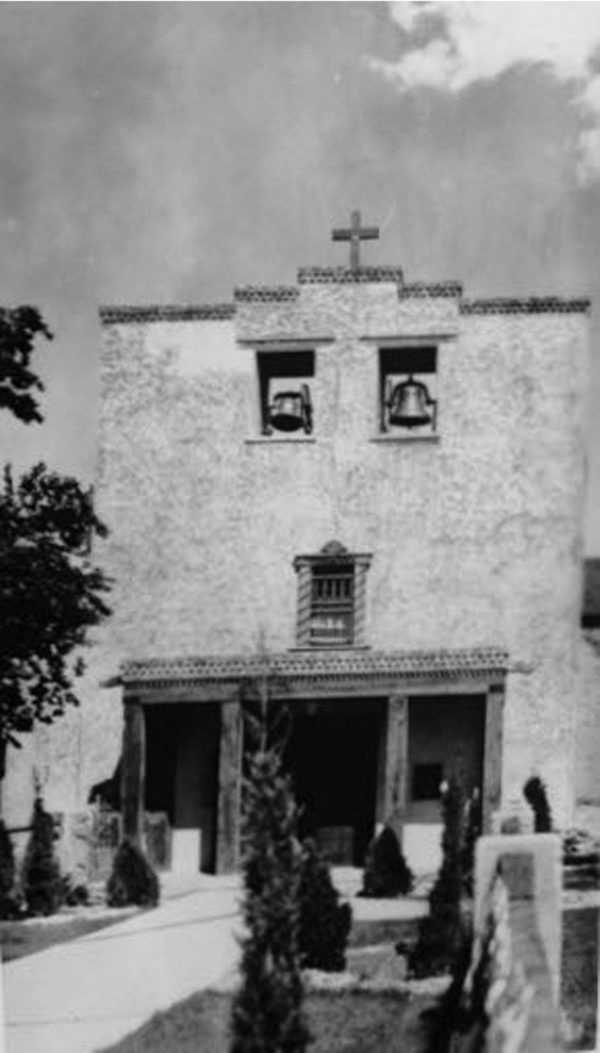
He next remodeled the portico to match the top of the new façade (Figure 8), noting in a March 1941 letter that the end of the renovations was not in sight since he was “working alone and penniless.” He did, however, receive assistance from several townspeople. A few helped him install a new door in the north transept along with wood posts he had decoratively carved.
Front Exterior of Our Lady of Guadalupe Church, Peña Blanca, after Renovation by Fray Angélico Chávez and Parish Members, 1941
We can imagine how hard this renovation work was as we read a letter Fray Angélico wrote in October 1941 after completing only half of the tall façade: “I cannot typewrite, and this pen is held by a rubber-gloved paw! My right hand is badly burned by cement and lime—result of my plastering the front of the church. I'm only half done as the rains . . . are holding me back. . . . Got a new pair of doors for the church front—12 panels and [I] hand-carved [them] all.” Following in the footsteps of his carpenter father, Fray Angélico carved the doors with images and words representing the Sacred Heart, the Virgin of Guadalupe, and the emblem of the Franciscan order. In the panels he carved symbols of 11 apostles, leaving one blank panel to represent Judas.Footnote 10
Revisionist Historian and Material Embodiments of the Past
Upon returning from military service at the Pacific Front in World War II, where he faced death with the other soldiers he ministered to as chaplain, he dedicated himself to work as a historian. With his service in the Pacific, Fray Angélico had undertaken a modern version of the early Franciscans’ journey across the Atlantic, sailing this time across a wider ocean on a troopship to minister to the spiritual needs of his countrymen as they engaged in battle. Perhaps because of this life-altering experience, Chávez sensed his place in history even more acutely, and began after the war to work steadily on researching and writing his groundbreaking histories of the Franciscans and the early Hispano population of New Mexico, once again while continuing to fulfill his full-time duties as a priest.
It is important to remember that Fray Angélico was an amateur dipping into a new field at this point, with no training in historiography. Perhaps it is precisely this lack of formal training in the field that nurtured and provided space for his multidimensional strategies of rematerialization as he began to construct new historical narratives. Asked in 1946 by the Franciscan provincial to investigate the history of the friar-martyrs of colonial New Mexico, Chávez began to organize the thousands of loose documents on which the centuries of Church history in New Spain were recorded. He was the first to employ these documents in recovering New Mexico history and wrote several revisionist articles correcting errors in previous writing about the period. Within a few months, “bitten by the documentary bug,” as Marc Simmons notes, Chávez told the provincial that he planned to write a full history of the Franciscan Custody of the Conversion of St. Paul in New Mexico from 1539 to 1925. His research would include checking all extant publications for errors in translation and interpretation and reviewing the unpublished manuscripts and the old parish registers in the archives and those scattered around the diocese. He envisioned that it would take him as long as 15 years to complete such a monumental task.Footnote 11
Instead of completing that project, however, his documentary research led him to new areas of interest and new trajectories that had little to do with the provincial's initial request. Intent on his work, he lived as a hermit, foregoing visits with colleagues and his summer fishing trips and working long hours into the night on documents that he sneaked into his room from the archives, a few at a time. He told the provincial that he was spending more time on this research than a pastor did on ministry and parish work. His dedication and tireless double duty over the next five decades led him to a prolific career as a historian.
After an initial series of articles about his new findings on the colonial period, Chávez applied his material experience of church renovation and his developing skills as a historian to correct errors about the first two churches of Santa Fe. In 1949 he documented the three sites occupied by the Santa Fe parroquia in the seventeenth and early eighteenth centuries, using previously unexamined records to show the relative positions of the three church-convent layouts and correcting errors about the location of the first church in Santa Fe. He drew figures to show the three locations relative to the present-day Cathedral of St. Francis. In a 1953 article, he showed that San Miguel chapel was built in 1610 but did not completely burn in the Pueblo Revolt of 1680; therefore, it should be considered the oldest church in the United States.Footnote 12
As Fray Angélico organized the centuries of Church documents, he made notes on index cards, and from these notes he developed many historical projects. One of the most important is Origins of New Mexico Families, a monumental book of New Mexico family names going back to colonial times, still in print today and widely read. But how would an encyclopedic catalogue of Hispano names give fellow New Mexicans a sense of their ancestors’ material presence in the northern reaches of New Spain? Fray Angélico commissioned his good friend in El Paso, the artist José Cisneros, to create images that would make the book more appealing, among them illustrations of Oñate and Diego de Vargas and special art and lettering for the title page. In letters to Cisneros, he described in detail how he wanted the two conquistadores to look—Oñate was to be on horseback, next to a friar without a beard, and a soldier with his wife. De Vargas and a friar would be gazing at a standard with the image of the Virgen de los Remedios. The Chávez coat of arms was to be at the center of the title page. He sent Cisneros photos of himself and his father and mother to copy into the faces of the figures in the drawings. Here he carried forward an inspiration from his previous work in recreating church history at Peña Blanca, where he had taken pictures of the townspeople and integrated them into the immense Via Crucis he painted on the walls of the church he had renovated there. Now, Origins of New Mexico Families would have a more attractive format that integrated readers visually into history and their ancestors’ material presence in New Mexico.Footnote 13
A second major project arose from Chávez's early work in making thousands of large index cards to organize the loose Catholic Church documents. La Conquistadora: Autobiography of an Ancient Statue and Origins of New Mexico Families are companion books written in 1953 like two siblings branching out from a common research root and paternity in the early pioneers in New Mexico. In writing these books, Chávez did intricate and persistent detective work to unearth and then connect various references in the archdiocesan document. He personified the statue of La Conquistadora as a paisana, or family member, of the immense clan of New Mexico Hispanos. Here again, his groundbreaking discoveries are rooted in his practices of rematerialization of history.
In the late 1940s, Chávez had begun research that would lead to authenticating the origins of the 325-year-old statue of La Conquistadora and its cofradía in colonial Santa Fe, discovering along the way that one of his ancestors had been a mayordomo of the confraternity. Fray Angélico sent a sliver of the statue's wood to a scientist who determined it was willow. Chávez was also able to date the statue's presence in New Mexico to 1625 by comparing the dimensions of a packing case that Fray Alonso de Benavides had brought with him to Santa Fe to the dimensions of the statue. The statue had come to the Santa Fe parroquia as a depiction of Our Lady of the Assumption, but over the next 30 years became Our Lady of the Rosary. Chávez personified the statue of La Conquistadora as one of the immense clan of New Mexico Hispanos. From church records, he documented the garments and physical appearance of the statue throughout its history, and then rematerialized this history by inviting local women to carry on the tradition by designing and sewing new dresses and capes for the statue, based on the original style of the clothing noted in the documents he had found. The groundbreaking articles he published on the statue were published in book form soon thereafter.Footnote 14
Chávez's hands-on involvement with La Conquistadora—taking wood samples, designing the statue's wardrobe, reviving the cofradía, working with artist Gustave Bauman to make a replica of the valuable historical artifact, and planning a pilgrimage with the statue for the Marian year 1954—resulted in a strong personal identification with the revered image. In his second book on the subject, the 1954 La Conquistadora: Autobiography of an Ancient Statue, he literally assumed the statue's identity, using an innovative narrative technique to recount 325 years of New Mexico history through her ancient eyes. This alternate materialization of the statue as a speaking subject who imparts historical wisdom under the guise of an autobiography is a creative reconfiguration of traditional historiography that Fray Angélico developed to entertain and draw readers to the new historical knowledge he had uncovered. He would carry this narratorial illusion one step further in 1954 when he drove the statue in a convertible on an 11,000 mile pilgrimage to every parish in New Mexico; with a humorous flourish, he reported, “There was no audible back-seat driving!”Footnote 15
From his research, Chávez learned that devotional societies in colonial Santa Fe had been allowed to raise money once a year by taking out La Conquistadora and another statue in the military chapel, Our Lady of Light, and leaving the statues overnight in various people's homes. This is likely to have inspired Chávez's 1956 revival of the cofradía to raise funds for the renovation of the Lady Chapel in the cathedral of St. Francis. He succeeded in raising $4,000 and completely redesigned the centuries-old chapel, building a new altar screen for the statue's “throne” and making a new pedestal covered in bronze paint and Spanish rococo molding to replace the pedestal that had been cut off to fit the statue into a niche. He also obtained donations of jewelry and holy objects for the statue. Sadly, after all these efforts he found himself hurt and discouraged when he was not invited to participate in the papal coronation ceremony after the renovations.Footnote 16
During the cathedral renovations in 1957, Fray Angélico opened an abandoned tomb behind the sanctuary and discovered the remains of two Franciscan priests who had died in the mid-seventeenth century and were reburied in the cathedral a century later—another discovery significant to approaching the material culture of the colonial period. He took a piece of each of the Franciscan habits used to wrap the bones in the reburial and a section of the knotted cord they had been tied with, thus preserving the only known examples of the blue habits worn by eighteenth-century Franciscans. Chávez then moved the remains to a more prominent site in the renovated La Conquistadora Chapel, where the tomb is visible to the public. The recovery, preservation, and display of these material artifacts of New Mexico history led to two more publications about the discovery, one a scholarly piece and the other a revised version of his popular and meticulously researched booklet on the history of the cathedral. The latter was made available in the church for everyone.Footnote 17
Chávez continued rematerializing history metaphorically in a literary text he published in 1957, written as he was redesigning the altar screen for La Conquistadora's chapel. From an Altar Screen: El Retablo: Tales from New Mexico, brings together stories from distinct historical periods to teach moral lessons along with the history of the Spanish colonial period. In every story a figure from a metaphorical nicho steps out from the altar screen and comes alive for the characters; Chávez's original title, When the Santos Talked, was altered by the publisher. Chávez describes the architecture and layout of the buildings on the Santa Fe plaza in detail to give readers a sense of being there physically. He uses detailed information from Franciscan Fray Atanasio Domínguez's descriptions in Missions of New Mexico, 1776, a book that he was translating and editing at the time, to recreate, image by image, what the protagonist of one story sees on the altar screen of the military chapel on the Santa Fe plaza dedicated to Our Lady of Light.
At this very time, Fray Angélico was painting a reproduction of the old reredos as it would have looked in 1776, to appear as the frontispiece of the Domínguez book he was editing. The huge stone reredos had completely faded to gray His fictional character Casilda, who has a miniature reproduction of the altar screen above her bed, engages in the same visual exercises he himself is using to paint the frontispiece, noting that if she squinted hard at the tiny painting, she could imagine the larger altarpiece. Casilda's story underlines how Fray Angélico's involvement in rematerializing the artistic practices of the eighteenth century strongly shaped his practice of historiography—here a fictional and visual recreation of the colonial period.Footnote 18
In 1958, Fr. Antonine Tibesar, head of the American Academy of Franciscan History, urged Fray Angélico to write a book on the life of Fray Juan de Padilla, a member of Coronado's expedition to the Southwest (1540-42) and the first Franciscan martyr in what is now the United States. Chávez agreed but wanted to expand the book to include all 40 Southwestern martyrs. To that end, he requested a leave from his many duties at Jemez Pueblo so he could travel to various sites to research the martyrs' stories, intending to work under the auspices of the academy in Washington, D.C.Footnote 19 He did not receive permission for the leave, and the book took ten years. Instead of writing about all 40 friars, he focused on Fray Juan de Padilla and five others who came to New Mexico on the 1540 expedition. Coronado's Friars (1968) corrected written accounts from as early as 1583 about the exact number and names of the friars on the Coronado expedition. To sort out the mistaken accounts, Chávez employed the techniques of textual criticism used by biblical scholars. For one, he looked for common phrases and paragraphs from writers who were, apparently, working separately and therefore must have been using a common source. In a creative strategy to make sense of the various documents, Chávez drew a “family tree” of the early texts starting with one initialed “RB,” whose author he identifies as Fray Rodrigo de Bienvenida. Here Chávez's creative spatial conceptualization helped to unravel a complicated documentary history.Footnote 20
Fray Angélico's extensive work in organizing the material that had been stored in loose and disordered form for centuries in the archives of the Archdiocese of Santa Fe and in parishes around New Mexico permeated all of the history he wrote from the late 1940s until his death in 1996. For Chávez, to piece together and recount the Franciscan missionary work in early New Mexico was in a sense to tell his own story as one who carried on this tradition. What he learned about the historical work of the missionaries through these documents affected his own sense of his contemporary missionary work, as well as his efforts to preserve old churches, safeguard documents, and write history from them. His youthful fascination with the Franciscans, which led to his vocation, was now infused with detailed historical information decoded, ordered, and interpreted from the handwriting of three centuries of his predecessors in New Mexico.
Fray Angélico continued his efforts in rematerialization throughout the 1960s and after his retirement from active ministry in 1971. In 1961, he remodeled the dilapidated church of San Francisco, then under his charge, in the small town of Golden, building the front pediment and a new bell tower himself, in the old mission style. The chapel's roof had been destroyed twice by storms and a new highway had been constructed near the church, so that many people would now see it. These events inspired Chávez to restore the historical character of the church (Figure 9). Using Shakespeare's words, Fray Angélico argued that the beautiful new chapel would function as a “sermon in stone” for passersby, giving visual and aesthetic testimony to the history of Catholicism in New Mexico.Footnote 21
Chapel of San Francisco, Golden, New Mexico, After Renovation by Fray Angélico Chávez, 1961
Although he left the active ministry in 1971 and devoted himself full-time to the writing of history, Chávez did not give up his dedication to rematerialization. For the centenary celebration of St. Francis Cathedral in Santa Fe in the late 1980s, he planned and designed the immense new high-altar screen that would include paintings of the saints of the Americas. He also planned and designed a visual history of the Church in New Mexico from 1539 to the late twentieth century, to be told in the sculpted bronze panels on the massive new cathedral doors that were later executed by Donna Quasthoff.Footnote 22
Carrying Fray Angélico's Inspiration into the Digital Age
The many innovative material practices in which Fray Angélico engaged as he researched and narrated history increased understanding of the past and simultaneously helped to preserve it, giving it a visual material presence beyond the written historical narrative. Simultaneously, specific knowledge related to material embodiments of the past permeates his historical writing. Fray Angélico Chávez's innovative enhancements of traditional historiography point the way to enticing modes of amplifying the writing and presentation of history in the digital age.
We might ponder, in concluding this overview of Chávez's lifework, what a twenty-first century version of his rematerialization of history would entail. Today, digital interfaces offer new opportunities for scholars and aficionados of history to participate in historical recovery. I argue that the digital has its own materiality, although we think of cyberspace as almost immaterial. One way to present a dynamic re-creation would be to design and publish enhanced ebooks with links to videos, voiceovers, maps, timelines, documents, 3-D models, and interviews with experts.
Such has been done in the Digital Dubliners project, a 2014 ebook made by students at Boston College under the direction of Professor Joseph Nugent and with the participation of other Joycean scholars. It is a stellar example of using digital techniques to rematerialize both a historical period and a classic literary work for twenty-first-century readers. Each of the 15 students in Nugent's class was responsible for researching one of the stories in James Joyce's The Dubliners (1914), constructing an annotated bibliography of key secondary sources, writing a critical essay, and creating a related chapter for the enhanced ebook.Footnote 23 In short videos, each student introduces a chapter, previews the critical essay and annotated bibliography for that chapter, and invites readers to enjoy the story. In addition, students include maps showing the story's setting, video interviews and visualizations, artworks, contemporary ads, photographs, music, newspapers, books, magazines, and other elements of early twentieth-century Irish material culture.
The students were divided into four peer-editing groups, supporting and critiquing one another as they worked on their essays for over a month. They also participated in five operational subgroups related to the technology of ebook creation: layout and design, editing, marketing, technology, and audio. The students glossed many words in Joyce's book, annotating them in sidebar links that readers can tap to discover more about the person, term, or context. Many sidebars contain captioned pictures that can be enlarged, and in some instances images are interleaved between pages of the stories themselves, intentionally breaking the narrative flow. The students also created video “office hours” with two Joycean scholars, with presentations by professors at other universities about the Joyce stories.
The Digital Dubliners project offers exciting new interfaces for digital learning in the humanities, pointing the way to an extension of Chávez's twentieth-century strategies of rematerialization in the research and writing of history. Enhanced ebooks are one path historians might take to continue such work, extending access to larger publics across the globe in dynamic interfaces that help history to come alive, and remain alive, for future generations.