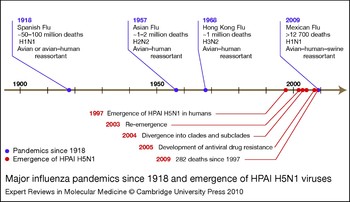
The three major influenza pandemics of the 20th century – in 1918 (Spanish Flu), 1957 (Asian Flu) and 1968 (Hong Kong Flu) – collectively accounted for millions of deaths worldwide (Ref. Reference Johnson and Mueller1); furthermore, 2009 saw the development of the Mexican Flu pandemic (Fig. 1). Pandemics arise when a novel influenza strain emerges that can infect and spread efficiently in immunologically naive human populations. Changes in the influenza viral genome can occur in one of two ways: (1) the accumulation of genetic mutations (antigenic drift), due to host selective pressure and/or a faulty viral RNA polymerase activity; and (2) the exchange of one or more fragments of its segmented genome (genetic reassortment) with other influenza viruses coinfecting the same cell, leading to the expression of novel surface antigen(s) (antigenic shift). The genetic novelty of the 1957 Asian and 1968 Hong Kong pandemic influenza viruses – classified as H2N2 and H3N2, respectively, according to the subtypes of the surface glycoproteins haemagglutinin (H) and neuraminidase (N) they express – were the result of genetic reassortment between human and avian influenza viruses, probably due to coinfection in pigs (Refs Reference de Jong2, Reference Kawaoka, Krauss and Webster3, Reference Scholtissek4, Reference Webster5) (Fig. 1). Recent evidence suggested that the genetic novelty of the 1918 Spanish pandemic influenza virus (H1N1) was possibly due to direct transmission of an avian influenza virus to humans, although the absolute origin of this virus remains unknown (Ref. Reference Taubenberger6); another study indicated that probably all three pandemic influenza strains of the 20th century may have been generated through a series of multiple reassortment events (Ref. Reference Smith7). The recent 2009 Mexican (or H1N1) Flu pandemic was also caused by reassortment (of avian, pig and human viruses), to produce a novel H1N1 virus that was able to spread rapidly worldwide, but with limited pathogenicity (Ref. Reference Dawood8).
Major influenza pandemics since 1918 and emergence of HPAI H5N1 viruses. Information regarding the virus serotype involved in each pandemic, its reassortant features and the estimated number of human deaths is included. The emergence of highly pathogenic avian influenza (HPAI) H5N1 viruses is also presented.

Prior to the 2009 Mexican Flu pandemic, the outbreaks over the past ten years of human influenza caused by the highly pathogenic avian influenza (HPAI) H5N1 virus caused serious concern because of its high lethality (Fig. 1), although the virus does not currently show efficient human–human transmission and is considered ‘prepandemic’. The 1997 outbreak of H5N1 influenza in Hong Kong was the result of direct transmission of an entirely avian influenza virus to humans (Refs Reference Bender9, 10, Reference Katz11, Reference Matrosovich12, Reference Shortridge13, Reference Yuen14, Reference Subbarao15), and resulted in 18 documented cases of respiratory disease including six deaths (Refs Reference de Jong2, Reference Subbarao15). The amino acid changes in the polymerase proteins, specifically PB2, identified in the 1918 virus are also seen in the 1997 H5N1 viruses (Ref. Reference Taubenberger6). In 2003, H5N1 viruses were again isolated from two human cases in Hong Kong, one of which was fatal (Ref. 16). Since then, human infections with H5N1 viruses have spread to several countries in Asia, Europe and Africa (Ref. 17), accounting for 471 cases, with a 60% case fatality (Fig. 1). H5N1 virus transmission within migratory and aquatic birds and its back-and-forth transmission to poultry populations and further spread to humans due to close contacts with the diseased birds are well documented. Furthermore, the H5N1 virus causes significant infections in dogs, tigers, cats, stone martens and perhaps other mammals, indicating that it has an expanded host range (Ref. Reference Liu18). In addition to influenza in humans caused by H5N1, respiratory infection in humans with other avian influenza subtypes (H9N2 and H7N7) have been documented in Hong Kong, southern China, and the Netherlands (Refs Reference Guo19, Reference Peiris20, Reference Lin21, Reference Fouchier22).
These events highlight the potential of other avian influenza viruses to cause a pandemic through the emergence of an avian–human reassortant capable of human transmission (Ref. Reference Webby and Webster23), and have renewed interest in developing vaccine strategies capable of inducing broad crossreactive immunity against novel influenza virus variants, and, in particular, the highly pathogenic H5N1. The emergence of H1N1 Mexican Flu in early 2009 and the declaration of the H1N1 pandemic by the World Health Organization (WHO) as early as June 2009 provided enough time for large-scale strain-matched egg-based vaccine preparation before the onset of the regular influenza season in the northern hemisphere. However, only 38 million out of the target 120 million doses of vaccine were available by October 2009 in the USA (Refs 24, Reference Fox25). Thus, the ongoing H1N1 pandemic is serving as a reminder to evaluate and modify our pandemic preparedness plans.
The estimated economic impact of a pandemic with a highly pathogenic virus would be up to US$166.5 billion in the USA alone, with an estimated 200 000 deaths, 730 000 hospitalisations, 42 million outpatient visits, and 50 million additional illnesses (Refs Reference Donnelly26, Reference Cox and Subbarao27). The US Food and Drug Administration (FDA)-approved H5N1 pandemic influenza vaccine offers limited protection against different strains of H5N1. These antigenically distinct H5N1 strains (categorised into various clades and subclades) (Ref. Reference Chen28) offer new challanges for vaccine design. There is a need for new vaccine technologies that provide long-lasting and broad immunity against highly pathogenic H5N1 influenza virus.
Pharmaceutical drugs and public health interventions
Issues with antiviral-drug-resistant strains
Although vaccines are the first choice for pharmaceutical intervention for seasonal or pandemic influenza, the use of antiviral drugs is also a crucial intervention strategy for pandemic preparedness. Antivirals can be used either for treatment or prophylaxis, and the FDA has licensed four antiviral drugs for influenza therapy (Ref. 29). These drugs fall broadly into two categories: blockers of the influenza matrix protein 2 (M2) ion channel (the adamantane derivatives such as amantadine and rimantadine); and (2) neuraminidase inhibitors (zanamivir and oseltamivir). Antivirals offer an important intervention strategy for pandemic preparedness as they can be stockpiled and have a longer shelf life than vaccines while not requiring refrigeration. However, there have been increasing reports of drug resistance of HPAI H5N1 viruses (Refs Reference Cheung30, Reference de31, Reference Moscona32) and seasonal influenza viruses (Refs Reference Dharan33, Reference Gooskens34, Reference Weinstock and Zuccotti35). The majority of H5N1 viruses isolated from Vietnam and Thailand are resistant to adamantanes (Ref. Reference Cheung30) and, recently, resistance of H5N1 virus to oseltamivir has also been reported (Refs Reference de31, Reference Moscona32, Reference Le36, Reference Kimm-Breschkin37). More recently, H1N1 resistance to oseltamivir in two different clusters of immunocompromised hospital patients was reported, and person-to-person transmission was suspected in both of these clusters (Ref. 38). This situation is alarming as oseltamivir has been the drug of choice for stockpiling as part of pandemic preparedness in many countries (Ref. Reference Patel and Gorman39).
This scenario has accelerated the development and evaluation of new antiviral agents directed towards the established targets neuraminidase and M2, or towards unexplored viral targets as well as host-cell molecules. The latter include surface viral receptors (e.g. DAS181 removes host cell-surface sialic acid, which is the primary receptor for the binding and entry of influenza viruses into the host cell; Refs Reference De40, Reference Hayden41) and components of the innate immune system such as Toll-like receptors (Refs Reference Lau, Tang and Ooi42, Reference Wong43).
Community mitigation strategies
The WHO has issued guidance for nonpharmaceutical public health interventions at national and community levels to reduce exposure of susceptible individuals to pandemic influenza viruses (Ref. Reference Bell44). These guidelines are based on evaluation of both historic and current observations, supplemented by mathematical models. Community mitigation strategies are intended to delay or reduce the impact of a severe pandemic by limiting the spread of the disease until a vaccine is available. These mitigation strategies involve both social distancing measures (closing of schools and childcare centres, avoidance of crowding, isolation of patients and quarantine of contacts) and personal protection and hygiene measures (wearing masks in public places, frequent hand washing, covering one's mouth and nose while coughing and sneezing, and avoiding spitting) (Ref. Reference Bell44). Some of these measures have already been applied in response to the 2009 H1N1 influenza pandemic.
Influenza vaccine strategies
An ideal prepandemic vaccine
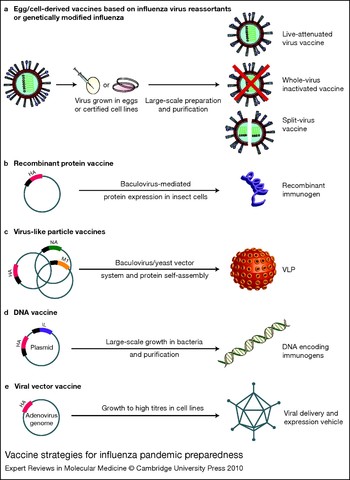
An ideal prepandemic vaccine should: (1) be highly immunogenic, eliciting broad immune responses (innate, humoral and cellular) with a low antigen dose delivered in a single shot; (2) offer protection across antigenically distinct clades; (3) be efficacious in individuals of different age groups and health status; (4) have a method of vaccine administration suitable for mass vaccination; (5) be amenable to rapid, cost-effective, flexible and scalable manufacture; and (6) have a durable shelf life, preferably at room temperature, thereby precluding the need for refrigeration (Ref. Reference Hoelscher45). Several strategies that are currently being evaluated in the search for an ideal pandemic influenza vaccine are depicted in Figure 2. It is almost impossible to predict the characteristics of the next influenza pandemic strain, and so a prepandemic vaccine able to induce some degree of crossprotective haemagglutinin-specific humoral response and a conserved-nucleoprotein-specific cellular immune response would likely provide reasonable protection before a haemagglutinin-subtype-specific vaccine becomes available.
Vaccine strategies for influenza pandemic preparedness. (See previous page for figure.) Some of the major vaccine strategies that are currently being used or are under clinical and preclinical development are shown. (a) Influenza virus vaccine candidates are grown in eggs or certified cell lines and then chemically inactivated to generate inactivated influenza vaccine. Live attenuated influenza vaccines are generated by reassortment between an egg-adapted, cold-adapted attenuated master donor vaccine strain (which can grow to high titres in eggs, with optimum growth at 25–33°C and reduced replication at 37°C) and a circulating epidemic or pandemic strain, resulting in a vaccine virus that expresses six gene segments derived from the attenuated master donor strain and the remaining two gene segments (haemagglutinin and neuraminidase) derived from the circulating relevant epidemic or pandemic strain. The reassortant viruses are then propagated in eggs or certified cell lines for bulk preparation and purification. (b) Recombinant baculovirus expressing haemagglutinin (HA) protein in insect cells can be grown in bulk for influenza vaccines based on the purified immunogen. (c) Virus-like particle vaccines are highly organised particles derived from the self-assembly of viral structural proteins – for example, HA, neuraminidase (NA) and matrix 1 (M1) – expressed by a baculovirus/yeast vector system in insect cells. (d) DNA vaccine plasmids are designed for robust expression in the vacinee driven by a strong viral promoter and also include a polyadenylation signal. Genes encoding immune-stimulatory molecules [e.g. cytokines such as interleukin (IL)] may also be included on the same or a separate plasmid. (e) Viral-vectored vaccines are derived from a range of viruses wherein the antigenic influenza virus protein/s is/are expressed under a strong promoter. Viral vectors such as that derived from adenovirus can accommodate multiple genes encoding HA from different influenza strains/subtypes or other influenza antigenic proteins such as conserved nucleoprotein (NP) or M2 protein, and serve as a live vaccine platform without the associated risk of infection.

Egg-derived vaccines
Currently, two types of influenza vaccines are approved for clinical use, and both of them are manufactured in embryonated chicken eggs: live attenuated influenza vaccines (LAIVs) and inactivated influenza vaccines (whole/subvirion) (Ref. Reference Ilyinskii, Thoidis and Shneider46). However, in the context of a pandemic, an egg-derived vaccine has several limitations (Ref. Reference Gerdil47). Following the procurement of certified eggs, the entire process of vaccine manufacture takes approximately five to six months from the determination of vaccine strains to vaccine release (Ref. Reference Gerdil47). Moreover, difficulties in adapting the virus strain for efficient replication in eggs, while retaining the antigenic and genetic fidelity, are often encountered in seasonal influenza vaccine production. The potential susceptibility of chickens to HPAI viruses further jeopardises the availability of eggs for vaccine production in the event of a pandemic strain arising from an HPAI virus. Nonetheless, the yields from A/Puerto Rico/8/1934 reassortants, which provide the seeds of the majority of inactivated influenza A vaccines, are higher in eggs than in continuous cell lines (Ref. Reference Tree48), and recent improvements in production yields and dose-sparing have led to the enhancement of the current egg-based vaccine manufacturing capacity by threefold over the past few years (Ref. Reference Roos49).
Cold-adapted, live attenuated vaccines
The FDA-approved LAIV against seasonal influenza is generated using an attenuated master donor vaccine strain (A/Ann Arbor/6/1960 caH2N2), which can grow to high titres in eggs (egg-adapted) with optimum growth at 25–33°C and reduced replication at 37°C [cold-adapted (ca)]. Reassortment of this master donor virus with isolates predicted to circulate during a specific influenza season results in vaccines that express six gene segments derived from the attenuated master donor strain, which impart reduced ability for systemic replication/disease at 37°C, and the remaining two gene segments (haemagglutinin and neuraminidase) derived from the circulating relevant pandemic or epidemic strain (Ref. 50).
LAIVs have noted advantages over their inactivated counterparts, as they mimic a natural infection and induce rapid and robust mucosal and systemic immune responses (Ref. Reference Tosh, Boyce and Poland51). LAIVs have also been shown to be efficacious in some high-risk populations and chronically ill subjects suffering from chronic obstructive pulmonary disease (COPD) (Refs Reference Gorse, Belshe and Munn52, Reference Gorse, Belshe and Munn53, Reference Treanor54). The efficacy of LAIVs has been evaluated in both healthy children and in children with recurrent respiratory tract infections and asthma (Refs Reference Belshe55, Reference Ashkenazi56, Reference Fleming57). Specifically, a comparative study between trivalent LAIV (vaccine consisting of three influenza viruses: two different influenza type A strains and one influenza type B strain) and an inactivated trivalent influenza vaccine (consisting of the recombinant 2004:2005 influenza strains) demonstrated comparable safety, but better efficacy for the LAIV in infants and young children (Ref. Reference Belshe55). Other reports indicated that LAIVs, in general, also conferred some degree of crossprotection (Refs Reference Belshe58, Reference Ilyinskii, Thoidis and Shneider46).
The needleless, intranasal administration of LAIVs makes this approach ideal for vaccinating children, and precludes the need for trained personnel for vaccine administration, thus making it amenable to rapid mass vaccination in a pandemic situation. Moreover, a higher amount of virus per egg can be produced than for the trivalent inactivated influenza vaccine, thereby enhancing the vaccine coverage with the existing manufacturing capacity and offering a potential advantage in terms of pandemic preparedness (Ref. 59).
Despite these potential advantages, over the years several concerns have arisen about LAIVs, such as adverse reactions to the vaccine, reversion to wild type, virus shedding and reduced efficacy, which have led to limited acceptability of LAIVs. Tosh et al. have argued against some of these concerns and highlighted the importance of LAIVs (Ref. Reference Tosh, Boyce and Poland51).
With advances in gene manipulation approaches, it is now possible to generate vaccine candidate strains without recourse to coinfection/reassortant methods. For example, vaccines can be derived from HPAI H5N1 viruses by modifying the polybasic cleavage site on the haemagglutinin gene (Refs Reference Gabriel60, Reference Govorkova61, Reference Nicolson62), which is associated with high pathogenicity and virus spread in birds (Refs Reference Horimoto and Kawaoka63, Reference Senne64). Several such H5N1 LAIVs have shown promising results in preclinical studies (Refs Reference Steel65, Reference Suguitan66). Specifically, H5N1 LAIVs generated by reverse genetics consisting of haemagglutinin and neuraminidase derived from H5N1 viruses isolated in Hong Kong and Vietnam in 1997, 2003 and 2004, with the remaining gene segments derived from the donor strain, A/Ann Arbor/6/1960 ca (H2N2), demonstrated complete protection in mice and ferrets against both homologous and antigenically heterologous H5N1 virus challenge (Ref. Reference Suguitan66). Similarly, a single dose of a low-pathogenic H7N3 live attenuated ca virus generated by reverse genetics was completely protective in mice and ferrets against both homologous and heterologous H7 virus challenge (Ref. Reference Joseph67). In addition to modification of the polybasic cleavage site within haemagglutinin, manipulation of other pathogenic determinants of these HPAI viruses has also been used to develop LAIVs (Ref. Reference Steel65). Specifically, an H5N1 LAIV based on A/Vietnam/1203/2004 was attenuated through modification of the haemagglutinin cleavage site, a truncation of the C-terminus of nonstructural (NS1) protein, and an amino acid substitution in the PB2 polymerase. This vaccine provided complete protection in mice and chickens following challenge with homologous H5N1 virus (Ref. Reference Steel65).
Unfortunately, the success of the seasonal trivalent LAIV has not been replicated in the pandemic vaccine candidate H5N1 LAIVs. To meet the requirement of the European Committee for Proprietary Medicinal Products (CHMP) for immunogenicity, for adults the seroprotection rate must exceed 70% and the seroconversion rate must be at least 40% (for elderly subjects, the respective limits are 60% and 30%) (Box 1). In a clinical trial, only 11% of the study subjects aged 18–49 years seroconverted following two doses of A/Vietnam/1203/2004 × A/Ann Arbor/6/1960 ca vaccine (Ref. 68). A similar vaccine based on A/chicken/British Columbia/CN-6/2004 H7N3 × A/Ann Arbor/6/1960 ca resulted in a 1.6-fold increase in haemagglutinin inhibition (HI) titres (Box 1) in 62% of study participants (Ref. 68). In addition, a high-growth reassortant Len17/H5 vaccine that contained the haemagglutinin gene from the nonpathogenic A/Duck/Potsdam/1402-6/1986 (H5N2) virus and other genes from the ca attenuated A/Leningrad/134/17/1957 (H2N2) strain (Ref. Reference Desheva69) resulted in 6% and 47% of subjects with fourfold or higher HI titres after one or two doses, respectively (Ref. 68). However, recently a candidate H9N2 LAIV (A/chicken/Hong Kong/G9/1997 × A/Ann Arbor/6/1960 ca) looked promising in a Phase I clinical trial wherein the vaccine generated a fourfold increase in HI titres in 92% of seronegative adult subjects under the age of 40 (Ref. 68).
Box 1. Haemagglutination inhibition (HI) titres for assessing H5N1 protection
Although the correlates of protection from H5N1 influenza infections are not defined, HI titres (assays of inhibition of haemagglutinin-induced erythrocyte clumping) are the accepted standard for measuring functional influenza-specific serum antibodies against haemagglutinin following vaccination. As per the European Committee for Proprietary Medicinal Products (CHMP) (Ref. 70) and US Food and Drug Administration (FDA) guidelines (Ref. 71), the endpoints of HI for the pandemic influenza vaccine licensure are: the percentage of participants with a reciprocal titre of ≥40 defined as seropositivity (the seroprotective threshold for seasonal influenza); and the proportion of participants who seroconverted (percentage of people vaccinated having a reciprocal titre of <10 before vaccination and a titre of >40 after vaccination) or showed a significant increase in antibody titre (percentage of people vaccinated having a reciprocal titre of >10 before vaccination and at least a fourfold increase in titre after vaccination). However, there are several concerns regarding the use of an endpoint HI titre of 1:40 for evaluation of protection efficacy against pandemic influenza. Questions remain about whether this titre can be used universally for all influenza strains, can reflect protection in a naive population, or can still indicate protection if there are changes in the assay procedure to enhance sensitivity to new virus strains (Ref. Reference Eichelberger72).
Whole-virus inactivated vaccines
Historically, whole-virus inactivated vaccines have been generated using genetic reassortment similar to that described for LAIV, with the haemagglutinin and neuraminidase genes derived from the relevant circulating strain, but with the major difference being that the internal genes are from the high-yield master donor strain A/Puerto Rico/8/1934. Subsequently, the reassortant virus is subjected to standard formalin inactivation (Ref. Reference Lin73). Split preparations (chemically disrupted influenza virus) or subunit preparations (antigenic proteins purified after chemical solubilisation of influenza virus) of inactivated vaccines have been preferred over whole-virus inactivated vaccines because of reactogenicity, especially in children (Refs Reference Brady and Furminger74, Reference Davenport75, Reference Laver and Webster76). Nonetheless, an inactivated egg-derived H9N2 whole-virus vaccine was shown to be more immunogenic (producing better responses) in a naive population with a single dose than its subunit counterpart (Ref. Reference Stephenson77). Furthermore, use of whole-virus vaccines may also avoid the antigen losses during the disruption process of an inactivated split-virion vaccine (Ref. Reference Lin73).
An alum-adjuvanted inactivated whole-virus H5N1 vaccine was well tolerated and resulted in 78% seropositivity (proportion of individuals achieving HI titres of ≥40) by day 42 with a two-dose regimen of 10 µg per dose (Ref. Reference Lin73) (Table 1). Recently, the same vaccine was shown to be broadly crossprotective after two inoculations with 10 µg in 98% and 87% of subjects against heterologous A/Indonesia/5/2005 and A/Anhui/1/2005 clade 2 strains, respectively (Ref. Reference Wu78).
A clade 1 A/Vietnam/1194/2004 NIBRG-14 H5N1 whole-virus prototype pandemic influenza vaccine, derived by reverse genetics and formulated with an aluminum phosphate adjuvant, was tested in 88 subjects [44 adults (19–60 years) and 44 elderly (60–83 years)], who received a single dose (6 µg) of the vaccine. Vaccine recipients demonstrated seroconversion in 90% and 68% of the adult and elderly subjects, respectively, against the homologous virus and also showed significant crossreactive immune responses against the different clade 2 H5N1 viruses in both age groups. Interestingly, higher titres of virus-neutralising antibodies and crossreactive antibodies were detected in the elderly, and a surprising 56% of the elderly subjects also seroconverted against an H1N1 strain, compared with only 18% of adults, suggesting the probable importance of regular vaccination with seasonal influenza vaccines in developing crossreactive immunity against pandemic viruses (Ref. Reference Fazekas79). This vaccine was shown to be safe and immunogenic in the first clinical trial in children, and of the 12 healthy children (9–17 years) who received a single dose of 6 µg of vaccine, 75% seroconverted 21 days after vaccination (Ref. Reference Vajo80).
Owing to the inherent low immunogenicity of H5 haemagglutinin in humans, novel adjuvanted formulations of inactivated whole-virus vaccine will not only enhance the immunogenicity but also lead to dose-sparing. However, a potential safety concern regarding the use of an adjuvanted inactivated influenza vaccine became apparent when an intranasal vaccine formulation introduced in Switzerland was strongly associated with Bell palsy (Ref. Reference Mutsch81), suggesting the need for a large-scale safety trial for the licensure and commercial release of a new vaccine formulation.
Inactivated split-virus vaccines
One of the first studies that evaluated the safety and immunogenicity of an inactivated, unadjuvanted subvirion H5N1 vaccine (A/Vietnam/1203/2004 × A/Puerto Rico/8/1934) in a clinical setting demonstrated that high doses (two 90 µg doses) were required for developing protective antibody titres (Ref. Reference Treanor82). Nonetheless, this vaccine was subsequently approved by the FDA and has the distinction of being the first avian influenza vaccine available in the USA (Ref. 83). In a sequel to this study, a third dose of the vaccine, administered six months after the second dose, resulted in protective antibody titres in 78% and 67% of the subjects who initially received 90 or 45 µg doses, respectively. The neutralising antibody levels remained significantly higher even five months after the third dose, compared with that observed after the second dose (Ref. Reference Zangwill84). It should be noted, however, that increasing the amount of antigen and the number of doses is not a viable strategy for pandemic preparedness both in terms of time and economics, and therefore dose-sparing using novel adjuvant strategies will be required (Refs Reference Leroux-Roels85, Reference Levie86, Reference Nicholson87, Reference Bernstein88, Reference Leroux-Roels89).
Alum is the only approved adjuvant for use in the USA in human vaccine formulations, but alum-adjuvanted inactivated influenza vaccines have demonstrated variable results, with effects ranging from moderate to none (Refs Reference Bresson90, Reference Keitel91, Reference Nolan92). An alum-adjuvanted inactivated split-virion vaccine (A/Vietnam/1194/2004) elicited 67% seroconversion at the highest dose (30 µg) tested (Ref. Reference Bresson90). Other clinical trials evaluated the immunogenicity of a nonpathogenic H5N3 virus (A/Duck/Singapore/1997) adjuvanted with the squalene-based oil-in-water emulsion MF59 (Refs Reference Nicholson87, Reference Stephenson93, Reference Stephenson94). This study demonstrated significantly higher seroconversion at a dose of 7.5 µg in the adjuvanted vaccine group compared with the nonadjuvanted vaccine group (Ref. Reference Nicholson87). Recently, a promising dose-sparing study using an egg-derived, inactivated split vaccine (A/Vietnam/1194/2004 × A/Puerto Rico/8/1934) along with a proprietary oil-in-water emulsion-based adjuvant elicited 86% seroconversion at the lowest dose of 3.8 µg given twice (Ref. Reference Leroux-Roels85). Interestingly, 77% of the study subjects seroconverted for neutralising antibody titres against an antigenically dissimilar clade 2 virus, highlighting the potential for crossclade seroprotective immune responses at a low antigen dose (Ref. Reference Leroux-Roels85). The crossclade protective efficacy of this vaccine was amply demonstrated in a ferret model (Ref. Reference Baras95). The safety and reactogenicity profile of a 15 µg haemagglutinin dose of the same proprietary oil-in-water emulsion-adjuvanted split virion (A/Vietnam/1194/2004 NIBRG-14 H5N1) vaccine preparation was evaluated in a multicentre, randomised, Phase III clinical trial in healthy adults and was considered clinically acceptable in the context of its use against pandemic influenza (Ref. Reference Rumke96). Another clinical trial evaluating an even lower dose (1.9 µg) of an influenza A/Vietnam/1194/2004 NIBRG-14 (H5N1) vaccine given along with a 5% squalene-in-water emulsion-based adjuvant showed seroconversion in 72% of the study subjects (Ref. Reference Levie86).
A clinical trial involving 486 healthy adults (aged 18–60 years) and elderly individuals (60 years and over) with an MF59-adjuvanted clade 1 (A/Vietnam/1194/2004) inactivated subunit H5N1 vaccine demonstrated comparable seroprotection in both adult and elderly populations after two doses of 7.5 or 15 µg of vaccine, ranging between 72% and 87% (Ref. Reference Banzhoff97). There was a significant reduction in seroconversion after six months in both the adults and elderly. However, the group that received a third booster dose (7.5 or 15 µg) showed seroprotection of 90% and 84% or better in the adult and elderly groups, respectively. This vaccine formulation also generated crossneutralising antibodies to a clade 2 H5N1 virus, suggesting that it can be used in a prepandemic scenario and, more importantly, for all age groups (Ref. Reference Banzhoff97).
Given the potentially serious course of influenza in children, the efficacy of the H5N1 influenza vaccine has also been evaluated in infants and children (Refs Reference Chotpitayasunondh98, Reference Nolan99). Two 30 µg doses of an aluminium-adjuvanted, inactivated, split-virus, clade 1 (A/Vietnam/1194/2004 NIBRG-14) H5N1 vaccine given in infants and children (N = 150) aged six months to nine years was well tolerated and elicited a strong neutralising antibody response in 99% of subjects, with persistence of neutralising antibody response up to six months after vaccination in 85% of the children. Furthermore, 80% of the subjects showed crossreactivity to a clade 2.1 variant strain (A/Indonesia/5/2005 CDCRG2) (Ref. Reference Nolan99). Similarly, a Phase II clinical trial involving children (N = 180) aged six months to 17 years given two 30 µg doses of an aluminium-hydroxide-adjuvanted H5N1 influenza vaccine (A/Vietnam/1194/2004 NIBRG-14) administered 21 days apart showed seroresponses in 79% of the subjects (Ref. Reference Chotpitayasunondh98).
The concept of proactive prepandemic priming that may induce long-lasting immune memory and allow a single booster vaccine to induce protection has gained momentum as a potential strategy for pandemic preparedness (Ref. Reference Jennings100). Two 7.5 µg booster doses of an inactivated MF59-adjuvanted A/Vietnam/1194/2004 NIBRG-14 vaccine were administered in subjects who had previously (at least six years earlier) been primed with two doses of either MF59-adjuvanted or nonadjuvanted A/Duck/Singapore/1997 (H5N3) vaccine containing 7.5–30 µg of haemagglutinin. These booster doses induced a significantly better vaccine response in subjects primed with MF59-adjuvanted vaccine in terms of early induction and persistence of crossreacting antibody responses for six months than in unprimed subjects or in those primed with an unadjuvanted vaccine. Seven days after administration of the booster, 90% of MF59-primed subjects exhibited high titres of neutralising antibodies towards diverse H5N1 viruses, as well as to the original H5 priming strains, suggesting H5 priming with MF59-adjuvanted vaccine may result in dose-sparing by limiting the amount and number of doses required to achieve seroprotective titres from a distinct H5 strain. This might be due to the induction of an immune memory B cell pool that probably expands more rapidly and efficiently with booster immunisation (Refs Reference Stephenson101, Reference Galli102). These recent findings have highlighted the importance of novel adjuvant formulations and prime–boost strategies in influenza pandemic preparedness.
Egg-independent vaccine strategies
Cell-derived whole-virus inactivated vaccines
As a part of pandemic preparedness, the US Department of Health and Human Services has offered substantial monetary incentives to the vaccine industry to develop cell-based influenza vaccine infrastructure in the USA (Refs 103, Reference Roos104). Major vaccine manufacturers are at various stages of developing cell-derived vaccines for seasonal and pandemic influenza (Refs 103, Reference Roos104), and a cell-derived seasonal influenza vaccine is already on the market in Europe (Ref. 105). Cell-derived vaccines assume much significance with respect to pandemic preparedness since their production is not exposed to anticipated vulnerabilities in the supply of embryonated eggs in a prepandemic/pandemic scenario. Additionally, cell-based vaccine manufacturing in closed scalable bioreactors reduces the risk of exogenous contamination. Following the identification of the pandemic strain, it has a shorter lead manufacturing time of one to three months compared with approximately five to six months for the egg-based approach (Ref. 106). The cell-based production of influenza vaccines minimises the selection of any virus variants with reduced immunogenicity and altered antigenicity, which might sometimes result during the adaptation of virus strains to eggs in an egg-based vaccine manufacturing process (Refs Reference Hardy107, Reference Robertson108, Reference Schild109). However, some of the limitations of the cell-based vaccine approach are the lack of standardised reagents and the potential safety concern regarding the introduction of adventitious agents during the cell-based vaccine manufacturing process (Ref. Reference Gregersen110).
To date, three cell lines – African green monkey kidney (Vero), Madin–Darby canine kidney (MDCK) and human PER.C6 – are approved for influenza vaccine production, and influenza vaccines produced using these cell lines have been tested in several preclinical trials (Refs Reference Howard, Kistner and Barrett111, Reference Kistner112, Reference Palker113). Vero-cell-derived whole-virus inactivated vaccine based on clade 1 (A/Vietnam/1203/2004) and clade 2 (A/Indonesia/5/2005) viruses was shown to induce crossneutralising antibodies and highly crossreactive T cells, and protected mice from challenge with antigenically divergent H5N1 viruses (Ref. Reference Kistner112). In a dose-escalation Phase I/II clinical trial, two 7.5 µg doses of the same Vero-cell-derived clade 1 (A/Vietnam/1203/2004) inactivated whole-virus vaccine resulted in virus neutralisation titres of ≥20 in 76% of the study subjects (Ref. Reference Ehrlich114). Importantly, the vaccine also induced crossneutralising antibody titres (≥20) in 76% of subjects against clade 0 (A/Hong Kong/156/1997) and in 45% against clade 2 (A/Indonesia/5/2005) viruses (Ref. Reference Ehrlich114). Advanced Phase III clinical trials are currently under way to test this vaccine in adults, the elderly and specified risk groups, such as human immunodeficiency virus (HIV)-infected individuals and chronically ill patients (Refs 115, 116). However, the use of such a cell-derived whole-virus H5N1 vaccine with an intact haemagglutinin polybasic cleavage site represents a potential public health hazard.
Recombinant-protein-based vaccines
Generation of antigenic protein by recombinant baculoviruses in insect cells is a convenient and fast method to generate large amounts of haemagglutinin protein for influenza vaccines (Ref. Reference Ikonomou, Schneider and Agathos117) (Fig. 2). Baculovirus-mediated protein expression is extremely efficient under a strong polyhedrin promoter, and the expressed protein undergoes post-translational modifications similar to those occurring in mammalian cells (Refs Reference Altmann118, Reference Safdar and Cox119). Several clinical trials have demonstrated the safety and immunogenicity of baculovirus-expressed recombinant haemagglutinin (Refs Reference Huber and McCullers120, Reference Roos121, Reference Lakey122, Reference Powers123, Reference Treanor124, Reference Treanor125). Two 90 µg doses of a purified recombinant haemagglutinin from a clade 0 H5N1 virus (A/Hong Kong/156/1997) generated potentially protective neutralising antibody titres (1:80) in 52% of the naive subjects (Refs Reference Treanor125, Reference Goji126). In a follow-up study eight years later in the same subjects, 68% of the subjects (now clade-0-primed), induced potentially protective titres (≥1:40) when immunised with a single 90 µg dose of an egg-derived inactivated subvirion clade 1 vaccine (A/Vietnam/1203/2004 CDCRG1) as compared with only 45% in nonprimed subjects receiving two 90 µg doses of the same vaccine (Ref. Reference Goji126). This suggests that prepandemic priming may reduce the global vaccine burden in a pandemic scenario. Use of better adjuvants and conserved internal protein(s) in the recombinant haemagglutinin vaccine formulations may further broaden the vaccine efficacy.
Virus-like particle (VLP)-based vaccines
VLP vaccines are highly organised particles derived from the self-assembly of viral structural proteins that lack viral nucleic acid and hence are completely noninfectious. Thus, they mimic live viruses and can induce robust humoral and cellular immune responses (Ref. Reference Grgacic and Anderson127), and can be manufactured in bulk using a baculovirus expression system and insect cells (Refs Reference Ludwig and Wagner128, Reference Roy and Noad129) (Fig. 2). Recently, a VLP-based human papilloma virus (HPV) vaccine was launched for commercial use, emphasising the safety and immunogenicity of this approach (Refs 130, 131). Furthermore, the safety and protective efficacy of this approach for the development of pandemic influenza vaccines has been evaluated in several preclinical trials (Refs Reference Bright132, Reference Kang133, Reference Mahmood134, Reference Perrone135). An H5N1 A/Indonesia/5/2005 VLP vaccine evaluated for its immunogenicity and safety in a Phase I/IIa clinical trial was well tolerated and immunogenic in healthy adult subjects (Ref. Reference Hayden136). The vaccine dose (15, 45 or 90 µg) showed a dose-dependent increase in HI titres, and the highest dose of 90 µg resulted in seroconversion (HI titres ≥ 1:40) in 63% of the study subjects (Ref. Reference Hayden136). The protection coverage offered by VLP influenza vaccines can be further broadened by developing multivalent VLP vaccines incorporating haemagglutinin from different influenza virus subtypes (Ref. Reference Quan137).
DNA vaccines
DNA vaccine technology enables easy manipulation to incorporate single or multiple genes of interest in a plasmid (Fig. 2). Furthermore, molecules that can modulate or stimulate the immune response can also be incorporated in the same plasmid to further boost the vaccine efficacy. DNA vaccines are capable of inducing both humoral and cellular immune responses with either a predominant T helper 1 (Th1)- or Th2-type response, depending on the route of DNA delivery (specifically, intramuscular injection versus gene gun delivery to the skin, respectively) (Refs Reference Feltquate138, Reference Huber139). While demonstrating protective efficacy in a mouse model (Ref. Reference Ulmer140) and a good safety profile (Ref. Reference Webster and Robinson141), DNA vaccines have suffered from inefficient gene-delivery methods resulting in suboptimal immune responses (Ref. Reference Luxembourg, Evans and Hannaman142). Currently, electroporation or bombardment with particles coated with DNA into the skin are the preferred methods for the delivery of DNA vaccines (Refs Reference Sharpe143, Reference Wang144). Nonetheless, development of efficient delivery systems that may result in better antigen expression and subsequent immune responses are needed (Ref. Reference Ulmer, Wahren and Liu145).
DNA vaccines aiming to induce crossprotective immune responses by incorporating multiple haemagglutinin genes delivered simultaneously (Ref. Reference Huber, Thomas and McCullers146), using a consensus haemagglutinin sequence (Ref. Reference Chen147), or expressing highly conserved influenza virus proteins (such as nucleoprotein or M2) are currently being evaluated in preclinical trials (Refs Reference Epstein148, Reference Epstein149, Reference Laddy150, Reference Laddy151). A trivalent Vaxfectin-formulated DNA vaccine (Refs Reference Hartikka152, Reference Reyes153) encoding H5 haemagglutinin (A/Vietnam/1203/2004), nucleoprotein and M2 consensus sequences administered intramuscularly or with a Biojector 2000 injection system was shown to be safe and efficacious in a Phase I clinical trial (Ref. 154). The vaccine induced protective antibody titres in 67% of the study subjects receiving two doses of 0.5 or 1.0 mg of vaccine (Ref. 154). The protective efficacy of a three-dose regimen of a DNA vaccine encoding H5 haemagglutinin (A/Indonesia/5/2005) following intramuscular inoculation using a Biojector is currently being evaluated (Ref. 155). The safety, rapid scalability and well-defined manufacturability of DNA vaccines make this approach suitable for developing vaccines against emerging infectious diseases like influenza.
Viral-vector-based vaccines
Viral vectors act as delivery vehicles that carry the gene(s) of interest into the host cell for efficient expression (Fig. 2). They serve as a live vaccine and induce robust immune responses without the associated risk of pathogenicity/infection. Viral vectors, by virtue of innate immune activators, also exert an adjuvant effect, thereby boosting the vaccine efficacy. Furthermore, the ease of incorporating multiple genes/adjuvants in a single vector may offer flexibility in vaccine design. Viral vectors can be grown to high titres in qualified cell lines in large quantities. Vectors based on a range of viruses are currently under consideration for influenza vaccines, with adenovirus-based vectors receiving particular attention.
Adenoviruses possess several attributes that make them suitable candidates for vaccine vectors. They are nonpathogenic viruses capable of infecting both dividing and nondividing cells, facilitating high levels of transgene expression without integration into the host genome, and more importantly can be grown to high titres in qualified cell lines (Ref. Reference Bangari and Mittal156). Adenoviruses exert an adjuvant-like effect by stimulating the innate immune system through both Toll-like-receptor-dependent and -independent pathways (Ref. Reference Zhu, Huang and Yang157). The effectiveness of an adenovirus (Ad)-vectored vaccines against many infectious diseases, including measles, severe acute respiratory syndrome (SARS), HIV, hepatitis B and Ebola, has been evaluated in human and animal models (Refs Reference Fooks158, Reference Gao159, Reference Gomez-Roman160, Reference Lubeck161, Reference Sullivan162).
The viability of a human Ad (HAd)-vectored vaccine for H5N1 pandemic influenza vaccine (HAd-H5HA) in mouse and chicken models has been demonstrated (Refs Reference Gao163, Reference Hoelscher164, Reference Holman165). Two doses of 1 × 10⁸ plaque-forming unit (PFU) of HAd-H5HA expressing the haemagglutinin gene of A/Hong Kong/156/1997 generated significantly high levels of virus-neutralising antibody titres, and elicited a significantly increased haemagglutinin-epitope-specific CD8+ T cell population secreting interferon γ, in a mouse model (Ref. Reference Hoelscher164). The vaccine protected mice against lethal challenge with homologous as well as antigenically distinct H5N1 influenza viruses (Ref. Reference Hoelscher164). The immune responses (humoral/cell-mediated) and the protective efficacy of HAd-H5HA vaccine persisted for at least 12 months after immunisation in mice (Ref. Reference Hoelscher166). Inclusion of haemagglutinin from clade 1 and clade 2 as well as the conserved nucleoprotein in the vaccine formulation further broadened the protective efficacy of HAd-based H5N1 vaccines, thereby offering complete protection in mice against challenge with either clade 1 or clade 2 virus (Ref. Reference Hoelscher167).
Ad-vector-based influenza vaccines have been shown to be safe and immunogenic in humans (Refs Reference Hoelscher45, Reference Van Kampen168), and intranasal administration of a two-dose regimen of 5 × 10⁸ virus particles expressing haemagglutinin from A/Puerto Rico/8/1934 resulted in a fourfold increase in HI titres in 83% of the subjects in a clinical trial (Ref. Reference Hoelscher45). Several preclinical studies have suggested HAd-vector immunity (the presence of pre-existing HAd-specific neutralising antibodies) might inhibit generation of immune responses against the transgene product (Refs Reference Bangari and Mittal156, Reference Kostense169), but a clinical trial specifically demonstrated that increasing the vaccine dose of an HAd-based HIV vaccine overcame the HAd-vector immunity (Ref. Reference Catanzaro170). Nonetheless, the use of nonhuman Ad-vector-based vaccines, either alone or as the boost component in a DNA-prime and Ad-vector-boost immunisation strategy using a combination of DNA and Ad-vector antigen-delivery systems (Refs Reference Bangari and Mittal156, Reference Barouch171, Reference Roy172, Reference Singh173, Reference Yang174), is among several alternative approaches that are being explored to circumvent the limitations of HAd-vector immunity. A bovine-origin Ad vector (bovine Ad subtype 3 or BAd)-based H5N1 vaccine (BAd-H5N1) has been shown to circumvent high levels of pre-existing HAd-vector immunity in a mouse model (Ref. Reference Singh173), and this vaccine completely protected mice against homologous H5N1 virus challenge (Ref. Reference Singh173). In addition, a prime–boost strategy using HAd and BAd vectors generated better immune responses compared with the responses generated with either vector alone, suggesting the importance of two vector systems in improving vaccine-induced immune responses (Ref. Reference Singh173).
Other viral vectors of potential interest for influenza vaccines include those based on alphavirus, Newcastle disease virus (NDV), vesicular stomatitis virus (VSV) and pox virus. Vectors based on alphaviruses (positive-strand RNA viruses) have primarily been developed using Venezuelan equine encephalitis, Sindbis or Semliki Forest viruses (Ref. Reference Lundstrom175), and have shown protection in numerous models for infectious diseases, including influenza, HPV and Ebola (Refs Reference Pushko176, Reference Schultz-Cherry177, Reference Velders178, Reference Huber139). Alphavirus replicon particles expressing the haemagglutinin gene from an H5N1 isolate (A/Hong Kong/156/1997) were shown to be protective in chickens (Ref. Reference Schultz-Cherry177). Another alphavirus, expressing haemagglutinin from A/Wyoming/3/2003 (H3N2), was immunogenic in preclinical studies in mice, rabbits and macaques (Ref. Reference Hubby179). A Phase I clinical trial using the same H3N2 vaccine induced protective HI titres in 77% and 80% of subjects receiving a single dose of low- and high-concentration vaccine, respectively (Ref. 180). A second immunisation in these individuals enhanced seroprotective responses to 86% for both dosage levels and extended the duration of T cell responses as compared with the single immunisation (Ref. 180).
NDV vectors have demonstrated immunogenicity and protective efficacy against HPAI in several preclinical studies in mouse and chicken models (Refs Reference Ge181, Reference Veits182). Reverse genetics technology has helped in developing NDV as a safe and efficacious vaccine vector (Ref. Reference Huang183), and both the natural mucosal route of infection by NDV and the high degree of attenuation of this virus in primates make it suitable as a vaccine vector for humans for the control of respiratory virus infections such as influenza (Ref. Reference Bukreyev and Collins184). A live attenuated NDV-based vaccine expressing haemagglutinin (NDV-HA) of highly pathogenic H5N1 virus (A/Vietnam/1203/2004) was highly attenuated in nonhuman primates, and a single inoculation by both the intranasal and intratracheal routes with 107 PFU of NDV-HA per site induced substantial serum IgG and mucosal IgA responses (Ref. Reference DiNapoli185).
VSV vectors have been developed as potential therapeutic and vaccine vectors for various diseases (Refs Reference Geisbert186, Reference Geisbert187, Reference Iyer188, Reference Kapadia, Simon and Rose189, Reference Roberts190, Reference Roediger191, Reference Zinkernagel, Adler and Holland192). A recombinant VSV expressing haemagglutinin of an H5N1 virus induced robust neutralising antibody titres against the homologous and more recent antigenically distinct H5N1 viruses in mice (Ref. Reference Schwartz193). A single dose of the vaccine offered durable protection for up to seven months against lethal challenge with the homologous H5N1 virus (Ref. Reference Schwartz193). The VSV vector expressing haemagglutinin of HPAI A/FPV/Rostock/1934 (H7N1), in place of the VSV G gene, protected chickens against challenge with the homologous H7N1 virus but not against the H5N2 virus (Ref. Reference Kalhoro194). Low seroprevalence of VSV in humans makes it a suitable vector for human applications, but more preclinical studies are required to prove its usefulness for the design of a pandemic influenza vaccine.
Poxvirus vectors can accommodate large or multiple gene inserts of approximately 25 kb in size (Refs Reference Smith and Moss195, Reference Lockey196). Modified vaccinia virus Ankara (MVA) recombinants expressing influenza virus antigens have been evaluated in several preclinical trials (Refs Reference Altstein197, Reference Jakeman, Smith and Sweet198, Reference Sutter199). A vaccinia-virus-based multivalent H5N1 influenza vaccine expressing haemagglutinin, neuraminidase and nucleoprotein from A/Vietnam/1203/2004 and M1 and M2 from A/CK/Indonesia/PA/2003, and adjuvanted with interleukin 15, elicited protective neutralising antibody titres (1:80) against both clade 1 and clade 2.2 viruses in mice (Ref. Reference Poon200). Appreciable amounts of influenza-specific antibody responses were detectable in mice for up to 14 months after vaccination (Ref. Reference Poon200). Similarly, a single dose of a nonadjuvanted replication-defective vaccinia H5N1 vaccine based on A/Vietnam/1203/2004 induced substantial cell-mediated immune responses and provided crossclade protection in mice (Ref. Reference Mayrhofer201).
Passive antibody therapy
Antibody therapy for influenza has gained more interest in recent years due to its potential to rapidly deliver a universal therapeutic and prophylactic remedy against pandemic influenza strains/subtypes. During the 1918 pandemic, the transfusion of convalescent human blood products from patients recovering from Spanish Flu may have been associated with a reduction in the pandemic death rate (Ref. Reference Luke202). More recently, human monoclonal antibodies (mAbs) generated from the blood of H5N1 (A/Vietnam/1203/2004) convalescent patients resulted in protection against a homologous virus challenge in a mouse model (Ref. Reference Simmons203). Several techniques to rapidly generate influenza-specific human mAbs have been described (Refs Reference Kashyap204, Reference Throsby205, Reference Wrammert206), and these mAbs have demonstrated a broad heterosubtypic neutralising activity (Refs Reference Kashyap204, Reference Throsby205).
Using antibody phage display, a panel of haemagglutinin-specific broadly neutralising mAbs from B cell libraries constructed using IgM+ memory B cells from seasonal influenza vaccinees were identified (Ref. Reference Throsby205). These mAbs displayed broad, heterosubtypic neutralising activity across antigenically diverse subtypes (H1, H2, H5, H6, H8 and H9) (Ref. Reference Throsby205). The most potent antibody (CR6261) was protective in mice when given before and after a lethal H5N1 or H1N1 challenge, suggesting both a prophylactic and a therapeutic efficacy (Ref. Reference Throsby205). The broad heterosubtypic activity of these mAbs might be due to their specificity towards a conserved region of the haemagglutinin stem domain (Ref. Reference Throsby205). Furthermore, the CR6261 epitope on haemagglutinin was recently characterised and the mechanism of neutralisation established by elucidating the crystal structure of the antibody bound to the haemagglutinins from the 1918 H1N1 and 2004 H5N1 (A/Vietnam/1203/2004) viruses (Ref. Reference Ekiert207).
Using a similar technique, a panel of high-affinity broad-spectrum human neutralising antibodies (nAbs) against haemagglutinin were identified, with neutralising activity against avian H5, 1918 H1, and several other human influenza subtypes (Ref. Reference Sui208). Some of these nAbs protected mice from a lethal dose of HPAI H5N1 when given before or after challenge, suggesting their prophylactic and therapeutic efficacy (Ref. Reference Sui208). In both of these studies, the broad neutralising activity of these mAbs was due to their binding to a highly conserved pocket in the stem domain of haemagglutinin, which inhibited haemagglutinin-mediated virus–host membrane fusion (Refs Reference Ekiert207, Reference Sui208).
The complete antibody repertoire in the convalescent serum from H5N1 (A/Vietnam/1203/2004)-infected individuals has been characterised (Ref. Reference Khurana209), using an entire influenza genome fragment phage display library where virus proteins were expressed in fragments of 15–350 amino acids (Ref. Reference Khurana210). Passive antibody therapy directed against conserved haemagglutinin epitopes holds promise for pandemic preparedness due to its therapeutic and prophylactic value and its potential ability to provide broad protection. These conserved epitopes could be exploited for designing a universal influenza vaccine.
Conclusions
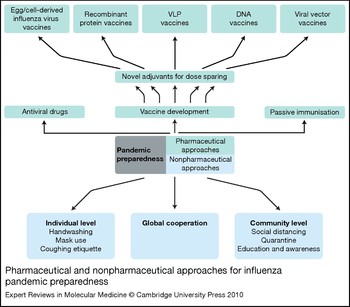
Human history is fraught with deadly epidemics and pandemics of influenza that have resulted in millions of deaths worldwide. Never before has humankind planned so comprehensively to control and prevent an influenza pandemic (Fig. 3). The current case fatality rate of more than 60% (and potentially higher) associated with the HPAI H5N1 virus has resulted in renewed fears of a massive loss of human life in the event of an H5N1 influenza pandemic. Over the years, there have been remarkable advancements in medicine to combat infectious diseases. However, the tightly interlinked modern global community has faced new challenges in the form of severe acute respiratory syndrome (SARS) outbreaks in 2003 and in the novel H1N1 influenza pandemic of 2009, where the worldwide virus spread occurred at a remarkably rapid rate in a relatively short time period that was in contrast to our understanding of influenza transmission from previous influenza pandemics.
Pharmaceutical and nonpharmaceutical approaches for influenza pandemic preparedness. Pharmaceutical approaches include antiviral drugs, passive antibody therapy, and vaccines derived from both conventional egg-based technology and egg-independent technologies (Fig. 2). Development and use of novel adjuvants will be the key to dose-sparing and enhancing vaccine coverage. Simple nonpharmaceutical measures at individual, community and international levels will go a long way in curtailing a rapid spread of pandemic influenza.

Combating an influenza pandemic will require concerted global efforts on the part of international agencies, the healthcare industry, governments and individuals. The ongoing H1N1 pandemic is offering valuable information with regard to disease outbreak and spread, and the effectiveness of containment strategies outlined in the pandemic preparedness plans of various countries.
Development of an influenza vaccine that can provide broad durable protection at a low antigen dose is the cornerstone of any pandemic preparedness plan. However, the prepandemic vaccine strategy is only as good as our ability to predict the pandemic virus strain, as amply demonstrated by the onset of the current H1N1 pandemic in the midst of our preparation for a probable H5N1 pandemic. While the egg-based influenza vaccine manufacturing strategy has been the backbone of seasonal influenza vaccine production for decades, it might no longer support the massive global requirements for a pandemic vaccine. Although egg-based vaccine production in the ongoing H1N1 pandemic was initiated soon after the identification of the pandemic strain, issues such as low virus yield resulted in a delay in timely availability of enough vaccine doses. The inability of an egg-based strategy to quickly produce massive doses of necessary vaccines in a timely manner clearly emphasises the need to explore alternative, egg-independent vaccine strategies, not only to complement the existing capacity but also to ensure rapid scalability.
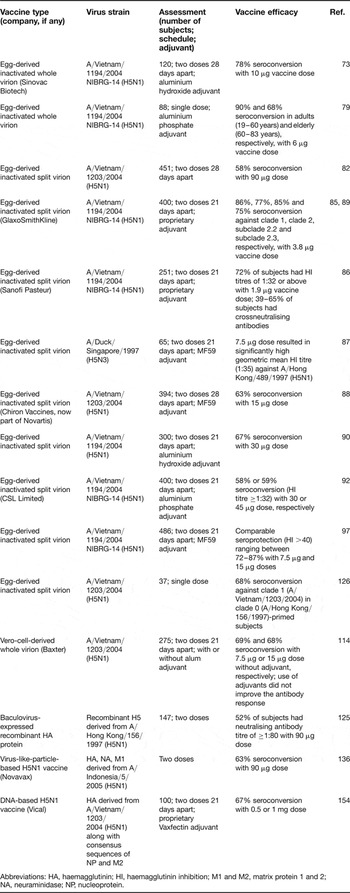
Several technologies for alternatives or supplements to the current egg-based approach are being explored (Table 1). Cell-derived seasonal/pandemic vaccines have looked promising in clinical trials and have been licensed in Europe; they are likely to be licensed in the near future elsewhere. VLP-based influenza vaccines are rapidly catching up as a result of their safety and immunogenicity. Vaccines based on viral vectors and DNA vaccine technologies have also gained momentum in recent years, thus adding to the growing list of egg-independent strategies for pandemic influenza vaccines. However, the lack of official calibrated reagents and assays for the evolving egg-independent technologies is a major impediment for regulatory approval. Further simplifying regulatory processes for fast-track approval of vaccines (in prepandemic and pandemic scenarios) by regulatory agencies will improve the effectiveness of a pandemic preparedness plan.
Efficacy of various vaccine strategies in humans for H5N1 influenza pandemic preparedness

Abbreviations: HA, haemagglutinin; HI, haemagglutinin inhibition; M1 and M2, matrix protein 1 and 2; NA, neuraminidase; NP, nucleoprotein.
Antivirals offer a therapeutic intervention strategy for the first phase of an influenza pandemic. Novel antiviral molecules with reduced risk for drug-resistance need to be identified and evaluated since currently available antivirals are rapidly losing their reliability. Recently generated mAbs directed towards conserved haemagglutinin epitopes could potentially provide a rapid and broad protection, but they require further clinical evaluation. In addition to vaccines and antivirals, however, a comprehensive pandemic preparedness plan should also include nonpharmaceutical intervention strategies that will limit the spread of the pandemic virus. Controlling the spread of the virus assumes even greater significance in the modern global interlinked environment. Development of diverse vaccine and antiviral strategies will offer flexibility in planning plausible intervention strategies for people in varied geographical and economical settings. The ongoing H1N1 pandemic may have shifted our focus from H5N1, but the threat of an H5N1 influenza pandemic still remains significant.
Acknowledgements and funding
This work was supported by Public Health Service grant AI059374 from the National Institute of Allergy and Infectious Diseases. We are grateful to Drs S. Sambhara and J. Katz, Influenza Division, US Centers for Disease Control and Prevention, for critical reading of this manuscript, and J. Kovach for her excellent secretarial assistance. We also appreciate the suggestions given by the peer reviewers.