1. INTRODUCTION
This articleFootnote 1 is framed within an enquiry into how architecture can contribute to the practice of composition. By using architecture as a filter to modulate and understand music from a different perspective, it constitutes an attempt to concentrate on the aspects that can reframe compositional practice and contribute to its expansion in ever more varied directions.
As a composer with a background in architecture, I try to find strategies in architectural practice and thought, questioning and confronting concepts, methodologies and problematics from both disciplines. By exploring the margins where both music and architecture meet, the practice of composition can expand beyond its traditional borders and embrace a wider set of concerns. This might provide it with a clearer or renewed purpose in contributing to the ongoing transformation in the arts.
2. SOUND AND SPACE, MUSIC AND ARCHITECTURE
Every musical experience is held in a specific space, be that a concert hall, our living room, a church, or a free field: ‘No sound exists outside of space and no space is truly silent. [Both] are mutually reinforcing in our perception’ (Ripley Reference Ripley2007: 2). The perception of sound is always affected by the properties of the spaces where it is heard. This means, on the one hand, that music is modulated by the architecture that houses it and, on the other hand, listening to sound is always listening to space. Why, then, do we separate musical experience from architectural experience, or even conceive music as an autonomous object, detached from that which is part of its constitution?
Although we can identify each discipline as a specific cultural practice, there is a fundamental relation between music and architecture that has become more and more prominent over the last century. This relation centres around the experience of space.
The parallels between music and architecture are many and have been increasingly explored by artists and theorists. However, we can argue that in Western classical music, prominence has been given to what can be understood as an abstract or intellectual perspective, through which the formal and mathematical relations between both disciplines are emphasised. This can be due to a predominantly theoretical approach of ‘our logocentric and visually biased world, [where] we take the “text” of the score as being more accurate than any realisation in performance … [and where] composition is implicitly defined as the “inverse” of analysis, and involvement in the former discouraged without prior studies in the latter’ (Harrison Reference Harrison1998: 117). In fact both architects and composers have been traditionally focused on the ‘text’, since they were trained within (from) the process of writing/drawing. Thus, their praxis becomes identified with the coding of symbols that are much better able to represent abstract concepts, rather than subjective experiences. The ‘text’, clean of the ‘impurities’ of real life, contributes to the reification of works as autonomous objects, independent of their creation and of our experience of them.
The concept of autonomy is part of an old and long debate around the idea that art can refer only to itself and be independent of external forces. Although this debate in not resolved, and is beyond the scope of this article, there is a growing acceptance and interest in recognising that art is never independent of its context, of the circumstances that involve its creation and fruition. During the twentieth century, the many narratives created by new conceptions of space contributed to the questioning and relativisation of this autonomy. Space as relative, as a social product, multiple and political, started to shake the discourses around art.
Although the concern with space in the arts has developed most significantly in areas such as architecture, sculpture and installation, it has also affected music and other sound-related practices through a growing appreciation of sound as a physical phenomenon. The idea that we are changing from a tone-centred musical culture to a sound culture (Solomos Reference Solomos2013: INT, 2, 4),Footnote 2 where sound emerges from a progressive evolution internal to music that can generate new properties (ibid.: 7), has driven musicians to develop their interest towards space through sound, for the emergence of sound is equally the emergence of space (ibid.: INT, 3, 9).
This is clear throughout twentieth century’s music. On the one hand, in electroacoustic or acousmatic music, where space and spatial experience are aesthetically central (Smalley Reference Smalley2007: 35), the art of diffusion as an ‘extension of the compositional approach’ (Harrison Reference Harrison1998: 125) became a new discipline of performing space. On the other hand, many instrumental musics have recovered and developed old traditions such as the Cori Spezzati (split choirs), to create a deeper engagement with the listening space: think of Stockhausen’s Gruppen (1955–7), or Xenakis’s Terretektorh (1965–6), and how today many composers write for (and design) a specific, non-standard distribution of musicians in the performance space. Spatialisation has become an important element in composition, and a way to deliberately engage with concerns that move beyond the self-referential loop of the ‘musical text’ – its combinatorial operations of abstract parameters – towards an exploration of the sensuous experience of space through sound. Through this practice, architecture gains a renewed focus in the compositional domain.
The acoustics of spaces has always been acknowledged by musicians who adjusted their performances to best fit specific conditions. It can be argued that different spaces originated different musics: reverberation enhances harmony, while dry acoustics favours rhythmic articulation, or the intelligibility of speech (Forsyth Reference Forsyth1985: 3). Thus, ‘early composers were very aware of the effect on their music of the surroundings in which it was to be performed, and … they deliberately shaped their music accordingly’ (ibid.: 8), or even ‘wrote their music with a particular building type in mind’ (ibid.: 9). For this reason, significant developments in architecture had an impact on musical composition, as in the relations between the reverberant Romanesque cathedrals and Gregorian chant, the small Protestant churches and Bach’s masses, or in more recent adaptations to dry concert halls (Blesser and Salter Reference Blesser and Salter2009: 111). It is noteworthy that ‘[i]n all cases, the acoustical properties of the space originated from social forces unrelated to the aural arts … Composers simply adapted to the prevailing spaces’ (ibid.).
With the development of the concert hall, specific conditions were established allowing a more predictable setting for music performance, hence reducing its variability. If this contributed at the time to a concentration on the ‘musical text’, and a disregard for the performance space during the compositional process, there are many examples of music today that develop an integration of the physical space, as the ones mentioned above. Composers do not just adapt their music to spaces anymore, but integrate space and architecture as a fundamental element of their music.Footnote 3
Thus the interest in the relations between sound and space extends to music and architecture, and has also been responsible for the creation of exceptional architectural experiments. These were only possible through significant technological advancements, and became important references for architects, musicians and sonic artists: the Philips Pavilion at Expo’58 in Brussels (Xenakis, Le Corbusier and Varèse), Xenakis’s Polytopes, the German Pavilion at the Osaka’s World Fair of 1970 (Fritz Bornemann and Stockhausen), Prometeo’s ark of 1984 (Renzo Piano and Luigi Nono), and the Swiss Pavilion for the Hanover Expo in 2000 (Peter Zumthor and Daniel Ott). But not every architect or composer has the opportunity to build lavish pavilions, and thus the relations between music and architecture found their development in other streams of the sound-space culture.
Sound installations became central within the sonic arts, precisely because of the relation between sound and space. The intrinsic spatial qualities of sound establish necessarily a relation to the specific space where it is installed. And this is one of the most important contributions of installation art (it is not by chance that it developed alongside conceptual art): its relation with context. The sound-work is recognised as situated in a context, much like a building is, and thus artists start to dwell on the implications of that situation.
Soundscape is another field of study that converges sound and space, and has contributed to the multiplication of sound practices. Based on an expansion of awareness from sound towards sonic environment, here too context becomes central to the listening act. The notion of Soundscape opened the way to new disciplines based on the relations between sound and environment (soundscape composition, acoustic ecology, etc.), many supported by improved recording technologies that allowed new approaches to analysis. It is significant that the initiators of this endeavour are often composers for they expose not only an acute concern with everyday sound, but also traditional music’s neglect of it.
Music could not be indifferent to the development of these and other fields of art that happened mainly since the 1960s, and indeed many musicians explored the limits of their practices, diversifying more and more the fields of music and sound art. In a wide landscape of sound practices, the figure of the experimental composer appears as an alternative to more traditional approaches to composition that maintain an autonomous position, ignoring the conditions they are nevertheless embedded in: ‘In the experimental “open work,” musical arguments are replaced by processes that result in “music”, and the writing of music is supplanted by the creation of situations’ (LaBelle Reference LaBelle2006: 7). The composer, as a creator of situations, expands the traditional craft of score writing, to engage with a broader network of disciplines, as is the case of architecture.
3. MUSIC THROUGH ARCHITECTURE
Architecture is understood today, not only as a complex perceptual experience, but also within a frame of cultural, social and political forces that shape it. Its blatant material presence in the concrete places of the everyday, its demand for substantial interactions between different actors and mediation apparatuses, and its ability to outlive authors’, promoters’ and users’ intentions and expectations may have more similarities to music than we initially expect.
My research was based on the idea that architecture, sharing so many aspects with music, can become a platform to reframe the field of composition by questioning its limits. It was developed through a body of compositional worksFootnote 4 that, in different ways, explore the proposed research framework, while demonstrating its relevance. This framework was built around five somewhat overlapping areas of approach or dimensions informed by architecture that constitute different conceptual tools with which the relations between music and architecture can be articulated. They are: material, site, drawing, programme and use. These are not only analytical, but also instrumental in compositional practice: they suggest possible ways out of the self-referential loop, through the engagement and articulation of the multiple and different spaces that music can concretise.
3.1. The materiality of sound
Musical material can be approached as an exploration of the materiality of sound as implicated in the materiality of physical objects, architectural elements, acoustic environments and the body. Sound as a consequence, not only of actions, but also of other agencies that are routed in the same elements that organise our body–space: walls, floors, ceilings, their texture and porousness, their dimension and position, are all modifying agents of the sound that instruments produce. Thus, we can consider sound matter as part of what the composer works with. This helps to turn the focus of the work away from the abstract operations that create a growing complexity of form – an Adornian view of musical material and structural listening – to concentrate on the possible meanings that sounds afford through the listening act. Sound, as a physical phenomenon, dynamic and relational through different modes of spatiality (LaBelle Reference LaBelle2006: ix–xi), affects the listener before any convention has been constructed.
Material can thus be understood as a means, and not an end – not a container of meaning or a language that symbolises ideas, but a medium – one of many agents in the production of meanings, integrated in a distributed network of mediations. Material is not a formal dimension of sound, but sound potential, sound affordance – a complex relation between sound matter and its ability to mean and affect, not idealised, but concretised in listening. Thus, the composer organises the possibilities for meaning to emerge by participating in that network.
In light of the above, musical and architectural materials meet in their physical presence and manifestation, and in their affective ability. As sound implicates space, musical materials, rooted in sound matter, are implicated in their architectural setting. Thus, architectural materials form musical materials, or even become musical materials, in the sense (and to the extent) that they can be composed or used in a composition.
This approach can be found in the works of many artists that in some way expand and experiment on the relation between sound and the architecture where it is presented. The case of Alvin Lucier is particularly relevant here, as he not only focused on exploring the expressive, performative quality of sound and space, but also engaged with sound as material, the physicality of which is intimately related to the physicality of architecture: ‘Thinking of sounds as measurable wavelengths, instead of as high or low musical notes, has changed my whole idea of music from a metaphor to a fact and, in a real way, has connected me to architecture’ (Lucier Reference Lucier, Gronemeyer and Oehlschlägel2005: 88). Works such as La Monte Young and Marian Zazeela’s Dream House (1964) and David Tudor’s Rainforest (1968) are important references to many artists today that explore sound through extended instruments or architecture itself. More recently, Tarek Atoui’s work is another example of a rich integration of the physicality of sound and the objects that produce it (installations of purpose-built instruments), as material for diverse creations, reinforcing the progressive consistency of this branch of music.
Two of the works developed in my research explore this possibility of expanding musical material through installation devices, where the instruments explicitly become part of a larger system that is implicated in the architecture of the presentation space. In Music for Sax and Boxes (Sound example 1) and Inside out (Situation#) Footnote 5 (Sound example 2), boxes or pipes are distributed in space in a composed configuration and emit the sound of the instruments through attached speakers. These objects resonate and spatialise the instruments’ sounds, revealing a strong perceptible relation between their physical forms and sizes, their different timbres and their position in space.
Apartamento em Lisboa (narrador presente) Footnote 6 (Sound example 3) is a tape piece that approaches material from a different perspective. It can be considered a soundscape composition, fully composed from sounds recorded inside an apartment. By exploring the aural architecture of the different spaces, the piece allows the listener to identify different materials, textures, reverberations and acoustical features. Thus architectural materials are used as musical materials, creating a musical narrative embedded with a sense of place.
3.2. Sounds in place
Architecture is always implicated in a site. A building is never independent from its context, from the contingencies of its place and surroundings, and thus, an architectural project always includes a consideration of the site. A site is never clear,Footnote 7 never empty or neutral. It reflects the character, identity, political and social forces that affect and are affected by any architecture that is situated there. Thus neglecting site in an architectural project ‘is to deny that any work of architecture is a work of site, to suppress that the work is political, ideological, and temporal’ (Burns Reference Burns1991: 165), letting architecture become prone to external forces, or as Bernard Tschumi would say, ‘the faithful production of dominant society’, instead of a ‘catalyst for change’ (Tschumi Reference Tschumi1996: 7).
The architectural work, then, is not autonomous, but situated – it has a context. The making of place becomes the task of the architect by merging work with site. This echoes notions of ecology where work and site interact and construct each other in a ‘relational condition … Design does not simply impose on a place. Site and designer engage in dialogic interaction … Therefore we claim the site as a relational construct that acquires meaning and value through situational interaction and exchange’ (Burns and Kahn Reference Burns and Kahn2005: xv).
Music, as an art of sound, dependent on space and thus intensely connected to architecture, should also be considered in relation to site. The sites of music creation and reception affect and are affected by the nature of places, influencing the way we listen. Musical sites are also architectural sites, never neutral, always related to their environment and their everyday contingencies. Can the composer, for example, ignore the normative forces of traditional concert halls?
Site-specific composition is rare. The scale of the investment in a work that cannot be easily commodified, and hence is confined to a limited audience, makes it a costly endeavour. For the same reasons, most works never acquire enough notability to create momentum as a practice. Despite this, we can recall some works such as Henry Brant’s Fire in the Amstel (1984) where dozens of musicians played across Amsterdam’s canals, or Daniel Ott’s composition for the Swiss Pavilion in Hanover mentioned above (2000). It is nevertheless more common to find site-related works that somehow are flexible enough to adapt to different sites, incorporating improvisation or other variable aspects that weaken the rigidity of the text.
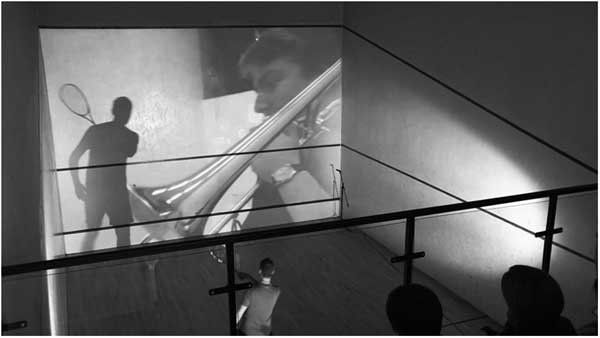
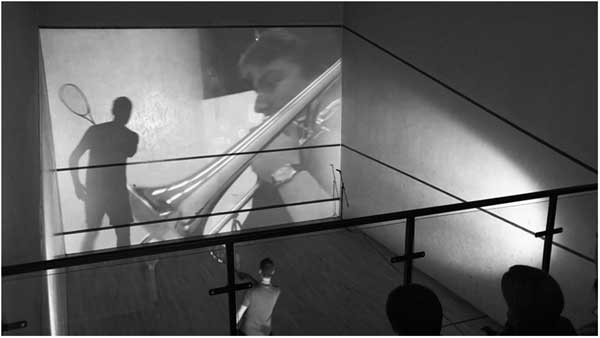
Play Footnote 8 (Movie example 1) is a site-specific project that took its site (the Queen’s University’s squash court building in Belfast) as the main material. It developed ideas around the specific place where the event happened – its architecture (modernist) with its particular use (sports facility), its acoustics (very reverberant, all courts connected through a common audience area), and its politically charged history (the grounds of a historical festival intended to ease of the tensions felt with the ‘Troubles’). Play was composed of live music (a brass ensemble), electronics, video projections and a live squash game, all converging towards transforming the perception of the site – as a physical and cultural space, politically contested and socially potential (Figure 1). All the sounds and the music were composed from recorded material of the space and its surrounding, allowing the audience to recognise a specific reverberation, or a local soundscape. The pitch content was determined by analysing the frequency content of those recordings. Moreover, the architectonic configuration of the spaces and their long reverberation times, conditioned the possibilities available to the musicians, who were playing different ‘musical games’. Music was explored as a game of resonance and reference, as an amplification of, and concentration on, the qualities of that site.
Last section in Play, the squash players’ shadows overlay the live feed projection of the brass ensemble, playing in the adjacent court.
Soundscape composition brings a different perspective to the discussion about site in music, through the referential dimension of sounds (Truax Reference Truax2008). It has become a field of enquiry about our relation to the environment through listening, and it is in this concern that it can constitute a rich methodology for the understanding of place.
For the composer, the sounds of environments bring new and enhanced meaning potentials in their reference to everyday life. From ‘composed versus natural structures’ (Barrett Reference Barrett2007: 249), to acousmatic versus referential sounds, soundscape composition questions the possibility of autonomy (through reduced listening), and the enhancement of ‘environmental listening and active engagement with our soundscapes’ through the ‘awareness of our role as sound-makers’ (Westerkamp cited in Barrett Reference Barrett2007: 249). Furthermore, soundscape composition can be a practice that ‘enhances our understanding of the world, and its influence carries over into everyday perceptual habits’ (Truax Reference Truax1996: 63). By including the sounds of the environment, composers contribute to the collective endeavour already in motion by other sound artists and ecologists, to fight against ‘an average practice of “listening-away”’, while developing the act of listening as ‘a manner of participating in the life of the world’ (Böhme Reference Böhme2012: 15).
In Travelogue #1 (Movie example 2) the approach to site is made not through reconfiguring or stressing the site of performance, but in a general way of inquiring about place. It is a four-channel soundscape composition that concentrates on specific soundscapes and aural architectures, all iconic spaces with a public history. Accompanying the sounds is a video projection with subtitles that identify the places where the sounds were recorded. Again, acoustic profiles are used to compose ideas about presence and place, while questioning notions of identity and memory, documentation and fiction, representation and presentation. As the atmospheres of other places contaminate that of the listening space, the listener’s body expands to a multiple affective space that merges remote places with present ones. If this piece (and also Apartamento em Lisboa) can relate to the listening site through diffusion, its attempt to stress the intensities of places might be a further contribution to create varied listening modes and to ‘participate in the life of the world’.
3.3. Drawing possibilities
By analysing how architects use drawings, we can re-imagine the use of the musical score. Drawing is a way of recording ideas, but also a form of thought and of communication. It can be understood as one of the factors behind the historical separation between the architect and the builder, as much as musical notation has been for the composer and performer.
In architecture, this separation allowed architects to distance themselves from the building site, establishing a new conceptual basis for the discipline – the drawing with its ‘disembodied but authoritative architectural presence’ (Robbins Reference Robbins1994: 36) becomes both a conceptual authority and a legal contract: an ‘instrument of cultural command … and of social power’ (ibid.: 48). This process is part of what Robbins has called the ‘essentialization’ of drawing – when drawing becomes essential in architectural practice and thought: ‘by essentializing drawing, architects have shifted the discourse about the built environment to issues that drawing can and does address best; i.e., formal, aesthetic, and cultural issues’ (ibid.: 49). Thus, and because ‘drawing conventions limit ideas of space … architecture will never move beyond the Renaissance world view, unless it challenges representation’ (Nesbitt on Peter Eisenman, in Nesbitt Reference Nesbitt1996: 65). This problem remains today, even after the promise of new possibilities brought by digital tools. New technology enabled a deeper control in the representation of form, material and physical space, thereby allowing new developments in architectural thinking and practice. However,
The goal of architectural practice is still highly predictable, especially in the way that representations remain focused on the production of buildings, and in the way that they remain static and lack the immersive qualities of phenomenal space … [Even] the use of parametric techniques to generate complex doubly curved geometries … is perhaps motivated by a move to create forms of architecture that while looking ‘new’ are still tied to the economic imperatives of late capitalism, and the traditional conception of the architect, defined through a particular set of narrowly delineated practices, remains uncontested. (Clear Reference Clear2013: 74)
On the other hand, other attempts aim at changing the representation process not specifically through technology, but by understanding and expanding the potentialities of drawing beyond its function as a descriptive tool (representing intended realities): be it as a learning method (in the observation and analysis of existing realities), or an experimental method (in the exploration of possible realities).Footnote 9
Jonathan Hill, in his book The Illegal Architect (1998), proposed a methodology, still useful today, to understand and transcend the limits of traditional representation, case by case, through
a threefold investigation of the architectural drawing. First, to consider how the drawing and architecture are similar and different; second, to develop new ways of visualising the qualities of architecture excluded from the drawing; and third, if these cannot be drawn, to find other ways to describe and discuss them. (Hill Reference Hill1998: 34)
These ‘other ways’ can be understood as an expansion of drawing, both through digital technologies, and interdisciplinary crossings where the architect embraces ‘the spatial possibilities offered by a whole range of design activities – actual, augmented and virtual’ (Clear Reference Clear2013: 72), while developing ‘forms of representation that are themselves speculative, immersive and time based’ (ibid.: 75). Because ‘architects do not make buildings; they make drawings of buildings’ (Robin Evans cited in Clear Reference Clear2013: 72), their discourse is embedded in drawing, and thus an interdisciplinary design research and ‘other challenging techniques’ are ‘a potential avenue to liberate architectural projections because it allows them to contain other disciplinary knowledge’ (Troiani and Carless Reference Troiani and Carless2015: 269).
Most of what has been said above can be transposed to composition. If notation began as a way to record music, it soon became a tool to observe, analyse, question and disseminate. In this process, the score distances itself from the performance and develops its own autonomy as a practice (the mystified composition) and as an object, contributing to what Lydia Goehr called the work-concept (Goehr Reference Goehr2007). Paraphrasing Robbins, by essentialising notation, composers have shifted the discourse about music to issues that notation can and does address best, that is, formal, aesthetic and cultural issues, neglecting and excluding many aspects of music that other non-conventional or post-literate Footnote 10 practices have developed, such as noise, or the complex social and political forces involved in its creation and performance. Thus, we can open notation to these dimensions by adopting Hill’s method proposed above, by analysing what in the score is similar and different from the music (what it excludes), by developing new ways of visualising those excluded qualities, and by finding new ways to describe those qualities that notation cannot access. This includes working with the many and diverse possibilities of graphic scores, as well as other non-conventional and interdisciplinary scores (sculptural, kinetic, sonic). ‘With notation that invites reflection and engagement (from both composers and performers) rather than execution, the notion of production becomes central’ (Rebelo Reference Rebelo2010: 20). By focusing on the generative and dialogical forces of an expanded idea of notation, on how it can convey information but also trigger creativity, scores become an open source of possibilities, where imagination (and authorship) is shared between performers and composers.Footnote 11 Today, alternative notations are a well-established practiceFootnote 12 and the development of digital tools keeps promoting a great variety of approaches from animated scores to variable content or interactive scores that allow new creative configurations between musicians. The score as a dialogical medium can be a social tool, capable of expanding music towards different social configurations and opening a wider and more permeable musical ontology.
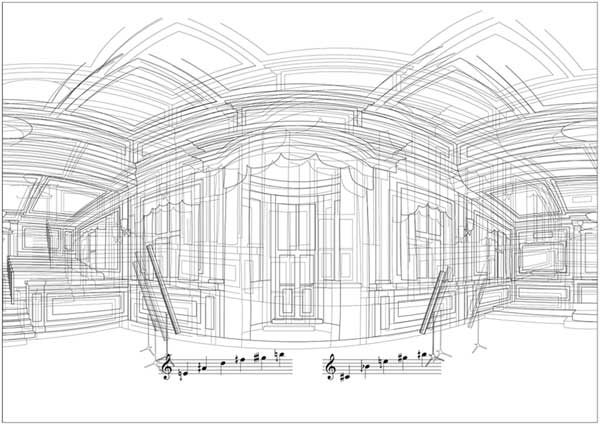
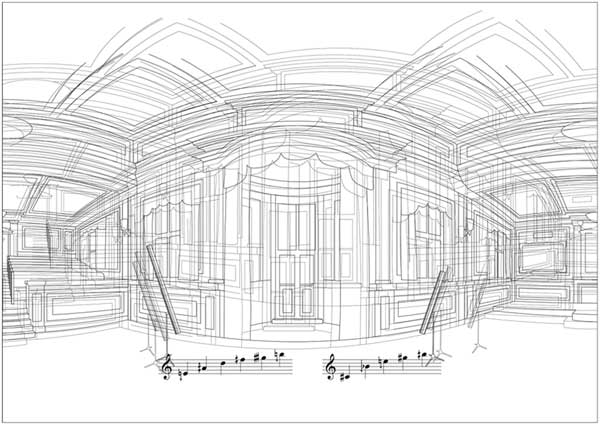
The score for Inside Out (Situation#) (Figure 2) is a graphic score consisting of several drawings that represent the performance space, the position of the pipes and their resonant pitches. It does not tell the performer what to play, but only informs (which pipes resonate which pitches) and suggests – gestures, sounds, atmospheres. It is a site-specific score, as it has to be designed for every new venue/installation. It is more than a representation or an indication of that space – it operates a metaphor for an open space of performative experimentation in which the performer may wander, explore, dwell.
Page 8 of the score for Inside Out (Situation#3), performed by Franziska Schroeder at Deptford Town Hall, Goldsmiths University London, October 2013.
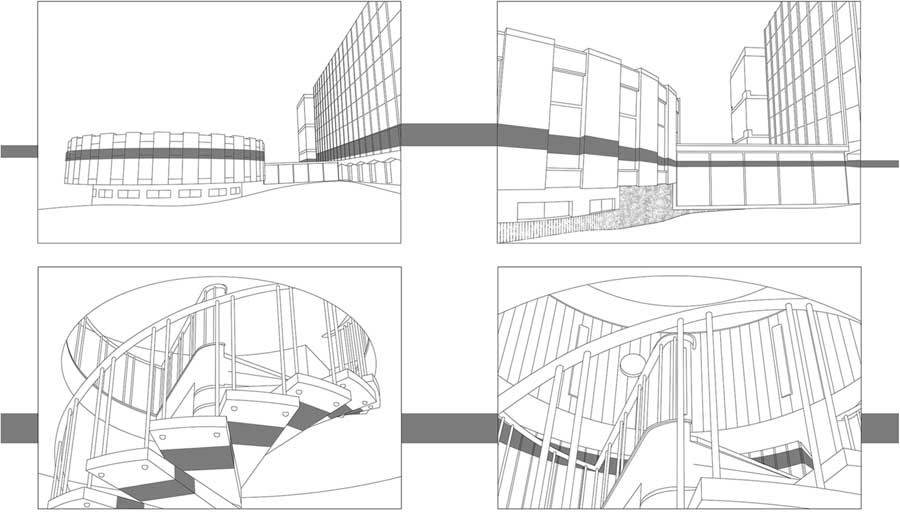
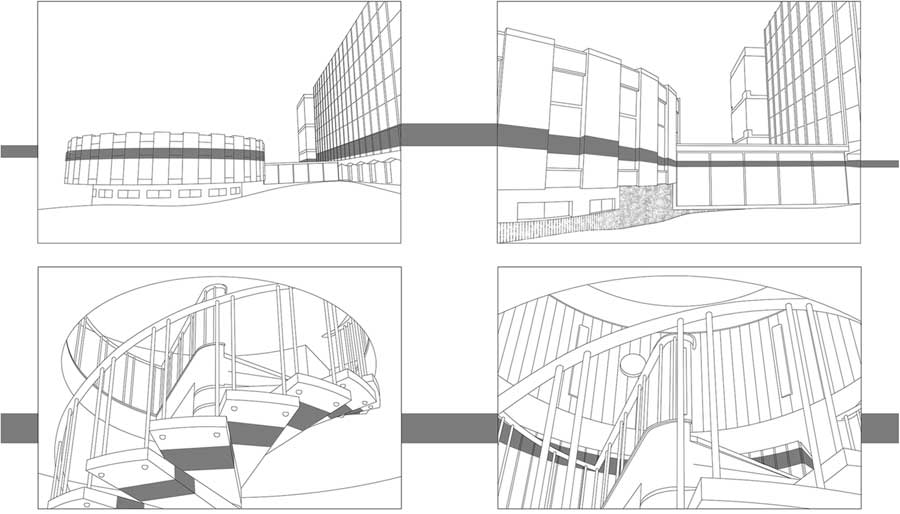
Tłumaczenie Footnote 13 (Sound example 4) for string quartet uses three different types of scores created from an analysis of one specific building.Footnote 14 The first part uses traditional (if extended) notation to establish sonorities that suggest specific material textures and architectural shapes; the second uses graphic scores (Figure 3) that represent parts of the building to suggest a sonic haptic transference; and the third uses a sound-score created from recordings made inside the building, proposing performance based on memory of its particular sonic configurations. These scores are not just interpreted but perceived as objects that suggest and affect, where the performers are given ‘a meaningful place in the construction of the work’ (Hanoch-Roe Reference Hanoch-Roe2003: 154).
Examples from the graphic score for Tłumaczenie (part II).
3.4. Programming concerns
Architects and composers plan, they programme, setting a framework for future events. The programme, as an agenda, is intrinsically political in that it can be an exercise of control: when it tries to determine every aspect of an architectural project or when, in music, it claims a meaning before listening has taken place. However, in architecture ‘programs are by definition unstable … programs have long ceased to be determinate, since they change all the time – while the building is designed, during its construction, and, of course, after completion’ (Tschumi Reference Tschumi1996: 20). As a consequence, there is ‘no necessary causal relationship between function and subsequent form, or between a given type and a given use’ (ibid.: 115). In other words, what architects programme will eventually create its own reality, independent from the one conceived. The programme as an instrument to condition use is very likely to fail.
Again the confrontation with music is useful. The programme can be a projection of control over what the music is about. In fact ‘programme music’ was based on the exercise of representing ideas external to music. Through the programme as a ‘preface’ to the music, ‘the composer intends to guard the listener against a wrong poetical interpretation’ (Liszt cited in Scruton: Reference Scruton2015) – the composer’s intended interpretation being the ‘right’ one to understand the objects represented. Here we can draw a parallel to Tschumi, by acknowledging that there is no causal relationship between programme and musical content. We could only say that an interpretation is wrong, if we believed the work has no value outside the composer’s intended meaning. If, as discussed earlier, meaning is constructed in the listening, then the relation between the intended, projected image of the composer and the experience of the work is close to arbitrary. It is exactly for that reason that programme notes need to be known in advance – to establish an artificial relation between unrelated ideas and percepts. This way, a programme, as a work of literary fiction, can become a device to bring the attention away from what the music is really about – be it its performance, its experience, its complex social arrangements, or even how it reflects and affects the tangible world.
To consider soundscape composition as programme music is equivocal. In fact, the disputed balance and ambiguous position it retains between an acousmatic and a more representational approach to sound (Drever Reference Drever2002) is still in debate.Footnote 15 It does, however, often present a narrative approach that could be described in programme notes. But a main difference lies in the fact that soundscape compositions rely on the listener’s ‘recognizability of the source material’ and ‘knowledge of the environmental and psychological context’ to ‘complete the network of meaning ascribed to the music’ (Truax Reference Truax1996: 63), while programme music projects the composer’s own emotions and vision of the world onto the work, claiming a predetermined meaning that needs to be understood (the ‘right’ poetical interpretation).
We can think of soundscape composition’s programmes as the establishment of a context, not a predetermination of content, but of concern, indicating what the work is about. Under this view, and expanding to other musical practices, to programme is to design situations, open possibilities, while not compromising different readings or interpretations. The programme is not just a framework, but a frame that contextualises the work. Lessons learnt from conceptual and performance art, the frame is always expandable, malleable, reframable. Perhaps never destroyed as without it ‘the picture’s form is undetectable’, and ‘the work leaks indiscernibly into the world’ (Kim-Cohen Reference Kim-Cohen2009: 243). It defines the limits, the margins between the work and the world, where composers exercise their ability to compose conditions for musical situations to emerge, instead of conditioning performance to a predetermined and idealised goal. Lessons learnt from poststructuralism and deconstructionism, ‘the contents of the margins … are more important than their location indicates’ (Nesbitt Reference Nesbitt1996: 150): it is on the periphery that internal and external concerns meet. The programme becomes a device to bring the attention towards the musical event and the circumstances surrounding its production and reception. Music is thus allowed to present itself, its situated manifestation, instead of trying (and failing) to represent something else.
This perspective can be traced back to composers such as Satie or Cage, where we find an agenda concerned with the different issues indicated: the absurdity of musical institutions, the rejection of the authoritarian control of the composer, the relevance of neglected sounds, etc. More recently, some composers and sound artists are exploring the idea of a conceptual sonic art, importing Duchamp’s gesture in the visual arts to the sonic arts.Footnote 16 Nevertheless, some criticism has pointed to a contradiction in terms that represents ‘a nostalgic desire for the semantic strength of conceptual art’ (Iddon Reference Iddon2016: 36), something music cannot afford with its ‘semantic “weakness” … its difficulty in depicting specific “things” in ways which are generally communicable without commentary which goes beyond the musical’ (ibid.: 37). Conceptual music, as a critique of autonomy, of ‘the sheltered spaces of “new music”’ (ibid.: 48) and their neglect of the political (who is given a voice and not), merely relocates autonomy: ‘though the insistence on new work being technically well made may subside, this is only replaced by an insistence that new work be well conceptualised’ (ibid.). The perspective of musical programme presented here is focused on an effort to understand music as political, not in what it represents, or in its internal structures, but in what it concretises, how it relates and affects, what it affords: ‘One must then no longer look for the political role of music in what it conveys, in its melodies or discourses, but in its very existence’ (Attali Reference Attali1985: 122).
Composing can be an exercise of programming by framing, and the margins are the permeable site that provides the compositional material, converting context into content, allowing the world to leak into the work.
In Tłumaczenie I developed a dense programme that uses architecture as a pretext to expose and question different musical problems, while investing in the collaborative creativity of the quartet. By defining a complex network of extra-musical references, the programme suggests different layers of concerns. First, an existing modernist building works as a guide to explore a translation of architectural elements to musical ones, and becomes a site of enquiry into the mode, and even the very possibility of that translation. The listening experience is contaminated by the speculation of how that process is being pursued. Some gestures might suggest a certain type of more or less direct formal or rhythmic translation, while texture provides a rich analogue, but the parallel is inevitably frustrated by the impossibility of a linear narrative that describes architecture musically.
Second, I made explicit references to a different artist in each of the three parts of the piece. These were used not only as methodological approaches that inform how the processes are being carried out, but also as concrete historical references that suggest or indicate other layers of meaning (perhaps a meta-programme): that there is a strong phenomenological approach to the work (Krzysztof Penderecki’s Second String Quartet and its sonorism); that there is also a conceptual proposition where the content is constantly re-situated (Edward Krasiński’s ubiquitous blue line);Footnote 17 and that there is a reaffirmation about the impossibility of translation (Stanisław Lem’s His Master’s Voice and its indecipherable signal). Furthermore, the coincidental date of these four references (1968) hints at a larger sphere of conceptual connections that arose from that particular hinge of history.
3.5. Useful music
The use of buildings or musical works is something unpredictable that happens after the artist’s plan, beyond the artist’s agency. Use goes beyond the concept of function to embrace notions that flow towards more complex and transformative human needs. Beyond utility, use is an existential postulate that evokes the possibility of the free act. The discussion about how music is used reveals, as in architecture, several questions that implicate directly on the composer’s activity.
A conception of architecture, not as building or object, but as ‘the gap between building and using’ (Hill Reference Hill1998: 26), an event, something that happens, situates architecture in a distributed position that includes the building and the action that takes place in it, that intrudes it, that happens in it: ‘[A]rchitecture … cannot be dissociated from the events that “happen” in it’ (Tschumi Reference Tschumi1996: 139). Thus architecture happens, becomes temporal, ‘it ceases to be a backdrop for actions, becoming the action itself’ (ibid.: 149). By acknowledging the reality of architecture’s occupation and its users, architects recognise ‘the political and the social content of architectural production’ (Wigglesworth and Till Reference Wigglesworth and Till1998: 9).
The idea of the musical work as a fixed object (again, Goehr’s work-concept) can be deconstructed in a similar way. Christopher Small’s notion of Musicking (Small Reference Small1998) – music as a practice – is just one example. Furthering the parallel with architecture, music can be understood as the gap between a composition, its performance and its listening, where composers, performers and audience are all different users and co-authors of a shared event. Music happens when it is experienced, in the spaces produced by its sounds and its social configurations. What this parallel with architecture seems to suggests is that a definition of music as event does not differ from a definition of architecture itself, as it lies equally in between a subject and an occupied object – which ‘is not necessarily a building, but can be a space, a text, artwork’ (Hill Reference Hill1998: 34) – a composition. Thus a rich metaphor for a composition as a programme is a building for use, where the performer is as much a user as the listener – both creative readers, always constructing ‘a new text in the act of reading’ (Hill Reference Hill1998: 26), and thus implicating as much in the political and social content of composition.
The pieces mentioned above, as many others today, show different possibilities of articulating use by working with different improvisatory settings, or experimental devices, interactive or simply open to variation. They tend towards a dispersion of the work-concept, allowing renewed configurations between the different types of users. In Inside Out there is a strong separation between what the composer defined and what the event is, each time it is performed. As an improvisatorial device, the tubes installation and the graphic score can be used in a variety of ways that avoid the crystallisation of the work. The focus is on how the performer takes action in that specific situation or site, originating always something new. Composition as a practice is not emancipated but relational. Working through a wide variety of different activities, its ultimate material is use, unforeseeable and transformative. Acknowledging use changes composition from being about ‘conditioning design’ to ‘designing conditions’Footnote 18 that allow the emergence of unpredictable relations and events.
4. CONCLUDING REMARKS
The insertion of architectural thought as strategy, or methodology into compositional practice, reveals a multiplicity of relationships between music and architecture that suggest an expanded practice of musical creation, one that explores the emergence of sound as the emergence of different types of spatial experiences (physical, social, political). The composer, much like the architect, plans a particular modulation of space used, thus their main production is not an object of contemplation, but a situation in space.
If a composition can be a building (a space to explore) and music can be architecture (an event), then the composer is an architect: not an organiser of form, but a planner of situations, an instigator of events, designing and orchestrating conditions towards a relational creativity that is not a reflection of society, but a project of sociality.