In paediatric cardiology, catheterisation of the heart and angiography are the frequently used invasive diagnostic methods.Reference Cil 1 It is possible for non-cardiac malformations to accompany many of the CHDs. Among these, kidney and urinary system abnormalities require special attention, as the urinary system abnormalities accompanying heart diseases are usually asymptomatic.Reference Barakat and Drougas 2 A survey of the literature reveals that CHDs and urinary system abnormalities are frequently encountered together. There are only few studies regarding the use of cineurographic images that may be obtained during diagnostic or interventional angiocardiography to identify the urinary system anomalies.Reference Ceviz, Eren and Karacan 3
In this study, the aim was to evaluate the cineurographic images obtained during angiocardiography performed in our centre between 1995 and 2015 in order to determine the frequency, distribution, and properties of urinary system anomalies accompanying heart diseases, and to find out the effectiveness of cineurographic images in detecting the urinary system anomalies.
Materials and method
Collection of the data
The data of the study come from the cineurographic images of 2022 patients obtained during diagnostic or interventional angiocardiography performed in the Department of Pediatric Cardiology between January 1995 and October 2015. Every patient that underwent angiocardiography was included in the study. The age range was 0–18 years. Patients that did not receive contrast were excluded from the study. Every patient was included only once in the analysis. The demographic characteristics and angiocardiography results of the patients were obtained from the records of angiocardiography reports, whereas the ultrasonography results and information on non-cardiac abnormalities were obtained from the hospital records. No further procedures were performed on the patients. The cineurographic images were obtained at the end of the process. We waited for few minutes until it was possible to get a suitable image. Otherwise, the patient was excluded from the study.
A virtual evaluation was performed by cineurography and was confirmed by ultrasonography.
Classification of the diseases
Cardiac diseases were classified into five different categories:
∙ Cyanotic – Fallot tetralogy, transposition of the great arteries, double-outlet right ventricle, total abnormal pulmonary venous return, single ventricle, Ebstein anomaly
∙ Non-cyanotic left-to-right shunted – ventricular septal defect, atrial septal defect, patent ductus arteriosus, atrioventricular septal defect
∙ Non-cyanotic stenotic – aortic stenosis, pulmonary stenosis, coarctation of aorta
∙ Complex cardiac anomalies – tricuspid atresia, pulmonary atresia, mitral atresia, single ventricle + pulmonary stenosis, truncus arteriosus
∙ Other heart diseases.
Urinary system anomalies were classified into four groups based on their anatomical location and the association between the heart diseases and the urinary system anomaly locations were evaluated. The classification of four groups is:
∙ Located on the right side
∙ Located on the left side
∙ Bilateral
∙ Others
Urinary system anomalies were separated into two groups in terms of their clinical severity. Renal agenesis, hydronephrosis, hydroureteronephrosis, ureteropelvic stenosis, and ureteral stenosis were considered to be clinically severe. Other urinary system abnormality diseases, like the pelvicalyceal ectasia, rotation anomaly, ectopic kidney, and ptosis, were considered clinically non-severe.
The ultrasonography records of the patients included in the study were also analysed. Cineurographic images were compared with the ultrasonography results in order to establish the accuracy of cineurographic evaluations in detecting the pathologies.
The Institutional Research Ethics Board approved this study, and consent was waived.
Statistics
The data analysis was performed using the statistics software package, Statistical Package for the Social Sciences 22.0; IBM Corp., Armonk, NY, United States of America. Data are described as frequencies, median with interquartile range, and means with SD, wherever appropriate. Normally distributed continuous variables were compared by analysis of variance techniques, whereas non-normally distributed continuous variables were compared using the Mann–Whitney U non-parametric method. The χ2-test and, when appropriate, Fisher’s exact test were used to test for differences in proportions.
Results
Urinary system anomalies were detected in 261 cases (12.9%) out of the 2022 cases included in our study. Among them, 148 were males (56.7%), while 113 were females (43.3%).
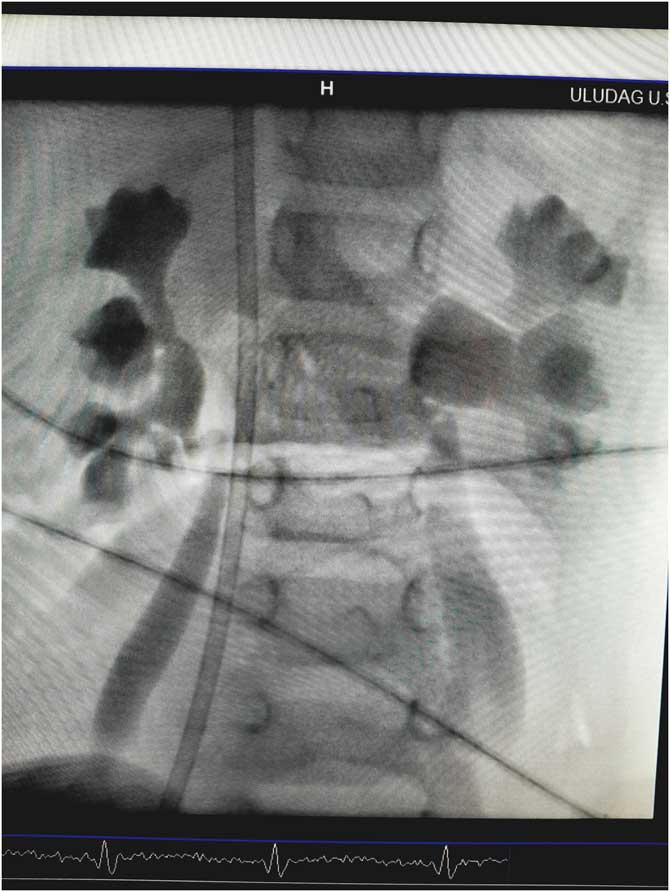
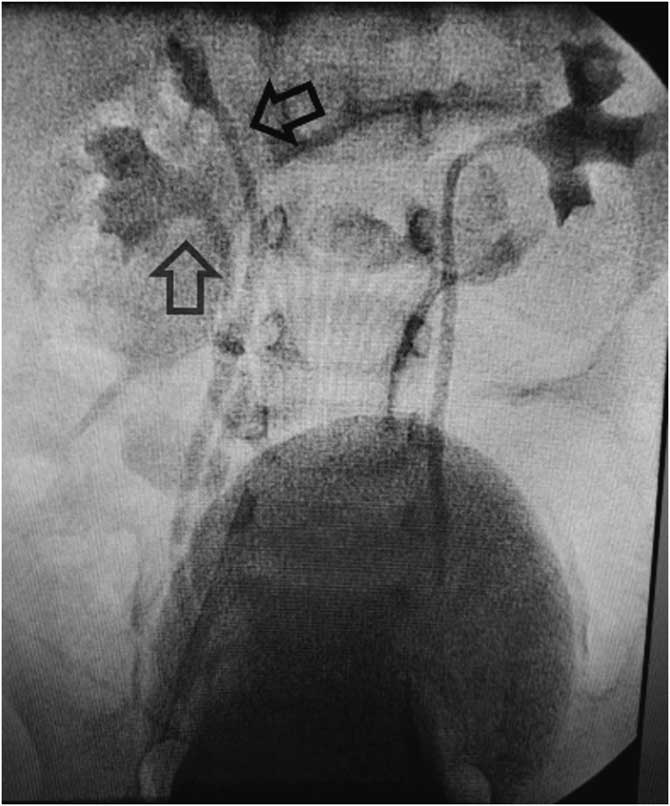
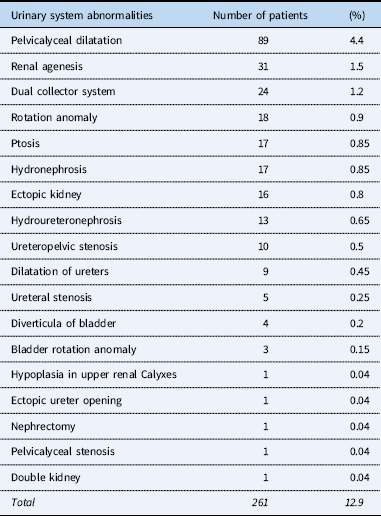
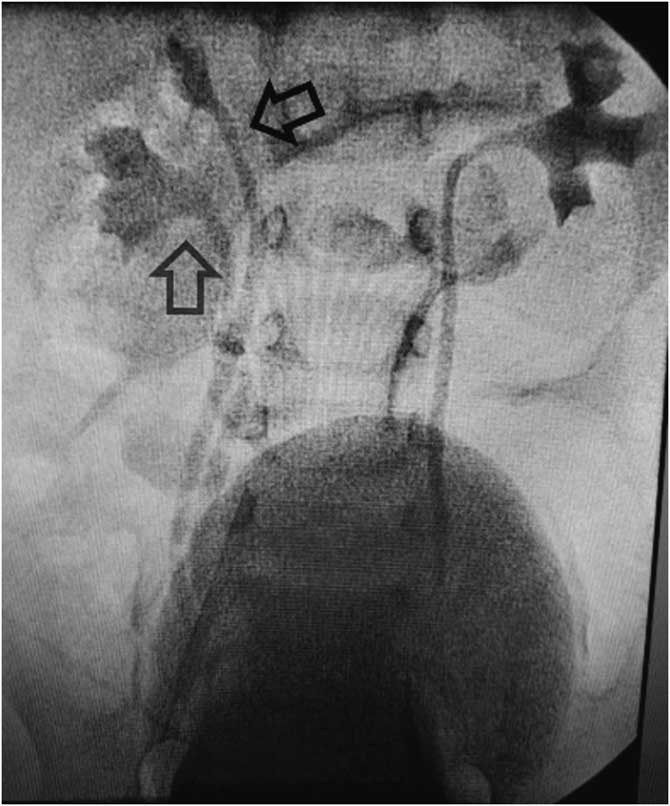
Table 1 summarises the distribution of urinary system abnormalities for the patients included in our study group. Pelvicalyceal ectasia was the most common anomaly, documented in 89/261 (34.1%) patients with anomalies. In terms of their clinical severity, 167 (64%) of the patients were determined to have clinically non-severe urinary system abnormalities, whereas 94 (36%) had clinically severe abnormalities. Figure 1 displays a representative cineurographic image from a patient with hydronephrosis, and Figure 2 demonstrates a double collecting system.
Bilateral hydronephrosis in one of our patients.

Double collecting system in the right kidney.
Distribution of urinary system abnormalities in our study group patients.

Urinary system abnormalities were classified into four groups based on their anatomical locations. Left-side urinary system anomalies were detected in 97 patients (32%), whereas 113 patients (43.3%) displayed right-side urinary system anomalies, and 34 patients (13%) had bilateral urinary system anomalies, whereas 17 (6.5%) had other urinary system anomalies.
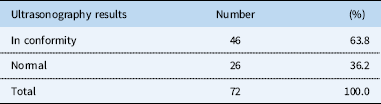
Ultrasonography records of the patients with urinary system abnormalities were also analysed. Ultrasonography was performed in 131 patients, and 26 patients (36.2%) were found to have normal ultrasonography image, whereas 46 of them (63.8%) had renal anomaly that was concordant with cineurographic images. Records of 58 of the cases (22.2%) were unavailable. Table 2 shows ultrasonography results of the patients in the study.
Ultrasonography results of the patients in the study.

Discussion
Catheter angiography is an invasive method performed in paediatric cardiology for either diagnostic or interventional purpose. It is possible to diagnose asymptomatic urinary system anomalies that accompany various cardiac diseases by means of cineurographic images that can be obtained during the process of angiocardiography.
Urinary system anomalies, which accompany cardiac diseases, are usually asymptomatic. Various studies have reported the frequency of accompanying urogenital system anomalies in children with CHDs to be between 4% and 23.1%.Reference Rosa, Rosa and Zen 4 It is important to diagnose these abnormalities in the preoperative period, particularly with complex cardiac pathologies. Furthermore, it is usually critical to identify some important renal abnormalities that can potentially results in end-stage renal disease without early diagnosis. There are many methods to make diagnosis of the renal abnormalities. Cineurography performed easily in the catheter laboratory at the end of the procedure is one of them. Ultrasonography could be used to confirm the diagnosis if there is any doubt in cineurographic images.
In our study, the frequency of urinary system anomalies accompanying the heart diseases detected by the cineurography images was found to be 12.9%. Various studies reported the frequency of urinary system abnormalities between 7.7% and 18.6% when only cineurography was used. In a study recently reported by the same authors of this study found the frequency of urinary system abnormalities as 18.6% in 295 patients that underwent catheter angiography.Reference Çil and Bostan 5 Another study has evaluated the cineurographic images of 680 patients and has detected urinary system abnormalities in 49 of the patients (7.2%).Reference Hoeffel, Méry and Worms 6
In our study, the heart disease most commonly accompanied by a urinary system anomaly was found to be the non-cyanotic left-to-right shunted cardiac diseases group (39.1%). Hoeffel et alReference Hoeffel, Méry and Worms 6 reported that the CHDs most commonly accompanied by urinary system abnormalities were the ventricular septal defect, pulmonary stenosis, and tetralogy of Fallot.
The most frequent urinary system abnormality detected in our study was the pelvicalyceal ectasia (34.1%). Other studies also reported the pelvicalyceal ectasia as the most commonly encountered urinary system anomaly.Reference Çil and Bostan 5 , Reference Pradat 7 , Reference Toprak 8
Of the cases where the cineurographic images were evaluated, clinically severe urinary system abnormalities were found in 94 of them (4.6%), whereas non-severe ones were detected in 167 cases (8.2%). Another study reported that in the post-angiocardiography cineurographic imaging of 450 patients, nine (2%) were found to have severe urinary system abnormalities, whereas 15 (3.5%) had non-severe ones.Reference Humphry and Munn 9 Our study revealed a higher frequency of clinically severe urinary system abnormalities. We thought that it was because of cineurography performed in all patients at the end of catheter angiography.
Considering the potential morbidities that may develop in the patients, these data reveal the significance of increased awareness on the subject.
Hospital records of the patients with urinary system abnormalities found with cineurography were also evaluated in our study and their ultrasonography results were compared. Ultrasonography was performed in only 72 cases (27.5%) and 46 of those (63.8%) were found to have results in conformity with the cineurography results. It was emphasised in other studies that cineurographic images must be confirmed with renal ultrasonography, particularly for the high-risk patients.Reference Semizel, Bostan and Çil 10 , Reference Tuson, McHugh and Archer 11 Since the retrospective feature of this study and because of most cases did not have ultrasonography evaluations, it is difficult to compare the effectiveness of cineurography and ultrasonography.
In conclusion, the patients with CHDs could have accompanying urinary system anomalies. Cineurography is an easy and practical screening method used to detect the clinically asymptomatic urinary system anomalies performed at the end of angiocardiography.
Even though most of the urinary system anomalies detected with this method are asymptomatic, it is also capable of finding out serious renal diseases like renal agenesis or advanced hydronephrosis. Furthermore, no additional contrast agent is required for this achievement, as the images are obtained after the filtration of the contrast agent normally used during the procedure in the kidneys.
It was emphasised that this method may lead to earlier treatment and improved prognosis for the patients, thus making it possible to prevent potential complications.
Acknowledgements
None.
Financial Support
This research received no specific grant from any funding agency, or from commercial or not-for-profit sectors.
Conflicts of Interest
None.