Significant outcomes
In males, impulsivity in adulthood is predicted already by low cholesterol levels in childhood.
Association between cholesterol and impulsivity in males is specific to maladaptive aspects of impulsivity.
The association between cholesterol and impulsivity is different in males and females of the same birth cohort.
Limitations
Impulsivity was self-reported.
Introduction
Low serum lipid levels have repeatedly been linked to several psychopathologies, including violent criminal behaviour (Repo-Tiihonen et al., Reference Repo-Tiihonen, Halonen, Tiihonen and Virkkunen2002), aggression towards others and self (Sahebzamani et al., Reference Sahebzamani, D’Aoust, Friedrich, Aiyer, Reis and Kip2013) and suicide (Daray et al., Reference Daray, Mann and Sublette2018). Impulsivity, being an essential feature of disruptive behaviour disorders (Dougherty et al., Reference Dougherty, Bjork, Marsh and Moeller1999), excessive risk taking (Eensoo et al., Reference Eensoo, Paaver, Vaht, Loit and Harro2018; Tokko et al., Reference Tokko, Eensoo, Vaht, Lesch, Reif and Harro2019) and pathologically aggressive (Barratt et al., Reference Barratt, Stanford, Dowdy, Liebman and Kent1999) or suicidal behaviour (Corruble et al., Reference Corruble, Damy and Guelfi1999), is one of the key elements of maladaptive behaviours associated with low cholesterol levels (Troisi, Reference Troisi2011). However, results of some studies have been in conflict with the assumption that cholesterol levels and impulsivity, aggressiveness or suicidality could be correlated in a general and linear manner (Corruble et al., Reference Corruble, Damy and Guelfi1999; Troisi, Reference Troisi2011; Tomson-Johanson and Harro, Reference Tomson-Johanson and Harro2018).
Meta-analyses conducted in adults or elderly population support the link between low levels of serum lipids and suicidality (Muldoon et al., Reference Muldoon, Manuck and Matthews1990; Wu et al., Reference Wu, Ding, Wu, Xie, Hou and Mao2015). In the same time, studies conducted in paediatric and adolescent psychiatric patients remain conflicting and are very scarce. In a study of 66 patients ranging from 8 to 18 years consecutively admitted to a psychiatric inpatient unit following attempted suicide, the levels of cholesterol were found to be significantly lower in attempted suicide patients compared to the inpatients who had not attempted suicide. Control subjects were paired with case subjects according to psychiatric diagnosis, age and gender (Plana et al., Reference Plana, Gracia, Méndez, Pintor, Lazaro and Castro-Fornieles2010). In contrast, in a similar study of 152 adolescent psychiatric inpatients aged 12–21 years, it was found that serum cholesterol levels were significantly higher in both male and female suicidal adolescent patients compared to the non-suicidal adolescents. Yet, within the suicidal group, but not in the total inpatient group, serum cholesterol correlated negatively with the degree of suicidal behaviour. No correlation between serum cholesterol levels and impulsivity was detected (Apter et al., Reference Apter, Laufer, Barsever, Hareven, Ofek and Weizman1999). Nevertheless, the age of the onset of the potential impact of cholesterol on behaviour may be of key importance.
Cholesterol is an essential structural component for cellular membrane and myelin. By forming microdomains with phospholipids, membrane rafts have been proposed to play active roles in a wide range of physiological processes, including signal transduction, protein sorting, cellular entry of viruses/toxins and apoptosis (Simons and Vaz, Reference Simons and Vaz2005). Both lack and surplus of cholesterol can have negative effects. It is well established that neuronal cells regulate their cholesterol content by a feedback mechanism that balances biosynthesis, import and excretion (Zhang and Liu, Reference Zhang and Liu2015). While the main sources of cellular cholesterol involve uptake from cholesterol-rich low-density lipoprotein (LDL) cholesterol or its de novo synthesis from acetyl-CoA, excessive cholesterol can be eliminated in the presence of high-density lipoprotein (HDL) cholesterol that acts as a lipid acceptor (Matsuda et al., Reference Matsuda, Nagao, Matsuo, Kioka and Ueda2013).
According to the classic theory of Engelberg (Reference Engelberg1992), lowered serum cholesterol concentration may contribute to a decrease in brain serotonergic neurotransmission via altered microviscosity, resulting in poorer suppression of aggression towards self and others. Cholesterol metabolism has a long-term effect on synaptogenesis, dendrite differentiation and axonal growth, thus being crucial for synaptic plasticity (Goritz et al., Reference Goritz, Mauch and Pfrieger2005). Cholesterol is also an essential component of neuronal physiology, is needed for synaptic growth and plays a crucial role during developmental stages (Mauch et al., Reference Mauch, Nagler, Schumacher, Goritz, Muller, Otto and Pfrieger2001).
Owing to the role cholesterol plays in neurodevelopment, children should be especially susceptible towards negative effects of low serum lipids. Yet while the association of serum lipid levels with various forms of aggression and impulsivity has been studied in adults in cross-sectional studies (Repo-Tiihonen et al., Reference Repo-Tiihonen, Halonen, Tiihonen and Virkkunen2002; Pozzi et al., Reference Pozzi, Troisi, Cerilli, Autore, Lo Castro and Ribatti2003; Vevera et al., Reference Vevera, Žukov, Morcinek and Papežová2003), cohort samples (Svensson et al., Reference Svensson, Inoue, Sawada, Charvat, Mimura, Tsugane and Sato2017), psychiatric patients (Bartoli et al., Reference Bartoli, Crocamo, Dakanalis, Riboldi, Miotto, Brosio and Carrà2017) and criminals (Hillbrand et al., Reference Hillbrand, Waite, Miller, Spitz and Lingswiler2000), such studies in children remain scarce. To our knowledge, there has been no investigation on whether serum lipid levels in childhood or adolescence would be associated with aggression or impulsivity in later life.
Aims of the study
The aims of the present study were to investigate the prognostic properties of serum lipid levels in childhood and adolescence on measures of impulsivity in early adulthood in a population-representative sample.
Material and methods
Sample
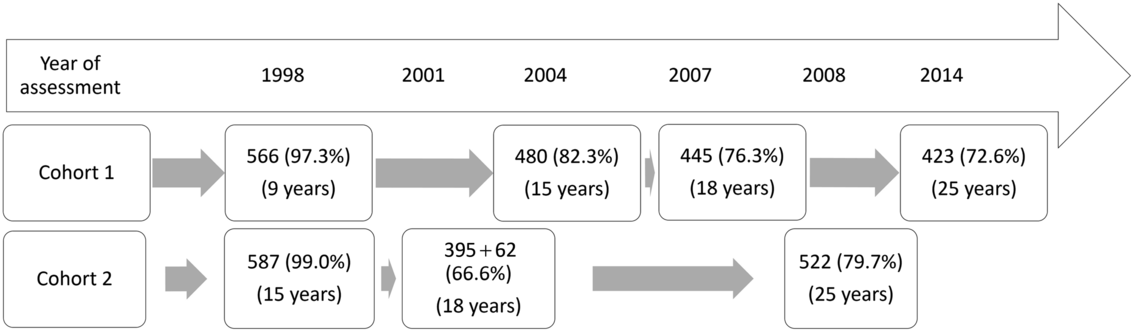
This study was carried out on the Estonian sample of the European Youth Heart Study (1998/1999), which was subsequently incorporated into the longitudinal Estonian Children Personality Behaviour and Health Study (ECPBHS). The European Youth Heart Study sample of the ECPBHS consists of two birth cohorts. The rationale and procedure of sample formation and further data collection waves have been described elsewhere in detail (Harro et al., Reference Harro, Eensoo, Kiive, Merenakk, Alep, Oreland and Harro2001; Tomson et al., Reference Tomson, Merenäkk, Loit, Mäestu and Harro2011; Roy et al., Reference Roy, Laas, Kurrikoff, Reif, Veidebaum, Lesch and Harro2018). In brief, all schools of Tartu County, Estonia, that agreed to participate (54 of the total 56) were included into the sampling using the probability proportional to the number of students of the respective age groups in the school, and 25 schools were selected. ECPBHS is highly representative of the birth cohorts of a local population, as 79% of subjects of the randomised regional sample participated in the original data collection. All the subjects are of European descent. The total number of subjects, for whom all data used in this paper were available, was 1160, 93.7% of the original sample. Schematic overview of the follow-up of the two cohorts is presented in Fig. 1. This study was approved by the Ethics Review Committee on Human Research of the University of Tartu, and written informed consent was obtained from all the participants and, in case of minors, from their parents.
Schematic overview of the follow-up of the two cohorts. Number of subjects with complete data on lipid levels and impulsivity available, percentage of original sample in brackets (in Cohort 2 at age 18 years, 62 new subjects were involved and the percentage at age 25 years indicates the proportion of original sample plus later included subjects).

Behavioural measures
Different facets of impulsivity (fast decision-making, excitement seeking, disinhibition, and thoughtlessness) were self-reported at 15, 18 and 25 years of age in both cohorts using the Adaptive and Maladaptive Impulsivity Scale [AMIS (Laas et al., Reference Laas, Reif, Herterich, Eensoo, Lesch and Harro2010)]. AMIS is an instrument for the measurement of distinct aspects of impulsivity developed on the basis of the concept of Dickman (Reference Dickman1990) functional and dysfunctional impulsivity. The subscales fast decision-making and excitement seeking form Adaptive Impulsivity, and disinhibition and thoughtlessness form Maladaptive Impulsivity. There are statistically significant, but weak, correlations between the subscales of Adaptive and Maladaptive Impulsivity (r = 0.1–0.3), while the subscales within Adaptive and Maladaptive Impulsivity are closely related (r = 0.52and 0.65, respectively; Laas et al., Reference Laas, Reif, Herterich, Eensoo, Lesch and Harro2010). Both the major aspects of impulsivity indicate openness to action with less forethought than risk free, but high Maladaptive Impulsivity has high harm risk, while Adaptive Impulsivity supports success by agility. Previously, AMIS has been applied in a series of studies on risk-taking behaviour and impulsivity-related candidate genes studies and found to have good predictive validity (e.g. Eensoo et al., Reference Eensoo, Paaver, Pulver, Harro and Harro2004; Paaver et al., Reference Paaver, Eensoo, Pulver and Harro2006; Laas et al., Reference Laas, Eensoo, Paaver, Lesch, Reif and Harro2015a,b, Reference Laas, Kiive, Mäestu, Vaht, Veidebaum and Harro2017; Luht et al., Reference Luht, Tokko, Eensoo, Vaht and Harro2019). Impulsivity data were available for 481 subjects at age 15 (Cohort 1 only, 260 females), 899 subjects at age 18 (509 females) and 935 subjects at age 25 (539 females).
At age 25, the Mini-International Neuropsychiatric Interview (MINI.5.0.0) (Sheehan et al., Reference Sheehan, Lecrubier, Sheehan, Amorim, Janavs, Weiller and Dunbar1998) Estonian version (Shlik et al., Reference Shlik, Aluoja and Kihl1999) was used to screen for current and lifetime psychiatric disorders. Diagnostic assessment was carried out by experienced clinical psychologists.
At the age of 18, maltreatment was assessed using the Tartu Family Relationships Scale, a self-reported scale that assesses relationships in the family and is composed of Estonian Children Personality, Behaviour and Health Study. Maltreatment scale comprises 17 Likert scale questions about misprize within the family and about emotional and physical abuse (Paaver et al., Reference Paaver, Kurrikoff, Nordquist, Oreland and Harro2008; Kiive et al., Reference Kiive, Kurrikoff, Maestu and Harro2010).
Blood lipid measurements
Fasting basal cholesterol (total cholesterol (TC), LDL and HDL) as well as triglyceride (TRG) levels were measured by conventional techniques in the Central Laboratory of the Tartu University Hospital and presented in mmol/l. The procedure was same for both cohorts throughout the study. The LDL data for sampling in 1998 were calculated based on the Friedewald formula (Winocour et al., Reference Winocour, Ishola and Durrington1989). In the follow-up studies, all serum lipid levels, including LDL cholesterol, were measured directly from the serum.
Smoking status and use of alcohol, narcotic substances and medications
Smoking status was assessed at the age of 25 years with the question whether participants had smoked in the last month, resulting in a two-point scale.
The subjects reported at the age of 25 whether they had consumed in the last year a certain type of alcohol at least once a month. Subjects were divided into low, medium and high alcohol use groups.
Illicit substance use was assessed at the age of 25 years with the question of whether participants had ever tried an illicit substance, resulting in a two-point scale.
Subjects reported the use of blood pressure medications and hormonal contraceptives by women at the age of 25. None of the subjects reported the usage of lipid-lowering drugs.
Statistical analysis
The effects of sex and age on serum lipid levels were studied using two-way analysis of variance (ANOVA) with Tukey post hoc test. To determine the predictive effects of serum lipid levels (TRGs, HDL, LDL and TC) at 9, 15 and 18 years of age on impulsivity traits at 25 years of age, one-way analysis of covariance (ANCOVA) was performed. The effects of serum lipid levels at each age group were tested separately; and for both sexes different models were constructed. In each analysis, an impulsivity measure (fast decision-making, excitement seeking, disinhibition, or thoughtlessness) was set as dependent variable; serum lipid level measured at specific time point as independent variable; and cohort, psychiatric disorders, medications, alcohol and illicit substance use, smoking and maltreatment as covariates. Outlier analysis was conducted to meet the ANCOVA assumption of normal distribution. Pearson correlation analysis was used to illustrate the strength of association of serum lipids with impulsivity measures and to investigate the relationship of impulsivity and serum lipid levels cross-sectionally at specific age. To omit any cohort effect both impulsivity and serum lipid levels were transformed into z scores within both cohorts. Serum lipid levels in males and females are innately different. To omit any sex effect on the link between serum lipid levels and impulsivity, males and females were analysed separately. The level of significance was set at p < 0.05. Statistical analyses were carried out using SPSS version 23 (IBM Corp, 2015).
Results
Description of the sample
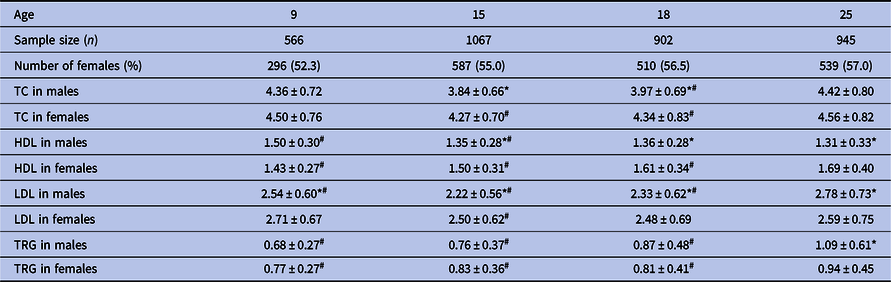
Sample characteristics, mean total, HDL, LDL cholesterol and TRG levels in males and females aged 9, 15, 18 and 25 years are presented in Table 1. Sex had a significant effect on total, HDL and LDL cholesterol [F(1,2833) = 79.9, 201.8 and 14.9, respectively; p < 0.001]. Mostly females showed significantly higher levels of lipids than males, with a few exceptions.
Characteristics of the analysed sample and an overview of the total, HDL and LDL cholesterol and triglyceride levels in different age groups

TC, total cholesterol; HDL, high-density lipoprotein cholesterol; LDL, low-density lipoprotein cholesterol; TRGs, triglycerides.
* p < 0.05, males versus females.
# p < 0.01, difference with serum lipid level at 25 years.
Values are given in mmol/l and expressed as mean ± SD.
Data of both birth cohorts were available, starting from the age of 15 years. For 15 years of age, serum lipid levels were compared with the recommended values of National Cholesterol Education Program Expert Panel on Cholesterol Levels in Children (1992). In the total sample, 72% of the participants had acceptable TC levels (<4.4 mmol/l), 22% had borderline high levels (4.4–5.2 mmol/l) and 6% had high levels (>5.2 mmol/l). In case of LDL cholesterol, 81% of the participants had acceptable levels (<2.8 mmol/l), 13% had borderline high levels (2.8–3.4 mmol/l) and 6% had high levels (>3.4 mmol/l). Of the participants, 80% had acceptable TRG levels (<1.0 mmol/l), 14% had borderline high levels (1.0–1.5 mmol/l) and 6% had high levels (>1.5 mmol/l). In all, 8% of the participants had low HDL cholesterol levels (<1.0 mmol/l), 8% had borderline low levels (1.0–1.2 mmol/l) and 84% had acceptable HDL cholesterol levels (>1.2 mmol/l).
The TC values of our sample at 9 years of age are in the same range as other studies. In a Norwegian study where blood samples of 1340 children were available at the age of 9 years, girls had the median TC values of 4.4 mmol/l and boys 4.2 mmol/l (Strand et al., Reference Strand, Fredriksen, Hjelle and Lindberg2018). In a Dutch study of 8071 children, the median value for 9-year-old boys was 4.1 mmol/l and for girls of the same age it was 4.2 mmol/l (Balder et al., Reference Balder, Lansberg, Hof, Wiegman, Hutten and Kuivenhoven2018). In a study where 23 cohorts of children from Europe and United States (total 22 479 observations) were pooled, the mean reference values of TC in girls were 4.4 mmol/l and in boys 4.25 mmol/l (Stavnsbo et al., Reference Stavnsbo, Resaland, Anderssen, Steene-Johannessen, Domazet, Skrede, Sardinha, Kriemler, Ekelund, Andersen and Aadland2018). As expected, the cholesterol levels correlated intra-individually; detailed information on this is provided in Supplementary Table 1.
Longitudinal analyses
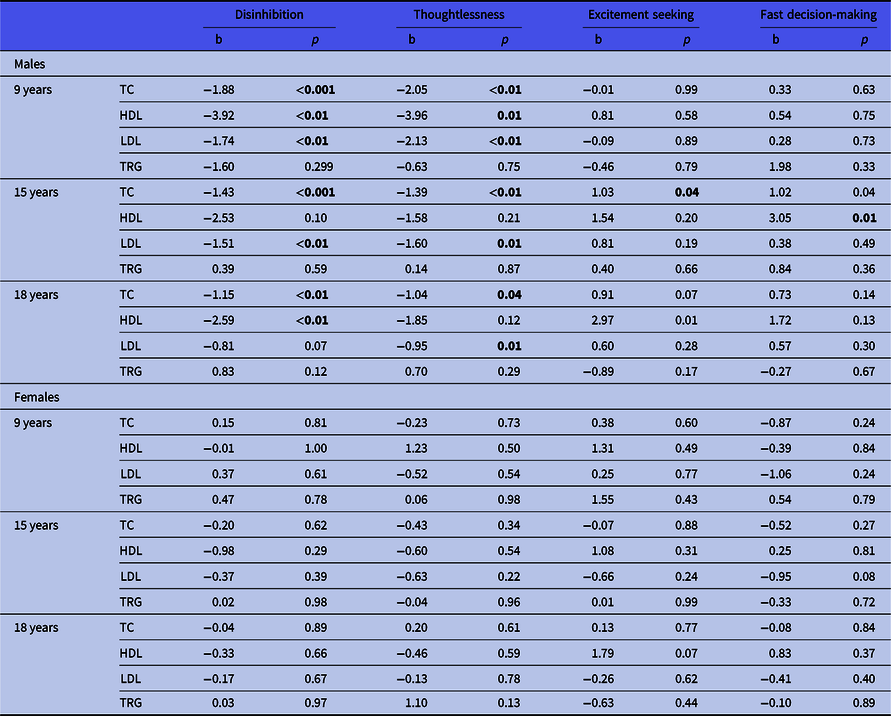
In males, according to ANCOVA models, impulsivity measures at 25 years were predicted by serum lipid levels as early as 9 years of age (Table 2). Both TC and LDL at 9, 15 and 18 years predicted disinhibition and thoughtlessness, both components of Maladaptive Impulsivity at 25 years. As to the facets of Adaptive Impulsivity, excitement seeking at 25 years was predicted only by TC at 15 years. Fast decision-making at 25 years was predicted by HDL cholesterol at 15 years.
Results of ANCOVA predicting impulsivity measures at 25 years of age based on serum lipid levels separately at 9, 15 and 18 years of age by gender

ANCOVA, analysis of covariance; TC, total cholesterol; HDL, high-density lipoprotein cholesterol; LDL, low-density lipoprotein cholesterol; TRG, triglycerides.
p-value marked in bold while significant at p < 0.05.
Covariates included cohort, psychiatric disorders, medications, alcohol and illicit substance use, smoking and maltreatment. Regression coefficients b presenting the effect size and direction and p-values are presented.
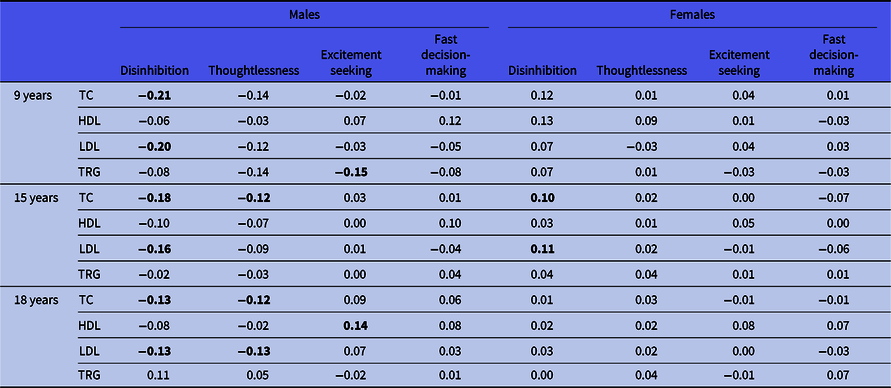
Correlation analyses without covariates were similar to the results with ANCOVA (Table 3). In most cases where serum lipid levels had predicted impulsivity measures at 25 years, the correlation also reached statistical significance.
Correlations between serum lipids at 9, 15, and 18 years, and impulsivity measures at 25 years, separately in males and females

Correlations of total cholesterol (TC), HDL cholesterol (HDL), LDL cholesterol (LDL) and triglycerides (TRG) with the impulsivity measures are in bold while significant at p < 0.05.
Significant correlations between serum lipid levels and impulsivity measures in males were negative, while in females these correlations were positive. While correlation was borderline significant between disinhibition measured at 25 years and total and LDL cholesterol at 15 years in females, it was not significant in ANCOVA model and thus can be attributed to the effect of covariates.
Adjusted r 2 was above 0.2 for models where disinhibition was predicted by total, HDL or LDL cholesterol measured at 9, 15 or 18 years. Surprisingly, this was the case for both men and women. In men, thoughtlessness predicted by total or LDL cholesterol measured at 9 years had an adjusted r 2 value of over 0.2.
Cross-sectional correlation analyses
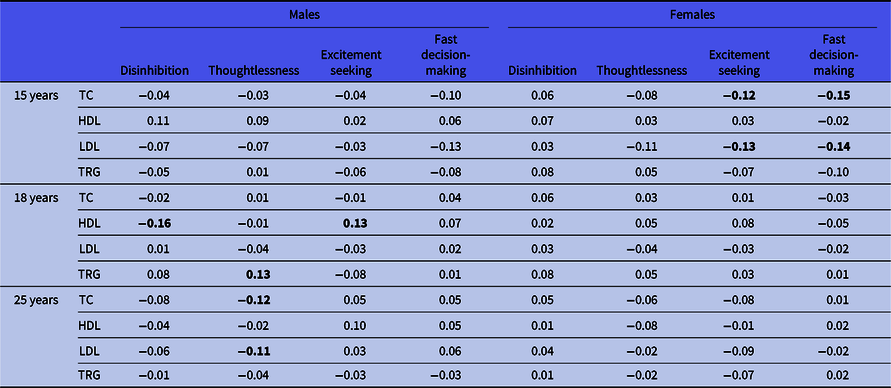
When impulsivity and serum lipid levels were examined cross-sectionally at age 15, 18 or 25 years, a few statistically significant correlations emerged (Table 4), but these were not very systematic. Perhaps most interesting was the finding of negative correlations between total and LDL cholesterol and both facets of Adaptive Impulsivity in females at age 15 years. Nevertheless, these correlations completely disappeared after puberty. In males, cross-sectional negative correlations of TC and LDL with Maladaptive Impulsivity emerged by age 25 years but only with the thoughtlessness facet (Table 4).
Correlations between serum lipid levels at 15, 18 and 25 years and impulsivity measures at the same respective age, separately in males and females

Total cholesterol (TC), HDL cholesterol (HDL), LDL cholesterol (LDL) and triglycerides (TRG) correlations with impulsivity measures are in bold while significant at p ≤ 0.05.
Discussion
We have found that, in males, impulsivity self-reported at 25 years of age was predicted by total and LDL cholesterol levels measured as early as 9 years of age. Indeed, correlations between cholesterol levels and impulsivity were higher at younger age and became lower as the subjects matured while remaining statistically significant throughout adolescence. This suggests that the oft-observed association between cholesterol levels and impulsive behaviour becomes established at early age and may, if anything, rather weaken under the influence of a variety of lifetime factors affecting blood lipid levels as well as impulse control regulation. Hence, the inconsistency between studies with regard to cross-sectional correlations may reflect the variability of confounding factors between samples.
While cognitive styles involving fast decision-making and excitement seeking are weakly related to disinhibition and thoughtlessness at a higher order level (Laas et al., Reference Laas, Reif, Herterich, Eensoo, Lesch and Harro2010), association of only Maladaptive Impulsivity with cholesterol levels suggests that the impact of cholesterol is specifically on those neurodevelopmental mechanisms that are responsible for the dysfunctional aspects of impulsivity. While serum lipid levels have been historically associated with impulsivity, several authors have drawn attention to the heterogeneity between sexes in that matter (Tomson et al., Reference Tomson, Vaht, Laas, Veidebaum and Harro2016; Eriksen et al., Reference Eriksen, Bjørkly, Lockertsen, Færden and Roaldset2017). Considerable number of studies that included both sexes has found the association between cholesterol and impulsivity only in males (Muldoon et al., Reference Muldoon, Manuck and Matthews1990; Lindberg et al., Reference Lindberg, Rastam, Gullberg and Eklund1992; Golier et al., Reference Golier, Marzuk, Leon, Weiner and Tardiff1995; Wu et al., Reference Wu, Ding, Wu, Xie, Hou and Mao2015). The studies where association has also been found in females remain rather conflicting. For example, the study by Svensson et al. (Reference Svensson, Inoue, Sawada, Charvat, Mimura, Tsugane and Sato2017) found, by analysing 16 341 men and 28 905 women aged 40–69 from the Japan Public Health Centre-based Prospective Study followed from 1990 to 2012, that suicide mortality was associated with high serum TC in women. No association was found between TC levels or lipid fractions and suicide in men. Similarly in the study by Siegman et al. (Reference Siegman, Malkin, Boyle, Vaitkus, Barko and Franco2002), the impulsive anger-out significantly predicted high total and LDL cholesterol and TRG levels but only in physically unfit women. In our study disinhibition in 25-year-old women was correlated with high levels of total and LDL cholesterol in 15 years old girls.
The gender differences may relate to the central serotonergic function, one of the possible mediators of serum lipid levels and impulsivity (Steegmans et al., Reference Steegmans, Fekkes, Hoes, Bak, van der Does and Grobbee1996; Terao et al., Reference Terao, Nakamura, Yoshimura, Ohmori, Takahashi, Kojima and Okuno2000; Vevera et al., Reference Vevera, Žukov, Morcinek and Papežová2003; Luht et al., Reference Luht, Tokko, Eensoo, Vaht and Harro2019). Serotonin pathways function as a behavioural restraint system that inhibits impulsive behaviour (Miyazaki et al., Reference Miyazaki, Miyazaki and Doya2012). A number of studies have suggested major differences between males and females in a variety of measures of the serotonergic system as well as in their functional associations (e.g. Nishizawa et al., Reference Nishizawa, Benkelfat, Young, Leyton, Mzengeza, de Montigny and Diksic1997; Walderhaug et al., Reference Walderhaug, Magnusson, Neumeister, Lappalainen, Lunde, Refsum and Landro2007, Reference Walderhaug, Herman, Magnusson, Morgan and Landro2010; Jovanovic et al., Reference Jovanovic, Lundberg, Karlsson, Cerin, Saijo, Varrone and Nordström2008; Kotting et al., Reference Kotting, Bubenzer, Helmbold, Eisert, Gaber and Zepf2013; Soloff et al., Reference Soloff, Chiappetta, Mason, Becker and Price2014). Similarly, studies on gene–environment interactions, with genes having major impact on serotonin function and on platelet monoamine oxidase (MAO) that reflects capacity of the central serotonergic system (Harro and Oreland, Reference Harro and Oreland2016), consistently support the notion that the role of serotonin system in behavioural regulation is not identical in males and females.
Cholesterol may influence the conformation and function of membrane-bound proteins and receptors by reducing neuronal membrane fluidity and increasing the mechanical strength of the membranes. Mechanisms underlying the association between cholesterol and serotonin activity have not yet become clear; however, it has been suggested that both high and low cholesterol levels may lead to lower serotoninergic activity (Papakostas et al., Reference Papakostas, Öngür, Iosifescu, Mischoulon and Fava2004). The rigidity of cholesterol-enriched membrane can alter or disrupt the function of lipid rafts (Björk et al., Reference Björk, Sjögren and Svenningsson2010) where a variety of neurotransmitter receptors operate (Bruses et al., Reference Bruses, Chauvet and Rutishauser2001; Sooksawate and Simmonds, Reference Sooksawate and Simmonds2001; Suzuki et al., Reference Suzuki, Ito, Takagi, Saitoh, Nawa and Shimizu2001). Low serum lipid levels have been found to influence the conformation and function of membrane-bound proteins and receptors (Ohvo-Rekila et al., Reference Ohvo-Rekila, Ramstedt, Leppimaki and Slotte2002) and, amongst others, to modulate the affinity of serotonin receptor agonists and serotonin transporter activity (Scanlon et al., Reference Scanlon, Williams and Schloss2001; Pucadyil and Chattopadhyay, Reference Pucadyil and Chattopadhyay2004; Sjöegren et al., Reference Sjöegren, Hamblin and Svenningsson2006). Other factors that could influence serum lipid and impulsivity association include age, nutritional status, substance (including alcohol) abuse, medication and lifestyle. Epidemiological studies relating impulsivity and serum lipids are limited by the fact that adults commonly have clinically problematic serum lipid levels. High TC levels can be a result of negative lifestyle choices that subjects have been exposed to for decades, which have been potentially managed with statins over a long period of time (Asellus et al., Reference Asellus, Nordström, Nordström and Jokinen2014; Naiberg et al., Reference Naiberg, Newton, Collins, Bowie and Goldstein2016; Bartoli et al., Reference Bartoli, Crocamo, Dakanalis, Riboldi, Miotto, Brosio and Carrà2017). One of the strengths of the current study is inclusion of children starting from the age of 9 years into the longitudinal design, who because of their young age have been exposed to possible confounding factors to a lesser extent. Several factors like demographics, biochemical factors and adverse childhood experiences have been shown to have an effect on the relationship of cholesterol and impulsivity (Bartoli et al., Reference Bartoli, Crocamo, Dakanalis, Riboldi, Miotto, Brosio and Carrà2017; Kraav et al, Reference Kraav, Tolmunen, Kärkkäinen, Ruusunen, Viinamäki, Mäntyselkä, Koivumaa-Honkanen, Valkonen-Korhonen, Honkalampi, Herzig and Lehto2019). By adding several covariates such as presence of psychiatric disorders, medications, alcohol and narcotic substance use, smoking and maltreatment to our statistic model, we have, however, eliminated their possible effect on the relationship of serum lipid levels and impulsivity in this age range. Also, the birth cohort representative design of the study decreases the bias caused by the confounding factors on the association of impulsivity and serum lipid levels. Nevertheless, confounding factors demand careful consideration in the future research.
Literature is inconsistent with regard to which lipid fractions could be the best predictors of psychopathologies associated with impulsivity. Low total serum cholesterol as well as low HDL cholesterol has been shown to predict violent behaviour during the follow-up in patients released after treatment at a psychiatric ward (Roaldset et al., Reference Roaldset, Bakken and Bjørkly2011; Eriksen et al., Reference Eriksen, Bjørkly, Lockertsen, Færden and Roaldset2017). In patients with schizophrenia (Mensi et al., Reference Mensi, Messaoud, Mhallah, Azizi, Salah, Douki and Gaha2016) and major depressive episode (Messaoud et al., Reference Messaoud, Mensi, Mrad, Mhalla, Azizi, Amemou and Gaha2017), low levels of TC have been proposed as surrogate markers for impulsivity and suicidality. In schizophrenic patients, LDL cholesterol levels have been recommended as a potential marker (Kavoor et al., Reference Kavoor, Mitra, Kumar, Sisodia and Jain2017). The results of the current study are in agreement with works showing that LDL and TC, rather than HDL cholesterol, are predictive of impulsivity, but this could vary within specific patient groups.
In the current study, disinhibition and thoughtlessness in males were predicted by total and LDL cholesterol but not by TRG level. The interaction of serum lipid levels and impulsivity may have behavioural background. TRGs have been used in previous literature to control for the nutritional intake effect on the association of cholesterol and impulsivity (Kaplan et al., Reference Kaplan, Muldoon, Manuck and Mann1997). Previous research has shown that considerable number of patients with higher body mass index, TRGs and cholesterol may have maladaptive nutritional behaviours such as binge eating. An association between binge eating and suicide attempts and suicidal ideation has been described in the literature (Favaro and Santonastaso, Reference Favaro and Santonastaso1997). Our study suggests that cholesterol levels are predicting impulsivity independently of TRGs, and thus it can be hypothesised that nutritional intake has not played a role in the interaction of impulsivity and serum lipid levels as a confounding factor.
In contrast to the longitudinal analysis, the cross-sectional analyses did not result in a coherent outcome. This is not surprising. While many studies show an association between low serum lipids and problematic behaviour including impulsivity, certain studies failed to find such an association. For example, the results of the Coronary Artery Risk Development in Young Adults study conducted in 4240 young adults aged 23–35 showed that while persons in the lowest 10% of plasma TC, LDL cholesterol, HDL cholesterol, and TRG levels were compared with the other participants in each race/sex group, using standardised measures of hostility, anger suppression, depressive symptoms and anxiety, low cholesterol levels were not related to any of the psychological measures in any race or sex group (Markovitz et al., Reference Markovitz, Smith, Raczynski, Oberman, Williams, Knox and Jacobs1997). Similarly, Fowkes et al. (Reference Fowkes, Leng, Donnan, Deary, Riemersma and Housley1992) failed to show the association between aggression and low serum lipids in a random sample of 1592 men and women aged between 55 and 74 years. A possible explanation to these inconsistencies is that low serum lipid levels have an effect on behavioural measures only during a specific period, not throughout the life. In addition, cross-sectional relationships may be inconsistent simply because the impulsive behaviour is a developmental outcome of interaction of past cholesterol levels and accumulating experiences. Cross-sectionally measured serum lipid levels may not adequately represent the effect lipids have on behavioural measurements. Cholesterol is an essential component of the cell membranes and is crucial especially during the sensitive time of neurodevelopment. Our results that highlight the importance the childhood serum lipid levels have on impulsivity in adulthood rather than impulsivity measured cross-sectionally are in line with the neurodevelopmental studies highlighting the role of cholesterol during childhood and early adolescence. During that period, the development of prefrontal cortex, part of the brain highly involved in the control of impulsivity, takes place (Casey et al., Reference Casey, Getz and Galvan2008; Steinberg, Reference Steinberg2008). During childhood and early adolescence, the prefrontal cortex and parietal lobes begin a period of prolonged pruning of neuronal axons resulting in thinning of cortical grey matter. It is hypothesised that pruning in the prefrontal cortex represents the growth of frontal control over impulsive behaviour (Romer, Reference Romer2012). While most cross-sectional analysis find an association between low serum lipid levels and high impulsivity in males, our results indicate that it can be helpful to measure cholesterol levels during childhood itself, the time when neurodevelopmental processes pave the road to future impulsivity.
Cholesterol metabolism is much more active in the first two decades of human life (Björkhem et al., Reference Björkhem, Lutjohann, Diczfalusy, Stahle, Ahlborg and Wahren1998) when external stressful events, such as interpersonal violence, are hypothesised to have larger developmental consequences for a young individual. This has been shown in a study of 81 adult who attempted suicide, with age ranging between 18 and 68 years where only in patients with serum cholesterol below the median (median 4.9 mmol/l), the correlation between exposure to violence as a child and used adult violence was significant (r = 0.52, p = 0.002); while in patients with serum cholesterol above the median, the correlation between exposure to violence as a child and expressed violent behaviour as an adult was not significant (r = 0.25, p = 0.2) (Naiberg et al., Reference Naiberg, Newton, Collins, Bowie and Goldstein2016).
In conclusion, low total and LDL cholesterol levels predict high impulsivity in adult males starting from early childhood itself, which continues throughout adolescence. Since cholesterol levels have a great impact on the development of impulsivity starting from early age and continuing throughout adolescence, they should also be monitored in psychiatry and early on.
Supplementary material
To view supplementary material for this article, please visit https://doi.org/10.1017/neu.2019.48
Acknowledgements
We are grateful to all participants of the ECPBHS team. This work was supported by Estonian Research Council Projects IUT20-40 and IUT42-2, the European Commission Seventh Framework Programme (FP7 2007-2013) Project Aggressotype (n°602805), Horizon 2020 Programme Projects CoCA (n°667302) and Eat2beNICE (n°728018).
Author contributions
KTJ designed and wrote the manuscript. TK, RAK and TV critically reviewed and edited the manuscript. JH designed, wrote and edited the manuscript. All authors critically reviewed the content and approved the final version for publication.
Conflicts of interest
None.
Ethical standards
The authors assert that all procedures contributing to this work comply with the ethical standards of the relevant national and institutional committees on human experimentation and with the Helsinki Declaration of 1975, as revised in 2008.