Introduction
Mammals are particularly vulnerable to environmental changes during the lactation period that could induce neuroendocrine adaptations and compromise health at adulthood. The “Development Origins of Health and Diseases” (DOHaD) hypothesis aims to explain the impact of environmental changes during early life stages. Reference Barker1 Chemicals and drugs exposures are important factors that are capable of programming the progeny to a deregulated metabolism in later life. Reference Haugen, Schug, Collman and Heindel2 As an example, nicotine, the major addictive compound present in cigarette smoke, has already been described as a chemical disruptor that changes milk supply and composition, Reference Bahadori, Riediger, Farrell, Uitz and Moghadasian3,Reference Horta, Victora, Menezes and Barros4 affecting the baby’s health at short and long term. Reference Napierala, Mazela, Merritt and Florek5,Reference Somm, Schwitzgebel and Vauthay6 Nicotine is an important emerging pollutant that can be found on surfaces, Reference Marcham, Floyd, Wood, Arnold and Johnson7 water, Reference Anastopoulos, Pashalidis and Orfanos8 soil, air Reference Selmar, Radwan and Abdalla9 and even in pregnant woman’s hair. Reference Li, Li and Zhang10 We have previously demonstrated that maternal nicotine exposure during lactation compromises rat offspring’s phenotype at long-term in a sex-dependent manner: male offspring showed, at adulthood, obesity, normophagia, despite hypothalamic leptin resistance, hyperleptinemia, hypercorticosteronemia and hypothyroidism, while female offspring had normal body mass, despite hyperphagia, unchanged leptinemia and corticosteronemia, but hyperthyroidism. Reference Miranda, Gaspar de Moura and Lisboa11-Reference Peixoto, Moura and Soares13
Several different mechanisms have been associated with endocrine dysfunctions, some of which have been linked to obesity onset. Studies have already described an interaction of a disturbed endocannabinoid system (ECS) with endocrine system changes and obesity. Reference Hillard14-Reference Zdanowicz, Kazmierczak and Wierzbinski16 The ECS acts in many physiological processes, both in the central nervous system (CNS) Reference Hu and Mackie17 and in peripheral tissues, Reference Ruminska and Dobrzyn18 via signaling pathways that depend on enzymatic machinery. The endogenous cannabinoids N-arachidonoylethanolamine (AEA) and 2-arachidonoylglycerol (2-AG) are derived from membrane phospholipids and are synthesized by the enzymes N-acylphosphatidylethanolamine-phospholipase D (NAPE-PLD) and diacylglycerol lipase (DAGL), respectively. Reference Zou and Kumar19 The endocannabinoids act via two G protein-coupled receptors: the cannabinoid receptor type-1 (CB1) and the cannabinoid receptor type-2 (CB2). Reference Howlett, Barth and Bonner20 Once utilized by the cells, AEA is degraded by the fatty acid amide hydrolase (FAAH) and the 2-AG is degraded by the monoacylglycerol lipase (MAGL). Reference Kilaru and Chapman21 In the CNS, endocannabinoids activity was shown to affect levels of anxiety and depression, neurogenesis, reward, cognition, learning, memory and food intake. Reference Mechoulam and Parker22,Reference Quarta, Mazza, Obici, Pasquali and Pagotto23 In the lateral hypothalamus (LH), ECS activation increases food intake Reference Sanchez-Fuentes, Marichal-Cancino, Mendez-Diaz, Becerril-Melendez, Ruiz-Contreras and Prospero-Garcia24 and reduces energy expenditure. Reference Richard, Guesdon and Timofeeva25 In the paraventricular nucleus (PVN), besides modulating energy expenditure, Reference Peterfi, Farkas and Denis26 endocannabinoids also seem to be involved in neuroendocrine processes, such as the inhibitory effect on the negative feedback of glucocorticoids on corticotropin-releasing hormone (CRH) secretion. Reference Barna, Zelena, Arszovszki and Ledent27 In the liver, endocannabinoids increase lipid accumulation and reactive oxygen species. Reference Wang, Meng, Chang and Tang28 In the white adipose tissue, they are involved in increasing production and storage of triglycerides, reduction of adiponectin synthesis, and mitochondrial biogenesis. Reference Silvestri, Ligresti and Di Marzo29 In the adrenal gland, ECS influences adrenocortical steroidogenesis Reference Ziegler, Mohn and Lamounier-Zepter30 and suppresses adrenalin release from adrenal medullary cells, Reference Niederhoffer, Hansen, Fernandez-Ruiz and Szabo31 while, in the thyroid gland, it inhibits thyroid hormone release. Reference Porcella, Marchese and Casu32
Some studies have shown that the ECS modulates the addictive and rewarding properties of nicotine. Reference Merritt, Martin, Walters, Lichtman and Damaj33-Reference Castane, Valjent, Ledent, Parmentier, Maldonado and Valverde35 However, to our knowledge, the literature does not report data regarding the effects of nicotine exposure during the lactation period on the ECS of experimental models of metabolic programming. Due to the fact that the ECS modulates energy homeostasis and many endocrine functions, we hypothesize that the dysfunctions previously characterized in the offspring of our experimental model of metabolic programming by maternal nicotine exposure during breastfeeding is associated with a disrupted ECS in the CNS and in of peripheral tissues, such as liver, adipose tissue, adrenal and thyroid glands.
Material and Methods
Ethics approval
The Ethical Committee for Use of Laboratory Animals of the Biology Institute, Rio de Janeiro State University (CEUA/033/2017) has approved all experimental procedures. All animals were housed under controlled conditions in a 12-h light-dark cycle (lights on from 7 a.m. to 7 p.m.) and at a temperature of 21 ± 2°C throughout the experiment. Water and standard rodent chow diet (Nuvilab®, São Paulo, Brazil) were offered ad libitum. We performed the experiments in accordance to the American Physiological Society’s guiding principles.
Animals and nicotine exposure
Female and male Wistar rats were mated at 3 months old. After detection of pregnancy, pregnant rats were housed in individual cages. At birth, all litters were normalized to six pups per litter. At postnatal day (PND) 2, 14 lactating rat dams were randomly assigned to one of the following groups:
I) Nicotine (NIC, n = 7): dams were anesthetized with thiopental, a 3 × 6 cm area on the back was shaved and an incision was made to insert an osmotic minipump (OMP, Alzet, 2ML2, Los Angeles, CA, USA) subcutaneously. OMPs were prepared with nicotine free-base (Sigma, St Louis, MO, USA) diluted in NaCl 0.9% to release a dose of 6 mg/kg of nicotine/day from the PND2 to PND16, as previously described Reference Oliveira, Moura and Santos-Silva37 ;
II) Control (n = 7): dams were implanted with OMPs containing NaCl 0.9%.
The nicotine exposure via s.c. OMP avoids the adverse effects of nicotine peaks. In this rat model, the regimen of maternal nicotine exposure results in a total exposure of 84 mg/kg in 14 days per dam, which approximates cotinine levels of heavy human smokers. Reference Ypsilantis, Politou, Anagnostopoulos, Kortsaris and Simopoulos38 The period of 14 days of exposure during lactation corresponds to approximately 3–4 months of maternal smoking during breastfeeding in humans. Offspring were exposed to nicotine exclusively via milk and, at weaning, the pup’s blood cotinine was 20 ng/mL. Reference de Oliveira, Moura and Santos-Silva39
Offspring, at PND180, from both sexes, were weighed and anesthetized with thiopental (i.p. 150 mg/kg of body mass) and euthanized by cardiac puncture. Brain, liver, VAT, adrenal and thyroid glands were collected, immediately frozen in liquid nitrogen and stored at −80°C for analyses.
Punch technique
Coronal brain sections were cut using a cryostat (Hyrax C25, Zeiss, Germany) and punches of the lateral hypothalamus (LH, bregma 2.04 to 3.60 mm) and the paraventricular nucleus of hypothalamus (PVN, bregma 0.6 to −2.1 mm) were extracted according to Paxinos and Watson stereotaxic coordinate atlas. Reference Paxinos and Charles40 The cut thickness was approximately 1500 μm for both nuclei (variations in this parameter occurred as a function of sex, age, and size of the animals).
Western blotting
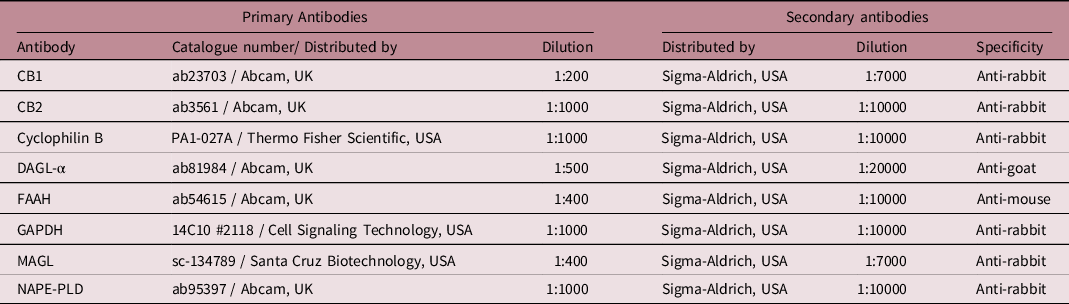
Frozen tissues were macerated in a specific extract buffer containing a protease inhibitor cocktail (S8830, SIGMAFAST™, Sigma-Aldrich, St Louis, MO, USA). The LH and PVN punches were sonicated twice in an ultrasonic processor for 10 s (15 s interval, 40% amplitude). Liver, VAT, adrenal and thyroid tissues were centrifuged at 17,004 × g for 15 min, 12,851 × g for 30 min, 10,621 × g for 5 min and 15,294 × g for 20 min at 4°C (Eppendorf 5417R, Hampton, USA), respectively. Total protein content was determined using a BCA™ Protein Assay Kit (Thermo Scientific®, Rockford, IL, USA). All samples were treated with Laemmli sample buffer (w/v: glycerol 30%; β-mercaptoethanol 20%; sodium dodecyl sulfate (SDS) 8%, 0.25 M Tris at pH 6.8 and bromophenol blue). Total protein extracts (15∼20 µg) were separated by 10% SDS-PAGE at 200 V for approximately 50 min. The proteins were then transferred from the gel to a polyvinylidene difluoride (PVDF) membranes using the Trans-Blot® turbo system (Bio-Rad® Laboratories, Hercules, CA, USA) and blocked with 5% BSA in Tween-Tris-buffered saline (TTBS; Tris-HCl, 1 mol/L; NaCl, 5 mol/L; and Tween 20, 0.05%, v/v) for 90 min under continuous shaking. Membranes were incubated overnight with the primary antibodies described in Table 1. PVDF filters were washed 3 times with Tween–TBS (0.1%), followed by 1 h incubation with appropriate biotin-conjugated secondary antibody (Table 1). Then, membranes were incubated with streptavidin-conjugated HRP (RPN1231V; Sigma-Aldrich, St Louis, MO, USA). Immunoreactive proteins were visualized with an ECL kit using an Image Quant LAS (Bio-Rad® Laboratories, Hercules, CA, USA). Bands were quantified by densitometry using Image J 1.4 software (Wayne Rasband, National Institutes of Health, Bethesda, MA, USA). Protein contents of glyceraldehyde-3-phosphate dehydrogenase (GAPDH) in the LH and PVN, as well as cyclophilin B in the liver, VAT, adrenal and thyroid, were used as loading controls.
Antibodies used in western blotting

CB1: cannabinoid type-1 receptor; CB2: cannabinoid type-2 receptor; DAGL-α: diacylglycerol lipase alpha; FAAH: fatty acid amide hydrolase; GAPDH: glyceraldehyde-3-phosphate 5 dehydrogenase; MAGL: monoacylglycerol lipase; NAPE-PLD: N-acylphosphatidylethanolamine-phospholipase D.
Statistical analyses
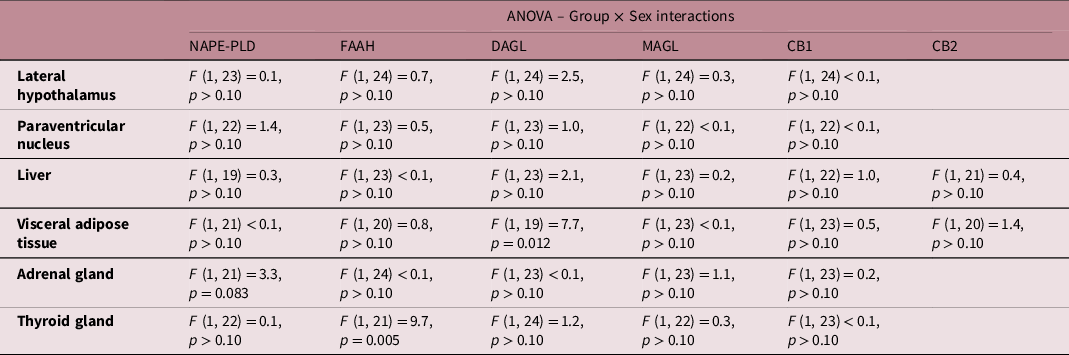
Data are expressed as mean ± standard error of the mean and were analyzed with the statistical program GraphPad Prism 6.0 (San Diego, CA, USA). Each variable was analyzed using two-way ANOVA with group and sex as between-subject factors (Table 2). Considering that, for the Western blotting analyses, males and females were assessed in different gels, the results in the graphs were analyzed separated by sex using Student’s t-tests (Control vs. NIC) for each protein. Differences were considered significant when p < 0.05. Effect size data is provided as Eta-squared (η2: small > 0.1, medium > 0.3, large > 0.5).
ANOVA results regarding nicotine exposure during lactation on endocannabinoid system of the adult offspring

CB1: cannabinoid type-1 receptor; CB2: cannabinoid type-2 receptor; DAGL-α: diacylglycerol lipase alpha; FAAH: fatty acid amide hydrolase; MAGL: monoacylglycerol lipase; NAPE-PLD: N-acylphosphatidylethanolamine-phospholipase D.
Results
NIC males showed a significant increase in body mass (595 ± 15 g) when compared to control males (520 ± 10 g), while NIC females showed no difference (NIC: 300 ± 8 vs. CON: 295 ± 10 g) when compared to control females. This finding agrees with findings of our previous studies. Reference Miranda, Gaspar de Moura and Lisboa11-Reference Peixoto, Moura and Soares13
ECS markers in the lateral hypothalamus (LH) and paraventricular nucleus (PVN)
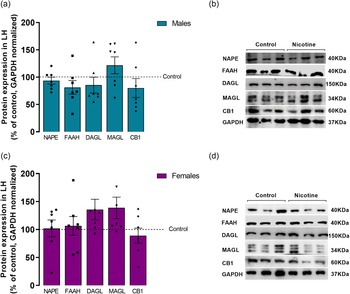
As shown in Fig. 1, the protein levels of the ECS markers in the LH were not affected by nicotine exposure in both male (Fig. 1 a and 1 b) and female offspring (Fig. 1 c and 1 d).
Effects of nicotine exposure during breastfeeding on the endocannabinoid system in the lateral hypothalamus (LH) of male (a) and female (c) offspring at PND180. Representative western blot bands for each protein are shown (b; d). GAPDH was used as housekeeping gene. Data are expressed as mean ± S.E.M, n = 7 animals from different litters/group. CB1: cannabinoid type-1 receptor; DAGL: diacylglycerol lipase; FAAH: fatty acid amide hydrolase; GAPDH: glyceraldehyde-3-phosphate 5 dehydrogenase; MAGL: monoacylglycerol lipase; NAPE-PLD: N-acylphosphatidylethanolamine-phospholipase D.

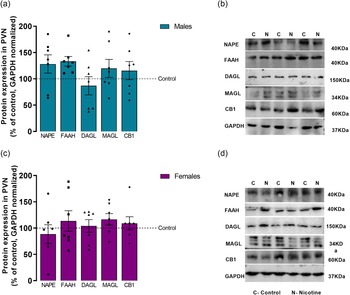
We did not observe significant differences between groups in the parameters of the ECS in the PVN in both male (Fig. 2 a and 2 b) and female offspring (Fig. 2 c and 2 d). In both nuclei, the ANOVAs failed to identify interactions between early nicotine exposure and sex (Table 2).
Effects of nicotine exposure during breastfeeding on the endocannabinoid system in the paraventricular nucleus (PVN) of male (a) and female (c) offspring at PND180. Representative western blot bands for each protein are shown (b; d). GAPDH was used as housekeeping gene. Data are expressed as mean ± S.E.M, n = 7 animals from different litters/group. CB1: cannabinoid type-1 receptor; DAGL: diacylglycerol lipase; FAAH: fatty acid amide hydrolase; GAPDH: glyceraldehyde-3-phosphate 5 dehydrogenase; MAGL: monoacylglycerol lipase; NAPE-PLD: N-acylphosphatidylethanolamine-phospholipase D.

ECS markers in the liver
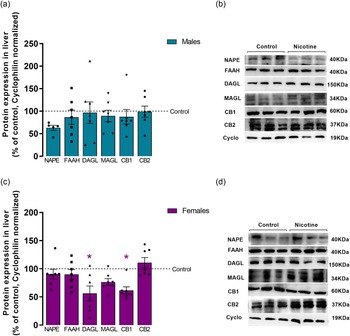
No significant differences were observed between groups in the ECS biomarkers of the male offspring (Fig. 3 a and 3 b). In contrast, NIC females had significantly lower DAGL (−44%, p = 0.012, η2 = 0.450) and CB1 protein levels (−40%, p = 0.028, η2 = 0.396) in the liver (Fig. 3 c and 3 d) in comparison with controls. No interactions between early nicotine exposure and sex were observed (Table 2).
Effects of nicotine exposure during breastfeeding on the endocannabinoid system in the liver of male (a) and female (c) offspring at PND180. Representative western blot bands for each protein are shown (b; d). Cyclophilin was used as housekeeping gene. Data are expressed as mean ± S.E.M, n = 7 animals from different litters/group, except for NAPE-PLD from males, n = 5 animals from different litters/group. Differences are represented by *, considering p < 0.05, (Student’s t-test); *p = 0.012 (DAGL) and *p = 0.028 (CB1). CB1: cannabinoid type-1 receptor; CB2: cannabinoid type-2 receptor; Cyclo: Cyclophilin; DAGL: diacylglycerol lipase; FAAH: fatty acid amide hydrolase; MAGL: monoacylglycerol lipase; NAPE-PLD: N-acylphosphatidylethanolamine-phospholipase D.

ECS markers in the visceral adipose tissue (VAT)
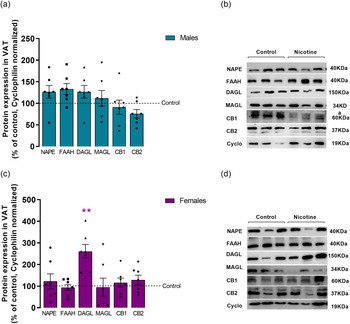
NIC males did not show any alteration in ECS markers (Fig. 4 a and 4 b) in the VAT when compared to control males. Conversely, NIC females showed a significant increase in DAGL protein level (2.6-fold, p = 0.002, η2 = 0.611) (Fig. 4 c and 4 d ) in this tissue, in line with the observation of a significant interaction between Sex and Group for this marker (Table 2).
Effects of nicotine exposure during breastfeeding on the endocannabinoid system in the visceral adipose tissue (VAT) of male (a) and female (c) offspring at PND180-day-old. Representative western blot bands for each protein are shown (b; d). Cyclophilin was used as housekeeping gene. Data are expressed as mean ± S.E.M, n = 7 animals from different litters/group. Differences are represented by **, considering p < 0.01 (Student’s t-test); p = 0.002. CB1: cannabinoid type-1 receptor; CB2: cannabinoid type-2 receptor; Cyclo: Cyclophilin; DAGL: diacylglycerol lipase; FAAH: fatty acid amide hydrolase; MAGL: monoacylglycerol lipase; NAPE-PLD: N-acylphosphatidylethanolamine-phospholipase D.

ECS markers in the adrenal glands
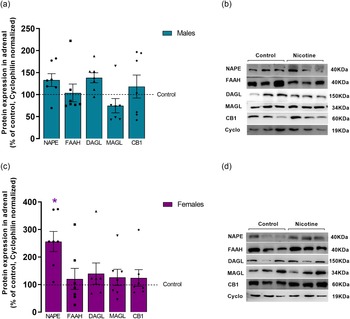
Nicotine exposure during breastfeeding did not program the ECS markers in adrenal glands of male offspring (Fig 5 a and 5 b). Conversely, NIC females had a significant increase in NAPE-PLD protein level (2.5-fold, p = 0.026, η2 = 0.438) in the adrenal glands (Fig. 5 c and 5 d), a result compatible with the significant Sex × Group interaction for this marker (Table 2).
Effects of nicotine exposure during breastfeeding on the endocannabinoid system in the adrenal glands of male (a) and female (c) offspring at PND180. Representative western blot bands for each protein are shown (b; d). Cyclophilin was used as housekeeping gene. Data are expressed as mean ± S.E.M, n = 7 animals from different litters/group. Statistical differences are represented by *, considering p < 0.05 (Student’s t-test); p = 0.026. CB1: cannabinoid type-1 receptor; Cyclo: Cyclophilin; DAGL: diacylglycerol lipase; FAAH: fatty acid amide hydrolase; MAGL: monoacylglycerol lipase; NAPE-PLD: N-acylphosphatidylethanolamine-phospholipase D.

ECS markers in the thyroid gland
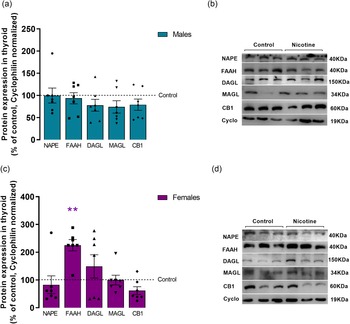
NIC males showed no changes in ECS markers when compared to control males (Fig 6 a and 6 b). Only NIC females showed an increased FAAH protein level (2.3-fold, p = 0.006, η2 = 0.586) in the thyroid gland (Fig. 6 c and 6 d), corroborating the Sex × Group interaction that was observed for this marker (Table 2).
Effects of nicotine exposure during breastfeeding on the endocannabinoid system in thyroid glands of male (a) and female (c) offspring at PND180. Representative western blot bands for each protein are shown (b; d). Cyclophilin was used as housekeeping gene. Data are expressed as mean ± S.E.M, n = 7 animals from different litters/group. Statistical differences are represented by **, considering p < 0.01 (Student’s t-test); p = 0.006. CB1: cannabinoid type-1 receptor; Cyclo: Cyclophilin; DAGL: diacylglycerol lipase; FAAH: fatty acid amide hydrolase; MAGL: monoacylglycerol lipase; NAPE-PLD: N-acylphosphatidylethanolamine-phospholipase D.

Discussion
In this study, for the first time, we characterized the ECS in different tissues in a programming model of nicotine exposure during breastfeeding. The ECS has a relevant role in the modulation of energy expenditure and in many physiological processes. Our main findings demonstrate that the major ECS markers were not affected in the LH and PNV nuclei of both male and female NIC offspring. Conversely, ECS markers of NIC females seem to be more affected in the peripheral tissues, since we characterized significantly lower protein expression of the biomarkers of ECS synthesis and action in the liver, higher DAGL expression (marker for 2-AG production) in the VAT, higher NAPE-PLD expression (marker for AEA synthesis marker) in the adrenal gland and higher FAAH expression (a marker of AEA degradation) in the thyroid gland.
Endocannabinoids are directly related to obesity onset. Several studies have demonstrated that the permanent overstimulation of the ECS, mainly in the CNS, contributes to the obese status. Reference Zdanowicz, Kazmierczak and Wierzbinski16,Reference Pagotto, Vicennati and Pasquali41,Reference Mazier, Saucisse, Gatta-Cherifi and Cota42 In our experimental model, NIC male offspring were imprinted to an obese phenotype at adulthood. It is therefore conceivable that the nicotine exposure during breastfeeding has modulated the offspring ECS. Indeed, the ECS was impaired in the CNS, specifically in dorsolateral striatum region, of adult Wistar rats that were exposed to nicotine, even after a long period of nicotine withdrawal. Reference Adermark, Morud, Lotfi, Ericson and Soderpalm43 Although this study did not evaluate the metabolic programming model or the same tissues that were assessed here, we suggest that an early nicotine exposure, during a phase of great CNS vulnerability, is capable of affecting the ECS at adulthood by imprinting a disruption of its activity. Interestingly, the imprinting process seems to be sex-dependent since only females showed marked effects.
Regarding the specific regions in the CNS in which the ECS plays important roles, such as the regulation of food intake, control of energy expenditure and neuroendocrine processes, Reference Sanchez-Fuentes, Marichal-Cancino, Mendez-Diaz, Becerril-Melendez, Ruiz-Contreras and Prospero-Garcia24,Reference Peterfi, Farkas and Denis26,Reference Barna, Zelena, Arszovszki and Ledent27 both the LH and the PVN must be highlighted. In the current study, we did not observe changes in ECS markers in the LH of both male and female offspring. This result is compatible with NIC males normophagia but not with females hyperphagia, as shown in our previous results, Reference Pinheiro, Oliveira and Trevenzoli44 which indicates that the endocannabinoid pathway did not contribute to this female phenotype. Other pathways, involving dopaminergic tonus or central leptin resistance, may explain this hyperphagia in NIC females. Reference Peixoto, Moura and Soares13 In the PVN, we did not observe changes in ECS markers in the offspring of either sex. ECS function could be associated with the regulation of glucocorticoid negative feedback in the PVN since NIC male offspring exhibit higher corticotropin-releasing hormone (CRH), higher adrenocorticotropic hormone and hypercorticosteronemia, as previously demonstrated by our group. Reference Pinheiro, Oliveira and Trevenzoli44 In the PVN, the feedback mechanism is mediated by a non-genomic corticosterone binding to glucocorticoid receptor and involves the endocannabinoid synthesis. Reference Di, Malcher-Lopes, Halmos and Tasker45 In addition, pharmacological inhibition of CB1 receptors results in increased corticosterone concentrations in male and female Wistar rats. Reference Roberts, Stuhr, Hutz, Raff and Hillard46 Similarly, the endocannabinoid system also acts in the inhibition of thyrotropin-releasing hormone (TRH) release, as indicated by an experiment that blocked CB1 receptors with an antagonist and observed, as a result, an increased TRH release in mouse median eminence explants. Reference Farkas, Varga and Kovacs47
The deregulation of the ECS does not occur only at a central level, but also in the periphery. Obese people show both central and peripheral ECS increases. Reference Pagotto, Vicennati and Pasquali41 Moreover, a deregulated ECS can be involved in other diseases. In the liver, for example, an upregulation of CB1 is related with hepatic fibrosis, steatosis, oxidative stress and lipid accumulation. Reference Osei-Hyiaman, DePetrillo and Pacher48-Reference Miranda, De Almeida and Rocha50 Our group has already demonstrated that NIC males have increased lipid accumulation, oxidative stress and steatosis. Reference Conceicao, Peixoto-Silva, Pinheiro, Oliveira, Moura and Lisboa51 However, these dysfunctions in our male experimental model apparently are independent of the ECS function, since ECS tonus was unaltered. In contrast, NIC females had a reduction of DAGL and CB1 receptor in the liver, which may help to protect this tissue from the harmful effects of ECS overstimulation, since NIC females have unchanged hepatic cytoarchitecture, as we have previously shown. Reference Bertasso, Pietrobon and Lopes52 It is possible that a compensatory effect is improving liver function by a mechanism remains to be determined.
The ECS also acts in the white adipose tissue stimulating lipogenesis and adipogenesis. Reference van Eenige, van der Stelt, Rensen and Kooijman53 In the VAT, NIC males did not show changes in ECS markers, while females had higher DAGL. In most cases, the deregulation of ECS is characterized by their overactivation. Reference Di Marzo54 The increase in the biosynthetic enzyme DAGL in the female offspring VAT suggests an increased 2-AG synthesis, which could be related with the higher adipocyte area as well as with the increased protein content of acetyl-CoA carboxylase and transcription factor CCAAT/enhancer-binding protein (C/EBP) beta that were previously observed in these animals. Reference Peixoto, Moura and Soares55 It is also known that increased 2-AG biosynthesis is involved in pro-inflammatory and prostaglandin responses, mainly because it serves as substrate for cyclooxygenases. Reference Janssen and van der Stelt56,Reference Rouzer and Marnett57
Concerning the ECS in the adrenal gland, NIC males did not show any changes, while NIC females had higher NAPE-PLD, which could indicate higher AEA synthesis. However, it is important to highlight that bioactive N-acylethanolamines, including AEA, can be formed from N-acylated plasmalogen through a NAPE-PLD-independent pathway. Reference Tsuboi, Okamoto and Ikematsu58 Our research group has already described the effects of nicotine exposure during lactation on the adrenal function of the offspring. We observed that males had higher adrenal catecholamine content, but lower in vitro catecholamine release, Reference Pinheiro, Oliveira and Trevenzoli44 while females had normal adrenal function. Reference Peixoto, Moura and Soares55 Endocannabinoids have an inhibitory effect on adrenaline secretion, as demonstrated by the administration of cannabinoids in isolated rabbit adrenal glands. Reference Niederhoffer, Hansen, Fernandez-Ruiz and Szabo31 In the adrenocortical cell line NCI-H295R, it was demonstrated that AEA is capable of inhibiting steroidogenesis. Reference Ziegler, Mohn and Lamounier-Zepter30 Furthermore, the administration of CB1 antagonist AM251 was shown to increase corticosterone levels in the adrenal cortex. Reference Newsom, Garcia and Stafford59 Contrasting with the unaltered expression of adrenal CB1 in our model, Surkin and Gallino Reference Surkin, Gallino, Luce, Correa, Fernandez-Solari and De Laurentiis60 suggest that, in the adrenal cortex, AEA has a potent effect via the vanilloid transient receptor potential cation channel subfamily V member 1 (TRPV1 receptors), which was not evaluated here. It is important to highlight that endocannabinoid stress modulation could be bidirectional: stress could alter the ECS activity as well as the ECS activity could induce alterations in HPA axis function.
The ECS is also present in the thyroid gland. Reference Porcella, Marchese and Casu32 Studies suggest that endocannabinoids have a negative regulation on TSH, T3 and T4 secretions. Reference Porcella, Marchese and Casu32,Reference Borowska, Czarnywojtek and Sawicka-Gutaj61,Reference da Veiga, Fonseca Bloise and Costa62 In addition, FAAH knockout mice had significant TSH, T3 and T4 reductions. Reference Brown, Gillum and Lee63 In a previous work, we demonstrated that NIC males showed low TSH, T3 and T4 plasma levels, while NIC females had higher T3 and T4. Reference Miranda, de Moura and Soares12 Here, NIC males did not show changes in thyroid ECS markers, but NIC females had higher thyroid FAAH protein expression. We can speculate that the overexpression of FAAH may avoid the accumulation of AEA and prevent its inhibitory effect on thyroid hormones secretion in females.
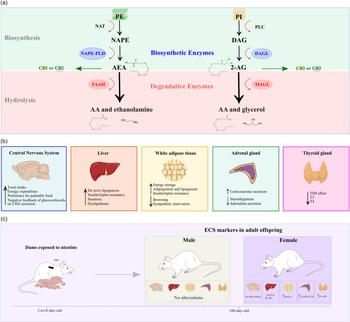
Regarding sex dimorphism, there is evidence in the literature that the ECS show sex-related differences. For instance, females seem to have lower activation of ECS than males. Reference Roberts, Stuhr, Hutz, Raff and Hillard46,Reference Riebe, Hill, Lee, Hillard and Gorzalka64 Considering other programming models, studies reported differences in ECS between sexes. Reference Miranda, De Almeida and Rocha50,Reference Almeida, Dias-Rocha and Souza65-Reference Moussa-Tooks, Larson and Gimeno67 Here, comparing male and female offspring, the differences observed in ECS markers could have the involvement of the sex hormones. We have already assessed estrogen and testosterone plasma levels in the neonatal nicotine exposure model: NIC females showed no alterations in estradiol and testosterone levels, while NIC males had lower testosterone without changes in estradiol. Reference Miranda, de Moura and Soares12 In the present study, only NIC females were affected. Thus, the protective effect mediated by estrogens Reference Carrillo, Collado, Diaz, Chowen, Perez-Izquierdo and Pinos68 did not occur regarding the ECS markers. We have previously detected, in a different experimental model, that adult female rats that were programmed by maternal cigarette smoke during lactation showed lower estradiol levels, higher hypothalamic DAGL protein expression, lower hepatic DALG and lower VAT CB1. Reference Soares, Miranda and Peixoto69 Thus, the late effects of nicotine exposure during lactation in the ECS of the female progeny differ from the effects observed in females exposed to cigarette smoke for the same period, suggesting that other compounds in the cigarette can also affect ECS tonus. However, in both models (nicotine and smoke), nicotine appears to be responsible for the reduction of DAGL in the liver. We summarize in Fig. 7, the ECS biosynthesis and degradation pathways, the main effects of the endocannabinoids in different tissues and the ECS markers in our experimental model.
The first panel (a) depicts the main proteins involved in endocannabinoid synthesis and degradation pathways. Phosphatidylethanolamine (PE) is converted to N-acylphosphatidylethanolamine (NAPE), catalyzed by the NAPE-phospholipase D (NAPE-PLD), producing anandamide (AEA). In addition, phosphatidylinositol (PI) is hydrolyzed by phospholipase C (PLC), originating diacylglycerol (DAG), which is converted to 2-arachidonoylglycerol (2-AG) by diacylglycerol lipase (DAGL). The endocannabinoids AEA and 2-AG act by binding to both type-1 or type-2 cannabinoid receptors (CB1 or CB2). The degradation of the endocannabinoids is mediated by fatty acid amide hydrolase (FAAH), which is responsible for AEA degradation, and by monoacylglycerol lipase (MAGL), which is responsible for 2-AG degradation. The metabolites of AEA and 2-AG are the arachidonic acid (AA) and ethanolamine, and AA and glycerol, respectively. The second panel (b) shows the main effects of the endocannabinoids in different tissues. The third panel (c) describes the ECS markers in adult rats that were nicotine-exposed during breastfeeding. OMP: osmotic minipumps.

Constitute limitations of our study the lack of measurement of AEA and 2-AG levels and of the activity of the enzymes involved in endocannabinoids metabolism.
In conclusion, we demonstrated that nicotine exposure during lactation imprinted a deregulated ECS in the female offspring. The central and peripheral characterization of ECS is a contribution to an understanding of the phenotype observed in this experimental model. Unraveling the associated mechanisms can contribute to the discovery of new pharmacological targets for the treatment of several metabolic diseases originated during development, especially those caused by maternal smoking or caused by the use of nicotine patch by mothers who wish to quit smoking.
Acknowledgments
We thank the Mr. Ulisses Risso Siqueira for animal care and to Mrs. Fabiana Gallaulckydio and Mr. Leandro Fraga Bezerra for technical assistance.
Financial support
This work was supported by Fundação Carlos Chagas Filho de Amparo à Pesquisa do Estado do Rio de Janeiro, Coordenação de Aperfeiçoamento de Pessoal de Nível Superior and Conselho Nacional de Desenvolvimento Científico e Tecnológico (CNPq).
Conflicts of interest
The authors declare that no conflict of interest.
Ethical standards
All experimental procedures performed in this work are in accordance with the ethical standards of the relevant guides on the care and use of laboratory animals and were approved by the institutional ethics committee of the Institute of Biology of the University of the State of Rio de Janeiro (CEUA/033/2017).