Introduction
Apathy and depression are common in community-dwelling older individuals (Van der Mast et al., Reference Van der Mast2008; Ligthart et al., Reference Ligthart2012; Luppa et al., Reference Luppa2012) and both conditions have been associated with several adverse outcomes, including cognitive and functional impairment (Brodaty et al., Reference Brodaty, Sachdev, Withall, Altendorf, Valenzuela and Lorentz2005; Van Reekum et al., Reference Van Reekum, Stuss and Ostrander2005; Wilkins et al., Reference Wilkins, Kiosses and Ravdin2010). Although apathy, which is primarily defined as a disorder of motivation (Robert et al., Reference Robert2009), can occur as a symptom of depression, it can also occur independently as an isolated syndrome. Apathy can be discriminated from depression by lack of motivation in the absence of dysphoric symptoms, such as a depressed mood, guilt, hopelessness, and helplessness (Marin et al., Reference Marin, Firinciogullari and Biedrzycki1993). Differentiating apathy from depression is clinically relevant, because management and prognosis differ (Fones, Reference Fones1998), and because both conditions appear to be differentially associated with future cardiovascular disease. Recently, symptoms of apathy were found to be an independent risk factor for incident cardiovascular disease in community-dwelling older individuals, whereas depressive symptoms were not (Eurelings et al., Reference Eurelings, Ligthart, Van Dalen, Moll Van Charante, Van Gool and Richard2014a). This may reflect different underlying etiologies of both conditions, and, in particular, may indicate the involvement of vascular factors in the development of apathy (Van der Mast et al., Reference Van der Mast2008; Ligthart et al., Reference Ligthart2012).
Cardiovascular disease is often accompanied by a chronic, low-grade systemic inflammatory reaction. CRP, a sensitive systemic marker of inflammation, has been associated with the initiation and progression of atherosclerosis and with an increased risk of cardiovascular events (Ridker, Reference Ridker2003; Bisoendial et al., Reference Bisoendial, Boekholdt, Vergeer, Stroes and Kastelein2010). Especially CRP levels >3 mg/L are associated with a high risk of future cardiovascular events, but even those with 1 to 3 mg/L are at moderate risk (Ridker, Reference Ridker2003). Systemic inflammation has also been hypothesized to foment “sickness behavior”, referring to a cluster of adaptive behavioral symptoms including somnolence, loss of energy, malaise, and diminished interest in activities (Dantzer et al., Reference Dantzer, O’Connor, Freund, Johnson and Kelley2008), that overlap with symptoms of apathy. In this manner, low-grade inflammation associated with atherosclerosis may manifest as apathy-like symptoms.
Elevated levels of CRP have been associated with depression (Howren et al., Reference Howren, Lamkin and Suls2009; Valkanova et al., Reference Valkanova, Ebmeier and Allan2013). However, because apathy and depression may be confused due to overlapping clinical features (Fones, Reference Fones1998), this association may be confounded by symptoms of apathy. Whether mild to moderate elevations in CRP are associated with symptoms of apathy is unclear due to conflicting findings (Maas et al., Reference Maas, Van der Mast and de Craen2009; Hall et al., Reference Hall, Johnson, Vo, Barber, Winter and O’Bryant2012). An association between apathy symptoms and increased CRP levels may point in the direction of a mechanistic explanation for the independent association of apathy symptoms with incident cardiovascular events that was reported previously (Eurelings et al., Reference Eurelings, Ligthart, Van Dalen, Moll Van Charante, Van Gool and Richard2014a). Symptoms of apathy could be a behavioral manifestation of the low-grade inflammatory reaction associated with underlying atherosclerosis, a process that in itself may lead to an increased risk of future vascular events.
In the present study, we assessed whether CRP is differentially associated with present or future symptoms of apathy and depression. Given the increased risk of incident cardiovascular disease associated with symptoms of apathy, we hypothesized that increased CRP levels would be associated with both present and future apathy symptoms.
Methods
Participants
The study sample was drawn from the ongoing prevention of dementia by intensive vascular care (preDIVA) trial (ISRCTN29711771). This is a cluster-randomized controlled trial with a follow-up of six years to assess the efficacy of nurse-led intensive vascular care on the prevention or postponement of dementia and disability in a primary healthcare population. Mortality, cognitive decline, depression, and vascular events (including myocardial infarction, peripheral arterial disease, angina pectoris, and stroke) are secondary outcomes. Between May 2006 and March 2009, 3,533 community-dwelling older individuals aged 70–78 years were included. All eligible individuals in 116 general practitioner (GP) practices were invited, resulting in a participation rate of 53.3%. The non-respondents did not differ substantially from the study participants (Ligthart et al., Reference Ligthart2012). The Medical Ethics Committee of the Academic Medical Center in Amsterdam has approved the study and all participants signed informed consent before enrolment. A detailed description of the preDIVA study design has been published elsewhere (Richard et al., Reference Richard2009). For the present analyses the population is considered as a cohort, irrespective of randomization group.
Assessment of symptoms of apathy and depression
At baseline and after two and four years of follow-up, symptoms of apathy and depression were assessed using the 15-item Geriatric Depression Scale (GDS-15) (range from 0–15, higher scores indicate worse functioning), which is a widely used self-administered depression screening measure (Lesher and Berryhill, Reference Lesher and Berryhill1994). Participants were requested to fill out the questionnaire at home before visiting a practice nurse. During the visit, the practice nurse ran through the questionnaire to check whether the participant had completed all items and to help in case of any questions. In line with previous factor analyses (Ligthart et al., Reference Ligthart2012), an apathy score was calculated using the sum of three apathy-items (GDS-3A; range 0–3 points, higher scores indicating more apathy). These items are: (1) Have you dropped many of your activities and interests?; (2) Do you prefer to stay at home, rather than going out and doing new things?; and (3) Do you feel full of energy? Face validity of this 3-item apathy subscale was established by an expert team of psychiatrists, behavioral neurologists, and neuropsychologists who consented on the same three GDS-15 items as representing apathy symptoms, while being unaware of the factor analyses results (Van der Mast et al., Reference Van der Mast2008). The remaining 12 items were considered to represent depressive symptoms and were summed to calculate a depression score (GDS-12D; range 0–12 points, higher scores indicating more depressive symptoms). Symptoms of apathy and depression were defined as GDS-3A≥2 and GDS-12D≥2, respectively. Participants with >2 items missing on the GDS-12D and/or >1 on the GDS-3A were excluded from the analysis.
Assessment of C-reactive protein
At all three visits, serum CRP levels were determined in local laboratories affiliated with the GP practices using immunoturbidimetric assays (Beckman Coulter Olympus AU2700, Siemens Advia 2400, Roche Cobas 6000, and Roche Modular P800). Because CRP values above 10 mg/L mostly indicate active inter-current infection, rather than a low-grade inflammatory reaction associated with cardiovascular disease risk, individuals with CRP values higher than 10 mg/L were removed from the analysis (Ridker, Reference Ridker2003).
Other measurements
At baseline, data on socio-demographic features (age, sex, and level of education) were obtained for all individuals. Presence of a history of cardiovascular disease (including myocardial infarction, peripheral arterial disease, and angina pectoris) or stroke was evaluated by interview with a practice nurse in combination with simultaneous review of the GP's electronic medical records. At baseline and after two and four years follow-up, data on cardiovascular risk factors were recorded: blood pressure, diabetes mellitus (DM), cholesterol, body mass index (BMI) (calculated as weight in kilograms divided by height in meters squared), and smoking (current vs. never/former). Cognitive function was assessed with the Mini-Mental State Examination (MMSE) (range from 0–30, higher scores indicating better functioning) (Folstein et al., Reference Folstein, Folstein and McHugh1975).
Statistical analysis
To correct for possible confounding of the association between low-grade inflammation and symptoms of apathy/depression by previous cardiovascular disease or stroke (since symptoms of apathy and depression can occur as a direct consequence of a stroke lesion, or as a result from disability caused by previous vascular disease), we excluded individuals with a history of cardiovascular disease or stroke from the primary analyses (Eurelings et al., Reference Eurelings, Ligthart, Van Dalen, Moll Van Charante, Van Gool and Richard2014a). However, using a sensitivity framework, all analyses were repeated including these participants.
CRP values were skewed to the right and were natural log transformed (ln-CRP) after adding 1 to all CRP values to avoid excessive separation of values. Logistic regression analysis was used to analyze the cross-sectional and longitudinal associations of ln-CRP (independent variable) with symptoms of apathy and depression (dependent variables). Because of the transformation, OR represent OR per natural log unit increase in CRP (natural logarithmic base≈2.72). Separate analyses were performed for apathy symptoms (GDS-3A≥2) and depressive symptoms (GDS-12D≥2). Three separate cross-sectional analyses were performed using the baseline, the two-year, and the four-year follow-up data on CRP and GDS-3A/GDS-12D scores. In the longitudinal analysis, the association between baseline CRP and incident symptoms of apathy and depression after four years of follow-up was assessed, restricting the analysis to participants who did not have baseline symptoms of apathy or depression (GDS-3A≤1 and GDS-12D≤1). As a sensitivity analysis, the association between baseline CRP and incident symptoms of apathy and depression after two years of follow-up was also assessed.
All cross-sectional analyses were adjusted for demographic characteristics (age at the respective visit, sex, and level of education (<7, 7–12, and >12 years)) and additionally for cardiovascular risk factors at the respective visit (hypertension (systolic blood pressure (SBP)≥160 mmHg), dyslipidemia (total cholesterol≥251 mg/dL), current smoking, BMI≥30 kg/m2, and DM). The longitudinal analyses were adjusted for baseline demographics and additionally for baseline cardiovascular risk factors. Furthermore, to assess the effect of CRP on apathy symptoms independent of co-morbid depressive symptoms and the effect of CRP on depressive symptoms independent of co-morbid apathy symptoms, all apathy analyses were adjusted for GDS-12D score and all depression analyses for GDS-3A score. The data were analyzed with SPSS statistical software, version 20.0 (IBM Corp., Armonk, NY).
Results
Study population
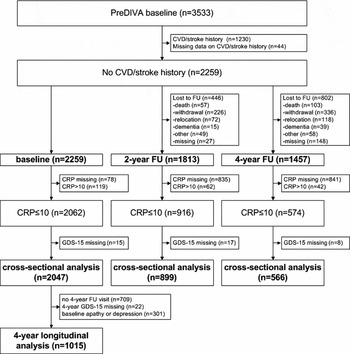
Of the 3,533 participants that completed the preDIVA baseline assessment, 2,259 had no history of cardiovascular disease or stroke (Figure 1). Of these, 78 refused blood sampling resulting in 2,047 participants with a baseline CRP≤10 mg/L who were available for inclusion in the cross-sectional analysis using baseline data. Of the 2,259 participants without a history of cardiovascular disease or stroke, 1,813 and 1,457 participants completed the two- and four-year follow-up visit, respectively. At both visits, the most frequently occurring reasons for drop-out were withdrawal on own request and relocation. Of the participants that did attend the two-and four year follow-up visit, respectively 835 and 841 refused blood sampling, resulting in respectively 899 and 566 participants with a CRP level≤10 mg/L who were available for analysis. Both after two and four years of follow-up, there were no major differences with respect to important baseline characteristics between participants with an available CRP measurement and those without (i.e. those who did not attend the follow-up visit and those who did attend the follow-up visit but refused blood sampling) (see Table S1 published as supplementary material online attached to the electronic version of this paper at http://dx.doi.org/10.1017/S1041610214002683). For the longitudinal analysis on incident symptoms of apathy and depression after four years, 1,015 participants with a baseline CRP≤10 mg/L and without symptoms of apathy or depression at baseline were studied. For the analysis of incident symptoms of apathy and depression after two years of follow-up, the number of studied participants was 1,264.
Flowchart of selection of study participants. Missing items on the 15-item Geriatric Depression Scale (GDS-15): >2 items missing on the Geriatric Depression Scale-12D and/or >1 item missing on the Geriatric Depression Scale-3A. CVD, cardiovascular disease; FU, follow-up; CRP, C-reactive protein (in mg/L).

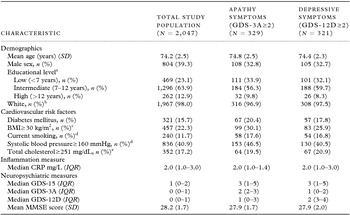
Baseline characteristics are summarized in Table 1 for the total study population (n = 2,047) and separately for participants with apathy symptoms (n = 329 (16.1%)) and depressive symptoms (n = 321 (15.7%)). The baseline median CRP concentration was 2.0 mg/L (interquartile range (IQR) 1.0–3.0) in the total study sample. At the two-year follow-up assessment (n = 899), apathy symptoms were present in 145 (16.1%) participants and depressive symptoms in 142 (15.8%) participants. At the four-year follow-up visit (n = 566), these numbers were 110 (19.4%) and 89 (15.7%), respectively. The median CRP concentration was 2.0 mg/L (IQR 1.0–3.0) after two years of follow-up and 1.7 mg/L (IQR 1.0–3.3) after four years of follow-up.
Baseline characteristics of all participants without cardiovascular disease/stroke and according to symptoms of apathy and depression

SD = standard deviation; BMI = body mass index; CRP = C-reactive protein; IQR = interquartile range; GDS-15 = 15-item Geriatric Depression Scale; GDS-3A = 3-item apathy subscale of the GDS-15; GDS-12D = 12-item depression subscale of the GDS-15; MMSE = Mini-Mental State Examination.
aMissing data for total sample, participants with apathy symptoms and participants with depressive symptoms respectively: n = 20, n = 2, n = 6. Percentages do not add up to 100 because of rounding. bMissing data for n = 39, n = 3, n = 5. c Missing data for n = 1, n = 0, n = 0. d Missing data for n = 2, n = 0, n = 0. e Missing data for n = 4, n = 1, n = 0.
Cross-sectional associations
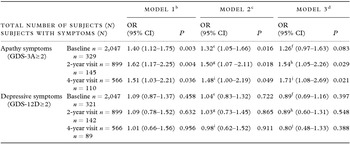
CRP level was cross-sectionally associated with symptoms of apathy at all visits (OR baseline visit = 1.40, 95% CI = 1.12–1.75; two-year follow-up visit = 1.62, 95% CI = 1.17–2.25; four-year follow-up visit = 1.51, 95% CI = 1.03–2.21) (Table 2). This did not change importantly after adjustment for demographic characteristics. Additional adjustment for cardiovascular risk factors and GDS-12D score did not affect the association found at two and four years of follow-up (OR two-year follow-up visit = 1.54, 95% CI = 1.05–2.26; OR four-year follow-up visit = 1.71, 95% CI = 1.08–2.69), but led to slight attenuation of the association at the baseline visit (OR = 1.26, 95% CI = 0.97–1.63). This attenuation was largely due to adjustment for BMI. No associations were found between CRP level and depressive symptoms (Table 2).
Cross-sectional associations between CRP and symptoms of apathy and depressiona

CRP = C-reactive protein; OR = odds ratio; CI = confidence interval; GDS-3A = 3-item apathy subscale of the 15-item Geriatric Depression Scale (GDS-15); GDS-12D = 12-item depression subscale of the GDS-15.
aLogistic regression analysis for natural log-transformed C-reactive protein (CRP) in subjects without a history of cardiovascular disease/stroke and with CRP≤10 mg/L.
bUnadjusted.
cAdjusted for demographics: age at respective visit, sex, educational level (<7 years, 7–12 years, >12 years).
dAdjusted for demographics, cardiovascular risk factors (systolic blood pressure (SBP) ≥160 mmHg, total cholesterol≥251 mg/dL, current smoking, body mass index (BMI) ≥30 kg/m2, and presence of diabetes mellitus), GDS-12D score (apathy analysis) and GDS-3A score (depression analysis).
eMissing data for 20 participants. fMissing data for 29 participants. gMissing data for 10 participants. hMissing data for 37 participants. iMissing data for 7 participants. j Missing data for 40 participants.
Longitudinal associations
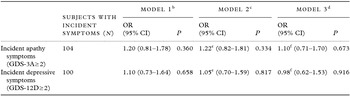
Table 3 shows the results of the longitudinal analysis for participants free of symptoms of apathy and depression at baseline. Baseline CRP level did not predict incident symptoms of apathy (OR = 1.20, 95% CI = 0.81–1.78) or incident depressive symptoms (OR = 1.10, 95% CI = 0.73–1.64) after four years of follow-up. In addition, baseline CRP level was not associated with incident apathy or depressive symptoms after two years of follow-up (see Table S2 published as supplementary material online attached to the electronic version of this paper at http://dx.doi.org/10.1017/S1041610214002683).
Longitudinal associations between baseline CRP and incident symptoms of apathy and depression after four years of follow-upa (n = 1015)

CRP = C-reactive protein; OR = odds ratio; CI = confidence interval; GDS-3A = 3-item apathy subscale of the 15-item Geriatric Depression Scale (GDS-15); GDS-12D = 12-item depression subscale of the GDS-15.
aLogistic regression analysis for natural log-transformed baseline C-reactive protein (CRP) in subjects with baseline CRP≤10 mg/L, without baseline apathy and depressive symptoms, and without a history of cardiovascular disease/stroke.
bUnadjusted.
cAdjusted for baseline demographics: age, sex, educational level (<7 years, 7–12 years, >12 years).
dAdjusted for baseline demographics, baseline cardiovascular risk factors (systolic blood pressure (SBP) ≥160 mmHg, total cholesterol≥251 mg/dL, current smoking, body mass index (BMI) ≥30 kg/m2, and presence of diabetes mellitus), GDS-12D score (apathy analysis) and GDS-3A score (depression analysis) at four years of follow-up. e Missing data for 8 participants. f Missing data for 15 participants.
Repeating the cross-sectional and longitudinal analyses including all participants with a history of cardiovascular disease or stroke (n = 1,230) and with missing data on this variable (n = 44) did not change any of the conclusions.
Discussion
In the present study in community dwelling older individuals, a cross-sectional association was found between CRP level and symptoms of apathy at multiple points in time during follow-up. No cross-sectional association was found with depressive symptoms. Also, baseline CRP level did not predict incident symptoms of apathy or depression after two or four years of follow-up.
The results of this study suggest a concurrent relationship between CRP levels as a marker of low-grade inflammation and symptoms of apathy. These symptoms may be a behavioral manifestation of a chronic low-grade inflammatory process. The finding that CRP levels did not predict incident apathy symptoms after two or four years of follow-up could reflect that the relationship between increased CRP levels and apathy symptoms is merely concomitant. This is consistent with the “sickness behavior” hypothesis, which proposes presence of apathy-like symptoms at the time of systemic inflammation (Dantzer et al., Reference Dantzer, O’Connor, Freund, Johnson and Kelley2008). However, in spite of the clinical similarities between apathy and sickness behavior, the overlap between both conditions may only be partial. Sickness behavior represents a cytokine-induced adaptive response to infection which is normally fully reversible when the pathogen has been eliminated (Dantzer et al., Reference Dantzer, O’Connor, Freund, Johnson and Kelley2008). Apathy on the other hand may be a maladaptive, potentially non-reversible response induced by chronic low-grade inflammation. Another reason for not finding a longitudinal association between increased CRP levels and apathy symptoms could be selective drop-out of participants, given that the most frequently occurring reasons for drop-out were withdrawal on own request and relocation. Part of the participants that withdrew from the study could have been too apathetic to attend a follow-up visit and some of the participants who did not attend the follow-up visit due to relocation could have been institutionalized due to cardiovascular disease, which is associated with both increased CRP levels (Ridker, Reference Ridker2003) and apathy symptoms (Van der Mast et al., Reference Van der Mast2008; Ligthart et al., Reference Ligthart2012; Eurelings et al., Reference Eurelings, Ligthart, Van Dalen, Moll Van Charante, Van Gool and Richard2014a).
Symptoms of apathy have been found to significantly increase the risk of future cardiovascular events, and mediation analyses have revealed that part of this association can be explained by the mediating effect of smoking, physical inactivity, and DM (Eurelings et al., Reference Eurelings, Ligthart, Van Dalen, Moll Van Charante, Van Gool and Richard2014a; Reference Eurelings, Jaccard, Moll van Charante, Ligthart, Van Gool and Richard2014b). However, the majority of the effect of apathy symptoms on incident cardiovascular disease is caused by other, yet unknown, factors (Eurelings et al., Reference Eurelings, Jaccard, Moll van Charante, Ligthart, Van Gool and Richard2014b). If symptoms of apathy are indeed a behavioral manifestation of underlying low-grade inflammation associated with atherosclerosis, this may be an additional explanation why these symptoms are predictive for future cardiovascular events. The finding that no association was observed with depressive symptoms may indicate a differential effect of inflammation on the development of symptoms of apathy and depression. This lends further support to the concept of apathy and depression as being separate clinical constructs, although often co-occurring.
The results of this study are in line with previous findings of an association between CRP level and apathy in elderly women with cognitive impairment (Hall et al., Reference Hall, Johnson, Vo, Barber, Winter and O’Bryant2012). Similarly, an association between apathy and level of tumor necrosis factor alpha (TNF-α) or its soluble receptors, as markers of inflammation, has been reported in two studies in elderly individuals with cognitive impairment (Hall et al., Reference Hall, Vo, Johnson, Winter, Barber and O’Bryant2011; Guimarães et al., Reference Guimarães, Caramelli, de Paula França, Afonso, Fialho and Teixeira2013). In a population-based cohort study of older individuals, CRP was specifically associated with worse performance on information processing speed and attention and executive functioning (Heringa et al., Reference Heringa2014), which are frequent neuropsychological correlates of apathy (Brodaty et al., Reference Brodaty, Sachdev, Withall, Altendorf, Valenzuela and Lorentz2005; Van Reekum et al., Reference Van Reekum, Stuss and Ostrander2005). Importantly, these associations were independent of depressive symptoms. Similar findings were observed in a study of older individuals with cardiovascular disease (Hoth et al., Reference Hoth2008). Our results are in contrast with earlier findings from the Leiden 85-Plus Study in which no cross-sectional association with either symptoms of apathy or depression was found and higher baseline CRP levels increased the risk of depression (Maas et al., Reference Maas, Van der Mast and de Craen2009). These discrepancies may partly be due to the different study populations, most notably the substantially higher age of the participants of the Leiden 85-Plus Study. CRP has been shown to display different characteristics depending on the age of the population studied. For example, elevated levels of CRP have been associated with an increased risk of future cognitive decline in mid- and early late-life, but are associated with less cognitive decline in the very old (Lima et al., Reference Lima2014). We did not observe any association between raised CRP levels and depressive symptoms, in contrast to findings of meta-analyses indicating that increased CRP levels are associated with both present and future depression (Howren et al., Reference Howren, Lamkin and Suls2009; Valkanova et al., Reference Valkanova, Ebmeier and Allan2013). Several explanations may account for this. First, in the meta-analysis of longitudinal studies, the effect was only modest (Valkanova et al., Reference Valkanova, Ebmeier and Allan2013) and the strongest associations have been observed in clinically depressed patient samples as opposed to community-based samples (Howren et al., Reference Howren, Lamkin and Suls2009). The degree of depressive symptoms in the current population-based sample may not have been sufficient to detect such an association. Second, the effect sizes differed substantially across individual studies (Howren et al., Reference Howren, Lamkin and Suls2009), and part of this heterogeneity may be due to confounding by apathy, since several studies used depression assessment instruments containing apathy items. Recent studies indicate that inflammation predominantly induces vegetative symptoms such as fatigue and loss of energy, rather than affective symptoms such as disturbances in mood and feelings of guilt or worthlessness (Duivis et al., Reference Duivis, Vogelzangs, Kupper, de Jonge and Penninx2013; Inagaki et al., Reference Inagaki2013).
Strengths of this study include its large sample size and longitudinal design. Earlier studies on the association between apathy and markers of inflammation have predominantly been performed in relatively small samples. The population-based design increases the generalizability of our findings. Some limitations to the present study should also be noted. Because an extensive clinical examination of apathy and depression was not part of the preDIVA study protocol, formal diagnoses of depression and apathy according to clinical guidelines could not be established. Although the three apathy items from the GDS-15 have a sensitivity of 69% and specificity of 85% when compared to the Apathy Scale (Van der Mast et al., Reference Van der Mast2008), it is not clear how these symptoms relate to apathy as an independent syndrome. The three items do not cover all three areas (reduced goal-directed behavior, goal-directed cognitive activity, and emotions) of the consensus diagnostic criteria as described by Robert et al. (Reference Robert2009). It is therefore important to note that the use of the GDS-3A implies that only the association between low-grade inflammation and symptoms representing apathy, as a behavioral dimension rather than a discrete syndrome, can be examined. The same applies to the measurement of depressive symptoms in the current study. The percentages of participants with symptoms of apathy and depression were fairly similar at baseline and also over time, potentially indicating co-morbidity between both conditions. One could therefore argue that the association between increased CRP levels and apathy symptoms was mainly driven by concomitant depressive symptoms. However, this association remained after adjustment for GDS-12D scores, indicating an effect of CRP on apathy symptoms, independent of depressive symptoms. Although participants without a CRP measurement did not differ substantially at baseline from those with a CRP measurement, it is possible that missing CRP at follow-up is not the result of missing completely at random. Extensive co-morbidity, age, socio-economic status, and, as mentioned above, even the presence of apathy or depression are potential reasons for missing the laboratory assessment, which may have introduced sampling bias. We were not able to adjust for inflammatory co-morbidities, such as rheumatoid arthritis and malignancies, but since individuals with these conditions generally have CRP levels>10 mg/L (Allin and Nordestgaard, Reference Allin and Nordestgaard2011) and were thus excluded from this study, it is unlikely that this has led to substantial residual confounding. Finally, although CRP is frequently used as an indicator of systemic inflammation, other, more direct markers of inflammation, such as interleukin-1 and TNF-α, may better indicate inflammation, and are the main pro-inflammatory cytokines involved in “sickness behavior” (Dantzer et al., Reference Dantzer, O’Connor, Freund, Johnson and Kelley2008). The use of CRP as the only measure of inflammation in the present study may therefore have led to an underestimation of the associations.
In conclusion, in this large sample of community-dwelling older individuals, we found a concurrent relationship between low-grade inflammation and symptoms of apathy. Apathy symptoms may be a behavioral manifestation of concomitant underlying low-grade inflammation. The absence of a relation with depressive symptoms may indicate a differential effect of inflammation on apathy and depression and underlines the importance of discriminating between both conditions.
Conflict of interest
None.
Description of author's roles
Eurelings had full access to all the data in the study, performed the statistical analysis, and was responsible for drafting of the manuscript. All authors are responsible for the conception and design of the study, interpretation of data, and critical revision of the manuscript for important intellectual content. All authors approved the final version of the manuscript.
Acknowledgments
The preDIVA trial is supported by grant 50-50110-98-020 from the Dutch Ministry of Health, Welfare, and Sports, grant 05-234 from the Innovatiefonds Zorgverzekeraars (innovation fund of collaborative health insurances), and grant 62000015 from ZonMw (The Netherlands Organisation for Health Research and Development). Eurelings has received an AMC PhD scholarship (2011/1190). The authors would like to thank all preDIVA participants for study participation, all practice nurses for assessment of the participants and Carin Miedema for trial coordination.
Supplementary material
To view supplementary material for this article, please visit http://dx.doi.org/10.1017/S1041610214002683