Introduction
Adenoidectomy and tonsillectomy are among the oldest and the most frequently performed operations in ENT practice.Reference McNeill1 Tonsillectomy was the most common surgical procedure at the beginning of the twentieth century, but is currently being performed much less widely. The main reason for this is the development of effective antibiotics, as well as increased knowledge of tonsil immunology and the identification of specific indications for tonsil surgery. Previously, the most common indication for adenotonsillectomy was chronic or recurrent infection; currently, the leading indications for surgery are airway obstruction and sleep apnoea due to adenotonsillar hypertrophy.Reference Alexiou, Salazar-Salvia, Jervis and Falagas2
Recent reports indicate that peripheral lymphopenia, thrombocytosis and neutrophilia reflect the overall inflammatory status of the body.Reference Fogar, Sperti, Basso, Sanzari, Greco and Davoli3–Reference Kusumanto, Dam, Hospers, Meijer and Mulder5 An increased neutrophil count reflects ongoing inflammation, whereas a low lymphocyte count reflects malnutrition and inflammatory status.Reference Avanzas, Quiles, Lopez de Sa, Sanchez, Rubio and Garcia6, Reference Fock, Blatt, Beutler, Pereira, Tsujita and de Barros7 The neutrophil-to-lymphocyte ratio, by integrating the deleterious effects of neutrophilia and lymphopenia, is now recognised as a systemic inflammatory marker.Reference Roxburgh and McMillan8 Measuring the neutrophil-to-lymphocyte ratio is an inexpensive, readily available and reproducible testing method. An increase in the neutrophil-to-lymphocyte ratio is reported to be associated with poor clinical outcomes for cardiac disease and several malignancies.Reference Tamhane, Aneja, Montgomery, Rogers, Eagle and Gurm9, Reference Halazun, Aldoori, Malik, Al-Mukhtar, Prasad and Toogood10
This study aimed to investigate whether the neutrophil-to-lymphocyte ratio can help indicate ongoing systemic inflammation and the impact of relevant surgery in paediatric adenoid hypertrophy, adenotonsillar hypertrophy and chronic tonsillitis patients.
Materials and methods
This prospective study was approved by the local Clinical Research Ethics Committee. Written informed consent was obtained from the parents of all patients.
The study included 356 patients who presented to the ENT out-patient clinic during June – December 2013 at the Department of Otorhinolaryngology, Mevlana University, in Turkey: 156 females (43.9 per cent) and 200 males (56.1 per cent).
Pre-operative complete blood cell counts were available for all patients. Patients that were lost to follow up or lacked post-operative complete blood cell counts were not included in the study. Patients were also excluded from the study if they had chronic lung disease, hypothyroidism, chronic kidney disease, craniofacial anomalies, cerebral palsy, malnutrition, neuromuscular diseases, chronic allergic rhinitis, mental and/or physical retardation due to Down's syndrome, diagnosed cardiac disease, or various other illnesses that might cause chronic inflammation.
Patients were divided into four different groups based on their diagnosis: adenoid hypertrophy, adenotonsillar hypertrophy, chronic tonsillitis. Healthy children were included in the control group.
The adenoid hypertrophy group comprised 92 patients ranging in age from 2 to 15 years. Patients were examined with a flexible fibre-optic endoscope and the dimensions of the hypertrophic adenoids were measured. All patients in this group had greater than 50 per cent obstruction of the nasopharyngeal airway, thus confirming a diagnosis of adenoid hypertrophy according to the Brodsky scale.Reference Brodsky, Moore and Stanievich11 All patients in this group underwent adenoidectomy.
The adenotonsillar hypertrophy group comprised 110 patients with an age range of 3–16 years. They presented to the ENT out-patient clinic with nasal congestion, snoring and open mouth sleeping. They were examined with a flexible fibre-optic endoscope and their adenoid dimensions were measured. The tonsils and adenoid tissues of all patients were obstructing more than 50 per cent of the nasopharyngeal airway, thus confirming a diagnosis of adenotonsillar hypertrophy according to the Brodsky scale.Reference Brodsky, Moore and Stanievich11 All patients in this group underwent adenotonsillectomy.
The chronic tonsillitis group comprised 76 patients with an age range of 3–18 years. They presented to the ENT Out-patient Clinic complaining of nasal congestion, snoring, open mouth sleeping, poor appetite and frequent, recurrent tonsillitis. Inclusion criteria for the chronic tonsillitis group were recurrent throat infection with a frequency of at least seven episodes in the last year, at least five episodes per year for two years or at least three episodes per year for three years. Documentation in the medical record was required for each episode of sore throat involving one or more of the following: a temperature greater than 38.3°C, cervical adenopathy, tonsillar exudate, or a positive group A beta-hemolytic streptococci test. All patients were diagnosed with tonsillar hypertrophy according to the Brodsky scale, with the tonsils obstructing more than 50 per cent of the nasopharyngeal airway.Reference Brodsky, Moore and Stanievich11 All patients in this group underwent tonsillectomy.
The control group comprised 78 healthy children who had previously been treated for anaemia in the out-patient clinic of the Paediatrics Department and were clinically healthy with normal complete blood cell counts at their follow-up visits. Their age ranged between 4 and 14 years. These patients did not undergo any surgical treatment.
For all patients, changes in white blood cell (WBC), neutrophil and lymphocyte counts and the calculated neutrophil-to-lymphocyte ratio were obtained from their pre-operative and one month post-operative complete blood cell differential counts. Pre- and post-operative WBC, neutrophil and lymphocyte counts and neutrophil-to-lymphocyte ratios were compared within and between groups.
Calculating the neutrophil-to-lymphocyte ratio
Blood samples were obtained from all patients and a complete blood cell count was performed at admission and one month post-surgery. Complete blood cell counts and automated differential counts were determined using a Sysmex XT 2000i fluorescent flow cytometer (Sysmex, Kobe, Japan), providing total WBC, neutrophil and lymphocyte counts per microlitre. The neutrophil-to-lymphocyte ratio was calculated twice for each patient by dividing the number of neutrophils per microlitre by the number of lymphocytes per microlitre: neutrophil-to-lymphocyte ratio = neutrophils (×103 per µl) ÷ lymphocytes (×103 per µl).
Statistical analysis
NCSS (‘Number Cruncher Statistical System’) version 2007 and Power Analysis and Sample Size (‘PASS’) version 2008 (NCSS statistical software, Utah, USA) programs were used to evaluate all data obtained in the study. Descriptive statistics (mean and standard deviation) were first used to evaluate the data. The Wilcoxon signed rank test, one-way analysis of variance (ANOVA) and the Tukey's honestly significant difference test were then used to compare quantitative data and normally distributed parameters between groups. Significance was set at p < 0.05.
Results
This study involved 356 paediatric patients treated in our clinic during June – December 2013 divided into four groups: the adenoid hypertrophy, adenotonsillar hypertrophy, chronic tonsillitis and control groups.
The adenoid hypertrophy group included 92 patients, with a mean age of 7.50 ± 2.96 years (range 2–15 years). The adenotonsillar hypertrophy group included 110 patients with a mean age of 8.25 ± 3.48 years (range 3–16 years). The chronic tonsillitis group included 76 patients with a mean age of 7.75 ± 2.29 years (range 3–18 years). The control group included 78 healthy individuals with a mean age of 8.15 ± 2.89 years (range 4–14 years). There was no significant difference in the mean age among groups (p > 0.05) according to the Tukey's honestly significant difference test (Table I).
Comparison of patient demographics by group*

* Using the Tukey honestly significant difference test; †mean ± standard deviation; A = adenoid hypertrophy; AT = adenotonsillar hypertrophy; CT = chronic tonsillitis
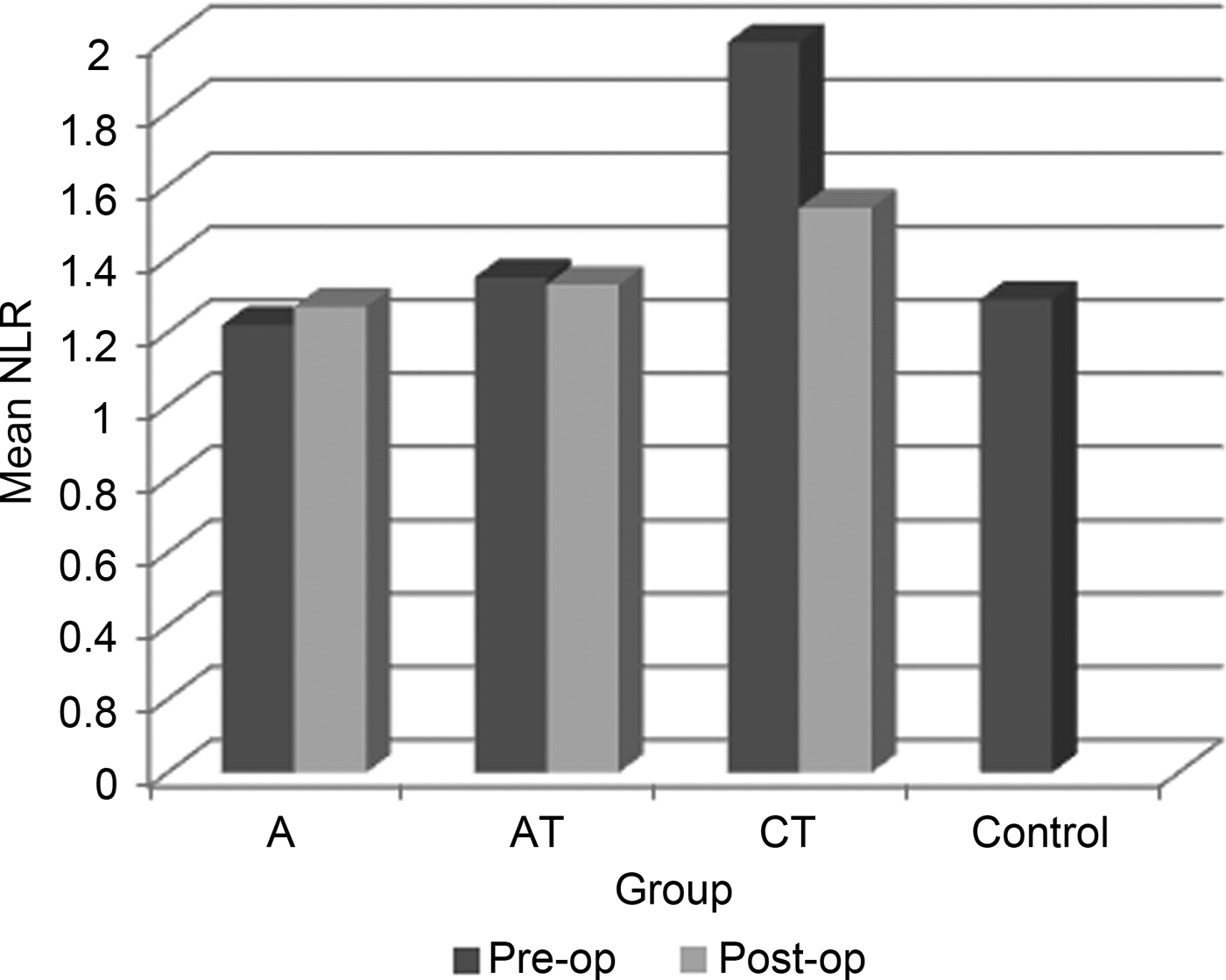
The pre- and post-operative neutrophil-to-lymphocyte ratios were significantly different for all groups (p < 0.05). The Wilcoxon signed rank test showed that the mean pre- and post-operative neutrophil-to-lymphocyte ratios of the chronic tonsillitis group were significantly higher than those of the adenoid hypertrophy and adenotonsillar hypertrophy groups combined (p = 0.045). In contrast, there was no significant difference in pre- and post-operative neutrophil-to-lymphocyte ratios between the adenoid hypertrophy and adenotonsillar hypertrophy groups (p = 0.684 and p = 0.890, respectively; Table II).
Laboratory data by group*

* Using the Wilcoxon signed rank test; †p < 0.05; ‡p < 0.001; A = adenoid hypertrophy; AT = adenotonsillar hypertrophy; CT = chronic tonsillitis; Pre-op = pre-operative; Post-op = post-operative; NLR = neutrophil-to-lymphocyte ratio; WBC = white blood cell
The percentage change between pre- and post-operative neutrophil-to-lymphocyte ratios for patients in the chronic tonsillitis group was significantly greater compared with those in the adenoid hypertrophy, adenotonsillar hypertrophy and control groups.
The Wilcoxon signed rank test showed no significant difference in pre- or post-operative WBC counts among all groups (p > 0.05). However, there was a significant difference between pre- and post-operative lymphocyte counts in the chronic tonsillitis group (p < 0.001; Table II).
One-way ANOVA showed that pre-operative neutrophil-to-lymphocyte ratios were significantly higher in the chronic tonsillitis group than in the adenoid hypertrophy, adenotonsillar hypertrophy and control groups combined (p = 0.000). In contrast, there was no significant difference in post-operative neutrophil-to-lymphocyte ratios among all groups (p = 0.584; Figure 1).
Bar chart showing the pre- and post-operative neutrophil-to-lymphocyte ratios for the different groups. A = adenoid hypertrophy; AT = adenotonsillar hypertrophy; CT = chronic tonsillitis; NLR = neutrophil-to-lymphocyte ratio; Pre-op = pre-operative; Post-op = post-operative
Discussion
The major finding of this study is that the pre-operative neutrophil-to-lymphocyte ratios for chronic tonsillitis patients were significantly higher than those of the other groups (p = 0.000), while there was no significant difference in post-operative neutrophil-to-lymphocyte ratios among all groups (p = 0.584). In the chronic tonsillitis group, the neutrophil-to-lymphocyte ratio was significant lower post-surgery (p = 0.045). The neutrophil-to-lymphocyte ratio may therefore be used to determine the timing of surgical intervention and post-operative follow up in chronic tonsillitis patients to help prevent local and/or systemic complications.
Although the indications for tonsillectomy and adenotonsillectomy are well defined, the extent of these surgical procedures varies according to age, time period, geographic location, the quality and availability of healthcare in each country, the approach of ENT doctors and paediatricians toward such operations, and the educational and socioeconomic levels of patients and their parents.Reference Faramarzi, Kadivar, Heydari and Tavasoli12, Reference Erickson, Larson, St Sauver, Meverden and Orvidas13 The number of tonsillectomies performed because of infections began to decrease with the availability of more effective antibiotics, together with the more appropriate use of such drugs.Reference Bluestone, Cantekin and Beery14 The reduction in tonsillectomy and/or adenotonsillectomy frequency continued until the 1990s. At this point, a new emphasis on airway obstruction due to adenotonsillar hypertrophy led to another increase in those surgical procedures.Reference Rosenfeld and Green15
It is notable that patient age is an important factor for determining the different indications for adenotonsillar surgery. A study noted that in patients aged 0–3 years, the percentage of adenotonsillectomies performed due to obstruction was 92 per cent, decreasing to 73 per cent in 4–10 years old; in those aged 11–18 years, surgery rates of obstruction and infection were very similar. Reference Parker and Walner16 This data indicates that for adenotonsillectomies in younger age groups the main indication is obstruction, while in older patients, infection is another major indication.
Chronic tonsillitis, in which infection symptoms continue for at least three months accompanied by a sore throat, is a significant cause of tonsillectomies performed due to infection.Reference Discolo, Darrow and Koltai17 Suppurative complications such as peritonsillar, parapharyngeal and retropharyngeal abscesses, and non-suppurative complications such as scarlet fever, acute rheumatic fever and post-streptococcal glomerulonephritis are commonly seen in chronic tonsillitis patients who are not treated in a timely and appropriate manner. Infections of this anatomical region are polymicrobial and usually reflect the oropharyngeal flora.Reference Vieira, Allen, Stocks and Thompson18
Recent studies indicate that neutrophilia and relative lymphocytopenia are independent predictors of mortality in acute heart failure patients.Reference Arruda-Olson, Reeder, Bell, Weston and Roger19, Reference Rudiger, Burckhardt, Harpes, Muller and Follath20 The neutrophil-to-lymphocyte ratio was also shown to be a potential marker of inflammation in both cardiac and non-cardiac disease patients.Reference Tamhane, Aneja, Montgomery, Rogers, Eagle and Gurm21–Reference Walsh, Cook, Goulder, Justin and Keeling23 The neutrophil-to-lymphocyte ratio was reported to be a predictive marker for long-term mortality after percutaneous coronary interventions.Reference Duffy, Gurm, Rajagopal, Gupta, Ellis and Bhatt24 Higher neutrophil-to-lymphocyte ratios were also associated with poor survival rates after coronary artery bypass grafting.Reference Gibson, Croal, Cuthbertson, Small, Ifezulike and Gibson25 Several cancer survival studies suggest that the neutrophil-to-lymphocyte ratio can be a significant determinant of the overall and disease-specific survival of cancer patients.Reference Walsh, Cook, Goulder, Justin and Keeling23, Reference Sarraf, Belcher, Raevsky, Nicholson, Goldstraw and Lim26 Systemic inflammation was reported to be a major determinant of cancer patient survival. It is still unclear whether systemic inflammation in cancer patients relates to the malignancy itself or is triggered by any of the accompanying comorbid conditions. Recently, research into identifying a reliable biomarker for predicting survival has generally focused on systemic inflammation.Reference Sarraf, Belcher, Raevsky, Nicholson, Goldstraw and Lim26
Unlike for other biomarkers of inflammation such as interleukin-6 (IL-6), interleukin-1 alpha (IL-1A), tumour necrosis factor alpha (TNF-α) and other inflammatory cytokines, determining the neutrophil-to-lymphocyte ratio does not impose any extra cost. It can simply be calculated from the neutrophil and lymphocyte counts available from routine complete blood cell counts.Reference Turkmen, Guney, Yerlikaya and Tonbul27 The neutrophil count reflects the overall inflammatory status, while the lymphocyte count relates to stress and the nutritional condition of the body. The neutrophil-to-lymphocyte ratio is now accepted as a significant predictor of adverse clinical outcomes. Various studies have found it to be a reliable biomarker in cancer,Reference Walsh, Cook, Goulder, Justin and Keeling23, Reference Sarraf, Belcher, Raevsky, Nicholson, Goldstraw and Lim26 cardiac disease (acute coronary syndromes, heart failure and coronary revascularisation procedures),Reference Tamhane, Aneja, Montgomery, Rogers, Eagle and Gurm21, Reference Nunez, Nunez, Bodi, Sanchis, Miñana and Mainar22 and several other diseases that are accompanied by systemic inflammation such as Alzheimer's disease, ulcerative colitis and appendicitis.Reference Kuyumcu, Yesil, Ozturk, Kizilarslanoğlu, Etgül and Halil28–Reference Biaaas, Taran, Gryszkiewicz and Modzelewski30
This study reports preliminary data. Its main limitation is the lack of comparison with C-reactive protein or other established inflammatory markers. In addition, the sample size was small and neutrophil-to-lymphocyte ratios were not correlated with chronic tonsillitis severity measures such as the tonsillitis episode frequency, antibiotic use, symptom scores or quality of life measures. Moreover, the change in neutrophil-to-lymphocyte ratio was not correlated with the change in disease severity post-tonsillectomy. Studies including larger patient numbers are therefore needed to confirm our findings. Previous studies on the neutrophil-to-lymphocyte ratio involved cancer and cardiovascular disease patients, and no reports have described its role as a chronic infection marker.
• The pathogenesis of chronic tonsillitis is multifactorial
• The neutrophil-to-lymphocyte ratio, integrating the deleterious effects of neutrophilia and lymphopenia, is a systemic inflammatory marker
• This study aimed to investigate whether the neutrophil-to-lymphocyte ratio can indicate ongoing systemic inflammation and the impact of surgery in chronic tonsillitis
• This study is the first to show a relationship between the neutrophil-to-lymphocyte ratio and chronic tonsillitis
This study suggests that the neutrophil-to-lymphocyte ratio, which increases as a consequence of the systemic inflammatory response in chronic tonsillitis, can be used as an adjunctive tool for clinical follow up. This is the first study to reveal the importance of the neutrophil-to-lymphocyte ratio for treating chronic tonsillitis patients.
Conclusion
This study is the first to show a relationship between the neutrophil-to-lymphocyte ratio and chronic tonsillitis. The results identify the neutrophil-to-lymphocyte ratio as a biomarker of systemic inflammation in chronic tonsillitis patients. Calculating this ratio may provide an easy, readily available tool at no extra cost that may be successfully used to determine the timing of surgical intervention and post-operative follow up and may help prevent local and/or systemic complications in chronic tonsillitis patients.