Green Revolution and Green Evolution
World population is increasing rapidly and therefore it is necessary to increase world food production. Nearly 842 million people, or one in eight, were suffering from chronic undernourishment in 2011–2013, according to the UN hunger report (FAO, 2013).
Crop production has also increased rapidly in the last century (Tilman et al., Reference Tilman, Cassman, Matson, Naylor and Polasky2002; Fig. S1(a), available online). The most important factors that contributed to the increase in food production called the ‘Green Revolution’ were based on high inputs of artificial N (ammonia) fertilizers into farmlands (up to 100 million tonnes per year) and improved irrigation (Fig. S1(b), available online). However, artificial N fertilizers are produced using energy from fossil fuels and therefore are not a sustainable aspect of food production.
Legumes evolved a symbiotic N-fixing system about 65 million years ago (Udvardi and Scheible, Reference Udvardi and Scheible2005), and at present legume crops fix about 50 million tonnes of atmospheric N annually. Considering this environmentally friendly N fixation, the system of symbiotic N fixation can be called ‘Green Evolution’. It is expected that more legume crops will be grown in future cropping systems to achieve low-input sustainable crop production.
Evolution of Vigna
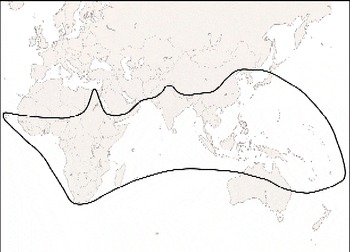
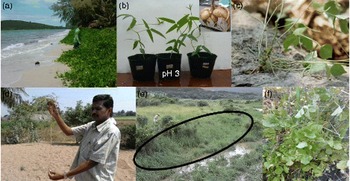
The genus Vigna of the Leguminosae plant family consists of about 100 species distributed in the tropical and subtropical areas of the world (Maxted et al., Reference Maxted, Mabuza-Dlamini, Moss, Padulosi, Jarvis and Guarino2004; Tomooka et al., Reference Tomooka, Vaughan, Maxted and Moss2002; Fig. 1). Wild Vigna species are adapted to various habitats (Tomooka et al., Reference Tomooka, Kaga, Isemura, Vaughan and Chittaranjan2011). They include harsh environments such as sandy beaches, acid soils, limestone rocks, deserts and wetlands (Fig. 2). Studies carried out to clarify the mechanisms of adaptation to these extreme environments will furnish information that may enhance world food production.
Global distribution of wild Vigna plants (except in the American continent). Distribution information was collected from Tomooka et al. (Reference Tomooka, Vaughan, Maxted and Moss2002) and Maxted et al. (Reference Maxted, Mabuza-Dlamini, Moss, Padulosi, Jarvis and Guarino2004).

Candidate Vigna species for ‘neo-domestication’: (a) V. marina for saline lands, (b) V. vexillata for acidic lands, (c) V. exilis for alkaline lands, (d) V. trilobata for drought-prone lands, (e) V. luteola for flood-prone lands and (f) V. stipulacea for pest and disease resistance. The site where V. luteola plants grow is indicated by a black circle.

Vigna species are diploid, except V. reflexo-pilosa, and have relatively small genome size (ca. 550 Mb). In addition to the high intraspecific variation to stresses, some species still retain cross-compatibility and can be used for gene mapping. For example, we have developed an interspecific mapping population between V. luteola and V. marina for salt resistance qualitative trait locus (QTL) analysis (Chankaew et al., Reference Chankaew, Isemura, Naito, Ogiso-Tanaka, Tomooka, Somta, Kaga, Vaughan and Srinives2014). Many Vigna species are fast growing and high seed producers. Therefore, Vigna species have ideal characteristics to make them suitable for ‘new model plant species’ for the genetic study of natural adaptation to various stress environments. To provide a foundation for genome analysis, the Vigna Genome Project has been initiated, in which 15 wild Vigna species are the targets of genome sequencing (Naito et al., Reference Naito, Kaga, Tomooka and Kawase2013; Sakai et al., Reference Sakai, Naito, Ogiso-Tanaka, Kaga, Itoh and Tomooka2013).
Domestication genetics of Vigna
Within the genus Vigna, nine species have been domesticated. They are moth bean (V. aconitifolia), azuki bean (V. angularis), black gram (V. mungo), mungbean (V. radiata), creole bean (V. reflexo-pilosa = V. glabrescens), bambara groundnut (V. subterranea), rice bean (V. umbellata), cowpea (V. unguiculata) and tuber cowpea (V. vexillata). Vigna crops are suitable for comparative genetics of the domestication syndrome. The domestication syndrome includes an increase in seed or fruit size, loss of seed dispersal mechanism (pod dehiscence), loss of seed dormancy (water absorption by seeds), more determinate growth (or apical dominance), change in seed colour and change in flowering time (synchronization and loss of photoperiod sensitivity). Domestication-related QTLs have been identified for V. angularis, V. mungo, V. radiata, V. umbellata and V. unguiculata (Chaitieng et al., Reference Chaitieng, Kaga, Tomooka, Isemura, Kuroda and Vaughan2006; Isemura et al., Reference Isemura, Kaga, Konishi, Ando, Tomooka, Han and Vaughan2007, Reference Isemura, Kaga, Tomooka, Shimizu and Vaughan2010, Reference Isemura, Kaga, Tabata, Somta, Srinives, Shimizu, Jo, Vaughan and Tomooka2012; Kaga et al., Reference Kaga, Isemura, Tomooka and Vaughan2008; Kongjaimun et al., Reference Kongjaimun, Kaga, Tomooka, Somta, Vaughan and Srinives2012a, Reference Kongjaimun, Somta, Tomooka, Kaga, Vaughan and Srinivesb). These studies supported the domestication syndrome theory that important domestication traits are controlled by a small number of major QTLs with a few minor QTLs and that most of the causative mutations are ‘loss-of-function’ type (Doebley et al., Reference Doebley, Gaut and Smith2006).
Crop production on marginal lands
The yields of major crops are considered to have reached a plateau and significant further increase in yield is unlikely. One approach to increase crop production is to use lands that are currently not suitable or not used for crop production. These include lands with high salinity, high acidity, and high alkalinity, those that are drought prone and those that have waterlogged soils. Even among the lands presently used for crop production, about 70% are categorized as ‘problem soils’. To achieve reasonable crop production on marginal lands, new crops that can grow well on marginal lands are needed. Hence, we propose ‘neo-domestication’.
Neo-domestication
Compared with simple genetic change during domestication, evolutional adaptation to stress environments is based on a very complex gene network. Therefore, rather than improving stress resistance of existing domesticated species, it may be more appropriate to domesticate wild species well adapted to stress environments. Generally, the levels of resistance to environmental stress in existing domesticated species are low.
To achieve ‘neo-domestication’, a conventional mutation breeding methodology, such as irradiation or chemical mutagenesis, can be used. Mutant screening can be done efficiently using TILLING in case target genes are being cloned. Currently, domestication genes of specific interest are being cloned. These include a multiple-organ-size-increase gene from black gram (V. mungo), a seed-size-increase gene from rice bean (V. umbellata), pod-length-increase gene from yard long bean (V. unguiculata) and a pod-shattering gene from azuki bean (V. angularis).
Some of the candidate Vigna species for ‘neo-domestication’ are V. marina, V. vexillata, V. exilis, V. trilobata, V. luteola and V. stipulacea. V. marina can grow on beaches with extremely high levels of salt resistance (Fig. 2(a)). An accession of V. vexillata can grow vigorously and can accumulate 30% more dry weight under conditions of pH 3 than under those of pH 6 (Fig. 2(b)). V. exilis can grow well directly on alkaline limestone rocks (Fig. 2(c)). V. trilobata has a deep taproot that enables it to grow under very severe drought conditions (Fig. 2(d)). V. luteola can grow in flood-prone habitats adjacent to rivers (Fig. 2(e), habitat indicated by a circle). V. stipulacea has been found to be little affected by pests and diseases in the absence of pesticides in a NIAS experimental field (Tsukuba, Japan). By contrast, other Vigna crop species were eaten by insects even with pesticides being applied every 2 weeks in an adjacent field (Fig. 2(f)). Local people use, as food, seeds and immature pods of all these wild Vigna species. In the case of V. vexillata, well-developed tubers are also eaten (Fig. 2(b), upper right). Edibility is particularly important when selecting stress-resistant wild species as candidates for ‘neo-domestication’.
Ability of N fixation under stress environments
V. marina plants achieve a high rate of N fixation under high-salinity conditions of sandy beaches. The isolated symbiotic bacteria from the root nodules of V. marina have been found to exhibit very high levels of salt resistance and survive up to 5% salt concentrations (Akatsu et al., Reference Akatsu, Sano, Kanekatsu, Ishikawa, Ohkama-Ohtsu, Tomooka and Yokoyama2012). Stress-adapted symbiotic bacteria produce nodules on stress-adapted Vigna species. Therefore, conducting genetic diversity studies of bacteria growing symbiotically with wild Vigna species of marginal lands and studies on the process of symbiosis under stress environments is a high priority.
Supplementary material
To view supplementary material for this article, please visit http://dx.doi.org/10.1017/S1479262114000483