Introduction
Tobacco harm reduction involves attempting to reduce the physical and/or psychological harm from smoking without complete cessation of tobacco. One type of harm reduction is the use of nicotine replacement therapy (NRT) for smoking reduction. Another involves use of NRT in situations when smoking is not permitted, i.e., during periods of temporary abstinence. Data from clinical trials indicate that use of NRT for smoking reduction may result in significant reductions in cigarette consumption and toxin intake (Asfar et al., Reference Asfar, Ebbert, Klesges and Relyea2011; Fagerstrom, Reference Fagerstrom2005; Hughes, Reference Hughes2000; Hughes & Carpenter, Reference Hughes and Carpenter2006; Moore et al., Reference Moore, Aveyard, Connock, Wang, Fry-Smith and Barton2009; Stead & Lancaster, Reference Stead and Lancaster2007; Tonnesen, Reference Tonnesen2002; Wang et al., Reference Wang, Connock, Barton, Fry-Smith, Aveyard and Moore2008; Zellweger, Reference Zellweger2001). However, a potential unwanted consequence of such an activity is that it may undermine motivation to stop smoking altogether. Data from clinical trials suggests that, on the contrary, use of NRT for smoking reduction could increase the rate at which smokers try and succeed in stopping (Asfar et al., Reference Asfar, Ebbert, Klesges and Relyea2011; Fagerstrom, Reference Fagerstrom2005; Hughes, Reference Hughes2000; Hughes & Carpenter, Reference Hughes and Carpenter2006; Moore et al., Reference Moore, Aveyard, Connock, Wang, Fry-Smith and Barton2009; Stead & Lancaster, Reference Stead and Lancaster2007; Tonnesen, Reference Tonnesen2002; Wang et al., Reference Wang, Connock, Barton, Fry-Smith, Aveyard and Moore2008; Zellweger, Reference Zellweger2001).
However, there are several reasons why these data may not mean that people who reduce smoking in the general population are more likely to reduce or stop smoking than those who do not. First, in trials NRT was provided free of charge and this may have helped to ensure that usage was at the level required to achieve a clinically significant effect. Secondly, the regular follow-up and behavioural support provided in the clinical trials may have helped participants to gain benefit from NRT which may not occur without such support. Thirdly, the volunteers for the trials may have been more highly motivated to reduce their smoking than those using NRT in the population of smokers as a whole. Fourthly, in the general population of smokers there are significant numbers of people with mental health problems and these are usually excluded from clinical trials; such smokers may experience particular difficulties in achieving smoking reduction.
Consequently, the current review aimed to assess how far the use of NRT for smoking reduction and/or temporary abstinence is associated with (i) attempts to stop smoking and smoking cessation, and (ii) reduction in cigarette consumption, in the population. The current review presents data comparing those using NRT for smoking reduction and/or temporary abstinence to (i) other smokers generally, (ii) smokers using NRT for smoking cessation, and (iii) smokers attempting to cut down or to temporarily abstain without NRT. The third comparison provides the most valid data regarding the ‘effectiveness’ of NRT use for harm reduction purposes at a population level; with any difference being attributed to the use of NRT. In comparison, any difference amongst those using NRT for smoking reduction and/or temporary abstinence and other smokers, could be due to their use of NRT or a consequence of their attempts to reduce their cigarette intake.
A secondary aim was to determine how many smokers are using NRT for smoking reduction and/or temporary abstinence. This is important from a policy perspective, providing an indication as to the likely uptake of population-based reduction programmes. The most useful data presented are those from random/quasi random population surveys of smokers, as these provide a reliable estimate of the number of smokers using NRT for smoking reduction and/or temporary abstinence in the population. It is of additional interest to ascertain the socio-demographic and smoking characteristics of those using NRT for harm reduction purposes for two reasons: (1) to inform population-based interventions as to those who may be the most interested in a harm reduction approach and (2) to determine whether harm reduction approaches are targeting a set of smokers previously ignored by conventional tobacco control approaches.
Methods
Edibility criteria
Studies were initially selected on the basis of whether the target population were smokers and whether the studies had been published. Further selection was then based on whether the studies (1) involved the assessment of smokers who had used or were currently using NRT for smoking reduction and/or temporary abstinence; (2) involved smokers who had not taken part in a harm reduction programme; and (3) assessed prevalence and/or association with cigarette consumption and/or association with attempts to quit smoking and/or smoking cessation.
Information sources
The electronic databases EMBASE, MEDLINE, Web of Science and PsycINFO, were searched up to March 2011. The search combined four parameters: smoking (smok*, cigarette, tobacco), NRT (nicotine, NRT), smoking reduction and/or temporary abstinence (smoking reduction, cut down, cutting down, reduce, schedule, gradual, controlled smoking, temporary abstinence, smoke-free, smoking restriction, harm reduction, risk reduction), and smoking cessation (quit, cessation, intention, motivation, cease, desire, stop). References of selected studies were screened and independent journal searches conducted (Tobacco Control; Nicotine & Tobacco Research; Addiction) using the journals website search facilities.
Study selection and data collection process
The title and abstract of studies found from the above information sources were assessed for initial inclusion criteria. The full articles of eligible studies which met these criteria were then screened to ascertain whether they met the specific inclusion criteria. Data were abstracted independently by two researchers using a structured data abstraction form, which included socio-demographic and smoking characteristics, the country in which the study was conducted, method of recruitment, prevalence data and differences among groups in cigarette consumption, attempts to quit smoking and smoking cessation. Disagreements were discussed and resolved, with 90% agreement attained.
Quality assessment and risk of bias
Study quality was assessed using criteria adapted from the Newcastle-Ottawa scale (www.ohri.ca/programs/clinical_epidemiology/nosgen.pdf), recommended by Cochrane reviewers (Higgins & Green, Reference Higgins and Green2008): (1) Representativeness of the sample (do recruitment methods result in a sample of smokers representative of the general population?), (2) validity of measurements (is the use of NRT for smoking reduction assessed retrospectively or currently?), (3) adequate sample size (is the study sufficiently powered?), and (4) study design (is the study cross-sectional or prospective?). Two separate quality measures were produced for those looking at prevalence and effectiveness of NRT for harm reduction. Quality was rated good, moderate or poor. Studies assessing prevalence were classed as good quality if they: (1) recruited representative samples; (2) with an adequate sample size and; (3) assessed current use of NRT. They were classed as moderate if they satisfied two of these criteria, and poor if they satisfied less than one. Those assessing the effectiveness were classed as good quality if they satisfied at least three of the following: (1) adequate sample size, (2) representative sample, (3) assessment of current NRT use, and (4) used a prospective design. They were classed as moderate quality if they satisfied two, and poor quality if they satisfied less than one. Potential risks of bias from the included studies were also considered.
Outcome measures
For studies assessing the number of smokers using NRT for harm reduction purposes, the primary outcomes were current prevalence, cumulative prevalence, and initial reasons for purchasing NRT. For those measuring cessation, the primary outcomes for the review were quit attempts and smoking status. Finally, for studies measuring consumption, the primary outcomes were differences in cigarette consumption, changes in nicotine intake (measured by salivary cotinine), average percentage reduction in cigarette consumption from baseline, or the number of those attaining a reduction in cigarette consumption of 50% or more.
Synthesis of results
Due to the diversity of methods used across studies, a meta-analysis could not be conducted; therefore a narrative synthesis of the findings was undertaken. This involved assessing the average and distribution of prevalence estimates and the direction and consistency of associations reported. PRISMA guidelines were followed throughout (Moher et al., Reference Moher, Liberati, Tetzlaff and Altman2009). Studies assessing prevalence using population-based surveys were reported separately from those which surveyed NRT users only or those studies with biased recruitment methods. Studies assessing cigarette consumption, attempts to quit smoking, and smoking cessation, were split according to study design: cross-sectional, prospective and mixed (cross-sectional and prospective).
Results
Study selection
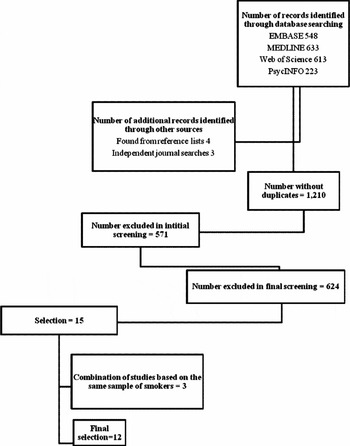
Fifteen studies were identified; three studies used data from the Smoking Toolkit Study (www.smokinginengland.info) (Beard et al., Reference Beard, McNeill, Aveyard, Fidler, Michie and West2011a; Beard et al., Reference Beard, Fidler and West2011b; Beard et al., in press) and two from the International Tobacco Control Four Country Study (www.itcproject.org/) (Hammond et al., Reference Hammond, Reid, Driezen, Cummings, Borland, Fong, McNeill and Hughes2008; Shahab et al., Reference Shahab, Cummings, Hammond, Borland, West and McNeill2009); these were combined [reported as STS and ITC, respectively], leaving 12 studies overall (see Figure 1). The paper by Hughes and colleagues (Reference Hughes, Lindgren, Connett and Nides2004) included two studies which are denoted throughout as (2004a) and (2004b), respectively. Eleven of the studies assessed the proportion of smokers using NRT for smoking reduction and/or temporary abstinence, six assessed the issue of cigarette consumption, and three assessed attempts to quit smoking and/or smoking cessation.
Flow of information through the different phases of the systematic review

Study characteristics
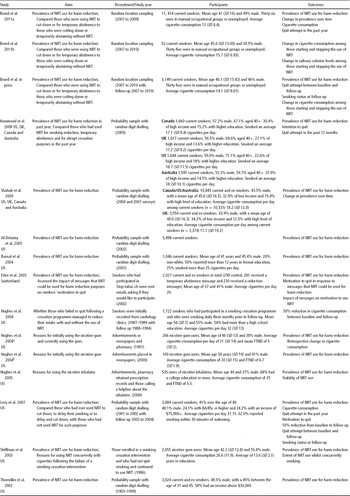
All 12 studies were conducted in one or more of the following countries: US, UK, Canada, Switzerland and Australia (see Table 1). In six of the studies, recruitment involved telephone surveys using random digit dialling with a panel of respondents. Three studies used advertisements in pharmacies or newspapers and one study used random location sampling (STS). Hughes et al. (Reference Hughes, Adams, Franzon, Maguire and Guary2005) also recruited smokers who had phoned a help line for the inhalator or who had recently collected a prescription for the product. A further three studies recruited participants who had taken part in a smoking cessation programme and had failed to quit smoking (Etter et al., Reference Etter, le Houezec and Landfeldt2003; Hughes et al., Reference Hughes, Pillitteri, Callas, Callahan and Kenny2004; Shiffman et al., Reference Shiffman, Hughes, Di Marino and Sweeney2003).
Characteristics of the selected studies for inclusion in the systematic review

Note: NRT = Nicotine Replacement Therapy; SD = Standard Deviation; FTND = Fagerstrom Test for Nicotine Dependence; CO = carbon monoxide Dependence
Of the 11 studies assessing the number of smokers using NRT for smoking reduction and/or temporary abstinence, seven surveyed current and ex-smokers (Al-Delaimy et al., Reference Al-Delaimy, Gilpin and Pierce2005; Bansal et al., Reference Bansal, Cummings, Hyland and Giovino2004; Etter et al., Reference Etter, le Houezec and Landfeldt2003; ITC; Levy et al., Reference Levy, Thorndike, Biener and Rigotti2007; Thorndike, Reference Thorndike, Biener and Rigotti2002; STS), while four surveyed gum users (Hughes, Reference Hughes, Lindgren, Connett and Nides2004ab; Shiffman et al., Reference Shiffman, Hughes, Di Marino and Sweeney2003) or inhalator users only (Hughes et al., Reference Hughes, Adams, Franzon, Maguire and Guary2005). Current NRT use for smoking reduction and/or temporary abstinence was measured in three of the studies (Hughes et al., Reference Hughes, Lindgren, Connett and Nides2004a; Shiffman et al., Reference Shiffman, Hughes, Di Marino and Sweeney2003; STS), lifetime use of NRT or cumulative prevalence in five of the studies (Al-Delaimy et al., Reference Al-Delaimy, Gilpin and Pierce2005; Bansal et al., Reference Bansal, Cummings, Hyland and Giovino2004; Etter et al., Reference Etter, le Houezec and Landfeldt2003; Levy et al., Reference Levy, Thorndike, Biener and Rigotti2007; Thorndike et al., Reference Thorndike, Biener and Rigotti2002), and use of NRT in the past year in one study (ITC). Three studies assessed whether smokers had initially purchased NRT for smoking reduction and/or temporary abstinence (Hughes et al., Reference Hughes, Lindgren, Connett and Nides2004ab; Hughes et al., Reference Hughes, Adams, Franzon, Maguire and Guary2005). Of those assessing cigarette consumption and/or quit attempts, three were cross-sectional (Etter et al., Reference Etter, le Houezec and Landfeldt2003; ITC; Hughes et al., Reference Hughes, Pillitteri, Callas, Callahan and Kenny2004b), one prospective (Hughes et al., Reference Hughes, Lindgren, Connett and Nides2004) and two used a mixed design (Levy et al., Reference Levy, Thorndike, Biener and Rigotti2007; STS). Follow-ups ranged from six months to five years (Hughes et al., Reference Hughes, Lindgren, Connett and Nides2004; Levy et al., Reference Levy, Thorndike, Biener and Rigotti2007; STS). Two of the studies compared smokers who were using NRT for smoking reduction and/or temporary abstinence to those who were cutting down or temporarily abstaining without NRT (Hughes et al., Reference Hughes, Lindgren, Connett and Nides2004; STS); two compared smokers who had used NRT for smoking reduction and/or temporary abstinence to other smokers generally (Etter et al., Reference Etter, le Houezec and Landfeldt2003; Levy et al., Reference Levy, Thorndike, Biener and Rigotti2007); and one compared those who had used NRT for smoking reduction and/or temporary abstinence to those who had used NRT for smoking cessation purposes (ITC). A further study compared smokers’ current cigarette consumption with their retrospectively reported cigarette intake prior to NRT use (Hughes et al., Reference Hughes, Pillitteri, Callas, Callahan and Kenny2004a).
The use of NRT for smoking reduction was assessed by asking participants if they had ever used NRT to reduce the amount they smoked. The use of NRT for temporary abstinence was assessed by asking participants if they had ever used NRT to tide themselves over during periods of abstinence, for example, on planes, in restaurants and on trains (Etter et al., Reference Etter, le Houezec and Landfeldt2003; Levy et al., Reference Levy, Thorndike, Biener and Rigotti2007), or if they had ever used NRT during periods of time when they were unable to smoke/where smoking was not permitted (Hughes et al., Reference Hughes, Lindgren, Connett and Nides2004ab; Hughes et al., Reference Hughes, Adams, Franzon, Maguire and Guary2005; ITC; STS). One study used open-ended questions to assess the reasons for NRT use, with responses categorised into ‘to try to quit’, ‘to tide one over in situations where I cannot smoke’, ‘to replace some cigarettes so I smoke less’ and ‘just curious’ (Al-Delaimy et al., Reference Al-Delaimy, Gilpin and Pierce2005). Only six studies checked that smokers were reducing without aiming to quit smoking (Bansal et al., Reference Bansal, Cummings, Hyland and Giovino2004; Hughes et al., Reference Hughes, Adams, Franzon, Maguire and Guary2005; ITC; Levy et al., Reference Levy, Thorndike, Biener and Rigotti2007; STS; Thorndike et al., Reference Thorndike, Biener and Rigotti2002).
Quality assessment and risk of bias
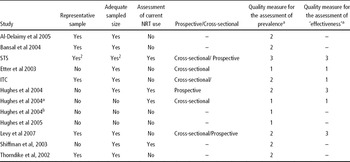
Table 2 summarises the results of the quality assessment. Most of the studies were of poor to moderate quality, with only three studies classed as good quality (Hughes et al., Reference Hughes, Lindgren, Connett and Nides2004; Levy et al., Reference Levy, Thorndike, Biener and Rigotti2007; STS). Those studies categorised as being of low quality could bias results in a number of ways: (1) many asked smokers to retrospectively recall their NRT use for harm reduction purposes, the reliability of which is dependent on smokers’ ability to remember their previous usage of NRT; (2) the recruitment of unrepresentative samples in a number of the studies undermines their generalisation to the population of smokers; (3) some of the studies were underpowered and so would not have been able to detect differences even if these existed; and (4) many were cross-sectional in nature, resulting in the inability to determine the true direction of the relationships reported (Etter et al., Reference Etter, le Houezec and Landfeldt2003; Hughes et al., Reference Hughes, Lindgren, Connett and Nides2004ab; Hughes et al., Reference Hughes, Adams, Franzon, Maguire and Guary2005; ITC). Other sources of bias include a dependence on ‘Westernised samples’ and diversity in the periods of data collection (1987–2010). Since the early 1990s substantial changes have occurred in the licensing of NRT and in the acceptability of smoking.
Summary of the quality assessment of included studies

NRT = Nicotine Replacement Therapy; – = Not applicable
1Beard et al [STS refers to the combination of data from Beard et al (Reference Beard, McNeill, Aveyard, Fidler, Michie and West2011a), Beard, Filder and West (Reference Beard, Fidler and West2011b) and Beard et al (in press)
2Beard, Fidler and West (Reference Beard, Fidler and West2011b) did not recruit a representative sample or a sample of an adequate size
a Quality measure 1 = Poor quality, 2 = Moderate quality, 3 = Good quality
Prevalence of NRT use
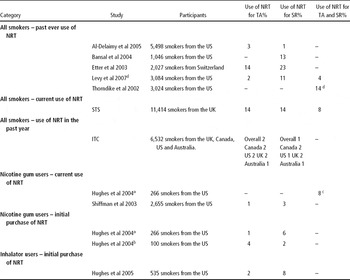
Five studies assessed the past ever use of NRT for harm reduction among smokers generally (Al-Delaimy et al., Reference Al-Delaimy, Gilpin and Pierce2005; Bansal et al., Reference Bansal, Cummings, Hyland and Giovino2004; Etter et al., Reference Etter, le Houezec and Landfeldt2003; Levy et al., Reference Levy, Thorndike, Biener and Rigotti2007; Thorndike et al., Reference Thorndike, Biener and Rigotti2002) (see Table 3); of these, four considered the use of NRT separately for smoking reduction and three for periods of temporary abstinence. These studies respectively provided data on 11,655 and 10,609 smokers. Nine per cent (Confidence Interval (CI) 8.3–9.3) of smokers were found to have ever used NRT to reduce their cigarette consumption and 5% (CI 4.4–5.2) for periods of time when they were unable to smoke. One further study assessed the use in the past year (ITC), noting that less than 6% of smokers had used NRT for temporary abstinence and/or smoking reduction. Only one study assessed the current use of NRT for harm reduction purposes, reporting a prevalence of 14% for smoking reduction and 14% for temporary abstinence (STS). Two studies assessed gum users’ reasons for initially purchasing NRT (Hughes et al., Reference Hughes, Pillitteri, Callas, Callahan and Kenny2004ab). These studies provided data on 366 smokers. Two per cent of smokers (CI 0.9–3.9) reported that they had initially purchased nicotine gum to tide them over during periods of temporary abstinence, while 5% (CI 3.1–7.6) had purchased nicotine gum initially for smoking reduction. Two further studies (Hughes et al., Reference Hughes, Pillitteri, Callas, Callahan and Kenny2004a, Shiffman et al., Reference Shiffman, Hughes, Di Marino and Sweeney2003) assessed the current use of nicotine gum for harm reduction; only one of these (Shiffman et al., Reference Shiffman, Hughes, Di Marino and Sweeney2003) assessed the use separately for smoking reduction and temporary abstinence, reporting prevalence's of 3% and 1% respectively. Finally, one study (Hughes et al., Reference Hughes, Adams, Franzon, Maguire and Guary2005) assessed the initial reasons for using the nicotine inhalator, reporting that 2% of smokers had purchased it for temporary abstinence and 8% for smoking reduction.
Prevalence of the use of Nicotine Replacement Therapy for smoking reduction and/or temporary abstinence

Note: NRT = Nicotine Replacement Therapy, TA = temporary abstinence, SR = smoking reduction – = Not applicable; c Prevalence of those using NRT for smoking reduction and/or temporary abstinence; d Analysis restricted to patch and gum users only
The patch and gum were the most commonly used form of NRT for harm reduction purposes (Bansal et al., Reference Bansal, Cummings, Hyland and Giovino2004; ITC; STS). Prevalence did not differ between countries, over time, or as a function of the extent to which smoking restrictions were imposed (ITC; STS), but did vary as a function of smokers’ characteristics. The use of NRT for harm reduction was more common among married smokers with a high nicotine dependency (Al-Delaimy et al., Reference Al-Delaimy, Gilpin and Pierce2005; Etter et al., Reference Etter, le Houezec and Landfeldt2003; Levy et al., Reference Levy, Thorndike, Biener and Rigotti2007; STS). The use of NRT for smoking reduction was also associated with age, while the use of NRT for temporary abstinence with the ethnic category ‘White’ (Levy et al., Reference Levy, Thorndike, Biener and Rigotti2007; STS). Those using NRT for these purposes also tended to have higher educational attainments and were more reliant on cigarettes than those using NRT for smoking cessation (Hughes et al., Reference Hughes, Pillitteri, Callas, Callahan and Kenny2004a; ITC). The use of NRT for harm reduction purposes was not associated with smokers’ income, while findings for gender were inconsistent (ITC; Levy et al., Reference Levy, Thorndike, Biener and Rigotti2007; STS).
Reductions in cigarette consumption
In the cross-sectional analyses, the use of NRT for harm reduction purposes was associated with higher cigarette consumption (of around one to two cigarettes per day) relative to other smokers (Etter et al., Reference Etter, le Houezec and Landfeldt2003; Levy et al., Reference Levy, Thorndike, Biener and Rigotti2007), those attempting reduction without NRT (STS) and those using NRT for smoking cessation (ITC). Only two of these studies adjusted for socio-demographic variables and nicotine dependence (ITC; STS). In the prospective analyses, Levy et al. (Reference Levy, Thorndike, Biener and Rigotti2007) found no association at two years follow-up between the past use of NRT for smoking reduction and/or temporary abstinence and a reduction of 50% or more in cigarette consumption. Hughes et al. (Reference Hughes, Lindgren, Connett and Nides2004) found greater reductions among reducers who had used NRT at any time point over the previous year. Smokers who had used NRT at years two, three, four and five, also had more reduction in those years than non-NRT users at the same points in time. Beard et al. (STS) found that smokers reported slightly lower cigarette consumption (around 1–2 cigarettes per day) at times when they were using NRT for smoking reduction and/or temporary abstinence compared to when they reported smoking reduction or temporary abstinence without using NRT, but that this slight change was not associated with a change in nicotine intake (measured using salivary cotinine). Hughes et al. (Reference Hughes, Lindgren, Connett and Nides2004a) also noted a reduction in cigarette consumption when smokers reported that they were using NRT for smoking reduction.
Attempts to quit smoking and smoking cessation
In the cross-sectional analyses positive associations were reported between the use of NRT for smoking reduction and past attempts to quit smoking (Levy et al., Reference Levy, Thorndike, Biener and Rigotti2007; STS). Beard et al. (STS) reported that those using NRT for smoking reduction were 3.6 times more likely to have attempted to quit smoking in the previous year than those cutting down without NRT, while Levy et al. (Reference Levy, Thorndike, Biener and Rigotti2007) that those who had used NRT to cut down in the past were 1.8 times more likely to report a recent quit attempt than other smokers generally. Findings were less consistent regarding the association between the use of NRT for temporary abstinence and quit attempts; while Levy et al. (Reference Levy, Thorndike, Biener and Rigotti2007) failed to report an association, Beard et al. (STS) reported that smokers using NRT for TA were 3.9 times more likely to have made a recent quit attempt than smokers not using NRT for TA. However, those using NRT for smoking reduction and/or temporary abstinence were less likely to report a previous quit attempt compared to those using NRT for smoking cessation (ITC). People who used NRT to reduce or for temporary abstinence were as likely to intend to quit smoking as other smokers generally (Levy et al., Reference Levy, Thorndike, Biener and Rigotti2007) but were less likely to report an intention to quit than smokers who had used NRT for smoking cessation (ITC).
In the prospective analyses, one study reported that people who had used NRT to reduce or for temporary abstinence were no more likely to attempt to quit smoking or succeed in stopping than smokers not using NRT (Levy et al., Reference Levy, Thorndike, Biener and Rigotti2007), while another reported that NRT users were more likely to attempt to quit smoking and stop (STS) Beard et al. (STS) established that those using NRT for smoking reduction were 1.6 times more likely to report a quit attempt between baseline and follow-up, and 1.5 times more likely to report four-week point prevalence cessation at follow-up, than those cutting down without NRT. Those using NRT for temporary abstinence were 1.9 times more likely to report a quit attempt and twice as likely to be abstinent at follow-up than those not using NRT for such purposes. Of interest, is that messages informing smokers that NRT could be used to manage smoke-free situations appeared to have no impact on motivation to quit, while a message that it could be used for smoking reduction increased motivation to stop smoking (Etter et al., Reference Etter, le Houezec and Landfeldt2003). Only two of these studies adjusted for confounding variables (ITC; STS).
Discussion
This is the first review to synthesise evidence about the prevalence of NRT use for harm reduction. The finding that a minority of smokers have ever used NRT for such purposes is unsurprising given that studies suggest that less than 20% of smokers who are attempting to quit smoking use medicinal nicotine (Zhu et al., Reference Zhu, Melcer, Sun, Rusbrook and Pierce2000). The cost of concurrently purchasing NRT and cigarettes is likely to partially account for the low prevalence of use (Bauer et al., Reference Bauer, Carlin-Menter, Celestino, Hyland and Cummings2006; Johnson et al., Reference Johnson, Stevens, Hollis and Woodson1992), as are the negative beliefs many smokers hold towards NRT (Bansal et al., Reference Bansal, Cummings, Hyland and Giovino2004; Cummings et al., Reference Cummings, Hyland, Giovino, Hastrup and Bauer2004; Hajek et al., Reference Hajek, West, Foulds, Nilsson, Burrows and Meadow1999; Johnson et al., Reference Johnson, Stevens, Hollis and Woodson1992; Miller et al., Reference Miller, Frieden, Liu, Matte, Mostashari, Deitcher, Cummings, Chang, Bauer and Bassett2005). The pharmaceutical industries have also historically directed their heavily invested consumer advertising of NRT towards those smokers who are already primed to stop smoking or to reduce on their own (Cummings & Hyland, Reference Cummings and Hyland2005). Moreover, product labelling has been rather cautious and out-dated. Although this has now largely been rectified in the UK, in other countries NRT product labels imply to consumers that the medication is only for cessation purposes and dangerous if taken for prolonged periods of time (Shiffman et al., Reference Shiffman, Feguson, Rohay and Gitchell2008). However, although there was little evidence of within study changes in prevalence (ITC; STS), those studies conducted more recently had a higher prevalence of NRT use for harm reduction; pointing towards the possibility that more smokers may start to use NRT for non-cessation purposes in the coming years.
The use of NRT for smoking reduction and/or during periods of temporary abstinence was more common among older smokers and those with higher nicotine dependency; giving some indication as to those who may be the most receptive of a harm reduction approach. Since smokers with a greater reliance on cigarettes are likely to find it harder to cope with momentary abstinence, it is perhaps of little surprise that they are more likely to opt to use NRT. There is also evidence that older smokers hold greater positive beliefs about medication generally (Horne & Weinman, Reference Horne and Weinman1999). As these findings largely coincide with studies on the characteristics of those using NRT for smoking cessation (Botello-Harbaum et al., Reference Botello-Harbaum, Schroeder, Collins and Moolchan2010; Emmons et al., Reference Emmons, Goldstein, Roberts, Cargill, Sherman, Millman, Brown and Abrams2000; Kotz et al., Reference Kotz, Fidler and West2009), they raise the concern that tobacco harm reduction approaches may not be reaching a sub-set of smokers who are unwilling or unable to quit smoking. This certainly requires further investigation; although Hammond et al. (STS) did establish differences among those using NRT for cessation and non-cessation purposes.
In contrast to the findings from the clinical trials (Asfar et al., Reference Asfar, Ebbert, Klesges and Relyea2011; Fagerstrom, Reference Fagerstrom2005; Hughes, Reference Hughes2000; Hughes & Carpenter, Reference Hughes and Carpenter2006; Moore et al., Reference Moore, Aveyard, Connock, Wang, Fry-Smith and Barton2009; Stead & Lancaster, Reference Stead and Lancaster2007; Tonnesen, Reference Tonnesen2002; Wang et al., Reference Wang, Connock, Barton, Fry-Smith, Aveyard and Moore2008; Zellweger, Reference Zellweger2001), the use of NRT for smoking reduction in population surveys does not appear to be associated with sizable reductions in cigarette consumption. Although no randomised controlled trial has considered the use of NRT for temporary abstinence, the lack of reductions in cigarette consumption is also rather surprising. One would assume that NRT would mitigate a tendency to compensate prior to and following periods of momentary abstinence, with a reduction in cigarette consumption consequently occurring.
The findings regarding the association with smoking cessation are less than consistent. In the cross-sectional analyses the use of NRT for harm reduction purposes was associated with increased odds of a previous attempt to quit smoking relative to other smokers generally/those not using NRT for harm reduction purposes (Levy et al., Reference Levy, Thorndike, Biener and Rigotti2007; STS). However, this could be for many reasons: it may be that the use of NRT for smoking reduction increases smokers’ motivation to quit; it may be that use of NRT and attempts at cessation are both manifestations of a general tendency to try and mitigate the harmful effects of smoking; it could also be that the use of NRT for smoking reduction is an after effect of a failed quit attempt. Prospective analyses partially resolve the issue of causality inherent in the cross-sectional studies, with one prospective study failing to find an association between the use of NRT for harm reduction purposes and attempts to stop smoking (Levy et al., Reference Levy, Thorndike, Biener and Rigotti2007), while another found a beneficial effect of NRT use on smoking cessation (STS). This may have been because the prior study was plagued by methodological issues: (1) a follow-up of two years and no intermediate assessments; (2) the measurement of past ever NRT use as opposed to current use; and (3) a failure to adjust for confounding variables.
Limitations
The studies included in this review were biased in a number of ways. Firstly, many assessed the past use of NRT; a measure which is highly confounded by smokers’ ability to accurately remember situations in which they used medicinal nicotine (Berg et al., Reference Berg, An, Kirch, Guo, Thomas, Patten, Ahluwalia and West2010). Secondly the use of advertisements in order to recruit samples is likely to have resulted in selection bias. Consequently, any findings are unlikely to generalise to the population of NRT users. More weight should therefore be given to studies using sampling methods such as random digit dialling or random location sampling, which aim to attain a population-based cohort. Thirdly, few studies adjusted for nicotine dependency or any other potential confounding variables. This limits the conclusions that can be drawn, especially regarding cross-sectional data. It may be that those using NRT for smoking reduction are not found to smoke fewer cigarettes than other smokers simply because they were a prior more nicotine dependent. Fourthly, no study assessed the extent of NRT use and length of use; two factors which may account for lack of reliable reductions in cigarette intake. Fifthly, there is a need in future to include biological measures of disease risk. The one study to do so found stability in salivary cotinine prior to and following NRT use, despite little reduction in cigarette intake (Beard et al., Reference Beard, Fidler and West2011b). This points to the possibility that smokers may compensate for the additional nicotine from NRT by modifying how they smoke their cigarettes; a possibility that needs to be considered further. Finally, all of the studies were conducted in the ‘Western World’; thus there is a need to assess whether the findings reported here generalise to other countries perhaps that do not possess such extensive smoking or NRT product restrictions.
Conflicts of interest
PA has undertaken consultancy work on smoking cessation for Celtic (Xenova), Pfizer and McNeil. EB has received conference funding from Pfizer. RW undertakes research and consultancy and receives fees for speaking from companies that develop and manufacture smoking cessation medications. He also has a share of a patent for a novel nicotine delivery device.