Introduction
Conservation education can play a major part in mitigating the current threat of species extinction (Wallis & Lonsdorf Reference Wallis and Lonsdorf2010; Tsoi et al. Reference Tsoi, Chan, Lee, Ip and Cheang2016). Conservation education conveys the importance of the natural environment, with the goal of prompting positive change (Espinosa & Jacobsen Reference Espinosa and Jacobsen2011; Crudge et al. Reference Crudge, O’Connor, Hunt, Davis and Browne-Nuñez2016; Erhabor & Don Reference Erhabor and Don2016). This type of education most often targets students at the primary stage of learning (Jiménez et al. Reference Jiménez, Díaz, Monroe and Benayas2015) because they are at a stage in which their world-views are still forming (Asunta Reference Asunta2003). Having early positive experiences in nature can lead to future pro-environmental behaviours (Wells & Lekies Reference Wells and Lekies2006). Evaluating how such programmes can influence the knowledge, behaviours and attitudes of students is vital in increasing their effectiveness, and increasingly, researchers are exploring ways to evaluate learning in conservation education (Norris & Jacobson Reference Norris and Jacobson1998, Kleiman et al. Reference Kleiman, Reading, Miller, Clark, Scott, Robinson and Wallace2000, Kuhar et al. Reference Kuhar, Bettinger, Lehnhardt, Townsend and Cox2007). Most studies, however, have focused on single research sites, and it is essential to develop methods that can be broadly applied across one or more regions (Bettinger et al. Reference Bettinger, Kuhar, Lehnhardt, Cox and Cress2010, Kuhar et al. Reference Kuhar, Bettinger, Lehnhardt, Tracy and Cox2010, Tsoi et al. Reference Tsoi, Chan, Lee, Ip and Cheang2016, Nekaris et al. Reference Nekaris, McCabe, Spaan, Ali and Nijman2018).
Countries with high levels of demographic diversity can pose a challenge to conservation educators, as people with differing backgrounds and demographics can have diverse relationships with nature (Wells & Lekies Reference Wells and Lekies2006, Zhang & Yin Reference Zhang and Yin2014, Rosa et al. Reference Rosa, Profice and Collado2018). Conservation education programmes developed for a group of people in a specific study area, therefore, may not prove effective for others (Ressurreição et al. Reference Ressurreição, Gibbons, Kaiser, Dentinho, Zarzycki, Bentley and Austen2012, Esson & Moss Reference Esson and Moss2016), thus limiting the utility of such programmes away from their original study sites. Furthermore, conservation education is often conducted alongside ecological research by scientists who are not themselves educators, and may lack the confidence or skills to develop their own materials. Thus the sharing of well-developed education materials across multiple sites can effectively reach a wider audience.
Two factors that may influence students’ attitudes towards nature are previous experience in nature, and the attitudes and experience of teachers. Past positive experience with wildlife can lead to an increased connection to nature, spurring knowledge acquisition and pro-environmental behaviours (Bögeholz Reference Bögeholz2006, Wells & Lekies Reference Wells and Lekies2006, Zhang et al. Reference Zhang, Goodale and Chen2014, Rosa et al. Reference Rosa, Profice and Collado2018). Students in Slovenia, who had previous experience with live owls, for example, were able to provide more information about owls than students who had no previous experience (Gnidovec & Torkar Reference Gnidovec and Torkar2019). Such results may be linked to place-based education, where conservation education is done directly in the habitats that conservationists aim to protect or where students gain a direct first-hand experience with the target species (Jacobson & Padua Reference Jacobson, Padua and Jacobson1995, Sobel Reference Sobel2003). Teachers from forest areas in Madagascar had higher retention of knowledge regarding threatened lemur species than those from urban settings (Balestri et al. Reference Balestri, Campera, Nekaris and Donati2017). Research into the factors that influence teacher attitudes and practices has been inconclusive, but teachers’ past experience within the curriculum area may influence teaching attitudes, and thereby the learning of their students (Linder & Simpson Reference Linder and Simpson2018). For example, the students of teachers who had previously participated in a conservation education programme performed significantly better on a test about knowledge of and positive attitudes towards wildlife (de White & Jacobson Reference de White and Jacobson1994), and teachers become more motivated to teach conservation subjects on their own (Grieser et al. Reference Grieser, Rawlins, Khulood, Day and Monroe2000).
Indonesia is a megadiverse country vital for biodiversity and is home to more than 300 000 species of wildlife, c. 280 of which are either Critically Endangered or Endangered, and over 500 are Vulnerable (IUCN 2018). Indonesia comprises over 17 000 islands and 300 ethnic groups with over 600 spoken languages, but it is united by a lingua franca Bahasa Indonesia (Adam et al. Reference Adam, Legge, Leinbach, Mohamad, Wolters and McDivitt2019). School systems are also diverse with ranges of available materials, student demography and school settings. Thus, developing a conservation education programme that could potentially reach this diversity is a challenge. Evaluations of programmes that face this internal diversity are needed.
Nekaris et al. (Reference Nekaris, McCabe, Spaan, Ali and Nijman2018) evaluated an education programme, included in a long-term conservation project, using an illustrated book and associated materials in West Java, using cultural consensus analysis (CCA) (Mueller & Veinott Reference Mueller and Veinott2008). The CCA evaluation of the mutual agreement of essays written before and after the curriculum on the seven slow loris species (primate genus Nycticebus) showed that knowledge changed at several levels of Bloom’s taxonomy (Nekaris et al. Reference Nekaris, McCabe, Spaan, Ali and Nijman2018). These species occur throughout Indonesia’s major islands, and all are threatened by habitat destruction for agricultural land and capture for illegal trade as pets and medicines (Nekaris et al. Reference Nekaris, Shepherd, Starr and Nijman2010; Nekaris Reference Nekaris and Waller2016). We aimed to see if the education programme and its assessment methods would work outside the site for which they were designed and in places with no previous conservation efforts, by including Central Java, West Sumatra, North Sumatra and West Kalimantan. Our objectives were to answer the questions: can a programme that was successful in one province of Indonesia be expanded to other sites in the country, does student knowledge about slow lorises change over the course of the programme, and does student experience of visiting tropical forests and experiencing wildlife including slow lorises impact their learning? Unlike the previous programme, we also included teachers in our assessment using a novel analytical approach for conservation education – structural equation modelling (cf. Zhang et al. Reference Zhang, Goodale and Chen2014). In particular, we also asked: were the programme materials used when the researchers were not present and did this impact student performance? We make suggestions for investigating change and knowledge in other conservation education programmes in areas of high biodiversity with low levels of infrastructure, including advice on how to empower teachers to use materials.
Methods
Participants
We visited 12 schools in West Kalimantan, West Sumatra, North Sumatra and Central Java from April to December 2018. Schools were visited two times, with an average of 176 days between visits (Min = 120, Max = 247, SD = 53.3). Across both sessions, 529 individual students in a total of 12 schools participated in the curriculum, with 182 students present at both sessions. Ages ranged from 6 to 16 years old (mean = 10.7, SD = 2.0), with two participants who were 20 years old and 73% of participants aged between 8–12 years old. Class sizes ranged from 11 to 57 students (mean = 30.6, SD = 20.12). Schools tended to be located in rural/semi-rural areas in which agriculture and native plant life grew. Although regional languages differed, all participants fluently spoke Bahasa Indonesia. With few exceptions, all participants were Muslim. The Sumatran school locations, except for one that was located in a small town, were close (i.e. within 1 km of) to palm oil plantations that were surrounded by natural forest. The Java school locations were close to shade-grown coffee plantations surrounded by natural forest. The Kalimantan location was the only one with little access to nature, with the school located just outside of a small city. We considered school settings by dividing between ‘urban’ and ‘rural’. A total of 12 teachers (one from each school) participated in the programme.
Curriculum
We used a 30-page storybook entitled Slow Loris Forest Protector (Nekaris et al. Reference Nekaris, McCabe, Spaan, Ali and Nijman2018) as the feature component of both sessions. The book was intended for children aged 8–12, as this age group was thought to possess the appropriate literary comprehension skills, and included key topics about the behaviour, habitat and relationships of slow lorises (Nekaris et al. Reference Nekaris, McCabe, Spaan, Ali and Nijman2018). In each school, we gave roughly 20 books to each teacher to be made available to children who wanted to read them, and for the teachers to use in class again.
Sessions lasted approximately 2 hours and were conducted in Bahasa Indonesia. During each session, we asked children to create drawings and essays about slow lorises with no prompting information given. Researchers then gave a 10–20-minute lesson about slow loris behaviour, habitat and food anatomy. Extra time was given in Session 2 to discuss current threats to slow loris conservation. Key aims of the lessons included that students would learn that slow lorises have complex social behaviour with kin, have a unique diet that benefits humans through pollination and pest control, are vital for the ecosystem and thus should not be caught as pets. After Session 1, along with copies of the storybook, we gave each teacher an activity pack including 12 different educational activities (nine including visual and/or drawing components, and three including kinaesthetic or acting components) relating to what the students had just learned, and an accompanying teacher’s pack including detailed information about slow lorises and instructions for all activities in Bahasa Indonesia. We encouraged teachers to use these materials in classes in between our initial and final visit to educate students further about slow lorises. For all schools, the book and accompanying materials were novel resources, as teachers often did not have access to ‘fun’ educational materials targeting endangered local species, let alone small, less charismatic species such as slow lorises.
Interviews and questionnaires
We asked students in Session 1 via questionnaire if they had seen a slow loris before (and if so, where), if they had ever been to the forest, and how far the forest was from their homes. We asked students in Session 2 if they had re-read their class’s copies of Slow Loris Forest Protector in their own time. We asked teachers during Session 1 via interview if they had taught children about wildlife conservation before, if they had seen a slow loris and if they thought it was important to teach children about conservation on a scale of 1–3 (3 = extremely important; 2 = important; 1 = not important). During Session 2, we asked if they had used the book and activity resources in class after our initial visit.
Data analysis
Freelists were used to allow participants to create an ‘inventory’ of all the information they have about a certain category (Quinlan Reference Quinlan2005, Schrauf & Sanchez Reference Schrauf and Sanchez2008). To test saliency, higher weight was given to words that are used more often and earlier (Nekaris et al. Reference Nekaris, McCabe, Spaan, Ali and Nijman2018), revealing which terms describing a certain category are of the most importance to the tested population. Coherence testing showed how similar one participant’s responses were to those of another. This relationship is also known as cultural competence (Mueller & Veinott Reference Mueller and Veinott2008), and can give insight into the extent to which certain knowledge is shared within the community (Nekaris et al. Reference Nekaris, McCabe, Spaan, Ali and Nijman2018).
For each student, we extracted the first 10 usable key words from essays from both sessions and converted them into freelists. In some instances, we kept phrases intact in order to retain meaning (e.g. burung hantu, which means owl, rather than bird and ghost). Essays were kept in Bahasa Indonesia in order to prevent subjectivity in translations, although for the purposes of understandability, key words reported here were translated into English. Indonesian children generally learn to read at 5–6 years of age, but in some instances, participants’ written literacy levels were not yet high enough to produce legible essays. Therefore, we only extracted key words from essays that were legible. After combining data from each student in each region, we compiled the top 15 key words from each session (Table 2). We generated saliency scores for each of the top 15 key words for both sessions and regions. We then used Smith’s saliency index to calculate the change in saliency scores for shared words across sessions (Schrauf & Sanchez Reference Schrauf and Sanchez2008). To do this, we subtracted the initial saliency score from the final saliency score, with scores farther from zero representing words that changed the most between essays (Nekaris et al. Reference Nekaris, McCabe, Spaan, Ali and Nijman2018).
We examined changes in coherence from Sessions 1 to 2 between students from the same school (Comrey & Lee Reference Comrey and Lee2013; Nekaris et al. Reference Nekaris, McCabe, Spaan, Ali and Nijman2018). We calculated mean frequency scores for each group, separated by school and session. Within each group, a frequency score was given to each key word used. We then averaged these to create mean frequency scores, with higher scores indicating increased cultural coherence within each group (Comrey & Lee Reference Comrey and Lee2013, Nekaris et al. Reference Nekaris, McCabe, Spaan, Ali and Nijman2018). We examined change in mean frequency scores with a Wilcoxon Z test.
We examined the presence or absence of domain coherence (or cultural consensus; Nekaris et al. Reference Nekaris, McCabe, Spaan, Ali and Nijman2018) in each school between Session 1 and Session 2. We created an item respondent matrix for each school and condition (Session 1 or 2), which consisted of binary presence and absence data for each word listed within that group. We analysed these matrices individually with minimal residuals factor analysis (MRFA) in the programme UCINET 6, and considered the ratios between the first and second eigenvalues; ratios greater than 3:1 indicated that cultural consensus was present in the school (Schrauf & Sanchez Reference Schrauf and Sanchez2008). We tested whether the cultural consensus changed between sessions via a Wilcoxon signed rank test for related samples.
To test for mediation effects between variables, we used structural equation modelling (SEM) via IBM Amos 25 software. In this analysis, we used the variables ‘student’s age’, ‘been to forest’, ‘distance from forest’, ‘school setting’, ‘teacher used education materials’ and ‘student re-read book’ as both dependent and independent variables, mediating the variables ‘drawing accuracy’ and ‘essay accuracy’. We used maximum likelihood estimation and bias corrected 95% confidence intervals to calculate model parameters. We assessed the goodness-of-fit of our model by root mean square error of approximation (RMSEA) and comparative fit index (CFI; Hooper et al. Reference Hooper, Coughlan and Mullen2008, Zhang et al. Reference Zhang, Goodale and Chen2014).
Results
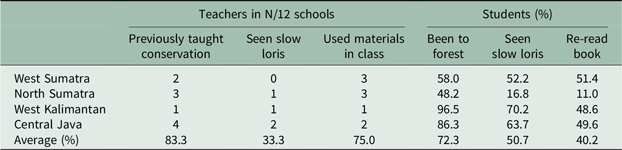
In total 529 students and 12 teachers from all 12 schools answered questionnaires (Table 1). Of the various answers as to where students had seen slow lorises, 17.1% had seen slow lorises in books or TV, 10.1% in the forest, 6.7% in a zoo and 2.3% saw one kept as a pet. Forty per cent of students lived within 1 km of the forest, 23.6% lived within 5 km of the forest, 13.7% lived within 10 km of the forest and 22.2% lived more than 10 km from the forest. Ninety-one per cent of teachers gave a rating of ‘extremely important’ for teaching conservation education, with the remaining 8.3% giving a score of ‘important’. Almost one third of students attended schools in a more urban area, while the remaining 67.4% attended schools in rural areas.
Questionnaire responses for teachers and students over the course of Sessions 1 and 2 in 12 schools in Indonesia

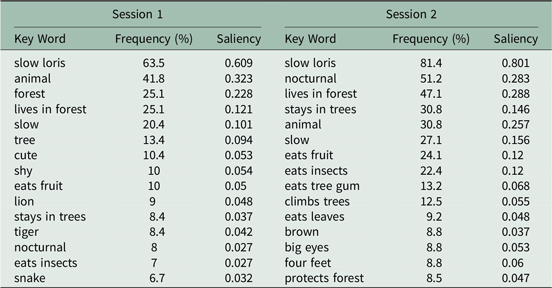
In Session 1, students used a total of 300 unique key words (sum of all words = 3870). In Session 2, students used a total of 156 unique key words (sum of all words = 3100); 231 key words from Session 1 were not used in Session 2, in which there were 87 new words used. Sixty-nine key words were used in both sessions. There were marked differences in the most frequent and salient words used in both sessions (Table 2). Of all the essays, the greatest increase in saliency was the term ‘nocturnal’ (change score = +0.256); the greatest decrease in saliency was the word ‘forest’ (−0.228) unaccompanied with any phrasing relating to slow lorises. For example, during Session 1 many children wrote something similar to ‘in the forest there are tigers and snakes’. During Session 2, references were in relation to slow lorises, such as ‘slow lorises live in trees in the forest’. From Session 1, common irrelevant terms such as ‘snake’, ‘lion’ and ‘tiger’ were rarely mentioned in Session 2 (−0.045, −0.032, −0.015).
Frequencies and saliencies of the top 15 key words describing slow lorises in Sessions 1 and 2 for 12 schools visited in Indonesia

Saliency scores were generated with Visual Anthropac 1.0.
Terms that increased in saliency in Session 2 included those relating to feeding, such as ‘eats tree gum’ (+0.061) and ‘eats insects’ (+0.093), and physical characteristics of slow lorises, such as ‘big eyes’ (+0.035), ‘slow’ (+0.055) and ‘climbs trees’ (+0.049). Of notable importance, the term ‘protects forest’ (+0.041) increased in saliency during Session 2. Sessions 1 and 2, however, did not significantly differ in cultural coherence (Z = 60.0, N = 12, p = 0.099).
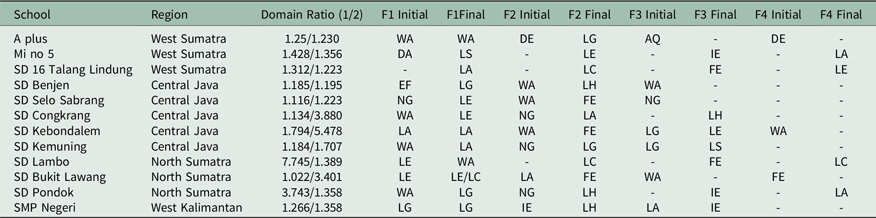
Overall, the cultural consensus did not differ between sessions (Z = 47.0, N = 12, p = 0.530). In Session 1, the schools SD Lambo and SD Pondok reached cultural consensus, while in Session 2 a cultural consensus was reached in SD Congkrang and SD Kebondalem. During Session 1, students usually included more general domains, while in Session 2 they provided more information on loris anatomy, ecology, feeding and conservation (Table 3).
Results of the cultural consensus analysis conducted to understand shared meanings regarding the cultural domain of slow loris for 12 schools visited in Indonesia

F = factor scores generated in UCINET; WA = wild animal; NG = Nature general; LS = loris sociality; LE = loris ecology; FE = feeding ecology (loris); LA = loris anatomy; LC = loris conservation; IE = incorrect ecology; DE = domestic environment; DA = domestic animal; EF = ecosystem function; AQ = Aquatic; LG = loris general; LH = loris habitat/region.
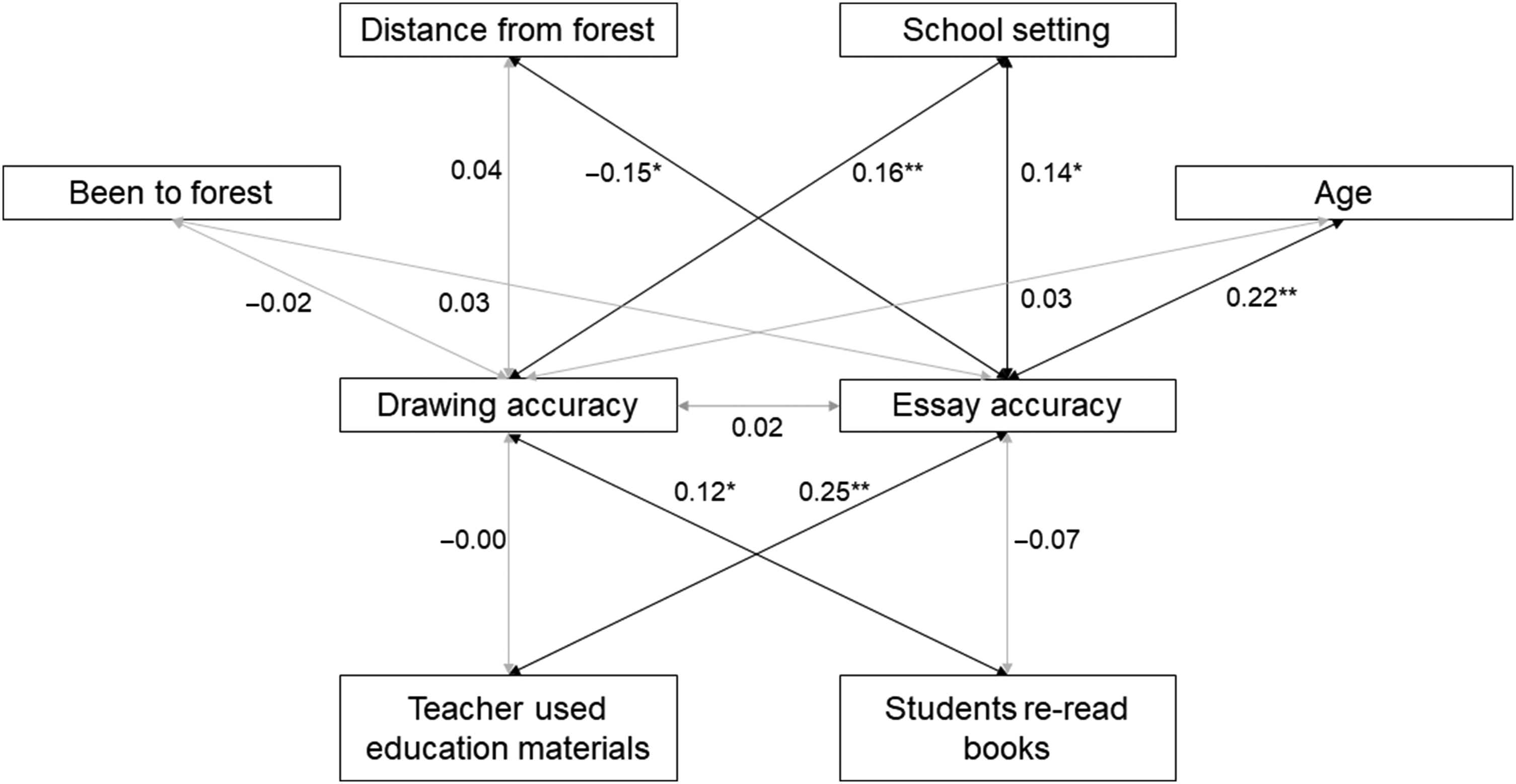
The goodness-of-fit for the ESM model was high (RMSEA = 0.08, CFI = 1.00) (Fig. 1). The model indicates that ‘drawing accuracy’ was positively correlated with the variables ‘school setting’ (β = 0.015 ± SE 0.006, p = 0.006) and ‘students re-read books’ (β = 0.028 ± SE 0.014, p = 0.043). ‘Essay accuracy” was negatively correlated with the variable ‘distance from the forest’ (β = −0.073 ± SE 0.035, p = 0.037), and positively correlated with ‘teachers used education materials’ (β = 0.042 ± SE 0.010, p < 0.001), ‘school setting’ (β = 0.011 ± SE 0.004, p = 0.010) and ‘age’ (β = 0.167 ± SE 0.044, p < 0.001). All the other relationships were not significant (Fig. 1).
Representation of the structural equation model to understand the determinants of drawing and essay accuracy in schools in Indonesia. Black arrows indicate significant correlations. *p < 0.05, **p < 0.01.

Discussion
A relatively broad curriculum is important to educate groups of people effectively in varying regions, as their experiences and relationships with nature can differ (Wells & Lekies Reference Wells and Lekies2006, Zhang & Yin Reference Zhang and Yin2014, Rosa et al. Reference Rosa, Profice and Collado2018). People belonging to one demographic group, therefore, may not respond well to a curriculum tailored specifically to another (Ressurreição et al. Reference Ressurreição, Gibbons, Kaiser, Dentinho, Zarzycki, Bentley and Austen2012; Esson & Moss Reference Esson and Moss2016). Students in the present study, despite living in different regions of Indonesia, showed improvements in their knowledge about slow lorises in response to the same curriculum. Building on Nekaris et al. (Reference Nekaris, McCabe, Spaan, Ali and Nijman2018) and McCabe and Nekaris (Reference McCabe and Nekaris2018), this study indicates the adaptability of a well-designed educational storybook to teach a wide range of students about a threatened taxon native to their country, and offers insight into how similar environmental education curricula could be created for other multi-site programmes. We thus concur with previous studies that highlight the importance to share, adapt and transfer education packs that are successful (e.g. Jacobson Reference Jacobson1991, Padua & Jacobson Reference Padua and Jacobson1993).
Increased drawing accuracies were linked to students re-reading the educational storybook on their own time. Session 2 essays also included more topics relating to information given about slow lorises throughout the storybook (foods that slow lorises are known to eat as well as the fact that slow lorises are nocturnal). The effectiveness of storybooks as education tools is recognized (Trundle et al. Reference Trundle, Troland and Pritchard2008, McCabe & Nekaris Reference McCabe and Nekaris2018, Nekaris et al. Reference Nekaris, McCabe, Spaan, Ali and Nijman2018) and the storybook used here clearly helped students retain and recall information about slow lorises. Moreover, students showed increased knowledge of slow lorises despite the fact that a large portion of the students in Session 2 had not been present in Session 1. The storybook, therefore, seems to have been useful in increasing the dissemination of knowledge to students outside the original study group. A limitation of the current study was that researchers were not able to travel with enough books to give to each child individually; the teachers were given 20 books which students would be able to request. Had each student been able to take a book home, there may have been an even greater increase in knowledge during Session 2. Future studies that focus on creating curricula with a storybook as a principal feature should ensure that every child receives an individual copy. Researchers should also consider the novelty for the students of receiving a storybook. If students do not have regular access to such materials, their performance compared with students who do may differ. We thus highly recommend to share education materials that can be used by both students and teachers.
Although we found no increase in students’ mutual understanding of slow lorises (Mueller & Veinott Reference Mueller and Veinott2008), this may have occurred, because many students wrote the same incorrect information during Session 1, thereby increasing the coherence and cultural consensus of Session 1 and preventing a significant increase in Session 2. In Session 2, children wrote more accurate, yet varying information about slow lorises. This result may be linked to the students not having had their own copies of the storybook. Nekaris et al. (Reference Nekaris, McCabe, Spaan, Ali and Nijman2018) gave each child a book to take home, and found that children tended to quote directly from the storybook in their Session 2 essays, producing strong cultural agreement. Few children in the current study made direct quotes from the storybook. The current results reinforce the importance of giving children individual materials to take home to reinforce their learning. A limitation of the current study in this area, though, is the fact that some participants had greater levels of written literacy than others. Future studies might therefore quantify the literacy levels of participants in order to measure the effect on programme success, or provide alternative assessment such as verbal rather than written reports.
Performance was not affected by whether students had been to the forest or seen a slow loris before, but essay accuracy was higher for students who lived closer to the forest. Moreover, drawing and essay accuracy were both positively correlated with school setting, with students from rural areas scoring higher. Positive experiences in nature can lead to increased pro-environmental behaviours (Wells & Lekies Reference Wells and Lekies2006, Rosa et al. Reference Rosa, Profice and Collado2018), as well as increased knowledge about nature (Bögeholz Reference Bögeholz2006). Place-based education where students are taught in the environment about which they are learning can increase student engagement and achievement (Jacobson & Padua Reference Jacobson, Padua and Jacobson1995, Sobel Reference Sobel2003). Students in the rural sites may have been more receptive to learning about slow lorises because they lived closer to, and therefore had more interaction with, the habitat of the animal about which they were learning. Results of the current study support the importance of students having a context for the information about which they are learning, and the current curriculum may have been improved, particularly for the students in urban areas, by the addition of an outdoor component near to a slow loris habitat or in a setting such as a zoo. Future studies could incorporate this in order to further investigate the relationship between place, experience and education.
Students whose teachers used the education materials in class produced more accurate essays, but did not change in drawing accuracy. The result for essays agrees with previous findings that teacher involvement in conservation education can have a positive effect on students (de White & Jacobson Reference de White and Jacobson1994, Grieser et al. Reference Grieser, Rawlins, Khulood, Day and Monroe2000). The fact that drawing accuracy did not increase may be explained by the fact that not all of the educational materials given to teachers included a drawing component. Drawing can increase student engagement and understanding of the lesson topic (Brooks Reference Brooks2002, Ainsworth et al. Reference Ainsworth, Prain and Tytler2011), but students may convey different information more clearly in drawings versus essays and vice versa (Gnidovec & Torkar Reference Gnidovec and Torkar2019, Torkar et al. Reference Torkar, Gnidovec, Tunnicliffe and Tomažič2019). It may be difficult, therefore, for students who have learned through writing or acting activities to translate that knowledge into drawings. Nevertheless, the extra materials given to teachers in the current study had positive benefits for the students. It is important, therefore, to involve teachers in continuing the goals of the lesson plans by providing them with their own materials.
In lieu of experiencing nature first-hand, visual media can be a powerful tool in learning about the environment (Marriott Reference Marriott2002). In developing countries, effective conservation education, especially about native species conservation, remains a challenge (Spiteri & Nepalz Reference Spiteri and Nepalz2006). Moreover, the long-term evaluation of such programmes is vital in increasing their success (Norris & Jacobson Reference Norris and Jacobson1998). The present study had a positive influence on the many communities visited, while also providing a broad-reaching analysis of the curriculum’s effectiveness. Implications for future conservation education programmes include the benefit of: providing teachers with materials to use after the researcher has left; giving each child their own copy of any visual materials used in the lessons, for which storybooks are particularly effective; following up with students and teachers about the use of such materials; and asking questions geared towards understanding teacher and student experience with and attitudes towards the study subject. Finally, we encourage practitioners to share their good practice. Well-developed conservation education materials require great effort as well as funding to develop. The lessons from these materials can extend beyond the species or habitat for which they were designed. Together, these factors may help researchers to create and assess wide-ranging conservation education programmes.
Acknowledgements
We conducted this research in collaboration with the Ministry of Research, Technology, and Higher Education of the Republic of Indonesia (KEMENRISTEKDIKTI). We thank the teachers and pupils of the Kerinci, Bukit Lawang, Kemuning and Pontianak areas for their support and participation in this project, as well as special thanks to L. Mackin, A. Molyneaux, Planet Indonesia, the students of Universitas Gadjah Mada, and the Javan Wildlife Institute team for their invaluable help with this project.
Financial support
This work was supported by grants to Nekaris from Zoo Augsburg, Amersfoort Zoo, Brevard Zoo, Cleveland Metroparks Zoo, Cleveland Zoo and Zoo Society, Columbus Zoo, Cotswold Wildlife Park, Disney Worldwide Conservation Fund, International Primate Protection League, Margot Marsh Biodiversity Foundation, Mohamed bin Zayed Species Conservation Fund (152511813), National Geographic (GEFNE 101-13), Omaha’s Henry Doorly Zoo, People’s Trust for Endangered Species, Phoenix Zoo, Primate Action Fund and Shaldon Wildlife Trust.
Conflict of interest
None.
Ethical standards
This research was approved by the University Research Ethics Committee at Oxford Brookes University, Oxford, UK (#OBUUREC_1718_VN003). A proposal outlining all education and research methods was given to each school, and a subsequent Memorandum of Understanding between the researchers and the headmaster or senior teacher of each school was signed. Protocols followed the ethical guidelines proposed by the Association of Social Anthropologists of the United Kingdom and Commonwealth. All research and corresponding activities were approved by the Ministry of Research, Technology, and Higher Education of the Republic of Indonesia (KEMENRISTEKDIKTI) (#104/SIP/FRP/E5/Dit.KI/IV/2018).