Introduction
The indigenous chickens of Ethiopia have various names and are characterized on different grounds, as in many other parts of Africa. Teketel (Reference Teketel1986) characterized them on the basis of plumage colour, for example, Kei (red) or Tikur (black). Tadelle (Reference Tadelle2003) referred to them as “local chicken ecotypes” and Halima et al. (Reference Halima, Neser, vanMarle-Koster and deKock2007b) as “native chicken populations”, both named on the basis of the geographic region of sampling. Each local ecotype or native population actually comprised chickens with a wide range of morphologic or genetic diversity. Thus far, only 5 Ethiopian chicken types have been listed in the Domestic Animal Diversity Information System (DAD-IS) of the FAO (derived from FAO, 2008) and 10 in the Domestic Animal Genetic Resources Information System (DAGRIS) of the International Livestock Research Institute (ILRI; derived from DAGRIS, 2008), including those listed in DAD-IS. This small number represented in the databases indicates the shortage of data on chicken genetic resources in Ethiopia, suggesting that much of the diversity that exists in the locally adapted populations still remains undocumented.
Identification and characterization of the chicken genetic resources generally requires information on their population, adaptation to a specific environment, possession of traits of current or future value and sociocultural importance, which are crucial inputs to decisions on conservation and utilization (Weigend and Romanov, Reference Weigend and Romanov2001). Indigenous chickens of the tropics are important reservoirs of useful genes and possess a number of adaptive traits (Horst, Reference Horst1989).
Genetic variations in chickens can be described, among other approaches, using monogenic traits based on pigmentation differences and comb types. Pigmentation differences, which are attributable to melanin, produce a variety of plumage colours in the chickens. The presence and level of melanin pigments such as trichochrome is related to feather colour and is considered to be indicative of genetic differences among certain plumage colours (Smyth, Reference Smyth and Crawford1990). Similarly, the presence or absence of the carotenoid pigments, primarily xanthophylls, in the feed is responsible for the diversity in skin colour of chickens. The genetic basis of this variation was described by Eriksson et al. (Reference Eriksson, Larsen, Gunnarsson, Bed'hom, Tixier-Boichard, Stromstedt, Wright, Jungerius, Vereijken, Randi, Jensen and Andersson2007).
In addition to their significance in describing genetic variations and adaptive attributes, qualitative morphological traits have important economic value in chickens. There are specific choices for plumage and skin colours that affect preferences of different geographic markets around the world (Jiang, Reference Jiang1999; Smyth, Reference Smyth and Crawford1990). In Ethiopia there is no specific preference for skin colour, and plumage colour is only second in importance to live weight in affecting market preference for chickens (D. Nigussie et al., unpublished data). In certain communities of Ethiopia (Leulseged, Reference Leulseged1998) and other parts of Africa (Gueye, Reference Gueye1998), it has cultural and religious functions as well. In northern Ethiopia both producer–sellers and intermediary traders of chickens attach the highest market preference to plumage colour and feather distribution followed by comb type (Aklilu, Reference Aklilu2007). This clearly suggests that qualitative traits with specific characteristics must be carefully identified and considered in developing breeding strategies.
The objectives of this study were to describe the physical features of different populations of indigenous chickens and to assess the morphological variations among the populations in order to depict the useful attributes of indigenous chickens. This work will also contribute to the existing scarce information on the indigenous chicken genetic resources of Ethiopia.
Materials and methods
A list of physical descriptors was prepared to record both qualitative morphological characters and certain quantitative traits. In each of the study regions, individual households were selected that kept only local chickens. Moreover, each of the selected farmers was interviewed to describe the family history of the flock, and only unrelated adult birds were sampled for the recording. Neighbouring households were skipped to avoid the risk of sampling chickens sharing the same cock.
Naming of indigenous chickens
There are certain discrepancies in the nomenclature of the indigenous chickens of Ethiopia that forfeited retrieval, utilization and comparison of results that are published or unpublished thus far. To avoid such discrepancies and limit further variations, we adopted the naming referred to by Halima et al. (Reference Halima, Neser, vanMarle-Koster and deKock2007b), which uses the term indigenous instead of native, in the context of the classification proposed by Tixier-Boichard et al. as cited in Weigend and Romanov (Reference Weigend and Romanov2001) for chickens comprising domesticated but unselected populations.
Description of study areas
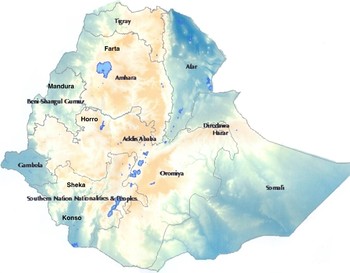
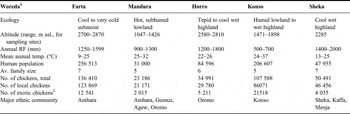
The study areas were selected considering the agro-ecology, socioeconomic significance of chicken production and population of indigenous chickens based on the atlas published jointly by the International Food Policy Research Institute and the Central Statistics Authority (CSA, 2006). Five woredas (districts) were covered in the study: Farta (Amhara region), Mandura (Benshangul Gumuz region), Horro (Oromia region) and Konso and Sheka (southern region). The ecological and demographic features of the study areas are described in Table 1 and the sampling sites are illustrated in Figure 1.
A map of Ethiopia showing the location of sampled populations of indigenous chickens in Farta, Mandura, Horro, Konso and Sheka. Pink areas denote high altitude regions and sky blue areas represent low altitude regions. See Table 1 for detailed descriptions of the sampling sites.

Ecological and demographic characteristics of sampling areas.

1Woreda is an administrative domain at the third level down a region and immediately below a zone.
2Exotic chickens distributed by the office of Agriculture since 2005. (This study was conducted in 2007.)
Data collection and analysis
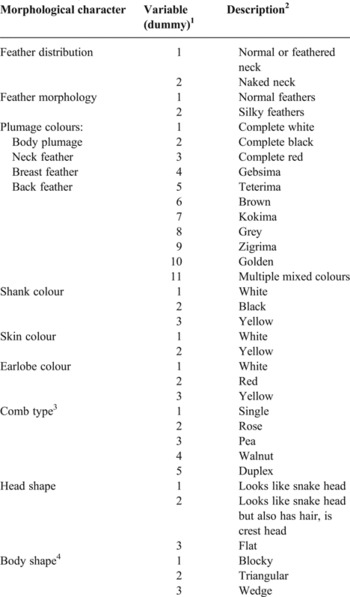
Morphological variations were studied based on feather distribution (presence or absence of feathers on the neck); feather morphology; colours of the body plumage, neck, breast and back feathers; shank colour; skin colour; earlobe colour; comb type and head and body shapes. Data were recorded for a total of 1 125 indigenous chickens of both sexes following the FAO descriptors for chicken genetic resources (FAO, 1986): 225 chickens (~8 months or older) each of Farta, Mandura, Horro, Konso and Sheka Woredas. Descriptions of comb types were based on illustrations presented by Somes (Reference Somes and Crawford1990). The morphologic variables were recorded in different character states (see Appendix 1). Each character state was recorded as a binomial variable (1 if present, 0 if not). Measuring tapes and a spring balance were used to measure the respective shank length and body weight of individual chickens in the field.
Data were analyzed using the SPSS 12.0 statistical package (SPSS, 2003). Binomial variables from records on qualitative morphologic characters were reported as percentages.
The qualitative data were analyzed for descriptive statistics using frequency procedures and cross-tabulation of SPSS. The Kruskal–Wallis Test was applied to test the effects of populations or regions of sampling on each of the qualitative morphological variables. The Binomial Test was used to analyze the significance of the differences within the population in feather morphology, feather distribution and skin colour; the Cochran Test was applied to test the differences in shank and earlobe colours, comb type and head and body shapes.
The generalized linear modeling procedure of SPSS was used to analyze the quantitative data, fitting live weight and shank length as independent variables and region of sampling (the populations) and sex of the chickens as fixed factors. The age of the chickens was not included in the model because only 8-month-old or older adults were sampled.
Results and discussion
Description of the populations
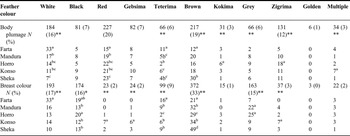
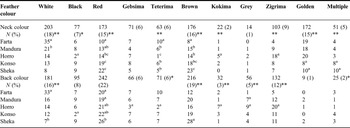
The morphological characteristics of the different populations of indigenous chickens in this study are delineated in Tables 2, 3, 4, 5, 6 and 7. The specific features of each population are elaborated in the following sections. The data disaggregated by sex is only presented for morphological traits, showing some interesting variations between the sexes because of space limitations.
Description of body plumage and breast feather colours of indigenous populations of chickens sampled from different regions (percentage of chickens within the population, number of chickens sampled per population = 225, N = 1 125).

Note: Different superscript letters within each column indicate significant differences between the populations or regions, based on the Kruskal–Wallis Test (*p < 0.05, **p < 0.01). Gebsima, wheaten strips on black background; Teterima, black or red speckles on white background; Kokima, white or grayish strips on brown or reddish background; Zigrima, black and white spotted feather; N (%), figures within each row of body plumage and breast colours denote the number of individuals having the specific feather colour out of the total number of chickens (1 125) sampled in all populations, and the numbers in parentheses show their respective proportions.
Description of neck and back feather colours of indigenous populations of chickens sampled from different regions (percentage of chickens within population, number of chickens sampled per population = 225, N = 1 125).

Note: Different superscript letters within each column indicate significant differences between the populations or regions, based on the Kruskal–Wallis Test (*p < 0.05, **p < 0.01). Gebsima, wheaten strips on black background; Teterima, black or red speckles on white background; Kokima, white or grayish strips on brown or reddish background; Zigrima, black and white spotted feather; N (%) figures within each row of neck and back colours denote the number of individuals having the specific feather colour out of the total number of chickens (1 125) sampled in all populations, and the numbers in parentheses show their respective proportions.
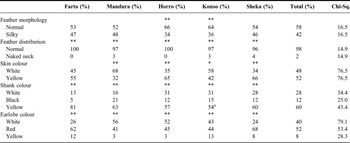
Variations in the morphology and distribution of feathers and colours of skin, shank and earlobe of indigenous populations of chickens (percentage of chickens within the population).

Note: Asterisks indicate significant differences between rows at the 5% (*) and 1% (**) probability levels, based on the Binomial Test for feather morphology, feather distribution and skin colour, and the Cochran Test for shank and ear lobe colours. Chi-Sq., the chi-square values within a row denote significant differences between populations or regions (p < 0.01), based on the Kruskal–Wallis Test.
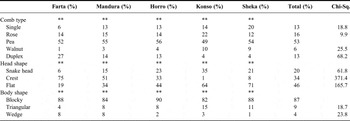
Variations in comb type and head and body shapes of indigenous populations of chickens (percentage of chickens within the population).

Note: Asterisks indicate significant differences between rows at the 1% probability level according to the Cochran Test. Chi-Sq., the chi-square values within a row denote significant differences between populations or regions (p < 0.01), based on the Kruskal–Wallis Test.
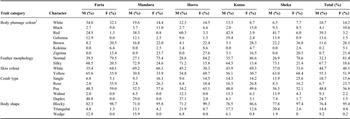
Variations in certain morphological characters between sexes of indigenous chicken populations (% of chickens within sex).

1The percentage values for plumage colours do not add to 100 because only the major colours variants were considered here.
Note: Gebsima, wheaten strips on black background; Kokima, white or grayish strips on brown or reddish background; Zigrima, black and white spotted feather.
Adult live body weight and shank length of the different populations of indigenous chickens.

Note: Means in a row with different superscript letters denote significant differences between populations or sampling regions (p < 0.05) and asterisks within a column indicate significant differences between males and females for each parameter at the 1% (**) level of probability.
Farta chickens
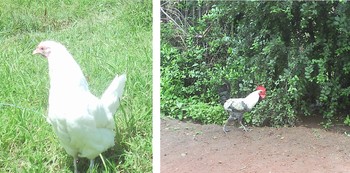
Farta chickens (Figure 2) are found in the Amhara regional state in northern Ethiopia at altitudes ranging from 2 700 to 2 870 m above sea level (asl) in a cool to very cold, submoist ecological zone. The population of these chickens numbers about 123 800, and they are kept by the Amhara community (Table 1). They are maintained under scavenging regimens with occasional supplementation and sheltered in the family house (D. Nigussie et al., unpublished data). The chickens have predominantly white body plumage that occurs at similar frequency in both sexes. Red (25 percent) and gebsima (wheaten strips on a black background) are the typical plumage colours in males but are not observed in females (Table 6). The other peculiar feature in males is a black breast (locally referred to as libe tikur), which is almost absent in females (Table 2). Naked neck chickens were not found in the population. About 55 percent of the birds have yellow skin, 65 percent of which are males (Table 4). The population is mainly pea combed (54 percent) followed by duplex combs (26 percent). Crest head (locally referred to as gutya) and blocky body shape are the predominant features in both sexes (Table 5). The average shank length of adult males is 8.2 cm and that of adult females is 6.6 cm. Adult males weigh about 1 630 g and females 1 054 g (Table 7).
A single combed ‘gebsima’ male, and a female chicken of the white plumage that predominantly characterizes the Farta population.

Mandura chickens
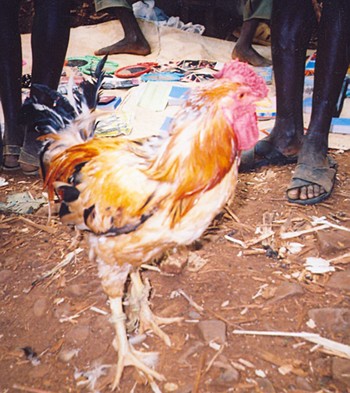
The Mandura (Figure 3) population is found in the Benshangul Gumuz regional state in northwest Ethiopia at altitudes ranging from 1 047 to 1 426 m asl in a hot, subhumid lowland ecological zone. They are reared by mixed communities of Amhara, Gumuz and Agaw. The population of these chickens is relatively small, estimated to be only 21 200 (Table 1). Most of the households keeping these chickens provide separate shelters for housing during the night, but they spend the day scavenging in the backyards supplemented with grains and food leftovers (D. Nigussie et al., unpublished data). Brown is the most predominant plumage in the population followed by red, white and kokima (white or grayish strips on brown or reddish background; Table 2). Complete red is typical of males (38 percent of male plumage) but absent in females. Hens have all variants of colours including zigrima (24 percent), the most predominant, which is almost absent in males (Table 6). The majority of males (about 40 percent) possess shining red back feathers that are entirely absent in females. Almost all chickens have normal feather distribution except a small proportion (3 percent) of naked neck chickens (Table 4). The majority of the birds have white skin, regardless of sex, and most of the chickens are pea combed (55 percent). The average shank length of adult males is 8.4 cm and that of females is 7.1 cm. Adult males weigh about 1 652 g and females 1 426 g (Table 7).
A Mandura chicken with a silky feather morphology prevalent in the population and predominantly characterizing the males.

Horro chickens
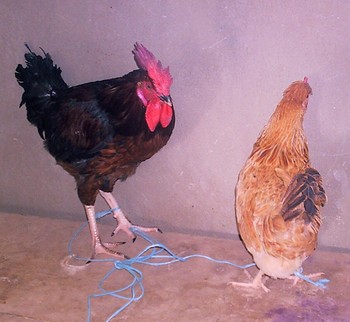
Horro chickens (Figure 4) are found in the Oromia regional state in western Ethiopia at altitudes ranging from 2 580 to 2 810 m asl in a tepid to cool wet highland ecological zone. The size of the population is estimated to be about 29 800, and the Oromo ethnic community raises them (Table 1). Horro chickens are reared under scavenging management with supplemental feeding, and in most cases the birds are sheltered in the family house during the night (D. Nigussie et al., unpublished data). The single most important plumage colour of males is red (60 percent). Only 3 percent of the females are red and the most frequent colour is zigrima, which is totally absent in males. All chickens have feathered necks. Yellow is the dominant skin colour in both sexes (Table 6). The predominant body shape is blocky (Table 5). However, quite a large proportion of cocks (22 percent) have a triangular body shape. The average shank length of adult males is 8.8 cm and that of females is about 6.8 cm. Adult males weigh about 1 700 g and females 1 372 g (Table 7).
Male and female chickens of Horro. Males are predominantly of deep red body plumage colour.

Konso chickens
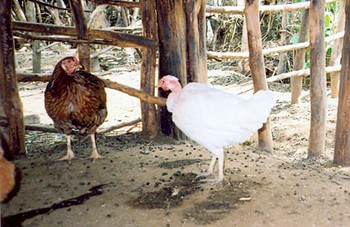
These chickens (Figure 5) are found in the Southern Nations, Nationalities and Peoples Regional State in south Ethiopia at altitudes ranging from 1 471 to 1 898 m asl in a humid lowland to wet highland ecological zone. The population is estimated to be approximately 107 600, and the major ethnic community keeping this population is the Konso (Table 1). Konso chickens are reared under scavenging management. The proportion of households practicing supplementary feeding is the smallest compared to farmers in other regions, although about 62 percent supplemented their chickens (D. Nigussie et al., unpublished data). Unlike other regions, most of the farmers (82 percent) here provide separate housing for their chickens. Most of the cocks (43 percent) have red body plumage whereas brown (28 percent), zigrima (17 percent) and black (15 percent) are the prominent plumage colours in hens. About 4 percent of the cocks and less than 2 percent of the hens have naked necks. Both white (54 percent) and yellow (46 percent) skin colours exist (Table 4). However, 56 percent of the cocks have yellow skin (Table 6). The birds are mainly pea combed (49 percent) followed by a relatively large proportion of rose comb (22 percent). The shape of the head is mainly flat (45 percent); most of the chickens have blocky body shapes (Table 5), although about 17 percent of the cocks and 13 percent of the hens have a triangular body shape. The average shank length of adult males is 10.1 cm and that of females is 7.1 cm. Adult males weigh about 1 411 g and females 1 011 g (Table 6).
The Konso chicken scavenging in the family backyard. Some of the naked neck chickens recorded in this study were found in the Konso population.

Sheka chickens
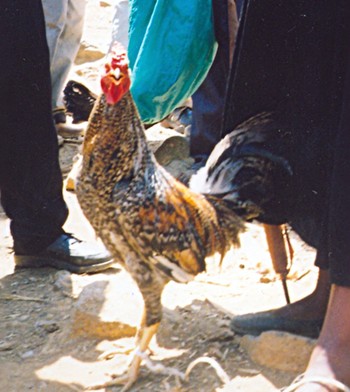
The population of Sheka chickens (Figure 6) is found in the Southern Nations, Nationalities and Peoples Regional State in south Ethiopia at an altitude of 2 285 m asl in a cool wet highland eological zone. They are reared mainly by the Sheka and other very small populations of Kaffa and Menja communities. The Sheka population is about 46 450 (Table 1). The proportion of households providing separate housing and sheltering the chickens in the family house is almost equal. Most households practice supplementary feeding (D. Nigussie et al., unpublished data). Brown is the predominant plumage followed by red, zigrima and black (Table 2). Cocks (42 percent) have mostly red plumage (Table 6). A brown breast is typical of both sexes, but black is the second largest breast colour in cocks (22 percent), locally referred to as libe tikur. Cocks are chiefly red or golden on the neck, and hens are mainly brown necked. Six percent of the hens and 3 percent of the cocks have naked necks. The majority of the chickens in the population have white skin, yellow shank and red earlobes (Table 4). The population is mainly pea combed (54 percent) with 20 percent single combs. The average shank length of adult males is 9.4 cm and that of females is about 7.8 cm. Adult males weigh about 1 697 g and females 1 517 g (Table 7).
A Sheka male showing a triangular body shape found at a much higher proportion compared to males in all other populations, except the Horro. However, it is a characteristic feature of males in all populations.

Chicken populations
The chicken population of Ethiopia seems to have been consistently declining in the last few years. According to FAO (2000), it was estimated that there were 65 million chicken, more than 95 percent of which comprised indigenous chickens. Estimates of the population of indigenous chickens were 42.9 million in 2003 (Central Agricultural Census Commission, 2003), which declined to about 30 million in 2005 (CSA, 2005). The average flock size of indigenous chickens kept per rural smallholder family varied from 6 to 10 (Alemu, Reference Alemu1995; Halima, Neser and vanMarle-Koster, Reference Halima, Neser and vanMarle-Koster2007a). The average estimated size of indigenous flocks per household was quite small in the current study: only about 3.5 (ranging from 2.1 in Konso to 6.5 in Sheka).
Morphological variations
Tables 2 and 3 show the proportions of the different body plumage, breast, neck and back feather colours in the chicken populations of different regions. In agreement with the results reported from other regions of Ethiopia (Halima et al., Reference Halima, Neser, vanMarle-Koster and deKock2007b), each population in this study possessed multiple variants of feather colours, although there were highly significant differences among the different populations in the proportion of specific feather colours characterizing them. White, red, brown and zigrima are the dominant colours of most of the populations, except for the breast colour that comprises large proportions of black and grey instead of red and zigrima feathers (Table 3). The presence of multiple variants of feather colours within a population is also a typical feature characterizing indigenous fowl in other parts of Africa (Badubi, Rakereng and Marumo, Reference Badubi, Rakereng and Marumo2006; Gueye, Reference Gueye1998) and Asia (Bhuiyan et al., Reference Bhuiyan, Bhuiyan and Deb2005).
The Farta population comprises the largest proportion (33–35 percent) of chickens with white body plumage, breast, neck and back feathers. Halima et al. (Reference Halima, Neser, vanMarle-Koster and deKock2007b) also reported the white feather colour of the Farta chicken population as one of its prominent features. Conversely, the populations in the southern (Konso and Sheka), Benshangul-Gumuz (Mandura) and Oromia regions (Horro) constituted larger numbers of chickens with red body plumage compared to the population in the north (Farta). Interestingly, this pattern is compatible with the farmers' stated preferences for plumage colour in the respective regions reported by D. Nigussie et al. (unpublished data) as a separate part of this study. The fact that farmers consider plumage colour as one of the important selection criteria in the traditional breeding practices appeared to have a favourable affect on the frequencies of the most preferred white and red plumage colours.
A golden colour is a characteristic peculiar to the neck feathers (Table 3). The proportion of chickens having golden neck feathers is significantly smaller in the southern populations of Konso and Sheka (8–10 percent) compared to all others (19–20 percent).
The populations in the high altitudes (Farta, Horro and Sheka) constitute larger proportions of yellow skinned chickens relative to the others, and there were significant differences between the proportions of yellow and white skinned chickens in all regions except Farta (Table 4). However, despite the ecological region, the proportion of males with yellow skins was larger than that of females. This is probably because the scavenging feed resource base is relatively better in the high altitude regions compared to low altitude areas and the foraging behavior of cocks is stronger than the hens. The yellow skin colour is the result of the expression of carotenoid pigments in the skins of birds (Smyth, Reference Smyth and Crawford1990). According to Eriksson et al. (Reference Eriksson, Larsen, Gunnarsson, Bed'hom, Tixier-Boichard, Stromstedt, Wright, Jungerius, Vereijken, Randi, Jensen and Andersson2007), it is generally considered to be associated with the individual's adaptive fitness that reflects its nutritional status or health that is indicative of its foraging efficiency and immune status.
The naked neck (Na) gene is described as one of the major genes in local chickens of the tropics that has desirable effects on heat tolerance and adult fitness (Horst, Reference Horst1989). However, the number of chickens expressing this gene is quite small (23 out of a total of 1 125, i.e. <2 percent) in the populations that we studied (Table 4). As expected, these are found mainly among the populations in low altitude regions with warm climates (Mandura in the west region and Konso in the southern region). The exact size and geographic distribution of naked neck chickens in Ethiopia is not clearly established, and only a very limited number of works have been reported thus far (Teketel, Reference Teketel1986). The total frequency of chickens carrying the Na gene in the populations that we studied was smaller than the proportion (6 percent) reported in Nigeria (Gueye, Reference Gueye1998) and in Botswana (3.6 percent; Badubi et al., Reference Badubi, Rakereng and Marumo2006). An important reason for this is that farmers did not prefer the naked neck chickens (Aklilu, Reference Aklilu2007), ultimately favouring selection against this valuable gene. Thus, it appears that the future of the Na gene is at stake unless measures are taken towards its conservation.
The overall pattern of the variation in comb type is similar to that reported by Halima et al. (Reference Halima, Neser, vanMarle-Koster and deKock2007b). The highest proportions of single, rose and walnut combs were found in the southern populations (rose and walnut in Konso, and single and walnut in Sheka), whereas the Farta population constituted a significantly larger proportion (27 percent) of chickens with duplex combs (Table 5). In contrast, the major proportion of indigenous chickens in all regions in this study carried the pea comb (49–56 percent). The pea comb gene (P) is related to an important effect in breeding for tropical conditions in terms of reduced frequency of breast blisters and improved late juvenile growth (Horst, Reference Horst1989). Although the effect of the P gene on growth might be indirect, the reduced frequency of breast blisters directly results from the presence of a ridge of thickened skin in pea combed birds that runs the length of the keel over the breast bone (Somes, Reference Somes and Crawford1990). However, the high frequency of pea combs and the opposite very low frequency of walnut combs in the current populations probably needs further verification. Somes (Reference Somes and Crawford1990) indicated the possibility of classification errors with regard to comb types and suggested that it is useful to examine the breast ridge in distinguishing between birds with pea and single combs and between those with rose and walnut combs. The breast ridge is a well-established manifestation of the P gene that is also characteristic of walnut combed birds. We did not investigate the breast ridge in this study.
Most of the chickens in the northern population (75 percent in Farta) were identified with crest heads, but flat heads were a characteristic feature of those in the south (64 percent in Konso and 71 percent in Sheka). The populations were significantly different from each other in terms of head shape characteristics, except that comparable proportions of flat head chickens were found in the south (Table 5). This probably suggests that head shape can be considered as one of the most important morphological characteristics to discriminate between different populations of indigenous chickens.
The average body weight of adult males and females varied significantly among the populations. Females in Mandura, Horro and Sheka populations were significantly heavier than those in Farta and Konso populations (Table 6). The weight ranges for males (1.4 kg in Konso to 1.7 kg in Horro) and females (1.0 kg in Konso to 1.5 kg in Sheka) in the current study were within the ranges reported earlier by Mebratu (Reference Mebratu and Sonaiya1997) for different “plumage colour types” of indigenous chickens of Ethiopia reared under confined management regimens (1.3–1.7 kg for males and 1.0–1.2 kg for females). However, the ranges in this study were much higher than those reported by Halima et al. (Reference Halima, Neser, vanMarle-Koster and deKock2007b) for seven indigenous populations of chickens in north Ethiopia that were kept under intensive management conditions (1.0–1.5 kg for males and 0.64–0.87 kg for females at 22 weeks of age).
The discrepancies could be attributable to the variation in the age of the birds (there were no records of the exact age of birds in this study) or were simply indicative of the negative effects of confined management on the performance of local chickens. Studies in Ethiopia showed that indigenous chickens have very poor adaptation to confined environments and suffered huge mortality (up to 90 percent) and morbidity resulting in poor performance (Brannang and Pearson, Reference Brannang and Pearson1990).
Males were significantly heavier and particularly so in the Farta, Horro and Konso populations by 36, 20 and 28 percent, respectively, compared to the females. Cocks in the Konso population and the hens of Sheka have significantly longer shanks compared to their counterparts in other populations. Males in all populations have significantly longer shanks, about 17 percent (Farta and Sheka) to 30 percent (Konso) longer compared to the females. The chickens in this study were generally shorter relative to their Tanzanian counterparts (Msoffe et al., Reference Msoffe, Minga, Olson, Yongolo, Madesen, Gwaksa and Mtambo2001). However, the ranges in shank length were somewhat similar to those reported by Badubi et al. (Reference Badubi, Rakereng and Marumo2006) for the indigenous chickens of Botswana and close to the figures reported by Halima et al. (Reference Halima, Neser, vanMarle-Koster and deKock2007b), especially for the Mecha chickens of Ethiopia.
Variations in morphological characteristics between males and females
Most of the morphological characteristics varied between the males and females. Interesting variations were observed in the body plumage colour, feather morphology and comb type. Males in most regions were largely identified with silky, bright red plumage and higher proportions of duplex combs, and females had peculiarly mixed plumage colours (zigrima and kokima) with a larger proportion of rose combs.
The absence of feathers on the neck (naked neck), recorded at a very low frequency (23 birds out of a total of 1 125), characterized both sexes. About 70 percent of the naked neck chickens had brown, white or red body plumage colours, which is because about 56 percent of the chickens in the entire population carried these colours.
Generally, silky feather morphology, red body plumage and back feather colour and black breast were the prominent features observed at high frequencies in males, probably suggesting that a considerable proportion of cocks in the regions that were studied carried at least some of the physical features ascribed to the red jungle fowl. Crawford (1990) stated that the feather colour of red jungle fowl is retained almost exactly in the black breasted red phenotype of domestic fowl and in males the colours are enhanced by modifications in feather morphology.
Conclusion
Although generally not considered as ideal measures of genetic variability, the morphological traits were found to be useful in describing different populations of indigenous chickens. The populations in this study carried multiple variants of plumage colours and other physical features. However, there were certain features characterizing each population such as the distinctly predominant white plumage colour and crest head of the Farta chickens in the north and the prominent red body plumage and flat head in the southern populations. Likewise, the populations in the high altitude regions were predominantly (55 percent in Farta, 65 percent in Horro and 66 percent in Sheka) characterized by yellow skin colour, a trait reflecting the adaptive fitness of birds under foraging environments. Other attributes that are important in breeding for tropical conditions were also identified, such as the pea comb gene, in populations of all regions, and the naked neck gene, particularly in those of low altitude areas. However, the limited geographic distribution and the very small frequency of the naked neck chickens that we found in this study suggests that the future of the Na gene associated with this trait is at stake unless measures are taken towards its conservation.
Acknowledgements
This project is funded by The Netherlands Foundation for the Advancement of Tropical Research (WOTRO). This project is a collaborative work between Wageningen University and ILRI. We sincerely thank the farmers who participated in the project.

1Each character state was recorded as a binomial variable (1 if present, and 0 if not).
2Colour descriptors are local feather color identifications used by farmers: Gebsima, wheaten strips on black background; Teterima, black or red speckles on white background; Kokima, white or grayish strips on brown or reddish background; Zigrima, black and white spotted feather.
3Blocky body shape is meant to represent a horizontal, oblong body resembling the distinct characteristic shape of the Rhode Island Red and the Rhode Island White. Wedge shape represents almost the opposite feature, oblong but vertical.
4Descriptions of comb types were based on illustrations presented by Somes (1990).