The photo library of the International Committee of the Red Cross (ICRC), containing a rich collection of some 120,000 pictures,Footnote 1 is probably one of the best visual databases on humanitarian activities. Unlike textual documents,Footnote 2 these visual records are under-utilised and few people are even aware of their existence. Photography, the use of which started to expand at the end of the nineteenth century, especially in the illustrated press, has proved to be an excellent medium for providing and storing information on and evidence of realities in the field. It even competes with the audiovisual media.
Nonstop imagery (television, streaming video, movies) is our surround, but when it comes to remembering, the photograph has the deeper bite. Memory freeze-frames; its basic unit is the single image. In an era of information overload, the photograph provides a quick way of apprehending something and a compact form for memorizing it.Footnote 3
This special link between memory and photography is perceptible in the visual heritage of the ICRC. This almost encyclopaedic collection, which has been built up over decades, questions therefore the institution's memory preservation policy. The collection testifies to the ICRC's careful record-keeping, in that it encompasses not only photographs taken by its members but also pictures which it has received or bought. Although, at first, delegates made fairly random use of the camera, they were then encouraged to take pictures during visits to prisoners' camps during the Second World War. The diversity of the material thus gathered became plain only when the archives were completely reorganised in the 1950s. The importance of visual evidence was confirmed in the 1960s through recourse to professional photographers.
Within the ICRC, the wealth of such a collection has already formed the source material for some thought-provoking works. The first, Focus on Humanity: A Century of Photography. Archives of the International Committee of the Red Cross,Footnote 4 published in 1995, showed how war and the history of the Geneva Conventions were perceived in the twentieth century. The book was revised in 2009Footnote 5 and enhanced with several magnificent pictures taken from the project ‘Our World at War’.Footnote 6 In addition to these two publications, the exhibition Terrain(s),Footnote 7 organised by the International Red Cross and Red Crescent Museum, drew on the historical testimony of this collection. Its subject matter was extensive, as are the issues raised in this article, because the photographs combine a penetrating look at the real contexts of action with some of the classic images of twentieth-century photojournalism.
The purpose of this article is not therefore to engage in a specific case study, but to suggest some historical milestones for a reflection on and the use of these archives by historians, political scientists, sociologists, and anthropologists, because these photographs have helped to forge a visual identity and symbolism, to provide (institutional and operational) legitimacy, to offer anthropological and ethnological insight, and to create an awareness of other human beings and their suffering. As it is impossible to cover all the events recorded in the archives, we have deliberately opted for a fragmented view encompassing a chronological, historical, and semiological approach. This choice was made after exploring the contents of the works to which we refer, examining the 200 photographs selected at the time of the 150th anniversary of the ICRC and then systematically analysing the search terms of the photo library's database. This made it possible to outline several categories in relation to space, time, and theme: periods shown and historical developments (nineteenth to twenty-first century), geographical contexts (marking the expansion of humanitarian action outside Europe), and types of ICRC action and beneficiaries (soldiers and civilians). This framework is suggested as an initial basis for more targeted research into a number of topics.
These categories have been grouped under three main focuses, each of which is illustrated by one or more photographs. The first is the delegate, who personifies the values of the institution and represents the famous link so essential to humanitarian action, that of the benefactor amidst suffering. The second is the actual context of action, which has diversified over the last one and a half centuries. The ICRC wants to make its action in the field visible, and here the operational photographs underscore its activities. Their main focus is on resilience, but they also seek to show the affected populations and their living conditions. Lastly, the role of photography is also to awaken our awareness of other human beings' suffering and to question the need to show it.Footnote 8 The pictures in this category therefore concentrate on victims and on the visual relationship with death and violence.
The delegate: creating an institutional identity in the field(s)
The history of any institution necessarily takes us back to its origins and, consequently, to the almost mythological aspect of its history. The mythFootnote 9 in the case of the ICRC is to be found in the figures of its founding fathers, but we will not go into this here.Footnote 10 The delegate is the iconic referent who transcends the myth of the ICRC's origins, who creates the whole symbolic visibility of the ICRC in the field, and who entrenches this link to its heritage. He or she personifies the activities of protection and assistance in three fundamental contexts: visiting prisoners of war, working in offices and delegations in the field, and disseminating international humanitarian law (IHL). This line of research also enables us to pinpoint the institution's rules on taking pictures and shows how they have evolved. Not only has policy on delegates' photography changed, the visual imagery has also shifted from the masses to the individual, as its purpose has gone from that of gathering donations to that of documentary testimony.
Detainees
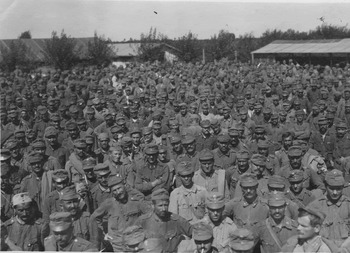
The world of prisons figures prominently in ICRC iconography. The photographs illustrate historical variations in the perception of detention, starting with the first visits to prison camps during the First World War. It was then that the International Prisoners of War Agency was founded. The first pictures of its headquarters convey the important role that visits to detainees play in ICRC activities.
We find dozens of examples of the kind of photograph shown in Figure 1, taken at different geographical locations up until the post-1945 period. The mass view used in the postcard campaigns mounted by the ICRCFootnote 11 refashioned the link between what was happening behind the lines and the ‘prisoner’ front, between families waiting for news and those who, away from the fighting, were still in need. The scale of aid needed is symbolised here by the depth of field of the photograph showing a blur of hundreds of men who seem to stretch back into infinity and who need help. This explains why such campaigns raised funds.
Austrian prisoners in the hands of the Italians, Italian front, 1914–1918 War. © ICRC photo library (DR).

During the Second World War, photographs started to serve increasingly as documentary evidence as the ICRC headquarters authorised or even recommended delegates to take pictures when visiting prisoners of war, as was the case of Maurice Rossel in the Theresienstadt ghetto, which the Nazis had intended to be seen.Footnote 12 This photography therefore originates as an act of testimony, but it also describes reality in the field. However, taking wartime photographs poses the risk of manipulation or propaganda because they concern a sensitive context. The ICRC, whose identity is rooted in humanitarian principles and the legal framework of the Geneva Conventions, cannot take photographs unbeknown to the governments authorising delegates' visits and thus risk accusations of spying. Photographs may be taken and circulated only with the agreement of all the parties concerned. Hence, in 1944, Jean Pictet drew up a note specifying the use to which these photographs could be put and stressing that they were taken by delegates in order to accompany their report and were then sent to the detaining authorities. Only a small proportion were to be used in the International Review of the Red Cross (hereafter referred to as the Review) or other ICRC publications.Footnote 13 At all events, the Information Service had to examine each photograph to see if it was suitable for publication. Those which were regarded as unsuitable could nonetheless be preserved in the photographic archives for reasons of thematic and/or historical interest. Thus, in 1952, Jean-Pierre Maunoir of the Executive Board informed the ICRC delegation in Indonesia that the photographs which it had supplied could not be published because:
the governor of Nusakambangan prison did not authorize you to take pictures inside the buildings. This is most regrettable. … When you visit prison camps or detention centres we would be grateful if, whenever you have been given the possibility, you would take some photographs showing detention conditions.Footnote 14
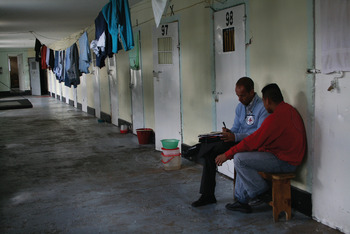
Since the 1940s, photographs of the masses have gradually given way to those of the face-to-face meeting between delegate and prisoner. They have left the world of camps to document and show life in prison – a world usually hidden from sight – irrespective of the grounds for detention (be they political, criminal, etc.).
The focus in the photograph shown in Figure 2 is on equality between two people – the delegate and the prisoner. It recreates the dialogue and makes the sharing of information central to the overall picture which always includes detention conditions. The universe is clearly identifiable through a wide shot on symbolic references in the background such as cell doors and a line of washing. It is therefore easy to understand why it is important to include this kind of photograph in reports in order to describe the detention facilities. From the 1980s onwards, as image rights gained in importance, it became a principle of the ICRC that, in accordance with the Geneva Conventions, prisoners can never be recognisable in photographs taken during international conflicts.Footnote 15
An ICRC delegate talks to a detainee on patio 4 of La Picota prison, Bogotá, Colombia, 27 February 2007. © ICRC photo library/Virginie Louis.

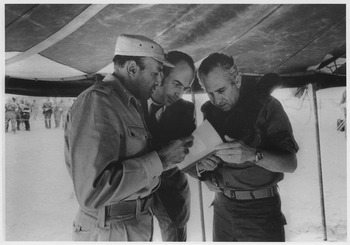
The ICRC's protective activity therefore makes it an organisation that has close contact with states, at least when negotiating the release or exchange of prisoners. This is mainly illustrated by images of a delegate standing beside politicians or military men, such as the picture shown in Figure 3 of a meeting between Israeli and Egyptian generals at the end of the Six-Day War between Israel, Egypt, Jordan, and Syria. In this case, the deliberate intention behind the purchase and circulation of this image was precisely to show negotiation and agreement between the two parties. This demonstration of goodwill is all the more important because the photograph was not taken by the ICRC, but was received from the Israeli army's press service. Detention is turned into a story; there is a ‘before’ (a combatant, a soldier), a ‘during’ (imprisonment), and an ‘after’ (release, repatriation, or exchange of prisoners). Throughout this story, the delegate is present at various stages and participates in several activities. The time frame is important for the ICRC, which gathers numerous photographs of this long, drawn-out process – one tends to forget that, no matter whether they are hostages or former combatants, detention is lost time for prisoners and is made even worse by the fear that they might be forgotten – of which the operative symbol is therefore that of an unbroken link.
General Sharif from the Egyptian side and General Eyal from the Israeli side, Israel–Egypt, UNEF tent at km 101, 1967. © Israeli Government Press Office.

The narrative figure of the delegate
Hence, the photographic testimony of and by the delegate is of utmost importance as a means of establishing institutional identity in the field. The Information Service therefore encouraged delegations to make use of it, even if that meant having to be accompanied by a photographer if delegates could not take pictures on their own.Footnote 16
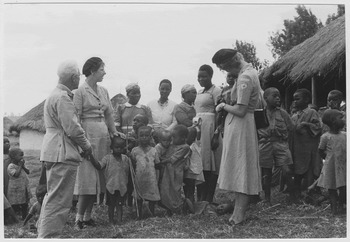
This was the case with the photograph shown in Figure 4, which was taken in Kenya during the on-the-spot activities of the ICRC after the Mau Mau uprising. It sets the scene – that of the meeting between two links in the chain of humanitarian action, the benefactor and the beneficiary. What is striking in the composition of this photograph is that the delegate standing at the back of the group is nevertheless the central figure. He is the only man in a group of women – for a long time the image of the delegate was male. The photographer, who accepts his role as an observer, is fascinated by this distinctive feature of a meeting between Africans (who are looking at the camera) and white staff (who have their backs turned to it). It symbolises the thrust of humanitarian action which has shifted from a mainly European universe to a North–South axis after the expansion of ICRC activities in Africa and Asia during the Second World War. The photograph is documentary evidence and, at the same time, it shows a universe that will form the basic ingredient of third-world scenography.
Visit of Dr Jean Maurice Rübli and Mr Henri Philippe Junod, accompanied by assistants from the Kenya Red Cross Society, to a Kikuyu village, Kenya, 12 June–9 July 1959. © ICRC photo library (DR).

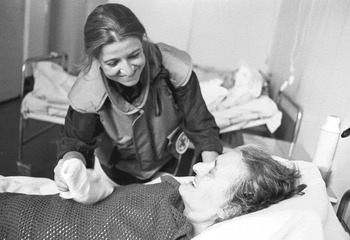
The delegate plays several narrative roles in these photographs: that of an inspector, a first-aider, a protector, and a kind and reassuring presence. By the end of the twentieth century, humanitarian imagery had switched to an approach that placed greater emphasis on the individual relationship between victim and first-aider.Footnote 17 The photograph shown in Figure 5 is a distillation of several powerful symbols: this time our gaze immediately falls on the delegate, a referent who can be recognised by her accoutrements (stethoscope and ICRC emblem), and is then guided along the line formed by the clasped hands embodying the iconic symbol of the outstretched hand.Footnote 18 In the foreground lies the archetypal victim (an old lady who is supine). The scene depicted here is reminiscent of the angelic figure so often evoked in the mythology of the earliest posters of Red Cross societies;Footnote 19 if the delegate can act as observer as well, what is expressed here is above all gratitude for kindness.
An ICRC delegate visits a paraplegic woman at Kosevo Hospital, Sarajevo, Bosnia and Herzegovina, 1 May 1993. © ICRC photo library/Ana Feric.

This figure is there to tell a story, that of the alleviation of suffering; the delegate is both narrator and reporter, and sometimes photographer as well. The setting up of a photographic laboratory at the ICRC in May 1958 enabled the institution both to play its role of heritage guardian and to step up its activities of supplying Red Cross Societies, other humanitarian institutions, the general public, journalists, and editors with documentation and sending illustrated reports to donors.Footnote 20 However, the number of photographs taken by delegates tended to fall in the following years because the photographic service preferred to hire professional photographers who provided better-quality work than the often amateurish snapshots of delegates, or to use pictures donated by army communication services.Footnote 21 Delegates continued to take photographs in prisons because protection activities (such as visits to detainees, assessments of conditions of detention, etc.) are confidential.
Dissemination of IHL
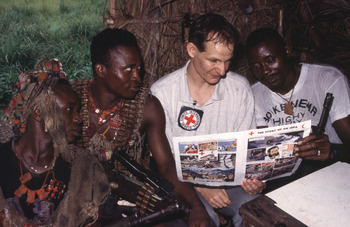
While the universalising, cultural, and memory-based dimension of the figure of the Good Samaritan (as benefactor/delegate/first-aider) has long been widespread in humanitarian iconography, many ICRC pictures concentrate on the dissemination of IHL to armed groups, which is another activity specific to the institution. In Figure 6, we leave the ‘totem’Footnote 22 of the helpful gesture for an actual encounter with the combatant, another relationship between two people that is fundamental to humanitarian action.Footnote 23 This is essentially a military and legal universe, because the central purpose is familiarisation with the Geneva Conventions. The symbol of the outstretched hand is replaced with that of a text.
Teaching IHL and the principles of the Red Cross to traditional Kamajor hunters at a road checkpoint between Bo and Kenema, Sierra Leone, 25 August 1998. The hunters believe that their vodoo (a ritual object resembling a red microphone) makes them invulnerable. © ICRC photo library/Till Mayer.

This type of photograph recreates the scenography of the meeting, because it necessarily raises the issue of the intrinsically intercultural nature of the dissemination of IHL and the ideologically charged relations which may arise from dispensing an idea in contexts which are sometimes completely alien. The focus is also on the central figure of the white delegate. The interpretation is that of sharing: our gaze follows the thread of the cartoon book illustrating Dunant's idea, which is being read by several people. The delegate is sitting in the centre of the group – part of it, but not the dominant member. We should also note the overall composition of the picture, through which the photographer wished to stress the cultural contrast inherent in IHL dissemination since the ICRC has been operating outside Europe, by including on the left two African warriors who are looking away from the camera. They are in full war regalia and carry the ritual objects described in the caption. This intercultural dimension is absent in other photographs of the collection which underscore the presence of local employees, as we will see later. Nevertheless, it demonstrates the sensitive contexts which may be deduced from photographs of a delegate alongside groups of combatants who do not all belong to regular armies and the risk of being treated as a sympathiser of a cause. Here the ICRC is also defending its policy by stressing that it is necessary to have access to all armed groups taking part in a conflict, while at the same time respecting its principles. This message is conveyed by showing IHL instruction sessions.
Lending legitimacy to the ICRC's presence in a variety of contexts: relief operations
The second focus explored is that of the context of humanitarian action where the diversity of operations is stressed and local staff members are depicted. It is possible to discern from old pictures of Red Cross Societies the way in which policy on archives and the collection of photographs as a guarantor of institutional memory has gradually emerged, and the changes it has undergone. Although the main intention behind this policy was to keep a record of operations and the resources deployed, it now allows us to look back at the societies where relief was supplied, as reflected in ethnographic photography.
National Red Cross Societies were pioneers when it came to photographing their activities in the field, as may be seen from the collection's earliest photographs of the Franco-Prussian War of 1870–1871, or of the Russo-Turkish War in 1876–1878, where the emphasis was on means of transport and national staff. The approach was both evidential and documentary, since the purpose was visually to ‘record’ the effective nature of relief among vulnerable population groups, who, during the first decades, remain depicted in a military and medical world (soldiers, ambulances, and hospitals).
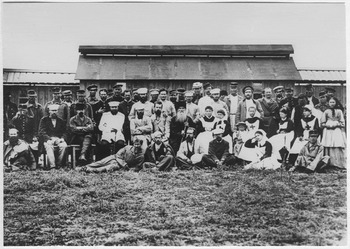
This documentary approach is perceptible in the picture shown in Figure 7, taken by the Russian Red Cross Society, where the photographer aimed above all to create a backcloth in a static shot composed for the occasion: the misery of the line of wounded men, their large number and the nurses beside them, all of them facing the lens. In this ‘constructed’ image we are close to the scientific photography of the years between 1920 and 1940, when the camera became an instrument for probing social issues and illustrating the reality of the fieldwork of sociologists, ethnologists, and anthropologists.Footnote 24 The posed scene so typical of nineteenth-century war photographs was dictated by the technical constraints of the cameras of the day, which needed fairly lengthy exposure times. It was necessary to wait for technical improvements and cameras that were easier to handle in order to be able to take ‘action’ shots accentuating the realism that also appeared in ICRC photos from the 1960s, when professional photographers made their appearance.
Russian Red Cross infirmary, Frateshty, Bulgaria, Russo-Turkish War, 1877–1878. © ICRC photo library (DR).

Little by little these pictures were gathered and/or sent spontaneously to the ICRC. The Information Service began to publish the first photographs in the Review in the 1920s. For this it turned not only to national societies but also to delegations abroad, in order to illustrate their activities and the international conferences which punctuated the history of IHL.Footnote 25 The great store of images of every kind was scattered among different services, however, and it therefore became necessary to index and specifically organise an iconographic collection. This was done in several stages. In 1946, after the war, following the expansion of photographic reporting by delegates, Jean Pictet sent a note to all services asking them to hand over any photographs of the institution which they might possess for the reorganisation of the iconographic service of the archives.Footnote 26 After a first incomplete attempt at classification by a student of the Social School in 1948, Mrs. Vuagnat of the Archives Service proposed in 1953 ‘a complete regrouping of all photographic material including that predating 1939, that of the 1939–1945 war and that of the Information Service’.Footnote 27 The classification of the wide variety of that materialFootnote 28 by theme, chronology, and keywords was therefore indicative of a determination to promote research and lending. As this activity of the documentation centre grew in importance over the years, it came to constitute the real ‘memory’ of Red Cross action. But while it evidenced the wide variety of the contexts illustrated at that time, be they ‘disasters’ (such as famines) or prisoner-of-war camps, it also brought to light the lack of traceability of some images. Their content had to be pieced together from other pictures which contained clear enough clues to identify them. In 1957, this lack of clarity led Robert Melley from the Information Service to propose that the 50,000 items in the photographic archives should be reorganised. ‘It was virtually impossible, especially for staff members who did not have “executive” duties, to provide each picture with an appropriate caption.’Footnote 29 The purpose behind this strengthening of documentary and research capacity was to minimise the dispersion and mislabelling of documents in ‘compartmentalised’ archives. There is a marked difference between contemporary or recent documents, which serve to publicise ICRC activities, and those prior to 1939, which are only of ‘historical’ interest. That was when thought was first given to setting up a photo library at the ICRC in order to facilitate printing and reproduction for information and publicity purposes.
New horizons, new practices?
This determination to depict the wide range of operations intensified at the end of the twentieth century. The focus of the first ‘technical’ photographs on the means of action has now shifted to the multiplicity of local actors. The individual is central to the image. The title of the exhibition shown at the International Red Cross and Red Crescent Museum in 2007, the plural noun Terrain(s) (field(s)), underscores the diversification of ICRC action over a span of 150 years into contexts (health, sanitation, food, psychology, logistics, etc.) and in favour of categories of persons (soldiers and civilians) that go beyond its initial objectives. The differences in photography typify this evolution.
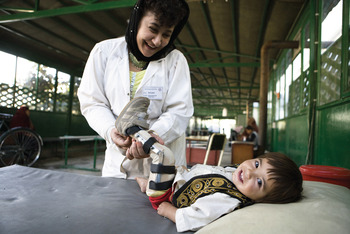
As in the other cases, the group view gave way more and more to pictures of the individual. In Figure 8, the central feature which attracts our attention is the face of the child, who is looking straight at us. It represents a path to follow, from the little girl to the physiotherapist's life story which is recounted in the caption and which allows a kind of projection. This image echoes that of the earlier one of the delegate and the old lady in Bosnia. But the photograph also emphasises a second change, that of the replacement of the expatriate by a local Afghani woman doctor.
Physiotherapist treating a child at Ali Abad orthopaedic centre, Kabul, Afghanistan, October 2007. Rohafza, whose right leg was amputated at the age of 10 after she had stepped on a mine by the gate of her school in Kabul, is a physiotherapist at the centre. She is fitting a child with an orthotic device. The limb-fitting and rehabilitation centre offers care to all persons with physical disabilities. Many have been injured by landmines or in accidents, while others have congenital deformities. Rohafza says: ‘It is so rewarding to help those who most need help, to see someone who was wheeled into the centre be able to walk out by themselves.’ © ICRC photo library/Marko Kokic.

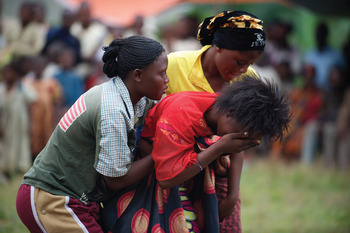
Another example is shown in Figure 9, which depicts a scene from a play, though it is not at first recognisable as such. The immediately identifiable signs are those of distress, or of some sort of tragic event (we can see a crowd in the background). At this level there is no trace of the delegate, the first-aider, or an emblem which would help to identify this scene as part of a humanitarian action. Only the caption indicates that it is a play about rape. Photography here has two functions: it illustrates a reversal of humanitarian thinking which now aims to build local, civilian capacity, and it is also educational. It ‘culturally’ informs a Western public unfamiliar with this kind of staging, and it warns the Congolese public about war crimes.
Democratic Republic of the Congo, Hombo, South Kivu Province, 17 June 2010. Women acting in a play. In this scene, relatives comfort a woman who has been raped. © ICRC photo library/Pedram Yazdi.

The third change is that of the extension of assistance to new sectors, in particular the reconstruction and rehabilitation measures put in place by the ICRC, which goes beyond the time frame of emergency relief. The numerous photographs of orthopaedic centres for the disabled, refugee camps, or the process of finding missing persons are evidence of this.
Although in Figure 10 we find the emblem, which seems to be a benevolent ‘sentinel’ protecting the group, we have left the world of medical care to enter the family sphere. This is suggested by the arrangement of the group – at the centre is a woman, who is surrounded by her children. Someone is missing. We can imagine that the absent person is at the other end of the telephone. The scene described is that of an ‘imaginary’ restoration of a family link via the symbolic referent of the telephone line. This modern vision of a ‘Red Cross message’ exchanged between a prisoner and his family focuses not on the victim (the prisoner) but on a group of people who are all too frequently forgotten in the chaos of suffering (the family).
Detainees' families talk to their relatives via a videoconference in Kabul, Afghanistan, at the ICRC delegation, January 2008. © ICRC photo library/Robert Keusen.

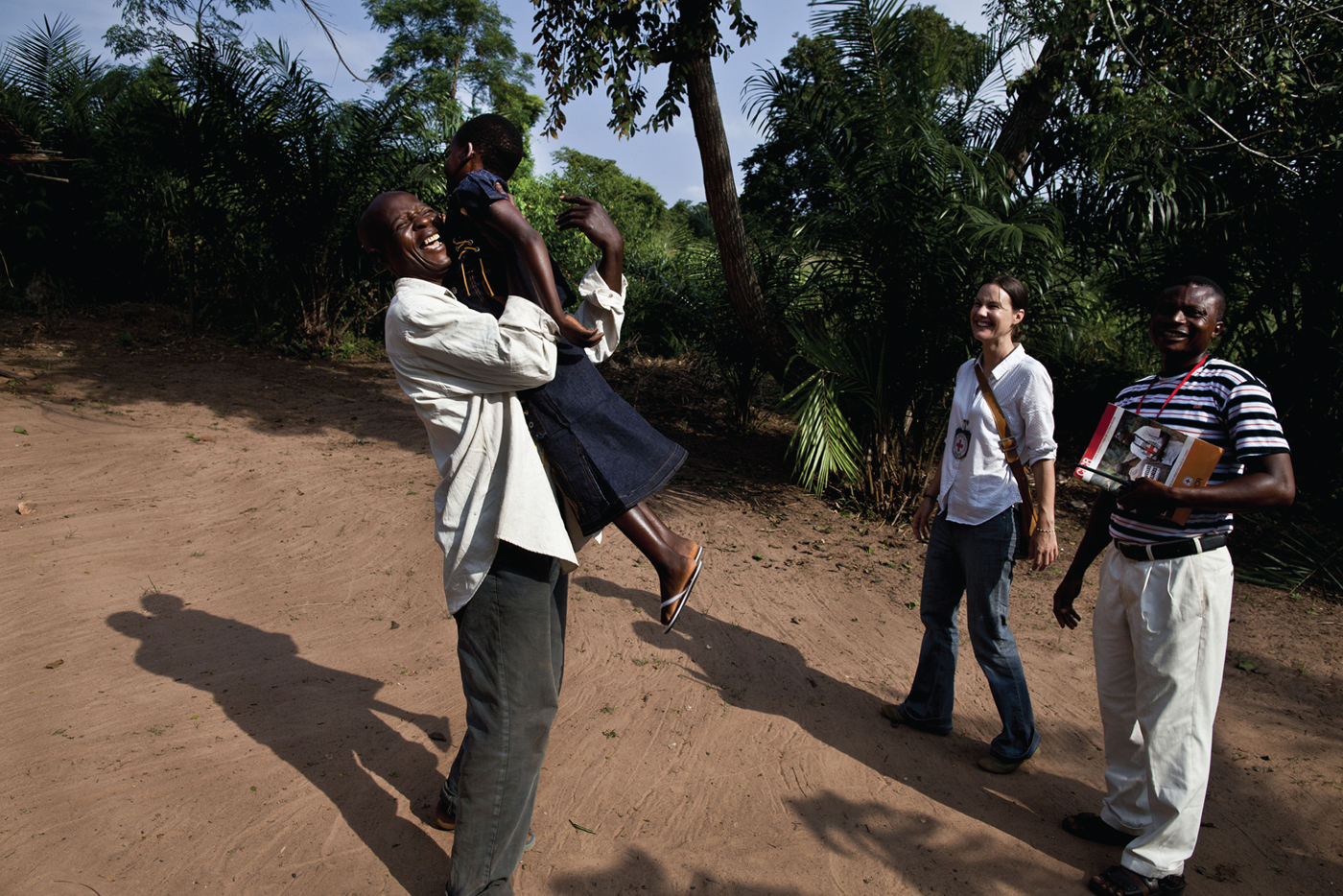
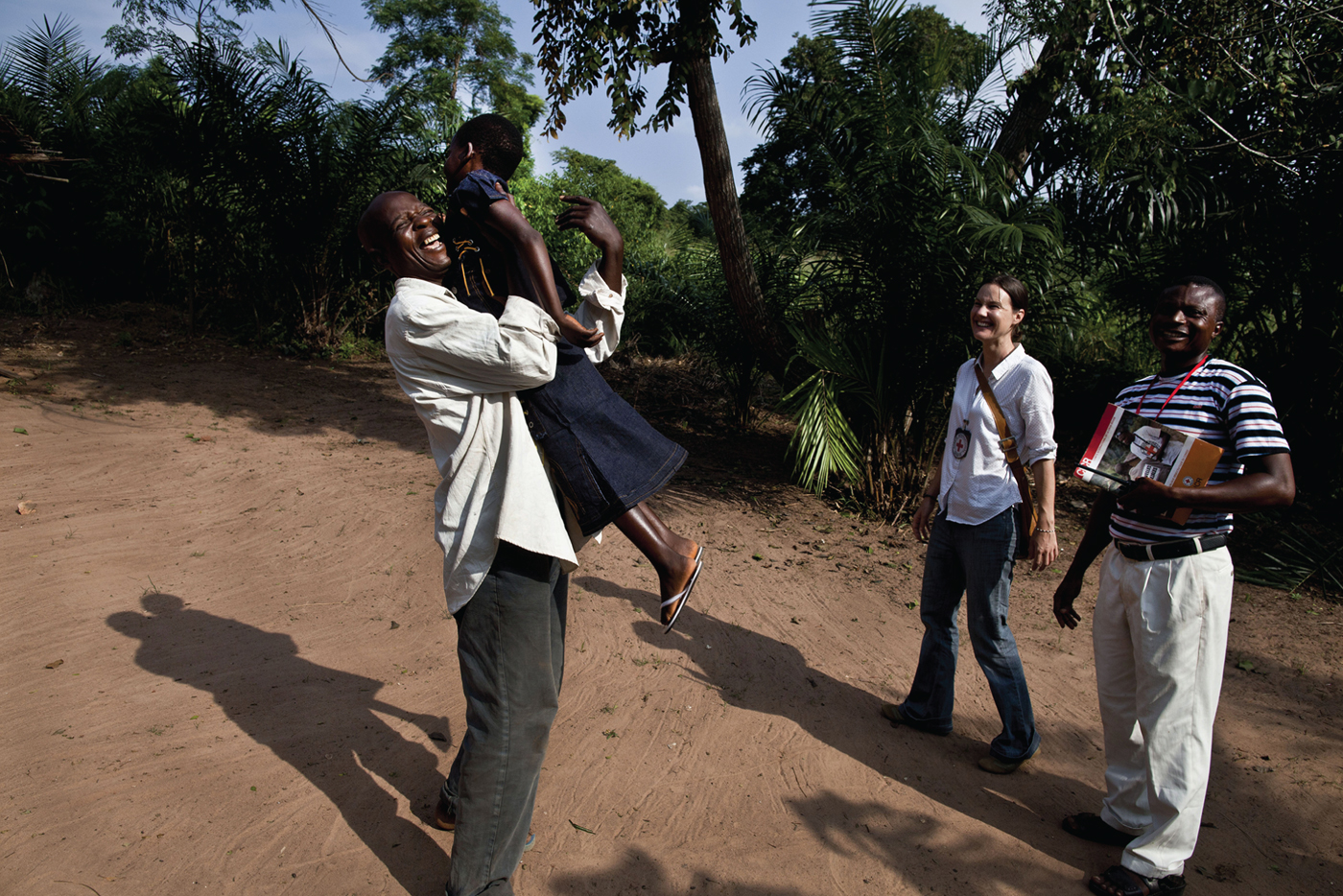
Figure 11 shows the last stage of the story – the family is together again. The ‘action shot’ aspect to which we referred earlier is plain here: no pause, just a snapshot of the joyous gestures and emotion of reunion. The scene is universal and stresses a central theme connecting all the work of the ICRC: restoring human dignity.
ICRC representatives restore contact between a man and his nine-year-old niece who was separated from her family during the violence in 2009, Equateur Province, Dongo, Democratic Republic of the Congo, 18 August 2011. © Getty Images/ICRC photo library/Jonathan Torgovnik.
Encounters
The last type of photograph dealt with in this section is totally unexpected and brings us back to our relationship with other human beings. These photographs are not intended for publication or circulation, although they constitute an undeniable visual heritage and reveal the social and cultural relations between protagonists. They cast an anthropological or ethnological glance not at relief operations, but at population groups and their daily life. They are classified under the headings ‘landscapes’ and ‘portraits’ in the database of the ICRC photo library. They have nothing to do with the world of suffering and instead convey the human element.
In the portrait of an Afghani refugee shown in Figure 12, we find the typical characteristics of the kind of photography which emerged in magazines such as the National Geographic. It is a humanist photograph which speaks from human being to human being.Footnote 30 The head and shoulders portrait makes us look closely at the expression of this other person and arouses our curiosity about his story:
The close-up portrait, against a uniform background, with the subject looking the observer straight in the eye, like a constant reminder of his presence, exemplifies this tremendous individuation. The idea expressed visually is that the human being is at the centre of the world and his image is our most perfect fetish.Footnote 31
Portrait of an Afghani refugee, Peshawar, Pakistan, 1989. © ICRC photo library/Cédric Piralla.

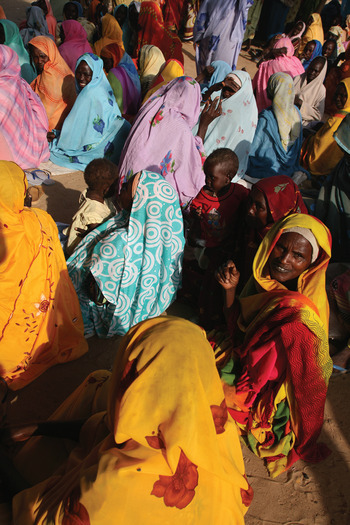
The type of photograph shown in Figure 13 is an introduction to peoples and a wide range of cultures. It no longer captures signs of chaos or assistance, but rather signs of life, ways of eating, dressing, and enjoyment, in an explosion of colour. In fact, it encapsulates the impressions of delegates who often go to countries which they do not know, and is like a travel diary that records feelings, daily scenes, communities, and the strength and rich cultural heritage of peoples – elements of ordinary life which are missed when the focus is on an emergency.
Portrait of a woman during distribution of food by the ICRC, Gereida, Sudan, November 2007. © ICRC photo library/Boris Heger.

The account of such a journey, which is very similar to an explorer's tale, is particularly explicit in the case of ICRC operations in Yemen at the time of delegate André Rochat's mission (1963–1970). During that period ICRC policies on communication and memory preservation were developed in greater detail: delegates were asked to supply photographs in order to document action and, at the same time, rules were laid down for filming activities. Contact was made with the news media, which wished to film Red Cross activities on the spot. The missions to such countries turned conventions upside down, and the photographs taken there illustrated the pioneering spirit of an unusual, exotic adventure. As if alluding to that sense of discovery, the photo shown in Figure 14 provides some insight into the motives of the delegate being photographed as he snaps a group of warriors in order to document his visit and, at the same time, to preserve a memory of this meeting.Footnote 32 This approach constituted a major asset of the ICRC and still explains the choice of the images kept in the photo library.
Royalist warriors crossing the western front, Yemen, 1964. Neither the photographer (possibly Yves Debraine) nor the delegate are identified. © ICRC photo library (DR).

The representability of violence, suffering, and victims
The photo library was initially set up as an archive service to gather photographic documents but has since taken on a communicational role, and it ensures that images comply with the institution's rules. This is especially important because the photographs collected over the years do not all come from reliable sources. Not all of them are dated or accompanied by a caption. Some are legacies that depict war scenes which, although highly informative, are not suitable for publication in the Review because they are inconsistent with the principles, credibility, and identity of the ICRC. In his 1957 report, Melley noted the existence of a section called ‘Visions of War’ which featured troubling photographs containing scenes of capture, military operations, destruction, and starving children. He proposed the creation of new categories such as ‘Victims’ or ‘Effects of War’ and recommended their use (probably on account of their emotional impact) during exhibitions intended for the general public.Footnote 33 Although this section has since been largely reorganised and further subdivided into new categories (violence, war crimes, genocide, famine, etc.), it underlines the special relationship between violence, imagery, and sensitivity, which is explored in this third section dealing with photographs illustrating the typology of violence and suffering, where the focus gradually shifts from the delegate and relief to the victim. In this kind of imagery the emphasis is not only on the emotional dimension, because the photographs are intended to be widely circulated in order to create public awareness, but also on the ethical and denunciatory dimension, which raises questions about the ICRC's rules on circulating war photography.
Photographing destruction
The age of the collection and the ICRC's presence in virtually all conflicts for more than a century necessarily raise the issue of the way death is portrayed and how much space is devoted to showing violence inflicted on persons and property. In this context, photography has the status of ‘proof’ of the facts and the protagonists.
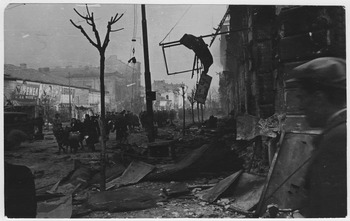
The field is primarily the scene of fighting and destruction, as is clear from Figure 15, which records the increasingly intense urban bombings that occurred during the Second World War. Already in 1944, the scenes of chaos in the foreground and the departure of residents who are joining the stream of refugees in the background are documentary evidence of the repercussions of armed conflicts on the civilian population (detention, migration, and maltreatment). This type of photography links in with Boltanski's ‘topic of denunciation’,Footnote 34 because it plays on a register of injustice (failure to respect civilian areas). Denunciation, however, would also entail another essential dimension to which the author refers – that of the figure of the persecutor, who, presumably, is absent from ICRC photographs in order to preserve the neutrality of the organisation's testimony. As we will see, however, this is not always the case.
War damage, 1939–1945 War, Grivita, a suburb of Bucharest, 1944. © ICRC photo library (DR).

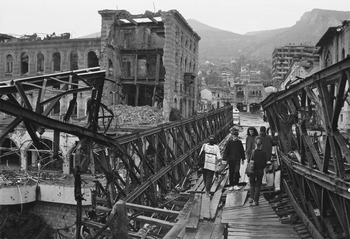
ICRC photographs do not only show destruction; they try to avoid the pitfall of dramatisation by also demonstrating that life goes on, thus harking back to the idea of resilience to which reference was made earlier. In the aestheticised, ethereal vision of a ruined Mostar presented in Figure 16, the photographer wanted to evoke ‘the other side of daily life’ in war, where people still go to work and to the market, despite the chaos. The symbol of the bridge is a strong one – it allows people to cross from one riverbank to the other, to ‘reach the next stage’. The picture illustrates an aspect of humanitarian action, that of ‘giving back a person the capacity to choose’.Footnote 35
The ruined town of Mostar, Bosnia and Herzegovina, 1 May 1994. © ICRC photo library/Joëlle Comé.

Violence
The photo library both archives and produces pictures,Footnote 36 but it also promotes lines of conduct to be followed when determining acceptable criteria for the choice of photographs. These criteria rest on humanitarian custom and expertise and do not take the form of written rules. While in the past there was more freedom, because practice, being haphazard and not institutionalised, resulted in a variety of photographic testimony decided on a case-by-case basis, today there is more self-censorship when taking pictures of violence or showing dead bodies. The ICRC's policies on identity and memory preservation mean that most of the pictures in the archives have been produced by the institution. But the determination to keep a historical record of conflicts and their protagonists has also led the library to obtain photographs not directly related to its activities.
This is true of certain categories of combatants. The photograph shown in Figure 17, bought from Anthony Teun Voeten, is intriguing because it contains two rarely depicted actors, namely women fighters. This portrait of two militia women is not accusatory, but sets out to show the reality of war and what it does to people, thus revealing an anthropological perspective on violence and the sociology of combatants.Footnote 37
Women members of government armed forces/milita mounting guard, Ganta, a town on the border with Guinea, Liberia, June 2003. © ICRC photo library/Anthony Teun Voeten.

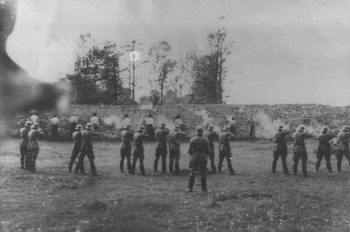
Some photographs of executions or massacres have been received as ‘bequests’ from army communication services present during conflicts, from national societies, or from resistance groups. This is true of some rare photographs of the Armenian genocide or of the liberation of the Nazi concentration camps. The origin of some of these photographs, like the Polish one shown in Figure 18, is uncertain.Footnote 38 The oldest ones frequently contain only the briefest of information about the place or the date of the event in question. Like most of the ICRC's photographs until the 1950s, they are also anonymous, as we can see from some of the pictures chosen for this article. Not all were taken by delegates or their photographers. Perhaps the name of the author was not recorded when the picture was taken, or it was lost by the time the photo library was set up. A traceability study would be necessary in order to understand the reasons why the author and/or the protagonists wanted to have it sent to the ICRC.Footnote 39
Execution of Poles by the Germans, Poland, 1939–1945 War. © ICRC photo library (DR).

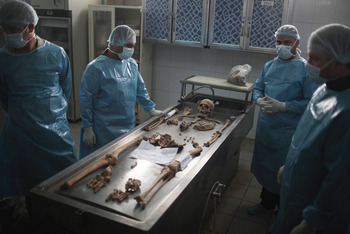
In addition to execution scenes we also find pictures of death, sometimes when almost nothing remains. Although they are rare, some photographs show mass graves. Such images demonstrate the historical link with the ICRC and its forensic experts as far back as the controversial case of Dr. François Naville and his role in the inquiry into the Katyn massacre in 1943.Footnote 40 The photograph shown in Figure 19 allies science (reconstitution of bodies) with memory preservation (restoring the dignity of victims of war crimes). The latter dimension of photographs of mass graves and mass violence remains an integral part of the archiving policy of the ICRC, because the photo library also possesses pictures of places (such as the Tuol Sleng prison in Cambodia)Footnote 41 or of monuments (grave stones at Srebrenica)Footnote 42 which here symbolises, a posteriori, a conscious effort of remembrance. In both instances, professional photographers went to the site to record these historical ‘traces’ of violence imprinted in the visual heritage of humanity.
Forensic anthropologists reconstitute the remains of a body found in a common grave in Saklawyia, Anbar Province, in the morgue of the forensic institute, Baghdad, Iraq, 2 May 2005. © ICRC/Getty Images/Ed Ou.

Civilian suffering
Showing suffering directly, in the middle of a conflict, nevertheless poses an ethical and moral dilemma, because it could be tantamount to denouncing the guilty party. The simultaneous presence of the torturer and the victim is rare in ICRC photographs, and such images which do exist, as we have seen, are not the product of the institution. However, showing a victim does not necessarily lead to the identification of the oppressor. The semiological ‘language’ of an image is too poor for that, because it cannot supply a causal link, except in cases of flagranti delicto. Since the words accompanying the images can point to possible responsibility, for obvious reasons of neutrality, ICRC photographs remain silent as to the perpetrators of violence, in case the pictures are circulated. Despite this dilemma, which is inherent in rendering any suffering visible, the ICRC very quickly capitalised on the emotional impact of victims' images, since it realised what effect their use could have on the general public. The typology of victims underwent a series of changes, switching from the wounded soldier to the civilian. Women and children began to appear in the pictures as conflicts affected more and more non-combatants after the interwar period.
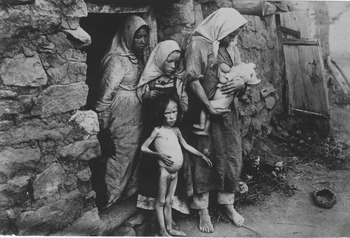
In the anonymous photograph shown in Figure 20, probably taken by the Russian Red Cross, our eye falls at once on the figure of the naked child displaying all the symptoms of malnutrition.Footnote 43 This was to become a standard feature of famine photographs,Footnote 44 in Ukraine (1921–1922), Hungary (1919), and Greece (1941–1942).Footnote 45 At the end of the 1914–1918 war, European public opinion was moved as its conscience was pricked by photographs showing young victims incarnating innocence snatched away.Footnote 46 Another characteristic means of stirring compassion was to depict a mother cradling a child in her arms – a Pietà – thus employing the traditional Christian code of such representations of charity in order to encourage donations. Moreover, the way this image is constructed underscores the masterly use of the visual rhetoric of the victim for the benefit of politics. Thanks to it, the Soviet Red Cross was able to mobilise support around the time of the Ukrainian famine.
Malnourished Russian children during the Russian famine, 1921–1923, Russia, 1922. © ICRC photo library (DR).

The ICRC was certainly aware of the aesthetic power of images to spur compassion when it chose to work with renowned press agencies and war photographers in the 1950s. Their visual testimony served to raise funds at a time when the ICRC did not have the means to pay photographers everywhere in the field. In an appeal to Magnum to cover Hungary and the Middle East, where the ICRC had just started to operate in 1956, Robert Melley emphasised the gains in terms of visibility on the international scene: ‘Although the experiment appears expensive at first sight, it seems worth a try. It is likely to lead to the circulation by the major newspapers of ICRC photos taken by the elite of reporters.’Footnote 47
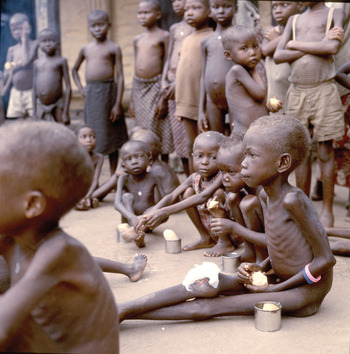
This growing cooperation with professional photographers therefore permitted the development of the aesthetics of compassion, particularly in the years between 1960 and 1970, with the rise of photojournalism.Footnote 48 The photograph of Biafra shown in Figure 21 is almost an iconic piece of journalism and marks a decisive turning point towards Boltanski's ‘topic of sentiment’.Footnote 49 Its mobilising dimension is very strong. Biafra and its camps of starving children illustrate all too well the link between images, politics, and humanitarian action. In 1968 the serried ranks of naked skeletal bodies were reminiscent of the Jewish genocide – but do they not conjure up an older visual memory, that of the great European famines of the twentieth century?
Distribution of food to undernourished children, Nto Edino reception centre, Biafra, Nigeria, 1968. © ICRC photo library/Max Vaterlaus.

Such images therefore raise questions about the visual rhetoric at work and its origin, especially in terms of the exemplary role allotted to the victim, who becomes the ‘screen’ symbolising the humanitarian cause, often without any reference to the socio-political reality which has turned that person into a victim: ‘The cognitive archetype of what is allowed to be seen or, more rarely, guessed, is the victim through their suffering body, the victim who has become an aesthetic canon.’Footnote 50 This is, however, still a far cry from some humanitarian activists' denunciation of the mass media.Footnote 51 ICRC photographs follow a number of rules, especially since the institution started to work with professionals. The determination not to play the media game by employing increasingly violent images led photographers who had been commissioned to work for the Red Cross to make greater use of symbolic relationships and suggestive effects. This resulted in the outstandingly evocative images of the Terrain(s) exhibition.
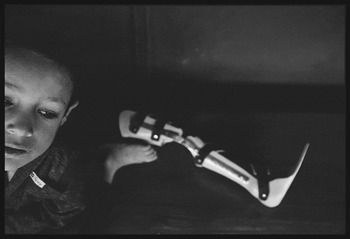
Figure 22 presents an image that does not focus on the victim, but seems to hint at the violence of amputation. It raises the issue not only of the representation of the victim and the aesthetic depiction of suffering, but also of the public relations of an organisation which defends the humanitarian principles of its communication policy with photographs that are sometimes criticised on the grounds that they enable the organisation to profit from the misery of others, especially since the ICRC has increased its collaboration with prestigious agencies such as VII, Magnum, and Getty (as from 2009). The worlds of humanitarian action and photojournalism intersect, although they are not always based on the same standards.Footnote 52 Yet the same belief in the power of the visual medium unites both worlds in the conviction that photographing suffering can change something in the struggle against indifference and trivialisation.
ICRC orthopaedic centre, Kabul, Afghanistan, March 2009. © ICRC/VII/James Nachtwey.

Conclusion: humanitarian photography or the West's way of looking at things?
One of the ideas put forward in the Terrain(s) exhibition is that humanitarian action would not have been the same without photography. At a time when there is talk of wayward trends in the manner in which the media depict humanitarian action, of sensationalism and compassion fatigue, when the Western hegemony on humanitarian action is challenged – some people even underline the role of humanitarian organisations in these representationsFootnote 53 – this collection of photographs makes it possible to put some things in perspective. It constitutes a genuine centennial record. It is evidence of a photographic inquiry which gives value to the institution's memory and the public dissemination of images. It is a valuable weapon against indifference. It shows that a forgotten memory also exists of an older approach which moulded the general public's perception, which raises questions about the representability of suffering, and which prompts curiosity that induces a readiness to reach out to other human beings. The whole collection forms a genuine anthropological study of humanitarian work, violence, and fighting that is far removed from purely miserabilist pity. Its aesthetic codes have become the signature of the renowned photographers who have supported the ICRC.
These photographs are the product of an institution which displays its values and ethics through them. This communication policy is further justified by the fact that it ensures greater credibility.
The ICRC acts predictably, according to definite terms of reference, and its public communication must reflect its determination to be coherent and predictable. It therefore attaches greater importance to the credibility of its information and to medium and long-term strategies rather than to ‘media coups’.Footnote 54
The ICRC distinguishes itself from other humanitarian organisations which are more ready to claim communication strategies displaying a desire for publicity (such as the use of celebrities by UN agencies), or oriented towards denunciation or media ‘hype’ (like the advocacy campaigns of Médecins Sans Frontières (MSF)). The ICRC's mandate is grounded in a legal framework entailing possibly stricter communication rules than other organisations. It would be worth carrying out comparative studies going beyond the scope of this article, even though some organisations do not possess such well-established visual archives as the ICRC and do not have the same policy on memory preservation. Some similarities do exist, however, in the visual culture which predominates in Western humanitarian imagery. For example, it was primarily Eglantyne Jebb, the founder of Save the Children, who created a willingness to sensitise public opinion by using photographs of starving children and to forge a consensus surrounding apolitical pictures of innocent child victims.Footnote 55 This tendency was copied in the visuals of the ICRC, National Red Cross Societies, and the American Relief Administration during the 1920–1930 period. More recently, partnerships between several humanitarian organisations and some press agencies (such as VII, which has also worked with MSF)Footnote 56 have raised the issue of establishing common codes. British and American photography does seem predominant when one looks at the agencies which have been contacted. Nor should one neglect the visual composition, which is in a way the signature of photographers who have been commissioned for this work and who, although they follow a set of stricter rules, nonetheless convey their own perception of the context.
While the ICRC therefore endeavours to ‘show’ its action, taking the form of its permanent presence in all humanitarian fields, it also wants to make itself identifiable through the permanent nature of symbols such as the logo and the delegate. In addition, the humanitarian world is perceived as a field of operations, action, gestures, thought, perception, and approach. However, like any other form of photography, humanitarian photography has its own ‘language’ limits. While its emotive power is undeniable, it is necessary to reflect on the goals assigned to it. Is this photography solely historical and ideological testimony aimed at ‘telling the story of people caught up in conflict, both victims and relief workers’, or is it ‘the record of a century marked by deeds of extreme heroism as well as utmost infamy, bringing hope as well as despair’?Footnote 57 ICRC photographs are more than just images of an institution. They have many purposes: testimony and proof, illustration and description, fund-raising and documentation, information and communication, education and awareness-raising.
By concentrating too hard on observation and contemplation, the limitations of such a visual heritage can be forgotten. The first limitation is cultural; although they claim to be universal in scope, ICRC photographs abide by Western visual codes around suffering and relief constructed over a period of two centuries. This photography can function only through symbols largely belonging to European culture, its religious roots, and its memories, because over time it has accustomed the public to seeing and understanding them.Footnote 58 The danger also lies in the world not seeming to exist beyond the visible boundaries of what we are allowed to see. While photography is still a wonderful knowledge tool, it is necessary to give some thought to what it does not depict. The third limitation is contextual: the abundance of universally available visual media has helped to saturate the public arena via the social media. The production of images, their circulation, and therefore their instantaneous visibility to all protagonists can have as many advantages (triggering awareness) as stumbling blocks (risk of manipulation and misuse as propaganda) for humanitarian institutions, whose identity in the field is undeniably bound up with the production and use of visual material.