Do photographs open a window onto the ideology of the National Socialist dictatorship? The popularity of television histories of this period suggests they do. Yet, as many commentators have argued, the apparent authenticity of historical photographs can often be deceptive.Footnote 1 Photographs have certainly been subject to deliberate manipulation.Footnote 2 But even with apparently “naïve” photographs—as in the case of millions of amateur snapshots taken in this period—the images still present historians with innumerable challenges with respect to interpretation. They do show us glimpses of quotidian moments and visceral experiences that rarely find their way into written documents—in part because many such moments were too “ordinary” to merit recording in a diary, letter, or other self-consciously reflexive “ego-document,” and in part because photographs obviated the need to translate embodied and affective experiences into written language.Footnote 3 In another sense, such snapshots reveal less about the time in which they were taken than many written sources do, because in its adherence to pictorial conventions, amateur photography was also a peculiarly conservative medium. The speed of innovation in photographic technology generated much excitement in the first half of the twentieth century, as we shall see. But this new technology did not automatically produce new visual imaginaries and expressions.
The research for this article, as well as for a larger research project on photographic practice in Europe in the 1930s and 1940s, involved studying several hundred private photo albums made by Germans during the Nazi regime, and looking through many thousands of individual photographs from the same period.Footnote 4 It is tempting to conclude from such a sample that most of these photos reflect the conventions of the genre more than they do one particular moment in time, let alone specific political dispositions or unique personal experiences. While the events depicted in amateur snapshots may have been intensely personal and “of the moment” for those who were present in front or behind the camera, the resulting images are often almost indistinguishable from one another. From a baby's first steps to high school graduation, from a christening to a wedding, from a Sunday picnic to a beach holiday, a repertoire of conventional life milestones and their attendant “appropriate” poses and settings fill the pages of these albums. They resemble similar scenes photographed in the decades before and after the Nazi period, as well as comparable photographs in British and American albums of the same era. Neither the behavior of those being photographed (their actions, poses, and inevitable smiles), nor that of the photographers (their choice of the picturesque setting, angle, lighting, and focus) changes dramatically in this time, or in distinctly recognizable patterns. Unless a photograph contains accidental clues about its temporal context, such as a distinctive new piece of technology or fashion, it is often impossible to tell whether an image of civilian life that survived outside the context of an album and without a caption was taken in 1920, 1930, or 1940.
This is not just because those engaged in the production of these photographs failed to think or live outside conventions, or to do away with pictorial precedents. Family photos are nearly always acts of preemptive commemoration. Their purpose is to represent the moment: not just for immediate consumption, but also as it is to be remembered in the future, and by future generations.Footnote 5 The fact that this future is never wholly knowable, and that the value judgements of its inhabitants are unpredictable, means that it is perfectly rational to take photos in a style that is relatively risk-adverse, thus tending to privilege the generic over the idiosyncratic and original. Such limitations notwithstanding, this article argues that photographs can tell us particular and particularly important things about Nazi Germany that are not easily apparent in other types of sources. At the same time, it also demonstrates that photographs offer significant insights into movement and rootedness, a sense of new beginnings, subjectivity, as well as the authenticity of time in the political imaginations of Germans living under National Socialism.
Much of this depends, of course, on how we understand the category of “the political.” Historiographical controversies about life in Nazi Germany have long focused on the regime's ability or inability to extend its ideological tentacles into the private sphere. Where Roger Griffin saw the birth of new, distinctly modern fascist subjects united in a single Volksgemeinschaft, a cohort of skeptical historians has treated such ambitions as propagandistic hyperbole or window-dressing for political coercion and terror.Footnote 6 Moving beyond this dichotomy, another group of cultural historians has turned to the study of subjectivities as a realm in which politics and selfhood commingled, without seeing individuals as either victims or resisters.Footnote 7
All these historiographies describe important aspects of life in Nazi Germany. But where photographs can make the greatest contribution is not in clarifying “facts,” but in exploring mentalities, behaviors, and practices. If we focus on what National Socialism meant to people, rather than what it tried to do to people, a much more amorphous anthropological picture emerges. Rituals and practices, and the objects and spaces in which these were performed, defined people's sense of selfhood and shaped how they engaged with the political world around them, as well as how they pulled that world—its phrases, images, and objects—into their own. Written sources, which are, by definition, laborious to produce, requiring effort, deliberation—and, in Nazi Germany, also a careful calibration of possible political consequences—capture such transfers only in highly mediated ways. The majority of Germans living through the Third Reich left no such sources behind. Taking photographs was a ubiquitous practice, however, and became second-nature to such an extent to many that it became an integral part of lived experience. Photos are thus particularly suited to exploring the experiential dimension of life in Germany between 1933 and 1945. They are not “objective” documents showing whether or not people resisted or were “duped” by the fascist regime and its ideology. Rather, photos are part of what people did with this ideology, and how they translated it back into a sense of selfhood. Viewed in this way, the apparent ordinariness of many of the images in question does not detract from their political relevance: asserting ordinariness in the face of the extraordinary is, in itself, an immensely political act—and one that requires careful decoding on the part of the historian.
For many Germans, the caesura of 1933 was not as marked as it appears with the benefit of historical hindsight. Technological and economic change occurred more incrementally than regime change, but it arguably did more to transform quotidian practices and subjectivities. Consumerism, new leisure practices and industries, as well as new media spectacles certainly helped redraw the boundaries between the public and private spheres. Some in the Nazi leadership regarded such developments as “transmission belts” for dangerous notions of individualism, gender equality, and “decadent” sexualities that were at odds with “healthy Aryan” lifestyles and the united Volksgemeinschaft. Others, meanwhile, tried to capitalize on the real or perceived economic successes that facilitated mass consumption.Footnote 8 Organizations such as Strength through Joy (Kraft durch Freude) linked leisure to politics, as did official products such as the Volksempfänger (a radio receiver) and the much anticipated and heavily advertised Volkswagen automobile, to name but the most iconic.Footnote 9 Seemingly mundane practices—from driving cars to drinking Coca-Cola, from seaside holidays to gymnastics—took on a significance far beyond the “purely private,” functioning as arenas in which political identities and ideological preferences were formed, performed, and contested. Beyond direct cooptation by the regime, private photographs offer insight into the ways in which people embraced such practices to fashion new identities and new modes of participation in the public sphere. Photography not only documents such activities, but was itself a new form of mass consumption: people bought cameras, films, albums and picture frames, instruction books, new and better cameras. And photography proved to be an incentive for embarking upon new forms of consumer behavior as well. Photos turned fleeting experience into a status symbol that could be displayed as a prized possession.
As the Introduction to this special issue notes, photography had long historical roots, but its social life underwent a dramatic transformation in interwar Germany. Two factors proved decisive. In the first place, the circulation of professional photographs increased significantly. Cheaper printing techniques facilitated the proliferation of photos in magazines and illustrated newspapers, and on advertising posters. When Janet Ward writes of the Weimar years as an epoch defined by “surfaces,” she is speaking to no small extent about the reproduction of photographic images.Footnote 10 Second, taking photographs became easier and more affordable as Germany led the world in the development of a new type of camera: lightweight, compact, extremely easy to use, and affordable. Iconic brands included Leica, patented in 1925, and Zeiss Ikon's Contax, which went on sale beginning in 1933. Countless cheaper versions of the same basic camera type came onto the market in the 1930s and early 1940s.Footnote 11 Photography quickly became a favored pastime for millions of German hobbyists. Leica alone sold a quarter of a million cameras by 1939, by which time an estimated seven million Germans owned a camera.Footnote 12 To that figure one must add all those part-time photographers who were handed a camera by friends or family members. Albums that show the same group of people with one individual at a time missing from each image—because they were taking the shot—are evidence of this.Footnote 13 Even those who did not participate behind the camera became involved by virtue of being in front of it. In short, being photographed by fellow soldiers, classmates, tourists, and work colleagues became a normal and regular experience for most Germans during the 1930s and 1940s.
Contemporaries were conscious of the transformative effect of this pervasive new practice. While some, such as László Moholy-Nagy, expressed excitement about the mass medium, others were alarmed by these developments.Footnote 14 But irrespective of the particular cultural pessimism of the extreme Left and Right, the sense that photography constituted a new language that would rival the written word was pervasive: it arose from the interrelationship between the viewing and the taking of photographs, and the fact that both became mass pursuits in this period. As the gaze of the professional photographer was imitated and appropriated by an army of lay photographers and snapshotters, people came to view photographs not just as aesthetic representations created by experts, but as a communicative practice in which everyone shared: those who produced it professionally, and those who consumed it and used it in their own private lives. For many ordinary Germans, then, photography became a language for expressing and sharing in a new zeitgeist. This not only encouraged and enabled the staging of large-scale photogenic events, such as the annual Nazi Party rallies or the Olympic Games, which have been central to the literature on fascism as “spectacle.”Footnote 15 But the impact of photography also reached far deeper into more quotidian lives, transforming the spatial and temporal parameters in which such lives were experienced and understood.
To acknowledge this deeper impact is to move beyond the confines of the concept of photography as propaganda. Certainly, propaganda photography exerted an important influence, but to think of photography in the Third Reich primarily as propaganda entails the danger that one identifies as significant only those features that directly correspond to that already known and recognized as “typical” of the regime and its ideology. Bernd Hüppauf has argued in an essay about the photos of World War II—programmatically entitled “Emptying the Gaze”—that “these photographs are customarily read… as illustrations of the well-known story of the immoral and barbaric ideology of the Nazi system. As long as the answer to the question as to what they show is known in advance, they will remain silent… Only focusing on the concreteness of details … will make visible what can be seen in the photos.”Footnote 16 Francis Guerin subsequently used this quotation to frame her discussion of a range of images, including so-called trophy pictures by German soldiers on the Eastern front, the not-quite “private” snapshots of the professionally trained Eva Braun, and ghetto photographs.Footnote 17
But what of photographs that depict more quotidian experiences of less obviously disrupted lives? One obvious difference lies in the fact that in German family photos of scenes of leisure, relaxation, or celebration, the individuals or groups depicted usually had significant agency in the production of the image. They chose or at least consented to having their photo taken; they posed, perhaps even dressed, for the camera; and they often played a role in deciding which images were kept and which discarded. This coproduction of the image by the photographer and the photographed differed from most perpetrator photographs, which robbed victims of much of this agency. And yet, there were also important similarities. For one, both types of photo drew heavily on preexisting templates. They mobilized collective memories, rhetorical clichés, and habitual poses. Though each deployment of such precedents may be subtly different from the next, it was not only the photos that deviated from the convention that were significant. Affirming a shared gaze can be just as meaningful as its subversion: lack of originality turns images into instruments of normalization.
The second commonality of photos of the most extraordinary and most ordinary aspects of life under the Third Reich is that all of them confer authority. As this article contends, taking a photograph puts the photographer, as well as those who pose for the camera or help with the mise-en-scène of the objects and spaces to be photographed, in charge of framing the meaning of the moment and how it will be remembered in the future. By monumentalizing experience in such tangible ways, photography created opportunities for political mobilization that went far beyond the confines of what is traditionally understood as propaganda photography. In this regard, however, snapshots are anything but simple: they, too, require careful decoding.
“Doing Nothing”? Action and its Absence
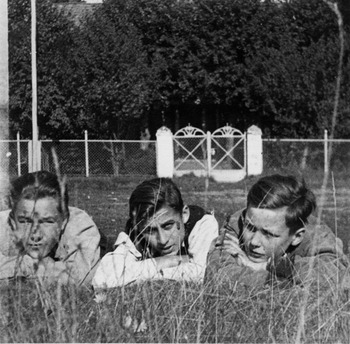
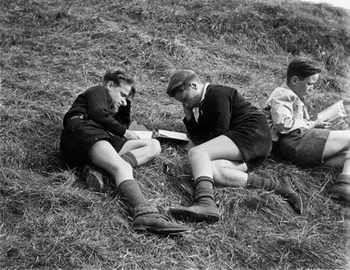
The two examples in Figures 1 and 2, dating from 1941 and 1942, respectively, are in many ways typical of the genre of private snapshots taken during the Third Reich. They show ordinary scenes—indeed, scenes that are remarkably uneventful. At first glance, this absence of content makes them seem radically removed from the world of politics, and, indeed, from the world of work: they capture leisure and contemplation, and their format, too, is unassuming. The first image was developed in the cheapest possible format (the size is 5.4 by 4.2 cm). Its owner, shown on the right-hand side of the photo, is the author's father, Horst Umbach, who has kept this image from his schoolboy days in an envelope all his life. Horst did not own a camera as a fifteen-year-old, but did become a passionate hobby photographer in the postwar period. He nevertheless collected many photographs during the 1940s: most of these feature him alone or with friends, and some were shot with a camera he borrowed from those friends.
Horst Umbach (right) and two classmates during auxiliary harvest service in 1941 in Ovelgönne. Property of the author.

Horst Umbach (right) and two classmates in Riedenburg (Franconia) during the child evacuation program (Kinderlandverschickung) in 1942. Property of the author.

This particular image (Figure 1) was taken when a class of pupils from the Breitenfelderstraße school in Hamburg-Eppendorf—a Mittelschule (secondary school) less elite than the classical Gymnasium, but more academically rigorous than the basic Volksschule—was requisitioned to help with the potato harvest in Ovelgönne, just south of the Elbe River. The picture shows three friends lying in the grass, and were it not for the extreme economic turbulence of the times, we might classify their milieu as middle class. But for many German families, the war simultaneously opened up new opportunities and rendered social survival more precarious. This was certainly true for the Umbachs, and in making sense of these images, it is worth briefly reflecting on this background.
In the Weimar years, Horst's parents, both of whom came from relatively humble, provincial families, moved to Hamburg to try their hand at a more bourgeois lifestyle. They danced, partied, and tried new drinks and new sports, including horseback riding. But their aspirations largely ended in failure. Horst's father designed a new car, the Umba-Wagen, and tried to set up a manufacturing plant, but never got beyond building a prototype and producing advertising materials—before the hyperinflation put a quick end to his dreams. He wore shoes with leather soles but walked to work for hours every day because he could not afford the tram fare. Horst's parents divorced in 1936, leaving a single mother of two struggling to put food on the table.
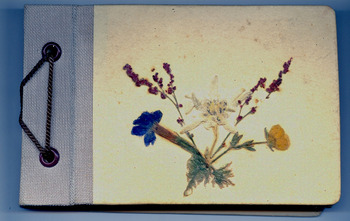
In some ways, the war made a difficult situation more difficult. In other ways, though, it opened up new opportunities. Horst's mother was drafted into war service as a telegraphist. The family now lived in an apartment block, the so-called Breitenfelder Burg, in Eppendorf. They subsidized the 72 Reichsmark (RM) rental payments by subletting one of the three rooms in the apartment to a medical student. Such stories illustrate the difficulty of classifying the practice and motifs of amateur photography in straightforward “class” terms. By 1942, when the second image (Figure 2) was taken, the now regular nighttime bombings of the city in the wake of Winston Churchill's Area Bombing Directive led to the child evacuation program (Kinderlandverschickung): the Breitenfelderstraße school pupils and their teachers were subsequently evacuated to rural Franconia. Numerous photos were again taken, and Horst purchased copies from his classmates to assemble his own small album. Together with thirty-two other photos from the same trip, he arranged them in a pocket-sized album measuring 9.5 by 15 cm, and decorated the cover with pressed flowers (Figure 3), including an Edelweiss. This, he explains today, constituted a piece of Bavarian exoticism.Footnote 18
(Color online) Self-made cover image of Horst Umbach's photo album documenting the child evacuation program in 1942. Property of the author.

The other photos in this album show the pupils at play, exploring the area, climbing, canoeing, and, as in the photos reproduced here, doing not very much at all: relaxing, taking a break, resting, or reading. Like those from the summer of 1941, these images seem far removed from the public face of National Socialism. Indeed, they appear almost as its emotional antithesis: we see rest rather than activity, contemplation rather than paramilitary drill, individualism rather than collectivism. Both of the photographs seen here, like many other pictures from these two collections, show boys together, yet they display no visible sense of community: they act individually, alongside one another. Even the most militarized youngsters would occasionally enjoy breaks, of course. Yet, the frequency with which such breaks and withdrawals—rather than the activities between them—were photographed is noteworthy. In fact, this conspicuous inactivity struck one British interlocutor as distinctly “German” when we compared these photographs to her own husband's wartime snapshots.Footnote 19 British youngsters photographed each other during sporting activities much like their German counterparts often did, but she still thought it “strange” that Horst's photographs contained so many examples of people “doing nothing.”
These teenagers from Hamburg apparently considered doing nothing to be important: worth recording, worth preserving, worth spending meagre resources on. It would be tempting to interpret such images as evidence of an “inner emigration” or “resistivity.”Footnote 20 These pupils do not look like ardent young Nazis, and they might have been using photography to capture a conspicuous display of individualism. The book Horst recalls reading in this photograph was Thomas Mann's Magic Mountain—a novel published in 1922 that remained a popular staple on German middle-class bookshelves even after the Nazi regime had stripped the author of his German citizenship. It is interesting to consider the particular way in which reading is performed in this photograph in the context of a novel about self-exploration and the troubled inner lives of Europe's fin-de-siècle bourgeoisie. Thomas Mann wrote the Reflections of a Non-Political Man at about the same time: a paradigmatic text for those who saw true contemplation as somehow rising above the vulgarity of traditional politics.
Neither of these books—nor Horst's pose, for that matter—were genuinely “non-political,” however A similar photo of him from 1944, taken after he had joined the air force's training program, features him looking demonstratively contemplative in the face of imminent total defeat—while reading Heinrich Schliemann's report of the archaeological excavation of Troy.Footnote 21 Such literary poses provided vantage points from which one could regard the spectacle of everyday life from a position of seemingly cultural (and, if desired, ideological) superiority. But they were mediated by wider pictorial contexts in multiple ways. When asked why this and so many other photos like it were taken at such a difficult time, Horst responded: “We were reading so many illustrated magazines back then.”Footnote 22 In his recollections at least, there was thus an important link between the consumption of published images, on the one hand, and the production of one's own “private” photographs, on the other. The link with the print culture of the time was not necessarily that of a direct imitation. Rather, this was a shared pictorial imaginary on which both professional and amateur photographs of the period were drawing.
The Natural German
Part of what renders Horst Umbach's photos so distinctive is the fact that what is, in some ways, a typically bourgeois practice and pose—the silent, contemplative immersion in “serious” books—is here transplanted into the open air. This seemingly paradoxical move was not just an act of youthful transgression: the pose of reading in nature had, in fact, its own ideological traditions. Reflecting on these is not about uncovering a direct “precedent,” but rather about tracing the contours of something more diffuse: a collective pictorial memory, a repository of “thinkable” visual configurations and stereotypes that underpinned, animated, and made possible the aesthetic self-stylization of teenagers in photos such as Horst's.
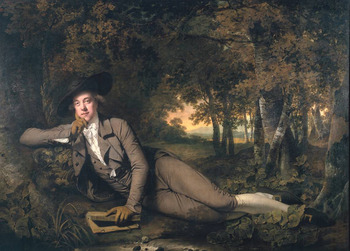
One of the most influential images that defined such quasi-literary ways of posing outdoors is British painter Joseph Wright of Derby's 1781 portrait of Brooke Boothby, a pioneer of the cultural movement of eighteenth-century sentimentality (Figure 4). Unlike his peers in contemporaneous portraits by Joshua Reynolds, Thomas Gainsborough, or Johann Zoffany, who preside over landscapes as territorial possession, Brooke Boothby reclines in a forest, at ease with seemingly untamed nature. His pose suggests no sense of ownership. Instead, he communes with his environment, the contours of his body blending organically into those of the river embankment on which he rests. The book in his hand is Jean-Jacques Rousseau's 1762 novel Emile, and Boothby, a leading Rousseauist of his time, had paid for the English-language translation he is clutching.Footnote 23 Rousseauism was understood as offering an antidote to cultural alienation by seeking inspiration in nature. As such, it is sometimes seen to signal a retreat from politics—if by politics one means official, public, and formalized forms of political behavior. To find traces of it in these photographs from the 1940s would therefore resonate with a reading of those photographs as anti-political. Yet, anti-politics can be a powerful political practice in its own right.
(Color online) Joseph Wright of Derby, “Sir Brooke Boothby,” 1781. Source: Wikimedia commons.

The further evolution of this pictorial convention makes this clear. Sentimentality was predicated historically on a rejection of the alleged decadence of the formal courtly culture widely associated most closely with France. In Germany, it was promoted visually by artists such as Daniel Nikolaus Chodowiecki, director of the Berlin Kunstakademie, who created over 6,000 art works, mostly aquafortes, and 4,000 drawings, many of which illustrated literary texts.Footnote 24 In 1779 he published a series of engravings titled “Natural and Affected Acts of Life,” with a commentary by Georg Christoph Lichtenberg. The first two sets of these engravings juxtapose German ways of living life “naturally”—in conversation, instruction, and prayer, for example, or by taking promenades—with “affected” French ways of performing the same actions.Footnote 25 The German way is depicted as one of quiet introspection, modesty, and sensibility; all outdoor pursuits are in harmony with the surrounding natural landscapes. The corresponding French affectations are associated with pompous rococo costumes, with exaggerated gesticulation, and, in the outdoor scenes, with the trimmed, geometrical hedges of a baroque garden.
Such national dichotomies provided useful ideological ammunition when the conflict with the French turned violent during the era of Napoleon's occupation of the German Reich. Painters such as Caspar David Friedrich and Georg Friedrich Kersting drew on this pictorial tradition when they produced patriotic images that commemorated the anti-Napoleonic “Wars of Liberation” as an uprising of Germanic energies infused and rendered authentic by their synergies with natural forces. The French appeared as an alien presence on German soil, alienated from place and from nature itself.
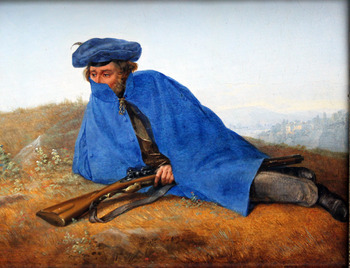
In Georg Friedrich Kersting's Auf Vorposten of 1815 (Figure 5), which commemorates a fallen martyr, the uniform identifies the protagonist as a member of the German volunteer units. It shows him not engaged in military action, but at rest, the contours of his body melting into those of his natural surroundings. Caspar David Friedrich's famous 1814 painting of The Chasseur in the Forest makes a similar connection, depicting the German military victory by showing a single French soldier being physically and spiritually overpowered not by an army, but by the German forest. In such images, nature—or, better said, the presumed German ability to commune with nature—bestowed moral legitimacy on one national culture while denying the same to others. This notion was put to manifold use during the Third Reich: the policy of “Germanizing” the East through gigantic programs of reforestation drew on this association, as did the promotion of encounters with German and Nordic landscapes in the Strength through Joy holiday programs.Footnote 26 Such attitudes and behaviors were not the products of a singular “Nazi ideology,” however: images like these contained templates of meaning that spoke to different constituencies, ones to which they often appealed precisely because they were ideologically malleable.
(Color online) Georg Friedrich Kersting's Auf Vorposten (Outpost Duty), 1815. Source: Wikimedia Commons.

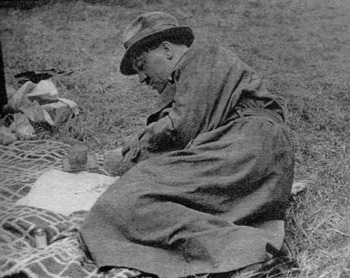
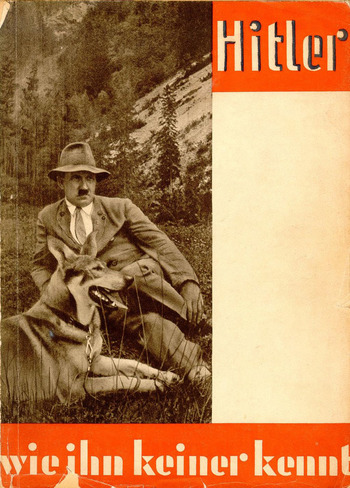
One particularly prominent and widely distributed set of images that staged the connection with landscape as part of a “Nazified gaze” were official ones taken by Adolf Hitler's photographer of choice, Heinrich Hoffmann. These photographs were published in periodicals and in bestselling coffee table books that claimed to show “the Führer as nobody knows him.” Titles such as these were highly suggestive, inviting readers to imagine that they were being offered privileged insights into moments of genuine selfhood and privacy.Footnote 27 In the examples shown here (Figures 6 and 7)—one of which was, it is important to note, selected as the cover image for the volume of the same title—the Führer is shown in poses that echo those of Kersting's heroes: picnicking, resting, or quietly contemplating his surroundings. His body blends harmoniously into the surrounding landscape, with which he appears to be communing: a true German thinker, immersed in the quiet contemplation of nature and the enjoyment of its authenticity.
Heinrich Hoffmann, Hitler Abseits vom Alltag (Berlin: Zeitgeschichte-Verlag, 1937), 47.

(Color online) Heinrich Hoffmann, Hitler wie ihn keiner kennt (Berlin: Zeitgeschichte-Verlag, 1935), cover page.

Hoffmann's particular talent for producing images such as these lay not just in the clever use of particular iconographic traditions, but also in his ability to recast such traditions in an idiom of apparent spontaneity reminiscent of snapshot photography. Many of Hoffmann's images are off-center or “wonky,” and thus appear to capture a seemingly random part of the action. Where Hitler is seen interacting with ordinary people, one often sees only a part of his body—sometimes as little as one hand reaching into the scene from beyond the camera. But the images nevertheless focus on his presence, which is reflected in the emotionally expressive faces of those he touches. The seemingly casual framing of the action in such shots conjures up the excitement of the moment and thus serves as a counterpoint to the calm composedness of more obviously staged propaganda imagery that usually documented official occasions. By making much of the photographic vernacular in this way, Hoffmann also encouraged amateur imitation: some of his published pictures show members of the Hitler Youths taking their own photos of the Führer, for example. Disseminating such images as propaganda material provided the ultimate sanction for the private production of images. The photographer's gaze onto the Führer, they imply, is one in which everyone could partake.
“Good Times”
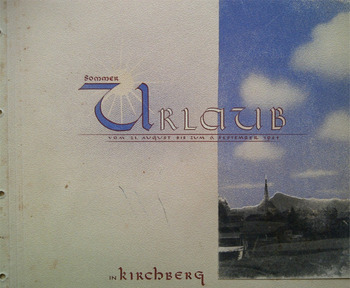
It was not just the practice of taking photos that officials encouraged, but also the associated habit of arranging these images into albums. The regime produced and distributed a variety of albums to encourage individuals to keep such records to document their service in the armed forces, in the Deutsche Arbeitsfront (German Labor Front, or DAF), and in other auxiliary organizations—as the ready-made title pages with decorative embossed metal lettering suggest. Similar albums with a more civilian focus were produced as commercial products for sale to Germans who might have wished to create their own albums documenting “historic” events, such as the 1936 Olympic Games. Thousands of these albums can still be found in archives today.Footnote 28 Homemade album covers were often elaborate, multimedia artifacts, no less ambitious than their professionally produced counterparts. They were important “frames” that defined the raison d’être and emotional tone of the photos they contained. Like the cover of Horst Umbach's miniature album, the example shown in Figure 8 combines different media: the cardboard cover combines a black-and-white landscape photograph with a hand-painted blue sky, while a large, calligraphic caption, written across the image of a shining sun, proclaims the word holidays (Urlaub) in large letters. The album documents a 1941 family summer vacation in Kirchberg, and the cover sets an appropriately cheerful tone.
(Color online) Private photo album of a family holiday in Kirchberg (Tyrol) during the summer of 1941. Reproduced by kind permission of the Deutsches Historisches Museum Fotoarchiv, Berlin (uncatalogued).

The photos inside this album show the family mostly outdoors. Time spent in an unfamiliar environment provided the cue for exploration and outdoor fun, in which geographical and individual mobility were closely intertwined. Yet, even here, most photos were not action shots. Throughout this album, the emphasis, as in Horst's photos, is on images depicting the protagonists taking a break, relaxing, and adopting contemplative poses in the landscape.
The persistence of the holiday-album genre well into 1944 is remarkable, given the turn the war had taken by this point. On some level, of course, it is not surprising that Germans in the Third Reich often took vacation as an occasion for shooting photos; the practice was certainly familiar during the postwar decades. Photos tend to document events seen as significant, either because they are milestones in a life narrative, such as weddings, birthdays, and christenings, or because they open up new experiences and perspectives, such as a trip away from home. The intensity with which such trips were undertaken and staged for the camera under the Nazi dictatorship is nevertheless remarkable given the conditions of total war.
Both before and after the outbreak of war in 1939, countless albums were made of seemingly constant vacations, from short weekend excursions to longer holidays. Some albums feature, in a single year, winter holidays, Easter holidays, Pentecostal holidays, one or two summer holidays, mid-autumn holidays, and Christmas holidays. Such albums not only convey a strong narrative of “good times,” but also project travel and the exploration of new landscapes and environments as a central goal. These types of encounter forged “character” and invited comparisons between personal experience and the broader spirit of the times. This enabled a transfer of photographic perspectives and poses from regular holiday albums to ones that documented absences from home occasioned by military service or various labor and auxiliary services.
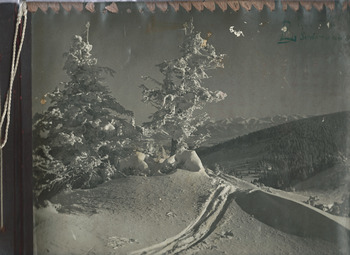
At first glance, the next album cover (Figure 9) looks like yet another collection of holiday snapshots: a photo of a picturesque landscape in the snow traversed by skiing tracks, physical markers of that all-important movement through space, has been glued onto a linen-bound album cover. It takes up the entire surface of the cover, and it has been stitched on by hand with a rough thread. A handwritten inscription in the top right-hand corner designates the album as a souvenir of “happy times” (“Schön war die Zeit”). Yet, this album does not commemorate a vacation: it documents a young woman's public service, first in the Reichsarbeitsdienst (Reich Labor Service) from April to October 1943, and then in the Auxiliary War Service (Kriegshilfsdienst) until May 1944.
(Color online) Private photo album, “1943: RAD (Reichsarbeitsdienst); 1944: KHD (Kriegshilfsdienst)– Schön war die Zeit!” Property of the author.

Many pages in this album are indistinguishable from typical German travel albums of the time. They show the protagonist frolicking on meadows, cycling, climbing mountains, sitting by rivers. Other photos show her performing agricultural labor with her female “comrades” and entertaining visiting soldiers. The accompanying captions, nearly always ending in an exclamation mark—“A happy gathering!,” “Happy breaktime!,” “A lovely summer's day!,” “Jolly lasses!”—convey a sense of unremitting gaiety. Occasionally—especially in other albums documenting similar scenes—captions appear to be quoting lyrics from popular musical films of the time. It was in this way that Germans could cast the occasion of being away from home—on labor duty, on child evacuations, and even at the front—as a positive holiday experience, without identifying with any explicitly political rationale for such undertakings. Instead, such holiday-style albums asserted happiness in the face of separation from loved ones, physical exertion, and possible danger, and facilitated participation in a zeitgeist defined through new beginnings, mobility, and generic excitement. Circumventing the need for explicit political verbalization, photography of this kind entailed a certain affective alignment with some of the ways in which the regime sought to “naturalize” its political ambitions in terms of the shared sentiments, aspirations, and instincts of the imagined community of the Volk.
“On the Road”
Certain motifs stand out in the family albums of this period. One is a focus—with an intensity bordering on fetishization—on roads as sites of movement, and on the vehicles used for getting around: cars, motorbikes, bicycles, and, occasionally, cruise ships. Horses and military vehicles often take pride of place in at least half of the photos in soldiers' albums, the vehicles typically shown with their occupants either inside of them or standing proudly next to them (Figure 10).
Photo from a private German holiday album, c. 1937. Reproduced by kind permission of the Deutsches Historisches Museum Fotoarchiv, Berlin (uncatalogued).

Some photo albums depict a vehicle entirely on its own, often anthropomorphizing it. One inscription (Figure 11) mentions the car's nickname, Opelchen (the term literally translates as “Little Opel,” but plays on the similarity with Onkelchen, a common term of endearment for an uncle or other close family member), and the album makes it the active subject of a narrative sequence that runs over several captions, describing Opelchen whizzing over what are referred to as “the Führer's roads.” This and the following three pages of the album show different stretches of the route being traveled, each shot harmoniously blending the road and the landscape, each stretch identified by place names in the captions (but with no other visible landmarks), until the destination is finally reached.
(Color online) Private German photo album documenting a car journey from Bavaria to Berlin in 1937. Reproduced by kind permission of the Landesarchiv Berlin (uncatalogued).

The historiography has not been silent about the idolization of the motorway in National Socialism.Footnote 29 There is a clear sense in these pictures that roads—including, but not only, the new motorways—are seen as spaces of a peculiar charismatic power, as trajectories, literally and metaphorically, for transporting smiling travelers into a brave new world. At the same time, these travel photos are marked by an air of relaxation, leisure, and pleasure. Outdoor relaxation is once again a leitmotif, then: travelers are shown sunbathing, sleeping, and picnicking in pictorial narratives that are less concerned with speed than with rest. Again, one might be tempted to see in this emphasis on non-action a moment of Resistenz to the official, utilitarian, and technological view of the motorway. And yet, like the photograph of the youths reading outdoors (Figure 2), these images, too, did not exist in isolation from professionally produced and published photographs. Two examples, taken from distinct yet extremely popular genres of the time, illustrate some of the connections between public images and private snapshots.
One example comes from the illustrated monthly publication Unser Schwabenland (Our Swabia). Founded in the mid-1920s, it was coproduced by Swabian homeland protection associations (Heimatvereine) and commercial partners, including associations for the promotion of tourism. It operated after 1933 under the oversight of the Gauleiter. The magazine combined explicit reflections on National Socialism with coverage of Swabia's economy and assets, such as industrial products, urban development, tourism, popular festivals, and, last but not least, stories about expatriate Swabians in the United States and elsewhere. One of its stated aims was to promote identification with the Swabian homeland, which it cast as a space that was simultaneously about tradition and progress, ostentatiously celebrating folk costumes alongside the technological superiority of high-tech wares “made in Swabia.” In photographic terms, the image of the Swabian Heimat that the journal promoted was Janus-faced as well. On the one hand, there was an emphasis on rural settings and the recreational and spiritual benefits of urbanites reconnecting with the region's agrarian roots. On the other hand, modern technology and modern sensibilities shaped such encounters. The countryside was no longer an untouched repository of “authentic” lifestyles to be venerated from an appropriate distance. Rather, it was portrayed as something within easy reach for modern city dwellers and car drivers, a space readers were encouraged to visit and “consume” on weekend outings and tourism.
The cover image of the March 1938 issue (Figure 12) folds many of these themes into one pictorial representation. It promotes the industrial region of Swabia through its flagship product, the Mercedes car, while at the same time promoting an idyllic view of rural Swabia. To that end, it features a young girl with plaited hair presenting an urban woman, elegantly dressed in a grey flannel suit, with handpicked daisies from the meadow. Above all, it suggests harmony: city and countryside do not collide; they are happily reconciled in a moment of respite. The car has stopped; even conversation has stopped as the protagonists immerse themselves in the sights and smells of nature. The pages of the magazine were filled with similar photos showing Swabians and visitors enjoying this archetypal German Heimat, traversing it by car—but experiencing its meaning and beneficial effects on physical and mental health in moments of relaxation and quiet contemplation of the natural settings and scenic views.
(Color Online) Unser Schwabenland, vol. 14 no. 3, (March 1938), cover image.

A second example of this type of image comes from another popular genre of German print culture during this period: the illustrated coffee table book. In an investigation of photography and sense of space in German culture, Celia Applegate has argued that books such as these signaled a move away from an “authentic” to a “fake” sense of place under National Socialism. She, too, sees such photos embedded in older iconographies, notably drawing “on long-established traditions of place representation and pitch[ing] this new infrastructural wonder [the motorway] as the means by which German, indeed ur-German, love of home and of travel would be reconciled and fulfilled.” Yet, crucially for Applegate, such photography had the effect of eliminating the very sense of place it claimed to showcase:
But a funny thing happened in the process of building the autobahn and selling it to the German people—place itself disappeared. … The regime's photographers themselves contributed to the task of erasure even while celebrating the ‘new’ landscapes the autobahn created. The glossy photography books of Erna Lendvai-Dircksen and Wolf Strache, among others, were remarkably inadequate in their portrayal of Germany's distinctive place-ness… [T]he blandness of the images seemed to emphasize photography's capacity to abstract from the world, not capture it. The details of place disappear in vistas of landscape that could be anywhere.Footnote 30
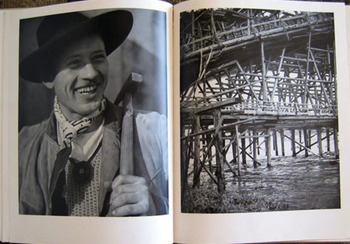
It is true that the motorway photos by Lendvai-Dircksen and Strache conjure up a sense of speed, expansive space, and auratic technology. Yet, the perception that they necessarily eradicate either the sense of the past or the distinctiveness of place by doing so may relate more to the actions of the Nazi regime than to the photos themselves. What makes Lendvai-Dircksen's image (Figure 13) of a traditionally attired German carpenter, hammer in hand, standing next to the wooden support frame of a new motorway bridge “bland and inauthentic,” while similar depictions of the glories of German Handwerk and labor from the 1920s are not?
(Color online) Erna Lendvai-Dircksen, Reichsautobahn. Mensch und Werk (Bayreuth: Gauverlag Bayreuth, 1937), unpag. illustrations.

Lendvai-Dircksen was not the only photographer publishing in the Third Reich to use the medium in order to pull different temporalities into a single space. Like the photographs of roads found in the family albums discussed earlier, published photos of German motorways also often show drivers and their families taking a break from their travels, resting next to their car or using a picnic spot built for that purpose. The motorway became domesticated in such photos, and its everyday users became its symbolic owners. The term gemütlich—cosy, homely, sentimental, at ease—in the caption of the next image (Figure 14), also from Unser Schwabenland, signifies both.
Unser Schwabenland, vol. 14 (May/June 1938), 22.

By “grounding” new infrastructures such as motorways in the traditional attributes of place and in conspicuous performances of contemplative times of rest, these photos can certainly be seen as ideological tools in the domestication of modern technology. Applegate is right to suspect that such photos, when publicly reproduced, served propagandistic intentions. But it is unlikely that such intentions fully controlled the meanings of such photos for those who looked at them. They do not, therefore, necessarily constitute aberrations from longer histories of ordinary Germans negotiating the experience of time and space. Such continuities of pictorial “meaning-making” can be obscured by the moral censure that inevitably accompanies the analysis of cultural practices under Nazism. But the medium of photography itself may have also contributed to Applegate's assessment: like the technology of motorway construction, photography as a technology of mass production triggers a suspicion that the significance or uniqueness of what is photographed may disappear—like the aura of the work of art in Walter Benjamin's “age of technological reproduction.”Footnote 31 Because the mass (re)production of photography was a twentieth-century invention, it is easy to assume that its relationship to tradition, place, and authenticity is necessarily problematic. But it is worth pausing to ask what exactly constitutes the novelty of photography in engaging with place.
Photography owed much to other genres of visual representation; in landscape or portrait photography, no neat dividing line separates painterly from photographic representation. The pictorial culture promoted by the Nazi regime to celebrate the motorways encompassed many genres, including traditional oil painting. Figure 15 is an image of a postcard showing one of a range of oil paintings from the 1936 exhibition Die Straßen Adolf Hitlers in der Kunst (The Roads of Adolf Hitler in Art). Such images did not necessarily hollow out the German tradition of Heimat; they reinvented it, precisely by detaching its representation from a purely backward-looking, nostalgic discourse, and making variegated Heimats compatible with a visual discourse that embraced modernity and change. Far from making the imaginary of Heimat unusual, such political appropriations helped boost its popularity in the postwar years by “modernizing” the genre.Footnote 32
Postcard featuring a painting from the 1936 traveling exhibition Die Straßen Adolf Hitlers in der Kunst.

The Ideological Vernacular
What then, if anything, was so specific about photography in the modernization of Heimat? Through its openly technical quality and the speed with which it was produced—compared to a painting or even a sketch—photography transported a distinctly modern temporality into the human relationship with nature. Although cars, roads, and other emblems of the technological conquest of space were favorite motifs in private and public photography during the Third Reich, photographs did not rely on such props to visualize “harmony” between man and nature, movement and rootedness, new beginnings and authenticity: the speed inherent in a photo's production already transported such dialectics into every image. It also made such relationships thinkable as a collective imaginary. In a different political context, one might have spoken of the “democratization” of the human relationship with landscape and space. Photography also invoked another dialectic in the interplay between spontaneity and intuition, on the one hand, and scientific accuracy and veracity, on the other. Unlike art, it could claim to represent self-evident truths in an objective way that did not depend on the opinion of the photographer. Inadvertently or not, this assumes an important dimension in the specific political context in which it was situated.
The category of race was central to the many varied discourses that together constituted Nazi ideology. All these discourses assumed that the “truth” of racial characteristics was not just intellectual or spiritual, but also visible to the naked eye, i.e., something that could be documented photographically. Physical attributes were deemed to indicate a hierarchical order among imagined ethnic groups or “types.” Pseudo-scientific experts theorized about skull shapes and nose sizes that conformed to Aryan ideals.Footnote 33 But race was not just physiognomic: it was also thought to relate to habitus and character, which, in turn, manifested themselves in interactions between people and their environment. To put it in a different way, racial membership in the Volksgemeinschaft implied ways of being attached to a place. Alongside physiognomic representations, professional ethnographic photographs portrayed the habits of different races.Footnote 34 It was not so much attachment to the (ultimately liberal or constitutional) idea of the nation-state that determined racial “health.” Rather, the “earthy” particularity of the German tribes and their native regions created the cultural identity of the Volksgemeinschaft. This quality of being rooted in particular traditions and places—even if this, in turn, inspired highly dynamic and mobile behaviors—was what distinguished Germans from the “unhealthy” and “degenerate” absence of such rootedness in iconic diasporic “races” such as Jews and gypsies.Footnote 35
Viewed against this background, it is problematic to assume that the “blandness” of landscape photography under National Socialism eliminated place-based identities. Such a view cannot account for the centrality of race in depictions of people in landscapes. That is not to say that there was a fixed correlation between race and place in these photographs. The rootedness of the tribe in its regional habitat, the Landschaft, was a metaphor that remained flexible and malleable; indeed, tribes that inhabited fluid and contested “border regions” were particularly valued and valorized.Footnote 36 What mattered was the ability to root one's identity in a given place; the exact scope and location of Heimat could be renegotiated as political, economic, and territorial contexts evolved. Photographers exploited this flexibility to offer a whole host of what might be called Deutungsangebote, or templates of meaning, from which actors could choose what spoke to their own political agendas and emotional dispositions. What the photographs of Germans being in and with “nature” had in common was that they fused traditional markers of place-based identities (such as folklore), or iconic ways of designing houses and landscapes, with a gaze that was often intensely rational, typologizing, encyclopedic, and, at times, positively scientific.
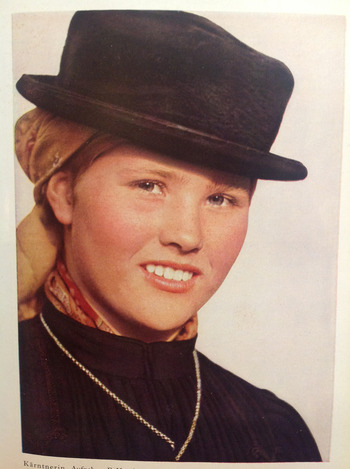
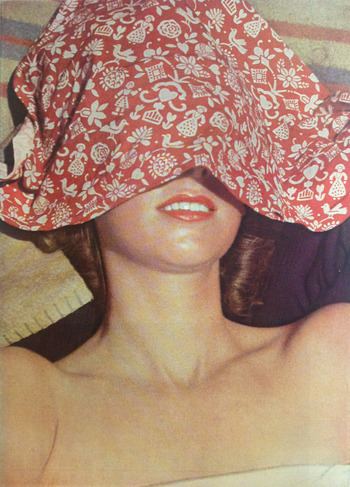
There are thousands of propaganda images that illustrate this linkage. What is less often recognized, however, is how deeply such practices reached into much more vernacular, seemingly apolitical forms of photography. The two photos shown in Figures 16 and 17 exemplify the naturalization of this gaze. They were published in a 1940 instructional manual on taking color photographs. Two directly adjacent pictures show young ladies in folkloristic attire. Figure 16 is a portrait of a young woman who supposedly represents the characteristic physical features, as well as the traditional regional dress of Carinthia; although the portrait serves no obvious scientific purpose, it resembles images that one finds in official Nazi tracts about racial science. The other photo, figure 17, which appeared next to it, is much more playful: a lipstick-wearing, scantily-clad, sunbathing young woman is using a headscarf with folkloristic motifs to shelter her eyes from the brightness of the sun. And yet, she, too, represents an ideal German, clearly of Aryan descent, in her self-assured and conspicuous enjoyment of the freedom the Third Reich offered for those whom the regime classified as part of the Volksgemeinschaft. As the presence in a single publication of both a traditional “documentary” photo of place-based identity and a lighthearted and consumerist take on the same theme makes clear, understanding the sense of place in German photography in this period cannot just be a question of identifying the reach of official Nazi propaganda. The meaning of place, so powerfully bound up with ideas of belonging and identity, preoccupied Germans in multiple ways, and photography was an arena in which literally millions of Germans could participate in defining its significance. It was the malleability of this ideological trope, not a singular scientific meaning of race, that enabled its ready absorption into vernacular modes of image production.
(Color online) Hans Nordhoff, photograph, published in Hans Windisch, Schule der Farben Fotografie (Harzburg: Heergin-Verlag, 1940), 136.

(Color online) E. Hausknost, photograph, “The Carinthian,” published in Hans Windisch, Schule der Farben Fotografie (Harzburg: Heergin-Verlag, 1940), 137.

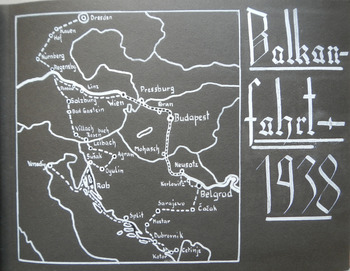
Private photo albums, especially those that included the experience of travel outside the Altreich (either touristic travel before the war or travel in newly occupied territories during it) paid particular attention to capturing modes of attachment to place and to the notion of place-based “character.” Such albums often contained features such as maps (hand-drawn or pasted in and marked with highlighter pens) that identified the locations where the photos in the album had been taken. Such features enabled a spatial plotting of the observations documented in the photographs. For example, a hand-drawn map was included as a frontispiece in an album created by a school teacher employed at an elite Napola (Nationalpolitische Erziehungsanstalt, or NPEA) school, the NPEA Klotzsche, which documents a trip across the Balkans he organized with his pupils in 1938 (Figure 18).
(Color Online) Photo album documenting a 1938 school trip to the Balkans by a class of seventeen-year-olds (Unterprimaner) of the Nationalpolitische Erziehungsanstalt Klotzsche. Reproduced by kind permission of the Deutsches Historisches Museum Fotoarchiv, Berlin.

The photos show landscapes and people encountered on the trip, but the focus is very much on the relationship of those people to the landscapes. The images are accompanied by captions identifying “ethnic types.” Rather than just focusing on physiognomy, they make such classifications on the basis of distinctions among desirable, authentic, and active ways of inhabiting places—and their antithesis (i.e., undesirable, inauthentic, and inactive ways). German settlers are depicted as upright and dynamic, traversing the beautiful landscapes with elegant strides, while so-called Balkan types are shown in urban settings, passive to the point of laziness, typically sitting or lying on the street (Figure 19).
(Color Online) Page from the photo album of the Nationalpolitische Erziehungsanstalt Klotzsche school trip. Reproduced by kind permission of the Deutsches Historisches Museum Fotoarchiv, Berlin.

What is being implicitly drawn here is a fine yet decisive dividing line between spending quiet time in nature and being merely idle. The German Pause (break, rest time, recreation period)—as it was captured in and staged for thousands of professional images and private snapshots in the Nazi era—was a deliberate, reflective time, thinkable only in dialectic tension with action, movement, and transformation. It was distinctive from the mere absence of action or will, which could be described as idleness. This dialectic is staged in two ways in the photos. First, it emerges from the rhythm of the album—the Pause is that which punctuates the movement and action gleaned from the inclusion of maps—and from the photos of roads, cars, bicycles, and wide open spaces already traversed. Second, the dialectic is also present in individual shots of quiet moments in nature. These are not photos devoid of action; the action is merely turned inward. Germans reclining in the great outdoors did not photograph themselves “slouching,” the way the locals do—those “Balkan types” who, the juxtapositions imply, lack inner discipline.
Members of the Volksgemeinschaft “relaxed,” that is to say, in a disciplined way. Relaxation was the crowning achievement of a life well lived: like a mountaineer posing on a summit after a perilous ascent. Having fun was serious business and it is significant that the majority of captions under such photos end in rhetorical exclamation marks. The album of the auxiliary services discussed earlier displays not just a break and a lake, but a “Happy break!” and “Rotgüldensee in September!” The protagonists’ ability to establish significance through deliberate downtime relates to their position within a “meaningful” landscape. Its very contemplation is the task in which those who appear to be relaxing are, in fact, engaged. The meaning of the landscape is communicated visually through an adherence to traditions of landscape aesthetics that designate it as space produced by harmonious interactions between nature and culture: green pastures; gentle, rolling hills; elegant, free-standing trees in the foreground, darker woods in the background; and, last but not least, human settlements nestling harmoniously in the center of such lush green settings—or perched on hillsides, like the ruins of castles admired from the picnic site off the Reichsautobahn. A sunny sky—blue or structured by elegant cumulus clouds—forms a natural vault over such spaces. Because such landscapes constitute a “text” that is “legible,” individuals passing time within it are not so much “doing nothing” as engaging in an act of symbolic and immersive reading. This affinity explains the popularity of the motif of outdoor reading: a novel like The Magic Mountain does not distract from the experience of being in nature. Instead, it is a metaphor for the proper habitation of the civilized—and therefore legible—landscape.
This “way of being” in landscapes also played an important role in the occupation of conquered territories during the war. In the sample of soldiers’ albums from the front available at the German Historical Museum's photo archive in Berlin, there is an interesting differentiation between the ways in which foreign landscapes were “legible” and thus, potentially at least, culturally meaningful spaces, “empty” (and, hence, intrinsically meaningless), or awaiting (German) intervention to give them meaning. Some of these differences may reflect the personalities and politics of the individuals who made them, but such differences also occur in different albums made by the same person while engaged in different military campaigns. In the example reproduced in Figure 20, a German soldier—who describes himself elsewhere in the album as an “incorrigible individualist,” and who clearly prefers to be photographed in pensive and restful poses—composed a page about the Vosges region in eastern France invaded by German troops in 1940. The three shots that depict him were obviously posed and taken by a fellow soldier. In the first image, he scales the steep slope of a mountain; in the second, he drinks from a well, evidently on top of the mountain; and, in the third, he is depicted from behind, glancing back into the valley in a pose reminiscent of the figures invariably shown from behind in Caspar David Friedrich's spiritual landscapes.Footnote 37 Such a staging might suggest a recoding of this French landscape as Germanic—and is hence a form of intellectual or spiritual “occupation.” But it nevertheless works with, rather than against, what is already there: a “civilized” and thus “beautiful” European landscape.
(Color online) Vosges region, from a photo album documenting the military service of a German soldier from the invasion of France in 1940 to the campaign in Russia up to 1942. Reproduced by kind permission of the Deutsches Historisches Museum Fotoarchiv.

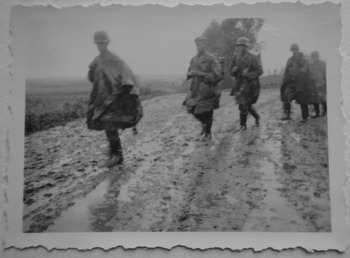
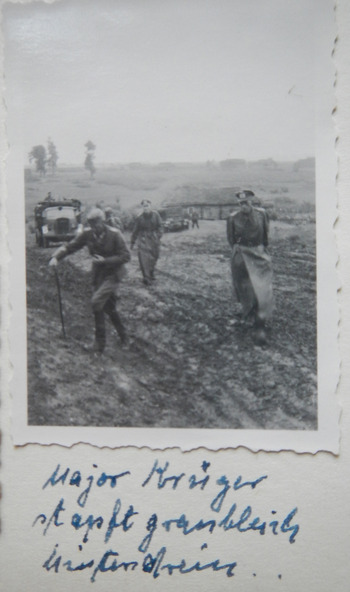
The same soldier's album then documents his service on the Eastern Front in 1941 and 1942, before he was killed in battle in the Soviet Union. The mood changes significantly: photos of German war dead and makeshift graves abound, with captions underscoring a sense of melancholy and mourning, including occasional expressions of doubt, such as “Why all this bloodshed?,” and farewell messages to fallen comrades. The way the landscape is captured changes accordingly. Germans are now depicted acting in a featureless, muddy desert (Schlamm)—a term also used in the captions. The latter also accentuate the grayness of the landscape photographs, which characteristically combine close-ups of water-logged soil and an empty, flat horizon—and which is likened to the grayness of the German soldiers’ faces (Figures 21, 22), which, the captions say, seem to be marked by death.
Russia (1942), from the same photo album in Fig. 20. Reproduced by kind permission of the Deutsches Historisches Museum Fotoarchiv.

(Color online) Russia (1942), from the same photo album in Fig. 20. Reproduced by kind permission of the Deutsches Historisches Museum Fotoarchiv, Berlin.

To some extent, such a representation of landscapes in eastern Europe builds on and is informed by the colonial trope of “empty” space as a space to be conquered.Footnote 38 Yet, these are not optimistic images; both their affective tone and the accompanying captions suggest skepticism and pessimism—though not open political opposition or sympathy with the victims of German military aggression and genocide. Still, the tone of this album does not suggest that the war effort is experienced as a conquering—much less a “civilizing”—mission; the landscape remains fundamentally alien and unknowable. The featureless emptiness of the space, which the captions underscore repeatedly, is linked to the experience of mental and moral disorientation. Military action loses its clear sense of purpose, and the unboundedness of the terrain in which it takes place resonates with the failure of existing templates of “meaning-making.” The sense of purpose, or telos, dissolves in the endlessness of the landscape.Footnote 39 A final page from the same album suggests that the very category of “experience,”—which was so central to both the official and the vernacular discourses of the Third Reich—disappears along with this loss of purpose. The page is poignantly titled “The experience of Uschakova” (Figure 23): the German term for experience, Erlebnis, places a particular emphasis on being alive, i.e., experiencing is a way of being alive, of living in and through events. Yet, this kind of “life” experience, so frequently invoked by Nazi propaganda, is turned here into its precise antithesis: the words are framed only by soldiers’ graves. Against empty horizons, lining, as the other caption indicates, the “grey roads” that traverse the Russian landscape, they stand as silent witnesses to the end of all experience.
(Color online) Russia, near Uschakowa, from the same photo album in Fig. 20. Reproduced by kind permission of the Deutsches Historisches Museum Fotoarchiv, Berlin.

Conclusion
Soldiers’ albums from World War II are marked by great differences in atmosphere, tone, and, occasionally, overt political commentary.Footnote 40 The argument is not that the album just discussed is in any way representative of the experience, mentality, or ideology of the German Wehrmacht in the East in toto, or that such photographs should be read, individually or collectively, as directly illustrative of an ideology that supposedly fueled the Nazi war in the East. What this article argues is that private and professional photographs—images made for personal consumption, as well as those intended for political propaganda or commercial advertising—existed in a relationship with one another. But this relationship was not a straightforward story of “influence”; rather, it involved multiple appropriations and reappropriations of visual templates, even overtly propagandistic ones, which, in turn, were constructed from older conventions and pictorial precedents. Images, the recent historiography on “spectacle” has argued, were central to the success of fascism.Footnote 41 Yet, the same images also lent themselves to the fashioning of more individual identities, as well as to the telling of stories that deviated from official propaganda narratives. “Spectacle” during fascism was not merely an ideological ploy used by a regime to manipulate a population. It was coproduced by countless actors, from above, from below, and, most typically, from in-between. The political significance of image-making cannot be reduced to the influence of Nazi ideology. Indeed, in a minority of instances, it could even be used to celebrate and memorialize poses and attitudes that clashed with certain aspects of what is normally considered to be a part of the National Socialist belief system.
In a different sense, however, mass photography has to be considered an enabling factor for the Nazi regime's reach into the constitution of individual subjectivities. The arrival of the camera in practically all domains of private life—which coincided in Germany with the Nazis’ rise to power—transformed Germans into political actors in ways that formal political organizations or top-down propaganda could never have achieved on their own. The presence of the photographer turned those being photographed into performers: almost all aspects of life change for and through the gaze of the camera, as they now became acts of representation and commemoration. Even where the camera was temporarily absent, behavior was no longer naïve; it was seen through the prism of photographs of similar scenes, which were reenacted, appropriated, or subverted.
The mass production of photographic images during the Third Reich thus opens more than just a window onto aspects of the human experience about which written sources often provide more mediated evidence. When people staged their lives for the camera as they wanted them to be recorded, seen by others, and remembered by posterity, boundaries between private and public lives faded. This did not turn people into Nazis per se, but it did prove conducive to the ambitions of totalitarianism: as a form of affective and performative political behavior that transcended that which had traditionally been defined as the business of politics. Experience itself thereby assumed a new significance as it was captured, memorialized, preserved, and displayed in photographs. This in itself was not unique to life under National Socialism. But the valorization of experience within the political imagination of National Socialist Germany can be more fully appreciated on this basis. Photography did not produce the Nazi view of “experience” on its own. But it did make it thinkable. Without the material reality of photographs, constant discursive invocations of experience in the contemporary print culture and political speeches would have rung hollow. Photographs turned experiences into material realities—and thereby arguably did the same for ideology.