Introduction
Agricultural advisory services play an important role in promoting agricultural productivity and increasing food security. Research and development projects have tried various extension methods in Africa. The limitations of the Training and Visit method, in particular, have led to the search for methods that respond better to farmers’ needs, especially toward participatory and group approaches (Davies, Reference Davies2006). Participatory approaches, such as farmer-to-farmer extension and farmer field schools, are now used to support information sharing and experimentation, so farmers can creatively adopt or adapt agricultural technologies (Kiptot and Franzel, Reference Kiptot and Franzel2014). However, scaling up is still a key challenge. Those farmers who participate in extension programs often share the information with few or no other rural people (Nathaniels, Reference Nathaniels2005), casting doubt on the ability of conventional extension to reach large audiences of farmers (Bentley, Reference Bentley, Peshin and Dhawan2009).
Extension specialists must draw lessons from participatory methods and create tools that share information with the many people who need agricultural information (Defoer, Reference Defoer2002). Many farmers in developing countries never see extension service providers because of limitations in funding and because the public extension services can no longer meet the changing needs of farmers (Davis, Reference Davis2008). Innovative learning tools, such as learning videos, can share information with large audiences and support agricultural extension in developing countries (Van Mele et al., Reference Van Mele, Wanvoeke and Zossou2010). Various studies have shown that the learning video is a powerful extension tool when used by Non-Governmental Organizations (NGOs), farmer associations, extension workers, and others (Okry et al., Reference Okry, Van Mele and Houinsou2014). Videos and other visual learning strategies developed by Witteveen and Lie (Reference Witteveen and Lie2012) highlighted the power of images to enhance learning in ways not always possible with other written material. Video attracts rural people’s curiosity and overcomes the hurdles of illiteracy, and most importantly, it sits comfortably with the narrative culture that prevails in most developing countries (Lie and Mandler, Reference Lie and Mandler2009). Nowadays, mass media are often used as communication channels in the process of learning, rural extension, and transformation. Mass media make use of video to help spread innovations. According to the Technical Centre for Agricultural and Rural Cooperation (Lie and Mandler, Reference Lie and Mandler2009), the findings from scientific research are often targeted at academic journals, which farmers hardly have access to, and even with access, the presentation of findings is too technical for them to understand and apply.
Many development organizations have invested in video production and farmers’ access to it. The farmers’ video viewing club was used to train farmers on cocoa-integrated crop and pest management in Ghana with the support of the World Cocoa Foundation (David and Asamoah, Reference David and Asamoah2011). The International Crops Research Institute for the Semi-Arid-Tropics (ICRISAT) supported the production of the “Fighting Striga” videos and facilitated their distribution through local organizations in Mali (Bentley et al., Reference Bentley, Van Mele, Touré, van Mourik, Guindo, Zoundji and Sillitoe2017). In Benin, AfricaRice supported the production of the parboiling rice video and its distribution via NGOs (Zossou et al., Reference Zossou, Van Mele, Wanvoeke and Lebailly2012). With funding from United States Agency for International Development (USAID) and the Bill and Melinda Gates Foundation, the Cereal Systems Initiative for South Asia and International Maize and Wheat Improvement Centre (CIMMYT) supported the production of the “Save More, Grow More, Earn More” video in Bangladesh, with screening to farmers facilitated by NGOs (Bentley et al., Reference Bentley, Chowdhury and David2015). In southern Benin, learning videos on rice production practices were disseminated by giving Digital Video Disc (DVD) to farmers, video projection without facilitation, and video projection with facilitation (Davito et al., Reference Davito, Okry, Kouevi and Vodouhê2017). The international non-profit organization Access Agriculture plays a crucial role in South–South sharing of farmer learning videos through innovative information and communication technologies (ICTs) and a growing network of global scaling and local video distribution partners (www.accessagriculture.org). So far, video distribution has often been based on project support (screening videos to farmers with facilitation by extension workers and giving DVDs to farmers for own screening later) and non-project support (independent organizations, media houses, and companies). According to Bentley et al. (Reference Bentley, Van Mele and Musimami2013), the distribution of videos needs to be improved, because simply leaving DVDs with rural advisory organizations does not always get videos to the grass-roots level. However, there is no strategic and tactical principle underlying sustainable, viable, and effective distribution mechanisms of videos, and the organizations and distributors often do as they see fit. This study, which assesses the effectiveness of learning video disseminated by commercial channels, by projects, and by independent organizations in Benin and Mali, constitutes an important step toward filling this knowledge gap. It thereby aligns with a major policy recommendation from the recent Food and Agriculture Organization of the United Nations (FAO) report “Inclusive Rural Communication Services” “to enhance the communication and information capacity of rural family farmers and populations to amplify their voices in policies and enhance full participation in rural development processes” (FAO, 2017, p. 38).
Materials and Methods
Evaluation is a support for rational decision making, including assessment of past performance and informing current and future practices (Funnel and Rogers, Reference Funnell and Rogers2011). In agricultural development, various methods have been used to evaluate extension programs. The sustainable livelihood approach was used to measure the effectiveness of farmer-to-farmer extension in the Andes (Hellin and Dixon, Reference Hellin and Dixon2008). In Kenya, the farmer trainer approach was evaluated by looking at how well farmers had learned about and adopted the push–pull technology (Amudavi et al., Reference Amudavi, Khan, Wanyama, Midega, Pittchar and Nyangau2009). Some authors used human capacity, content, processes, outputs, inputs, and sustainability as criteria to assess the effectiveness of extension programs (Karuhanga et al., Reference Karuhanga, Kiptot and Franzel2012; Goe et al., Reference Goe, Bell and Little2008).
In addition, relevance, effectiveness, efficiency, impact (changes in practices), and sustainability are the most commonly applied criteria, established by the Organization for Economic Cooperation and Development (OECD) for evaluating aid interventions (Chianca, Reference Chianca2008). In view of available models cited above, this study looked at the effectiveness of agricultural learning video dissemination in terms of: (i) information and knowledge sharing – the process and method through which the information is shared, i.e., the flow of knowledge, information, and materials among farmers. (ii) Satisfaction and relevance – the level of learning video viewers’ satisfaction and perception of relevance. Effective reaction of farmers toward the use of videos as learning tool, i.e., the fulfillment of certain prior expectations. (iii) Changes in practices (behavioral change) – applying the learning on farms. The main focus here is about what has been learned, i.e., alternative ways of doing farming activities based on videos. (iv) Sustainability of the dissemination method/channel – this is the feasibility for farmers, their organizations, NGOs, local institutions, private entrepreneurs, and companies to manage and support the approach without donor support (for example, the capacity to organize one’s own video learning, learning without extension worker’ facilitation, etc). Knowing the sustainable method of video dissemination would be of utmost importance to facilitate self-learning.
The choice of these criteria is also reinforced by the fact that evaluation of agricultural extension programs implies the systematic collection of information about the activities, characteristics, and outcomes of a program to make judgments about the program, improve its effectiveness, and/or inform decisions about future programming (Dart et al., Reference Dart, Petheram and Straw1998). This study compares three different approaches for acquiring a learning video in light of the above. Although all of the videos discussed in this paper were produced by projects, there were various distribution strategies. This study focused only on the effectiveness of distribution. Videos are usually distributed with project support (funded by donors), but also by organizations without donor support to distribute videos (referred to as “independent organizations” in this paper). Videos can also be distributed by the private sector (Zoundji et al., Reference Zoundji, Okry, Vodouhê and Bentley2016). In this paper, each of the above three approaches is illustrated with a different case study.
Case 1: Commercial dissemination of learning videos (DVDs): DVDs were sold to farmers and other users. DVD buyers are supposed to organize their own video screenings without facilitation. DVD distribution was a stand-alone mechanism in this case (video alone).
Case 2: DVD dissemination by project support: organizations showed videos to farmers free of charge, using project support for the power generator, television set, DVD player, and travel expenses. In this case, an extension worker or a progressive farmer is available for facilitation and to respond to farmer’ questions after watching the videos. After video screening with project support, farmers are supposed to continue watching videos (just the video or the video as a supplement to interpersonal interaction).
Case 3: DVD dissemination by independent organizations: NGOs and farmer associations, which received DVDs without any donor support, are supposed to distribute or show them to farmers, also free of charge (just the video or the video as a supplement to interpersonal interaction).
The case studies share some similarities. For example, purposive sampling (willingness of farmers to participate in the study) was used to select respondents for each case. As each case is based on the field reality of DVD dissemination, they may not present at first sight a convincing level of similarities to classify as comparable datasets. However, the authors consider that it is better to have a real, authentic field situation than an experimental setting, which could provide some uniformity, but could distort how farmers view and perceive the videos. In addition, the fact that data were gathered from varying respondents justified the specificity of each case. For example, distributing videos through commercial channels gives a fair chance to everyone to learn, because the DVDs were sold on the open market at an affordable price. In this case, the respondents could be farmers, researchers, students, business entrepreneurs, etc. In the case of the DVD dissemination by project support and independent organizations, the focus is only on farmers. So, in these two cases, all the respondents are farmers.
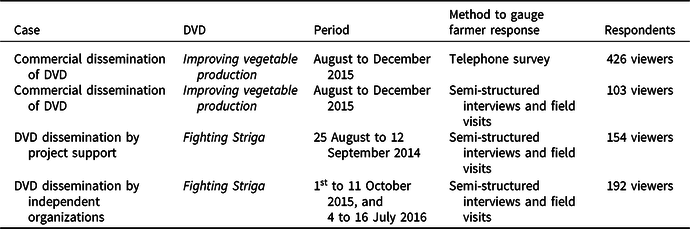
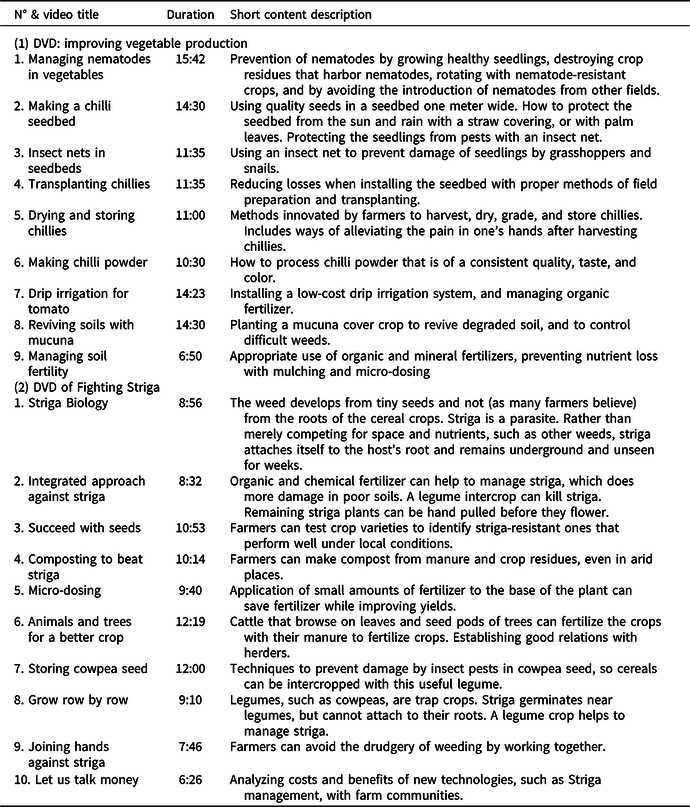
Each case was situated in Benin or Mali as part of a larger research project, “Videos for Farmers,” conducted in these and other African countries. Table 1 provides a more detailed overview of research activities. Two different DVDs were used; one for Case 1 and another for the other two cases, to prevent a distortion of the searched reality for market vendors who would, otherwise, have to compete with organizations that distributed the DVDs for free (see Kemp (Reference Kemp2005) on avoiding conflict in market settings). The DVDs were a set of farmer-to-farmer videos with a language menu, offering the viewer the choice of watching the videos in French, English, and major West African languages, such as Fon, Bambara, and Yoruba (for the DVD Improving vegetable production) and Bambara, Bomu, Hausa, Mooré, Peulh, Zarma, Nago, and Dendi (for the DVD Fighting Striga). The content of each video is briefly described in Table 2. The videos were produced according to the zooming-in, zooming-out (ZIZO) method in which innovative technologies and their underlying scientific principles are explained by farmers and by a narrator in easy-to-understand language (Van Mele, Reference Van Mele2006). In this paper, “DVD” means a disc with several videos while “learning video” refers to the videos on the DVDs.
Overview of research activities

Short description of each video

Source: Access Agriculture
Case 1: Commercial dissemination of DVDs
The DVD Improving vegetable production was sold by entertainment DVD vendors, agro-dealers, a vegetable vendor, and a motorcycle-taxi driver. This paper refers to such retail sales as the commercial approach of DVD dissemination. From August to December 2015, copies of Improving vegetable production DVDs were sold in four municipalities of southern Benin (Sèmé-Podji, Cotonou, Ouidah, and Abomey-Calavi), which are major vegetable cropping areas (Adégbola and Singbo, Reference Adégbola and Singbo2001). They are also the main towns of the country where the entertainment video trade is well developed, and people are used to purchase DVDs and DVD players for home entertainment (Zoundji et al., Reference Zoundji, Okry, Vodouhê and Bentley2016). Each DVD was sold for at least United States Dollars (USD) 1.0, and the sellers registered the name, phone number, and address of the DVD buyers for the follow-up. From August to December 2015, a telephone survey was conducted with 426 people (about 64% of those who bought the DVD); these were viewers who called the study team at the phone number pasted into the DVD jacket. Among these viewers who telephoned to request other videos to buy, 72.5% had bought Improving vegetable production videos. Authors also organized semi-structured interviews with 103 video viewers who had not called the researcher. The authors contacted other viewers over the phone and met 7 DVD buyers who identified 96 other video viewers who attended video screenings organized by DVD buyers.
Case 2: DVD dissemination by project support
Some NGOs and farmer associations received the DVD Fighting Striga from ICRISAT. These organizations screened the videos to farmers for free and left copies of the DVD in the communities for future screening on their own. From 25 August to 12 September 2014, we interviewed farmers who watched videos via project support (i.e., from ICRISAT) in 11 villages of three regions (Mopti, Ségou, and Sikasso) in Mali where the NGOs Aga Khan Foundation (AKF), Association Malienne d’Eveil au Développement Durable (AMEDD), and the farmers’ organization Union des Agriculteurs du Cercle de Tominian (UACT) were engaged with ICRISAT in Striga management for food security. Through purposive sampling, we interviewed 154 farmers in Mali with a mean of 14 farmers per village. The absence of a pretest–posttest control group is justified by previous studies in Mali, which revealed that before watching the videos, farmers were not aware of the danger of striga seeds and unconsciously let the Striga plants flower, and disperse their seeds on farm (Van Mele et al., Reference Van Mele, Bentley, Harun-ar-Rashid, Okry and van Mourik2016; Bentley et al., Reference Bentley, Van Mele, Touré, van Mourik, Guindo, Zoundji and Sillitoe2017).
Case 3: DVD dissemination by independent organizations
The DVD Fighting Striga was also disseminated without project support by NGOs and farmer associations, which received the videos unsolicited, for free from Access Agriculture. These organizations are called “independent organizations” in this paper, because the organizations had no project support for distributing videos. As projects may provide incentives that influence farmers’ technology adoption (Organisation for Economic Co-operation and Development, 2011), this case aims to explore farmers’ learning and behavioral change from video without any project incentives. From 1 to 11 October 2015 and 4 to 16 July 2016, farmers were purposively selected in five municipalities (Glazoué, Tchaourou, N’Dali, Sinendé, and Bembereke) of Benin influenced by the NGOs Centre de Recherche et d’Action pour le Développement des Initiatives à la Base (CRADIB), Développement Durable Economique et Socio-Culturel (DeDESC), Groupe d’Etude et de Recherche sur l’Environnement et le Développement (GERED), and a farmers’ organization: Union Communale des Producteurs (UCP) de N’Dali. We interviewed 192 farmers (Glazoué: 55, Tchaourou: 31, N’Dali: 90, Sinendé: 7, and Bembereke: 9). There is no control group here as well, because we conducted an exploratory study from May to June 2015, which showed that farmers were not doing any actions toward striga management in the villages where videos have not seen. In Benin and Mali, we also interviewed leaders of organizations that had received copies of the Fighting Striga DVD.
Countries research description and relevance of videos
Benin is a West African country on the Gulf of Guinea with a surface area of 112,622 km2. Benin’s population was about 11.2 million in 2017. More than 70% of the population works in agriculture. This contributes around 36% of the country’s Gross Domestic Product (GDP) and 82.5% of export income (World Bank, 2019). Cotton is the principal cash crop, which received more attention from extension services than other crops. However, corn, beans, rice, peanuts, sorghum, millet, cassava, other tubers, and vegetables and fruits are grown for local subsistence and for export to neighboring countries. It is important to highlight that cotton is produced in all the municipalities (Glazoué, Tchaourou, N’Dali, Sinendé, and Bembereke) where the Fighting Striga DVD was disseminated. Nevertheless, cereal crops as major traditional staple crops are produced in those municipalities. Mali is a landlocked country in West Africa. Mali covers a large area of 1,241,238 km2, but 65% of it is in the desert or semi-desert region. Mali’s population was about 19.6 million in 2018 (70% rural). Agriculture is the mainstay of the Malian economy, accounting for 50% of the GDP and employing much of the workforce (International Renewable Energy Agency, 2019). The most highly stressed regions of the country are in the south where agriculture is concentrated, including Sikasso, Mopti, and Segou. Cereals dominate the Malian diet, and the main subsistence crops grown are rainfed millet and sorghum millet, with commercial agriculture devoted to cotton and rice. Most of the major investments in agriculture, including extension services, market development, and increased use of inputs, have focused on cotton and rice, with less emphasis on crops critical to the country’s food security, such as sorghum, millet, and corn. There are some variances between study areas (Sikasso, Mopti, and Sego). For example, except for the Sikasso region, which has a cotton-based system, the regions of Segou and Mopti have cereal crop-based systems, and Mopti is the strategic crossroads for the cereal trade (USAID, 2011). Despite weak extension support, farmers in both countries are slowly diversifying their crops. Farmers’ access to technology will be of the utmost importance to foster agriculture diversification and food security.
The DVD Improving vegetable production is appropriate for Case 1, because vegetables are an important emerging cash crop in West Africa. However, vegetable production is limited by technical knowledge in Benin and Mali where cotton has received much more attention. Vegetables are intensive crops with high use of external inputs, such as fertilizer and pesticides. As video is an excellent tool to strengthen farmers’ technical knowledge (Zoundji et al., Reference Zoundji, Okry, Vodouhê and Bentley2016; Zossou et al., Reference Zossou, Aminou, Diagne and Agboh-Noameshie2016), the Improving vegetable production DVD was sold through commercial channels in Benin and Mali to allow farmers to pay some of the cost of extension. Rural advisory activities implemented up to 2011 are neither cost effective, nor efficient or sustainable (Pye-Smith, Reference Pye-Smith2012). Therefore, rural advisory service providers have been looking for cost effective, efficient, and sustainable extension tools and approaches. Due to the recent security issues in Mali, we were not able to complete the data collection on the commercial dissemination of videos in that country. So, Case 1 of this study focused only on the Benin experience. In Benin and Mali, the DVD of Fighting Striga used for Cases 2 and 3 is appropriate, because corn, sorghum, and millets are principal staple foods, and their production is constrained by Striga (World Bank, 2012). The successful management of Striga can bring rapid benefits to farmer communities in West Africa where this weed can cause an estimated 40–80% yield loss in sorghum and millet (International Crops Research Institute for the Semi-Arid-Tropics, 2009). The Improving vegetable production and Fighting Striga videos are relevant for the two countries as well as for the farmers involved in the study.
Results
Case 1: Commercial dissemination of DVD
Information and knowledge sharing
A vegetable farmer in southern Benin, who has a tea shop with a DVD player, bought a DVD and shows the videos frequently to attract customers (mainly farmers) in the village. During the first screening in the shop, 17 farmers attended and 11 of them asked where they could buy the DVD. For the next three screenings, an average of 13 farmers attended. Farmer’ cooperatives in northern Benin (Atacora-Donga) paid to have 27 copies made of the DVD, and screened videos during meetings attended by 126 farmer representatives from 13 municipalities. After these screenings, the farmers’ cooperatives distributed copies of the DVD to 13 farmers’ associations at the municipal level. A vegetable farmer association in Abomey-Calavi municipality of southern Benin also acquired the learning videos and organized screenings for 68 group leaders. About 77% of these group leaders later bought their own DVDs and showed the videos to farmers in their villages.
Four local NGOs working in different areas in the country showed videos several times to vegetable farmers, while several church leaders screened videos to people before church services. Faith-based organizations are key local institutions, so they could become more important in the future for sharing videos in farm communities. Most (67%) of the respondents surveyed watched the videos in groups, such as family, tea shops, churches, and farmers’ groups. Although buying a DVD is an individual action, buyers like to watch the videos in groups. After buying the DVD, about 43% of respondents borrowed DVD players, and one person in five bought a DVD player (for USD 20 to USD 30) to watch the videos. Some people (about 11% of respondents) cooperated with others to gather enough viewing equipment, including the DVD player, and the battery. Such cooperating and viewing in groups reinforce social cohesion and may promote agricultural information sharing between farmers.
Farmers use learning videos in different ways, whether they buy the DVD or receive it as a gift (e.g., from relatives who buy the DVD at a shop). Several people took the initiative to share learning videos with a large audience. For example, a farmer who did not have the DVD proudly showed us how he watched all nine vegetable videos on his mobile phone. Someone had bought a DVD and converted the videos from the DVD into 3GP format (for viewing on phones) and shared them with the farmer. About 152 students from the high school of Agriculture in Benin downloaded all nine videos onto their Universal Serial Bus (USB) sticks from a fellow student who received the DVD as gift from his father, a farmer. The students took the further initiative of sharing the videos by copying them onto computers. These students also shared the videos with their families. People innovated by converting the videos to smaller file sizes (e.g., with formats such as 3GP) and by sharing them with friends via WhatsApp, Bluetooth, SD card, and USB sticks. Youths are interested in video and will become the extension agents of tomorrow.
Farmer satisfaction of learning videos
Farmers were motivated to pay for DVDs and make an effort to watch the videos. About 700 copies of the DVDs were sold within five months, and farmers were willing to pay for them. At the researchers’ suggestion, vendors sold the DVDs for at least USD 1.0, but sometimes for more. Customers paid between USD 1.0 and USD 9.0 for a copy of the DVD. We received feedback through phone calls from 426 people (64% of the video viewers). These video viewers never asked for clarification on the content, but requested more videos on other crops. This feedback revealed that farmers are eager to buy more learning videos, which may be an opportunity for the private sector.
Changes in practices
After watching the videos, farmers made various behavioral changes. About 79% of respondents claimed to have rotated with crops that are resistant to pests; 62% protected seedlings by putting an insect net over them. Most of respondents (81%) said they now spent less money on pesticides, because they adapted their management practices according to information they learned from the videos. Respondents (11%) bought and installed drip irrigation kits. Learning videos disseminated via commercial channels have triggered farmers’ behavioral changes in vegetable production (Zoundji et al., Reference Zoundji, Okry, Vodouhê and Bentley2018). Video enables viewers to reframe images they see, to later change their behavior (Witteveen, Reference Witteveen2009). Videos can go beyond providing farmers with technical information, enabling them also to generate and promote innovations.
Sustainability of DVD dissemination
Farmers who buy a DVD take charge of and organize their own learning and access to technology without extension services. Where extension services have been reduced, an alternative is for farmers to buy DVDs and watch them in self-organized groups. Commercial dissemination of videos is an alternative, sustainable way to allow farmers to share the costs of extension, and to reach more farmers or anyone who needs agricultural information.
Case 2: DVD dissemination by project support
Since 2006, AKF, AMEDD, and farmer organization UACT and other organizations have participated in the project Harnessing Opportunities for Productivity Enhancement (HOPE) of sorghum and millets in Sub-Saharan Africa and South Asia, funded by Bill & Melinda Gates Foundation and implemented by ICRISAT. HOPE worked with farmer field schools to experiment with various Striga control options, developing practical and profitable-integrated Striga and soil fertility management practices for millet and sorghum. However, bottlenecks such as the scarcity of skilled trainers and maintaining quality training hampered efforts to scale up the new practices. Inspired by the experiences from AfricaRice with learning videos, in 2010, ICRISAT decided that videos were worth investing in. In 2011, ICRISAT commissioned Agro-Insight to produce the Fighting Striga videos in partnership with AKF, UACT, AMEDD, and others. In the videos, the farmer field school graduates described and showed many of their experiences.
Information and knowledge sharing
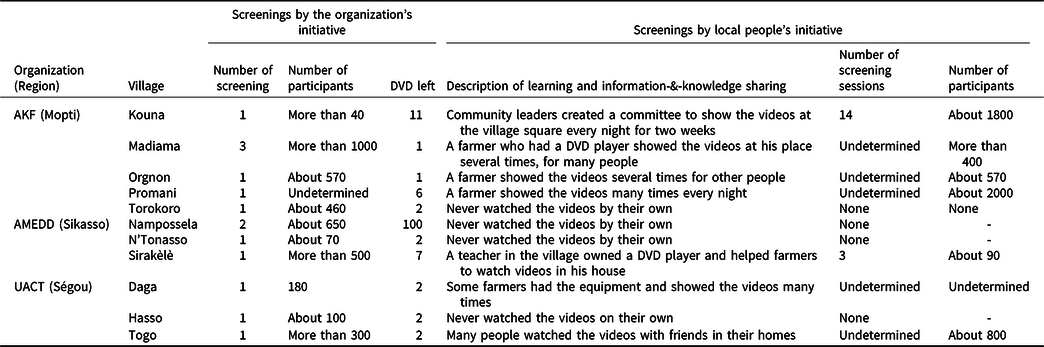
After screening the videos in the villages where they work, AKF, UACT, AMEDD, and other organizations leave copies of the DVD with the village development committee, a voluntary association of village people, which arranges further screenings. Among five villages where AKF organized public video screenings (facilitated by extension agents who could answer questions), four of the villages continued watching videos on their own (Table 3). In Kouna village, AKF screened the video for more than 40 farmers, including village leaders, women, and youth. After the video screening, AKF left 11 copies of the DVD with the villagers who liked the videos and decided to show them to everyone. For that, they set up a video committee and screened them for free in the village square every night for two weeks, until everyone had seen them. The village leaders bought the fuel for generator to show the videos. People from the nearby hamlets (less than 1 km) and faraway (more than 1 km) also came to watch the videos during the two weeks of screening. To keep watching the videos, people decided to distribute the 11 DVDs received as follows: three DVDs for the central village and two for each of the four hamlets.
Information and knowledge sharing

Eight out of 11 villages in Mali continued watching videos on their own after the public screenings (Table 4). The audiences could easily recall the content of videos even those who had not seen the videos for two years and had only watched them once. The audiovisual image of video enhances farmers’ memory, because when we asked farmers what they had learned, they usually described the content of the videos by focusing on the video images, which illustrated the practices they had used and adopted. During the interview, few farmers mentioned sharing the DVDs. Mainly farmers shared the ideas informally (especially hand-pulling striga and compost-making), talking about them with the people that they usually interact with in the course of their daily lives. A few groups shared more actively.
Change in practices or innovations inspired by learning videos

In the village of Nampossela with 100 copies of the DVD received from ICRISAT through AMEDD, we were surprised to observe that farmers never watched the videos on their own. These farmers grow cotton, which may have dampened their interest in the videos, because cotton kills striga seed in the soil. Cotton is a subsidized crop of national importance and, therefore, is well fertilized, which also helps control striga. So, striga may not a problem in the village of Nampossela.
Farmers’ satisfaction of learning video
The farmers’ reaction to the videos was mixed. In Kouna village, people enthusiastically organized their own video watching, but the farmers of Torokoro village did not watch videos on their own, because they lacked video screening equipment. However, those who had seen the video during the public screening could recall the content well. In two of the three villages where AMEDD organized screenings, the villagers never watched the videos again, citing a lack of viewing equipment. In the villages where UACT operated, farmers did later watch the videos on their own initiative, except in Hasso village.
Changes in practices
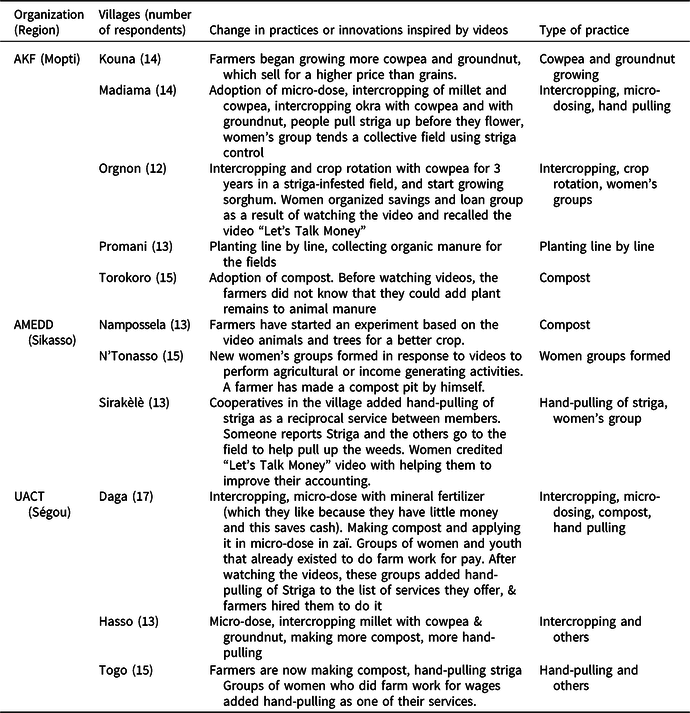
Behavioral changes mentioned by farmers in Mali as a result of the learning videos are summarized in Table 5. In all of the villages, farmers learned about the biology of striga from the videos and experimented with various new practices, as a result of the information they learned. Intercropping was the most frequently mentioned (in four villages out of 11), following by hand-pulling of striga and compost-making. One farmer described an innovative form of intercropping. He puts two cowpea seeds and three or four sorghum seeds in one hole. In the next, he only puts sorghum. The cowpea covers the soil, and he puts small doses of nitrogen fertilizer into the soil. So, farmers are creatively adapting the information from the videos. They also said that they wait until the ground is soft to hand pull the striga, so as not to break it off at the roots, a technique shown in the “Joining hands against Striga” video. A better understanding of the biology of the parasitic weed also triggered communities to work together to hand-pull striga weeds.
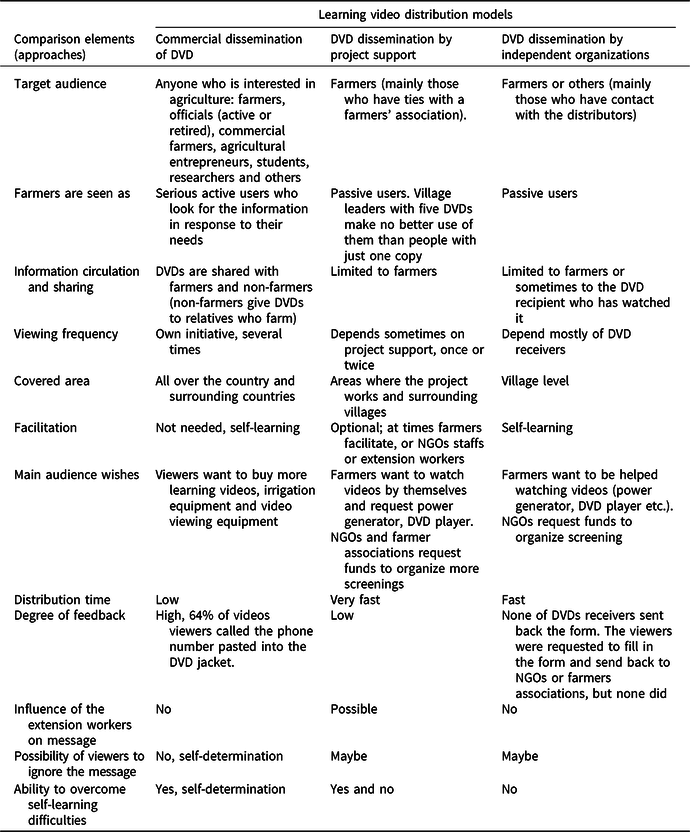
Comparison of dissemination models of learning videos

Sustainability of DVD dissemination
DVD distribution with project support enables farmers to easily watch videos at screenings in their community. After projects show the videos, most villages (64%) screened videos several times on their own initiative, a self-sustaining way to continue learning. Farmers who only see the videos in village screenings do recall at least some of the content.
Case 3: DVD dissemination by independent organizations
Information and knowledge sharing
GERED received 50 DVDs and distributed most of them to 35 owners of DVD players in the municipalities of Sinendé and Bembereke. With the facilitation of GERED, each DVD receiver has shown the video once to about 20 farmers. In the Municipality of Tchaorou, DeDESC received 150 DVDs and distributed only 33% of them to 50 individual farmers. The farmer’s association UCP N’DALI received 300 DVDs and distributed 93% of them to 30 farmers’ cooperatives, which then organized at least one public screening in their village. After the video screenings, the cooperative leaders and young people in each village received a copy of the DVD for further screening. CRADIB received 300 DVDs and distributed all of them with the help of representatives of political parties at the village level who took the lead to show the videos in ten districts of the municipality of Glazoué. They planned the screenings carefully and announced them by the town crier and sometimes through local radio. They organized several public screenings and used the opportunity to talk about the communal (2015) and presidential (2016) electoral campaigns. Before the campaign season, DVDs were only distributed to farmers individually.
Of seven farmers we found in the municipality of Sinendé who had received the DVDs, only one watched the videos with friends and remembered the content of the videos. In the municipality of Bemberekè, only three farmers out of nine who received DVDs watched the learning videos and one of them organized a public screening in the village for about 35 viewers. In the Municipality of Tchaorou, 19 out of 31 DVD receivers interviewed watched and remembered the videos well. The cooperative leaders and young people of the UCP N’DALI showed videos several times to their cooperative members, families, and friends in 17 villages out of 30 where DVDs were distributed. The respondents recalled the content and were especially impressed with the part about Striga biology. In the municipality of Glazoué, 55 farmers were interviewed in five villages, and all of them had watched the videos in the public screenings organized by the representatives of the political parties; farmers remembered much of the content of the videos. Of those 55 farmers, 27 of them received the DVD individually, but only eight watched it on their own.
Farmers’ satisfaction of learning video
During the research, it was a challenge to trace those villagers who received the DVD in areas where DVDs were distributed. All of the local people who received a DVD for free were asked to show the videos to other rural people, but all of them demanded support such as money to buy petrol or repair the generator. This can be interpreted as people’s lack of motivation to pay for information. Villagers asked “What will we do with videos when we do not have electricity or a generator and DVD players?” according to the Chairman of the DeDESC. When DVDs are free, people may not recognize their value, or be uninterested in watching them. When the cost of a good is zero, people may assume that the value is also nothing. All the farmers interviewed were aware of and the damage striga causes. However, they took little initiative to learn from the Fighting Striga videos.
Changes in practices
Among five municipalities where we held interviews, farmers only tried out ideas from the videos in Glazoué and N’Dali. They tried intercropping, hand-pulling of striga, compost-making, and micro-dosing, and some farmers also mentioned new ways of storing cowpea seed. More farmers mostly watched videos in Glazoué and N’Dali where political leaders and farmer associations were more active in showing the videos.
Sustainability of DVD dissemination
Independent organizations were less engaged in showing and distributing DVDs than organizations with support from projects. Except for farmers associations, none of the independent organization screened videos to farmers on the own initiative. All of them requested financial support, such as video screening equipment and travel expenses. But, even these independent organizations did distribute the DVDs to farmers, and some of them watched the videos. As a DVD can be printed for about $1, some farmers can be reached at relatively low cost, through independent organizations, although distribution is more effective through organizations connected to a specific project.
Discussion
Using learning videos in agricultural extension is an innovative approach with the potential to inform many farmers about new technologies. However, the sustainable use of videos as a learning tool depends on the dissemination approaches. This study showed that those farmers who bought their own DVDs were more motivated to watch them, share them, and use the information creatively. Farmers are more likely to pay for services that are attractive and useful (Moumouni and Streiffeler, Reference Moumouni and Streiffeler2010). This study confirmed that farmers were less motivated to learn when they received the DVDs for free and without support to watch them. Farmers who watched the videos through project support continued to watch on their own if the videos were interesting to them. When a DVD costs nothing, people may think it is worth nothing. Wanvoeke et al. (Reference Wanvoeke, Venot, Zwarteveen and de Fraiture2015) found a similar situation in Burkina-Faso where drip irrigation kits were no longer in use after being distributed for free to farmers. Similarly, metal grain bins had a higher demand and greater impact on Guatemala where the government charged for them than in El Salvador where the metal silos were given to farmers for free (Bokusheva et al., Reference Bokusheva, Finger, Fischler, Berlin, Marin, Pérez and Paiz2012).
The reaction of NGOs was variable. Organizations, which were connected to a project, were more motivated to screen videos and distribute DVDs than organizations with no such connection. Not all NGOs, which received the DVDs for free, showed videos to farmers. Most of these NGOs were unable to monitor the DVD recipients, except for one NGO which was involved in video screening with politicians’ help as part of an electoral campaign. On the other hand, some local NGOs that bought the DVDs did show the videos to farmers, several times, and also paid to make copies of the DVDs to give to farmers. In other words, NGOs that bought DVDs invested time and money to share the videos with farmers, while organizations that received DVDs for free requested support before showing them to farmers. The following quote from a Chairman of the NGO is a useful illustration: “Dear friend, what can we do with your DVDs as a local NGO with very limited financial capacity?” This is in line with The World Bank (2007) findings, which stated that attitudes and practices of organizations determine their propensity to innovation. NGOs requested incentives such as operational funds before showing videos to farmers.
Selling DVDs to farmers and NGO staff may foster self-determination to use and show the videos even without external support. Farmers and NGOs give more value to products, such as DVDs, that are sold at a cost, and not given for free. This dissemination approach provides evidence that farmers are willing to bear some of the costs of agricultural extension, which was formerly free of charge. Several authors have advocated for the use of service fees, while agricultural extension services are dependent on public service or donor funds (Ulimwengu and Sanyal, Reference Ulimwengu and Sanyal2011). According to Forum for Agricultural Research in Africa (2006), the costs of extension service should be gradually shared with farmers’ associations, and eventually, the producers themselves to enable Africa’s agricultural productivity efforts to be successful. Thus, farmers’ cost-sharing through learning videos could be a sustainable support to the delivery of agricultural extension services. However, further empirical study is needed to explain clearly why farmers do not always value what they receive for free, because Shampanier et al. (Reference Shampanier, Mazar and Ariely2007) theorize that the free character of a product constitutes an additional benefit for consumers.
In rural areas of many developing countries, such as Benin, cash may be distributed during political campaigns to buy votes (Wantchekon, Reference Wantchekon2011), but it was astounding to see political leaders attract voters by showing agricultural learning videos in public screenings. Screening learning videos to farmers to increase electoral support is an innovation, although there may be ethical questions about mixing politics and communication services. Of all types of organizations, the farmer associations were the most highly motivated to show the videos and watch them with their members. As the success of any sustainable development program is largely determined by the level of participation of farmers (Axinn, Reference Axinn, Scarborough, Killough, Johnson and Farrington1997), the farmer organizations’ video dissemination strategies are more sustainable than dissemination by NGOs. Thus, enhancing the capacity of farmer organizations to distribute videos would help them to provide more advice in response to their members’ needs, and the organizations’ improved capacity remains within the communities after donor support ends, so learning will continue. However, this approach favors members of farmers’ organizations, while the commercial approach provides access to anyone who is interested in agriculture (Table 5).
Conclusion
Distributing farmer learning videos through commercial channels reaches more serious users and increases farmers’ self-determination for learning, and farmers are more motivated to provide feedback than viewers who receive DVDs for free or via project support, NGOs, or farmer organizations. However, selling DVDs could take more time to reach the real end users, because distribution is slower than when videos move through NGOs and farmers’ association. Nevertheless, this study suggests that distributing videos through the private sector is more inclusive and sustainable. As farmers are motivated to pay for the learning videos and most technologies transform into innovations through business mechanisms, developing new business models with videos may play a significant role in distributing and showing learning videos. Furthermore, as the private sector has a role to play, both in making technologies available and in teaching farmers how to use them, their contribution would create space for innovation. However, development partners and governments can help to support smallholder farmers where they cannot afford DVD players, screens, and generators. This study identifies the strategic and tactical principle underlying sustainable, viable, and effective distribution mechanisms of agricultural learning videos and constitutes an important step toward filling knowledge gap observed in the technology dissemination for farmers’ knowledge development.