Early detection of carriers of methicillin-resistant Staphylococcus aureus (MRSA) among hospitalized patients is crucial in preventing further spread of this organism. The standard method for identifying MRSA carriers is swab culture of the nostrils.Reference Wertheim, Melles and Vos1 In the study referenced as the rationale for using nasal swab culture for active screening, almost 80% of MRSA-colonized patients, defined as those with any positive swab culture from multiple anatomic sites, were positive for the organism in the nostrils.Reference Coello, Jimenez and Garcia2 In the same study, however, less than 40% of patients who had clinical infection with MRSA had a positive nasal culture at the same time. In addition to the nostrils, MRSA frequently colonizes the skin and directly causes skin and soft tissue infections, including surgical site infections.Reference Huang and Platt3–Reference Thompson and Houston5 The addition of a second screening method has been shown to improve the sensitivity of MRSA detection.Reference Sim, McBryde, Street and Marshall6, Reference Harbarth, Schrenzel, Renzi, Akakpo and Ricou7 The use of a sponge in lieu of a swab enables sampling of a larger skin area and generally improves the detection sensitivity for skin-colonizing pathogens.Reference Hambraeus, Hoborn and Whyte8 We recently demonstrated this approach to be highly sensitive in detecting colonization of multidrug-resistant Acinetobacter baumannii.Reference Doi, Onuoha and Adams-Haduch9
Based on the hypothesis that the use of a sponge to collect MRSA screening samples on the skin would improve the sensitivity of MRSA detection, we conducted this proof-of-concept study to determine the sensitivities of various screening sites and 2 screening methods (swab and sponge) in detecting MRSA carriage among patients who recently had a positive clinical MRSA culture.
METHODS
Study Design
This study was approved by the Institutional Review Board of the University of Pittsburgh (PRO10060148). Patients who were admitted to the University of Pittsburgh Medical Center Presbyterian Campus between January 2011 and September 2013 were eligible. The inclusion criterion was MRSA growing from any clinical culture within the last 10 days, with or without positive nasal MRSA culture. The exclusion criteria were (1) MRSA growing from nasal swab culture only, (2) receiving nasal mupirocin treatment, and (3) expected survival of <24 h. We collected general demographic and clinical data including age, sex, underlying diseases, antimicrobial agents received between the positive clinical culture and study enrollment, and clinical outcomes. The sponge index was defined as the cumulative number of positive sponge specimens (up to 3); swab index was defined as the cumulative number of positive swabs (up to 5); and colonization index was defined as the cumulative number of total positive specimens (up to 8). Anti-MRSA agents were defined as vancomycin, tigecycline, linezolid, and daptomycin.
Specimen Collection
After obtaining informed consent, 5 rayon swabs (BBL CultureSwab Plus 220116; BD, Sparks, MD) and 3 sponges (Polywipe premoistened sponge swab MW728; Medical Wire, Wiltshire, England) were used to collect specimens from each patient. For the swabs, each of the 5 sites (forehead, nostrils, pharynx, axilla, and groin) were rubbed in a rotating manner to cover up to a 5×5-cm area when feasible, using a new swab for each site. These are body sites from which MRSA was recovered in previous studies.Reference Marschall and Muhlemann10, Reference Lim, Marshall and Spelman11 For the sponges, the forehead, axilla, and groin were swiped down approximately 12.7 cm using both sides; each site was swabbed with a new sponge and gloves. After sampling, each sponge was dropped into the sterile container provided with the sponge. To rule out contamination of MRSA from sources other than the skin, a negative control sponge was included with each patient. The swab and sponge specimens were then transported to the research laboratory for immediate processing.
Specimen Processing
Each swab was suspended in 1 mL of 7% sodium chloride nutrient broth (Becton Dickinson, San Jose, CA, USA) in a 2-mL freezer tube and vortexed. Each container with a sponge was filled with 10 mL of the same broth to soak the sponge and vortexed. The tubes and containers were incubated at 37°C with loose caps overnight for enrichment. The overnight enrichment process has been shown to increase the sensitivity of MRSA screening cultures.Reference Van Vaerenbergh, Cartuyvels, Coppens, Frans, Van den Abeele, De Beenhouwer and Group12 After 24 h of enrichment, 100 µL broth was taken from each specimen and inoculated onto HardyCHROM MRSA plates (Hardy Diagnostics, Santa Maria, CA). The plates were then incubated at 37°C for 24 h before reading. For mauve colonies that grew, the identity of S. aureus was confirmed by a Staphaurex latex agglutination test (Remel, Lenexa, KS).
PCR for SCCmec Typing
Typing of staphylococcal cassette chromosome mec (SCCmec) was performed using a previously described polymerase chain reaction (PCR) method.Reference Kondo, Ito and Ma13 Briefly, the genomic DNA was extracted using NucliSENS easyMAG (bioMerieux, Durham, NC) and subjected to multiplex PCR. The cycling conditions were as follows: 95°C for 5 min, 40 cycles of 95°C for 1 min, 52°C for 1 min, 72°C for 3 min, and a final extension at 72°C for 7 min. The following strains were included as positive controls: MRSA513, SCCmec type I; MRSA509, SCCmec type II; MRSA505, SCCmec type III; MRSA1, SCCmec type IV; and MRSA501, SCCmec type V.
Statistical Analysis
The characteristics of the study patients were described using proportions for categorical variables and medians and ranges for continuous variables. Because all patients were known carriers of MRSA at least just prior to enrollment, the sensitivity of each method was calculated as the percentage of tests that were positive. McNemar’s test for paired proportions was used to compare the sensitivities of the 2 methods based on specimens from the same patients. Under the assumption that the composite sensitivities of the nasal swab culture alone and the nasal swab culture combined with sponge culture would be 55% and 80%, respectively, this study was designed to enroll at least 70 patients to achieve 80% power for detecting a difference between the 2 sensitivities with a 2-sided α of 0.05. The analyses were performed using SAS, version 9.3 (SAS Institute, Cary, NC), and the significance level was set at P<0.05.
RESULTS
General Clinical Characteristics
A total of 380 potential study participants with positive MRSA cultures within the previous 10 days were screened, and a total of 109 patients were enrolled in the study. Four study participants were subsequently excluded from the analysis: 1 patient was enrolled for a positive nasal swab culture, 1 patient had growth of MRSA from the negative control sponge, 1 patient declined to have specimens collected after providing consent, and 1 patient was outside the enrollment window. Thus, data for the remaining 105 study participants were included in the analysis.
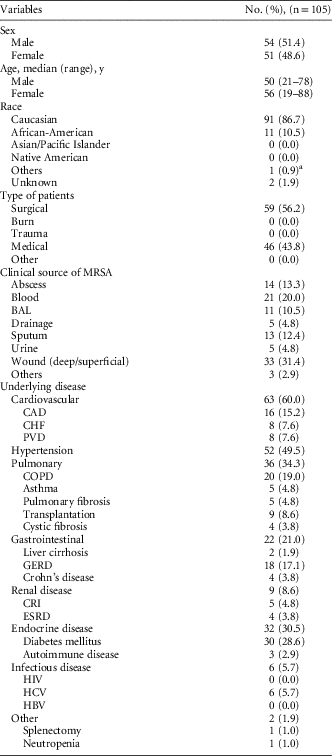
Of the 105 study participants, 54 (51.4%) were male, 91 (86.7%) were Caucasian, and the median age was 52 years (range: 19–88 yr). The demographics, sources of the positive clinical cultures and underlying diseases of the study participants are listed in Table 1.
Clinical Characteristics of the Study Participants

NOTE. MRSA, methicillin-resistant Staphylococcus aureus; BAL, bronchoalveolar lavage; CAD, coronary artery disease; CHF, congestive heart failure; PVD, peripheral vascular disease; COPD, chronic obstructive pulmonary disease; GERD, gastroesophageal reflux disease; CRI, chronic renal insufficiency; ESRD, end-stage renal disease; HIV, human immunodeficiency virus; HCV, hepatitis C virus; HBV, hepatitis B virus.
a Arabic.
Sensitivities of Sponge and Swab Specimens in Detecting MRSA Colonization
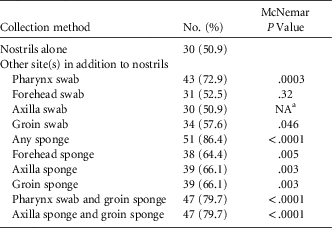
The sensitivities of the 8 collection sites in detecting MRSA colonization are shown in Table 2. At least 1 swab specimen was positive in 44.8% and at least 1 sponge specimen in 36.2%. Overall, 59 (56.2%) of the study participants had at least 1 positive specimen (collected by either swab or sponge). Among the patients who had any positive specimen, the sensitivities of MRSA detection were 79.7% with any swab screening and 64.4% with any sponge screening. The sensitivity of the nasal swab screening was only 50.9%, even among patients who at least had 1 positive specimen (Table 2). Thus, the sensitivity achieved by sponge screening (64.4%) was higher than the sensitivity of nasal swab screening (50.9%; p=0.17).
Sensitivities of the Collection Sites and Methods in Detecting MRSA Colonization
NOTE. MRSA, methicillin-resistant Staphylococcus aureus; NA, not applicable.
Contribution of Nonnasal Specimens in Improving Sensitivities
We compared the sensitivity of nasal swab screening alone (50.9%) with sensitivities of nasal swab sampling plus specimens from other site(s) (Table 3). Most composite sensitivities were statistically higher than for nasal swabbing alone, and the difference was most significant when nasal swab sampling was combined with any sponge sampling method (86.4%, P<0.0001). The composite sensitivity of nasal and pharyngeal swab sampling methods was 72.9% (P=0.0003).
Comparison of Methicillin-Resistant Staphylococcus aureus (MRSA) Detection Sensitivities Between Nasal Swab Alone and in Combination with Other Specimen(s)
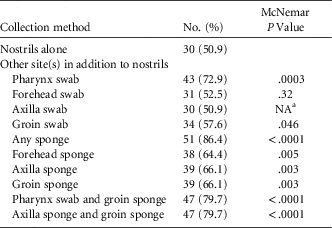
NOTE. n=59. NA, not applicable.
a All pairs are concordant.
Effect of Source of Culture and Treatment with Anti-MRSA Agents on the Positivity of MRSA Colonization
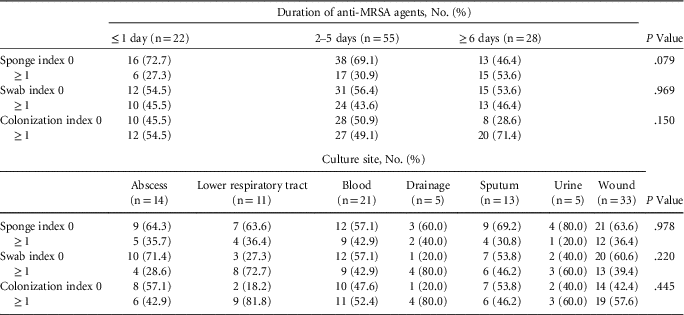
There were no statistically significant differences between duration of prior therapy with an anti-MRSA agent and the sponge index (P=0.079), the swab index (P=0.969), or the colonization index (P=0.15) (Table 4). Likewise, there were no statistically significant differences between each source of culture and these 3 indices (P=0.978, P=0.22, and P=0.445, respectively).
Methicillin-Resistant Staphylococcus aureus (MRSA) Colonization Indices According to Duration of Anti-MRSA Agents and Source of Clinical Cultures
SCCmec Typing of MRSA
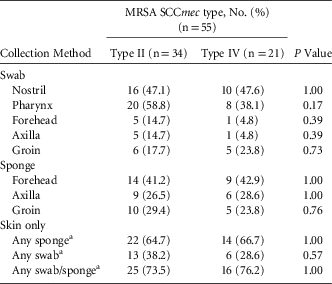
A total of 182 MRSA study isolates collected from 59 patients were subjected to SCCmec typing to determine whether the SCCmec types differed based on the collection sites. Most isolates had SCCmec type II (109, 59.9%) or type IV (65, 35.7%). SCCmec type was indeterminate for 8 isolates. There was no statistical difference in the SCCmec status according to the collection site or method (Table 5).
Relationship Between Methicillin-Resistant Staphylococcus aureus (MRSA) SCCmec Types and Collection Sites

NOTE. SCCmec, staphylococcal cassette chromosome mec.
a Forehead, axilla, or groin.
DISCUSSION
The association between nasal carriage of S. aureus, including MRSA, and development of infection due to this organism is well established.Reference Wertheim, Melles and Vos1, Reference von Eiff, Becker, Machka, Stammer and Peters14 In a recent study, there was a 3-fold increased risk for non-surgical patients who were nasally colonized by S. aureus to subsequently acquire S. aureus bacteremia compared with noncarriers.Reference Wertheim, Vos, Ott and van Belkum15 Early detection of colonization is therefore crucial in implementing appropriate infection control measures.
Our study yielded several salient findings. First, our data confirmed the less-than-optimal sensitivity of nasal swab culture in detecting MRSA carriage (50.9%), even among patients with any positive screening specimen as the denominator. Of all patients with recent MRSA infection, only 28.6% had a positive nasal swab culture despite the inclusion of a broth enrichment process. In the actual clinical setting where nasal swabs are inoculated directly onto a selective agar, the sensitivity is likely to be even lower. This raises concerns over the effectiveness of this active screening approach. Second, screening of skin colonization with a sponge, which in practice could be performed using 1 sponge with serial sampling of the forehead, axilla and groin, yielded higher sensitivity in detecting MRSA colonization than the nasal swab sampling method. However, the sensitivity achieved by sampling skin with a sponge (64.4%) did not appear sufficient as the sole method of screening for MRSA. Third, the best sensitivities were achieved by combining the nasal swab screening with a second method: sampling the skin with a sponge (86.4%) or sampling the pharynx with a swab (72.9%).
Given the low overall MRSA colonization rates among the study participants, all of whom were recently colonized with this organism, we sought to determine whether prior use of anti-MRSA agents was associated with lower rates of colonization at the time of enrollment and specimen collection. Contrary to our hypothesis, there was no relationship between the duration of use of anti-MRSA agents and colonization indices. This finding is comparable with that of a study showing that parenteral agents, especially vancomycin, were ineffective in clearing nasal colonization.Reference Keene, Vavagiakis and Lee16
The screening isolates mostly had SCCmec type II or type IV. MRSA with SCCmec type IV is primarily reported in patients with community-associated infections that often present as skin and soft tissue infections. However, we did not find distinct patterns of colonization between patients infected with SCCmec type II isolates and type IV isolates. This may be due to the fact that, even for those infected with SCCmec type IV isolates, the study specimens were collected well into their hospitalization.
There are several limitations inherent in our study. The study was conducted at a single tertiary care hospital, and the findings may not be directly generalizable to other clinical settings. Specifically, a separate study would be required to address how to best screen for MRSA carriage in the community. Next, standard culture was used to process the specimens. It would be interesting to see how the proposed sampling methods benefit from nucleotide amplification tests. Also, rectal swab culture was not performed due to low acceptance rates. Finally, the study was pragmatic in that it only enrolled patients with recent MRSA infection. Therefore, we do not know how the proposed screening methods perform in the general hospitalized population.
In conclusion, the sensitivity of nasal swab culture for screening MRSA carriage is low, but it can be improved significantly by adding a second method, either sampling the skin or the pharynx. This approach would require more resources but may be justified and beneficial in reducing transmission in settings with moderate rates of MRSA infection.
Acknowledgments
Financial support. This work was supported by a research grant from the Agency for Healthcare Research and Quality (R03HS021521). Y.D.’s participation was also supported by research grants from the National Institues of Health (R21AI107302 and R01AI104895).
Conflict of interest. All authors report no conflicts of interest relevant to this article.