Introduction
The Antarctic Region has a special interest since it is practically isolated from the adjacent regions, both because of the geographical distance and because of its hydrographical and climatic conditions. Moreover, this region is surrounded by the Atlantic, Indian and Pacific basins, with depths of 4000–5000 m, so the only current connection with the sub-Antarctic islands and the continental lands is through a number of submarine bridges. Marine biogeography is intimately linked with both water temperature and currents; making the Southern Ocean, with its strong currents and temperature fronts, a good reason to study distributional patterns.
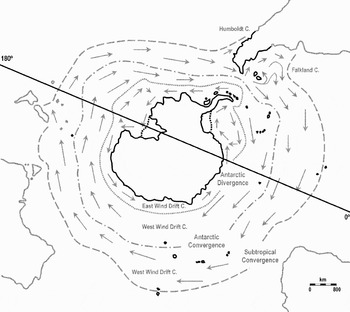
The Southern Ocean can be separated into two concentric rings. In the inner one, between the continent and the Antarctic Divergence (about 65°S), the East Wind Drift Current flows westwards with numerous eddies generated by the topography of the coast, most importantly those of the Ross Sea and the Weddell Sea (Fig. 1). The outer ring is limited by the Polar Front and within this the water flows eastwards as part of the West Wind Drift Current. The Antarctic Polar Front lies at about 50°S and is where the cold surface water sinks below the warmer temperate water, leading to a rapid change in water temperature over very short distances.
Coastline of Antarctica, sub-Antarctic islands and South America showing the principal oceanic currents. Biogeographical areas in black. See text for more details.

The sub-Antarctic Region is located in the Southern Ocean, between the Antarctic Polar Front and the Subtropical Convergence (this last one is very variable, between 35° and 45°S). Uniquely it has no continental barrier to interrupt it around the globe. Only at the Drake Passage (between Cape Horn and South Shetlands Islands) is the West Wind Drift Current restricted to a narrow passage of about 300 km. Here, part of the flow is directed northwards to the Humboldt Current system along the Chilean coast and part is entrained into lower latitudes after rounding Cape Horn, flowing north as the Falkland Current (with cold sub-Antarctic waters) until it reaches the Brazil Current. Cold-core eddies are shed at this point because the Falkland Current makes an abrupt cyclonic loop and returns towards the south-east parallel with the flow of the Brazil Current.
The ascidians have a sessile lifestyle for the adults and direct development or a short-term planktonic stage of their larvae (combined embryonic and larval periods of up to two weeks: Cloney et al. Reference Cloney, Young, Svane, Young, Sewell and Rice2002), making them an excellent group for biogeographical studies, but there have been few studies on their distributional patterns.
Although there is a relatively high number of taxonomic studies of ascidians in the Antarctic, sub-Antarctic and South America regions (Millar Reference Millar1960, Kott Reference Kott1969, Monniot & Monniot Reference Monniot and Monniot1983, Sanamyan & Schories Reference Sanamyan and Schories2003) biogeographical studies are scarce and they generally only make a passing reference to species distribution or geographical relationships (Kott Reference Kott1969). To date, only Monniot & Monniot (Reference Monniot and Monniot1983) and Ramos-Esplá et al. (Reference Ramos-Esplá, Cárcel and Varela2005) have dealt with statistical biogeography for these regions. Nevertheless, there are a number of recent biogeographical studies for these regions on other organisms (Sarà et al. Reference Sarà, Balduzzi, Barbieri, Bavestrello and Burlando1992: demosponges, Saiz-Salinas & Pagola-Carte Reference Saiz-Salinas and Pagola-Carte1999: sipunculids, Sicinski & Gillet Reference Sicinski and Gillet2002: polychaetes, Barnes Reference Barnes2006: bryozoans, Linse et al. Reference Linse, Griffiths, Barnes and Clarke2006: molluscs).
Encouraged by a study of the biogeography of Southern African ascidian fauna (Primo & Vázquez Reference Primo and Vázquez2004) our taxonomic study on the Antarctic ascidians provided us with the opportunity to look at possible explanations for their biogeographical distribution. As good data on currents and surface water temperature extended north beyond the Antarctic region, we decided to extend the study to the sub-Antarctic and the South America regions as well.
Materials and methods
A presence/absence matrix of species and biogeographical regions was first assembled, using mainly the work of Monniot & Monniot (Reference Monniot and Monniot1983) together with recent data. The biogeographical regions used were those proposed by Briggs (Reference Briggs1995). Although the exact number of provinces around the Antarctic, sub-Antarctic and South America regions, as well as their boundaries, appears to vary with each taxon, for the purposes of the present study, the regions studied were divided into provinces, also according to Briggs (Reference Briggs1995) who proposed the following (Fig. 2):
1. Antarctic Region: (PSP) South Polar Province, including the Antarctic continent as well as South Shetlands (60°30′S–60°W), South Orkney (60°30′S–45°W) and South Sandwich (59°S–27°W) islands, (PSG) South Georgia Province (54°30′S-36°W), (PBO) Bouvetøya Province (55°S–3°30′E).
2. sub-Antarctic Region: (PKE) Kerguelen Province, including Iles Kerguelen (49°30′S–69°40′E), Heard and McDonald islands (53°S–72°30′E), Marion and Prince Edward islands (46°30′S–38°E) and Iles Crozet (46°S–51°E), (PMQ) Macquarie Island Province (54°S–159°E).
3. South America Region: undivided, from Chiloé Islands (43°S–73°30′W) on the west coast to Valdes Peninsula (42°30′S–64°W) on the east, as well as Falkland Islands (51°45′S–59°W).
We also considered the Amsterdam-Saint Paul islands (38°S–77°30′E) in the South Indian Ocean and the Tristan da Cunha group of islands (38°S–12°20′W) in the South Atlantic Ocean, both within the limits of the Subtropical Front.
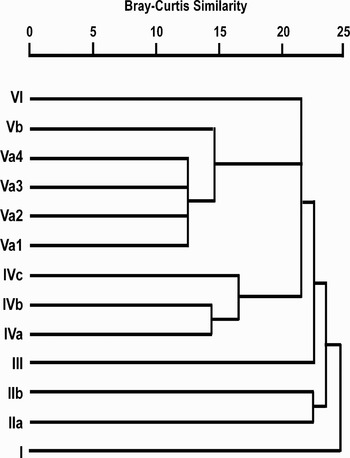
Bray-Curtis classification analysis of the 237 ascidian species present in the regions studied. The numbers are given in the text.

The Ascidiacea studied included all species cited for these regions, from the intertidal to the abyssal zone (7000 m depth), but excluding those of uncertain identification (see Appendix A). The latter includes 16 mainly colonial species distributed among the different genera.
Each record was assigned to one of the biogeographical provinces and, in addition, we reviewed the world distribution of each species and assigned them to the classical regions proposed by Briggs (Reference Briggs1995). With all this information a presence/absence matrix of 237 species and 27 biogeographical areas was constructed (Appendix A).
Ascidian species were classified by cluster analysis and the Bray-Curtis coefficient was applied. Legendre & Legendre (Reference Legendre and Legendre1998) suggested that the most suitable indices were those that avoid the effect of double-zeros, so that the double-absences are not taken as an indication of similarity. The UPGMA (unweighted pair group method using arithmetic averages) aggregation algorithm was applied.
The distribution of the species in the biogeographical components, on the basis of their distribution beyond the limits of the studied regions, was calculated directly from the presence/absence matrix as species frequency. We considered the following groups:
1. endemics - species not recorded from beyond the limits of the considered region,
2. cosmopolitan - species present in most of the global regions,
3. Southern Hemisphere - species with a broad distribution in the Southern Hemisphere,
4. cold regions - species from the cold and cold-temperate regions in the Southern Hemisphere,
5. Antarctic–sub-Antarctic - species only from Antarctic and sub-Antarctic waters,
6. Antarctic–South American, Antarctic–Southern New Zealand, Antarctic–Tasmanian and Antarctic-Southern African - species recorded in the Antarctic and/or sub-Antarctic regions and in South America, Southern New Zealand, Tasmania and Southern Africa respectively,
7. Southern American - species recorded from beyond the South America Region, in the warm-temperate regions of the continent.
Biogeographical divisions were obtained in the same way as for the species, but in this case the results of the classification were combined with MDS ordination (non-metric multidimensional scaling) to confirm the groups obtained. Analyses were run using SPSS (Statistical Package for the Social Sciences).
Results
Specific composition
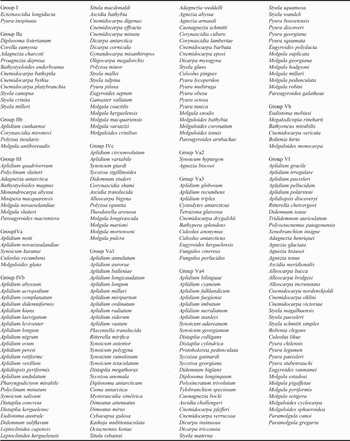
The Bray-Curtis classification analysis revealed six major groupings (Fig. 2; species per group in Appendix B).
I) two species living in the Amsterdam-Saint Paul islands, both endemic.
II) 15 species divided into two subgroups:
IIa) 11 cosmopolitan species, most of them present at Tristan da Cunha islands and/or at Amsterdam-Saint Paul islands, and
IIb) four endemic species from the Tristan da Cunha islands.
III) nine species related in the Macquarie Province, four of them endemic.
IV) species from sub-Antarctic waters divided into three subgroups:
IVa) five sub-Antarctic species that also inhabit the New Zealand regions, although Synoicum kuranui is not present in the sub-Antarctic Region but in the South American one;
IVb) 44 species associated with Kerguelen Province, 32 of which are endemics whilst others appear in adjacent regions;
IVc) 14 species with a broad distribution in the Southern Hemisphere.
V) those related to Antarctic waters divided into:
Va) 102 species with a restricted distribution in the studied regions, 49 of them present in the South Polar Province - 44 of which are endemics
Va1) two Antarctic species which also extend to the Australian regions
Va2) 12 species centred in the South Polar Province but also present in the sub-Antarctic and South America regions
Va3) 39 species from South Georgia and Bouvetøya provinces also distributed in the sub-Antarctic and South America regions,
Vb) six species with a rather broad distribution in the Southern Hemisphere, but most of them principally associated with the Southern African Region.
VI) 40 species from the South American Region, 22 of which are endemics.
Biogeographical components
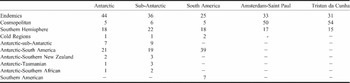
The frequency distribution of species in the biogeographical components (Table I), on the basis of their distribution beyond the limits of the regions studied, allows a better interpretation of the composition of the ascidian fauna. We considered each region separately in order to clarify the interpretation, so some species will appear in several analyses, since they are present in several biogeographical areas.
Frequency distribution in the biogeographical components of the biogeographical areas considered.

After classifying the 136 Antarctic species into nine faunistic components, we showed that the endemic component was the richest one, representing almost half of the total ascidian fauna (most of the species only from the South Polar Province). The Antarctic-South American and Southern Hemisphere components were the next largest groups, followed by the Antarctic–sub-Antarctic. Finally, the cosmopolitan, cold regions and Antarctic–Southern New Zealand, Antarctic-Tasmanian and Antarctic-Southern African components were minority groups.
The 105 sub-Antarctic species had a similar distribution within the biogeographical components, although the percentages were quite different. The endemic species had a lower percentage (most of them only from the Kerguelen Province). The Southern Hemisphere and Antarctic–South American components were similar, but with inverse importance. They were followed by the Antarctic–sub-Antarctic and cosmopolitan components. The minority groups had greater percentages here than in the Antarctic Region.
In the South America Region, with 87 species, the richest group was the Antarctic-South America component, closely related to the South Georgia Province. The endemic and Southern Hemisphere components were quite numerous too, while the Southern American, cold regions and cosmopolitan species were minority.
As for the Amsterdam-Saint Paul and Tristan da Cunha groups, with 6 and 13 species, the distribution in biogeographical components was very similar, with the cosmopolitan component dominant, followed by the endemics and the Southern Hemisphere group. However, because of the relatively low number of samples collected from these provinces, interpretation of these data should be still considered as preliminary.
Affinities with other biogeographical regions
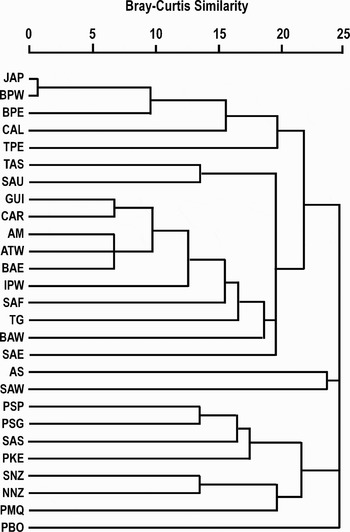
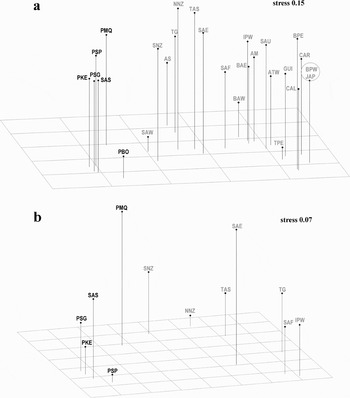
The cluster obtained from the classification analysis of biogeographical areas (Fig. 3) showed that the Bouvet Province appeared to be very different from the rest of the Antarctic provinces, which were grouped and associated with the South America Region and the sub-Antarctic Kerguelen Province. Macquarie Province was however related to New Zealand regions, although this group also showed a certain similarity with the cold regions cluster. Amsterdam-Saint Paul and Tristan da Cunha appeared definitively separated in this analysis. The MDS ordination (Fig. 4a) confirmed the separation of Amsterdam-Saint Paul and Tristan da Cunha, while Bouvet Province, although separated, appeared quite near to the rest of Antarctic provinces. Macquarie Province was nearer to the cold regions than to Southern New Zealand, but it seems to serve as a “bridge” between these regions.
Bray-Curtis classification analysis of the 27 biogeographical areas. (PSP = South Polar Province, PSG = South Georgia Province, PBO = Bouvet Province, PKE = Kerguelen Province, PMQ = Macquarie Province, SAS = South America Region, AS = Amsterdam-Saint Paul, TG = Tristan da Cunha, TAS = Tasmania Region, SNZ = Southern New Zealand Region, SAF = Southern Africa Region, SAE = Eastern South America Region, SAW = Western South America Region, TPE = Eastern Pacific Region, IPW = Indo-West Pacific Region, SAU = Southern Australia Region, NNZ = Northern New Zealand Region, JAP = Japan Region, BPW = Western Pacific Boreal Region, BPE = Eastern Pacific Boreal Region, CAL = California Region, GUI = Eastern Atlantic Region, AM = Mediterranean-Atlantic Region, BAE = Eastern Atlantic Boreal Region, BAW = Western Atlantic Boreal Region, CAR = Carolina Region, ATW = Western Atlantic Region).

MDS ordination analysis of the 27 biogeographical areas. a. All biogeographical areas considered. b. Bouvet Province, Amsterdam-Saint Paul, Western South America Region, Southern Australia Region, Eastern Pacific Region, Eastern Atlantic Region, Western Atlantic Region, and all the Northern Hemisphere regions removed. (The areas are the same as given in the caption for Fig. 3).

We were concerned that the inclusion of some regions with only a few citations may have masked the true relationships among the other areas. We therefore repeated the analysis excluding those regions with less than ten citations (Fig. 4b). The results of the second analysis confirmed the affinities of the Antarctic, sub-Antarctic and South America provinces already shown by the cluster analysis and showed the Tristan da Cunha group closer to the Southern Africa Region.
Discussion
Specific composition, biogeographical components and affinities with other biogeographical regions
Amsterdam-Saint Paul and Tristan da Cunha groups were included in this study because of their location near the Subtropical Front, so they are affected by the West Wind Drift Current, which carries cold water from the Antarctic. However, these two groups were clearly isolated in the analyses (Figs 2–4). This may be due to the considerable geographical distances that separate them from the continental landmasses combined with the ascidian short planktonic larval stage, thus leading to a higher endemic percentage (Table I). Cosmopolitan species acquire more importance probably because of their location at the limits of the Subtropical Front (from where ascidians could have extended their distribution). Species with a broad distribution comprised a high percentage (in all the areas considered) for an organism with a brief larval stage (in fact, species restricted only to cold regions were scarce); passive transport by floating wood, seaweeds or, more recently, by anthropogenic factors such as hull fouling, is the most likely explanation for this distribution (Monniot et al. Reference Monniot, Monniot and Laboute1985). The apparent similarity between Tristan da Cunha and the Southern African Region seen in Fig. 4b was rejected by Primo & Vázquez (Reference Primo and Vázquez2004), where a slight connection with the Antarctic and sub-Antarctic regions was suggested. However, in a strict sense, those species related to Antarctic and sub-Antarctic are not restricted to these regions. The result is a fauna composed only of endemics and species with a broad distribution, so neither Amsterdam-Saint Paul, nor Tristan da Cunha shows a clear relationship with any other region. Another possibly important factor is water depth, since many of the cited species were found at abyssal depths, especially at Tristan da Cunha.
The lack of Bouvet endemics is remarkable. This could be explained by its youth and because, despite its isolation, it is located in the West Wind Drift Current and the Weddell Gyre (Linse Reference Linse2006) so it could be a stepping stone between the Antarctic and sub-Antarctic regions for benthic organisms. A more extensive study is required to clarify the real affinities of this province because of the small number of citations (only eight species) in spite of recent cruises (Arntz et al. Reference Arntz, Thatje, Linse, Avila, Ballesteros, Barnes, Cope, Cristobo, De Broyer, Gutt, Isla, López-González, Montiel, Munilla, Ramos-Esplá, Raupach, Rauschert, Rodríguez and Teixidó2006). However, at present its separation from the other Antarctic provinces (Figs 3 & 4) could simply be due to the low sampling effort. Bouvet species appeared in the Antarctic group in the analysis of specific composition (Fig. 2); all of them were collected from the Antarctic Region and two of them have an exclusive Antarctic distribution, so it seems to be more associated with this region.
South Polar and South Georgia provinces appear more related (Fig. 3). Nevertheless, South Georgia, because of its location, seems to be an overlapping region whose fauna is the consequence of several successive invasions from South America and Antarctica, depending on the fluctuations of the Antarctic Polar Front and currents over the geological periods of time (Monniot & Monniot Reference Monniot and Monniot1983) which could be the cause of the lack of endemism in this province. Anyway, it seems to be more related to the Antarctic Region (13 endemic species from South Pole and South Georgia as opposed to five species shared with South America).
As for the Antarctic Region as a whole, the endemic component represents almost half of the total Antarctic ascidian fauna, which is not surprising if we take into account the isolation of the fauna in this region both because of its geography and its oceanography. The opening of the Drake Passage, the development of a circumpolar current, the physical barrier of the Antarctic Polar Front (especially effective for organisms with a limited dispersal capacity) and the great depths that surround the continent certainly contribute to its isolation. It is notable that in other groups such as pycnogonids, amphipods or isopods there are c. 80–90% of endemic species (Peña-Cantero & García-Carrascosa Reference Peña-Cantero and García-Carrascosa1999).
Antarctic and South America are the most related regions (see Fig. 3), although it is no so evident in the specific composition (Fig. 2) or the MDS affinities among regions (Fig. 4). This is probably due to the combination of several factors, such as their geological history (since South America was the last continent separated from Antarctica) and their geographical proximity. This would allow the species exchange through the Scotia Arc in spite of the great depths of Drake Passage, the strong flow of the West Wind Drift Current or the presence of the Antarctic Polar Front. The abundance of Antarctic-sub-Antarctic-South American species confirms a close relationship between these regions, in particular with South Georgia Province (Fig. 4). In fact, this was the most important group of the South America Region, even more so than the endemic component.
The South America Region seems to be characterized by Antarctic, sub-Antarctic and South American populations, so it is considered as a biogeographical complex resulting from the interaction between these elements (Alveal et al. Reference Alveal, Romo and Valenzuela1973). Southern American species were poorly represented and none of these species appears simultaneously in the three temperate South American regions, which implies that their faunas are very different: the west coast is influenced by the cold Humboldt Current while the eastern one is influenced by the warm Brazil Current.
The sub-Antarctic Kerguelen Province, in spite of its cold waters and its proximity to the Antarctic Province, appeared rather separated (Fig. 3) perhaps because of the considerable distances between the islands. The low percentage of Antarctic-sub-Antarctic ascidians (Table I) confirms this. Besides, in some cases the connexion between these areas is probably through the South America Region (via the Scotia Arc), with the colonization of species transported by the West Wind Drift Current from this region (Branch Reference Branch1994). This seems to be supported by the fact that there are several species present simultaneously in the three regions (groups Va3 and Va4 in Fig. 2). On the other hand, the lower number of sub-Antarctic endemics and the slightly higher percentage of Antarctic-South New Zealand, Antarctic-Tasmanian and Antarctic-Southern African species in comparison to the Antarctic could be due to the reduced efficiency of the Subtropical Front as a barrier to the adjacent cold-temperate regions.
Macquarie Province was even more separated and related in some way to the New Zealand regions (Figs 3 & 4), which is not surprising because of the geographical proximity of the areas and the presence of colder waters around New Zealand than those around Tasmania or Southern Africa.
Comparison with other fauna
The distribution of the Antarctic, sub-Antarctic and South American biogeographical provinces was thoroughly revised. Nevertheless, a slightly different division can arise, depending on the organism studied, historical extinctions, radiation and dispersal events, as well as ecological factors such as reproduction, capacity for dispersal and feeding mode.
In general, there has been much confusion with respect to the limits, the sub-divisions and the terminology employed in describing these zones in the literature. Even recent works with different taxa have divided the Antarctic Region in very different ways: High and Low Antarctica, being the limit of the permanent pack ice (López-Gónzalez & Williams Reference López-González and Williams2002: sea pens), East and West Antarctica based on a trans-Antarctic current from the Ross Sea to the Weddell Sea, separating the West Antarctic microcontinental fragments from the East Antarctic during the Eocene, before the opening of the Drake Passage (Linse et al. Reference Linse, Griffiths, Barnes and Clarke2006: bivalves), continent and islands because of the geographical distances or the warmer character of a particular island e.g. South Georgia (Briggs Reference Briggs1995: marine fauna) or considered as a whole, an undivided region delimited by the Polar Front (Moyano Reference Moyano, Gordon, Smith and Grant-Mackie1996: bryozoans). The case of the sub-Antarctic Region is even more complex because of the different sampling efforts and the fact that many studies did not take into account all the islands included here. It was divided into two or three groups of islands depending on its location in relation to the Polar Front and the sub-Antarctic Front (Briggs Reference Briggs1995: marine fauna) or not divided at all (Branch et al. Reference Branch, Griffiths, Kensley and Sieg1991: benthic crustaceans), although Macquarie Island has frequently been excluded from the analyses and related to New Zealand (Child Reference Child1998: sea spiders) due to its geographical proximity. The South America Region was initially divided in 3–5 provinces with different limits (Balech Reference Balech1954: littoral communities, Knox Reference Knox1960: marine fauna), but practically all recent works consider it as one biogeographical entitys usually including the Falkland Islands (Schmidt & Brandt Reference Schmidt and Brandt2001: tanaidacean), but not always (Linse Reference Linse1997: molluscs). Some authors even included the Tristan da Cunha group of islands in this region; they would be related through the Falkland and West Wind Drift current (Briggs Reference Briggs1974: marine fauna). These islands, together with Amsterdam-Saint Paul and some principal seamounts were also considered as a Southern African province (Collette & Parin Reference Collette and Parin1991: fishes), although Primo & Vázquez (Reference Primo and Vázquez2004) working with ascidians rejected this province and its biogeographical relation with South Africa for the ascidian fauna. A different case is that of Sarà et al. (Reference Sarà, Balduzzi, Barbieri, Bavestrello and Burlando1992) who worked with demosponges and considered Antarctic, sub-Antarctic and South America regions as part of a distinct Antarctic Faunistic Complex since they present close relationship.
As for ascidian biogeography, Millar (Reference Millar1960) considered South Georgia as intermediate between the Antarctic and South America, although it had more species in common with the last one. Kott (Reference Kott1969) divided the Antarctic in Continental and South Georgia provinces (the last one including the Bellingshausen Sea, the Antarctic Peninsula and the Scotia Arc islands and considered as an overlap area), while South America, Kerguelen and Macquarie and the New Zealand regions were grouped together with Bouvet Island was considered within the limits of the Antarctic. Monniot & Monniot (Reference Monniot and Monniot1983) also considered South Georgia, intermediate between Antarctica and South America, as a separated province (the remaining Scotia Arc islands belonging to the continental province) and Bouvet with an Antarctic character; they mentioned a certain relationship between the Tristan da Cunha group and the sub-Antarctic. Finally, Ramos-Esplá et al. (Reference Ramos-Esplá, Cárcel and Varela2005) considered South Georgia as a separated area intermediate between the Antarctic Province (continent plus South Shetland and South Orkney Islands) and the Magellan Region; South Sandwich Islands position was doubtful, related both to South Georgia and the sub-Antarctic, and Bouvet was considered from the start as sub-Antarctic.
The present study supports the inclusion of South Georgia in the Antarctic Region as a separated province (in spite of the lack of endemics) and intermediate between Antarctica and South America, regions that are more related to each other than the sub-Antarctic. Bouvet was also included in the Antarctic Region (which agrees with a number of papers: Arntz et al. Reference Arntz, Thatje, Linse, Avila, Ballesteros, Barnes, Cope, Cristobo, De Broyer, Gutt, Isla, López-González, Montiel, Munilla, Ramos-Esplá, Raupach, Rauschert, Rodríguez and Teixidó2006: isopods and amphipods, Barnes Reference Barnes2006: bryozoans, Linse Reference Linse2006: mollusc), although this and other Antarctic and sub-Antarctic areas (especially islands) have been poorly sampled. The lack of information in some areas can lead to wrong biogeographical conclusions, so it is essential to increase the sampling effort to make clear their biogeographical relationships. The division of the sub-Antarctic Region into Kerguelen and Macquarie provinces coincides with our results, being this last one definitively more related to the sub-Antarctic than to New Zealand. It is difficult to say whether the chosen limits for the South America Region are the most suitable for the ascidian fauna or not without a more detailed study, and the western and eastern South American coasts are some of the least studied zones of the globe, so much more data are essential to reach robust conclusions. The same is applicable for Tristan da Cunha and Amsterdam-Saint Paul groups of islands. The grouping proposed by Sarà et al. (Reference Sarà, Balduzzi, Barbieri, Bavestrello and Burlando1992) is not supported by our result since the three regions are different enough to be considered as independent, although they show a great affinity.
Considerations about the origin of the ascidian fauna in the Antarctic, sub-Antarctic and South America regions
Although the current technologies of molecular biology contribute with valuable information to the interpretation of the origin of the ascidian fauna, there are few papers dealing with Antarctic ascidian phylogeny (Sahade et al. Reference Sahade, Demarchi, Chiappero, Tatián, Gardenal, Thatje, Calcagno and Arntz2003). Moreover, there is a lack of fossil records of ascidians because they have soft bodies. Thus any hypothesis about the present distribution and origin of this fauna must be based on the analysis of their geological history and the main oceanographic features (Fig. 1).
The Antarctic Region has remained isolated for a long time (c. 25 m.y.), with climatic conditions that varied gradually, causing migration more than extinction (Clarke Reference Clarke, Kerry and Hempel1990). This would provide new adaptative zones, creating the opportunity for a spectacular independent radiation for many Antarctic benthic taxa (Brandt Reference Brandt2000) like ascidians, so the Antarctic Region has been described as an “evolutionary incubator” (Briggs Reference Briggs2003). The expansion of the ocean basins and the development of the Polar Front and a circumpolar current maintained the isolation of the Antarctic continent and gave it much stability. Probably the ancestors of the current endemic species colonized the Antarctic through shallow waters during the Gondwana disruption. The circumpolar West Wind Drift Current can also have helped the dispersion of benthic organisms around the Southern Hemisphere, especially during the coldest periods, when this current was intensified (Crame Reference Crame1999). Vicariance could be another plausible explanation for disjunctive distributions. The Antarctic fauna is now exposed to two new complementary forces (Tavares & de Melo Reference Tavares and de Melo2004): transport of exotic species (both by anthropogenic means and by passive transport) and the polar warming (Gille Reference Gille2002) which in turn could lead to changes in the temperature barrier around Antarctica allowing the migration of marine organisms.
The most obvious connection of Antarctica with the landmasses of the Southern Hemisphere is with South America, through the Scotia Arc. The current dispersion is, nevertheless, rather speculative (Brandt Reference Brandt1991) since these islands are surrounded by deep waters and passive transport is not probable because it would be against the flow of the strong West Wind Drift Current (Brandt Reference Brandt1992). Maybe this colonization happened in the past (c. 50 m.y.) when the Scotia Arc islands were closer. Under the cold Antarctic conditions, evolution is probably extremely slow (Ingels et al. Reference Ingels, Vanhove, De Mesel and Vanreusel2006). In addition, Antarctic species could have migrated northwards through Scotia Arc and then been dispersed by the currents, to reach the sub-Antarctic islands (Branch et al. Reference Branch, Jangoux, Alvá, Massin and Stampanato1993).
The current oceanographic conditions isolate the South America Region from the continent, with consequent effects on speciation processes. Moreover, there is little exchange between the warm-temperate faunas from both coasts, because of the high latitude of the South America Region. The particular conditions of the West Wind Drift Current, which influences the west South American coast south of 40°S as the Humboldt Current, and then as the Falkland Current in the east, could produce affinities among these areas and the Falkland Islands and would mark differences with the Antarctic Region (Cañete et al. Reference Cañete, Leighton and Aguilera1999).
It is possible that Antarctic ascidians radiated northwards from the whole region to the sub-Antarctic islands through submerged marine bridges. This radiation could have happened principally at Middle-Late Miocene, when an abrupt cooling produced a rapid expansion of the Antarctic ice sheet, with the consequent cooling of Antarctic and sub-Antarctic waters. This was a time of major expansion for the Antarctic marine fauna (Crame Reference Crame1999). The isolation of some of the sub-Antarctic islands since the formation of the Polar Front because of their location between the Antarctic and Subtropical fronts and the great geographical distances, seems to be the reason for the high level of endemism. Species would come not only from the Antarctic Region, but from the rest of the continents through the West Wind Drift Current. The same would be possible for Tristan da Cunha and Amsterdam-Saint Paul groups of islands.
Acknowledgements
We thank the two anonymous reviewers for their valuable comments. This study was financed by a post-doctoral fellowship to Carmen Primo from Xunta da Galicia.
Appendix
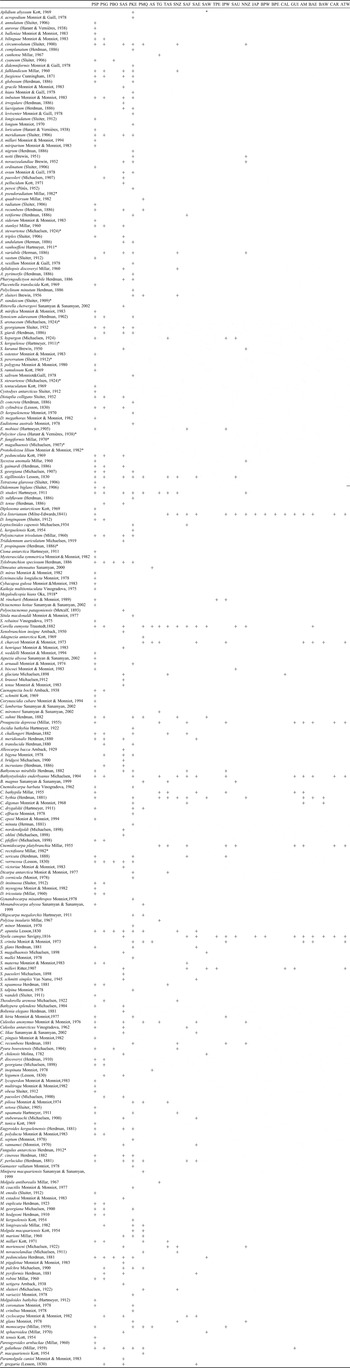
Presence/absence matrix of the 237 species recorded in the Antarctic, sub-Antarctic and South America regions per biogeographical divisions. Those species with* were excluded from the analyses because of uncertainty over identification.

Species per group in the Bray-Curtis classification between the 237 ascidian species present in the Antarctic, sub-Antarctic and South America regions.