INTRODUCTION
One of the most ubiquitous and major problems threatening our marine environment is accumulation and fragmentation of solid debris particularly plastics (Barnes et al., Reference Barnes, Galgani, Thompson and Barlaz2009; Thompson et al., Reference Thompson, Moore, Vom Saal and Swan2009). This versatile, inexpensive, light weight, durable and transparent material has many applications in our daily life with the annual global production at 245 million tonnes (Andrady, Reference Andrady2011). Since the mass production of plastics commencing around the 1950s, plastic items have accumulated around the world from pole to pole and are even reported from remote islands (Moore et al., Reference Moore, Moore, Leecaster and Weisberg2001a, Reference Moore, Gregorio, Carreon, Weisberg and Leecasterb; Edyvane et al., Reference Edyvane, Dalgetty, Hone, Higham and Wace2004; Barnes, Reference Barnes2005; Thompson et al., Reference Thompson, Moore, Vom Saal and Swan2009; Eriksson et al., Reference Eriksson, Burton, Fitch, Schulz and van den Hoff2013; Thiel et al., Reference Thiel, Hinojosa, Miranda, Pantoja, Rivadeneira and Vásquez2013). Despite the widespread recognition of the problem, evidence suggests that plastic debris accumulation is still increasing (Moore, Reference Moore2008; Barnes et al., Reference Barnes, Galgani, Thompson and Barlaz2009; Ryan et al., Reference Ryan, Moore, van Franeker and Moloney2009). The sources of the marine debris are from both land-based and marine-based activities, although it is estimated that half of the marine debris is produced from land-based activities (Sheavly & Register, Reference Sheavly and Register2007). On shorelines, accumulation of marine debris, especially plastics, is greater in the northern than in the southern hemisphere and there is evidence that plastic fragments are buried in the sediment (Barnes et al., Reference Barnes, Galgani, Thompson and Barlaz2009; Ryan et al., Reference Ryan, Moore, van Franeker and Moloney2009). Marine debris is not only an eyesore but the potential hazard to marine biodiversity from tiny filter feeders to giant mammals in all oceans (Laist, Reference Laist, Coe and Rogers1997; Thompson et al., Reference Thompson, Moore, Vom Saal and Swan2009; Van Franeker et al., Reference Van Franeker, Blaize, Danielsen, Fairclough, Gollan, Guse and Turner2011). Entanglement in plastic items, particularly discarded fishing gear is a serious threat to marine animals (see Laist, Reference Laist, Coe and Rogers1997; Moore et al., Reference Moore, Lyday, Roletto, Litle, Parrish, Nevins and Kell2009). Ingestion of stranded and fragmented plastic items can have fatal consequences for marine species (Browne et al., Reference Browne, Dissanayake, Galloway and Lowe2008; Van Franeker et al., Reference Van Franeker, Blaize, Danielsen, Fairclough, Gollan, Guse and Turner2011, Ramos et al., Reference Ramos, Barletta and Costa2012, Cole et al., Reference Cole, Webb, Lindeque, Fileman, Halsband and Galloway2014). Many comprehensive studies have been done to quantify and monitor coastal debris around the world (OSPAR, 2007b; Cheshire et al., Reference Cheshire, Adler, Barbière, Cohen, Evans, Jarayabhand and Westphalen2009; information is also available at marinedebris.noaa.gov) but no such data have been reported for the coastline of the Northern Persian Gulf. The data collected in this research have been derived from volunteer beach debris monitoring efforts conducted during May 2014. Here we present the first quantitative assessment of marine debris found along Bandar Abbas beach. We aimed to understand the amount and composition of marine debris along the coastline of Bandar Abbas to determine their origins. The data are valuable for decision makers in the initiation of national projects to deal with the marine debris problem.
MATERIALS AND METHODS
This study was conducted as a pilot project to assess marine litter on the Bandar Abbas coastline with a quantitative approach. Marine beach litter was distinguished in the field following the definition of marine debris of UNEP (Reference Jeftic, Sheavly, Adler and Meith2009): ‘Marine debris is any manufactured or processed solid waste material that has been accidentally or deliberately released to the sea’, available at http://www.unep.org/regionalseas/marinelitter/about/default.asp. Beach debris was collected based on the standard method introduced by OSPAR commission entitled ‘OSPAR Pilot Project on Monitoring Marine Beach Litter, Monitoring of Marine Litter in the OSPAR region’ (OSPAR, 2007b). This survey was completed by student volunteers from Bandar Abbas University. The survey site is a stretch of 6 km upper limit of a beach located in Bandar Abbas coastal park (27°11′10.22″N 56°20′10.89″E).
The selection of sites was made according to OSPAR (2007b) guidelines. The criteria include sediments of sand or gravel, exposed to open water, according to visual observation frequently littered, good accessibility to the surveyors, over 1 km in length, and not located near input sources of wastewater (OSPAR, 2007b).
The selected area is used heavily as an intertidal fishing ground and known as a recreational site for youth and families. Beach litter was collected and sorted at two different scales (100 and 1000 m). Materials used for this survey were simple and inexpensive. We used gloves, pencils, printed paper forms and rubbish bags prepared by Bandar Abbas University. Ten categories of debris were determined based on OSPAR monitoring beach litter guidelines (2007b). Each debris item was identified, photographed and documented in the printed survey forms. Data analysis was done using Excel.
RESULTS
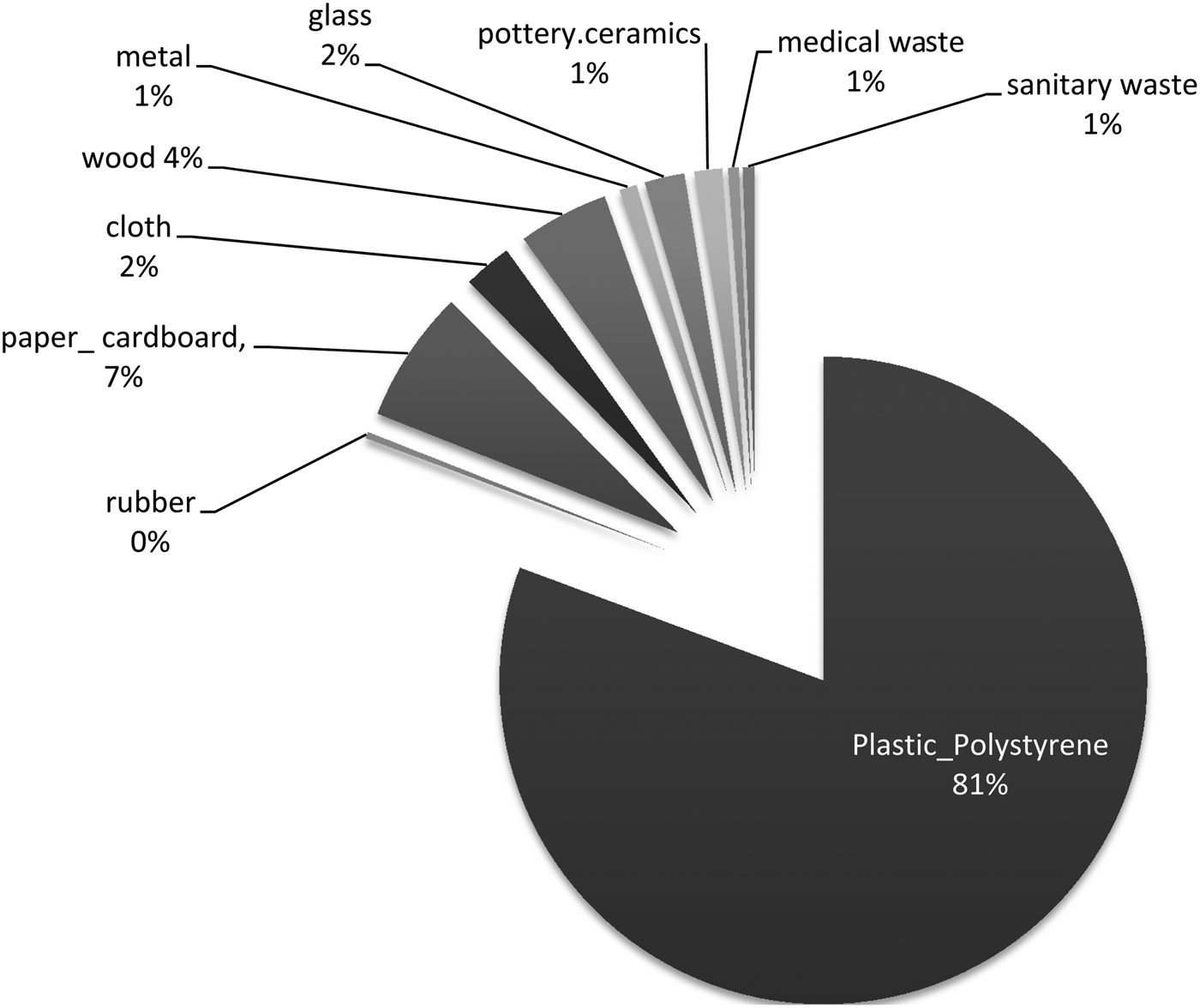
An average of 456 items of varying sizes were found per 100 m stretch of Bandar Abbas beach. Following the global tendency (Derraik, Reference Derraik2002) the largest proportion of marine litter found in coastlines was made of plastics. In this survey at the scale of 100 m, more than 80% of total items were plastic debris. Paper and wooden materials ranked second and third (Figure 1).
Proportion of different debris categories found in 100 m stretches of beach during the project on May 2014 on the coastline of Bandar Abbas, northern part of the Persian Gulf, Iran.

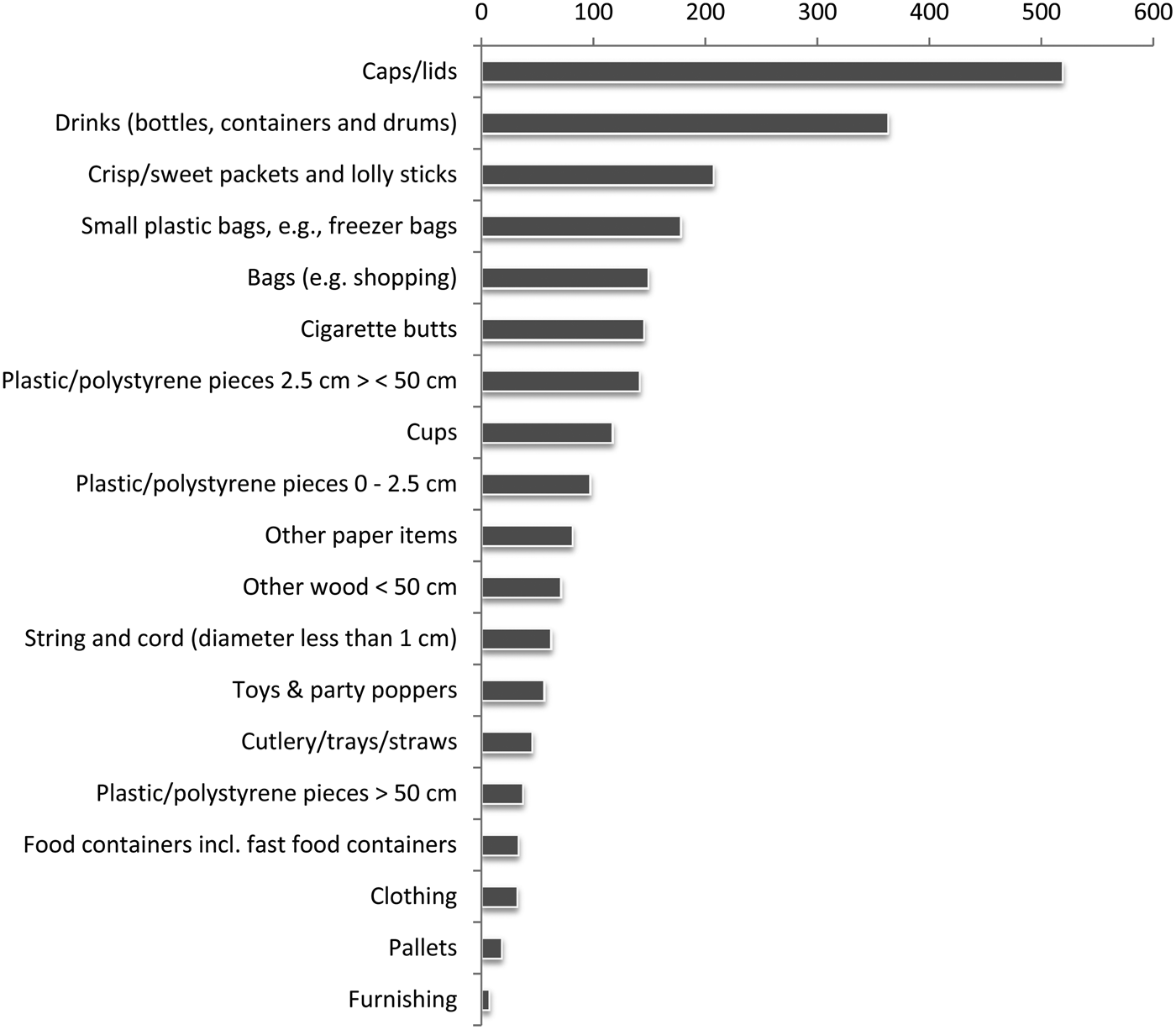
The most common items found in the highest number were made of plastic/polystyrene including caps/lids, drinks (bottles, containers, drums) and crisp/sweet packets and lolly sticks (Figure 2). Our results indicate an average density of 4.5 items per metre in this 6 km beach survey.
The most common marine litter items found in the highest number on 100 m stretches of beach in Bandar Abbas, northern part of the Persian Gulf, Iran.
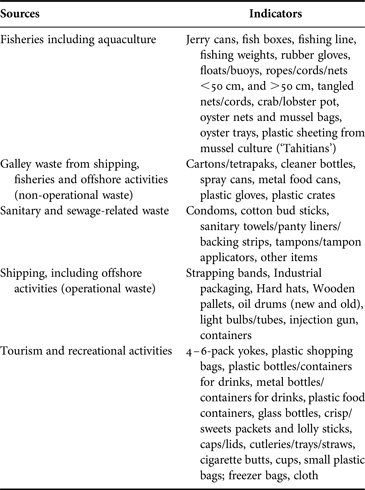
To estimate the sources of marine litter in this area, we defined some marine litter items as indicators for five categories of potential origins of marine debris (Table 1). The possible sources of marine coastal litter includes fisheries and aquaculture, shipping activities, sanitary and sewage-related waste, shipping including offshore activities, tourism and recreational based waste.
Sources and indicators selected for data analysis in the survey area on Bandar Abbas beach.
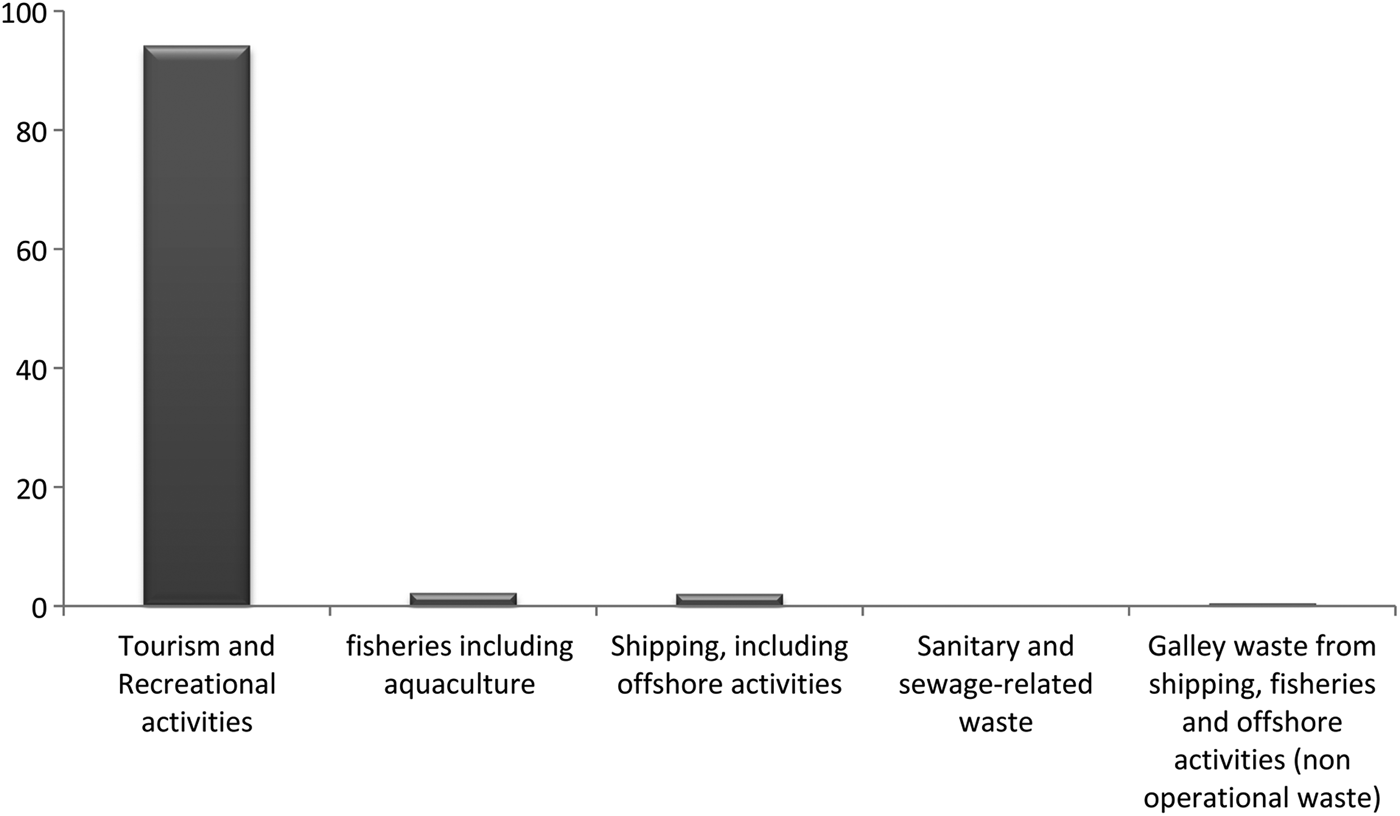
Analysis shows that the marine debris left on the beach is mainly produced by beach users and recreational activities (Figure 3). About 94% of all marine items originated from beach users. Fisheries and aquaculture in the area is responsible for about 2% of observed marine litter on the beach.
Sources of all marine litter found on on 100 m stretches of beach in Bandar Abbas, northern part of the Persian Gulf, Iran.
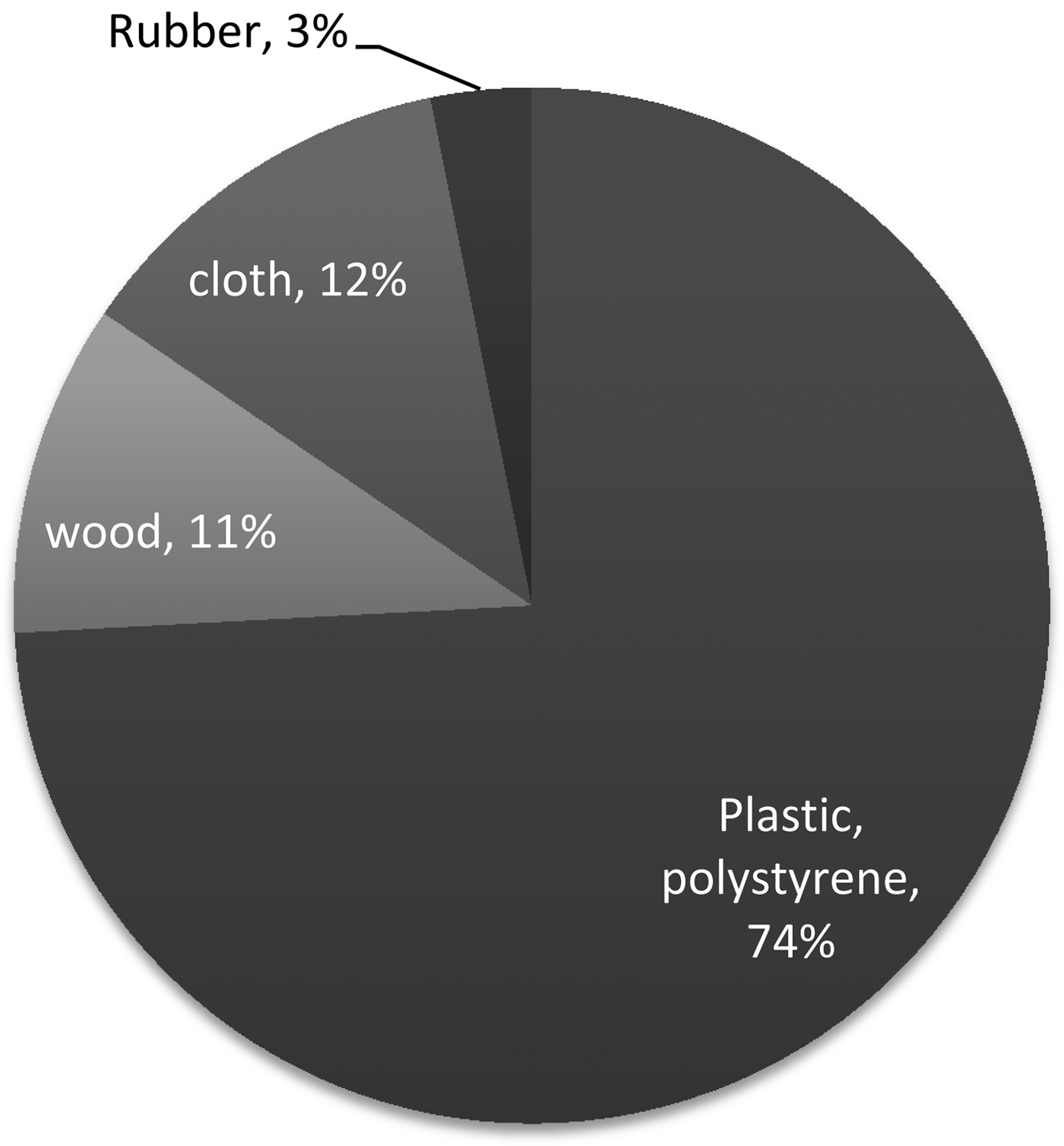
For the 1000 m scale of the survey, the 4 km of the beach were investigated to determine the quantity and composition of all marine litter >50 cm in size. An average total number of 106 items was found in the study area. The highest proportion of marine litter were plastics which represented about 74% of total debris (Figure 4).
Proportion of marine debris >50 cm recorded in 1000 m stretch of beaches during the project on May 2014 on the coastline of Bandar Abbas, northern part of the Persian Gulf, Iran.
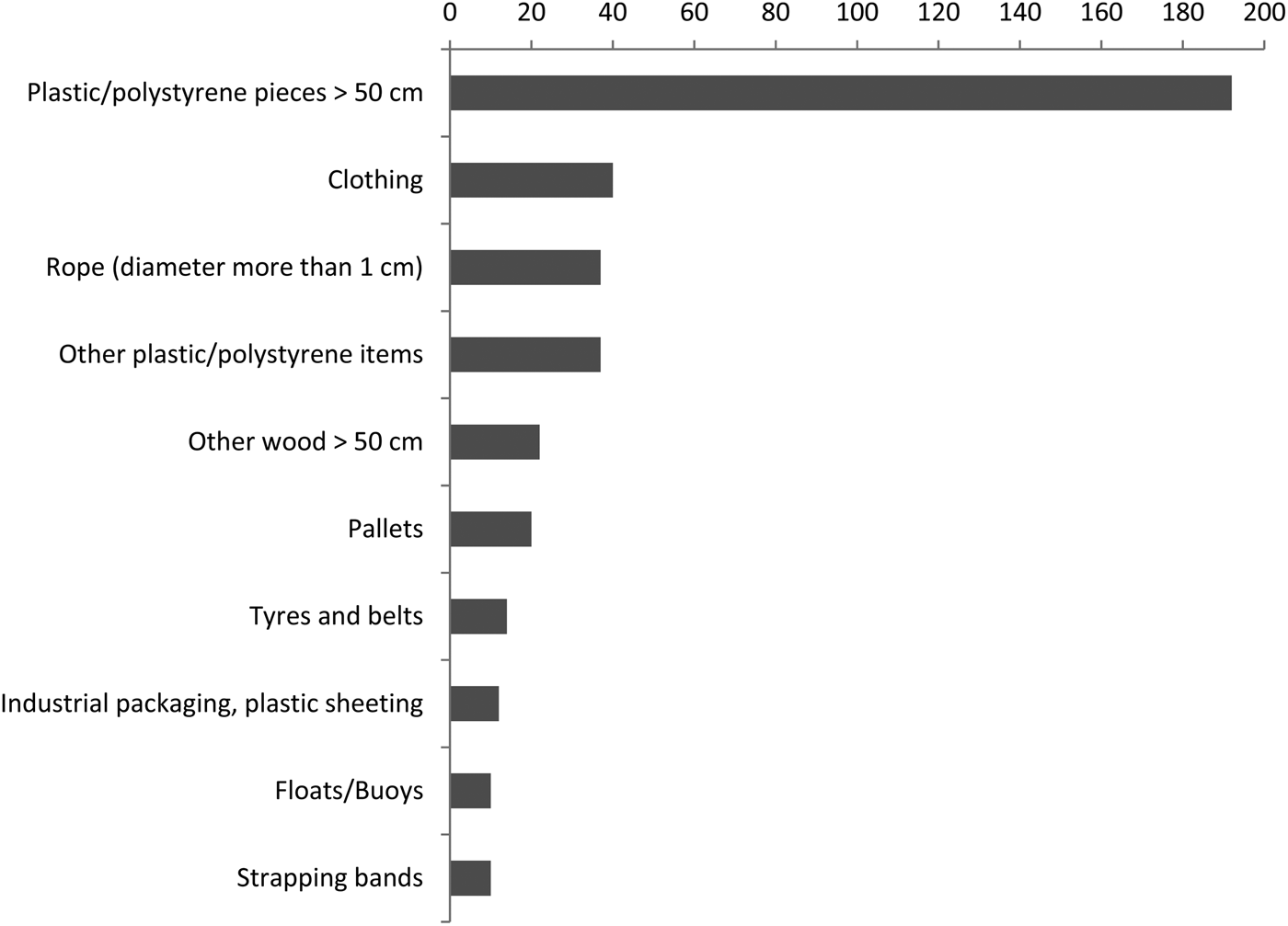
The most common items were plastic/polystyrene materials and clothing was the second-most common item observed on the reference beach (Figure 5). Of the other 10 categories found, plastic rope from the plastic/polystyrene category was third, which mostly indicates residuals of fisheries activities on the beach.
The most common marine litter items >50 cm found in the highest number on 1000 m stretches of beach in Bandar Abbas, northern part of the Persian Gulf, Iran.
DISCUSSION
Marine debris is a multidimensional problem of global scale that particularly challenges coastal communities (Cheshire et al., Reference Cheshire, Adler, Barbière, Cohen, Evans, Jarayabhand and Westphalen2009). Despite the large-scale effort from different commissions and institutes (OSPAR, 2007b; Cheshire et al., Reference Cheshire, Adler, Barbière, Cohen, Evans, Jarayabhand and Westphalen2009; NOAA available at marinedebris.noaa.gov) the problem remains unsolved till today. Iran has an extended sea coast border which is estimated as about 644 km lying along the southern Caspian shore and about 1770 km on the northern part of the Gulf of Oman and Persian Gulf (Fisher, Reference Fisher1968). Globally, the main source of marine litter is from land-based and oceanic-based activities, with 50% originated from land (Sheavly & Register, Reference Sheavly and Register2007). The Persian Gulf is under tremendous pressure from many levels such as hydrocarbon pollution, heavy construction, offshore activities, severe drought caused by construction of dams, and changes associated with global warming (Sheppard et al., Reference Sheppard, Al-Husiani, Al-Jamali, Al-Yamani, Baldwin, Bishop and Zainal2010). The rapid pace of heavy construction in coastal areas and mismanagement of municipal litter results in beaches and intertidal zones being dumping places of litter. As our results revealed (Figure 3) the origin of marine debris found on these beaches is mainly due to beach users’ behaviour, in that they accidentally or intentionally left their litter on the beach. A volunteer-based study conducted on Chilean beaches showed that the average of small plastic items per m2 is 27 and that these originated from coastal urban centres and their economic activities (Hidalgo-Ruz & Thiel, Reference Hidalgo-Ruz and Thiel2013). Another similar study on a Caribbean coast in mangrove beach sites revealed that plastic and polystyrene items were the most abundant debris (Debrot et al., Reference Debrot, Meesters, Bron and de León2013). The second source of marine litter is from fisheries activities (Figure 3) although it is not considerable compared with tourism and recreational activities. The traditional fishing method that is known as ‘Moshta’ is frequently observed at the intertidal zone. This efficient and environmentally friendly method of fishing is a cage of wooden bars that is embedded on the intertidal areas with a coverage of nets around it that simply traps fish and other marine animals. Fishermen collect animals at low tide by walking on the dry beach. It is estimated that some wood and nets are lost in storms or destroyed.
As well as the health and aesthetic problem, marine debris has fatal consequences for marine biota (Laist, Reference Laist, Coe and Rogers1997; Browne et al., Reference Browne, Dissanayake, Galloway and Lowe2008; Cole et al., Reference Cole, Webb, Lindeque, Fileman, Halsband and Galloway2014). Our great concern is about the amount of plastic items found on the beach (Figures 1 & 4). Following the global tendency (Ryan et al., Reference Ryan, Moore, van Franeker and Moloney2009; Thompson et al., Reference Thompson, Moore, Vom Saal and Swan2009) this non-degradable, long durable and inexpensive polymer makes up the highest percentage of total items recorded in the area. Recent studies show that fragmentation of plastic debris produces small fragments called ‘microplastics’ with harmful impacts on all trophic levels either through direct consumption or by release of chemicals (Rios et al., Reference Rios, Moore and Jones2007; Teuten et al., Reference Teuten, Saquing, Knappe, Barlaz, Jonsson, Björn and Takada2009; Thompson et al., Reference Thompson, Moore, Vom Saal and Swan2009; Ivar do Sul & Costa, Reference Ivar do Sul and Costa2014).
We suggest expanding the environmental educational systems in coastal borders along with establishing anti-littering policies, to raise awareness about the consequences of litter on the marine environment. Littering behaviour is the one that needs to be changed. Due to the fatal consequences of marine debris on marine biota, immediate concern is vital in Iran. We recommend to marine biologists and policymakers to open up serious and immediate discussion in this field of research in Iran.
ACKNOWLEDGEMENTS
We would like to thank marine biology and fisheries students of Bandar Abbas University for their enthusiastic volunteer participation in this project. We appreciate the anonymous reviewers for the valuable suggestions.
FINANCIAL SUPPORT
This study was supported financially by Hormozgan University in Iran.