INTRODUCTION
The genus Leptodius A. Milne-Edwards, 1863, belonging to the subfamily Xanthinae under the family Xanthidae, has 12 well-recognized species and all of them are found in the Indo-West Pacific region (Serene, Reference Serene1968; Ng et al., Reference Ng, Guinot and Davie2008). Among all the species reported under this genus, Leptodius exaratus is very commonly observed in the rocky intertidal areas of the western coast of India (Chhapgar, Reference Chhapgar1957; Dev Roy, Reference Dev Roy, Venkatraman, Sivaperuman and Raghunathan2013). Lee et al. (Reference Lee, Mendoza, Ng and Kim2013) carried out a study to solve the taxonomic complexity of Leptodius exaratus, and as a result, recognized two distinct species – Leptodius exaratus and Leptodius affinis. Besides their morphological features, the distinctions between the two species are made on the basis of the first male gonopod. Lee et al. (Reference Lee, Mendoza, Ng and Kim2013) also defined the distribution range of the two species, with Leptodius exaratus occurring in the western Indian Ocean, the Persian Gulf and the Red Sea, while Leptodius affinis is found in waters ranging from the eastern Indian Ocean to the central Pacific Ocean. In the present study, Leptodius affinis is reported from outside of its known distribution range for the first time, on the coastal areas of Gujarat, on the western coast of India.
MATERIALS AND METHODS
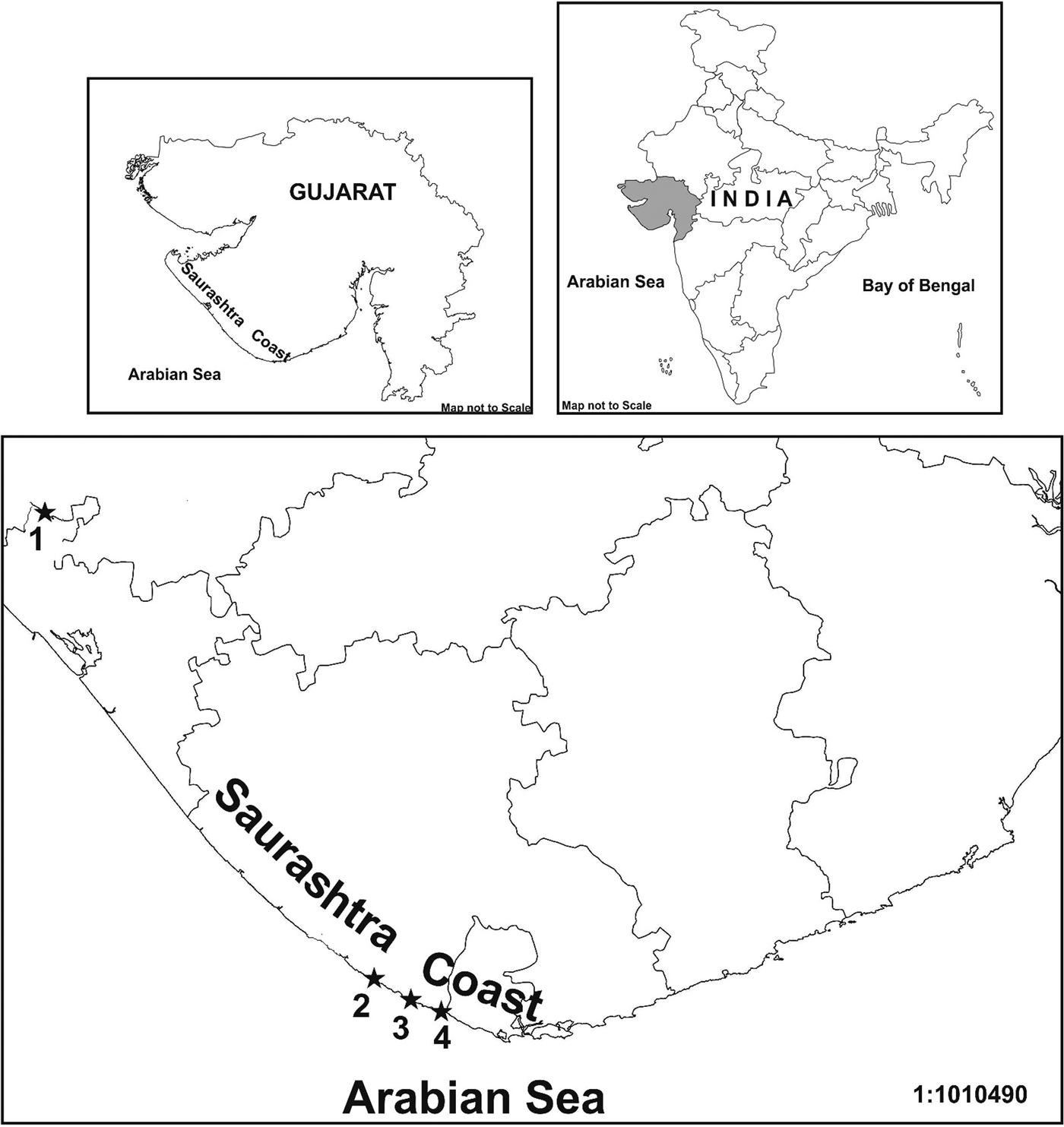
In the present study, a total of 35 male specimens were collected from four different locations: (1) Okha (22°28′48″N, 69°04′44″E) (specimens collected 23 August 2012, on rocky shore behind Fishery Research Centre); (2) Sutrapada (20°49′53″N, 70°29′17″E) (specimens collected 15 March 2013, on a rocky shore near the fishing harbour jetty); (3) Dhamlej (20°46′29″N, 70°36′19″E) (specimens collected 8 July 2013, on a rocky shore behind the fishermen community); and (4) Kodinar of the Gujarat state (20°45′29″N, 70°39′39″E) (specimens collected 12 July 2013, on a rocky shore near the cement factory jetty) (Figure 1). The male specimen of L. affinis (ZL-AR-CR-54, CL: 29.07 mm, CW: 18.09 mm) was deposited in the Zoology Museum at the Department of Zoology, M.S. University of Baroda, Vadodara, Gujarat, India.
Map of study area: 1. Okha; 2. Sutrapada; 3. Dhamlej; 4. Kodinar.

Specimens were handpicked during low tide from the site indicated. All the specimens were brought to the lab and preserved in 10% formalin for further studies. The specimens were identified to the species level using different identification keys and monographs (Chhapgar, Reference Chhapgar1957; Sethuramalingam & Khan, Reference Sethuramalingam and Khan1991; Jeyabaskaran et al., Reference Jeyabaskaran, Khan and Ramaiyan2000; Lee et al., Reference Lee, Mendoza, Ng and Kim2013). For further confirmation of species, all the specimens were examined and compared with the photographs and the identification information available on the Marine Species Identification Portal website (www.speciesidentification.org). A detailed morphometric analysis of all the specimens was conducted using a digital vernier caliper, and different morphological characters such as carapace length (CL), carapace width (CW) and front width (FW) were measured. The morphometric measurements of the male pleopod (total length (TL) and apical lobe length or tip length (TiL)) were acquired using an ocular micrometer.
RESULTS
SYSTEMATICS
Order decapoda Latreille, 1803
Infraorder brachyura Linnaeus, 1758
Superfamily xanthoidea Macleay, 1838
Family xanthidae Macleay, 1838
Subfamily xanthinae Macleay, 1838
Genus Leptodius A. Milne Edwards, 1863
Leptodius affinis (De Haan, Reference De Haan and von Siebold1835)
(Figures 2–4)
Cancer (Xantho) affinis De Haan, Reference De Haan and von Siebold1835, p. 48, pl. 13, Figure 8; Krauss, Reference Krauss1843, p. 30.
Leptodius affinis male ZL-AR-CR-54 (CL 29.07 mm, CW 18.09 mm): (A) dorsal view; (B) anterior view; (C) ventral view. Scale bar = 1 cm.
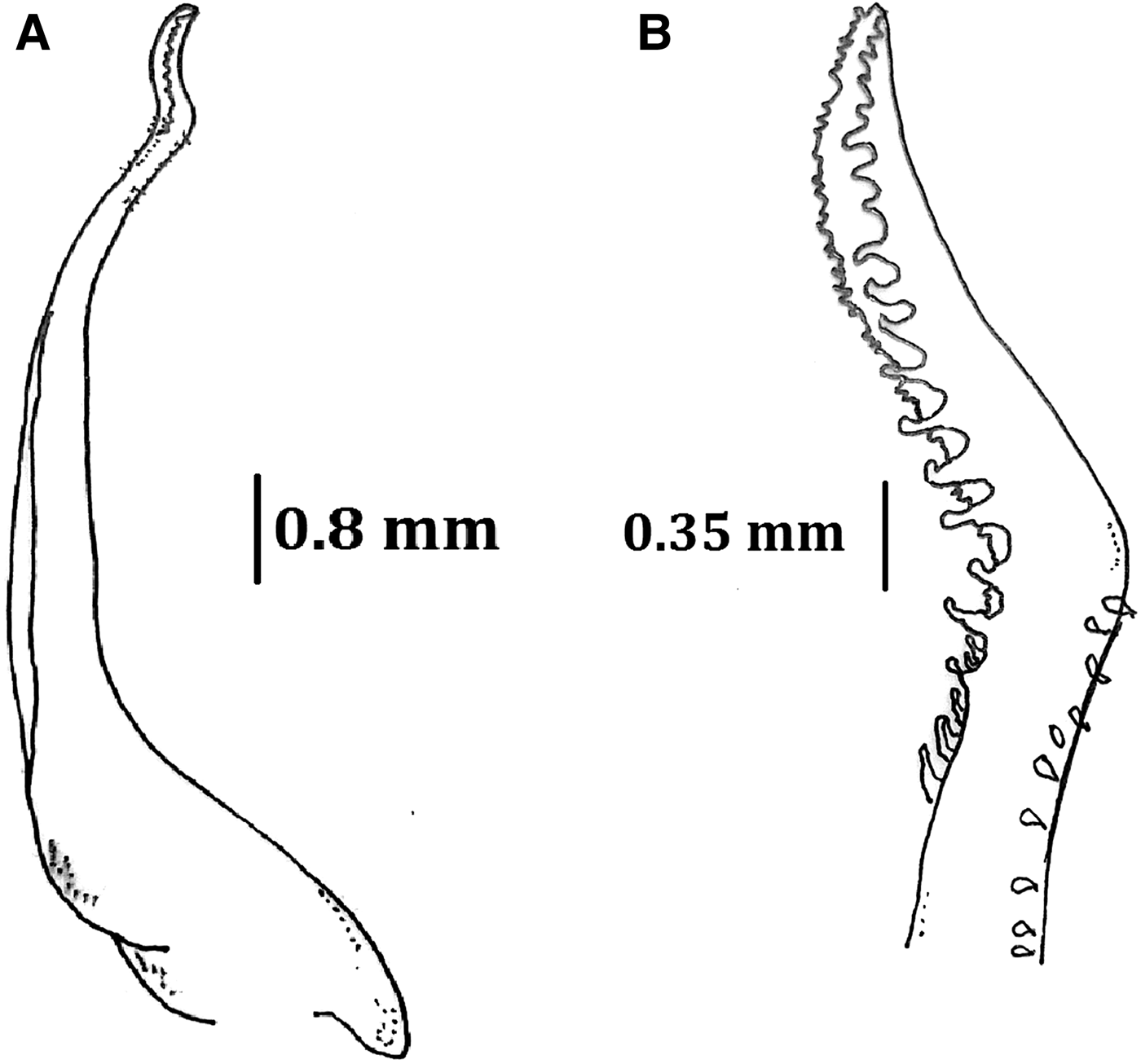
First pleopod (left G1) of male Leptodius affinis: (A) entire pleopod; (B) apical lobe.
Different colour forms of Leptodius affinis (De Haan, Reference De Haan and von Siebold1835) (A–E) and Leptodius exaratus (H. Milne Edwards, 1834) (F–H). A, B, F: Sutrapada; C, G: Dhamlej; D: Kodinar; E, H: Okha. A: carapace length (CL) = 19.07 mm, carapace width (CW) = 30.69 mm. B: CL = 17.51 mm, CW = 28.30 mm. C: CL = 20.60 mm, CW = 28.39 mm. D: CL = 14.97 mm, CW = 22.84 mm. E: CL = 18.47 mm, CW = 27.36 mm. F: CL = 15.64 mm, CW = 24.31 mm. G: CL = 19.66 mm, CW = 30.67 mm. H: CL = 19.51 mm, CW = 30.40 mm. (a–c: formalin preserved specimens, d–h: fresh specimens.)
Cancer (Xantho) lividus De Haan, Reference De Haan and von Siebold1835, p. 48, pl. 13, Figure 6.
Chlorodius exaratus Dana, Reference Dana1852, p. 208.
Leptodius exaratus A. Milne Edwards, Reference Milne-Edwards1873, p. 222; De Man, Reference De Man1887, p. 33; Alcock & Anderson, Reference Alcock and Anderson1984, p. 200; Chopra & Das, Reference Chopra and Das1937, p. 398; Sankarankutty, Reference Sankarankutty1962, p. 129; Garth & Kim, Reference Garth and Kim1983, p. 570; Jones & Morgan, Reference Jones and Morgan1994, p. 166; Ng & Davie, Reference Ng and Davie2002, p. 374.
Xantho exaratus var. typica Ortmann, Reference Ortmann1893, p. 445.
Chlorodius exaratus var pictus Stimpson, Reference Stimpson1907, p. 54, Figure 6.
Chlorodius exaratus var typicus Stimpson, Reference Stimpson1907, p. 55.
Xatho (Leptodius) exaratus Alcock, Reference Alcock1898, p. 118 [353]; Laurie, Reference Laurie1906, p. 402; Gravely, Reference Gravely1927, p. 146.
Xantho exaratus Holthuis, Reference Holthuis1953, p. 27; Buitendijk, Reference Buitendijk1960, p. 331, Figure 9.
Leptodius nigromaculatus Serène, Reference Serène1962, p. 255, Figure 1A–H; Dai et al., Reference Dai, Yang, Song and Chen1986, p. 272, Figure 155A.
Leptodius affinis Lee et al., Reference Lee, Mendoza, Ng and Kim2013, p. 192, Figures 3 & 4E–I.
TYPE MATERIAL
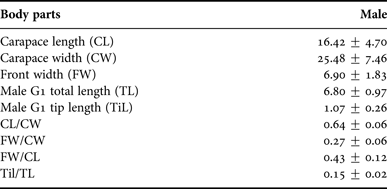
Twelve male specimens (six specimens from Dhamlej, four specimens from Okha and two specimens from Kodinar) were identified as Leptodius affinis. The morphological measurements of the specimens are given in Table 1. One male specimen, deposited in the Zoology Museum of the Department of Zoology, M.S. University of Baroda, Vadodara, Gujarat, India, was assigned the following details: catalogue number – ZL-AR-CR-54; site of collection – Okha; and date of collection – 23 August 2012. Additional specimens were sub-labelled from ZL-AR-CR-54(i) to ZL-AR-CR-54(xi).
Major morphological measurements of males of Leptodius affinis.
DIAGNOSIS
Transversely subovate in shape, carapace regions well-defined, dorsal surface of carapace is depressed and finely granular (Figure 2A), 1.4–1.6 times as broad as long, front short, cut in to two lobes (Figure 2B), ratio of FW/CL and FW/CW is 0.27 ± 0.06 and 0.43 ± 0.12, respectively (Table 1). Anterior margins of frontal lobes moderately concave, orbits small, oval in shape; superior margins having two small fissures while inferior margins having two blunt teeth. Anterior border with four teeth; between first anterolateral teeth and exoorbital angle with small concavity. First and last anterolateral teeth smaller in size while second and third more pronounced; small sinus observed between each anterolateral teeth. Posterolateral margin slightly concave. Antennules situated transversely; flagellum occupied by orbit hiatus. Buccal cavity completely covered by third maxillipeds; merus subquadrate; surface granular. Thoracic sternum with fused first and second sternites, fourth sternite (Figure 2C) with longitudinal line; fifth to eight sternites distinct.
Chelipeds asymmetrical with outer granular surface, anterior and posterior margins of merus with long setae; outer surface of carpus covered with fine granules; fingers black in colour and toothed, tips of fingers spoon shaped.
Ambulatory legs smooth, first to third pair with setae on anterior and posterior margins of merus; dactylus covered with dense setae.
Male abdomen narrow in shape; third to fifth somites fused together.
First pleopod of male long and slender in shape; proximal and distal parts of ventral margins of apical lobes ornamented with 5–6 and 6–8 small outgrowths, respectively, apical lobe curved in shape. Forms angle with the rest of the structure of first pleopod (Figure 3). Length of apical lobe 0.11–0.17 times the TL (Table 1).
REMARKS
The main difference between Leptodius exarartus and Leptodius affinis appears in the morphology of the first male pleopod. The apical lobe or tip is observed to be shorter in Leptodius exarartus than in Leptodius affinis. The angle formed between the apical lobe and the rest of the structure of the pleopod is greater in Leptodius exarartus, while the angle is lesser in Leptodius affinis. Therefore, the apical lobe appears to be more bent. On the ventral side of the apical lobe, outgrowth was observed in very few Leptodius exarartus, in comparison with Leptodius affinis. The ratio between the TiL and TL of the pleopod is observed to be less than 0.1 in Leptodius exarartus while it is greater than 0.1 in Leptodius affinis (Lee et al., Reference Lee, Mendoza, Ng and Kim2013). The colour of the species varies with the locality and different colour patterns have been reported. In the present study, a total of five different colour patterns were recorded for Leptodius affinis and three for Leptodius exaratus (Figure 4). Amongst the two species recorded, Leptodius exaratus is commonly found on the rocky shores of Gujarat (Chhapgar, Reference Chhapgar1957). This species utilizes a wide range of micro habitats such as rock crevices, deep tidal pools and algal assemblages, and the maximum abundance of the species was observed in the lower intertidal zone of the current study area. Colour patterns were labelled A–H, and the colour patterns of Leptodius exaratus, such as G and H, were commonly observed in the area where zoanthids were dominant, while the colour pattern F was commonly observed in algal assemblages (Figure 4). Leptodius affinis were found in upper intertidal areas where rocks and boulders were available. This species utilize different kinds of micro habitats such as algal assemblages, rock crevices, underneath the surfaces of rocks and boulders and shallow tide pools. In the present study, the maximum number of specimens of Leptodius affinis were collected from under rock surfaces. Specimens with the colour patterns A–D (Figure 4) were collected from underneath rock surfaces and tidal pools, while specimens with the colour pattern E were collected from algal assemblages.
The distribution range of Leptodius affinis comprises an area stretching from the eastern Indian Ocean to the central Pacific Ocean. In India, the species is recorded from several locations on the eastern coast, including the Mergui Archipelago (Chopra & Das, Reference Chopra and Das1937; De Man, Reference De Man1987), the Bay of Bengal (Alcock & Anderson, Reference Alcock and Anderson1984; Alcock, Reference Alcock1898), the Andaman islands (Sankarankutty, Reference Sankarankutty1962) and the Gulf of Mannar (Gravely, Reference Gravely1927). The present study reports the occurrence of this species for the first time on the western coast (Gujarat state) of India, located outside the known distribution range of Leptodius affinis. This creates an interesting scope for carrying out an investigation to determine the presence of the species at other locations along the western coast of India and to redefine the distribution range of the species.
ACKNOWLEDGEMENTS
The authors are grateful to Dr Peter K.L. Ng and Dr Jose Christopher E. Mendoza, Department of Biological Sciences, Faculty of Science, National University of Singapore, Singapore, for their guidance and comments regarding the identification of the species. The authors are grateful to Dr Sang-kyu Lee, School of Biological Sciences, Seoul National University, Seoul, Korea, for his confirmation of the identification of the species. Thanks are due to Ms Sumedha Arya, Ms Sripriya Iyer, Mr Ravi Vasava and Mr Gunjan Soni for providing technical support during the study. Trivedi Jigneshkumar is grateful to the UGC-RFSMS scheme for financial support.