



Introduction
Limestone rock outcrops are often largely covered with lichens because the substratum is too dry and impenetrable for other organisms. Taxonomic groups that are speciose and abundant in this environment include Verrucariaceae, Teloschistaceae, Megasporaceae, Lecanoraceae and several groups of cyanolichens (Nash Reference Nash1996). The phenomenon is almost cosmopolitan, except that limestone outcrops in the tropics are much poorer in lichens. The reasons for this are twofold: limestone in the (wet) tropics erodes quickly due to the frequent and copious rainfall, which dissolves the surface; and tropical limestone outcrops are often much overgrown by mosses and plants, including lianas and shrubs, because the substratum is relatively nutrient-rich and the abundance of water allows plant growth (Lambley Reference Lambley and Galloway1991). Lichens are generally more abundant in dry tropical regions, although even there, plant growth is much more lush than in temperate to arctic regions.
On a recent collecting trip to Apiaí in São Paulo State, southern Brazil (see Aptroot et al. (Reference Aptroot, dos Santos, Oliveira, Fraga, Spielmann and Cáceres2023) for other new species and records from this area), we visited an exposed limestone outcrop above a deep ravine. Despite the difficulties in collecting there, we encountered and collected a small number of lichens. One of them stood out: although in the tropics you collect an undescribed species almost daily, it is not often that you realize in the field that you are probably looking at a new species. This one was obvious: a Lecanora Ach. on hard limestone, with a verrucose thallus and small apothecia with pale discs with relatively prominent margins that are UV+ yellow (seen with hand lens with built-in UV feature). Morphologically, the species resembles some members of the Lecanora dispersa (Pers.) Sommerf. aggregate (Śliwa et al. Reference Śliwa, Miadlikowska, Redelings, Molnar and Lutzoni2012), initially classified under the genus Myriolecis Clem. (Zhao et al. Reference Zhao, Leavitt, Zhao, Zhang, Arup, Grube, Pérez-Ortega, Printzen, Śliwa and Kraichak2016). However, the older name Polyozosia A. Massal. (Kondratyuk et al. Reference Kondratyuk, Lőkös, Jang, J-S and Farkas2019) was subsequently discovered, and its use was adopted. Chemically, the presence of lichexanthone is a distinctive characteristic, rare within the genus Lecanora. It is otherwise known only from Lecanora lichexanthona Guderley (Guderley Reference Guderley1999) and Lecanora xanthoverrucosa L. A. Santos et al. (Santos et al. Reference Santos, Aptroot, Lücking and Cáceres2023). Considering Lecanora s. lat., lichexanthone (as well as other xanthones) has also been reported from the genus Vainionora Kalb.
While preparing the description of the new species, it was unclear if it should be placed in either Polyozosia or Myriolecis, or simply in the collective genus Lecanora. Phylogenetic analysis showed that it did not cluster with Polyozosia/Myriolecis. The presence of lichexanthone as a cortical substance is very common in almost all lichen groups in the tropics, while it is extremely rare in temperate lichens and absent in arctic species. Its restriction to a certain part of the thallus (in this case the apothecium margin) is not uncommon either. In the tropical Lecanora species that contain this substance (Guderley Reference Guderley1999), it is present in the thallus cortex, and each of the species differ from our new species in many additional characters; for example, L. lichexanthona by additionally containing three different secondary metabolites and L. xanthoverrucosa by the presence of lichexanthone predominantly in the thallus, dark brown discs and the lignicolous habitat. Neither are even remotely similar to each other or the new species.
Material and Methods
Specimens were observed with an Olympus SZX7 or SZ40 stereomicroscope and images were captured with either a Nikon Coolpix camera attached to the dissecting scope or with a Canon Eos M5 (with stacking using a Genesis GMR-150 rail on a Benro TMS07A tripod with a Sunwayfoto XB-2811 ball head). Hand-cut sections of ascomata and thalli were studied in material mounted in water, 5% KOH (K) and/or Lugol’s reagent (1% I2) after pretreatment with KOH (IKI). Chemical spot reactions are abbreviated as K (5% KOH), C (commercial bleach), KC (K followed by C), P (paraphenylenediamine), and UV (fluorescence at 366 nm). Thin-layer chromatography (Orange et al. Reference Orange, James and White2010) was performed in solvent A.
The methods for DNA extraction and polymerase chain reaction (PCR) amplification followed the same procedures as those outlined in Santos et al. (Reference Santos, Aptroot, Lücking and Cáceres2023); the primers ITS1F (Gardes & Bruns Reference Gardes and Bruns1993) and ITS4 (White et al. Reference White, Bruns, Lee, Taylor, Innis, Gelfand, Sninsky and White1990) were used to amplify the ITS rDNA region.
Sequences were assembled and edited with BioEdit v. 7.2.0 (Hall Reference Hall1999). For the reconstruction of the phylogenetic tree, the newly generated sequence was added to the set of ITS sequences selected from GenBank, initially aiming to encompass the highest diversity within the genus Lecanora. Sequences from Lecanora s. lat. (Santos et al. Reference Santos, Aptroot, Lücking and Cáceres2023), Lecanora s. str. (Zhao et al. Reference Zhao, Leavitt, Zhao, Zhang, Arup, Grube, Pérez-Ortega, Printzen, Śliwa and Kraichak2016; Malíček et al. Reference Malíček, Berger, Palice and Vondrák2017) and the Lecanora dispersa group (=Polyozosia) were included. After constructing the first tree, the ITS sequence set was narrowed down to the clade that included the target sequence and other phylogenetically related sequences. The sequences of Polyozosia, although not phylogenetically related to the new species, were retained as a sister group in the analysis to demonstrate that, despite the morphological similarity of the new species to Polyozosia species, they do not share a phylogenetic relationship. For reconstructing the phylogenetic tree, the newly generated sequence was added to the set of ITS sequences selected from GenBank that included species suspected to be closely related to the species under study (see Supplementary Material Table S1, available online), and were then aligned using MAFFT v. 7 (Katoh et al. Reference Katoh, Asimenos and Toh2009; Katoh & Standley Reference Katoh and Standley2013).
A maximum likelihood (ML) phylogenetic tree was inferred using RAxML v. 8.1.11 (Stamatakis Reference Stamatakis2006), with the GTR-Gamma model and 1000 bootstrap replicates. Trees were visualized and edited in FigTree v. 1.4 (http://tree.bio.ed.ac.uk/software/figtree).
Results
Phylogeny
Although we initially assumed that the new species belonged to the genus Polyozosia, which is why it was considered as a sister group in the phylogenetic tree presented here (Fig. 1), we conducted additional tests with various groups of taxa within Lecanora s. lat. As the selection of sequences was progressively refined, the target sequence consistently grouped, with high support, in a clade containing the sequences of Lecanora campestris (Schaer.) Hue and L. allophana (Ach.) Nyl. Based on these results and the reliability of the identification of the latter sequence, we infer that the new species probably belongs to the group Lecanora s. str., considering that Lecanora allophana and L. campestris are recognized members of the Lecanora subfusca group, which is the core group within Lecanora.
Phylogenetic analysis of Lecanora species, based on maximum likelihood analysis of ITS rDNA sequences. Numbers above branches indicate bootstrap support values. Voucher information associated with the sequences for which GenBank Accession numbers are provided is given in Supplementary Material Table S1 (available online). The new Lecanora species is marked in bold. In colour online.

Taxonomy
Lecanora austrocalcicola Aptroot, L. A. Santos & M. Cáceres sp. nov.
MycoBank No.: MB 858657
Saxicolous on limestone with a verrucose thallus, sessile apothecia, beige disc, white margin, and lichexanthone on the apothecial margin.
Type: Brazil, São Paulo, Apiaí, Parque Estadual Turístico do Alto Ribeira, along road on limestone outcrop, 24°32′S, 48°43′W, alt. 550 m, 28 May 2022, A. Aptroot & L. A. dos Santos (ISE 55269—holotype; ABL—isotype). GenBank Accession no.: PV461558.
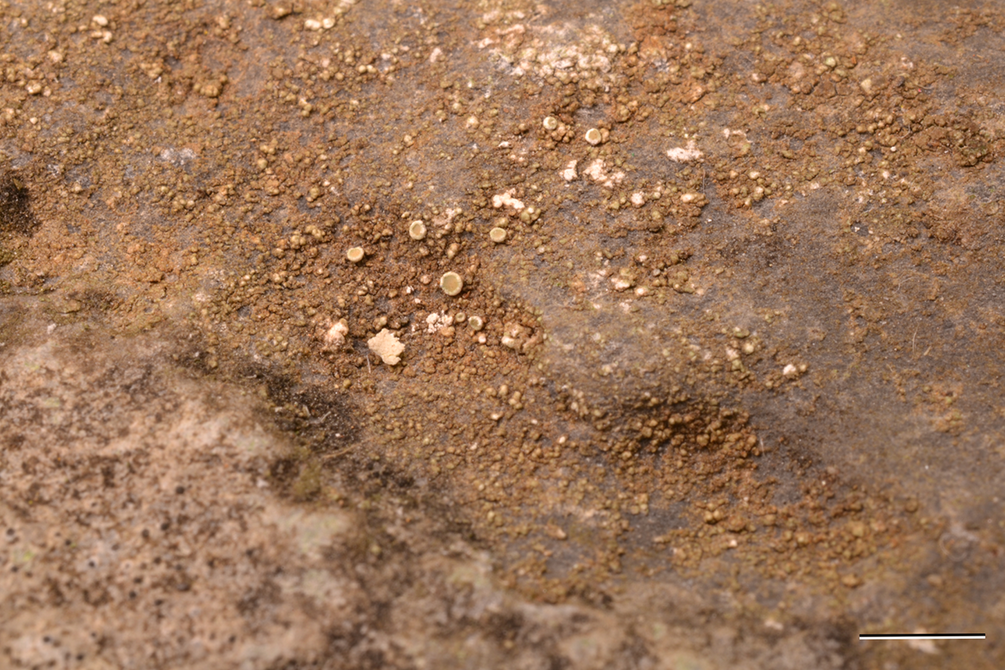
Habitus of the holotype of Lecanora austrocalcicola. Scale = 2 mm. In colour online.
Detail of the habitus of the Lecanora austrocalcicola holotype. Scale = 1 mm. In colour online.
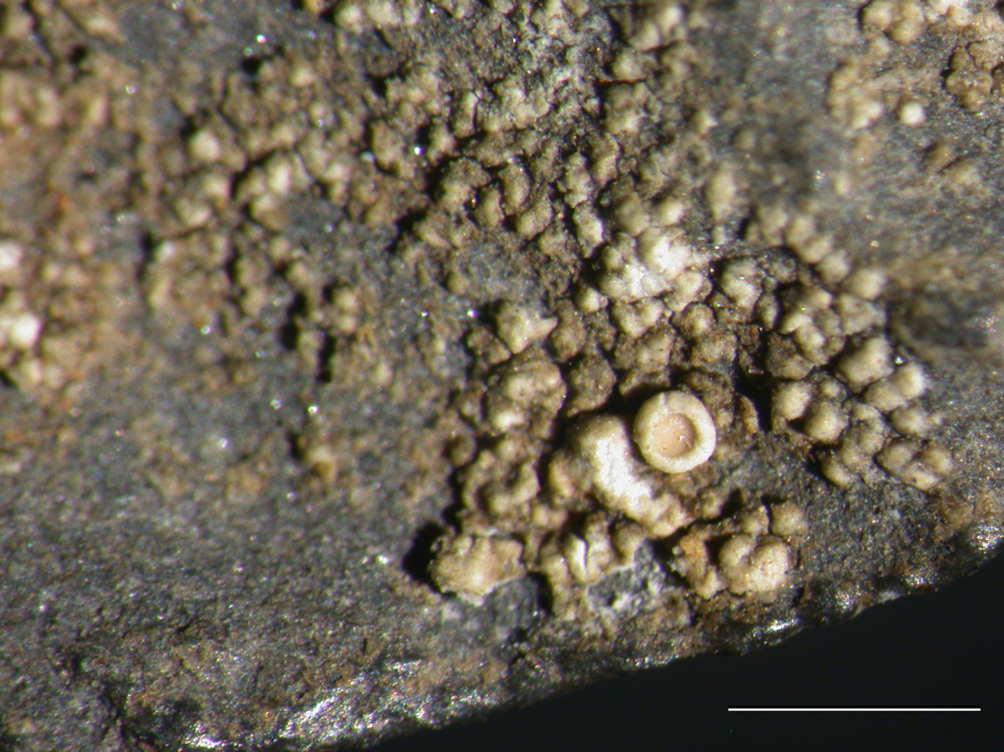
Thallus crustose, saxicolous, up to 4 cm wide, c. 0.1 mm thick, somewhat discontinuous, pale brownish grey, dull, microverrucose with more or less hemispherical warts of c. 0.1 mm diam., not pruinose, medulla creamish white. Soredia absent. Prothallus absent. Algae chlorococcoid.
Apothecia sessile, 0.2–0.3 mm diam.; disc beige, not pruinose; margin whitish, prominent, distinctly higher than the disc, persisting, entire, c. 0.05 mm wide. Amphithecium corticate, with dense small crystals which dissolve in KOH (=allophana-type). Hymenium hyaline, c. 50 μm high; paraphyses without darkened tips; epihymenium brown to yellowish brown (=chlarotera-type), c. 5 μm high, with small crystals; the pigment and small crystals not soluble in KOH. Hypothecium hyaline, with dense small crystals which dissolve in KOH. Ascospores 8 per ascus, ellipsoid, 9–11 × 4.5–5 μm.
Pycnidia not observed.
Chemistry
Thallus K−, P−, C−, UV−; apothecium margin K−, P−, C−, UV+ yellow. TLC: lichexanthone.
Etymology
The name refers to the presence of the species in the Southern Hemisphere and its calcicolous habitat.
Habitat and distribution
On a limestone outcrop in the Atlantic rainforest biome; known only from Brazil.
Notes
While several Lecanora species are usually present on every limestone outcrop in arctic, boreal, temperate and subtropical regions, they are rare to absent on limestone outcrops in the tropics. The new species is unique among all other species of the genus in containing lichexanthone in only the apothecium margin. Phylogenetically it does not cluster closely with any other species (or identify as an already described species).
Discussion
This species is remarkable for several reasons. Its habitat (exposed limestone cliff in the wet tropics) is rare because limestone in the wet tropics is usually overgrown with lush vegetation because it is so fertile and weathers fast. Secondly, it is among just a small number of lichens in Lecanora and even in the Lecanorales that contain lichexanthone as the only secondary metabolite. Both the genus and the family are most diverse outside the tropics, where almost no members of these groups contain lichexanthone; it thus seems to be an adaptation to the strong UV radiation on exposed tropical cliffs.
Supplementary Material
The Supplementary Material for this article can be found at http://doi.org/10.1017/S0024282925101126.
Acknowledgements
The material cited was collected under permit 71229-8 and is kept in the Brazilian herbarium ISE. This study was financed in part by the Coordenação de Aperfeiçoamento de Pessoal de Nível Superior (CAPES Brasil; Finance Code 001), who provided a visiting professorship to the first author. The first author warmly thanks the Stichting Hugo de Vries-fonds for a travel fund. The authors thank Conselho Nacional de Pesquisa e Desenvolvimento (CNPQ) for financially supporting this work with a Ph.D. scholarship to LAS (140847/2019-7), a research grant to MESC (307569/2019-5) and for financial support in the Universal project (Process: 437097/2018-8). Permission for collecting in the Parque Estadual Turístico do Alto Ribeira in Apiaí is thanks to the Instituto de Pesquisas Ambientais. The authors are grateful to the Plataform of Sequencing LABCEN/CCB in the UFPE for the use of its facilities.
Author ORCIDs
Andre Aptroot, 0000-0001-7949-2594; Lidiane Alves dos Santos, 0000-0002-2871-8693; Marcela Caceres, 0000-0002-5612-1309.



