INTRODUCTION
Subterranean clover (Trifolium subterraneum L.) is the most important annual pasture legume in the winter-dominant rainfall areas of Southern Australia (where mean annual precipitation (MAP) varies from 250 to 1200 mm) and is grown on more than 29 million ha (Hill & Donald Reference Hill and Donald1998; Nichols et al. Reference Nichols, Foster, Piano, Pecetti, Kaur, Ghamkhar and Collins2013). It is native to the Mediterranean basin, West Asia and the Atlantic coast of Western Europe (Morley & Katznelson Reference Morley, Katznelson, Baker and Stebbins1965; Katznelson Reference Katznelson1974; Gladstones & Collins Reference Gladstones and Collins1983; Zohary & Heller Reference Zohary and Heller1984). Subterranean clover has also been introduced to other countries with Mediterranean-type climates, including South Africa, Chile, Argentina, the west coast and gulf regions of the United States of America (USA), and to parts of New Zealand and Uruguay (McGuire Reference McGuire and Taylor1985; Smetham Reference Smetham2003). On the basis of worldwide usage, it makes the greatest contribution of all the annual clovers to livestock feed production and soil improvement (McGuire Reference McGuire and Taylor1985).
The initial introduction (and subsequent naturalization) of subterranean clover into Australia occurred with the early settlers from Europe in the 19th century, as a contaminant of wool fleeces, agricultural seeds or forage (Gladstones Reference Gladstones1966; Nichols et al. Reference Nichols, Foster, Piano, Pecetti, Kaur, Ghamkhar and Collins2013). Following its commercialization as an agricultural species in the 20th century, 45 cultivars have been developed (Nichols et al. Reference Nichols, Foster, Piano, Pecetti, Kaur, Ghamkhar and Collins2013). Systematic germplasm collections of subterranean clover from its centre of origin occurred from the 1950s, particularly by Australian scientists, in order to broaden the genetic base of the species (Nichols et al. Reference Nichols, Revell, Humphries, Howie, Hall, Sandral, Ghamkhar and Harris2012, Reference Nichols, Foster, Piano, Pecetti, Kaur, Ghamkhar and Collins2013). These have been used to select new cultivars and for use as parents for crossing programmes in Australia (Nichols et al. Reference Nichols, Foster, Piano, Pecetti, Kaur, Ghamkhar and Collins2013). The Australian Trifolium Genetic Resource Centre (ATGRC), operated by the Department of Agriculture and Food Western Australia (DAFWA), holds the largest collection of subterranean clover, with almost 9000 distinct lines from 21 different countries, in addition to more than 300 naturalized strains collected in Australia (Nichols et al. Reference Nichols, Foster, Piano, Pecetti, Kaur, Ghamkhar and Collins2013). Other smaller collections of subterranean clover are held in genetic resource centres (GRCs) in Spain, Germany, Italy, New Zealand, Syria, the USA, Chile, Iran and Portugal and the Australian Medicago GRC in South Australia.
Subterranean clover consists of three subspecies (ssp. subterraneum, ssp. brachycalycinum and ssp. yanninicum) (Katznelson & Morley Reference Katznelson and Morley1965), with each adapted to different soil types. Katznelson & Morley (Reference Katznelson and Morley1965), Katznelson (Reference Katznelson1974) and Piano et al. (Reference Piano, Sardara and Pusceddu1982) report that both ssp. subterraneum and ssp. yanninicum are found most commonly in their native habitat on moderately acidic soils, with ssp. subterraneum confined to well-drained soils and ssp. yanninicum to poorly drained soils or those with high water-holding capacity. Subspecies brachycalycinum, on the other hand, tends to grow on well-drained, neutral-alkaline, cracking or stony soils. The three sub-species frequently occur sympatrically but often have different boundaries (Katznelson & Morley Reference Katznelson and Morley1965; Katznelson Reference Katznelson1974; Piano et al. Reference Piano, Sardara and Pusceddu1982). These authors also suggest ssp. subterraneum is the most common with the widest distribution, whereas ssp. brachycalycinum tends to be more confined to areas adjacent to the Mediterranean Sea, and ssp. yanninicum tends to be confined to sites prone to winter waterlogging.
Generally, subterranean clover is not well-adapted to dry areas, high altitudes or high pH soils (Katznelson & Morley Reference Katznelson and Morley1965; Katznelson Reference Katznelson1974; Piano et al. Reference Piano, Sardara and Pusceddu1982). Furthermore, the species is facing the effects of climate change, as is the case with other species. In Southern Australia, the climate change trend is towards a warmer and drier future with increasing seasonal variability, which is likely to affect growth and survival of the species adversely and bring new pest and disease challenges (Revell et al. Reference Revell, Ewing and Nutt2012). To face these future challenges, enriching the genetic base of subterranean clover, as the main annual pasture legume in Australia, is arguably just as desirable as introducing new annual pasture species to Australian agriculture. Plant survival in changing environments is, to a large extent, dependent on the morphological responses to these changes. Versatility and specialization, and the corresponding eco-geographical traits, thus require specific attention if the aim is to conserve the important biodiversity of subterranean clover.
Increasingly, it is at the scale of the farm landscape that eco-geography is seen as crucial for the understanding, use and protection of diverse crop and pasture species (Meilleur & Hodgkin Reference Meilleur and Hodgkin2004). Interest in eco-geography at the regional and field scales has been accelerated by concern about genetic erosion and the goal of countering it through conservation. From the 1960s onwards, conservation-minded scientists have been raising the alarm about the growing loss of agricultural biodiversity and the threat of a ‘genetic wipe-out’ (Harlan Reference Harlan1975; Plucknett et al. Reference Plucknett, Smith, Williams and Anishetty1983; Wilkes & Williams Reference Wilkes and Williams1983). Meanwhile, fears about threats to non-crop plants and other organisms have led conservation biologists and landscape ecologists to call for more analysis of eco-geography and adaptation at the spatial scales of regions and smaller areas (Soule & Wilcox Reference Soule and Wilcox1980; Forman Reference Forman1995).
The present study reports on a meta-analysis of the distribution of the world collection of subterranean clovers and their relationships to eco-geographic variables of the collection sites in their native habitat. It has three main objectives:
1. to examine the adaptive traits and the variability of the subterranean clover complex within its native habitat;
2. to define more closely the eco-geography of its three sub-species; and
3. to identify both diversity hotspots (areas containing high phenotypic diversity at both the species and sub-species levels) and gaps (areas identified as being underrepresented) in the world collection to direct future collecting missions of subterranean clover.
The information from the present study will be highly valuable to plant breeders in the development of new subterranean clover cultivars adapted to future farming system challenges.
MATERIALS AND METHODS
Passport and site data of seed collections
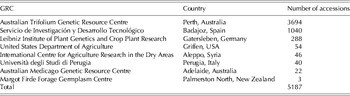
Information on available subterranean clover germplasm from eight GRCs around the globe was assembled in 2007 and 2008. Collectively, this represents the vast majority of the collected genetic resource of subterranean clover. This information consisted of eco-geographic data from the sites of collection, referred to as ‘passport data’, along with data on observations of samples and sites. Data were available for a total of 2692 collection sites (hereafter called accessions). The majority (0·62) of these came from the ATGRC, which ran a systematic collection and characterization programme for subterranean clover from 1973 to 1995. Information for the other accessions was obtained from GRCs in Spain, Germany, Italy, New Zealand, Syria, the USA and the Australian Medicago GRC (Table 1).
The number of subterranean clover accessions supplied by different Genetic Resource Centres (GRCs) for the present study

Collection strategies varied widely between collection missions, according to the sampling philosophies of the collector, time and resource constraints, and the nature of the terrain. Individual collection sites varied from a few square metres to several thousand square metres. Plant sample size also varied considerably at each site, both in the number of samples from each site and the size of each sample.
Geographic coordinates (latitude and longitude) were used to obtain accurate locations of collecting sites. Where coordinates were absent, they were obtained from site descriptions using Google Earth (http://www.google.com/earth/index.html). These were confirmed, using Encarta World Atlas© (Microsoft Reference Microsoft1999) and Global Gazetteer v. 2.1 (Falling Rain Genomics Inc. 2006), as described by Ghamkhar et al. (Reference Ghamkhar, Snowball and Bennett2007). Missing data for altitude were also obtained using Google Earth and this was used to check the accuracy of the data already available. Collection sites without location information were excluded from analyses. Collection sites with identical locations were rationalized by removing duplicates. Data on soil pH and soil type, available for more than 0·6 of collection sites, were used in the study.
Sorting accessions into distinct lines in Western Australia
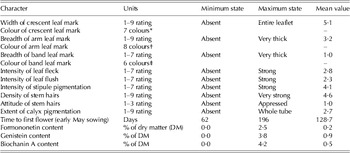
Subterranean clover is an ideal species in which to study genetic differences between plants collected both between and within a wide variety of sites. It is highly self-pollinated, and therefore breeds true to type, and has a series of highly heritable morphological markers that can be used to distinguish between different types. These include leaf marks, intensity and pattern of leaf anthocyanin flushes and flecking, intensity and extent of stipule and calyx tube pigmentation and the density of stem hairs. These traits are shown in Table 2 and described by Nichols et al. (Reference Nichols, Barbetti and Collins1996, Reference Nichols, Foster, Piano, Pecetti, Kaur, Ghamkhar and Collins2013). These distinguishing traits are used widely in the seed industry to certify different cultivars of subterranean clover (Nichols et al. Reference Nichols, Barbetti and Collins1996). Time to first flowering is a readily measurable trait that is highly heritable within and between seasons when sown at similar time at the same location, and is used as an additional distinguishing feature between different subterranean clovers (Gladstones Reference Gladstones1966; Gladstones & Collins Reference Gladstones and Collins1984; Piano Reference Piano1984; Ehrman & Cocks Reference Ehrman and Cocks1990, Reference Ehrman and Cocks1996; Nichols et al. Reference Nichols, Barbetti and Collins1996, Reference Nichols, Cocks and Francis2009, Reference Nichols, Foster, Piano, Pecetti, Kaur, Ghamkhar and Collins2013; Piano et al. Reference Piano, Pecetti and Carroni1996). Contents of the phyto-oestrogenic isoflavones formononetin, genistein and biochanin A are also highly heritable, with each subterranean clover type having a distinctive pattern (Francis & Millington Reference Francis and Millington1965; Gladstones Reference Gladstones1966; Nichols et al. Reference Nichols, Barbetti and Collins1996, Reference Nichols, Cocks and Francis2009, Reference Nichols, Foster, Piano, Pecetti, Kaur, Ghamkhar and Collins2013).
Characters and their states used for sorting accessions into distinct lines

* Colours of crescent leaf mark: Brown, Brown and Pale green, Cream, Pale green, Purple, Red, White.
† Colours of arm leaf mark: Brown, Cream, Pale green, Pale green to blue, Pale green to white, Purple, Red, White.
‡ Colours of band leaf mark: Brown, Cream, Pale green, Purple, Red, White.
The agro-morphological traits in Table 2 were used to sort subterranean clover accessions into distinct lines (using the terminology of Nichols et al. Reference Nichols, Foster, Piano, Pecetti, Kaur, Ghamkhar and Collins2013), which were each assumed to be true breeding. In the present study, the number of lines from a single accession is assumed to reflect the diversity at that collection site.
Accessions held in the ATGRC had been sequentially grown and separated into lines on the basis of morphology and flowering time since the early 1950s. Prior to 1984 this was conducted at the University of Western Australia Field Station, Shenton Park (31°56′S, 115°47′E), whereas between 1985 and 1995 it was conducted at the DAFWA field plots in South Perth (31°59′S, 115°53′E). Germplasm collected since 1995 and also acquired from other GRCs for the present study (except Spain) was grown, characterized and separated into lines in 2007 and 2008 at the DAFWA Medina Research Station (32°13′S, 115°53′E). These three sites are located on the Swan coastal plain within 40 km of each other and have similar soils, comprising sands with incorporated loam (for increased water-holding capacity) and pH 6·0–7·0 (measured using distilled water).
Growing conditions for material at Shenton Park and South Perth followed a standard protocol to minimize differences between years, as described in Nichols et al. (Reference Nichols, Cocks and Francis2009). Scarified seeds were sown into a weed-free seed bed in early May. Single superphosphate with potash (0·068 phosphorus (P), 0·124 potassium (K) and 0·083 sulphur (S)) was supplied at a rate of 100 kg/ha prior to sowing in May and was also applied to the soil surface by hand at the same rate in mid-September. Weeds were removed by hand, irrigation was supplied as required by overhead sprinklers until late November and seeds were harvested from senesced plants in December. Accessions were initially sown as spaced plants (30 cm apart) to enable them to be sorted into distinct lines: the sorted lines were subsequently grown by sowing 1 g of seed in each 1-m long row. The sowing procedure differed slightly for the accessions grown at Medina in 2007 and 2008. In this case, seeds were sown into peat jiffy pots in a glasshouse in May and transplanted 5 weeks later into holes cut into plastic film (for weed control). These holes were enlarged during seed set to allow burr burial. Other management factors were the same.
Data for flowering time and content of the oestrogenic isoflavones, formononetin, genistein and biochanin A were used in the present study, along with ratings for 12 morphological characters (Table 2). Flowering time was determined as the number of days from sowing to appearance of the first flower (for individual plants), or when at least half of plants had at least one open flower (for rows). Plants were checked every 3–4 days.
Contents of formononetin, genistein and biochanin A were measured using the technique of Francis & Millington (Reference Francis and Millington1965). Six discs (6 mm diameter) were taken from healthy, newly-opened leaves 60–100 days after sowing. Isoflavones were extracted in alcohol immediately and subjected to thin-layer chromatography. Duplicate samples for dry weight determination were oven-dried at 60 °C for 48 h. Results for isoflavone contents are expressed as a proportion of dry matter (DM).
Morphological ratings for leaf marks, intensity of leaf anthocyanin fleck and flush patterns, stipule and calyx pigmentation, and stem, petiole, leaf upper surface and peduncle hairiness are shown in Table 2 and were measured using descriptors in Gladstones & Collins (Reference Gladstones and Collins1984) and Nichols et al. (Reference Nichols, Barbetti and Collins1996).
Leaf marks are classified on the basis of: (i) width of ‘crescents’, which are central triangular markings (usually pale green) that in their maximum state can extend to the leaflet margins; (ii) thickness of ‘arms’, which vary in colour and extend from the leaflet margins about half-way towards their centres; and (iii) thickness of ‘bands’, which are alternative markings to triangular crescents (usually pale green) that extend between leaflet margins. Leaf marks can consist of crescents alone, arms alone, crescents with arms, bands alone or no marking at all.
Anthocyanin flush patterns and leaf flecks are additional leaf markings, which vary in location, colour (usually dark purple or brown) and extent among genotypes; they are most prominent in early winter and fade in spring. The amount and colour of anthocyanin pigmentation on the distal ends of calyx tubes is consistent between flowers of a genotype for the duration of flowering and is independent of light. Calyx tube pigmentation varies from pale pink to dark purple and its extent varies from none (green tubes) to its entire length. Anthocyanin pigmentation of stipules has a similar colour range to calyx tubes and is most prominent when they are shaded, tending to fade in direct contact with sunlight. The extent of this pigmentation is strongly genotype-dependent when observed under closed canopies.
Spanish accessions
The Spanish collection was too large to acquire seeds of all 1040 accessions. Therefore, agro-morphological data were obtained in Spain for this material following similar methods to sort into lines as those used in Australia. The validity of the Spanish data was checked in Western Australia by screening a subset of ten accessions and found to be consistent under Australian conditions.
Climatic and soil analyses
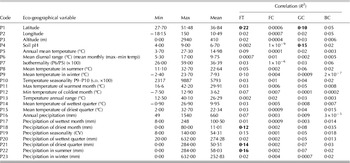
Data on 19 quantitative climatic variables described in BioClim (Hijmans et al. Reference Hijmans, Cameron, Parra, Jones and Jarvis2005; WorldClim 2006) were obtained and imported into the geographic information system software DIVA-GIS ver. 5·2·0·2 (http://www.diva-gis.org/) (Table 3). All variables relate to rainfall and temperature. Soil pH (H2O), altitude and slope data, acquired from passport information, were also included. Soil type was classified into five categories: sand, sandy loam, loam, clay loam and clay.
Climatic and geographic (eco-geographic) variables and their correlation (R 2) with flowering time (FT) and isoflavone content traits, formononetin (FC), genistein (GC) and biochanin A (BC), when sown in Perth, WA in early May. Numbers in bold indicate significant correlations (P<0·05). P5–P23 were obtained from BioClim

Climates corresponding to hotspots and to extreme agro-morphological traits were identified in DIVA-GIS. Pearson correlations of time to first flower and isoflavone content with climatic conditions were investigated by regression analysis using raw data in NTsys-pc ver. 2·21a (Rohlf Reference Rohlf2004).
Identification of hotspots and gaps
Diversity within a collection site was described by a ‘diversity index’ (DI), defined as the number of lines from that site. In the present study, ‘hotspots’ of each sub-species are defined as geographic regions: (1) where number of accessions of a sub-species in that geographic region are at least 0·05 higher than in the collection as a whole; and (2) containing a high DI (>1 line per site) across many sites in the region.
In the present paper ‘gaps’ are defined as locations either not represented or underrepresented in the current world collection. Such gaps were identified by: (i) matching climatic and vegetation regions (or eco- and sub-eco-regions) of each collection site with similar climatic and vegetation regions that contributed little or no germplasm to the collection; and (ii) comparing the ecological distribution of collected germplasm with distribution data from web sources, including Global Biodiversity Information Facility (GBIF; http://us.mirror.gbif.org/), GENESYS (http://www.genesys-pgr.org/) and USDA Germplasm Resources Information Network (GRIN; http://www.ars-grin.gov/cgi-bin/npgs/html/taxgenform.pl). The eco- and sub-eco-region categories were obtained from Geography Network Explorer (http://www.geographynetwork.com/explorer/) as in Ghamkhar et al. (Reference Ghamkhar, Snowball and Bennett2007).
The above information was compared with distribution and passport data. If there was no record among the collected germplasm but there was at least one record in herbaria or databases, then that region was considered as a gap. These data were incorporated into vegetation, temperature, precipitation and soil moisture maps using ESRI® ArcGIS™ and Geography Network Explorer, as detailed in Ghamkhar et al. (Reference Ghamkhar, Snowball and Bennett2007), to find the gaps in the collection. The gap-finding approach in the present study was very conservative, as any region with ⩾5 germplasm collection records was not considered as a gap. If there were >5 records in the herbaria or online databases for the detected gaps with <5 germplasm collection records, that gap area was considered as a priority gap. Such gaps are the most important targets for future collecting missions.
A cluster analysis was conducted to confirm the position of the hotspots with maximum diversity for the species using both eco-geographical and agro-morphological data. A versatility index (VI) was developed, where:
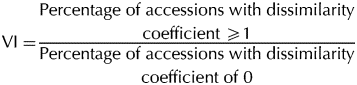 $${\rm VI =} {\displaystyle{{\rm Percentage}\;{\rm of}\;{\rm accessions}\;{\rm with}\;{\rm dissimilarity}\atop{\rm coefficient}\;{\rm \geqslant} {\rm 1}} \over \displaystyle{{\rm Percentage}\;{\rm of}\;{\rm accessions}\;{\rm with}\;{\rm dissimilarity}\atop{\rm coefficient}\;{\rm of}\;{\rm 0}}}$$
and dissimilarity coefficient is inferred from the Jaccard index (Downton & Brennan Reference Downton and Brennan1980) based on which the most diverse accessions show the highest dissimilarity coefficient and the identical accessions have a dissimilarity coefficient of 0.
Areas with a VI⩾1 were confirmed as the main hotspots or centres of diversification for the species as accessions from these areas/countries had even a higher VI than the Australian developed cultivars of the species. Versatility index differs from DI in that it is an indicator of subterranean clover diversity and not its sub-species.
RESULTS
Associations between macro- and micro-environments in the collection
A total of 5187 individual lines with unique agro-morphological data were identified from 2692 accessions with unique eco-geographic data. These collection sites were grouped into 31 clusters by a numerical taxonomy system (NTsys) cluster analysis, based on climatic, soil, flowering time and isoflavone content (data not shown). The most informative geographic, climatic and soil data (macro- and micro-environments) in the current analysis were latitude, soil pH and different forms of precipitation data, particularly rainfall in the driest month and summer quarter (Table 3).
Sites with highly acidic soils (pH<5·0) were the only sites with no diversity, whereas maximum diversity was observed in the pH range 6·0–6·5. There was no soil pH limitation for any of the five soil types, except that there was no record of pH<5·0 in loam and clay loam soils. Diversity of collection sites was not affected by soil type.
Effect of site variables on expression of traits
Flowering time
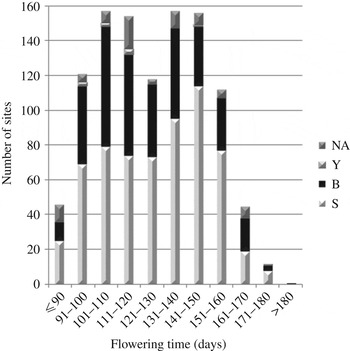
Time to first flower varied from 62 (unspecified subspecies) to 196 days (Fig. 1). Of the identified sub-species, ssp. brachycalycinum had the broadest flowering time range (73–196 days), with the range of ssp. subterraneum being 76–178 days and ssp. yanninicum being 94–154 days.
The distribution of sites based on days to flowering in Perth, WA from an early May sowing. The relative number of sites per sub-species for each flowering time category is also demonstrated. Y, ssp. yanninicum; B, ssp. brachycalycinum; S, ssp. subterraneum; NA, sub-species not determined.

There was a weak but significant (P<0·05) correlation between flowering time and latitude (Table 3). The ten earliest flowering accessions (⩽80 days) were all collected from the latitudes below 39°01′N and two latest flowering accessions (⩾180 days) from latitudes above 40°26′N. There was no overall correlation between flowering time and DI, although the earliest and latest flowering time extremes were all collected from sites that had only one phenotype. No correlations were found between flowering time and either longitude or altitude (Table 3).
Significant (P<0·05) but weak correlations of flowering time were found with the precipitation of the driest month, the driest quarter and the warmest quarter (each corresponding to summer rainfall) and the seasonality of precipitation or irregular distribution of rainfall between seasons (Table 3). However, there was no correlation between flowering time and annual precipitation.
There was no overall correlation between soil pH and flowering time (Table 3). However, all the latest flowering accessions originated from soils with a pH⩾5·5, regardless of the country of origin or sub-species. No overall correlation was found between flowering time and annual mean temperature. However, annual mean temperature for the collection sites of the latest flowering accessions was 9·7–12·4 °C, whereas collection sites for the earliest flowering accessions were warmer, ranging from 14·7 to 17·4 °C. No other significant correlations were found between flowering time and any of the other measured eco-geographical variables.
Isoflavone contents: formononetin, genistein and biochanin
Formononetin content (FC) among accessions ranged from 0 to 0·021 of DM, genistein content (GC) from 0 to 0·028 DM and biochanin A content (BC) from 0 to 0·028 DM (Table 4). There were no correlations between the contents of any isoflavone with any of the climate variables, but there were correlations between genistein content with two geographic variables: latitude and soil pH (Table 3). All accessions with a high FC (⩾0·019 of DM) originated from latitudes 36°03′ to 41°54′N; these belonged to ssp. subterraneum and brachycalycinum, but not to ssp. yanninicum. All accessions with high GC (⩾1·9) originated from latitudes 36°00′ to 42°01′N; these also belonged to either ssp. subterraneum or brachycalycinum. All accessions with high BC (⩾1·9) originated from latitudes 37°47′ to 47°52′N and were also collected from altitudes ⩽770 m a.s.l.; these belonged either to ssp. subterraneum or brachycalycinum, but not ssp yanninicum. All high BC collection sites had only one line (no diversity).
The range and mean of the three isoflavone contents (proportion of dry weight) in the three sub-species of subterranean clover

Sub-species distribution
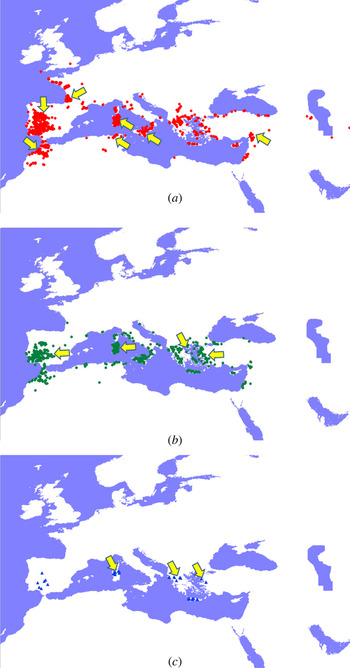
Considering collection sites at the sub-species level, 1544 sites contained ssp. subterraneum (Fig. 2(a)), 963 had ssp. brachycalycinum (Fig. 2(b)), and 55 had ssp. yanninicum (Fig. 2(c)), while 130 sites had unidentified sub-species. These sub-species often occurred together, but had different boundaries. Of the three sub-species, subterraneum and brachycalycinum occurred widely throughout the Mediterranean region (Table 5; Figs 2(a) and (b)). Sub-species subterraneum had the broadest latitude range, extending from 27°41′ to 51°17′N (Fig. 2(a)) whereas ssp. yanninicum was the most restricted, being confined to 38°30′–40°30′N (Fig. 2(c)).
Geographic distribution of the three sub-species of subterranean clover with arrows indicating diversity hotspots: (a) ssp. subterraneum (1543 sites); (b) ssp. brachycalycinum (964 sites); and (c) ssp. yanninicum (55 sites). Sub-species for the remaining collection sites are unknown.

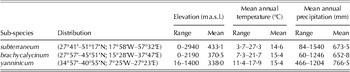
Eco-geographic variables affecting distribution of the three sub-species of subterranean clover based on the present study

Furthermore, sub-species yanninicum was not found above elevations of 1400 m a.s.l. (Table 5). This contrasts with an upper limit of 2190 m a.s.l. for ssp. brachycalycinum and 2940 m a.s.l. for ssp. subterraneum. Annual rainfall also appears to be a restricting factor in the distribution of ssp. yanninicum, which was only found where MAP was >466 mm and was most frequent in the areas with MAP >750 mm (Tables 5 and 6). In contrast, ssp. brachycalycinum and ssp. subterraneum were commonly found in areas with as little as 300 mm MAP, with some records suggesting their presence in areas with <100 mm MAP (Table 5).
Presence of the three sub-species of subterranean clover and the mean number of sub-species in the three main rainfall regions identified by ArcGIS

* MAP (mm).
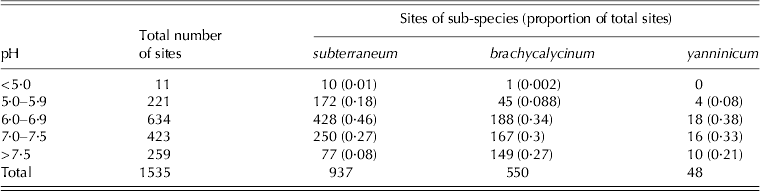
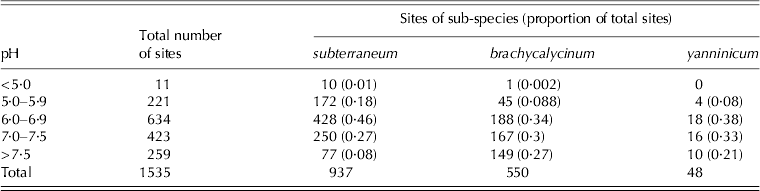
There were strong associations between sub-species and soil pH of their collection sites (Table 7). Sub-species subterraneum was generally found on more acidic sites than the other two sub-species, with 0·2 of all accessions coming from sites with pH<6·0, compared with 0·085 for ssp. yanninicum and 0·084 for ssp. brachycalycinum. A total of 0·011 of ssp. subterraneum was also found at the most acidic sites (pH<5·0), compared to a single accession (0·001) of ssp. brachycalycinum and no accessions of ssp. yanninicum. A large proportion of all three sub-species came from areas with a pH range of 6·0–6·9 (0·46, 0·35 and 0·38 for ssp. subterraneum, brachycalycinum and yanninicum, respectively). Higher proportions of ssp. brachycalycinum (0·58) and ssp. yanninicum (0·55) were collected on moderately alkaline (pH>7·0) sites than ssp. subterraneum (0·35). Sub-species brachycalycinum had the highest proportion (0·28) of accessions from the most alkaline sites (pH>7·5), whereas ssp. subterraneum (0·09) had the least.
Main soil pH (H2O) categories defined in ArcGIS, based on the distribution of collection sites with pH data, of the three sub-species of subterranean clover
Effect of climate on diversity
Collection sites were grouped into three categories based on rainfall (Table 6). Diversity was broadly dependent on rainfall, with a strong linear relationship between DI and MAP (R 2=0·88, P<0·01). In the wetter areas of Regions 2 and 3 (>450 mm MAP), the mean DI varied between 1·97 and 2·07 lines per site. In contrast, at the arid end of the spectrum in Region 1 (<450 mm MAP), mean DI was 1·16 lines per site. Diversity at the sub-species level was also dependent on rainfall (R 2=0·73, P<0·01). The number of sub-species per site followed a similar pattern but only in latitudes below 43°45′N. In Region 1, the average number of sub-species was 1·03 per site, in contrast to the wetter Regions 2 and 3, where the average was 1·07 and 1·06 sub-species per site, respectively.
The location of sites with high diversity was not related to either latitude or longitude. However, no highly diverse sites were found at altitudes higher than 1450 m a.s.l. The greatest diversity tended to be found at sites with intermediate climatic and soil conditions, being restricted at sites with extreme conditions. For example, sites with an annual mean temperature outside the range of 10·7–17·9 °C contained only one line. Similarly, no collection site with pH<5·0 contained more than one line.
Hotspots of diversity
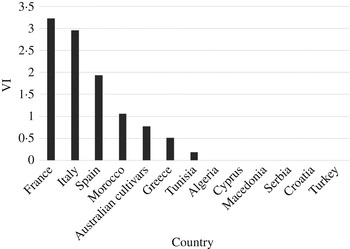
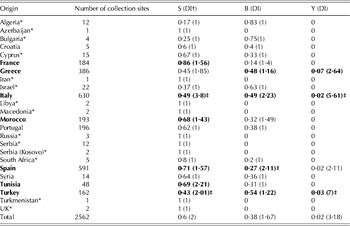
Table 8 shows the total number and sub-species composition of accessions from their countries of origin and the mean DI for each sub-species. Hotspots of diversity for each sub-species can be seen when this data is compared with the distributions of collection sites shown in Fig. 2(a) for ssp. subterraneum, Fig. 2(b) for ssp. brachycalycinum and Fig. 2(c) for ssp. yanninicum. Seven hotspots of diversity were identified for ssp. subterraneum: Western Spain, Western France, Northern Morocco, Northern Tunisia, Sardinia, Southern Italy (including Sicily) and Southern Turkey (Fig. 2(a)). Western Spain, Sardinia, Northeastern mainland Greece and Western Turkey were hotspots for ssp. brachycalycinum (Fig. 2(b)), while ssp. yanninicum had hotspots in Sardinia, Northwestern Greece and Western Turkey (Fig. 2(c)). Although some other regions also had a high proportion of accessions for ssp. subterraneum and brachycalycinum, they were not given hotspot status due to their small sample size (Table 8). The VIs inferred from cluster analysis identified France, Italy, Spain and Morocco as the main hotspots or centres of diversification for subterranean clover as a whole (Fig. 3). Countries such as Greece, Tunisia and Turkey were not included in this list despite being hotspots for some sub-species because their VIs did not indicate these countries as hotspots for the species as a whole.
Versatility index (VI) across all three sub-species of subterranean clover for each country indicating the main hotspots or centres of diversification of subterranean clover. Countries with no VI have the most similar pairs of accessions and therefore VI=0.

Number of accessions with identified sub-species of subterranean clover in the whole germplasm collection, their countries of origin and the proportion of accessions of each sub-species in these countries. Countries and numbers in bold indicate hotspots for the corresponding sub-species

* Locations where the proportions indicate hotspots but the DI is less than average and sample size is too small for confirming these results.
† Diversity index (DI): average number of lines per site if applicable.
‡ Identified as hotspots based on a more than average DI only.
Identification of gaps
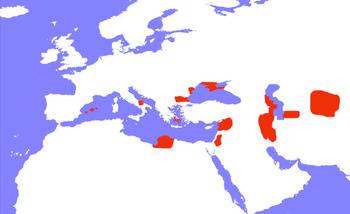
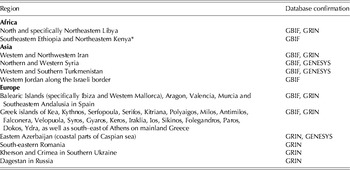
Gaps in the subterranean clover world collection were identified (Fig. 4) in ten vegetative areas, based on climatic and vegetative map matching (CVMM). These areas were then compared with data from the three online biodiversity and germplasm distribution web sources, GBIF, GRIN and GENESYS. Gaps from the CVMM analyses that were also present in at least one of the online databases are presented in Table 9. These areas should be the focus of future collecting missions of subterranean clover.
Gaps in the current subterranean clover germplasm collection identified in this study.

Priority gaps for future germplasm collection of subterranean clover, based on a match of the CVMM analysis with at least one of the online databases GBIF, GENESYS and GRIN.

* Not a priority for collection due to the presence of only one or two specimens.
Other gap areas suggested by our CVMM analyses that were not confirmed by other databases and web sources are as follows: Eastern and Northeastern Iraq, Central Israel (including the Gaza Strip and Southern West Bank), Tajikistan, Kyrgyzstan, Kazakhstan, and Eastern Uzbekistan, Southeastern and Central Turkey and an area in Italy surrounding the Golfo di Manfredonia. These areas could also be considered for targeted collecting.
DISCUSSION
Conservation of genetic resources
The most striking aspects of the present study were the diversity of subterranean clover, its broad eco-geographical distribution, and the effect of climatic conditions on its diversity. However, the lack of diversity and smaller populations in areas with <450 mm MAP is a cause for concern for conservation of material suited to these environments.
Another point concerns the conservation of rare or isolated populations, or populations found in environments atypical of the species as a whole. Such populations are readily identifiable for subterranean clover growing in areas reported to have <120 mm MAP. Such rainfall data need to be treated with caution; however, as the collection sites may be possibly a wadi or valley bottom with higher effective rainfall. This also applies to accessions from soils at the extremes of pH or from high altitudes. Such accessions are worthy of further investigation, as they may be of great value to plant breeders and agronomists. Every effort should be made to conserve such outliers.
Considering the conservation of genetic diversity within species, eco-geographic data are of value where storage space for ex-situ conservation is restricted. Data on distribution of the kind presented here represent an economic method of defining ‘duplicates’, by which accessions from geographically and climatically similar environments can be readily identified.
Selection of improved accessions
One reason for analysing the distribution patterns of subterranean clover in the Mediterranean and surrounding regions has been to identify accessions adapted to the various environments of its native range, with the prospect of selecting material better adapted to the farming systems in which they will be used. In this respect, eco-geographic data provide direct practical uses.
The results of the present study suggest that for subterranean clover, collection site criteria which could be used to select adapted accessions are:
1. the latitudinal coordinate, which is linked to flowering time;
2. mean temperature in winter, which might be linked to winter productivity; and
3. precipitation in summer, which may affect seed dormancy and persistence of the seed bank.
Species and sub-species distributions
It is clear that climate controls the distribution of T. subterraneum and its sub-species. As might be expected in the Mediterranean region, precipitation is the most potent climatic factor, with ssp. yanninicum restricted to areas with MAP >500 mm. However, high precipitation and high altitude are often related in the region (Ehrman & Cocks Reference Ehrman and Cocks1996; Piano et al. Reference Piano, Pecetti and Carroni1996) and altitude is also a limiting factor in the distribution of ssp. yanninicum, as it only grows up to 1500 m. Previous work (Cocks & Ehrman Reference Cocks and Ehrman1987) has demonstrated that frost frequency dictates the distribution of many pasture legume species, often resulting in ecotypic differentiation within species as well. Thus, the distribution of ssp. yanninicum is most likely limited to high rainfall coastal areas, because of their mild winter temperatures.
Latitude and mean annual temperature are other restricting factors in the distribution of ssp. yanninicum, being limited to 35°00′–41°00′N. Longitude also restricts the distribution of ssp. yanninicum, whereas ssp. brachycalycinum is less restricted and ssp. subterraneum is widely distributed longitudinally.
Correlations were observed between flowering time and four rainfall measures in summer. Despite this, the lack of correlation between flowering time and annual rainfall at the site of collection in our meta-analysis of the world collection contrasts with reports from several other studies (Piano Reference Piano1984; Ehrman & Cocks Reference Ehrman and Cocks1990, Reference Ehrman and Cocks1996; Piano et al. Reference Piano, Spanu and Pecetti1993, Reference Piano, Pecetti and Carroni1996; Pecetti & Piano Reference Pecetti and Piano2002). There are two possible reasons for this. Firstly, each of these studies reports on collection trips within individual regions or countries, where temperature and latitude (and hence photoperiod) differences are much smaller than across the whole range of the species, as in the present study. Flowering responses to these factors are likely to be much smaller than their response to rainfall (and hence growing season length) in specific regions. Secondly, measurement of flowering time was conducted in a central location in Perth, WA, rather than at the sites of collection. Differences in photoperiod and temperatures between these sites may result in different flowering time responses and overshadow rainfall differences at collection sites.
Soil type and pH affect the distribution of subterranean clover. However, soil type is not a separating factor for the distribution of the three sub-species. Surprisingly, diversity was unaffected by soil type. Soils with pH 6·0–7·0 produced the most widespread and diverse accessions, while very acid soils (pH≤5·0) had a lack of diversity within sites. This indicates a lower pH limit of about 5·0 (H2O) for the species in its natural environment, which may be attributable to a reduction in rhizobial nodulation beyond this limit (Richardson et al. Reference Richardson, Henderson, James and Simpson1988).
Katznelson (Reference Katznelson1974) and Gladstones & Collins (Reference Gladstones and Collins1983) state that in their native Mediterranean habitat, ssp. subterraneum and yanninicum are found on neutral-slightly acid soils and ssp. brachycalycinum on neutral-slightly alkaline soils. Piano et al. (Reference Piano, Sardara and Pusceddu1982) also noted that while some ssp. subterraneum are also found on moderately alkaline soils, ssp. yanninicum is confined to acidic soils. However, the results of the present study challenge these findings.
It was found that accessions of each sub-species were collected from soils with pH in the range of 5·0–8·0. However, there was trend for a higher proportion of ssp. subterraneum in soils with pH<6·0 than the other two sub-species. There was also a trend for ssp. brachycalycinum to have a high proportion of accessions from soils with pH>6·5. However, the findings for ssp. yanninicum were somewhat surprising, showing a pH distribution similar to ssp. brachycalycinum rather than ssp. subterraneum. Only 0·09 of accessions came from soils with pH<6·0 and no accessions were found in areas with soil pH<5·0. At the other end of the pH scale, ssp. brachycalycinum and yanninicum were found on soils with pH>7·5 but ssp. subterraneum was not. Collection sites with very alkaline (pH⩾8·5) soils were rare, indicating an upper limit for the species. Ehrman & Cocks (Reference Ehrman and Cocks1990) also indicated that alkaline soils in Syria are a limiting factor for the success of subterranean clover.
The commonly accepted pH ranges are 4·2–7·0 for spp. subterraneum and yanninicum and 6·5–8·5 for ssp. brachycalycinum (Nichols et al. Reference Nichols, Loi, Nutt, Evans, Craig, Pengelly, Dear, Lloyd, Revell, Nair, Ewing, Howieson, Auricht, Howie, Sandral, Carr, de Koning, Hackney, Crocker, Snowball, Hughes, Hall, Foster, Skinner, Barbetti and You2007). However, the current results suggest a range of 5·0–7·0 for spp. subterraneum and 6·0–8·5 for ssp. brachycalycinum and yanninicum for their growth in the Mediterranean region.
The distributions of the three sub-species show that they each have some degree of versatility, as indicated by their capacity to grow under a range of different climatic and edaphic conditions. Ecological versatility is most notable among accessions of ssp. subterraneum, as they were collected from sites ranging in mean annual temperature from 3·7 to 27·3 °C, in elevations from 0 (sea level) to 2940 m a.s.l., in soil pH from <5·0 to >7·5 and in MAP from <100 to 1540 mm.
Future collection missions to fill gaps
A comparison of the distribution of collected germplasm with reported distributions of subterranean clover suggests that there are still gaps in the germplasm that can be filled with further targeted collection missions. The majority of gaps shown in Table 9 and Fig. 4 match well with other online and printed information sources on subterranean clover distribution. However, the ecological portrait developed by the present study predicts the presence of subterranean clover in some regions from which there are no reports of its presence; most of these regions are in the Near East and recently independent central Asian countries. Factors that might have influenced the gaps identified in the present study comprise, but are not limited to, lack of accessibility of collection sites due to political instability or isolation and lack of a strong connection with local scientists and botanists. In the present study, it is suggested that the collection of plants for genetic conservation should be directed to areas with <500 mm annual precipitation. This is to obtain extreme types that may have different traits (e.g. drought tolerance) to current cultivars or germplasm and yield new germplasm.
CONCLUSIONS
Although the world collection of subterranean clover is still only partly explored, it already represents a wealth of information and genetic resources for future breeding efforts. While the literature has suggested that subterranean clover is adapted to areas with more than 400 mm of annual rainfall, below 1000 m in elevation and a maximum soil pH of 8·2, this collection contains an entry from a collection site with 210 mm of annual rainfall and altitude of 1200 m. There are also collection sites with as low as 50 mm annual rainfall, 2250 m a.s.l. elevation or pH as high as 9. Although such genotypes are exceptions, they might bear crucial genes for future breeding programmes for persistence.
In order to fully exploit the world germplasm resource for plant breeding and selection, a subterranean clover core collection of 97 accessions has been developed using eco-geographical, agro-morphological and Simple Sequence Repeat molecular data, which captures almost 0·8 of the diversity of subterranean clover (Nichols et al. Reference Nichols, Foster, Piano, Pecetti, Kaur, Ghamkhar and Collins2013; K. Ghamkhar, unpublished). This will allow more efficient utilization of the total collection and represents a primary source for the breeding of new traits and selection of parents for future breeding and selection. The future breeding of subterranean clover will be further enhanced by targeting the gap areas identified in the present study for further enrichment of the gene pool, with the prospect of novel genes for important traits.
We thank the Australian Research Council for financial support. Bill Collins and Kevin Foster collected much of the data for the ATGRC. The following GRC managers and their colleagues and support staff are gratefully acknowledged for donation of germplasm and associated information: Ulrike Lohwasser (Gatersleben, Germany); Brad Morris (Griffin, USA); Ali Shehadeh (Aleppo, Syria); Valeria Negri (Perugia, Italy); Steve Hughes (Adelaide, South Australia); and Kenyon Moore (Palmerston North, New Zealand). The Grains Research and Development Corporation have provided funding for the collection of much of the germplasm held in the Australian collections.