In recent years many Olmec specialists have concluded that the archaeological record of terminal Early Formative period Mesoamerica is highly variable with respect to the presence, quantity, and quality of portable “Olmec-style” objects, particularly ceramic vessels and figurines (see Pool Reference Pool2007:15–17). This materially-based recognition has not, however, generated consensus regarding the social and political significance of the Olmec style, its birthplace, or means of dissemination during this important yet brief era of Mesoamerica's development called the “Early Olmec horizon” (ca. 1150–1000 b.c.) by some scholars. Likewise, the role of the largest Gulf Coast polity, San Lorenzo, in the creation and spread of the Olmec style is uncertain and highly controversial. I contend that these issues and the many questions they raise are best approached by methodically examining the extent of stylistic similarity between portable Olmec-style objects made at San Lorenzo (or its immediate vicinity) and at places located hundreds of kilometers away.
Since the recent application of materials science has demonstrated multiple production loci for Olmec-style ceramic objects (see Blomster et al. Reference Blomster, Neff and Glascock2005), we are now well positioned to undertake rigorous stylistically-based analyses with confidence in both the provenience of the objects being compared and models developed to explain any stylistic differences and similarities noted. This essay summarizes part of a broader study aimed at doing precisely that—a study involving multiple classes of Olmec-style objects from San Lorenzo and Cantón Corralito, a potential Olmec settlement enclave site located in the Mazatan area of Pacific Coastal Chiapas some 450 km south of “Olman,” the Gulf Coast Olmec heartland. My focus here is excised Olmec-style pottery, known also by its ceramic type name, “Calzadas Carved.”
As aptly noted by Pool (Reference Pool2007:289), when we consider the significance of Olmec-style objects in relation to polities beyond the Gulf Coast we are faced with the challenge of explaining the “degree to which the Gulf Olmecs shaped the course of Mesoamerican history through their influence on their contemporaries… .” One way—but certainly not the only way—Gulf Olmecs may have exerted significant and protracted influence in distant regions was by establishing ethnic enclaves. Olmec-style objects made in such places would not have been mere copies inspired through contact with a distant land and its supernatural, mythical, and powerful peoples and paraphernalia (c.f. Helms Reference Helms1979, Reference Helms1988, Reference Helms1993), but culturally imperative objects—material necessities—stylistically and morphologically cast in the manner of counterparts made in the Gulf Coast and firmly grounded in the cultural practices of that region.
Whether or not ethnic enclaves were founded by Early Formative Gulf Olmecs, carved Olmec-style pottery is significant in the assessment of the extent and nature of Gulf Olmec influence on their contemporaries, if for no other reason than its ubiquity and highly stylized nature. Because Olmec-style carved pots transmitted images of supernatural creatures and other concepts of mythic or religious significance to the peoples who made and used them—of this there is little disagreement among archaeologists and art historians—the extent of image similarity between regions or sites is a reasonable proxy for the sharing of underlying belief systems. A state of complete image correspondence between regions or sites would therefore flag all or part of a single, shared belief system, with imperfect correspondence indicating the merger of two or more systems or one adopted in full or in part and reinterpreted locally. The latter situation could vary tremendously from near identical to very different image sets and associated beliefs, thus forming a continuum of possibilities manifest metaphysically and materially. All such scenarios have implications in terms of the peoples involved; the extent of interregional interaction, cohabitation, and so on. These too can be considered on a sliding scale ranging from indirect or direct contact between local cultures and Gulf Olmecs, to the establishment, at least potentially, of ethnic enclaves by Gulf Olmecs with subsequent influxes of immigrants.
The recent publication of some 1,000 chemical analyses of pottery and raw clays by Blomster and his colleagues (Reference Blomster, Neff and Glascock2005) underscores how fundamental and controversial Olmec-style pottery is to unraveling the nature of relations between Gulf Olmecs and contemporary Mesoamerican cultures. The study indicates a one-way flow of vessels, including carved pots, going out from San Lorenzo with no vessels coming in, a conclusion that has been challenged by Stoltman and others (Reference Stoltman, Marcus, Flannery, Burton and Moyle2005; see also Sharer et al. Reference Sharer, Balkansky, Burton, Feinman, Flannery, Grove, Marcus, Moyle, Price, Redmond, Reynolds, Rice, Spencer, Stoltman and Yaeger2006) on the basis of allegedly flawed statistical methods and related assumptions. Scrutiny of these criticisms (see Neff et al. Reference Neff, Blomster, Glascock, Bishop, Blackman, Coe, Cowgill, Cyphers, Diehl, Houston, Joyce, Lipo and Winter2006a, Reference Neff, Blomster, Glascock, Bishop, Blackman, Coe, Cowgill, Diehl, Houston, Joyce, Lipo, Stark and Winter2006b), however, makes it clear that the initial findings are valid. Early Olmec pottery was regularly exported from San Lorenzo to distant regions of Mesoamerica with few if any pots going in the other direction.
The one-way trafficking of decorated pottery is undeniably important in terms of some kind of San Lorenzo-based Gulf Olmec “influence,” and is a crucial body of supportive evidence suggesting that the Olmec style originated in the Gulf Coast, but when elaborately carved pots of San Lorenzo origin turn up in distant regions they do not necessarily flag the presence of Gulf Olmecs, nor do they automatically signal a transformation of indigenous religion or any other cultural practices to those of Gulf Coast peoples. More important with respect to the people behind the pots is the fact that in each place beyond the Gulf Coast where specimens of San Lorenzo origin have been chemically identified, they are always outnumbered—often vastly—by locally-made versions or copies that may or may not be faithful to Gulf Olmec stylistic canons. Given the geographic extent of decorated Olmec-style pots in Mesoamerica, imitation must have been based on motivations that varied greatly from region to region, even between centers within regions.
By allowing secure separation of local and imported products, chemical characterization permits comparison of designs and the technical properties of local and nonlocal pots on which they were executed—data that can potentially reveal the apprenticeship, aspects of religious beliefs and practices, and ultimately the cultural affiliation(s) of the peoples who made and decorated the pots. Yet decorated pottery alone is insufficient to confirm the presence of Gulf Olmec peoples at some distant place. It must be packaged with other classes of material culture at our disposal, such as figurines and undecorated or everyday ceramic wares that were less prone to importation, copying, and being display vessels during public gatherings involving food. Still, carved pottery provides additional traits or variables for comparison that plain pots do not, and for that reason the data provided here are noteworthy in their own right.
The information presented in this paper is used to address two fundamental questions: How similar are the carved designs on pots made at San Lorenzo and Cantón Corralito? How similar are the pots on which they occur? With respect to the first question, I am concerned with the range of identifiable designs, their frequencies, and whether the corpus at one settlement is congruent with that of the other. With respect to the second question, I present the complete inventory and relative frequencies of carved vessel forms for both settlements. I also explore the technical style (see Lemonnier Reference Lemonnier1986; M. Stark Reference Stark, Heidke and Stark1995) of carved pots via comparative examination of measurable post-production attributes. I conclude with an intraregional consideration of the Cantón Corralito data with respect to Calzadas Carved and other contemporaneous ceramic types elsewhere in the area, asking the question, just how stylistically and numerically divergent is the assemblage at Cantón Corralito?
MAZATAN AND CANTON CÓRRALITO
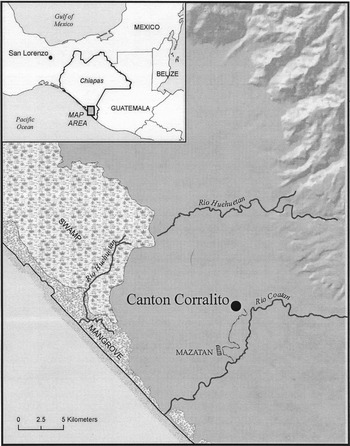
Mazatan, Chiapas (Figure 1) is an ideal area in which to explore the nature of long distance interaction during the San Lorenzo horizon—antecedent conditions are understood, and change can be monitored over fairly short segments of time. Between 1600–1250 b.c. (Barra, Locona, and Ocós phases), the political landscape of Mazatan evolved from numerous egalitarian villages to half a dozen or more chiefdoms (Clark Reference Clark1994). The “Mokaya” peoples responsible for this development maintained a distinctive tradition of pottery, figurines, and other artifacts (Blake et al. Reference Blake, Clark, Voorhies, Michaels, Love, Pye, Demarest and Arroyo1995; see also Clark and Cheetham Reference Clark, Cheetham, Carrión and Cook2005). But shortly after 1250 b.c. (Cherla phase) visible aspects of some traditions, most noticeably ceramics, began to resemble those of the emerging Gulf Coast Olmec culture centered at San Lorenzo, Veracruz (Coe and Diehl Reference Coe and Diehl1980). This process accelerated after 1150 b.c. (Cuadros phase), by which time the largest Mazatan chiefly center, Paso de la Amada, was abandoned and most material expressions of Mokaya identity were forsaken in favor of early Olmec-style objects similar to those of the coeval San Lorenzo phase at San Lorenzo. It has been hypothesized that this “Olmecization” (Clark Reference Clark1990; Clark and Blake Reference Clark, Blake and Macias1989) of Mazatan began as an elite Mokaya social strategy that backfired when Gulf Olmecs, presumably acting under the patronage of San Lorenzo elites, ultimately seized Mokaya territory and established a polity of regional governance at Cantón Corralito (Clark Reference Clark1997; Clark and Pye Reference Clark, Pye, Clark and Pye2000).
Map of the Mazatan zone of Pacific Coastal Chiapas locating Cantón Corralito and San Lorenzo (inset).

Ancient Cantón Corralito is now largely featureless, having been buried under—and completely destroyed by—a thick blanket of river sand around 1000 b.c. The site is divided by a modern two-lane highway and lies below a small, modern community (also called Cantón Corralito) of dispersed residences, agricultural fields, fruit tree orchards, and a primary school between the modern towns of Obregon and Mazatan, Chiapas. Ancient Cantón Corralito was occupied during the Late Archaic period (ca 2300–1600 b.c.) and most of the Early Formative period (ca 1600–1000 b.c.), although the length and nature of the Late Archaic occupation are poorly known. Throughout the Early Formative period, and likely earlier, the Coatán River or a tributary of it passed along the north end of the site. Living alongside this river, the region's largest, the residents of Cantón Corralito were strategically located to take economic advantage and perhaps control of waterborne travel and commerce in Mazatan.
Until 1997, the known distribution of ancient occupation at Cantón Corralito was around a broad, 2–3 m tall ancient housemound, the only feature now visible at the site (Clark Reference Clark1994). Cultural deposits from the mound, named San Carlos, date largely to the Barra and Locona phases. In 1997, several test pits 100–200 m north of this mound revealed substantial Cuadros phase deposits (Pérez Suárez and Lesure Reference Pérez Suárez and Lesure1998; Pérez Suárez Reference Pérez Suárez and Rivero2002), and the name Cantón Corralito was chosen for that area. The unusually rich quality, quantity, and variety of Olmec-style objects from those test excavations prompted large scale excavations in 2004 (Cheetham Reference Cheetham2006; Cheetham et al. Reference Cheetham, Clark, Luna, Powis, Suárez, Alvarado and Espinosa2007; Cheetham and Clark Reference Cheetham and Clark2006). The 2004 operations demonstrated that, during its Cuadros phase peak, Cantón Corralito was at least 25 ha in size with an estimated population of 750–1000 persons—a sizable town by Mesoamerican standards of the day. More important, excavation revealed that Olmec-style objects, including carved pots, were regularly used and discarded throughout the town.
CARVED POTTERY OF THE SAN LORENZO AND CUADROS PHASES
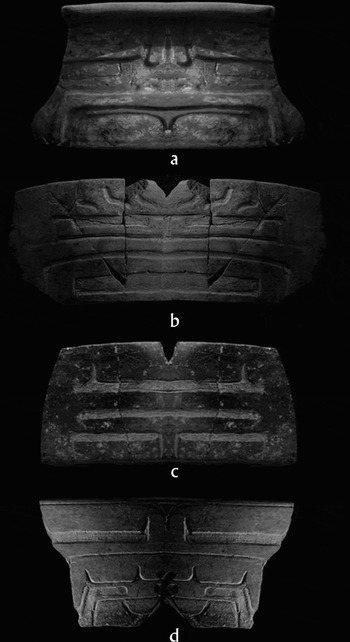
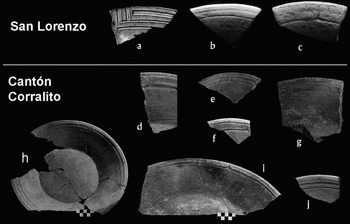
The carved Early Olmec horizon pottery of San Lorenzo and Cantón Corralito is artistically distinct, pleasing, and instantly recognizable (Figure 2). Vessels received a thin black, white, or black-and-white slip, but some are unslipped (or became “self slipped” through burnishing), and a few other slip colors are evident but much rarer. The vast majority of carved pots are small- to medium-size serving bowls, dishes, and plates, although a few vessels exhibit odd forms. At the leather-hard stage of drying, portions of the visible exterior surface were carved with motifs and designs in a consistent style—the Olmec style. The actual manner of excision is shared, with trough-shaped, convex, and flat bottom lines present in both collections and the depth of cutaway areas generally about 2 mm. I did not, however, quantify the relative proportions of excision modes or average depth of excisions. Judging by small cut marks and neatly trimmed corners of many design elements, it appears that obsidian blades were used to execute the designs, although some other worked material like hardwood or bone could have served the purpose just as well. Bright red to reddish-orange hematite was rubbed into the carved areas of many pots made at both centers, likely the vast majority of them.
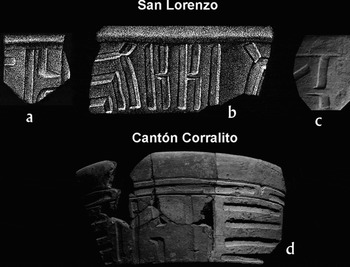
Frontal (mirror image) view of Calzadas Carved crocodilian or dragon supernatural: (a) San Lorenzo made; (b–d) Cantón Corralito made. Not to scale. San Lorenzo example after Coe and Diehl (Reference Coe and Diehl1980:22–23, No. 5).

The Samples
Evaluating the extent of correspondence between the carved and incised pottery of San Lorenzo and Cantón Corralito requires that the images in question come from pots made at one or the other site. Ideally, instrumental neutron activation analysis (INAA) would be used to determine this for each specimen involved, but I did not consider this necessary for San Lorenzo. Despite testing hundreds of vessel fragments excavated at the site, including scores of carved and incised specimens, the compositional analyses for my research and that of Blomster and his colleagues (Reference Blomster, Neff and Glascock2005) failed to find a single example made of non-local clay. This, of course, does not mean that decorated Olmec-style vessels from distant regions never arrived at San Lorenzo, but if they did they were certainly infrequent acquisitions. As a result, they would not create any substantial distortion in my results. It is also my impression from handling San Lorenzo pottery—its paste appearance, the frequent and liberal use of ash temper (see Cheetham et al. Reference Cheetham, Gonzáles, Behl, Coe, Diehl and Neff2009), and related tactile properties—that non-local pottery is lacking, at least in the collections I examined, which included the Yale project material and ceramics from several sites in its periphery (El Macayal, El Paraiso, La Abundancia, El Manati) excavated by Ponciano Ortiz and Carmen Rodríguez.
Accordingly, the San Lorenzo-made sherds used to address the extent of design and form correspondence include all sherds of the type Calzadas Carved excavated at the site during the 1960s. Note that the sample is much larger than the number of specimens illustrated in the San Lorenzo site monograph (Coe and Diehl Reference Coe and Diehl1980:Figures 138–145) and includes all vessel parts (rim, base, body). For the present study, these were augmented by a smaller number of sherds excavated at Cantón Corralito but determined through INAA to have been made at San Lorenzo (i.e., imports).
The collections of carved images attributable to Cantón Corralito, in contrast, come exclusively from pots of local manufacture as determined through INAA. Although INAA costs reduced the total number of specimens (n = 1,136) available for comparison, limiting comparison to sherds of known origin was a necessary step to assess the similarity of locally-made vessels since a considerable part of the collection at Cantón Corralito (12.6%) consists of pieces of carved pots made in the vicinity of San Lorenzo. Because the sampling of Cantón Corralito sherds for INAA was based on size and image preservation, the sherds used for stylistic analysis include the most complete images available. The resulting sample size at Cantón Corralito (n = 228) is slightly smaller than the sample representing San Lorenzo (n = 286).
With few exceptions, the samples used to determine the range and frequency of carved vessel forms include only rim sherds. This restrictive measure was necessary to ensure proper classification since base and wall sherds lacking a rim are often assignable to two or more of the form categories used in this study. The same samples were used to measure form-specific metric parameters (wall thickness, rim diameter, height, and so on) in order to assess the extent of technical style conformity between specific vessel forms made at both centers.
Frequency and Context
Calzadas Carved pottery comprises 6.4% and 2.2% of San Lorenzo and Cuadros ceramic complexes, respectively. The frequency at San Lorenzo is noteworthy, for it contradicts persistent claims (e.g., Flannery and Marcus Reference Flannery and Marcus2000) that carved pottery is rare there compared to sites with Early Olmec-style materials in other regions of Mesoamerica. Such assertions are based in part on calculations derived from the few tables and type frequency graphs presented in the San Lorenzo site monograph, which include all potsherds from single contexts (see Coe and Diehl Reference Coe and Diehl1980:Tables 4.1–4.4). The relative statistic used here (6.4%) is based on direct observation and classification of all San Lorenzo ceramic complex rim sherds obtained during the Yale excavations in the 1960s (Coe and Diehl Reference Coe and Diehl1980).Footnote 1 The issue of unsound comparison, particularly between San Lorenzo and the Mexican Highlands, runs much deeper and is discussed by Blomster (Reference Blomster2004:122, 2010) and Stark (Reference Stark, Scarborough and Clark2007:51–52).Footnote 2
Although carved pottery is three times as frequent at San Lorenzo compared to Cantón Corralito, this disparity is not as great as it seems. At Cantón Corralito, 3.7% of Cuadros phase rim sherds of various types were classified as “scraped-incised.” These are flat-bottom plates with low outsloping sides and linear designs encircling the rim interior (see Figure 11). Because at least one part of the design on most Scraped-incised specimens is scraped or lightly carved, I considered assigning these sherds to the Calzadas Carved type, as was done at San Lorenzo (see Coe and Diehl Reference Coe and Diehl1980:Figure 139 g), but I eventually decided to keep them in a separate category due to their extreme rarity at San Lorenzo (n = 3) and implications this may have in terms of the cultural practices and demography of the Cantón Corralito inhabitants. Curiously, the combined frequency of Scraped-incised and Calzadas Carved sherds at Cantón Corralito, 5.9%, is remarkably similar to the 6.4% reported here for Calzadas Carved at San Lorenzo. These two types appear to have been used in tandem or interchangeably at Cantón Corralito and, if so, may have been considered equivalent products by the center's residents.
Carved vessels were fairly common at Cantón Corralito, where intrasite distribution indicates they were regularly used in most, if not all, households. Like the Limón Incised type (the other hallmark Early Olmec horizon ceramic type), fragments occur across the site but never in special contexts. In fact, all Cuadros middens and most fill layers at Cantón Corralito yielded carved sherds alongside mundane household debris of various kinds. The consistency of context is important because it matches that of San Lorenzo but differs markedly from other regions of Mesoamerica where Olmec-style pots often occur in special contexts like burials (e.g., the Basin of Mexico, see Tolstoy Reference Tolstoy, Sharer and Grove1989). The residents of Cantón Corralito consumed about 150–300 carved vessels each year of the estimated 150 radiocarbon year Cuadros phase, of which some 20–40 would have come from the vicinity of San Lorenzo.Footnote 3
FORM AND METRIC PARAMETERS
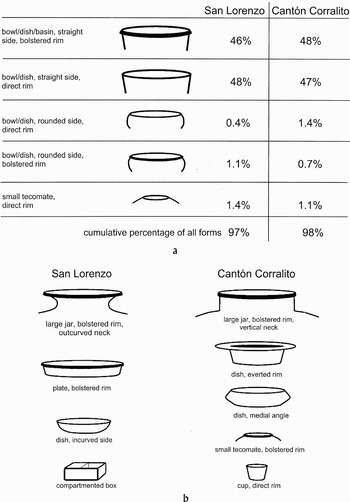
For all their showiness, Calzadas Carved pots are remarkably conservative in terms of form (Figure 3). The vast majority of specimens in both collections are flat bottom bowls and dishes with a direct or bolstered rim. As shown in Figure 3a, the frequency of these two forms is all but identical at San Lorenzo and Cantón Corralito. Combined they comprise 94% and 95% of the carved potsherds at San Lorenzo and Cantón Corralito, respectively.
Calzadas Carved vessel forms of San Lorenzo and Cantón Corralito: (a) shared forms and respective percentages, (b) rare forms exclusive to each site.

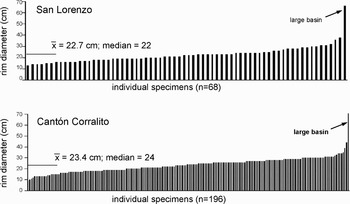
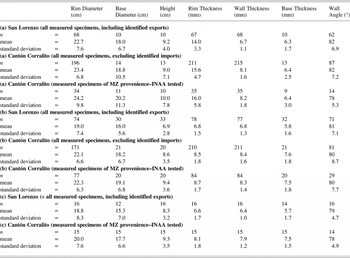
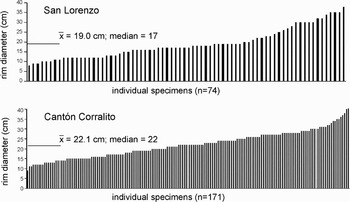
Other traits show resemblances as well. Figure 4 shows the distribution of rim diameters for bolstered rim Calzadas Carved vessels in both collections. Note the identical average diameter of 23 cm, with matching medians indicating normal distributions. When additional morphological parameters of this form are introduced, as shown in Table 1a, the similarity becomes more striking. For example, wall angle averages are nearly identical. Vessel height and base diameters are also similar, as are rim and wall thickness—considering that the eroded surfaces of San Lorenzo specimens effectively reduce values by 1–2 mm when both interior and exterior surfaces are combined. These similarities are evident when all recorded specimens from Cantón Corralito are used for comparison or just the subset demonstrated to be of local manufacture though INAA.
Distribution of rim diameters, Calzadas Carved bolstered rim bowls and dishes.

Technical style statistics, Calzadas Carved pottery: (a) bolstered rim bowls and dishes, (b) direct rim bowls and dishes, (c) direct rim bowls

Figure 5 charts the distribution of diameters for direct rim vessels, the other common form of carved pottery at both sites. The distributions are similar and normal, with averages of 19 and 22 cm. As with bolstered rim pots, there is a size continuum from small to large. Most other measured attributes are comparable (see Table 1b), although the Cantón Corralito pots tend to be slightly wider and taller on average.
Distribution of rim diameters, Calzadas Carved direct rim bowls and dishes.

The two most common forms discussed above are each composed of dishes and bowls, so it is worth looking at a subdivision of these data. Table 1c shows the comparative statistics for direct rim bowls, which are remarkably similar in both collections. The remaining three subdivisions of the two common Calzadas vessel forms (direct rim dishes, bolstered rim dishes, and bolstered rim bowls) yield similar results. The overall conclusion is inescapable: over 95% of Calzadas Carved pottery at both sites is nearly inseparable on morphological grounds. Evidently, a single technical style of manufacture was in operation at both settlements, at least as indicated by several measurable properties of finished products.
It is also worth noting that at both sites the sample of bolstered rim vessels includes one large basin. These super-size carved pots may have been used for communal eating or some other activity involving large numbers of people. The specimen from Cantón Corralito was found smashed on a patio floor alongside a massive Calzadas Carved jar which weighed in excess of 70 kilos (154 lbs), suggesting that they were used as a pair. The exterior of the San Lorenzo specimen has a frontal view of a sky dragon or crocodilian monster (see Figure 2a), and the Cantón Corralito specimen depicts a fish wrapping around the interior side of the vessel wall (Figure 13e). These are certainly different modes of presentation and subject matter, but massive basins with interior carving like the Cantón Corralito fish pot have been found by Ponciano Ortiz and Carmen Rodríguez in the periphery of San Lorenzo. The carved lines of the Cantón Corralito fish pot were heavily encrusted with hematite, and it is possible that this vessel and others like it fulfilled some ritual function if filled with water (Stark, personal communication 2005). Because it is on the interior, the fish design would certainly be obscured if the basin was filled with food.
Returning to the overall form breakdown, three of the remaining forms beyond the 95% covered by direct and bolstered rim pots occur at both settlements: dishes or bowls with rounded sides, identical pots with a bolstered rim, and small tecomates with a direct rim (Figure 3a). Combined, they make up about 3% of the Calzadas Carved rim sherds at both sites. Finally, there are rare forms specific to each collection, consisting of one or two specimens apiece (Figure 3b). While these are not shared in the present samples, they occur in other types at both sites, most notably Limón Incised.
DISSECTING IMAGERY: APOLOGIA AND SOLUTION
In contrast to the undeniable naturalism of Gulf Olmec monumental stone sculpture (see Coe Reference Coe and Willey1965; Coe and Diehl Reference Coe and Diehl1980:299–374; de la Fuente Reference de la Fuente and Benson1981, Reference de la Fuente and Clark1994, Reference de la Fuente, Benson and Fuente1996, Reference de la Fuente, Clark and Pye2000; Milbrath Reference Milbrath1979), carved and incised images on Early Olmec pottery are incredibly abstract. Most are simplified profile depictions of supernatural creatures, although more realistic frontal views of such creatures were sometimes made and other themes occur (e.g., spatial-directional concepts). Regardless of thematic content, most images are “large” in the sense that they wrap around the surface of whole pots and include multiple motifs; additionally, various features or elements of the motifs are part of the designs. The highly abstract nature of the imagery makes it difficult to reduce to hierarchical categories of design and problematic to draw a clear-cut line between such categories.
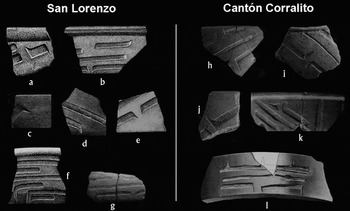
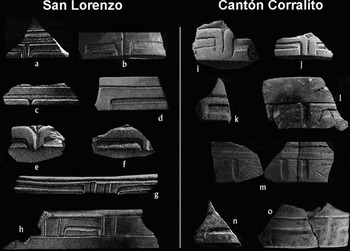
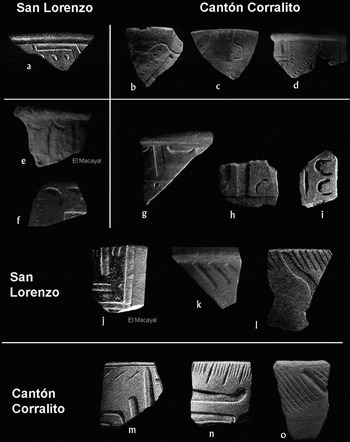
To appreciate this difficulty, let us consider a common supernatural creature on Olmec-style carved pots, the so-called “sky dragon” or “fire-”/“avian-serpent” (Taube Reference Taube, Clark and Pye2000). In profile it most often strikes a horizontal or diagonal pose suggestive of movement or flight, and the creature itself is generally defined by downturned gum brackets located below and parallel with two or more flaming eyebrows (for examples, see Figures 6–7). Other anatomical traits may be present, such as a trough-shaped eye or a fang located between the eyebrows and gum brackets, and on more elaborate renditions body elements, such as a “paw wing,” project from the rear. For this creature two or more discernable traits combine in a manner that makes it identifiable as an avian-serpent. Yet these same traits, when combined in different ways and in combination with still other traits, were used to define supernatural creatures other than the avian-serpent and they can occur in ways that defy identification of any particular creature. Even in the most favorable situation, then, should we consider an entire avian-serpent image a motif? On most examples only key aspects of the creature's head are shown, suggesting that the head stands for the whole in a pars pro toto sense. Or should we consider each depicted anatomical trait comprising the avian-serpent a motif, since each is recognizable and evidently artistically pliable because they were used in manifold ways?
Avian- or sky-serpent/dragon, Calzadas Carved. Not to scale.

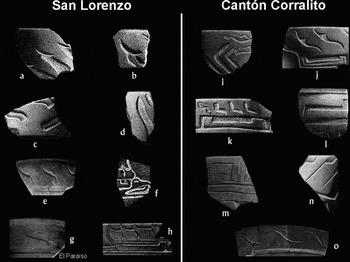
Flaming eyebrows, Calzadas Carved. Not to scale.

In my case, resolution of this classificatory problem was driven by a pragmatic desire to present a large amount of visual information in a readily digestible manner. The material at my disposal consists of potsherds, most of which capture only snippets of much larger presentations, yet on many sherds traits, such as flame eyebrows, gum brackets, and the like, are readily identifiable along with the finite design elements that comprise and accentuate them. If a sherd was large enough to include more than one recognizable trait, a specific supernatural creature could sometimes be identified, but this was the exception rather than the rule. Thus for the purpose of quantification and tabulation, I opted to lump both whole images (e.g., avian-serpent) and individual motifs (e.g., flame eyebrow) together.
For this study, then, the images on Calzadas Carved vessels were classified according to three analytical units: (1) motifs; (2) design elements; and (3) fillers/add-ons. These categories are loosely based on the hierarchical levels of design analysis devised by Friedrich (Reference Friedrich1970, Reference Friedrich, van der Leeuw and Pritchard1984; see also Plog Reference Plog1980), which I had intended on using without modification, and in fact I made several attempts to do so before finally settling on the analytical units noted above. Unlike Friedrich, I did not have the luxury of dealing with whole vessels and chatting with living informants (potters) and therefore was not permitted an unambiguous dissection and categorization of designs. My analytical units, while remaining loosely hierarchical in nature, are flexible in the sense that the division between them is somewhat fluid, especially categories 1 and 2. I believe that the abstract nature of Early Olmec-style ceramic imagery demands this approach.
As used here, a motif is an identifiable entity comprised of design elements and often fillers/add-ons. Examples include “flame eyebrows” and “gum brackets.” Motifs usually form part of larger representations and thus are not necessarily the most encompassing category or level of study. That level will be called whole image, although for reasons noted above I do not formally implement (quantify) such a category. Nonetheless, a few named and illustrated items clearly meet such a higher level of categorization and are discussed as such, even though for quantification purposes they are tabulated along with all other categories, as already noted.
Design elements are self-contained units of design that form part of a motif or a complete image. In reality, however, the line between a design element and a motif can be fuzzy. A good example is the flame eyebrow of avian-serpent and earth monster creatures. They are distinctive enough to stand on their own and symbolize such creatures, and in some cases they evidently do, but generally they occur above other lines representing the head, body, or eye element. Should they, then, be considered motifs or design elements when noted alone on a sherd—a sherd that may (or may not) have other observable and associated design elements carved into the adjacent surface area were the fragment only a bit larger? And so for quantification purposes design elements were tabulated with motifs. Fillers and add-ons, as the terms imply, accentuate or more fully define motifs or complete images. I suspect that they represent skin, scales, texture, or any number of other traits that were readily intelligible to the makers and users of the pots, although I have no way of demonstrating this.
Each of the above categories is amenable to measurement, as is Friedrich's (Reference Friedrich1970, Reference Friedrich, van der Leeuw and Pritchard1984) overarching analytical level of design field, or how a vessel surface is partitioned for design. I intended to take various measurements for each of the hierarchical levels and use the results to assess the degree of similarity between specific motifs and design elements executed on pots made at San Lorenzo and Cantón Corralito. It quickly became evident that this methodologically appealing approach was unachievable. Because I was dealing with sherds and not whole pots, it was often difficult or impossible to measure the design field. This was especially true in cases where the rim or base (or both) of a sherd was missing, thus preventing me from measuring the open space or gap between an image and those parts of the vessel. This was frustrating because it is my impression from handling the sherds and closely examining the few sufficiently intact examples that the design fields and sizes of motifs are very similar in both collections. In other words, mental partition of the vessel surface, subsequent image placement and motif size seem to have been concepts shared by potters in both communities. The figures will convey some of this information. Second, irregular breakage often prevented me from measuring the design elements and overall dimensions of specific motifs even if the motif itself could be readily identified. In the end, the number of sherds amenable to thorough recording of the metric properties of design fields, motifs, and design elements was simply too small to be statistically meaningful, and I abandoned efforts to measure hierarchical units.
In lieu of hierarchical trait measurement I identified and tallied the various motifs, design elements, and fillers/add-ons in order to reconstruct a design corpus (akin to Friedrich's [Reference Friedrich, van der Leeuw and Pritchard1984] design grammar) for Calzadas Carved pottery produced at San Lorenzo and Cantón Corralito. The approach is holistic in nature, aimed at revealing the content and limits of Early Olmec-style ceramic imagery at both places. My overall assessment of correspondence is therefore based on relative percentages, presence-absence, and visual data, especially the latter two. For this reason, I rely on ample illustration.
Finally, some mention of terminology is in order due to the nature of the images involved. For the most part, I will refer to specific supernaturals and other identifiable depictions according to language established in the archaeological literature. This does not mean that I agree with all such designations in terms of the actual referents, but this is not the place for detailed iconographic interpretation.
Designs
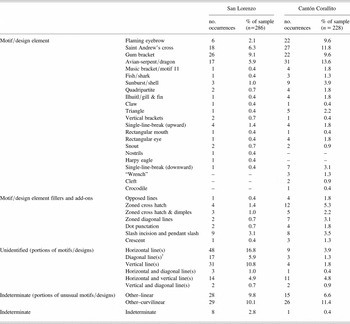
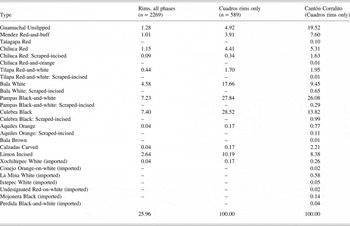
Table 2 shows the complete range and relative frequencies of carved designs on sherds from vessels made at San Lorenzo and Cantón Corralito. The total number of identified motifs and design elements is 22, with 19 of these occurring on sherds from San Lorenzo-made vessels. Remarkably, 17 of the 19 San Lorenzo motifs and design elements are found on sherds from vessels made at Cantón Corralito, a correspondence rate of 90%. The frequencies of individual motifs and design elements, on the other hand, are not always in agreement between collections because poor preservation and sherd size at San Lorenzo often prevented sure identification. This is most evident by the relatively high frequencies associated with the San Lorenzo grouping “unidentified: portions of motifs/design elements” shown toward the bottom of Table 2.
Identified motifs, design elements, and fillers or add-ons, Calzadas Carved potsherds
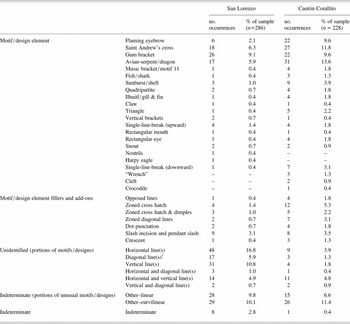
*Samples include rim, base, and body sherds. San Lorenzo sample includes all specimens of San Lorenzo context n = 247) and identified exports at Cantón Corralito (n = 39). Cantón Corralito sample consists of all carved sherds tested via INAA, excluding identified imports.
†Most likely portions of “avian serpent/dragon” motif, but portion too small for positive identification.
The number of motifs and design elements indicate that the repertoire is not reducible to a few catch-all categories. The breadth of supernatural or cosmological imagery is, in fact, quite remarkable at both centers, especially if the “indeterminate: portions of unusual motifs/designs” category in Table 2 is included, but among the named items a few are more common than others: the St. Andrew's cross, flaming eyebrows, gum brackets, and the avian (or fire) serpent/sky dragon. At times the St. Andrew's cross seems to be an integral unit of meaning that stands alone, but the autonomy of flaming eyebrows and gum brackets is doubtful and their attribution to specific supernaturals at times questionable, as already mentioned. These four commonly named items match closely with those recently presented and discussed for San Lorenzo by Di Castro and Cyphers (Reference Di Castro and Cyphers2006) based on recent excavations.
I suspect that most identified flaming eyebrows and gum brackets are associated with avian-serpent creatures, but there are exceptions. For example, less abstract frontal views of crocodilian or “earth monsters” occur, sometimes with gum brackets and flaming eyebrows (see Figure 2b–d). This is, however, very rare imagery and the overall body of carved design data presented here strongly supports Barbara Stark's (Reference Stark, Scarborough and Clark2007:52–53) observation that earth monster/were-jaguar imagery was fundamentally restricted to stone monuments at San Lorenzo. Stark's (Reference Stark, Scarborough and Clark2007) other observation pertains to the emulation of Gulf Coast imagery on carved pots made in the Mexican Highlands, where both feline (earth monster or were-jaguar) and reptilian (fire- or avian-serpent) imagery occurs. In other words, both categories were appropriated by peoples in the Mexican Highlands to suit their social contexts, perhaps as emblems associated with two descent groups (see Marcus Reference Marcus, Sharer and Grove1989; Pyne Reference Pyne and Flannery1976), but this dualism is not evident, at least to the same degree, on carved pots in the Gulf Coast. A near absence of earth monster/were-jaguar imagery is also the case at Cantón Corralito, suggesting that the themes carved on pots there were restricted by the same religious or mythological conventions in place at San Lorenzo.
Avian-serpent or dragon
This highly stylized creature (Figure 6), also known as a fire-serpent or sky-dragon (see Pyne Reference Pyne and Flannery1976), is depicted in profile view in both collections, either in a horizontal or slightly tilted position that lends an air of motion or flight. The creature generally consists of a central line or lines (the body or midline of the head) with one or more design elements positioned parallel to this and forming gum brackets (below) and flaming eyebrows (above). Less frequently other details were added, such as an eye (Figure 7h, j–k) or a paw wing. Despite these basic features, there is variability in the overall design of the creature, both between and within collections and in terms of the level of abstraction.
Flaming eyebrow
The flaming eyebrow motif was made in many different ways at both centers: as simple wavy lines, angled geometric lines, with barbed ends, and so on (Figure 7). Most often they were carved over an eye element or central line or lines (the body or midline of the head) of the avian-serpent and earth monster creature. Taube (Reference Taube1995:86) presents a convincing argument that flaming brows depict the crest of arboreal palm vipers or fer-de-lance (Bothriechis schlegelii) snakes native to the tropics of Middle America, hence my use of his term “avian-serpent.” If correct, this is yet another line of evidence indicating a Gulf Coast origin for Olmec-style imagery, since this reptile—and the crocodile—is not native to the Mexican highlands.
Gum bracket
This motif (Figure 8) is [-shaped, horizontal, and represents the upper portion of the open mouth of the avian serpent, crocodilian or earth monster, and possibly other creatures. It is frequently shown without any additional design elements aside from simple framing lines, thus standing for whatever creature is being depicted in a pars pro toto sense. This solitary use evokes a sense of power that makes the gum bracket an extremely potent Early Olmec motif. At Cantón Corralito and San Lorenzo carved gum brackets, when used in a pars pro toto sense, occur at the wall-base juncture or halfway up the vessel wall. Gum brackets also repeat around the vessel wall at regular intervals, either alone or in pairs, and when executed at the base of vessels, the entire interior area of the motif is generally carved (e.g., Figure 8e–f).
Downturned gum-brackets, Calzadas Carved. Not to scale.

St. Andrew's cross
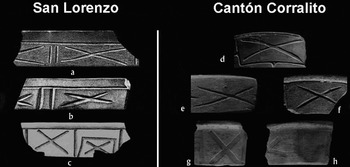
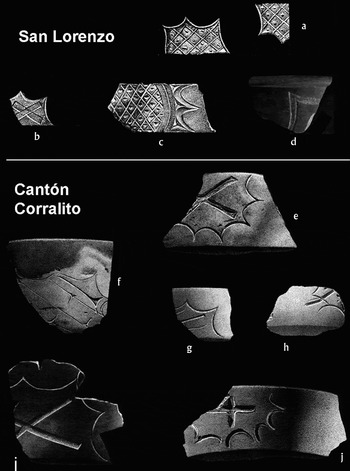
One of the most frequently shared motifs is the St. Andrew's cross, or crossed bands—which looks like a big X (Figure 9). They are common at both centers, come in wide and thin-line versions, and are sometimes framed within or set apart from other parts of the overall design. Sometimes crossed bands occur inside a scalloped, shell-like, or sunburst design (see Figure 10b, e, i). On the basis of much later Maya iconography, Michael Coe (Reference Coe1968:114) suggests that in Early Olmec times crossed bands symbolized both sky and serpent.
Saint Andrew's cross or crossed bands, Calzadas Carved. Not to scale.

Sunburst or shell, Calzadas Carved. Note co-occurrence with St. Andrew's Cross, quadripartite, and avian-serpent motifs. Not to scale.

Sunburst or shell
This motif (Figure 10), which is pendent from the rim or rises from the base, is roughly semicircular in appearance with multiple (>5) pointed or protruding elements. It may represent the outline of a shell or the sun, although most examples have a secondary motif, design element, filler, or add-on element located within the interior area, which complicates meaning. Secondary interior motifs include the St. Andrew's cross, quadripartite (vertical) cross, and avian-serpent. Diagonal cross-hatching with or without dimples occurs in the interior area but when present precludes secondary interior motifs. All the above combinations are present in both collections.
Single-line-break
Line breaks occur in association with avian-serpent and possibly other supernaturals. These design elements are triangular in appearance, often carved out, and extend up or down from the line to which they are appended (e.g., Figure 12d, top right of sherd). I suspect that they represent an appendage-like element or aspect of the head (crest or furrow/cleft) or body. In this sense, they are not true line breaks (i.e., with a gap between the lines), but the manner in which they are rendered at both sites is identical. Triangular and rectilinear line breaks also occur on the interior rim of “scraped incised” plates at both sites (Figure 11), although this use of the design this is much more frequent at Cantón Corralito than at San Lorenzo. When used in this manner they may represent a highly stylized version of gum brackets.
“Scraped incised” dishes and plates of various types showing multiple lines and line breaks. Not to scale.

Vertical brackets, Calzadas Carved. Not to scale.

Brackets
Two kinds of bracket designs occur in both collections. The first resembles the C-clef musical notation ({), hence the name “music bracket” (Pyne Reference Pyne and Flannery1976 called this “motif 11”). It consists of two lines—one rising from the vessel base, another descending from the rim—that verge sharply outward at the point of joining or just before joining, thus creating a pointed element. Two such units generally occur with one or more vertical lines located between them. Music brackets may have been used as a framing device when positioned vertically, but the break or pointed elements are suggestive of gum brackets and flaming eyebrows, especially when the overall design is positioned diagonally, and it is possible that this is a highly abstract version of the avian-serpent. Music brackets are rare in both collections and seem to be much more common in Mesoamerica during the era immediately postdating the downfall of San Lorenzo (see Cheetham Reference Cheetham and Powis2005:Figure 3.5; Clark and Cheetham Reference Clark, Cheetham, Carrión and Cook2005:Figure 30b, 31i, 34p, 42a; Coe and Flannery Reference Coe and Flannery1967:Figure 23b; MacNeish et al. Reference MacNeish, Peterson and Flannery1970:Figure 36; Niederberger Reference Niederberger1976:Lám L8, 10).
The other bracket design (Figure 12) is similar to the music bracket except that the opposed lines do not meet each other. Instead, the opposed lines—one rising from the vessel base, another descending from the rim—have a gap between them and the end of each line is hooked, pointing in the same or opposite direction. Because these vertical brackets often occur without a corresponding set located nearby, the design may have a meaning or use apart from a framing device.
Fish or shark
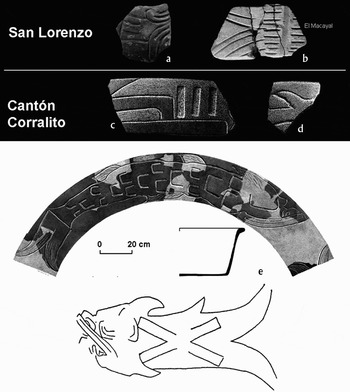
One aspect of rare fish and shark creature depictions (Figure 13) is a splayed tailfin section shown with multiple outcurved lines, although the example shown in Figure 13a may represent a partially husked ear of maize. Shark imagery includes depictions of dorsal fins (Figure 13d) and the external gill opening, pointed snout, and mouth (Figure 13c). The large fish shown in Figure 13e is stylistically similar to the shark creature on Monument 58 at San Lorenzo, shown at the bottom of Figure 13 at the same scale.
Fish (a–b, e) and shark (c–d) designs, Calzadas Carved. Not to scale. Monument 58 shark image at bottom after de la Fuente (Reference de la Fuente1973:237).

Other shared designs
Several other motifs and design elements occur on carved pottery made at San Lorenzo and Cantón Corralito, although most are less frequent than those discussed above.
Quadripartite motifs are variable in execution with some examples consisting of a vertical cross (e.g., Figure 10j) and others a diamond- or star-shaped cross. Either way the four arms of the cross are evident and oriented vertically and horizontally. The quadripartite design may represent a spatial or cosmological concept related to directionality, but in most cases it is contained within or presented alongside other motifs or design elements, which complicates meaning.
The triangle, a motif or geometric design element of unknown meaning, is depicted either in series with the pointed end down or appended to a motif or whole image. When used in the latter manner they point laterally and may represent the beak or some other protruding feature of the avian-serpent's head.
Another design element or motif is the claw, which most certainly represents just that—the paw of a jaguar (or were-jaguar) creature or hand of a crocodile. Examples are rendered in realistic manner or as hooked elements that rise from the vessel base or descend from the vessel mid-line.
The cleft motif or design element consists of two intersecting lines creating a sharp indentation or furrow. Positioned either horizontally or vertically, the cleft is part of a rectangular design that may represent the earth or agricultural fertility. While quite rare for this period, clefts are common on ceramics and portable art objects (e.g., jade figurines and masks) dated to the early part of the Middle Formative period (ca. 1000–600 b.c.). Taube (Reference Taube, Clark and Pye2000) discusses the cleft and its association with maize.
Another shared motif is the ilhuitl or gill-and-fin, rarely carved into pots but common on incised (Limón Incised) vessels (see Coe and Diehl Reference Coe and Diehl1980:Figure 144b–k, m, 145c). Comparison with fish effigy pots excavated by Ponciano Ortiz and Carmen Rodríguez at sites in the periphery of San Lorenzo suggest that this motif represents the gill and pectoral fin of a fish, not surprising given the dietary emphasis on marine and freshwater species by both Gulf Olmec and Mokaya peoples (Feddema Reference Feddema1993; Wing Reference Wing, Coe and Diehl1980).
Site-specific designs
On the basis of extant imagery several motifs or design elements listed in Table 2 occur in one or the other collection, but not both. One such motif at Cantón Corralito may represent a shark tooth. Noting examples from the Mexican Highlands, Joyce and her colleagues (Reference Joyce, Edging, Lorenz, Gillespie and Fields1991:149) suggest that this is an early reference to bloodletting. Another image specific to Cantón Corralito is a quite realistic crocodilian creature. Images specific to San Lorenzo include realistic depiction of crocodilian or earth monster nostrils (Figure 2a; Coe and Diehl Reference Coe and Diehl1980:Figure 140g) and the harpy eagle (Figure 7f).
Fillers or add-ons
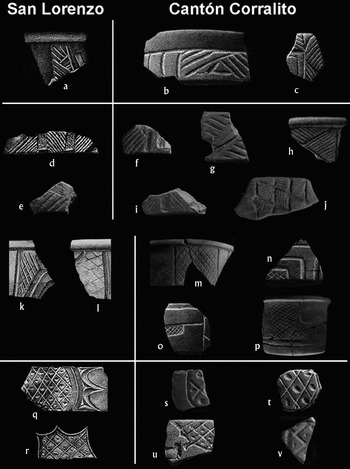
Remarkably, seven kinds of fillers and add-ons were noted in both collections (Figures 14–15), for a correspondence rate of 100%. Common examples include opposed lines, diagonal lines, and cross-hatching with or without dots or dimples in the resulting diagonal areas. Evidently, the manner of embellishing or finishing whole images was the same at San Lorenzo and Cantón Corralito insofar as specific fillers or add-ons usually occur in the same locations, are associated with specific motifs, and are always zoned or framed by design elements or motifs.
Motif and design element fillers and add-ons, Calzadas Carved: (a–c) opposed lines, (d–j) zoned diagonal lines, (k–p) zoned cross-hatch, (q–v) zoned cross-hatch and dimples. Not to scale.

Motif and design element fillers and add-ons, Calzadas Carved: (a–d) dot punctation, (e–i) crescent, (j–o) slash incision and pendant. Not to scale.

WHAT ABOUT THEIR NEIGHBORS?
The identification of any prehistoric ethnic enclave is, of course, based on material similarities with the homeland, but it is also based on material dissimilarities with the host community (see B. Stark Reference Stark, Berdan, Chance, Sandstrom, Stark, Taggart and Umberger2008; Stein Reference Stein2000, Reference Stein2002) that manifest at the site level (an enclave within a host settlement) or the territory as a whole (a spatially distinct settlement enclave). Based on the distribution of carved potsherds and other Olmec-style objects, Cantón Corralito appears to fall into the latter category and so it is necessary to turn to neighboring Mazatan sites to establish whether their residents enjoyed more, less, or equal access to Gulf Olmec goods and ideas than did the residents of Cantón Corralito.
For comparison, I analyzed a large sample of pottery excavated in 1985 at Aquiles Serdan, a site located 7 km northwest of Cantón Corralito with a Cuadros occupation and recognized corpus of Olmec-style material (Clark et al. Reference Clark, Blake, Guzzy, Cuevas and Salcedo1987). Most common Cuadros phase cooking, storage, and serving vessel types occur at both Cantón Corralito and Aquiles Serdan (Table 3), indicative of a shared ceramic tradition that, indeed, occurs across Mazatan (see Blake et al. Reference Blake, Clark, Voorhies, Michaels, Love, Pye, Demarest and Arroyo1995). There are, however, differences in the relative frequency of specific types, differences I believe to be meaningful in terms of practice and cultural demography. For example, undecorated black-slipped and white-slipped pots are more frequent at Aquiles Serdan than they are at Cantón Corralito. By itself this is no great matter, but their use at Aquiles Serdan came at the direct expense of fine-paste imported vessels and carved-incised pots (local and imported). Only one of the seven fine-paste imported types present at Cantón Corralito (kaolin Xochiltepec White pottery) occurs at Aquiles Serdan, and, overall, imported fine-paste pottery is seven times less frequent there. The disparity of excised (Calzadas Carved) pottery is more dramatic, being 13 times less common at Aquiles Serdan than at Cantón Corralito. In contrast, the frequency of incised pottery (Limón Incised) is about the same at both settlements, but even here the design repertoire at Aquiles Serdan is much less diverse compared to Cantón Corralito.
Comparison of Cuadros ceramic complex type frequencies at Aquiles Serdan (Trench 1, Sec. G, Levels 2–13) and Cantón Corralito
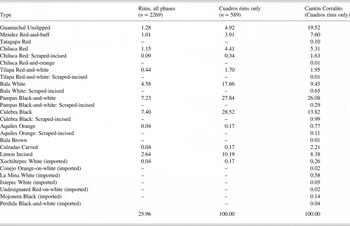
Although detailed comparison between the Cuadros phase pottery of Cantón Corralito and other Mazatan sites is currently limited to one site, the Aquiles Serdan data reveal a pattern of simultaneous conformity and divergence; a regional ceramic tradition with variation manifest at the site level. I believe that differences in the presence and frequency of specific types comprising the respective ceramic complexes of Aquiles Serdan and Cantón Corralito are best explained by unequal access to imported Gulf Olmec objects, varying cultural practices, and the ethnic composition of resident populations. With the analysis of collections from additional Mazatan sites, this pattern should become more pronounced, since Aquiles Serdan is one of the best represented local sites in terms of Cuadros phase Olmec-style objects.
IMPORTED POTS AS TEMPLATES?
Could the many formal and stylistic parallels between carved vessels made at San Lorenzo and at Cantón Corralito have come about without Gulf Olmecs residing at Cantón Corralito, either exclusively or in coresidence with indigenous Mokaya or Olmecized Mokaya? It seems highly unlikely but a possibility that cannot be ignored. Fortunately, this can be tested by comparing the formal properties of imported pottery at Cantón Corralito (the potential templates identified by INAA) against those of locally-made counterparts (the “copies”). If formal properties are nearly identical, then the possibility of imitation by indigenous Mokaya or Olmecized Mokaya without occupation by Gulf Olmec immigrants or their descendants cannot be dismissed. On the other hand, if formal properties are similar but also distinct, or strongly divergent, the case for Gulf Olmec occupation may be strengthened because imitation of imported pots could not explain the many similarities between pots made and excavated at Cantón Corralito and San Lorenzo.
While many formal traits compared very closely, rim diameters showed more differences. On the basis of rim diameter, a good gauge of vessel sizes, the two most common Calzadas Carved pottery forms made at Cantón Corralito (bolstered and direct rim bowls/dishes; see Figure 3a) are 5–7 cm larger, on average, than their imported counterparts. Size-wise, then, imported carved vessel forms were not closely copied by local potters; they were not templates in the strict sense of the word. Even so, I am not advocating that these highly decorated imported vessels were not used as templates at any level. To state this in the face of near complete form correspondence and so many shared designs and motifs would be absurd. These vessels were available for scrutiny, and local potters clearly fulfilled a demand for comparable pots. Then why, on average, do local counterparts tend to be larger? I believe this is best explained by the challenges involved in transporting these fragile objects hundreds of kilometers. Smaller and lighter pots are less prone to breakage, and more units could be delivered per journey.
This interpretation finds additional support in the collection of carved potsherds at San Lorenzo (i.e., made and excavated there). Again using rim diameters as a proxy for average vessel size, common bolstered and direct bowls and dishes are 4–5 cm larger at San Lorenzo than their imported counterparts at Cantón Corralito. Vessels with San Lorenzo site context are, in fact, more similar to those made at Cantón Corralito (see Figures 4–5) than they are to pots made at San Lorenzo and shipped to Cantón Corralito. And this is not only the case with carved pots, but forms associated with incised vessels (Limón Incised type) and undecorated types (slipped but otherwise plain) that occur as imports at Cantón Corralito. The exception appears to be forms associated with the fine-paste types Xochiltepec White and La Mina White, which are quite small and tend to be the same size in the locally-made collections from both sites and the imported specimens at Cantón Corralito.
These data are very revealing in terms of the habitual manner or technical style of ceramic production at Cantón Corralito. For obvious reasons, potters located in Mazatan could not easily inspect vessels in daily use at San Lorenzo, and yet they consistently made them in the same forms and to near identical proportions—both carved pots and other types—as those known for San Lorenzo. The most parsimonious explanation is that Mazatan-based potters had an intimate knowledge of Gulf Coast potting practices because some of them were Gulf Coast potters and received their training there or learned the craft from individuals who did receive training there. Decorated pots exported from San Lorenzo to Cantón Corralito were not strict templates. Templates appear to have been held in the minds of the artisans who realized them in clay.
CONCLUSIONS
The information presented in this paper is essential to the assessment of Gulf Olmec presence at Cantón Corralito for several reasons. Carved Olmec-style pottery embodies practices of a mythic-religious and cosmological nature like no other line of available evidence can, at least to the same degree. Carved (and incised) pots were a vehicle through which metaphysical beliefs became manifest at San Lorenzo, Cantón Corralito, and many other centers in Mesoamerica during the Early Olmec horizon. They were a portable and evidently widely accessible medium for both public and private expressions of belief and for this reason are fundamental to unraveling the extent of religious commonality between centers and across regions. Moreover, the manner of design execution and the technical style of carved pots provide a glimpse into the geographic origins or cultural affiliation of the potters who made them.
By 1150 b.c., the start of the San Lorenzo horizon, nearly all traces of indigenous Mokaya traditions had vanished at Cantón Corralito. Carved and incised pots were exported from San Lorenzo to Cantón Corralito in substantial numbers, continuing in modified and much amplified form a practice begun decades before the Olmec style emerged. Similarities between the carved pottery of San Lorenzo and Cantón Corralito include highly visual aspects like vessel forms and designs as well as more discrete traits like technical style characteristics attributable to rote behavior learned in a specific cultural setting. From common pots to the most rare and unusual forms, the carved pottery of the two sites is nearly inseparable and evidently part of a single tradition of ceramic manufacture, food presentation, and religious imagery. Comparison of imported and locally-made pots indicates that emulation by indigenous Mokaya cannot account for these similarities; most carved pots made at Cantón Corralito are more similar to counterparts of San Lorenzo context than they are to vessels made there and shipped to Cantón Corralito. Comparison with Cuadros phase pottery from one other Mazatan site, Aquiles Serdan, suggests that the quantity and variety of Olmec-style ceramics at Cantón Corralito, including carved pots, was unique in the region despite a shared tradition of plain and utilitarian ceramic types.
On the basis of these and other comparative data, including figurines (Cheetham Reference Cheetham, Halperin, Faust, Taube and Giguet2009) and plain pottery (Cheetham and Coe Reference Cheetham and Coe2009), it would appear that by 1150 b.c. the residents of Cantón Corralito consisted of Gulf Olmecs and their descendents or a combination of Gulf Olmecs and Mokaya who were fully “Olmecized.” Either way, the volume of imported pots and other objects certainly suggests a regular influx of people arriving as immigrants or traders from the Gulf Coast, people who would have been latecomers, relatively speaking, considering the likelihood that immigration began earlier.
And indeed there is ample evidence to suggest still earlier Gulf Olmec presence at Cantón Corralito. During Initial Olmec times (Chicharras and Cherla phases, ca. 1250–1150 b.c.), potters at San Lorenzo and Cantón Corralito produced decorated serving vessels with similar geometric designs and motifs and using the same techniques, most notably post-slip fine-line incision. The designs are non-Olmec style in appearance, but evidently meaningful since the pots on which they occur were exported from San Lorenzo to Cantón Corralito along with plain pots. In addition, the complete repertoire of Initial Olmec era vessel forms at both centers is remarkably similar (Cheetham and Coe Reference Cheetham and Coe2009).
Evidence of shared vessel designs and forms during Initial Olmec times is fundamental to understanding later developments at Cantón Corralito. Emulation was a one-way process during Initial Olmec times, with vessels, associated imagery, and several other classes of portable objects coming from the Gulf Coast to Mazatan. Yet vestiges of earlier, local (Ocós phase Mokaya) practices were maintained at Cantón Corralito and to a greater extent other nearby centers. The pervasiveness of Gulf Coast-inspired objects at Cantón Corralito—both mundane items and presumed special objects and imagery—suggests that Gulf Olmecs had taken up residence there during this incipient era, perhaps intermarrying with local Mokayas and thus accounting for the maintenance of some previous traditions. This incipient social strategy became amplified during subsequent generations, matured during Early Olmec times, and vanished about 1000 b.c. when Cantón Corralito was destroyed by floodwaters and San Lorenzo ceased to be the preeminent Gulf Coast center.
RESUMEN
Los objetos portátiles de “estilo olmeca” aparecen en diversas regiones de Mesoamérica hacia la parte final del segundo milenio a.n.e., frecuentemente en forma de figurillas cerámicas y vasijas grabadas e incisas. Los orígenes de tal estilo olmeca temprano y el significado de su distribución han sido enérgicamente debatidos, y resulta especialmente controversial en ambos sentidos el papel desempeñado por la cultura arqueológica olmeca de la Costa del Golfo y por su centro mayor, San Lorenzo. Aunque los resultados recientes de los análisis de composición química indican que algunas vasijas de estilo olmeca se exportaban de la Costa del Golfo hacia diversas regiones de Mesoamérica, en todas las áreas ubicadas fuera de la costa éstas resultan ampliamente superadas en número por las versiones de manufactura local, que podían ser fieles o no a los cánones estilísticos olmecas del Golfo basados en la forma de las vasijas, el estilo técnico de su manufactura y los criterios de diseño. El grado de concordancia estilística entre las vasijas elaboradas en la Costa del Golfo y las de regiones distantes presenta implicaciones directas en términos del origen geográfico, el entrenamiento y la adscripción cultural (etnicidad innata) de los artesanos que las produjeron. Consideraré aquí dichos aspectos a partir de la comparación de los diseños y formas de la cerámica grabada (Calzadas Grabada [Calzadas Carved]) elaborada en San Lorenzo y en Cantón Corralito, un posible enclave de pobladores olmecas del Golfo ubicado en la región de Mazatán, en la Costa Pacífica de Chiapas, a unos 450 kilómetros de distancia de San Lorenzo.
Los análisis han revelado que el 98% de la cerámica Calzadas Grabada producida en San Lorenzo y en Cantón Corralito entre 1150–1000 a.n.e. aproximadamente (el horizonte “San Lorenzo” o “Temprano”) presenta las mismas formas y casi idénticas propiedades métricas, como el grosor de las paredes y el diámetro de los bordes, lo que indica un estilo compartido en la técnica de manufactura. Además, 17 de los 19 elementos de diseño y motivos cerámicos identificados en las vasijas grabadas hechas en San Lorenzo aparecen en las vasijas elaboradas en Cantón Corralito, un grado de correspondencia del 90%. La imitación rigurosa de la cerámica exportada de San Lorenzo a Cantón Corralito no sustenta tales similitudes; de hecho, las vasijas grabadas producidas en Cantón Corralito resultan más parecidas a sus contrapartes elaboradas y excavadas en San Lorenzo que a las vasijas que fueron hechas allí y enviadas a Cantón Corralito.
Otras comparaciones entre el tipo Calzadas Grabado y diversos tipos cerámicos procedentes de Cantón Corralito y del vecino sitio de Aquiles Serdán nos permiten destacar la naturaleza única de la colección de Cantón Corralito en el entorno de Mazatán. Aunque sí aparece cerámica de estilo olmeca en Aquiles Serdán, existen diferencias notorias que incluyen una frecuencia de vasijas grabadas 13 veces menor que en Cantón Corralito y una ausencia casi total de vajillas de pasta fina importadas de San Lorenzo, las cuales, en contraste, resultan comunes en Cantón Corralito. Tal disparidad parece haber sido el resultado de un acceso desigual a los objetos importados de la Costa del Golfo, de prácticas culturales diferentes y, sobre todo, de la composición étnica de las poblaciones residentes en Aquiles Serdán y Cantón Corralito.
El análisis de la cerámica grabada, así como otros datos obtenidos, sugieren fuertemente que hacia el final del segundo milenio a.n.e. Cantón Corralito se había convertido en un gran enclave (de más de 25 hectáreas) habitado por un estimado de 750–1000 pobladores olmecas del Golfo y sus descendientes, o tal vez por una combinación de olmecas del Golfo y residentes locales que fueron completamente “olmequizados.” Como tal, representa la colonia más temprana reportada hasta el momento en América.
ACKNOWLEDGEMENTS
I thank Michael Coe, Frank Hole, and the staff at The Peabody Museum of Natural History at Yale University for allowing me to study and sample the San Lorenzo materials on two occasions. The consent of Mexico's Instituto Nacional de Antropología e Historia (Joaquín García Bárcena and Roberto Garcia Moll, Consejo Directors) was fundamental to this and all other Cantón Corralito project research. The New World Archaeological Foundation of Brigham Young University provided logistical and financial support for the Cantón Corralito project, with other funds and assistance coming from The Reinhart Foundation, National Science Foundation, The Foundation for the Advancement of Mesoamerican Studies, the University of Missouri Research Reactor Center, the Institute for Integrated Research in Materials, Environments and Society at CSU-Long Beach, the Social Sciences and Humanities Research Council of Canada, the School of Human Evolution & Social Change at Arizona State University, and the Graduate and Professional Student Association of Arizona State University. I thank these institutions and individuals associated with them for their support, John Hodgson for his help at the Peabody Museum, Ayax Moreno for his wonderful illustrations, and Lynneth Lowe for the Spanish abstract. This paper has benefitted from comments by John Clark, Richard Lesure, Barbara Stark, Jeffrey Blomster, an anonymous reviewer, and an earlier suggestion by David Grove to include comparative data on the intraregional scale. Any and all errors or omissions are, however, mine alone.