On 28 July 1944, a V1 flying bomb struck the High Street in Lewisham (a suburb of south-east London), devastating the town's street market and shops and killing 51 people.Footnote 1 The borough council's archives contain a photograph showing the local branch of Marks and Spencer reduced to a steel skeleton and in the course of demolition. Yet, in front of the wrecked shop is a market stall, open for business selling fruit and vegetables, with two traders just visible in the shadow of the stall's canopy in this rather indistinct image. The photograph dates from just after the end of the period considered in this article, but despite this it stands as a good starting point, capturing some of the themes under enquiry here: the role of the street market in modern London; the sites and spaces that markets occupied; their relationship to other retail forms (in this case the multiple store) and the resilience of this form of low-overheads, kerbstone trade, here demonstrated with great poignancy as the market quickly reasserted itself in the aftermath of violent destruction. Historians of retailing often characterize markets, and particularly street markets, as an unsophisticated form of retail provision. This may be true in some respects, yet the contention of this article is that street markets played a vital and expanding role in the retailing of many commodities in London from the mid-nineteenth century until well into the middle of the twentieth century, that they should be analysed in the context of their relation to other more complex, and more ostensibly ‘modern’, types of retail, and considered for their social and cultural impact on life in the city.
London's street markets are a common theme in popular reporting and representation of the city, in images, the press and tourist guides.Footnote 2 The market trader is a member of a cast of traditional London ‘types’, alongside the city gent and the black cab driver, and the market and its people recur in creative depictions, from fine art (Michael Landy's Taken to Market) to West End theatre (Me and My Girl) to contemporary television (Eastenders). As Judith Walkowitz says, ‘street markets. . .have long occupied a prominent place in the literary and visual panorama of London life’.Footnote 3 Interest in street trading as a characteristic aspect of London's culture and infrastructure dates back at least to the middle of the nineteenth century, so that the London street market of the later nineteenth and early twentieth centuries is well evidenced in primary sources. This article deals with the period from 1850 to 1939, thus an excellent starting point is Henry Mayhew's description of ‘London Street Markets on a Saturday Night’ in London Labour and the London Poor (1851):
Here is a stall glittering with new tin saucepans; there another, bright with its blue and yellow crockery. . .a butcher's shop, crimson and white with meat piled up to the first floor. . .this stall is green and white with bunches of turnips – that red with apples, the next yellow with onions.Footnote 4
‘Go to whatever corner of the metropolis you please’ on a Saturday evening or a Sunday morning, says Mayhew, and the scene will be the same.Footnote 5 Mayhew's account combines detailed journalistic description with an attempt at quantifying the scope and scale of street and market trade, and in both these approaches it is followed by many other sources; the street market can be traced as both a cultural form and as an economic entity that is to some extent measurable. Other sources deal with street markets from a legislative or governmental point of view, seeing them as an administrative ‘problem’ in need of a solution. Fewer, but not absent, are sources that give us ‘insider’ accounts of those who worked in the street markets, or shopped there. And finally, there is rich visual evidence, scattered across a huge range of sources. Thus, a brief representative sample of source material for this subject might follow Mayhew with George Dodd's The Food of London (1856).Footnote 6 George Sims and George Augustus Sala represent the journalists (serious and salacious) who published on this subject,Footnote 7 and across the period a number of memoirs give vivid descriptions, often based on childhood recollection.Footnote 8 In the late 1880s, the Royal Commission on Market Rights and Tolls gathered valuable witness evidence.Footnote 9 Then come two reports prepared by the London County Council (LCC) in 1893 and 1901,Footnote 10 and Charles Booth's great work of social observation, Life and Labour of the People in London, published between the late 1880s and early 1900s.Footnote 11 In 1913, American J.W. Sullivan published his examination of London's markets as a model for food supply reform in New York.Footnote 12 The year 1932 gives us the London School of Economics’ exhaustive updating of Charles Booth's research in the New Survey of London Life and Labour.Footnote 13 And towards the end of the period there is journalist Mary Benedetta's 1936 book The Street Markets of London.Footnote 14 Benedetta took most of her quantitative data directly from earlier sources, particularly the New Survey, but she added lively accounts of a number of markets, illustrated with photographs by Hungarian photographer Lazlo Moholy-Nagy (see Figure 1). Her description of a ‘typical’ London street market is more concise than Mayhew's 80 years earlier, but not inconsistent with it: ‘all kinds of food, fruit, vegetables, mushrooms and flowers. . .a frenzied climax of high spirits and quick selling on Saturday night’.Footnote 15
Lazlo Moholy-Nagy, ‘Berwick Street Market: general view’, from Mary Benedetta, The Street Markets of London (John Miles, London, 1936), facing p. 64. © Hattula Moholy-Nagy/DACS 2015.

This article concerns the street markets visited by Mayhew and Benedetta, and many observers in between, seeking to establish a coherent account of their growing number and changing nature, their legal standing, their relationship to other retail provision and their contribution to the culture of the emerging modern city.
Context: authorized and unauthorized markets
The Royal Commission on Market Rights and Tolls of 1889–91 set out a neat definition of a market as ‘an authorised public concourse of buyers and sellers of commodities, meeting at a place, more or less strictly limited or defined, at an appointed time’.Footnote 16 Buyers, sellers, commodities, place and time together constitute a market – yet this definition excludes the street market through its use of the word ‘authorised’. Street markets were informal in nature, organic in growth and barely regulated for much of the period under discussion here. The Royal Commission was overwhelmingly concerned with authorized markets, devoting just a few pages of its 13 volumes to street markets. London had around a dozen authorized markets in 1889: these were the great city markets established by ancient charters and grants of market rights, many of which dated back to the medieval or early modern periods. The oldest of these legal instruments gave a monopoly on the holding of markets to the Corporation of London, which governed the small central area within the boundaries of ancient London, and which owned Smithfield, Leadenhall and Billingsgate markets, amongst others. Later grants had given monopolies to markets in private ownership: these included Covent Garden and Spitalfields.Footnote 17 From the early nineteenth century, these authorized markets were subject to reforming pressure (although their owners also guarded their geographical monopolies jealously): the livestock market at Smithfield is a good example. For centuries, frightened animals were driven to Smithfield through the busy city streets, and once there traded and slaughtered in the open city square. By the early nineteenth century, this practice was increasingly abhorrent, and in 1855 Smithfield was replaced by the Metropolitan Cattle Market in Islington, to which livestock was brought by rail to be slaughtered in purpose-built premises away from the public gaze.Footnote 18 The old Smithfield site was redeveloped with a large covered market trading in meat, but not live animals. Between the 1830s and 1870s, many of London's authorized markets were provided with new, enlarged premises that aimed to remove their activities from the city's streets.Footnote 19
The reform of the authorized markets was not simply a response to changing sensibilities, but also to the huge growth of London's population and the ever-increasing demand for food. By the mid-nineteenth century, most of the authorized markets dealt almost exclusively in wholesale trade: as the city grew and spread, they were no longer the place to shop for everyday provisions. The gap was filled by retailers; shopkeepers and street traders. Charles Booth describes cogently the resulting transformation in London's market provision – this is where the unauthorized or street markets emerge:
As a natural result of the growth of London, the original retail markets have assumed an almost strictly wholesale character. From these markets the retail shops obtain their supplies, and to them the costermonger repairs to replenish his stock.
The first and proper business of the coster is to push his barrow and sell his goods from street to street; but it has come about that itinerant vendors, seeking their customers, gather together in certain places during a portion of the day or evening, and in these places their customers finally learn to look for them. Thus the circle is complete, and an informal, unauthorized market is the result.Footnote 20
Thus, street markets appeared in response to the same pressures of urban growth that necessitated the reform of London's authorized markets. Itinerant traders had long formed an important retail link between the authorized markets and consumers. As the city's peripheries grew and the authorized markets turned to wholesale trade, the street traders themselves began to settle into fixed sites, creating new markets, albeit that these were informal gatherings with no buildings or infrastructure.
The street markets provided a vital link in the supply chain of the city, yet their legal position was as tenuous as their physical formation, and none had any grant of market rights from parliament or crown. As they were disliked by rate-paying shopkeepers, and criticized on the grounds of noise, mess and obstruction of traffic, this made them vulnerable. Yet, as a counterbalance, legislation that might have been used to clear them off the streets was weak and uncertain. There was no specific law on street markets, although legislation from 1817 and 1869 allowed the Metropolitan Police to take some action against obstruction in the street, and to enforce maximum dimensions for street traders’ barrows and stalls.Footnote 21 In 1888, the Royal Commission took evidence from a costermonger, John Denton, who traded in Chapel Street market in Islington. The following exchange between Denton and Lord Balfour of Burleigh points to a gulf of incomprehension on the matter of regulation. Burleigh cannot quite understand that Denton has no one's permission to trade on the street, and conversely no right to occupy his accustomed pitch:
Burleigh: When you first took up your stall there, had you to get anybody's leave to go there?
Denton: No; we put our boards on trestles and started selling; only the police came up and told us to have our boards measured nine feet long, and three feet wide, and four feet in between; that is all.
Burleigh: Once having taken your position, you are not liable to be interfered with?
Denton: No; as long as we keep the place clean, and there are no rows, nobody interferes with us.
Burleigh: If you were away for two or three days, and did not occupy your stall, would anybody else take possession of the place?
Denton: Of course, if anybody put in there, I could do nothing.Footnote 22
In a final attempt to understand, Burleigh asks Denton if he bribes the police to let him trade and to protect his pitch, to which Denton replies with a curt and offended ‘certainly not’.
Legislation on street markets was not finally introduced until the London County Council's General Powers Act of 1927 gave the metropolitan boroughs the authority to license street market traders. Up until this point, national government, the LCC and the metropolitan boroughs had all shown a clear reluctance to act too officiously in London: despite disquiet concerning the chaotic and unruly nature of the street markets, there was widespread agreement on their utility, on the difficulty of reforming them and on the danger in interfering with the free market flow of cheap food. As the LCC's 1893 report concluded, the street markets were both a ‘serious nuisance’ and a ‘disgrace’, yet simultaneously ‘most useful’, ‘the means by which the surplus produce remaining unsold in the authorized markets are distributed among the poorer classes’.Footnote 23 The tension between free market approaches to market growth and intervention from the city authorities is not unique to London, as is, for instance, also testified in the work of Baics on New York, in this volume.
If the street markets’ informal nature led them to be overlooked by bodies such as the Royal Commission, then the same can be said for their treatment in the historiography of retailing. The urban market, and particularly the London street market is not well covered in the secondary literature, and when it is addressed, some historians have described it as declining during this period (this, as we shall see, was not the case).Footnote 24 In 1982, Roger Scola noted the tendency of retail historians to identify the most exciting developments in their field as taking place from the mid-nineteenth century onwards, identifying a natural tendency to concentrate on innovation and change, and in the process to characterize marketplace selling as an out-dated form in the modern period.Footnote 25 Many economic analyses of the development of retailing outline ‘evolutionary’ models of change, positing the staged growth of retail structures, with each stage bringing new innovations such as the development of department stores, chain stores and other economies of scale.Footnote 26 These changes are certainly where the focus of most retail historians lies when considering London's retail provision after 1850. There is a significant literature on the growth of the West End as a shopping district, with its increasing numbers of large and sophisticated department stores.Footnote 27 This retail literature has been greatly enhanced by the attention of cultural historians who have looked at how new forms of retailing transformed the city more generally, especially in the provision of leisure and professional opportunities for women.Footnote 28 Yet the emphasis on these important new developments means that older practices are in danger of being overlooked. Like Roger Scola (and more recently), John Benson and Laura Ugolini have noted the tendency of retail history to concentrate on innovation: they identify a cluster of more traditional practices that ‘deserves study in its own right’ yet which is often passed over: that cluster includes market selling.Footnote 29 Ian Mitchell cites Jon Stobart on the dangers of the ‘Whiggish’ view of retail development, and notes that change can be ‘cyclical’ as well as ‘linear’. He comments that markets in particular ‘have a tendency to reinvent themselves to cope with changing circumstances’, an interpretation that this article supports (see also Toftgaard's work on Danish markets in this volume).Footnote 30
Roger Scola's work on markets in Manchester from 1770 to 1870, Janet Blackman's on nineteenth-century Sheffield and Deborah Hodson's on nineteenth-century Lancashire have all helped to keep the market (though not in these instances the London street market) clinging to its place in the story of British retailing in modern times.Footnote 31 Alongside these accounts from northern England (where the trajectory of market development was somewhat different from that of London), Judith Walkowitz's recent micro-history of Berwick Street market in Soho and Jerry White's descriptive accounts of a number of London street markets in his multivolume history of London, ensure that the London market is not entirely ignored.Footnote 32 Yet, comprehensive and detailed analysis of London's street markets in the 1850–1939 period is lacking. If the street market is neglected, there has been some interest in London's authorized markets, and cultural historians such as Peter Stallybrass, Allon White and Patrick Joyce have been particularly taken with Smithfield as a case-study of urban unruliness.Footnote 33 Yet, with the mid-nineteenth-century reform of the authorized markets, this interest seems to slip away, and from this point onwards it is the retail forms more easily associated with modernity that receive most attention – and this does not include the street market. This article proposes that London's street markets require analysis in the context of the work of historians on other developments in the retail history of modern London, and that they are as amenable to cultural history analysis as the markets of the pre-1850 period, or as the department stores and other modern retailers of the nineteenth and twentieth centuries. Street markets were sites where poverty and plenty rubbed shoulders, where heterodox social encounters blossomed and where municipal authority and the free market independence of the market traders collided.
Markets in modernity: scope and spread
Henry Mayhew gives us a baseline account of London's street markets on which to build a chronology of subsequent change. Mayhew was an ambitious observer of London life, recording the city in both numbers and prose. He was prodigious with his statistics, giving figures, based on a variety of hard evidence, extrapolation and estimation, for the numbers of costermongers (defined as sellers of fruit, vegetables or fish) trading on the streets of London. The figures he cites are, variously: 11,403, 12,000 and 18,000, depending on how he makes his count.Footnote 34 Mayhew also gives figures for many other street traders, including 1,000 selling old clothes, 500 selling watercress and unspecified numbers selling (amongst many other things) toys, stationery, tubs, pails, mats, crockery, blacking, lucifers, corn-salves, clothes-pegs, brooms, sweetmeats, razors, dog-collars, dogs and birds – an early indication of the huge variety of goods traded on the streets of London.Footnote 35 Mayhew describes how some costermongers ‘carry on their business at the same stationary stall or “standing” in the street, while others go on “rounds”’, the former making up around one third of the total, the latter two-thirds.Footnote 36 In Mayhew's time, fixed and settled street markets certainly existed, and he noted that ‘the street sellers are to be seen in the greatest numbers at the London street markets on a Saturday night’: he lists a total of 37 such markets. Footnote 37 However, street selling in Mayhew's London was not characterized solely by markets, but also by large numbers of itinerant traders who pushed their barrows or drove their donkey carts or carried their wares up and down the streets, mingling with the crowds and the traffic, and sometimes (most frequently on Saturday nights) gathering together into informal markets.Footnote 38 Saturday was payday, the day on which London's working classes would have money in their pockets, and Saturday evening was the biggest shopping night of the week (see Figure 2).
‘Saturday night in the East End’, Good Words, Nov. 1868, 697. I would like to thank Professor Richard Dennis for drawing my attention to this image.

Thus, taking Mayhew as a starting point, the first notable change is a shift in the relative importance of itinerant street traders and settled market sites – that process described by Charles Booth in which street trade came to replace the retail functions of the city's authorized markets, and itinerant street traders settled into fixed, though informal, markets. Between Mayhew's account of 1851 and the London County Council's first report on markets in 1893, the perambulating costermongers, pedlars and hawkers that Mayhew describes appear to have experienced a relative (though not perhaps absolute) decline, against a parallel rise in traders in fixed street market sites. Some of these markets were already present and well established in Mayhew's day, but it is clear that they grew in both number and scale in the second half of the nineteenth century. The 1893 LCC report gives a date of origin for many of the markets it lists.Footnote 39 For most, this is no more than a vague suggestion of a decade, but nevertheless these dates indicate that many of the markets surveyed had come into being since mid-century. Mayhew listed 37 markets in 1851, the LCC report in 1893 lists 112,Footnote 40 showing clearly how the first part of the 1850–1939 period was a phase of street market formation in London. Although itinerant sellers continued to be present, almost certainly in large numbers, most sources agree that they were declining in number relative to the fixed market sites. This was partly to do with the legislative framework, uncertain as it was: there is evidence that police authorities were increasingly intolerant of free-roaming itinerant traders but willing to let them settle into fixed sites as long as these did not obstruct main thoroughfares and were concentrated in the poorer areas of the city.Footnote 41 It may also be the case that consumers increasingly showed a preference for the choice, variety and predictability offered by the market, rather than buying ad hoc from costermongers as they made their rounds. The London School of Economics’ New Survey of London Life and Labour (1932) supports this view: ‘Housewives nowadays seem generally to prefer to do their shopping in a market, where they can compare qualities and prices, rather than take the chance of getting the right article at the right price off an isolated barrow.’Footnote 42 Improved public transport may also have encouraged the formation of markets, as customers were able to travel to them more easily.
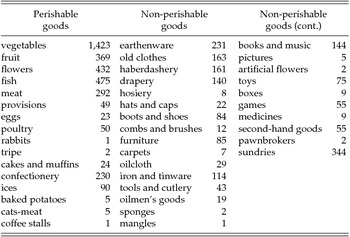
The second part of the period, from the 1890s to 1939, is richer in directly comparable and apparently reliable figures for the number of street markets and the number of stalls they contained. The 112 street markets identified by London County Council in 1893 were scattered across London from the centre to the peripheries, and contained in total 5,292 stalls. Of these markets, 13 were identified as being of sufficient scale to be designated ‘market centres’, drawing customers from beyond their immediate vicinity. They included Berwick Street, Chapel Street, Wentworth Street, Brick Lane, Chrisp Street and East Street in Newington.Footnote 43 The other 99 markets were spread widely and located predominantly, although not exclusively, in poorer areas. The range of products on sale, and the number of stalls devoted to each, is tabulated by the report (see Table 1): the list gives a snapshot of diverse produce.Footnote 44 As in Mayhew's time, London's street markets sold a huge array of goods, and there was not much that could be bought in a shop that could not also be had from a market stall.
Goods sold in London's street markets (numbers of stalls)

Source: London County Council Public Control Department, London Markets: Special Report of the Public Control Committee Relative to Existing Markets and Market Rights (London, 1893), 25.
Using the LCC's 1893 report as a starting point for the second part of the period, it is clear that from 1893 to the 1930s the number of market stalls in London grew substantially. In 1932, the New Survey made a count of 8,000, significantly up on the 5,292 counted by the LCC in 1893. This rise comfortably outstripped population growth over the period, constituting a net increase in the number of stalls per head of population. Itinerant traders continued to be present in large numbers, but, as in the earlier period, they were declining relative to the street markets.Footnote 45 Although no sources give concrete figures for turnover, the number of markets, the number of stalls and the centrality of markets in many accounts of shopping practices all suggest that street markets were a significant retail force in London in the early twentieth century. As they grew, the goods they sold changed; the New Survey of 1932 notes the decline in flowers and fish, second-hand furniture, household goods and crockery (these latter squeezed out by the rise of the penny bazaars or variety stores). It notes a substantial increase in the markets’ role in fashion retailing, led by a new generation of largely Jewish entrepreneurs. And it also records the widespread appearance of some very modern consumer products, namely gramophones, records and wireless sets, suggesting that the markets were incorporated into a flourishing consumer economy in London in the 1920s and 1930s.Footnote 46
The New Survey was unequivocal about the fact of the street markets’ increase in the early decades of the twentieth century:
Since it is chiefly the poor who are to be found in the street markets, and since the number of those living in poverty has. . .largely decreased. . .it might be expected that the street markets would also show a tendency to decline. In fact, however, they have shown a very substantial increase.Footnote 47
Its authors were, however, slightly unsure about whether they approved of this increase or not:
The street markets are an institution of real social and economic utility to the London poor, who believe, not without reason, that they get better value for their money by dealing with the stalls than with the shops. . .In a Utopia their existence would certainly not be tolerated. In a Utopia, however, there would be no poverty, and if the street markets were abolished to-day, the poor would certainly suffer.Footnote 48
This ambivalence towards the markets is repeated in many sources. The aim of the London County Council's 1893 report, for instance, was to reform the markets, both in order to provide better facilities for the substantial retail trade involved, and to improve circulation of traffic and pedestrians. It contains several proposals for new market-houses to replace the kerbstone trading of the street markets.Footnote 49 These were, however, never realized, and when legislation was finally put in place in 1927 its provisions were minimal: to license the existing street markets, rather than moving or rehousing them.
American investigator J.W. Sullivan described London's street markets in 1913 in a study that compared food supply in London, Berlin and Paris, with the intention of recommending reforms for New York. Unlike most British commentators, who hedged their praise of the street markets with calls for reform, Sullivan was unequivocally impressed with the free market efficiency of London's street traders. He described how they took produce from the wholesale markets and retailed it to the population at the lowest possible cost, unhindered by onerous systems of licensing, by market halls with rents and fees and with little legal restriction on the right to trade on the streets. He noted that as a result ‘American fruit in London streets is cheaper than in New York stores’:Footnote 50
Working-class London in general, and much of middle-class London as well, buy the bulk of their perishable necessaries from ambulant pushcart vendors or at the open-air markets. The system is at once the most ancient and the most modern. It is the cheapest of all systems – efficient, natural, democratic, rightfully communistic. It often gives the masses double rations.Footnote 51
Sullivan's assessment confirms that the growth of London's street markets can be seen as a flourishing of an ancient and simple retail form in response to the growth and spread of the city. Far from declining, the street market was expanding in response to modernity, yet it remained a feature of city life that provoked disquiet from retail competitors and the city authorities. This will be explored further in the next section.
The market in the high street
How did London's street markets relate to other users of the streets, and to the city's more formal retailers? Traders selling fruit, vegetables, flowers, fish or any of the many other commodities available in London's street markets are often depicted as somewhat distinct from London's shopkeepers. This perhaps goes back to Mayhew, whose quasi-anthropological characterization of street sellers as belonging to ‘wandering tribes’, quite separate from the ‘civilized tribes’ of mainstream society, had the effect of making strange those who sold on the street, who were often portrayed as the ‘casual poor’.Footnote 52 Yet, for all their distinctive characteristics, street markets were necessarily located in close proximity to shops, and are best understood in this context. Judith Walkowitz's work on Berwick Street, for instance, demonstrates how this Soho street market, tucked away in a poor corner of central London, bounded by but quite separate from the great shopping thoroughfares of the West End, was in the 1920s and 1930s drawn into the expansion of consumer culture. It became briefly a ‘cutting edge retail space for mass market ready-to-wear fashion’, visited by those who also shopped at the department stores of Oxford Street and Regent Street.Footnote 53
Lewisham in south-east London makes an interesting case-study of the relationship between street market and high street. Until the mid-nineteenth century, Lewisham was a rural village, but the arrival of the railway in 1849 brought rapid suburban growth with a socially mixed influx of population.Footnote 54 By the 1890s, the town centre had developed lively retail provision, with several drapers’ shops diversifying into small department stores.Footnote 55 Sainsbury had arrived by 1901,Footnote 56 Woolworth in 1912Footnote 57 and Marks and Spencer by the late 1920s, if not earlier. Also in the 1920s, the Royal Arsenal Co-operative Society moved into the town, expanding into its Tower House department store in 1933.Footnote 58 Lewisham's street market emerged some time during the 1890s. Figure 3 shows it in 1903: stalls ran parallel to the shops in the High Street.
Lewisham High Street and street market, 1903. With permission of Lewisham Local History and Archives.

The minute books of Lewisham Borough Council record a protracted attempt, running from 1901 to 1934, to remove the market from its High Street location.Footnote 59 Throughout, the market traders persisted in trading in what had become their habitual site, and the council struggled to prevent them. In the end it gave in, and in 1934, using the legislation introduced by London County Council in 1927, issued 54 licences to trade in Lewisham High Street.Footnote 60 This example shows that direct suppression of a market was difficult, and equally unsuccessful were attempts to prise markets away from their kerbside locations and house them in alternative locations. London County Council acknowledged this in its 1893 report, noting that the only way to reform the street markets was to ‘provide them with accommodation actually on the spot on which they have grown, and where experience has shown they are most needed’.Footnote 61 Its never-built proposals for new market halls suggested building these on the precise location of existing street markets. The most high-profile case of a failure to relocate street trade was Columbia Market, a palatial neo-gothic market hall in Bethnal Green built at great expense by philanthropist Angela Burdett-Coutts in 1869. This was shunned by the costermongers it was supposed to house, who preferred to stay on the streets.Footnote 62 Other failed market relocations/rehousings occurred in Clare Market and Woolwich.Footnote 63
The Lewisham traders’ motive for wanting to stay put was no doubt to be in the location with the highest footfall, the busy High Street, with its chain stores, department stores and co-op. But did markets follow shops, or shops follow markets? In Lewisham, the two developed concurrently, but other examples show how in some instances modern retailers colonized market streets. The New Cut in Lambeth was described by Mayhew as having a busy street market in 1851.Footnote 64 Photographs from the 1890s show that by that date it had also attracted the retail chains – branches of the Danish Dairy Company and W.H. Smith.Footnote 65 The relationship between stallholders and shopkeepers was on the surface characterized by hostility – rate-paying shopkeepers with expensive premises and high overheads did not like being undercut by barrow-trading costermongers who operated in the informal economy, more or less beyond the reach of regulation (resistance to paying rents and fees was one reason why costers shunned ‘improved’ market premises). In Lewisham, the council minute books document at length the shopkeepers’ discontent regarding the costermonger ‘problem’.Footnote 66 However, it is worth remembering that in many locations markets and shops had a symbiotic, as well as combative, relationship. The LCC's 1893 report notes that of the 5,292 stalls in London's unauthorized street markets, 790 were run by owners of adjacent shops.Footnote 67 Shopkeepers in market streets would often have a stall in front of their shop on which they sold pile-it-high and sell-it-cheap goods of inferior quality, distinguishing between this trade and that which they did inside their shops.
And however hostile Lewisham's shopkeepers were to the costermongers, for shoppers the market and shops together provided a continuum of retail provision. An unpublished memoir by William Parker recording his 1930s childhood in Lewisham describes a variety of street traders, including a costermonger who sold from a barrow, as well as recounting how Parker's family shopped at the co-op and independent and multiple bakers.Footnote 68 Another memoir, that of Dolly Scannell, describes Chrisp Street market in the 1910s, where Scannell's mother shopped at both shops and market stalls. In this instance, the market, that supposedly undeveloped form of retailing, was the site of Scannell's first encounters with some important aspects of retail modernity – branded products and advertising. She recalls several brands by name, including Nestlé’s milk, Mazawattee tea and two types of soap, Sunlight and John Knight's Family Health.Footnote 69
Urban experience and market culture
It was noted earlier that there is a strand in the (small) secondary literature on London's authorized markets that has analysed them culturally, as sites of urban encounter and unruliness. Historians’ interest in this aspect of the market fades with the mid-nineteenth-century reform of London's established markets, and does not carry forward to the strong emergence of the unauthorized, or street, market post-1850 (though arguably it shifts sideways to cast light on the more complex retail environment of the department store). This final section proposes that the street market of the later period might be amenable to a continuation of this analysis – it is worth looking at the market not just as an economic entity and a site of exchange, but also as a symptom of culture. Not all of the themes that preoccupied writers such as Patrick Joyce and Peter Stallybrass in the earlier period may be relevant. The street market does not appear to have continued the association with mob politics, for instance (however, resistance to regulation by street-trading costermongers, and their frequent refusal, as in Columbia Market and Lewisham High Street, to be rehoused or moved, does carry a faint echo of earlier street radicalism). Yet, if we consider the culture of the London street market more widely, there are several themes (which can be treated only briefly here) that suggest that it is worth deeper analysis.
The material culture of the market is a good point of access: London's street markets of the 1850–1939 period had a very particular materiality that is often described vividly by observers. Many descriptions of the goods on sale, the people selling and the people buying, stress poverty – ragged children hawking a few oranges, or poor women bargaining hard for cut price, low-quality meat or fish. It would not be difficult to construct a narrative of the London street market as a site of destitution and degradation, and many contemporary commentators did just this. Journalist George Augustus Sala, for instance, in Twice Round the Clock (1859), described the New Cut (by common consent the poorest and roughest of all the London street markets at that period) thus:
Women. . .brazen, slovenly, dishevelled, brawling, muddled with beer or fractious with gin. . .the howling of beaten children and kicked dogs. . .the fumes of the vilest tobacco, of stale corduroy suits, of oilskin caps, of mildewed umbrellas, of decaying vegetables. . .of deceased cats, of ancient fish, of cagmag meat, of dubious mutton pies, and of unwashed, soddened, unkempt, reckless humanity.Footnote 70
George Sims’ investigation into How the Poor Live (1883) also describes a street market:
We. . .emerge from comparative quiet into a Babel of sound. A sharp turn brings us from a side street into one long thoroughfare ablaze with light and busy as a fair. It is a fair in fact; the pavement and roadway are crowded with a seething mass of human beings, side by side with the meat-stalls, the fish-stalls, the fruit and vegetable-stalls, and the cheap finery stalls.Footnote 71
Sims’ account captures the excitement of the market and its crowds: the poverty and misery depicted by Sala are accompanied in this and many other descriptions by a vivid sense of the pleasures of the street market as a place of spectacle and stimulation. Street markets were not patronized exclusively by the very poor: they also attracted shoppers from the more settled working class, as well as some middle-class clients.Footnote 72 This is the case across the period covered here: writing in 1936, Mary Benedetta noted that street markets continued to serve ‘people in a happier position’ as well as the poor.Footnote 73 Sims’ account suggests, if not prosperity, then at least not absolute destitution either. These two descriptions (Sala and Sims) sit well together, because in both we have middle-class observers reporting on the street market as an urban phenomenon. Sims was the more earnest investigator, but Sala was typical of many journalists who visited street markets on a Saturday night in search of sensation, whether it be of horror or pleasure. Figure 2 includes just such a middle-class observer amongst the crowds and costermongers and ragged children. There is also a policeman, surveying the scene from its periphery and hinting at the street market's antagonistic relationship to authority.
Sims’ reference to blazing light alludes to the naphtha flares that lit the markets from the 1840s until into the twentieth century.Footnote 74 Reservoirs of liquid naphtha (by-product of the manufacture of town gas) fuelled naked flames that dipped and danced in the wind and gave a dramatically unsteady light that emphasized colour, shadow and movement and often provoked a shiver of danger in observers (see Figures 2 and 4). Charles Booth described the street markets in terms of this light: ‘the flaring lights, the piles of cheap comestibles, and the urgent cries of the sellers’,Footnote 75 as did social worker Helen Bosanquet, who in 1896 described ‘the flaring streets where the costers keep their stalls’.Footnote 76 The most vivid description comes from novelist Ethel Mannin's memoir of her London childhood: ‘shopkeepers and costers shouting prices, a din of traffic and shouting, a confusion of movement, colour, shadow, flares. . .wind-blown flares forever threatening the awnings, dipping towards them and then away again, tantalizingly’.Footnote 77
Frederick Barnard, illustration to George Sims, How the Poor Live (Chatto and Windus, London, 1883), 48. With the permission of Guildhall Library, City of London.

Flaring lights, heaped up goods, smell, noise and crowds are all repeated many times in descriptions of London's street markets. Another theme that often recurs is the performative aspect of the market, particularly at busy times. Dolly Scannell's autobiographical account describes a strong man, a patent medicine man who sold his wares through a lively and persuasive patter, and all sorts of street performers, in Chrisp Street market. Scannell treated these as a sort of linear variety show that stretched along the road.Footnote 78 Sims notes a similar array of characters: Figure 4 shows his illustration of a patent medicine man in full oratorical flow, dramatically lit by naphtha flares. In this regard, at least, the markets bear some comparison with contemporary descriptions of the much more affluent streets of London's West End. Here, historians of retail modernity have noted how lights (gas and then electric, rather than the dancing naphtha flares), plate glass, luxury goods, anonymous crowds and novel entertainments combined to provide sensory stimulation and pleasure, with shopping aligned closely with entertainment. As Wolfgang Schivelbusch notes, ‘the illuminated window as stage, the street as theatre and the passers-by as audience – this is the scene of big-city night life’.Footnote 79
Finally, the culture of the street markets also provided an opportunity for social interaction, and this was particularly important for their women customers. Helen Bosanquet, writing in 1896, noted that for the women she observed, shopping in the local market constituted ‘an unmixed and never-failing pleasure’, partly because it offered them ‘the practice of social intercourse’ and ‘the interchange of friendly amenities’.Footnote 80 Working-class women of this period often lived lives that were constrained geographically, home-centred and bounded within insular neighbourhoods of just a few streets. In this context, the busy market street would provide some measure of public life, however limited. Dolly Scannell recalls how her mother ‘chatted with friends, for Chrisp Street was the only social outlet mothers had’.Footnote 81 Mrs Bosanquet's description notes that the market offered women the opportunity to ‘exercise all of their intellectual faculties’ in ‘the keen zest of bargaining’.Footnote 82
Conclusion
American J.W. Sullivan was an enthusiastic admirer of London's street markets, which he saw as the perfect functioning of free enterprise, provisioning the huge city:
The commerce of the costermongers of London, singly roving the streets or together gathered in an open-air market, is accepted by the mass of Londoners as a metropolitan institution of primary importance. The ‘coster’ has his place, in song and story, in verse and picture, as one of London's best-known characters. He is of the people, for the people.Footnote 83
Other commentators may not all have been so admiring, with many advocating the rehousing or regulation of the London street markets, yet few disagreed that they were a vital component in retail provision. London's street markets have been somewhat overlooked in the secondary literature, perhaps because they seem rather primitive in the context of retail and urban modernity. Yet their strong growth, their changing nature and the fact that they contributed so extensively to popular conceptions of London and its people suggest that they played a key role in both the economy and culture of the city, alongside other and newer retail forms.