Introduction
The genus Hedyotis L. (Rubiaceae), in the wide sense, occurs throughout the tropical and subtropical regions of the world. Using a broad circumscription of this large and heterogeneous genus it contains approximately 515 species (Terell & Robinson, Reference Terell and Robinson2003; Dutta & Deb, Reference Dutta and Deb2004). In this sense the genus contains herbs and woody shrubs; the inflorescences may be panicles, corymbs, or umbellate to condensed capitate cymes; the flowers are usually 4-merous; the capsules vary from globose to ovoid or ellipsoid, dehiscing septicidally or loculicidally or the fruit is indehiscent; the seeds are minute, angled and embedded in the central placenta. The genus Hedyotis has variously been included in the subfamilies Rubioideae (Bremer, Reference Bremer1996) or Hedyotidae (Bremekamp, Reference Bremekamp1966; Robbrecht, Reference Robbrecht1988). Recent molecular studies have revealed that the broadly circumscribed Hedyotis is polyphyletic and that the name Hedyotis should be restricted only to the shrubby and septicidally dehiscing, capsular-fruited species distributed in tropical Asia (Guo et al., Reference Guo, Simmons, But, Shaw and Wang2011). Moreover, there has been considerable controversy over the delimitation of Hedyotis, even in this narrower sense, and Oldenlandia L. since the two genera were first proposed by Linnaeus (1753). A number of authors have combined the two genera under Hedyotis in the tribe Spermacoceae (Terell et al., Reference Terell, Robinson, Wagner and Lorence2005; Groeninckx et al., Reference Groeninckx, Dessein, Ochoterena, Persson, Motley and Karhed2009; Guo et al., Reference Guo, Simmons, But, Shaw and Wang2011).
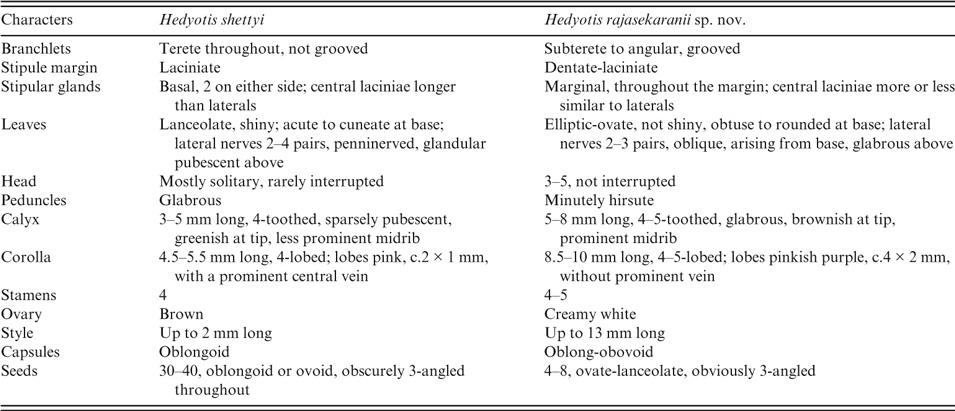
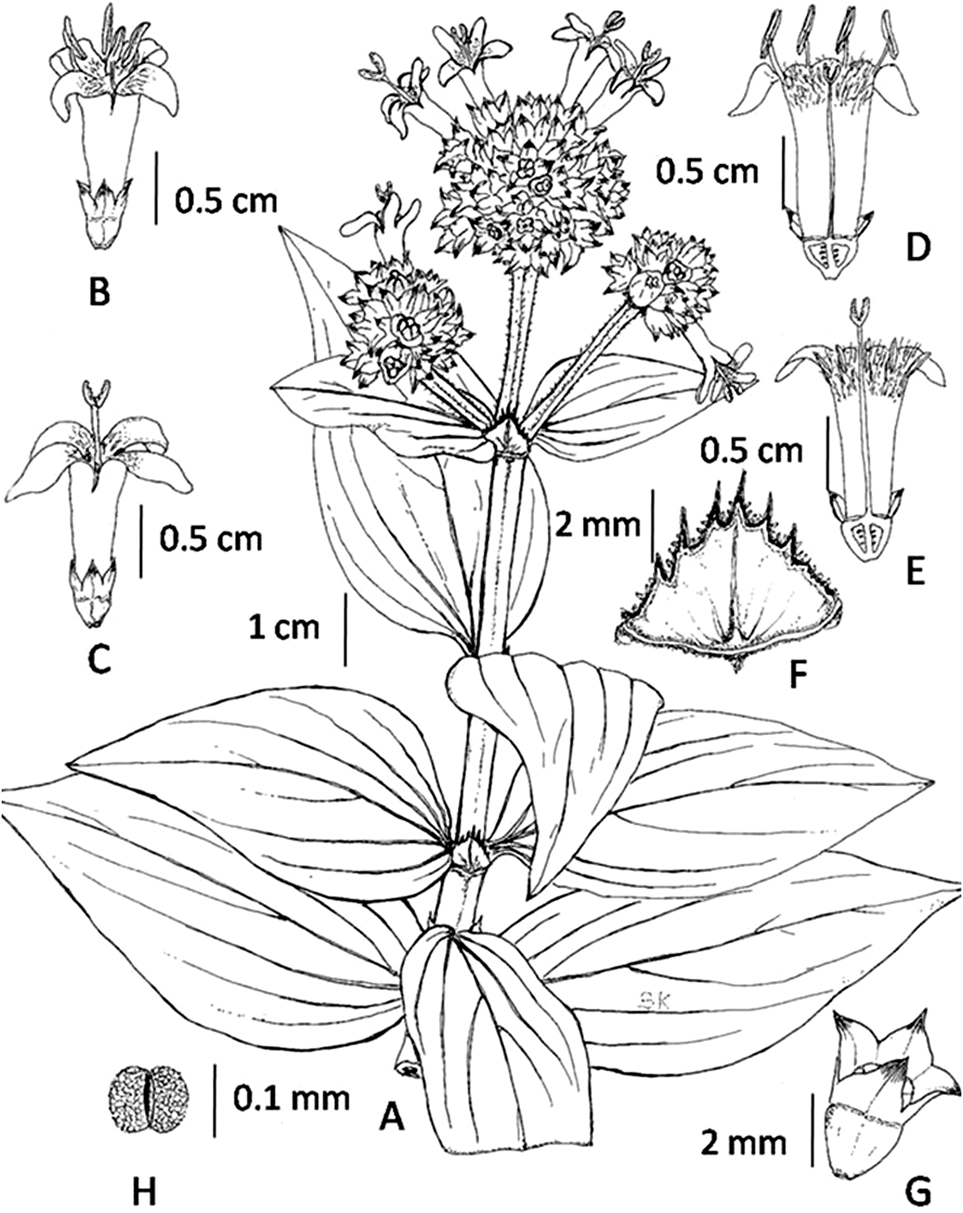
There are about 75 species of Hedyotis in India, many of them restricted to the hillier parts of southern India, especially the Western Ghats (Dutta & Deb, Reference Dutta and Deb2004). During routine botanical exploration of the Megamalai Hills of the Western Ghats, in the Theni District of Tamil Nadu, specimens of an interesting Hedyotis species were collected. They were critically studied against the pertinent literature and compared to specimens housed in Indian herbaria. The study revealed that the specimens belong to a new species allied to Hedyotis shettyi K.Ravik. & V.Lakshm. The new species is described and illustrated here. It can be distinguished from Hedyotis shettyi by the characters in Table 1.
Diagnostic characters of Hedyotis shettyi and H. rajasekaranii sp. nov.

Species Description
Hedyotis rajasekaranii Karupp. & Ravichandran, sp. nov.
Hedyotis shettyi K.Ravik. & V.Lakshm. affinis sed ramulis angulatis canaliculatis glabris, foliis elliptico-ovatis, obtusis vel rotundis ad basim, glabris, nervis lateralibus palmatis 2–3, obliquis, petiolis ad 8 mm longis, glabris; stipulis triangularibus, glabris, ad margines dentatis laciniatis vel glandulis, floribus in capitulis 3–5 terminalibus vel axillaribus dispositis, pedunculis angulatis, minute hirsutis, calycis tubo campanulato, lobis 4–5, glabris, costis prominentibus differt. – Type: India, Tamil Nadu, Theni District, Megamalai Hills near Kardana Estate, stream side on the way to Megamalai, ± 1350 m, 9°41.894′N, 77°24.049′E, 1 x 2012, S. Karuppusamy & V. Ravichandran 1402A (holo MH; iso Madura College Herbarium, Madurai [as S. Karuppusamy & V. Ravichandran 1402B], CAL [as S. Karuppusamy & V. Ravichandran 1402C & D]). Fig. 1.
Hedyotis rajasekaranii Karupp. & Ravichandran sp. nov. A, habit; B & C, entire flowers; D & E, longitudinal view of heterostylous flowers; F, stipule; G, fruit with persistent calyx; H, seed.
Shrubs, up to 2 m tall, stout, woody; branchlets angular, glabrous, grooved with persistent leaf scars; internodes up to 2.5 cm long, usually short and congested at branchlet apices. Stipules triangular, c.6 × 4 mm, glabrous, thick, margin dark brown-lined, with brown glandular hairs, dentate-laciniate at apex. Leaves elliptic-ovate, 3–7 × 0.5–2 cm, not shiny, obtuse to rounded at base, acute at apex, subcoriaceous, entire, glabrous on both sides, dark green above and yellowish below, crowded at apices of branchlets; lateral nerves 2–3, oblique, arising from the base; petioles up to 8 mm long, glabrous. Inflorescence a dense head, 3–5-flowered, mostly terminal but often axillary, c.2 cm across; peduncle 1–3 cm long, 4-angled, minutely hirsute. Flowers c.8–10 mm long. Calyx tubular, campanulate, 5–8 × 0.5–1.8 mm, shiny, 4–5-toothed, teeth triangular, c.2.5 mm long, apex acute, fleshy, glabrous, tip brownish, greenish below, with prominent midrib. Corolla tubular, 8.5–10 mm long, bluish purple, throat pinkish, densely hairy, glabrous outside, 4–5-lobed; lobes pink-purple, ovate-oblong, c.4 × 2 mm, entire, deflexed, glabrous, fleshy, without prominent veins. Stamens 4–5, attached at corolla throat, equal, erect, dorsifixed, dark brown, dehiscing longitudinally; filaments slender, 1.5–2.5 mm long, fleshy, glabrous. Ovary 2-loculed, creamy white; styles up to 13 mm long, fleshy, slender, heterostylous; stigmas 2, c.2 mm long, lineate, glandular tipped. Capsules oblong-obovoid, 2–3 × 1–2 mm, included in persistent calyx-tube, dehiscing septicidally into 2. Seeds 4–8, ovate-lanceolate, c.1 mm long, reticulate, angled, brown with many white membranous scales along margins.
Etymology. The new species is named in honour of Dr K. M. Rajasekaran, Department of Botany, The Madura College, Madurai, Tamil Nadu, India, for his valuable contribution to teaching and taxonomic research for more than 25 years.
Ecology. The new species is scarce in the undergrowth of dense evergreen forest, especially along perennial stream banks of the Kardana Estate and the surrounding area for a radius of c.10 km. The associated plant species include Croton laccifer L., Ligustrum perrottetii A.DC., Alseodaphne semecarpifolia Nees var. angustifolia Meissn., Clausena indica Oliv., Vernonia comorinensis W.W.Sm., Syzygium sriganesanii K.Ravik. & V.Lakshm., Syzygium myhendrae (Bedd. ex Brandis) Gamble, Phoebe wightii Meissn., Osbeckia aspera Blume var. wightiana Trimen and Mussaenda belilla Buch.-Ham.
Flowering and fruiting. September to December.
Provisional conservation status. Endangered (ENB1ab(i,iii)). The species has a restricted distribution in the Kardana Estate range of the Megamalai Hills in the Theni District of Tamil Nadu. In this area the habitat is threatened by the extension of tea and cardamom cultivation. Even though the area has recently been designated as the Megamalai Wildlife Sanctuary by the Tamil Nadu Forest Department, fragmentation of the natural forest for agriculture continues unabated. Hence this species can be categorised as endangered under the IUCN 9.0 guidelines (IUCN, 2012).
Acknowledgements
The authors are grateful to the Director, Botanical Survey of India (MH), Southern Circle, Coimbatore, for permission to consult the herbarium and library. The authors are also grateful to Dr K. M. Rajasekaran, Department of Botany, The Madura College, after whom this new species is named, for his constant encouragement and generous support for taxonomic research.